
初一英语英语阅读理解专项训练
初一英语英语阅读理解专项训练15篇标题:初一英语阅读理解专项训练15篇在初一英语学习中,阅读理解是一项重要的技能。
它不仅在考试中占据了大量的分值,也是提高英语语言能力的重要途径。
通过阅读,我们可以获取信息,开阔视野,学习到地道的语言表达方式。
为了帮助大家提高阅读理解能力,我们特别准备了15篇专项训练,每篇文章后面附有题目和答案。
希望同学们能够在完成这些练习后,找到自己的学习重点和难点,有针对性地进行提高。
练习1: When I was in junior high school, I had a friend named John. He always wore a smile on his face and was ready to help others. One day, we had a math test in class, and I was nervous because I was not prepared. John saw how worried I was, and he gave me his own test paper so I could copy it.1、What does the writer mainly want to tell us? A. John's kind heart. B. The importance of helping others. C. How the author got a good grade in math. D. The importance of being prepared for tests.答案:A解析:本文主要讲述了作者的朋友John的善良行为。
通过John在数学测试中帮助作者这一具体事例,突出了他的善良品质。
因此,答案为A。
练习2: Yesterday, I had a terrible day at school. In the morning, my alarm clock didn't work, and I missed the bus. Then, in math class, I couldn't understand what the teacher was writing on the board. To make matters worse, I forgot to bring my lunch, and the school cafeteria was closed. I was so hungry that I couldn't concentrate on my classes.1、What does the writer mainly want to tell us? A. The importance of setting an alarm clock. B. How to understand math lessons.C. The importance of bringing your lunch to school.D. The importance of keeping your alarm clock working.答案:D解析:本文主要讲述了作者在学校遇到的一系列糟糕的事情,包括闹钟不响、数学课听不懂、忘记带午餐等。
通过这些事情,作者强调了保持闹钟工作的重要性。
因此,答案为D。
初一英语英语完形填空专项训练10篇文章标题:初一英语完形填空专项训练10篇完形填空是英语考试中常见的一种题型,它旨在考查学生综合运用语言的能力。
在初一英语考试中,完形填空题目通常是一篇短文,其中有若干个空格,需要根据上下文语境和语法知识进行填空。
下面我们来看一下初一英语完形填空的专项训练题目。
第一篇:Once there was a little boy 1 loved to play soccer. He kicked the ball and 2 it into the net. The goalkeeper tried to stop it, but he couldn't. The boy was very excited because he had scored a goal. After the game, he received a gift from his father - a small soccer ball. He 3 it and started to play with it again.1、A. which B. who C. where D. when答案:B解释:本题考查定语从句,先行词为boy,在从句中作主语,因此用who引导定语从句。
2、A. kick B. kicked C. kicks D. kicking答案:B解释:本题考查动词时态,根据上下文语境,此处应该用一般过去时,故答案为B。
3、A. received B. received from C. received by D. received back答案:A解释:本题考查固定短语"receive sth from sb",意为"从某人那里收到某物"。
第二篇:Hello, my name is Li Lei. I 4 a new pen pal in my last letter. She is from the United States and she is 5 years old. Her name is Nancy. She 6 English very well and she is very kind. We often write to each other and 7 about our lives. Nancy 8 a pet cat named Mimi. It is very 9 and likes to play with balls. Nancy also likes to play sports, especially 10 .4、A. have B. had C. has D. having答案:A解释:本题考查动词时态,根据上下文语境,此处应该用一般现在时,故答案为A。
5、A. five B. six C. seven D. eight答案:A解释:根据上下文语境,此处应该用基数词表示年龄,故答案为A。
6、A. speaks B. told C. said D. talked答案:A解释:本题考查固定短语"speak English",意为"说英语",故答案为A。
六年级英语阅读理解专项训练六年级英语阅读理解专项训练一、背景介绍随着全球化的加速,英语已经成为一门全球通用的语言。
在小学阶段,尤其是六年级这个关键时期,英语阅读理解能力的培养显得尤为重要。
有效的阅读理解专项训练不仅有助于提高学生英语成绩,更有助于他们今后的学习和职业生涯。
二、问题分析在英语阅读理解训练中,学生常常遇到的问题主要有以下几点:词汇量不足,无法理解文章内容;语法知识掌握不扎实,影响对文章的整体理解;缺乏文化背景知识,对某些文章的主旨把握不准。
针对这些问题,我们需要制定有效的训练策略。
三、解决方案针对以上问题,我们提出以下解决方案:1、扩大词汇量:鼓励学生平时多积累词汇,通过阅读、背单词等方式增加词汇量。
同时,教授学生一些常用的构词法,帮助他们更好地理解生词。
2、强化语法知识:在日常教学中,注重语法知识的讲解和练习,帮助学生掌握扎实的语法基础。
同时,教授学生一些阅读技巧,如如何找主题句、如何猜测生词含义等。
3、补充文化背景知识:在阅读训练中,适时地引入一些文化背景知识,帮助学生更好地理解文章内容。
例如,在阅读关于英国的文章时,可以简要介绍英国的历史、地理、文化等背景知识。
四、实施步骤具体实施步骤如下:1、确定阅读材料:根据学生的实际情况,选择适合他们的阅读材料,可以是课本中的文章、课外读物或网络资源等。
2、阅读前热身:在开始阅读前,可以通过一些问题、图片或视频等方式,引入文章主题,激发学生阅读兴趣。
3、阅读理解训练:让学生独立阅读文章,鼓励他们在阅读过程中做好笔记,标记出不理解的地方。
随后,教师可以进行详细的讲解和讨论,帮助学生理解文章内容。
4、练习与反馈:针对学生在阅读过程中出现的问题,教师可以布置一些练习题,如完形填空、判断正误、回答问题等,以检验学生的理解程度。
同时,对学生的练习结果进行及时反馈,帮助他们找出不足之处并改进。
5、拓展阅读:为了提高学生的阅读兴趣和阅读能力,可以提供一些与文章主题相关的拓展阅读材料,让学生自主选择阅读。
同时,可以组织一些阅读分享活动,让学生分享自己的阅读心得和感悟。
五、总结评价经过一段时间的专项训练后,我们可以对学生们的阅读理解能力进行一次全面的评估。
评估方式可以是测试、问卷调查或者学生自评等。
通过评估,我们可以了解训练效果,总结经验教训,为今后的教学工作提供参考。
总之,六年级英语阅读理解专项训练对于提高学生英语阅读能力和综合素质具有重要意义。
我们应该从词汇、语法和文化背景知识等方面入手,制定有效的训练策略,并注重实施过程中的反馈与评估,为学生今后的学习和职业生涯打下坚实的基础。
初一英语阅读理解及答案初一英语阅读理解及答案阅读理解一直是英语考试中的重头戏,对于初一学生来说,提高英语阅读理解能力至关重要。
本文将结合实例,深入浅出地讲解初一英语阅读理解的解题方法和技巧。
首先,我们需要明确阅读理解文章的类型。
初一英语阅读理解文章通常以记叙文和说明文为主,议论文和文学作品的涉及较少。
记叙文主要讲述一个故事或事件,通过时间、地点、人物等元素展现情节发展;说明文则介绍一种概念、方法或物品,着重阐述其特点、用途等。
在阅读记叙文时,我们需要关注文章中的时间线索,这有助于我们理清故事的发展顺序。
同时,要注意人物的角色和关系,这有助于我们理解文章中的人物行为和情感。
在阅读说明文时,我们需要关注文章的逻辑结构,即总分总、分总、总分等,以及段落的主题句。
主题句通常位于段首,概括该段的内容。
下面我们通过具体实例来解析。
例1:阅读理解题目:The journey to China was exciting, but the best part was meeting the children. I will never forget the day I arrived in Beijing. The air was fresh and the sky was blue. The people were friendly and they spoke English very well. I visited many places and took many photos. The food was delicious and the stores were interesting. But the best part was definitely meeting the children. I spent a week at an Englishsummer camp in Beijing. I taught the children to sing English songs and they were very happy to learn. I also made many new friends. The experience was unforgettable.1、The best part of the journey to China was _______. A. visiting many places B. taking many photos C. meeting the children D. being in Beijing2、The people in Beijing were _______. A. friendly and spoke English well B. not friendly and didn't speak English C. not friendly and spoke English badly D. friendly and didn't speak English3、The author spent a week at an English summer camp in Beijing. During this week, the author _______. A. didn't do anything interesting B. taught the children to sing English songs and made new friends C. only played with the children D. didn't like being at the camp答案与解析:1、C 细节理解题。
(专项)七年级英语上册阅读理解专项训练及答案共20篇
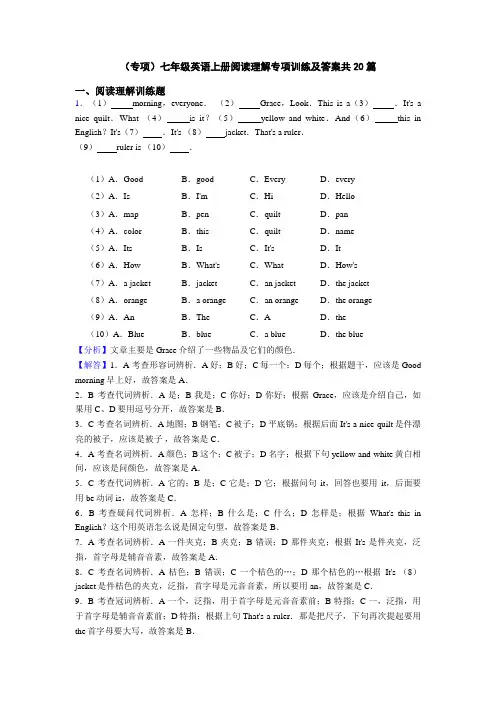
(专项)七年级英语上册阅读理解专项训练及答案共20篇一、阅读理解训练题1.(1)morning,everyone.(2)Grace,Look.This is a(3).It's a nice quilt.What (4)is it?(5)yellow and white.And(6)this in English?It's(7).It's (8)jacket.That's a ruler.(9)ruler is (10).(1)A.Good B.good C.Every D.every(2)A.Is B.I'm C.Hi D.Hello(3)A.map B.pen C.quilt D.pan(4)A.color B.this C.quilt D.name(5)A.Its B.Is C.It's D.It(6)A.How B.What's C.What D.How's(7)A.a jacket B.jacket C.an jacket D.the jacket(8)A.orange B.a orange C.an orange D.the orange(9)A.An B.The C.A D.the(10)A.Blue B.blue C.a blue D.the blue【分析】文章主要是Grace介绍了一些物品及它们的颜色.【解答】1.A 考查形容词辨析.A好;B好;C每一个;D每个;根据题干,应该是Good morning早上好,故答案是A.2.B 考查代词辨析.A是;B我是;C你好;D你好;根据Grace,应该是介绍自己,如果用C、D要用逗号分开,故答案是B.3.C 考查名词辨析.A地图;B钢笔;C被子;D平底锅;根据后面It's a nice quilt是件漂亮的被子,应该是被子,故答案是C.4.A 考查名词辨析.A颜色;B这个;C被子;D名字;根据下句yellow and white黄白相间,应该是问颜色,故答案是A.5.C 考查代词辨析.A它的;B是;C它是;D它;根据问句it,回答也要用it,后面要用be动词is,故答案是C.6.B 考查疑问代词辨析.A怎样;B什么是;C什么;D怎样是;根据What's this in English?这个用英语怎么说是固定句型,故答案是B.7.A 考查名词辨析.A一件夹克;B夹克;B错误;D那件夹克;根据It's是件夹克,泛指,首字母是辅音音素,故答案是A.8.C 考查名词辨析.A桔色;B错误;C一个桔色的…;D那个桔色的…根据It's (8)jacket是件桔色的夹克,泛指,首字母是元音音素,所以要用an,故答案是C.9.B 考查冠词辨析.A一个,泛指,用于首字母是元音音素前;B特指;C一,泛指,用于首字母是辅音音素前;D特指;根据上句That's a ruler.那是把尺子,下句再次提起要用the首字母要大写,故答案是B.10.B 考查形容词辨析.A蓝色的;B蓝色的;C一个蓝色的…;D那个蓝色的…根据题干,后面没有名词,应该是尺子是蓝色的,句中,不用大写,故答案是B.【点评】考查完形填空.根据所给的短文对意思有所了解,然后根据短文的大体意思,选择每个符合题意的答案,使短文更通顺.2. A:(1),Linda!Good morning!B:Good(2),sir!A:How(3) you today?B:I'm(4),thank you.And you?A:I'm fine,too.(5).What's this(6)?B:It's (7).A:How do you(8)it?B:R﹣U﹣L﹣E﹣R,ruler.A:You are right.What(9) is it?B:It's blue.A:Yes,it's(10).(1)A.Hello B.How C.Oh D.Good(2)A.evening B.afternoon C.morning D.today(3)A.am B.are C.is D.it's(4)A.fine B.good C.nice D.right(5)A.Thank B.Thanks you C.Thank you D.OK(6)A.in English B.of English C.for English D.English(7)A.ruler B.a ruler C.an ruler D.blue ruler(8)A.spell B.speak(讲话)C.say(说)D.read(读)(9)A.color B.ruler C.colors D.a color(10)A.a blue ruler B.blue ruler C.a white ruler D.a blue【分析】这是琳达和一名老师之间的对话,她们互相问候早安,然后又问尺子用英语怎么说,及这把尺子的颜色等.【解答】1.A.考查交际用语.A你好.B怎么.C哦.D好的.句意"__,琳达",可知,打招呼,应该说"你好".选A.2.C.考查名词.A晚上.B下午.C早上.D今天.句意"__好".根据上一句Good morning!早上好,可知,应该是"早上".选C.3.B.考查be动词.am通常与I连用.are复数.is单数.it's它是.句意"你今天好吗".由you可知,用are是.选B.4.A.考查形容词.A好的(形容身体).B好的.C好的.D对的.句意"我很__,谢谢".根据下一句I'm fine,too我也很好,可知,应该是"好的",对身体情况的回答,选A.5.C.考查搭配.A谢谢,动词.B不正确.C谢谢你.D好的.句意"我也很好__".根据上一句thank you.And you?谢谢你,你呢?可知,应该是thank you谢谢你.选C.6.A.考查介词短语.A用英语.B属于英语.C为了英语.D英语.句意"这个__怎么说".可知,应该是in English用英语.选A.7.B.考查名词.A尺子.B一把尺子.C不正确.D蓝色的尺子.句意"它是__".根据上一句What's this in English?这个用英语怎么说?可知,应该是它是"一把尺子".blue是以辅音音素/b/开头,用a修饰.选B.8.A.考查动词.A拼写.B讲话.C说.D读.句意"你怎么__它".根据下一句R﹣U﹣L﹣E﹣R,ruler.R﹣U﹣L﹣E﹣R,尺子.可知,应该是"拼写".选A.9.A.考查名词.A颜色.B尺子.C颜色,复数形式.D一种颜色.句意"它是什么__".根据下一句It's blue.它是蓝色的,可知,对颜色提问用疑问词组what color什么颜色.选A.10.A.考查搭配.A一把蓝色尺子.B蓝色尺子.C一把白色尺子.D不搭配.句意"是的,它是__".根据倒数第四行ruler尺子.倒数第二行It's blue它是蓝色的.可知,应该是"一把蓝色的尺子".这里表示泛指,blue是以辅音音素/b/开头,用a修饰.填 a blue ruler.选A.【点评】完形填空题型,抓住文章的大意,挑出信息词.同时凭借自己掌握的语法知识和一般的常识,兼顾人称、性别、单复数、语法和时态等等语法的因素,从语法的结构方面考虑答案.细心检查,避免疏漏.3. A:Hi ,Andy.B:(1),Lily.C:Good morning,Andy and Lily.A and B:Good(2),Miss Fang.Nice to meet you here.A:(3) are you ,Miss Fang?C:I'm fine.Thank you.And you?A:I'm(4)too.Miss Fang,come and meet some new student,please.C:Hi.What's your(5)?D:I'm Mille,Miss Fang.C:Oh,you're Jill,right?E:(6),I am.Glad to see you,madam.C:Hello!You're Nick,right?F:(7),I'm Peter.Are you(8)Fang?C:yes,you're right.I am your(9).And I have to go now.All students:(10),Miss Fang.C:Goodbye,class.See you later.(1)A.Bye B.Hi C.Morning(2)A.morning B.afternoon C.evening(3)A.What B.Who C.How(4)A.good B.right C.fine(5)A.school B.name C.game(6)A.Yes B.No C.Good(7)A.Yes B.No C.Right(8)A.Mr B.Mrs C.Miss(9)A.mother B.teacher C.student(10)A.Thank you B.Good night C.Goodbye【分析】这是一篇日常生活类阅读,主要是学生和老师之间的对话,方老师给大家介绍了几个新学生,他们互相问候、交谈,之后又互相道别.【解答】1.B.考查交际用语.A再见.B你好.C早.句意"__,Lily".根据上一句Hi ,Andy.你好,Andy.可知,打招呼,应该回答"你好".选B.2.A.考查名词.A早上.B下午.C晚上.句意"__好,方小姐".根据上一句Good morning,Andy and Lily.早上好,Andy和Lily.可知,应该是"早上"好.选A.3.C.考查疑问词.A什么.B谁.C怎么.句意"你__,方小姐".根据下一句I'm fine.Thank you.我很好.谢谢.可知,应该问How are you?你好吗?选C.4.C.考查形容词.A好的.B对的.C好的.句意"我也__".根据上一句I'm fine.Thank you.And you?我很好.谢谢.你呢?可知应该是"好的",形容身体用fine.选C.5.B.考查名词.A学校.B名字.C比赛.句意"你的___是什么?".根据下一句I'm Mille我是Mille.可知,应该是"名字".选B.6.A.考查肯定回答.A是的.B不.C好的.句意"__,我是".根据上一句Oh,you're Jill,right?哦,你是Jill,对吧?可知,应该用肯定回答Yes是的.选A.7.B.考查否定回答.A是的.B不.C对的.句意"__,我是Peter".根据上一句You're Nick,right?你是Nick,对吧?可知,应该是否定回答No不.选B.8.C.考查名词.A先生.B太太.C小姐.句意"你是方__吗".根据2空后Miss Fang方小姐.可知,应该是"小姐".选C.9.B.考查名词.A妈妈.B老师.C学生.句意"我是你的__".根据倒数第二行Goodbye,class.同学们再见.可知,C应该是"老师".选B.10.C.考查交际用语.A谢谢.B晚安.C再见.句意"___,方小姐".根据下一句Goodbye,class.同学们再见.可知,应该是"再见".选C.【点评】完形填空题型,抓住文章的大意,挑出信息词.同时凭借自己掌握的语法知识和一般的常识,兼顾人称、性别、单复数、语法和时态等等语法的因素,从语法的结构方面考虑答案.细心检查,避免疏漏.4.Lan and Fred are (1).They are both twelve years old,and they are in the same (2)in their school.Last Friday afternoon they had a(3)in class,and their teacher was very (4).He said to both of them,"Stay here after the lessons thisafternoon,and (5) your names a thousand (千) times." After the last lesson,all the other boys (6)home,but Lan and Fred stayed in the classroom with their (7)and began writing their names.Then Fred began (8).The teacher looked at him and said, " (9) are you crying,Fred?""Because his name's Lan May,and (10)name is Frederick Hollingsworth," Fred said.(1)A.sisters B.Girls C.brothers D.boys(2)A.room B.office C.playground D.class(3)A.rest B.fight C.classmate D.friend(4)A.happy B.nice C.angry D.worried(5)A.call B.write C.meet D.change(6)A.went B.got C.left D.came(7)A.brother B.classmate C.teacher D.father(8)A.laughing B.talking C.playing D.crying(9)A.How B.Why C.When D.Where(10)A.her B.your C.my D.his【分析】这是一篇人物故事类阅读,主要介绍Lan和Fred是同学,一天他们打架了,老师罚他们写一千遍自己的名字,Fred哭了,老师问他为什么,Fred说,我的名字是Frederick Hollingsworth,而Lan的名字是Lan May.【解答】1.D.考查名词.A姐妹.B女孩们.C兄弟.D男孩们.句意"Lan和Fred是__".根据6空前all the other boys所有其他男孩.可知,Lan May和Frederick Hollingsworth姓氏也不一样,因此是"男孩".选D.2.D.考查名词.A房间.B办公室.C操场.D班级.句意"他们在学校在相同的___".可知,应该是"班级".选D.3.B.考查名词.A休息.B打架.C同学.D朋友.句意"上周五下午他们在课堂上__".根据4空后He said to both of them, "Stay here after the lessons this afternoon他对他们俩说:"今天下午放学后留在这里.可知,应该是"打架".选B.4.C.考查形容词.A开心的.B好的.C生气的.D担心的.句意"他们的老师是非常__".根据上一句Last Friday afternoon they had a fight in class上周五下午他们在课堂上打架.可知,应该是"生气的".选C.5.B.考查动词.A叫.B写.C见面.D改变.句意"把你的名字__一千遍".根据7空后began writing their names开始写他们的名字.可知,应该是"写".选B.6.A.考查动词.A去.B得到.C离开.D来.句意"最后一节课后,其他的男孩都__家了".go home回家,用go的过去式went.选A.7.C.考查名词.A兄弟.B同学.C老师.D父亲.句意"但是Lan和Fred和他们的___呆在教室里,开始写他们的名字".根据上一句all the other boys went home其他男孩都回家了.可知,应该是"老师".选C.8.D.考查动名词.A笑.B谈论.C玩.D哭.句意"然后Fred开始__".根据9空后crying哭,可知,应该是"哭".选D.9.B.考查疑问词.A怎么.B为什么.C什么时候.D哪.句意"你__哭,Fred".根据下一句Because因为,可知,应该是"为什么".选B.10.C.考查代词.A她的.B你的.C我的.D他的.句意"___名字是Frederick Hollingsworth".可知,Fred自己说的话,修饰名词name用形容词性物主代词my我的.选C.【点评】完形填空题型,抓住文章的大意,挑出信息词.同时凭借自己掌握的语法知识和一般的常识,兼顾人称、性别、单复数、语法和时态等等语法的因素,从语法的结构方面考虑答案.细心检查,避免疏漏.5. A:Good morning!B:(1)!A:(2) your name,please?B:(3)name is Amy.And you?A:I(4) Peter.Nice to meet you!B:(5)!A:What's this(6) English?B:It's (7).A:And(8) this in the picture?B:(9) Kate.She's English.A:Thank you very much.B:(10).(1)A.Thanks B.Thank you C.Good morning D.I'm nice(2)A.What B.What's C.Who D.Who's(3)A.I B.I'm C.My D.My is(4)A.am B.is C.name D.name's(5)A.Nice to meet you B.Thanks C.Thank you D.OK(6)A.for B.at C.in D.with(7)A.picture B.a picture C.the picture D.an picture (8)A.what B.what's C.who D.who's(9)A.It's B.Its C.It D.He's(10)A.OK B.All right C.That's all right D.Right【分析】此对话讲述Amy和Peter在早上互相认识并谈论一张照片的一段对话.【解答】1.C 考查交际用语.句意:早上好!A.Thanks 谢谢你;B.Thank you.谢谢你;C.Good morning早上好;D.I'm nice.我很好.根据Good morning!的回答还是Good morning!故选C.2.B 考查疑问代词.句意:请问你的名字是什么?A.What 什么;B.What's 是什么.C.Who谁;D.Who's是谁.对姓名提问用what,句中无be动词,所以用What's,故选B.3.C 考查代词.句意:我的名字是Amy.A.I 我;B.I'm 我是;C.My我的;D.My is 我的是.句中name是名词,前用形容词来修饰,所以用My,故选C.4.A 考查be动词.句意:我是Peter.A.am 是;B.is 是;C.name 姓名;D.name's 姓名是.主语是I,后面应该接谓语动词,所以用be动词am,故选A.5.A 考查交际用语.句意:很高心认识你!A.Nice to meet you!很高心认识你;B.Thanks谢谢你;C.Thank you 谢谢你;D.OK.好的.根据Nice to meet you!的回答还是Nice to meet you!,故选A.6.C.考查介词.句意:这个东西用英语怎么说?A.for为,给;B.at 在;C.in 用,在…里面;D.with 和…一起,用.根据in English用英语,with叶可表示用,但with后常接工具,不合题意,故选C.7.B.考查名词.句意:它是一张照片.A.picture 照片;B.a picture 一张照片;C.the picture 那张照片;D.an picture 一张照片.根据 And(8)D this in the picture可知是一张照片,picture是辅音音素开头,不用an,故选B.8.D.考查疑问代词.句意:照片里的这个人是谁?A.what 什么;B.what's 是什么;C.who谁;D.who's 是谁.根据回答中的Kate,可知是问的是谁,故选D.9.A.考查代词.句意:是凯特.A.It's 它是;B.Its 它的;C.It 它是;D.He's 他是.指代身份或性别不明的人用it,根据句意,故选A.10.C.考查交际用语.句意:不用谢.A.OK.好的;B.All right行,好吧;C.That's all right.不用谢.D.Right.对的.根据上文Thank you very much.可知此处是不用谢,故选C.【点评】解答此类题需要快速阅读全文,了解对话大意,再带着选项去读,边读边做,注意联系上下文.6. Amy is (1) English girl. She(2)twelve years old. She is a student in my school.(3)Chinese teacher is Mr.Green.He always wears(穿)a black (4). Amy has a good friend. Tom. Tom is an American (5). He has a nice pencil case(铅笔盒). It's big and pink. There are a lot of things in it. Many students like (6)pencil case very much.The (7)in green is Lily.She is also Amy's friend. Amy, Tom and Lily (8) in the same class. But today, Amy lost(丢了)the (9), she can't open the door. So she wants (想) to (10) her friend at 850﹣488﹣06 for help.(1)A. a B. an C. /(2)A. am B. is C. are(3)A. Her B. His C. My(4)A. pen B. ruler C. jacket(5)A. baby B. girl C. boy(6)A. his B. her C. my(7)A. boy B. girl C. teacher(8)A. am B. is C. are(9)A. key B. jacket C. pen(10)A. find B. call C. please【分析】这是一篇记叙文的完形填空,主要记述了学生Amy和她的同学们的情况.【解答】1.B 考查冠词,English girl为名词,结合语境,Amy是一个英国女孩.表示一个用a/an,English第一个音是元音音素,故用不定冠词an.故选B.2.B 考查be动词,she第三人称单数,后be动词用is,句意理解为她十二岁了.故选B.3.A 考查形容词性物主代词,Chinese teacher 为名词,名词之前用形容词性物主代词,结合上文提及的人物是she,结合语境,她的中文老师是Green先生.故选A.4.C 考查名词,pen钢笔,ruler尺子,jacket夹克,结合语境,他总是穿一件黑色的夹克,故选C.5.C 考查名词,baby婴儿,girl女孩,boy男孩,结合语境,汤姆是一个美国男孩,Tom 为男孩的名字,故选C.6.A 考查形容词性物主代词,his他的,her她的,my我的,根据上文,He has a nice pencil case他有一个不错的铅笔盒,故判断本句意为学生们喜欢他的铅笔盒.故选A.7.B 考查名词,boy男孩,girl女孩, teacher老师,结合语境,那个穿绿色衣服的女孩是Lily.Lily是女孩名,故选B.8.C 考查动词,Amy, Tom and Lily 为复数名词,因此be动词用复数形式,句意理解为Amy, Tom和Lily 在同一个班级.故选C.9.A 考查名词,key钥匙, jacket夹克, pen钢笔,结合下句,she can't open the door.她打不开门了,因为判断她丢了钥匙.故选A.10.B 考查动词,find找到,call打电话,please使高兴,call sb at+电话号码,固定搭配,打电话给某人号码是……,结合语境,所以她想拨850﹣488﹣06向他的朋友求助.故选B.【点评】熟练掌握词性词义,结合语境选择正确的答案.7.Lucy,Tom,Mary and Jack are playing games.They put their coats(1)the table. They are white, blue, red and black. We know that the(2)coats aren't red and the girls' aren't black. What color(3)Lucy's coat? I don't (4). But I know it is not blue. Jack says, "(5)coat is white." Then what color are their coats?(2)A.boy's B.boys'C.boys D.boy(3)A.is B.are C.do D.does(4)A.think B.know C.look D.have(5)A.I B.Me C.My D.Mine【分析】本文主要讲述的是有关于四个人外套的情况.桌子上有四件外套,颜色是红白蓝黑,红色的是女孩的,黑色的是男孩的.路西的外套颜色不是蓝色的,Jack外套的颜色是白色的.【解答】1.A,考查介词,根据the table桌子,所以是将外套放在桌子上,A在…上面,B在…里面,C超过,D在…下面,故选A.2.B,考查名词所有格,根据the girls' aren't black女孩的衣服不可能是黑色的,所以此处讲的是男孩的衣服不可能是红色的,因为有Tom和Jack两个男孩,所以用复数,故选B.3.A,考查系动词,根据Lucy's coat路西的外套颜色,所以是在询问外套是什么颜色的,时态一般现在时,主语单数,用is,故选A.4.B,考查动词,根据But I know it is not blue但是我知道不是蓝色的,所以是不知道是什么颜色的,A想,B知道,C看,D有,故选B.5.C,考查代词,根据coat is white外套是白色的,所以是Jack说自己是的外套是白色的,A我,B我,C我的,D我的东西,故选C.【点评】对于完形填空题目,首先应该阅读全文,了解四个人外套的情况,然后根据题目意思进行分析,确定答案.8. A=Alice B=FrankA:Hello,Frank !B:(1),Alice !A:(2)are you?B:Fine,(3).A:Look! (4)this in English?B:It's a(5).A:Please(6)it !B:P﹣E﹣N.A:(7)color is it?B:It is green.A:Oh,no.It's(8).And what's this in(9)?B:It's a jacket.A:What's the color?B:It's(10)(1)A.Thanks B.Hello C.OK(3)A.yes B.too C.thanks(4)A.What B.What are C.What's(5)A.ruler B.jacket C.pen(6)A.spell B.say C.Spell(7)A.What's B.What C.How(8)A.yellow color B.a yellow C.yellow(9)A.Chinese B.English C.China(10)A.Green B.Red C.white【分析】文章主要是2人的对话,询问笔和夹克的英文怎么说,如何拼写,颜色是什么.【解答】1.B 考查名词根据Hello,Frank 你好,Frank ,可知此处讲你好,Hello你好,符合语境,故选B.2.B 考查疑问词根据Fine我很好,可知此处讲你好吗,how are you你好吗,符合语境,故选B.3.C 考查动词根据Fine我很好,可知此处讲谢谢,英语交际常用语,thanks谢谢,符合语境,故选C4.C 考查短语,根据this in English,此处是讲这个用英语怎么说,用What's,固定搭配,故选C5.C 考查名词,根据P﹣E﹣N,此处是讲这是一支钢笔,故选C6.A 考查动词,根据P﹣E﹣N,此处是讲请拼写一下,因为不在开头,首字母不用大写,故选A.7.B 考查疑问代词根据It is green,是绿色的,可知此处讲这是什么颜色的,提问颜色用what,故选B.8.C 考查名词,根据上文提问这是什么颜色,此处是讲这是黄色的,yellow黄色,不用加冠词,故选C9.B 考查名词根据It's a jacket这是夹克,可知此处讲这个用英语怎么说,English英语,符合语境,故选B.10.C 考查名词根据What's the color这是什么颜色的,可知此处回答颜色,因为不在开头,首字母不用大写,white白色,符合语境,故选C【点评】这是一篇记叙文,词汇较基础,适合平时训练使用.做题方法:首先要通读全文,了解文章大意,紧紧抓住上下文语境所提供的信息,然后明确词意,词型,词的搭配,并注意上下连贯,合乎逻辑.结合排除法逐一选出答案.最后再通读全文,核对答案.9.Hello,My name is Dale.(1)are you?I am from the UK.There are(2)people in my family. They are my parents, my sister and me. My father is a worker. My mother is a teacher. She is in a middle(3). My sister and I are students. My sister (4)15 and I am 12.This is a picture of my home.There is a big tree near my house.Can you(5) a cat in the picture,too?It is Mimi.I like my family,my home and(6)cat.(1)A.How B.What C.Who D.When(2)A.2B. 3C.4D.5(3)A.book B.school C.name D.evening(4)A.is B.are C.am D.be(5)A.know B.say C.listen D.see(6)A.your B.my C.his D.her【分析】这是一篇日常生活类阅读,主要介绍Dale介绍了他的家庭情况,他家有四口人,他父母和他姐姐.他爸爸是工人.他妈妈是老师.他和姐姐是学生.他家附近有棵大树,他家还有一只猫.他喜欢家里的一切.【解答】1.A.考查疑问词.A怎么.B什么.C谁.D什么时候.句意"你__".这里应该是问候的话,How are you?"你好吗".选A.2.C.考查数词.A2.B3.C4.D5.句意"我家有__口人".根据下一句They are my parents, my sister and me他们是我的父母、姐姐和我.可知,应该是4口人.选C.3.B.考查名词.A书.B学校.C名字.D晚上.句意"她在一所中__".根据上一句My mother is a teacher我妈妈是一名教师.可知,应该是"学校".选B.4.A.考查be动词.is单数.are复数.am通常与I连用.be原形.句意"我的姐姐__15岁".主语sister单数.用is.选A.5.D.考查动词.A知道.B说.C听.D看到.句意"你能在图片中__一只猫吗".可知,在照片里应该是"看到".选D.6.B.考查代词.A你的.B我的.C他的.D她的.句意"我喜欢我的家庭,我的家和__猫".可知,应该是"我的".选B.【点评】完形填空题型,要注重句子与句子之间、段落与段落之间逻辑关系以及对篇章的整体理解.结合语境,考虑人称、性别、单复数、语法和时态等等语法的因素,选择合适的词完成答案.10. Good morning!I (1) a boy.I'm Frank.Look!This is a(2).It's a nice quilt.(3) is it?(4) yellow and white.And what's this (5) English?It's a(n)(6).It's (7) orange jacket.That's (8) ruler.The ruler is (9).Blue is my favorite(最喜爱的)color.I can (10)"ruler",RULER.(1)A.be B.am C.is D.are(2)A.map B.ruler C.quilt D.key(3)A.What color B.What C.How D.How color(4)A.This B.That C.It D.It's(5)A.now B.OK C.fine D.in(6)A.orange B.jacket C.English D.pen(7)A.a B.an C.the D. /(8)A.your B.you C.my D.I(9)A.blue B.yellow C.brown D.white(10)A.say B.see C.thank D.spell【分析】文章主要介绍了作者的一些物品及颜色.【解答】1.B 考查动词辨析.A是,原型;B是,用于I的后面;C是,单数形式;D 是,复数形式;根据I,后面要用am,故答案是B.2.C 考查名词辨析.A地图;B尺子;C被子;D钥匙;根据下句It's a nice quilt它是个漂亮的被子,可知是被子,故答案是C.3.A 考查疑问代词辨析.A什么颜色;B什么;C怎样;D错误;根据下句yellow and white黄白相间的,可知要问是什么颜色的,故答案是A.4.D 考查代词辨析.A这;B那;C它;D它是;根据前面it,这里回答应该也是它是,故答案是D.5.D 考查介词辨析.A现在;B好;C好;D在…里;根据in English用英语是固定用法,故答案是D.6.B 考查名词辨析.A桔子;B夹克;C英语;D钢笔;根据后面orange jacket.可知是夹克,故答案是B.7.B 考查冠词辨析.A一个,泛指,用于首字母是辅音音素前;B一,泛指,用于首字母是元音音素前;C特指;D不填;根据orange jacket那是件夹克,泛指,首字母是元音音素,故答案是B.8.C 考查代词辨析.你的;B你;C我的;D我;根据That's (8)ruler全文都在描述我的东西,所以这里也是我的,故答案是C.9.A 考查词形容辨析.A蓝色;B黄色;C桔色;D白色;根据后面Blue is my favorite (最喜爱的)color蓝色是我的最爱,应该是蓝色的,故答案是A.10.D 考查动词辨析.A说;B看见;C感谢;D拼写;根据后面",RULER应该是拼写,故答案是D.【点评】考查完形填空.根据所给的短文对意思有所了解,然后根据短文的大体意思,选择每个符合题意的答案,使短文更通顺.11.A:Good afternoon,Bob.B:Good(47),Alice.A:How(48) you?B:Fine,(49).(50)are you?A:I'm(51).47.A.afternoon B.hello C.morning48.A.is B.are C.am49.A.thank B.thanks C.a thank50.A.How B.What C.Who51.A.Alice B.Bob C.fine【分析】本文是问候用语的对话.【解答】47.A 考查名词,A.afternoon下午B.hello喂C.morning早上,根据上一句Good afternoon,Bob.可知回答也用Good afternoon,故选A.48.B 考查动词,A.is第一人称单数B.are复数C.am 第一人称单数,根据回答是Fine,结合问句的主语是you,所以动词是are,how are you你好吗,故选B.49.B 考查名词,A.thank谢谢,动词原形B.thanks谢谢,名词复数C.a thank谢谢,单数,根据前一句How(48)B you?,可知回答是Fine,thanks/thank you,此处用thanks 或者thank you,故选B.50.A 考查副词,A.How如何B.What什么C.Who谁,根据问句是How(48)B you?所以反问对方也用同样的句型how are you,故选A.51.C 考查形容词,A.Alice爱丽丝B.Bob鲍勃C.Fine好的,根据问句(50)A are you?,回答用fine,故选C.【点评】解答完形填空题需要快速阅读全文,了解文章大意,再带着选项去读,边读边做,注意联系上下文.12. A:Good morning,Bob!B:(1),Gina!A:Look!This is (2) TV.B:(3)!It's a computer(电脑).A:What's this (4) English?B:It's (5) map.A:(6) it,please.B:(7),map.(1)A.Good morning B.Good evening C.Hello D.Good afternoon (2)A.a B.an C./D.the(3)A.No B.Yes C.OK D.Fine(4)A.to B.on C.of D.in(5)A.an B.a C./D.the(6)A.Spell B.spell C.Spele D.Spel(7)A.M﹣A﹣P B.M﹣U﹣P C.N﹣AD.N﹣U﹣P﹣P【分析】A:早上好,Bob!B:早上好,Gina!A:看!这是一台电视.B:不是!它是台电脑.A:这个有英语怎么说?B:它是一幅地图.A:请拼下它.B:M﹣A﹣P,map.【解答】1.A 考查句子辨析.A早上好;B晚上好;C你好;D下午好;根据上句Good morning,早上好,回答当然要用早上好,故答案是A.2.A 考查冠词辨析.A一个,泛指,用于首字母是辅音音素前;B一,泛指,用于首字母是元音音素前;C不填;D特指;根据This is (2)TV.这是台电视,泛指,首字母是辅音音素开头,故答案是A.3.A 考查副词辨析.A不;B是;C好的;D好;根据上句说是电视,下句It's a computer 是电脑,应该是否定的回答,故答案是A.4.D 考查介词辨析.A到;B在..上;C…的;D在…里;根据What's this (4)English?这个用英语怎么说?in English用英语是固定短语,故答案是D.5.B 考查冠词辨析.A一,泛指,用于首字母是元音音素前;B一个,泛指,用于首字母是辅音音素前;C不填;D特指;根据It's (5)map是张地图,泛指,首字母是辅音音素,故答案是B.6.A 考查动词辨析.A拼写;B拼写;C错误;D错误;根据下文.M﹣A﹣P,可知是要拼读,句首首字母需要大写,故答案是A.7.A 考查名词辨析.根据后面map,拼写应该是M﹣A﹣P,故答案是A.【点评】考查完形填空.根据所给的短文对意思有所了解,然后根据短文的大体意思,选择每个符合题意的答案,使短文更通顺.13.Hello,everyone!I (1)Linda.I meet Grace and Dale in the (2).I say good morning to them (他们).Grace has (3)red jacket.She likes(4)very much.She says to me, "Can you (5)‘red'?" I say, "Yes.R﹣E﹣D." Dale has a cup.(6)is green.He can say it(7)English.I have a (8),too (也).What color is (9) cup?It's yellow.I think (认为) yellow is a(n)(10)color.(1)A.is B.am C.are(2)A.morning B.afternoon C.evening(3)A.an B.a C.the(4)A.green B.yellow C.red(5)A.spell B.say C.see(6)A.This B.That C.It(7)A.at B.in C.on(8)A.cup B.jacket C.ruler(9)A.his B.your C.my(10)A.good B.OK C.English【分析】文章主要介绍了Linda和Dale及Grace在早上见面了,她们之间的对话.【解答】1.B 考查动词辨析.A是,单数形式;B是,用于I的后面;C是,复数形式;根据I,后面要用am,故答案是B.2.A 考查名词辨析.A早上;B下午;C晚上;根据后面 I say good morning 我对他们说早上好,应该是早上见面了,故答案是A.3.B 考查冠词辨析.A一,泛指,用于首字母是元音音素前;B一个,泛指,用于首字母是辅音音素前;C特指;根据 Grace has (3)red jacket,Grace有件红色的夹克,泛指,首字母是辅音音素,故答案是B.4.C 考查词名辨析.A绿色;B黄色;C红色;根据前面red jacket红色的夹克,可知喜欢红色,故答案是C.5.A 考查动词辨析.A拼写;B说;C看见;根据下句 R﹣E﹣D,可知是问能拼写不,故答案是A.6.C 考查代词辨析.A这;B那;C它;根据上句 Dale has a cup.Dale有个杯子,应该它是红色的,要用it代替,故答案是C.7.B 考查介词辨析.A在;B在..里;C在..上;根据题干,in English用英语是固定短语,故答案是B.8.A 考查名词辨析.A杯子;B夹克;C尺子;根据I have a (8),too 我也用,应该是我也有个杯子,故答案是A.9.C 考查代词辨析.A他的;B你的;C我的;根据上句我也有个杯子,这里What color is (9)cup?应该是我的杯子是什么颜色的?故答案是C.10.A 考查形容词辨析.A好的;B好;C英国的;根据I think (认为)yellow is a(n)(10)color应该是我认为黄色是好颜色,故答案是A.【点评】考查完形填空.根据所给的短文对意思有所了解,然后根据短文的大体意思,选择每个符合题意的答案,使短文更通顺.14. Bill:Hello,Tom.(1)are you?Tom:Hi,Bill.I (2) fine,thanks.And you?Bill:I'm (3),too.Tom,(4)this in English?Tom:Oh,(5) a jacket.Bill:(6)it,please.Tom:JACKET.Bill:I know,thank you.Goodbye.Tom:Bye.(1)A.What B.What's C.How D.How's(2)A.am B.is C.are D.I'm(3)A.good B.Mike C.OK D.fine(4)A.what B.what's C.is D.what's is(5)A.it B.it's C.I am D.this's(6)A.Say(说)B.Speak(讲)C.Spell D.Read(读)【分析】文章是两个人见面时的对话.【解答】1.C 考查疑问代词辨析.A什么;B什么是;C怎样;D怎样是;根据题干,How are you?你好吗?是固定句型,故答案为C.2.A 考查动词辨析.A是,用于I的后面;B是,单数形式;C是,复数形式;D我是;根据I后面用am,故答案为A.3.D 考查形容词辨析.A好;B Mike;C好;D好;根据上句I am fine.我很好,这里too,应该也很好,故答案为D.4.B 考查疑问代词辨析.A什么;B什么是;C是;C错误;根据题干,What's this in English?这个用英语怎么说?是固定句型,故答案为B.5.B 考查代词辨析.A它;B它是;C我是;D错误;根据上句this,回答要用it代替,动词要用is,故答案为B.6.C 考查动词辨析.A说;B讲;C拼写;D读;根据下句JACKET.应该是拼写,故答案为C.【点评】考查完形填空.根据所给的短文对意思有所了解,然后根据短文的大体意思,选择每个符合题意的答案,使短文更通顺.15. Hello,my name is Tom.I (1) a student.This (2) I meet Peter and Ray at school,and I say "Good morning" to them.They are my friends and they are always (3)to me.Peter has (4) green jacket.I like it a lot because I like the (5) of it.He asks me,"Can you (6)it?"I say,"Yes,J﹣A﹣C﹣K﹣E﹣T."Ray has a new ruler,and (7)is blue.I have a new blue (8),too.In class,Mr.Wang asks,"What is that (9)English?" I say," It is a map.Then he asks,"What is (10) favorite(特别喜爱的)color?""Green,"I say.(1)A.is B.am C.are(2)A.morning B.afternoon C.evening(3)A.good B.fine C.green(4)A.an B.a C.the。
七年级英语文学作品阅读练习题40题

七年级英语文学作品阅读练习题40题1. The main character in the story is very brave. He/She is not afraid of _____.A. the darkB. animalsC. heightsD. loud noises答案:A。
解析:故事中的主要人物很勇敢,通常勇敢的人不害怕黑暗,其他选项动物、高度和巨大噪音不一定能体现勇敢的特质。
2. The character who is kind always helps _____.A. old peopleB. childrenC. animalsD. strangers答案:D。
解析:善良的人通常会帮助陌生人,帮助老人、孩子和动物也能体现善良,但帮助陌生人更具代表性。
3. The shy character in the story doesn't like to _____.A. talk in publicB. read booksC. play gamesD. watch TV答案:A。
解析:害羞的人不喜欢在公众场合说话,读书、玩游戏和看电视不一定能体现害羞的特质。
4. The hardworking character spends most of his/her time _____.A. sleepingB. playingC. studyingD. eating答案:C。
解析:勤奋的人会把大部分时间花在学习上,睡觉、玩和吃不能体现勤奋。
5. The funny character makes people laugh by _____.A. telling jokesB. singing songsC. dancingD. drawing pictures答案:A。
解析:有趣的人通过讲笑话让人发笑,唱歌、跳舞和画画不一定能让人发笑。
6. The brave character decides to _____.A. stay at homeB. run awayC. face the dangerD. hide答案:C。
初一英语阅读理解专项训练可打印
初一英语阅读理解专项训练可打印全文共3篇示例,供读者参考篇1English Reading Comprehension Focused Training - A Student's GuideAs a junior high school student, one of the most critical skills we need to master is reading comprehension in English. It's not just about being able to decode words and understand their meanings; it's about being able to analyze, interpret, and draw inferences from written texts. That's why focused training in English reading comprehension is so essential.The Benefits of Focused TrainingYou might be wondering, "Why do I need focused training? Can't I just read more and get better?" While regular reading practice is undoubtedly helpful, focused training provides a structured approach that targets specific reading comprehension skills and strategies. Here are some of the benefits of focused training:Improved Reading Speed and AccuracyThrough targeted exercises and drills, focused training can help you read faster while maintaining accurate comprehension. You'll learn techniques for skimming, scanning, and identifying main ideas quickly.Enhanced Vocabulary BuildingFocused training often incorporates vocabulary-building exercises, exposing you to new words in context and helping you understand their meanings and usage more effectively.Better Understanding of Text StructuresDifferent types of texts (e.g., narratives, expository texts, persuasive essays) have distinct structures. Focused training will teach you to recognize and understand these structures, making it easier to comprehend the overall meaning and purpose of the text.Developed Inferencing SkillsReading comprehension isn't just about understanding the literal meaning of words; it's also about making inferences based on contextual clues and your own background knowledge. Focused training will help you develop these crucial inferencing skills.Improved Test PerformanceMany standardized tests, such as the TOEFL or IELTS, have a reading comprehension component. Focused training can help you prepare for these tests by exposing you to the types of questions and strategies needed to succeed.What to Expect from Focused TrainingFocused training in English reading comprehension typically involves a combination of targeted exercises, practice passages, and strategies for approaching different types of texts. Here's a general overview of what you can expect:Pre-Reading StrategiesYou'll learn techniques for previewing texts, activating background knowledge, and setting a purpose for reading. These strategies will help you approach texts more effectively and improve your overall comprehension.Vocabulary BuildingExpect to encounter exercises that focus on building your English vocabulary, such as matching words to definitions, identifying word roots and affixes, and using context clues to determine word meanings.Comprehension QuestionsA significant portion of focused training will involve answering comprehension questions based on various passages. These questions will target different reading comprehension skills, such as identifying main ideas, making inferences, understanding author's purpose and tone, and analyzing text structures.Post-Reading ActivitiesAfter reading a passage, you'll often engage in activities that reinforce your understanding, such as summarizing the main points, discussing the author's perspective, or applying the information to new situations.Strategy PracticeFocused training will introduce you to a variety of reading strategies, such as skimming for main ideas, scanning for specific information, annotating texts, and using graphic organizers to organize information.Tips for Effective Focused TrainingTo get the most out of your focused training in English reading comprehension, here are some tips to keep in mind:Be an Active ReaderDon't just passively read the passages; engage with the text by asking questions, making predictions, and connecting the information to your own experiences and knowledge.Practice RegularlyConsistency is key. Make focused training a regular part of your study routine, even if it's just for a short period each day. The more you practice, the more natural and effective your reading comprehension skills will become.Seek FeedbackDon't be afraid to ask for help or feedback from your teacher or tutor. They can provide valuable insights and guidance to help you improve your weaknesses and build on your strengths.Experiment with StrategiesDifferent reading strategies work better for different types of texts and individuals. Experiment with various techniques and find the ones that work best for you.Stay MotivatedReading comprehension is a complex skill that takes time and effort to develop. Don't get discouraged if progress seems slow. Celebrate your successes, no matter how small, and remindyourself of the long-term benefits of improved reading comprehension skills.ConclusionFocused training in English reading comprehension is an invaluable investment in your academic and personal growth. By dedicating time and effort to targeted exercises, practice passages, and strategy development, you'll not only improve your ability to understand and analyze written texts but also develop critical thinking and problem-solving skills that will serve you well in all aspects of life. Embrace the challenge, stay motivated, and remember that with consistent practice and a growth mindset, you can become a proficient and confident reader in English.篇2Middle School English Reading Comprehension PracticeHey there fellow students! As we all know, reading comprehension is a huge part of our English exams. That's why today I wanted to share a lengthy reading passage along with some practice questions. Hopefully this will help us get ready for those brutal tests!The passage is all about the history and cultural impacts of one of the most popular sports in the world - soccer (or football, as most countries call it). Let's dive in!The Global Game of SoccerSoccer is a sport loved and played by millions across the globe. While its origins are a bit murky, the game as we know it today has been around for centuries. Many civilizations had versions of a sport involving kicking a ball, from the ancient Chinese "Tsu Chu" to games played by Greek soldiers to stay fit. However, most historians credit the English for developing modern soccer rules in the 19th century.In 1863, representatives from schools across England met to standardize the guidelines of the game. They formed the Football Association (FA) and wrote down the first official laws of soccer. This included formalizing the number of players on each team, field dimensions, and outlawing the use of hands (which distinguished it from sports like rugby).From these humble beginnings, soccer quickly spread across Great Britain and then to the rest of the world. By the 1900s, it had become wildly popular across Europe and South America. The first international tournament, which later became the World Cup, kicked off in 1930 with teams from 13 nations.Since then, soccer has become one of the most-watched and played sports on Earth. The World Cup final match is the most widely viewed sporting event in the world, drawing billions of viewers every four years. Part of the game's appeal is its simplicity - requiring only a ball and open space to play. This has allowed it to cross cultural and economic borders globally.Professional soccer leagues exist on every continent populated with passionate fans. Clubs like Manchester United, Real Madrid, and Barcelona have supporters numbering in the tens of millions worldwide. Soccer superstars like Pele, Diego Maradona, and Lionel Messi have achieved international celebrity status through their skills on the pitch.Off the field, the culture surrounding soccer is also a significant part of the game's identity. For many, it is deeply intertwined with national pride and intense rivalries between countries and cities. Fans are well known for their face painting, chanting, merchandise collecting, and other dedicated traditions. Riots and violence have even broken out due to clashes between opposing fan groups.In many impoverished regions, soccer provides an important source of hope, joy and opportunity. Many professional players rose out of poverty by displaying talents first developed playingbarefoot with balls made of rags or bundled plastics on rough neighborhood fields. The chance to become the next superstar prospect motivates countless youths to practice constantly.So whether you're a passionate fan or someone who couldn't care less about sports, there's no denying the incredible global impact of soccer. The simple game played by strikers and defenders has become a cultural phenomenon crossing boundaries of language, religion and nationality. Where will the beautiful game go next? Only time will tell!Reading Comprehension QuestionsAccording to the passage, which of the following is NOT credited as a predecessor to modern soccer?A) Ancient Chinese game "Tsu Chu"B) Games played by Greek soldiersC) Early forms of basketballD) Games across medieval EnglandWhen were the first official rules and laws defining soccer created?A) 1863 by the Football Association in EnglandB) In the early 1900s as the sport spread across EuropeC) By FIFA in 1930 before the first World CupD) The exact origins are unclear according to the passageBased on details in the passage, which of these statements is true?A) Soccer was invented in South America in the early 1800sB) The World Cup has been played every 4 years since 1930C) The 2022 World Cup final was the most watched sporting event everD) Part of soccer's global appeal is that it only requires a ballWhich word could best replace "simplicity" in the following sentence?: "Part of the game's appeal is its simplicity - requiring only a ball and open space to play."A) ComplexityB) BasicnessC) ClarityD) SustainabilityBased on context clues, which of these phrases matches the meaning of "bare foot"?A) With shoes on one's feetB) Without any covering on one's feetC) Having expensive shoes or bootsD) Walking around with socks but no shoesWhy does the author say "Where will the beautiful game go next? Only time will tell!"A) To speculate about potential rules changes coming soonB) To question if soccer will remain popular in the futureC) To introduce a new section about the game's futureD) As a concluding statement about soccer's uncertain path aheadThe author's main purpose in writing this passage was to:A) Persuade readers that soccer is the best sport in the worldB) Describe the global history, impacts, and culture of soccerC) Analyze the differences between soccer and other sportsD) Critique the basic rules and gameplay of modern soccerWhich best describes the author's tone in the final paragraph?A) Humorous and sarcastic about the sport's popularityB) Solemn and respectful of the game's significanceC) Persuasive in trying to make readers become fansD) Objective in summarizing facts about soccer's reachLet me know if you have any other questions! I tried to make this reading practice challenging but relevant for middle school students like us. Time to get studying so we can ace those exams!篇3Middle School English Reading Comprehension PracticeHey guys! As a middle school student, I know how important it is to get practice with English reading comprehension. Those reading sections on tests can be really tough if you don't prepare. That's why I've put together some tips and practice materials to help you out.First off, let's go over some strategies for attacking those reading comprehension passages and questions:Preview the questions first. Before you start reading the passage, skim through the questions so you know what to look for as you read. This helps guide your reading.Identify the main idea. As you read, try to summarize the overall gist or main point of the passage in your own words. Having the big picture in mind helps with comprehension.Mark key details. Underline or highlight any important names, dates, definitions, examples, or other specific details mentioned as you go. You'll likely need to refer back to these.Annotate the passage. Jot brief notes or summaries in the margins as you read each paragraph or section. This keeps you engaged and aids retention.Use context clues. If you stumble across an unfamiliar vocabulary word, look for context clues in the surrounding sentences that may hint at the meaning.Visualize descriptions. For passages with vivid imagery or descriptive details, create mental pictures in your mind to enhance comprehension and memory.Pay attention to structure. Notice transition words, paragraph breaks, and the overall organization and flow of ideas in the passage.Okay, now let's move on to some practice! Here are a few sample reading passages with questions to test your skills:Passage 1 (Historical)The Renaissance was a period of artistic, cultural, and intellectual revival that originated in Italy during the 14th century before spreading throughout Europe. This "rebirth" marked a transition from the medieval era to modernity, with a renewed interest in ancient Greco-Roman philosophy, art, and literature...Questions:What is the main idea of this passage?In what country did the Renaissance begin?What does the word "revival" mean in this context?...Passage 2 (Scientific)The water cycle is the continuous circulation of water between the earth's surfaces and the atmosphere. It is driven by energy from the sun, which causes water to evaporate from oceans, lakes, rivers, and soil. This moisture condenses into clouds, eventually falling as precipitation like rain or snow...Questions:Identify two forms of precipitation mentioned.According to the passage, what drives the water cycle?Explain what "condenses" means based on context clues....Passage 3 (Literary)In the famous novel To Kill a Mockingbird by Harper Lee, the protagonist Scout Finch comes of age in a small Southern town haunted by racial injustice. With the help of her father Atticus, a principled lawyer, Scout is forced to confront harsh realities about prejudice and morality...Questions:What is the name of the main character?Which U.S. region is the novel set in?What does "protagonist" mean?...Those are just a few examples to get you started. The more practice passages and questions you drill, the better prepared you'll be for reading comprehension on tests. Don't getdiscouraged - it takes time and repetition, but your skills will improve! Mark up those passages, jot down notes, quiz yourself, and don't be afraid to re-read sections you struggle with.Mastering reading comp is also about building broader skills like focus, critical thinking, and attention to detail. Apply those strategies consistently and you'll be ready to ace those reading sections.I hope these tips and practice materials are helpful! Let me know if you need any other English reading resources or have additional questions. We're all in this together as we navigate middle school English. Wishing you the best of luck!。
【英语】七年级英语上册阅读理解训练题经典
【英语】七年级英语上册阅读理解训练题经典一、七年级英语上册阅读理解专项目练习(含答案解析)1.阅读理解The Kings lived in a small house in New York with their child. Sometimes Mr. King came back from work very late. When his wife and the child were asleep, he opened the front door of his house with his key and came in very quietly.But one night when he was coming home late, he lost his key. So when he reached his home, he rang the bell. Nothing happened. He rang it again. Again nothing happened. Nobody moved inside the house. Mr. King knocked at the bedroom window. He spoke to his wife, he shouted, but she didn't wake up. At last he stopped and thought for a minute. Then he began to speak like a small child. "Mother," he said, "I want to go to the toilet." He spoke quietly, but at once, Mrs. King woke up. Then he spoke to her, and she opened the door for him.(1)When Mr. King came back very late from work and his wife was asleep, he usually came into his house_____.A. with his wife's helpB. by knocking at the doorC. with his child's helpD. by opening the door with his key(2)One night when he found his key lost, he first_____.A. spoke to his wifeB. shouted at this wifeC. rang the bellD. knocked at the bedroom window(3)Mrs. King woke up because______.A. she heard the sound of the bellB. she heard Mr. King's voiceC. She heard a knock at the doorD. she heard the voice "mother" like her child's (4)Like a small child, Mr. King spoke to his sleeping wife______.A. loudlyB. in a low voiceC. angrilyD. with tears in his eyes(5)At last_____.A. Mrs. King opened the door for Mr. King.B. his child opened the door for Mr. King.C. Mr. King opened the door by force.D. Mr. King opened the door with his wife's help.【答案】(1)D(2)C(3)D(4)B(5)A【解析】【分析】主要讲了Mr. King下班回家晚了,并且丢了钥匙,但是妻子和孩子睡着了,他按门铃按了好几次,但是妻子没有听见,Mr. King想出主意:他安静地模仿他孩子的声音说:“妈妈,我想去厕所”,这时妻子醒来开了门。
七年级英语试卷阅读理解题型
七年级英语试卷阅读理解题型一、阅读理解(一)My name is Tom. I'm a student in a middle school. I have a good friend. His name is Bill. He is an English boy. He is twelve years old. We are in the same class.Bill has a sister. Her name is Kate. She is ten years old. Kate has a nice doll. It has long hair and big eyes. Kate likes it very much.Bill's father is an English teacher in our school. He likes playing basketball. Bill's mother is a doctor. She works in a hospital.1. Bill is from ______.A. China.B. England.C. America.D. Japan.解析:根据文中“He is an English boy.”可知,Bill是一个英国男孩,所以他来自英国,答案是B。
2. How old is Bill?A. Ten years old.B. Eleven years old.C. Twelve years old.D. Thirteen years old.解析:文中明确提到“He is twelve years old.”,所以Bill是12岁,答案是C。
3. Kate is Tom's ______.A. sister.B. friend.C. classmate.D. friend's sister.解析:由文中“Bill has a sister. Her name is Kate.”可知,Kate是Bill 的妹妹,而Bill是Tom的朋友,所以Kate是Tom朋友的妹妹,答案是D。
人教版(2024)英语七年级上册阅读专项训练练习卷
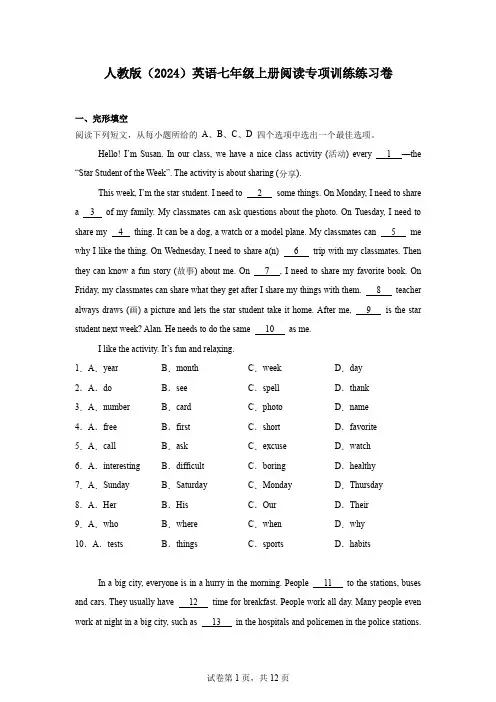
人教版(2024)英语七年级上册阅读专项训练练习卷一、完形填空阅读下列短文,从每小题所给的A、B、C、D 四个选项中选出一个最佳选项。
Hello! I’m Susan. In our class, we have a nice class activity (活动) every 1 —the “Star Student of the Week”. The activity is about sharing (分享).This week, I’m the star student. I need to 2 some things. On Monday, I need to share a 3 of my family. My classmates can ask questions about the photo. On Tuesday, I need to share my 4 thing. It can be a dog, a watch or a model plane. My classmates can 5 me why I like the thing. On Wednesday, I need to share a(n) 6 trip with my classmates. Then they can know a fun story (故事) about me. On 7 , I need to share my favorite book. On Friday, my classmates can share what they get after I share my things with them. 8 teacher always draws (画) a picture and lets the star student take it home. After me, 9 is the star student next week? Alan. He needs to do the same 10 as me.I like the activity. It’s fun and relaxing.1.A.year B.month C.week D.day2.A.do B.see C.spell D.thank 3.A.number B.card C.photo D.name4.A.free B.first C.short D.favorite 5.A.call B.ask C.excuse D.watch 6.A.interesting B.difficult C.boring D.healthy 7.A.Sunday B.Saturday C.Monday D.Thursday 8.A.Her B.His C.Our D.Their9.A.who B.where C.when D.why 10.A.tests B.things C.sports D.habitsIn a big city, everyone is in a hurry in the morning. People 11 to the stations, buses and cars. They usually have 12 time for breakfast. People work all day. Many people even work at night in a big city, such as 13 in the hospitals and policemen in the police stations.People are 14 making themselves and the city better (更好).When it is about 7:00 p.m., the 15 begins. Most of the offices are closed, but some shops are 16 open. People can do many things for fun. They 17 movies in the cinemas and they go to concerts to listen to music. At the moment, some people are 18 on the road. You can hear their songs. Some people are shopping. Others are 19 buses or taxis to meet friends.Day and night you can find people working and playing in a big city. A big city never 20 . Do you like the big city?11.A.run B.turn C.write D.talk 12.A.much B.good C.little D.new 13.A.actors B.doctors C.drivers D.teachers 14.A.busy B.lucky C.funny D.healthy 15.A.day B.night C.morning D.afternoon 16.A.also B.only C.again D.still 17.A.finish B.celebrate C.enjoy D.prepare 18.A.singing B.reading C.drawing D.cooking 19.A.putting away B.waiting for C.living in D.thinking of 20.A.works B.plays C.shares D.sleeps二、阅读理解①My name is Jenny Brown. I’m a middle school student. I am in Grade Nine. I havea sister. She’s Jane. She’s in my school, too. And she’s in Grade Seven. Lisa White is my good friend.① І am Alice, a student from No.10 Middle School in Chengdu. I found an English bookin the classroom. A picture of a cute dog is in it. Call Mrs. Clark at 345-6432. She is in Office 204. Ask her for it.①This is a photo of my classroom. Some books are in my desk. My redpencil box is on the desk. Two rulers, three pencils, a pen and an eraser are in it. My blue schoolbag is under the desk.①Here are two photos. My parents and I are in the first photo. My father isMike Green. He is 43. My mother is Mary Green. She is 40. I am Peter Green. I’m 15. I’m in Grade Nine. In the next photo are my friends and me. Dale and Eric are 15, too. They and I are in the same class.21.How many students in total are in Grade Nine in the above (以上的) passages?A.Two.B.Three.C.Four.D.Five.22.What colour is the pencil box?A.It’s red.B.It’s yellow.C.It’s purple.D.It’s blue. 23.Where is the lost English book now?A.In the library.B.In the classroom.C.In Office 204.D.In the desk. 24.Which passages are about “a. Friends and Family” and which passages are about “b. Things and Their Places”?A.a.①①; b.①①B.a.①①; b.①①C.a.①①; b.①①D.a.①①①; b.①“What do you usually have for breakfast?” I ask my students and hear the answers:“I never eat breakfast.”“I don’t get time to eat.”“I eat some bread and hurry to school.”Sometimes I don’t have breakfast or just get a coffee, so I want to do something for myself and my students. I set up (创建) the Breakfast Club. My idea is to have breakfast with a student every day and know more about them. When I tell my class about my new idea, they are excited.The next day, I put an invitation (邀请) on Nicholas’s desk. He is often late and he finds it difficult to do his schoolwork.When Nicholas sees the invitation, there is a big smile (笑) on his face. The next morning, he is my first student to get to school. We sit at my desk and eat a meal of bread and juice. I learn that he has two dogs and he likes sports. He plays soccer with his father on weekends. We both enjoy the breakfast. The next day, I put an invitation on a new desk. I see many benefits as my students have their turn to eat breakfast with me. No one is late for school; they work harder in school; they are happy to talk with me and other teachers.25.Why does the writer set up the Breakfast Club?A.To cook good breakfast for his students.B.To make parents cook breakfast for their children.C.To teach his students how to cook food by themselves.D.To eat breakfast with his students and know more about them.26.What do you know about Nicholas?A.He is good at his schoolwork.B.He doesn’t like animals.C.He is happy to have breakfast with his teacher.D.He plays soccer with his father on weekdays.27.What does the underlined word “benefits” probably mean in the last paragraph?A.问题B.方法C.好处D.麻烦28.What is the main idea of the text?A.We should have a good breakfast.B.The Breakfast Club helps the students a lot.C.Students can make friends at the breakfast time.D.Students have different kinds of breakfast food.三、选词填空根据短文内容,选择适当的单词填空,使短文意思完整。
人教版七年级英语阅读理解专项训练
人教版七年级英语阅读理解专项训练一、阅读理解题型分析。
1. 细节理解题。
- 这类题目主要考查学生对文章具体细节的理解能力。
例如,文章中提到某人的名字、地点、时间或者具体事件等。
在做这类题时,需要仔细阅读文章,找到与题目相关的句子,然后进行对比和选择。
- 常见的提问方式有:“What can we learn from the passage about...?”“Where did...happen?”“When did...?”等。
2. 推理判断题。
- 要求学生根据文章中的信息进行推理和判断。
不能直接从文章中找到答案,而是要在理解文章的基础上,对文章中的信息进行分析、归纳和推断。
- 例如:“What can we infer from the passage?”“Which of the following is probably true?”等是这类题目的常见提问方式。
3. 主旨大意题。
- 主旨大意题旨在考查学生对文章整体内容的理解和概括能力。
学生需要理解文章的中心思想,判断文章主要是关于什么内容的。
- 常见的提问方式包括:“What is the main idea of the passage?”“The passage is mainly about...”等。
4. 词义猜测题。
- 考查学生根据上下文猜测生词或短语含义的能力。
文章中可能会出现一些学生不认识的单词或者短语,但是可以通过上下文的线索来推测其含义。
- 例如:“The word ‘...’ in the passage probably means...”二、解题技巧。
1. 细节理解题解题技巧。
- 先读题目,明确题目要求,确定要查找的细节信息类型,如人物、事件、时间等。
- 然后带着问题快速浏览文章,利用关键词(如题目中的人名、地名、数字等)定位到文章中的相关段落或句子。
- 仔细对比选项和文章中的信息,注意选项中的细微差别,如时态、数量、范围等。
七年级英语阅读理解专项练习题及答案
七年级英语阅读理解专项练习题及答案一、七年级英语阅读理解1.阅读理解"Be proud of what you do," my father always told me, "whether you are a boss or a cleaner." When I was 15, I got a summer job in a hospital. I was told that my duties would include sweeping floors. I smiled and remembered Dad's words.Even though my job was the lowest, it made me feel excited. I saw it as a challenge because it was my first job. I learned to be on time and tried to do everything well. In return, I was treated with respect(尊敬)by doctors, nurses and patients. Each morning I imagined that the dirty dishes would make patients sicker if I were not there to wash them clean. After breakfast was done, I started sweeping the floors of all patient rooms and cleaning toilets. Though I was tired, I wanted the job to be done well. People would say, "That young boy really does a good job." That gave me pride.Working in the hospital taught me that being proud of one's job is important. It does not matter whether the job is sweeping floors or managing a large business. Through every job I have ever had, my father's words have always stayed with me. I have swept floors, and I have been a manager. I think Dad would be proud of me.(1)The writer's first job was a .A. bossB. cleanerC. managerD. doctor(2)Which of the following DIDN'T the writer do in the hospital according to the passage?A. Looking after patients.B. Washing dishes.C. cleaning toilets.D. Sweeping the floor.(3)When the writer was in the hospital, he .A. made the patients sickerB. wasn't tiredC. worked hardD. did everything (4)From the passage we know that .A. the writer's father always stayed with himB. the father didn't like the writer's first jobC. the writer wasn't proud of his first jobD. the father's words encouraged the writer to do everything well【答案】(1)B(2)A(3)C(4)D【解析】【分析】文章大意:从作者的第一份工作开始,父亲的话一直伴随着他,不管干什么都要都要为自己所做的事感到骄傲。
(完整)七年级英语阅读理解专项训练附答案
(完整)七年级英语阅读理解专项训练附答案七年级阅读理解专项训练1Tom likes fish very much. He often buys some fish in the shop and takes it home. But when his wife sees the fish, she says to herself, “Good! I can ask my friends to have lunch, and we can eat the fish. They like fish very much.”So when Tom comes home in the evening, the fish is not there and his wife always says, “Oh, your cat eats it.” And she gives Tom some bread for his supper. Tom gets very angry. He takes the cat and his wife to the shop near his house and weighs (称) the cat. Then he turns to his wife and says, “My fish weighs one kilo. The cat weighs one, too. My fish is here, you see, then where is my cat?”1. eats the fish.A. TomB. Tom’s wifeC. The catD. Tom’s wife and her friends2. What does Tom’s wife do with the fish?A. She eats the fish before Tom comes back.B. She asks her parents to come to eat the fish with her.C. She puts the fish in the fridge and waits for her husband.D. She cooks the fish for Tom.3. Tom weighs in the shop with his wife.A. the fishB. the catC. his wifeD. his friend4. How much fish does Tom often buy?A. One kilo.B. Two kilos.C. Three kilos.D. Four kilos.5. Tom likes very much.A. catB. his wifeC. fishD. his friend2Many Americans go to work five days a week. American school students go to school five days a week, too, so they usually have a two days’ weekend. The weekend is Saturday and Sunday. On weekends, people spend their time in many differentways. Sometimes they go shopping. Sometimes they go for a drive. Sometimes they visit friends. Many families enjoy weekends together.Many American families do some sports on weekends. For example, in summer they enjoy swimming. In autumn they play volleyball and tennis. In winter they go skating (滑冰) and skiing (滑雪). In spring they like sightseeing (观光) and hiking (徒步旅⾏).Some of them may invite (请) their friends to come over to have a party together. Some families may grow flowers and vegetables in their gardens or near their houses. For most Americans, weekends are very busy.Most Chinese go to work five days a week, too. And they also spend their weekends in many different ways. Some go shopping, some stay at home and do some cleaning, and some ask some friends to come home to play cards.How do you spend your weekends?1. What days are weekend in a week?A. From Monday to Friday.B. Sunday.C. Friday and Saturday.D. Saturday and Sunday.2. Do American families enjoy weekends together?A. Yes, they do.B. No, they don’t.C. Never.D. We don’t know.3. What sports do Americans do in winter?A. Swimming.B. Play volleyball and tennis.C. Sightseeing and hiking.D. Skating and skiing.4. How many days do most Chinese work a week?A. Six days.B. Seven days.C. Five days.D. Two days.5. What do some Chinese people like to do at their friend’s home on weekends?A. They play cards.B. They have a party.C. They grow flowers.D. They grow vegetables.3Ron loves to watch TV. But for one full (整) year, he didn’t watch TV at all. Why? Because his parents said they would give him $600 if he didn’t watch TV for a year.Ron’s parents thought he watched too much TV. One day his mother read a newspaper story about a boy who didn’t watch TV for a year. She showed the story to Ron. Ron liked the idea. He turned off (关上) the TV and said, “I can also do it if you give me some money.”At first, Ron’s parents were very happy. Ron read books and newspapers, played outside with his friends. Finally the year was over. Then Ron got the money. He started watching his favorite TV shows all day long again. Why did he want the $600? “I want to buy myself a TV set!” he said.1. Ron didn’t watch TV for one year because .A. he wanted the moneyB. watching TV too much is badC. he wanted to study hardD. he wanted to learn from the boy2. What do his parents want him to do?A. They want him to watch TV all day long.B. They want him to not to watch too much TV.C. They want him to get some money for them.D. They want him to read books and newspapers with them.3. What did Ron think of TV shows in the year?A. He couldn’t stand them.B. He doesn’t mind them.C. He still loved them but he has to stop watching them.D. He didn’t like them any more.4. What does Ron want to buy with the $600?A. Some books.B. Clothes.C. A computer.D. A TV set.5. The best title for the story is “”.A. A funny storyB. A year without TVC. A good boyD. Buying a TV4Mr. Black has two cats. One is big and one is small. He likes them very much. One day his good friend Mr. Green comes to see him. He is very surprised. He finds there are two holes in the door, a big hole and a small hole. He says, “My dear friend, why are there two holes in your door?”“To let them in and out,”Mr. Black answers. “But why are there two holes?” asks his friend. “How can the big cat go through the small hole?” he asks.1. Mr. Black has .A. two small catsB. two big catsC. a big cat and a small oneD. a cat and a bird2. Mr. Green comes to see .A. Mr. BlackB. Mrs. BlackC. the catsD. the holes3. Mr. Black wants to go through the two holes.A. the big catB. the small catC. a dogD. two cats4. Mr. Black thinks the big hole is only for .A. the small catB. the big catC. the two catsD. Mr. Green5. is not necessary.A. The big holeB. The small holeC. The big doorD. The small door5Jim, Kate and Li Ming are doing their homework together. Jim’s spelling of “Monday” is wrong. Kate tells him about it. Li Ming wants to borrow an eraser from Jim or Kate. Jim says he has one and gives it to Li Ming. Li Ming thanks Jim for his help. Jim says, “You’re welcome”. Now Jim says “Thanks very much” to Kate for her help. Kate says “That’s all right”. The three children are students in a school in Beijing. Jim is from London. Kate is from New York. Li Ming is a Chinese girl. They are good friends. They often do homework and playgames together. They often help each other.1. Jim is .A. an English girlB. an American girlC. an English boyD. an American boy2. Kate helps Jim with .A. his spelling3. Li Ming borrows .A. an eraser from KateB. an eraser from JimC. a ruler from KateD. a ruler from Jim4. The three students are .A. not in the same classB. in UKC. in BeijingD. in USA5. They are .A. doing homeworkB. playing gamesC. readingD. cleaning the room6What is color? Why do some of the things around us look red, some green, others blue?Colors are really made by reflected light (反射光线). We see colors because most of the things reflect light. Something is red, because it reflects most of the red light. In the same way, if something is green, it reflects most of the green light. If something reflects all light, it is white.Some of the light is reflected and some is taken in (吸收) and turned into heat. The darker the color is, the less light is reflected and the more light is taken in. So dark-colored (深⾊的) clothes are warmer in the sun than light-colored (浅⾊的) clothes.1. When something reflects light, we can .A. see its colorB. see its heatC. not see its colorD. see nothing2. Something looks white because it reflects .A. some lightB. no lightC. all lightD. less light3. The dark-colored clothes are warm because is taken in.D. less color4. In summer clothes make people feel cool.A. dark-coloredB. red-coloredC. green-coloredD. light-colored5. Which is the best title of this passage?A. Dark colorB. ColorC. HeatD. Clothes7Harry liked driving (开) his car very fast, and one day he hit (撞) another car. Harry jumped out and ran to it. There was an old man in the car. He was very angry and said to Harry. “What are you doing? You nearly killed (撞死) me!”“Yes,” Harry answered, “I’m very sorry.” He took a bottle out of his car and said, “Drink some of this. Then you’ll feel better.”He gave the old man some whisky (威⼠忌), and the man drank it, but then he shouted again, “You nearly killed me!” Harry gave him the bottle again. “I feel much better now. But why aren’t you drinking?”the man asked.“Oh, well,” said Harry, “I don’t want any whisky now. I’m going to sit here to wait for the police.”1. Harry drove his car very fast.A. alwaysB. sometimesC. neverD. hardly2. One day he hit a car because .A. he wanted to kill the old manB. he drank a lot of whiskyC. he drove his car too fastD. he had many bottles of whisky in his car3. The old man was very angry because .A. he wanted some whiskyB. Harry hit his carC. he was Harry’s fatherD. he drove his car too fast4. After drinking the bottle of whisky, the old man .A. felt much betterB. was still angryC. was very happyD. felt much worse5. What would probably happen to the old man?A. He would be hit again.B. He would be sent to the hospital.C. He would lose his way.D. He would be fined by the police.8Joe Brown had a shop where he sold meat. One day a woman came into the shop at five to one. “I’m sorry I’m late,” she said,“I need some more meat for my dinner tonight.” Joe had only one piece of meat in his shop. He took it out of the fridge and said, “This is $6.5.”“That piece is too small,” the woman said. “Haven’t you got anything bigger?” Joe went into the room behind his shop, took the meat into the fridge, took it out again and closed the door with a lot of noise. Then he brought the piece of meat to the woman and said, “This piece of meat is bigger and more expensive. It’s $8.75.”“Good,” the woman said with a smile. “Give me both of them, please.”1. What was Joe Brown?A. A bookseller.B. A shopkeeper.C. A conductor.D. A gateman.2. When did the woman come into the shop?A. Late in the evening.B. At midnight.C. Early in the morning.D. Early in the afternoon.3. Why didn’t the woman want that piece of meat at first?A. Because it was too cheap.B. Because it smelt bad.C. Because it cost too much.D. Because it wasn’t big enough.4. How many pieces of meat were kept in the fridge?A. Only one piece.B. Two pieces.C. Several pieces.D. Many pieces.5. Could Joe give the woman both pieces of meat?A. Certainly.B. Of course not.C. He would try his best.D. The story doesn’t give us the Answers.9An old man had a monkey. He liked it very much, because the monkey was very clever. When birds came into the garden, he chased (追赶) them away. He also helped the old man do many other things. The old man often fell asleep in the day in his chair. Then the monkey sat at the old man’s side and chased away the flies (苍蝇) from the old man’s face. One hot afternoon in summer the old man was asleep in his chair. A fly came and sat on the end of the old man’s nose. The monkey chased it away. Soon the fly came back and sat on the old man’s nose again. The monkey chased it away. This went on for five or six times. The monkey at last was very angry. He jumped up, ran into the garden and picked up a large stone. The next time that the fly sat on the old man’s nose the monkey hit it with the stone. He killed the fly, but unluckily he also broke the old man’s nose.1. The old man liked the monkey because .A. the monkey could chase the birds awayB. the monkey could chase the flies awayC. the monkey was very cleverD. the monkey could do many other things for the old man2. When the old man was asleep, the monkey .A. slept, tooB. chased away the birdsC. ran up and downD. chased away the flies3. One hot afternoon, a fly sat .A. on the old man’s faceB. on the old man’s noseC. on the monkey’s faceD. on the monkey’s nose4. The monkey at last.A. didn’t help the man this timeB. chased away the flyC. felt very happyD. felt very angry5. The story tells us .A. monkey’s are not clever enoughB. monkeys can chase away fliesC. monkeys can help people do many thingsD. sometimes friends may hurt us for good10Swee Lin has an interesting hobby. She collects stamps. She spends a lot of time on her stamp collection after school hours. She has collected hundreds of stamps from all over the world. They are all in color.Swee Lin likes stamps with pictures of animals and birds on them. In this way, she learns the names of many animals and birds. She also borrows books on animals and birds from her school library. She learns many things about them. Sometimes Swee Lin has many stamps of the same kind. She gives them to her friends. They then give her other stamps in return.Swee Lin writes to friends in many countries. She sends them stamps of her country. In return, they send her stamps of their countries. Swee Lin’s father also gives her stamps. He brings them home from his office for her.Many of Swee Lin’s friends collect other things. Some collect coins and others collect matchboxes. But, all of them say that Swee Lin’s collection is the most interesting of all.1. Swee Lin spends a lot of time on her hobby .A. before schoolB. during school hoursC. after school hoursD. during her holidays2. Swee Lin’s stamps are in color.A. All ofB. Some ofC. Many ofD. None of3. Swee Lin learns a lot about animals and birds from .A. her teacherB. her friendsC. her stampsD. her father4. Sometimes Swee Lin has many stamps of the same kind. She then .A. keeps themB. throws them awayC. sells them to her friendsD. sends them to her friends5. What does the word “hobby” mean? It means .A. matchbox collectionB. doing things one likesC. keeping coins one likesD. stamp collection11We all Chinese New Year the Spring Festival. There is a name for each Chinese year. We may call it the year of sheep, the year of horse or the year of the rooster (鸡). And this year is the year of dog.Before New Year’s Day, people are busy shopping and cleaning their houses. On New Year’s Eve (除⼣), there is a large family dinner. After dinner, all the family stay up (不睡觉) late to welcome the New Year. On the first day of the New Year, people put on their new clothes and go to visit their friends and relatives (亲戚). They say “Happy New Year and Gook luck”and some other greetings (祝福) to each other. People usually have a very good time during the festival.1. How many Chinese Festivals are talked about in this passage?A. One.B. Two.C. Three.D. Four.2. We can find every Chinese year is given .A. an animalB. a plantC. a familyD. a first3. What do Chinese people usually do on New Year’s Eve?A. They put on new clothes and go to the park.B. They visit their friends and relatives.C. They have a large dinner and stay up late to welcome the New Year.D. They are busy shopping and cleaning the house.4. On New Year’s Day, people usually say “” when they meet.A. Merry ChristmasB. Good luckC. Happy New YearD. both B and C5. The best title for this passage is “”.A. Good timeB. The Spring FestivalC. Big dinnerD. The year of the horse12Do you know there are two kinds of football games? One is American football, the other is soccer.In China, many young men like playing soccer. It is very popular. But the Chinese don’t call it soccer. Wecall it football. There are eleven players in a team. And the ball is round. Only the goalkeeper plays the ball with his hands. The other players can’t play the ball with their hands.In the USA, soccer is not very popular. They like playing American football more than playing soccer. There are also eleven players in a team. The ball is not round. It is oval-shaped (椭圆形的). All the players can play the ball with their hands and feet. And the goal is bigger than the goal of soccer games. American football is quite different from (与……不同) soccer. 1. How many kinds of football games are there in the world?A. Only one.B. Two.C. Three.D. Four.2. In China, the ball is .A. soccer; roundB. soccer; oval-shapedC. football; roundD. football; oval-shaped3. There are players in a ball team in two games.A. tenB. elevenC. twelveD. thirteen4. Which is NOT right?A. American football is different from soccer.B. In the USA, soccer is very popular.C. When playing soccer, only the goalkeeper can play with his hands.D. You can use your hands and feet to play American football.5. The goal of American football is than that of soccer.A. biggerB. smallerC. higherD. lower13There is a one-day holiday in most countries on New Year’s Day (元旦). The real celebrating (庆祝) for New Year happens on the night before ─ on New Year’s Eve. There are some interesting customs in the West, and there are many differences from country to country.Though Christmas is a time for family to get together, New Year’s Eve for some people is a time to be with friends, too. Parties are often held (举⾏) to welcome New Year. At such parties, there is food and drink and dancing until the time nears for the coming of New Year.At midnight, people often say “Happy New Year” to each other. Champagne (⾹槟) is a favorite drink for New Year’s Eve. In many western (西⽅的) countries fireworks are let off (燃放) at midnight, and many people like to make a noise, possibly to drive away (赶⾛) bad spirits (精灵).One important song at New Yea r’s Eve is the Scottish song of Auld Lang Syne (友谊地久天长).1. People usually have great celebrations for New Year on .A. the night before New Year’s EveB. New Year’s DayC. the night before New Year’s DayD. the night of New Year’s Day2. In the West, New Year’s Eve is also a time for .A. people to go from country to countryB. people to have a week’s holidayC. friends to write to each otherD. friends to get together3. The Chinese meaning of the word “custom” is .A. 聚会B. 习俗C. 劳动D. 饮⾷4. At midnight on New Year’s Eve, western people often .○1hold parties to welcome New Year ○2Make a noise to drive away bad spirits○3drink with friends or families ○4say “Happy New Year” to each other○5sing an important French song ○6let off fireworks in the day timeA. ○1○2○5○6B. ○1○2○3○4C. ○2○3○4○6D. ○3○4○5○65. This passage mainly talks about .A. how western people spend their New Year’s EveB. that western people have a good time on New Year’s DayC. what western people do on New Year’s DayD. that western people drink together on New Year’s Eve七年级阅读理解专项训练答案1. 1—5 DABAC2. 1—5 DADCA3. 1—5 ABCDB4. 1—5 CADBB5. 1—5 CABCA6. 1—5 ACADB7. 1—5 ACBBD8. 1—5 BDDAD9. 1—5 CDBBD 10. 1—5 CACDB 11. 1—5 AACDB 12. 1—5 BABBA 13. 1—5 CDBBA。
初一英语语法应用英语阅读理解30题
初一英语语法应用英语阅读理解30题**Reading Passage 1: School Life**My name is Tom. I'm a student in Grade 7. I like my school life very much. There are many interesting classes and activities. We have English classes every day. I like English because my English teacher is very kind. She often tells us interesting stories in English. We also have art classes. I can draw many beautiful pictures in art class. And I'm in the school basketball team. We practice playing basketball after school. It's great fun.1. What grade is Tom in?A. Grade 6B. Grade 7C. Grade 8D. Grade 9答案: B。
解析: 文章第一句话提到I'm a student in Grade 7,所以答案是B。
2. What subject does Tom like?A. MathB. ChineseC. EnglishD. Science答案: C。
解析: 文中提到I like English because my English teacher is very kind,表明Tom喜欢英语。
3. Who often tells interesting stories in English?A. Tom's motherB. Tom's fatherC. Tom's English teacherD. Tom's art teacher答案: C。