
2003年北京师范大学考博英语试题参考答案
2003年北京师范大学考博英语试题参考答案
Part One Listening Comprehension (略)
Part Two Reading Comprehension
Passage One 21-25 CBBBA
Passage Two 26-30 BADBC
Passage Three 31-35 AADCA
Passage Four 36-40 DCCBD
Passage Five 41-45 CDBCD
Part Three Translation and Writing
Part A Translation
Section A
1. 文化是人类知识、信仰和举止行为的综合形式的显现。
因此文化被定义为包含有语言、观点、信仰、风俗,禁忌、规矩、制度、工具、技艺、工作艺术、礼节、典礼等组成部分;同时文化的发展还取决于人类学习知识的能力以及如何运用这种能力带来完善并超越世代的发展。
每个人类社会都有它各自特定的文化,或者是说社会文化系统,并且都在一定程度上与其它系统相互交融。
社会文化系统的多样性可以归因于其自然环境及来源的差异,归因于不同地区活动中与生俱来所沿袭的事物可能性,例如语言、礼节、风俗、工具的生产、运用、社会发展的程度等等。
基于生态、环境等方式的变化,适应和变革也随之在文化中产生。
2. 数据库:通过计算机来将各类数据经过特别的组织,整理以便于快速的搜寻及检索。
数据库就是通过这种方法来组织和整合的,以此来促进数据的访问、操作和删除(通常是与其他数据处理系统相连的相关数据)。
数据库中的信息通常包括自然语言文本模式,就当前文字和短语而言,从那些计算机化的记录中被检索出来的信息和用户查询的信息是完全一致的。
在一个典型的查询中,用户通常提供字符的顺序,例如一个期刊的标题或是一个地区的名称,然后计算机就从数据库中去搜索相应顺序的字符并且提供上述字符出现过的来源材料。
查询是用户检索数据库信息的最主要的一种方式。
Section B
Skyscrapers:superhighway, saloon cars and various home electric appliances that appeared in the market, all of which showed that China has experienced a profound transformation since the Opening & Reform Policy in 1978. All of these changes are even seen within people’s eyes. However, besides the changes in people’s materialistic life, there exists some of the other changes even more important or meaningful.
Sociologists detect that since the living standards of people’s life has improved. The traditional living style and conception has changed gradually. Sociologists have been paying attention to this phenomenon for a certain period. From the evolvement of the family frame to changes of the women’s status, from the changing attitudes towards marriage to the changes of consumption conception, and finally the polarization of personal income ------ all of them become the researching subjects for the sociologists.
Part B Summary Writing
Europe was the first of the major world regions to develop a modern economy. Its successful modernization facilitated the movement of raw materials and finished goods and the communication of ideas.
Concerning the time, it first began in the 17th century. The traditional method of cultivation involved allowing land to remain fallow thus fewer farmlands were needed to work the land and the accumulated capital and labor created by this revolution fueled the development of the Industrial Revolution in the 18th century.
Industrialization outside of England began in the mid-19th century in Belgium and spread to some of the other European countries. Although they had recognized the importance of factory production and had taken steps to encourage local development, there still existed large areas untouched by modern in industrial development. During the 20th century Europe has experienced periods of economic growth and prosperity, but continued economic development in Europe has been handicapped to a large degree by its multinational character.。
(完整word版)北京大学博士英语考试试题及解析
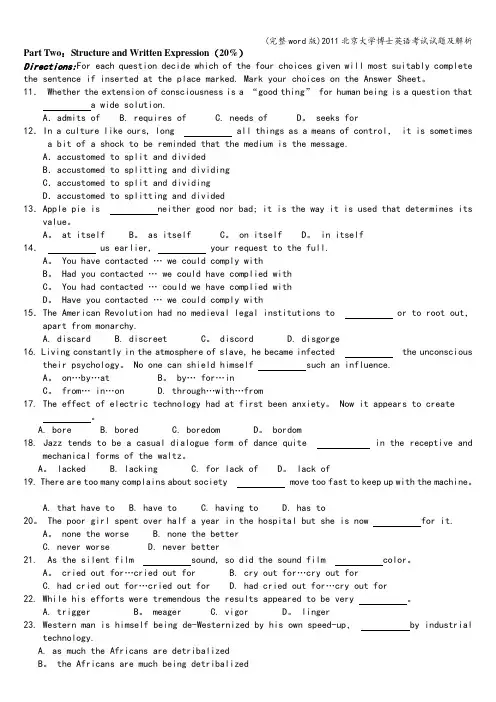
Part Two:Structure and Written Expression(20%)Directions:For each question decide which of the four choices given will most suitably completethe sentence if inserted at the place marked. Mark your choices on the Answer Sheet。
11. Whether the extension of consciousness is a “good thing” for human being is a question thata wide solution.A.admits of B. requires of C. needs of D。
seeks for12.In a culture like ours, long all things as a means of control, it is sometimesa bit of a shock to be reminded that the medium is the message.A.accustomed to split and dividedB.accustomed to splitting and dividingC.accustomed to split and dividingD.accustomed to splitting and divided13.Apple pie is neither good nor bad; it is the way it is used that determines its value。
A。
at itself B。
as itself C。
on itself D。
in itself14. us earlier, your request to the full.A。
北京大学博士英语试题及答案

北京大学博士英语试题及答案一、词汇与语法(共20分,每题2分)1. The company has been ________ for over a century.A. establishedB. establishingC. to establishD. being established答案:A2. Despite the heavy rain, the match will be held as ________.A. planB. plannedC. planningD. to plan答案:B3. The professor suggested that we ________ a meeting to discuss the issue.A. arrangeB. arrangedC. arrangingD. will arrange答案:A4. The book is worth ________.A. to readB. readC. readingD. being read答案:C5. The problem is too difficult for us ________.A. to solveB. solvingC. solvedD. being solved答案:A二、阅读理解(共30分,每题3分)阅读以下短文,然后回答问题。
The rise of artificial intelligence has brought about significant changes in various industries. Companies are now using AI to improve efficiency, reduce costs, and enhance customer experiences. However, with the rapid advancement of technology, there are concerns about job displacement and privacy issues.6. What is the main focus of the passage?A. The impact of AI on industriesB. The benefits of AIC. The concerns about AID. The advancement of technology答案:A7. Which of the following is NOT mentioned as a benefit of AI?A. Improved efficiencyB. Reduced costsC. Enhanced customer experiencesD. Increased job opportunities答案:D8. What is the concern associated with AI?A. Job displacementB. Increased efficiencyC. Reduced costsD. Enhanced customer experiences答案:A9. What can be inferred from the passage?A. AI is only used in certain industries.B. AI is a threat to privacy.C. AI is being embraced by companies.D. AI has no benefits.答案:C10. What is the purpose of the passage?A. To promote AIB. To criticize AIC. To inform about AID. To encourage debate about AI答案:C三、完形填空(共20分,每题2分)In the past, people used to believe that the world was flat. However, with the discovery of new lands and the development of navigational tools, this belief was gradually __11__.11. A. changedB. alteredC. modifiedD. transformed答案:A12. The explorers' voyages led to a __12__ understanding of the world.A. clearB. distinctC. preciseD. accurate答案:D13. As a result, the concept of a spherical Earth became__13__.A. acceptedB. acknowledgedC. recognizedD. known答案:A14. Today, we take for granted the fact that the Earth is round, but in the past, it was a __14__ idea.A. revolutionaryB. radicalC. groundbreakingD. innovative答案:A15. The __15__ of the Earth's shape has had a profound impact on science and exploration.A. realizationB. perceptionC. understandingD. comprehension答案:A四、翻译(共30分,每题10分)16. 随着互联网的普及,人们获取信息的方式发生了巨大变化。
北京师范大学2014年考博英语真题及详解【圣才出品】
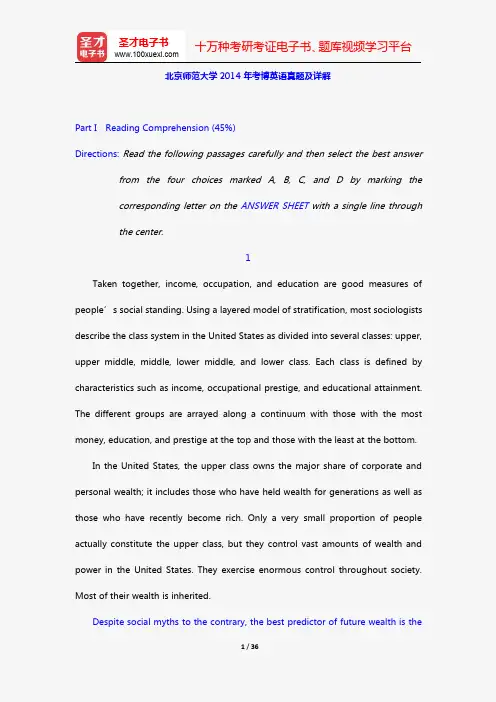
北京师范大学2014年考博英语真题及详解Part I Reading Comprehension(45%)Directions:Read the following passages carefully and then select the best answer from the four choices marked A,B,C,and D by marking thecorresponding letter on the ANSWER SHEET with a single line throughthe center.1Taken together,income,occupation,and education are good measures of people’s social ing a layered model of stratification,most sociologists describe the class system in the United States as divided into several classes:upper, upper middle,middle,lower middle,and lower class.Each class is defined by characteristics such as income,occupational prestige,and educational attainment. The different groups are arrayed along a continuum with those with the most money,education,and prestige at the top and those with the least at the bottom.In the United States,the upper class owns the major share of corporate and personal wealth;it includes those who have held wealth for generations as well as those who have recently become rich.Only a very small proportion of people actually constitute the upper class,but they control vast amounts of wealth and power in the United States.They exercise enormous control throughout society. Most of their wealth is inherited.Despite social myths to the contrary,the best predictor of future wealth is thefamily into which you are born.Each year,the business magazine Forbes publishes a list of the“Forbes400”—the four hundred wealthiest families and individuals in the country.Of all the wealth represented on the Forbes400list,more than half is inherited.Those on the list who could be called“self-made”were not typically of modest origins;most inherited significant assets(Forbes,1997;Sklar and Collins, 1997).Those in the upper class with newly acquired wealth are known as the nouveau niche.Although they may have vast amounts of money,they are often not accepted into“old rich”circles.The upper middle class includes those with high incomes and high social prestige.They tend to be well-educated professionals or business executives.Their earnings can be quite high indeed—successful business executives can earn millions of dollars a year.It is difficult to estimate exactly how many people fall into this group because of the difficulty of drawing lines between the upper,upper middle,and middle class.Indeed,the upper middle class is often thought of as “middle class”because their lifestyle sets the standard to which many aspire,but this lifestyle is simply beyond the means of a majority of people in the United States.The middle class is hard to define;in part,being“middle class”is more than just economic position.By far the majority of Americans identify themselves as middle class even though they vary widely in lifestyle and in resources at their disposal.But the idea that the United States is an open-class system leads many to think that the majority have a middle-class lifestyle because,in general,peopletend not to want to recognize class distinctions in the United States.Thus,the middle class becomes the ubiquitous norm even though many who call themselves middle class have a tenuous hold on this class position.In the hierarchy of social class,the lower middle class includes workers in the skilled trades and low-income bureaucratic workers,many of whom may actually define themselves as middle class.Examples are blue-collar workers(those in skilled trades who do manual labor)and many service workers,such as secretaries, hairdressers,waitresses,police,and firefighters.Medium to low income,education, and occupational prestige define the lower middle class relative to the class groups above it.The term“lower”in this class designation refers to the relative position of the group in the stratification system,but it has a pejorative sound to many people,especially to people who are members of this class.The lower class is composed primarily of the displaced and poor.People in this class have little formal education and are often unemployed or working in minimum-wage jobs.Forty percent of the poor work;ten percent work year-round and full time—a proportion that has generally increased over time.Recently,the concept of the underclass has been added to the lower class.The underclass includes those who have been left behind by contemporary economic developments.Rejected from the economic system,those in the underclass may become dependent on public assistance or illegal activities.1.Which of the sentences below best expresses the information in the highlighted statement in the passage?A.Although it is not generally accepted,your family provides the best prediction of your future wealth.B.You can achieve great future wealth in spite of the family in which you may have been born.C.It is not true that your family will restrict the acquisition of your future wealthand level of social status.D.Social myths are contrary to the facts about the future wealth and social status of your family.2.Why does the author mention the“Forbes400”in paragraph3?A.To explain the meaning of the listing that appears every year.B.To support the statement that most wealthy people inherit their money.C.To cast doubt on the claim that family income predicts individual wealth.D.To give examples of successful people who have modest family connections.3.According to paragraph5,why do most people identify themselves as middle class in the United States?A.They have about the same lifestyle as everyone else in the country.B.They don’t really know how to define their status because it is unclear.C.They prefer not to admit that there are class distinctions in the United States.D.They identify themselves with the majorities who have normal lifestyles.4.What can be inferred about poor people in the United States?A.They are not able to find entry-level jobs.B.They do not try to find employment.C.They are service workers and manual laborers.D.They work in jobs that require little education.5.According to paragraph7,why has the underclass emerged?A.The new term was necessary because the lower class enjoyed a higher lifestylethan it had previously.B.The increase in crime has supported a new class of people who live byengaging in illegal activities.C.Changes in the economy have caused an entire class of people to survive bywelfare or crime.D.Minimum-wage jobs no longer support a class of people at a standard level inthe economic system.【答案与解析】1.A语义判断题。
北京师大考博英语试题2003
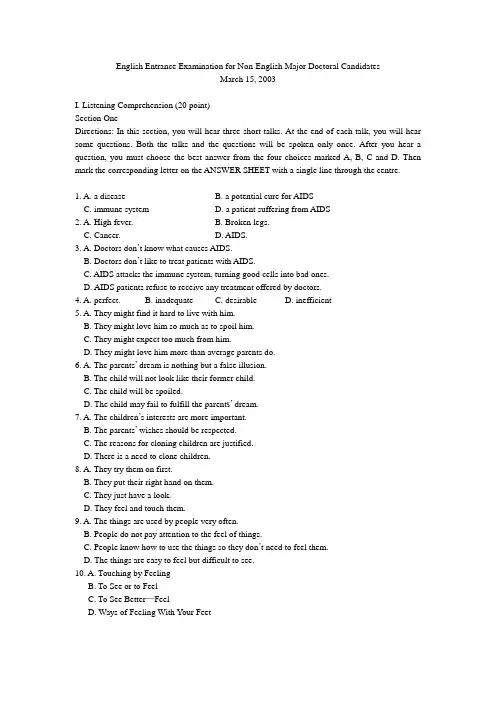
English Entrance Examination for Non-English Major Doctoral CandidatesMarch 15, 2003I. Listening Comprehension (20 point)Section OneDirections: In this section, you will hear three short talks. At the end of each talk, you will hear some questions. Both the talks and the questions will be spoken only once. After you hear a question, you must choose the best answer from the four choices marked A, B, C and D. Then mark the corresponding letter on the ANSWER SHEET with a single line through the centre.1. A. a disease B. a potential cure for AIDSC. immune systemD. a patient suffering from AIDS2. A. High fever. B. Broken legs.C. Cancer.D. AIDS.3. A. Doctors don‟t know what causes AIDS.B. Doctors don‟t like to treat patients with AIDS.C. AIDS attacks the immune system, turning good cells into bad ones.D. AIDS patients refuse to receive any treatment offered by doctors.4. A. perfect. B. inadequate C. desirable D. inefficient5. A. They might find it hard to live with him.B. They might love him so much as to spoil him.C. They might expect too much from him.D. They might love him more than average parents do.6. A. The parents‟ dream is nothing but a false illusion.B. The child will not look like their former child.C. The child will be spoiled.D. The child may fail to fulfill the parent s‟ dream.7. A. The children‟s interests are more important.B. The parents‟ wishes should be respected.C. The reasons for cloning children are justified.D. There is a need to clone children.8. A. They try them on first.B. They put their right hand on them.C. They just have a look.D. They feel and touch them.9. A. The things are used by people very often.B. People do not pay attention to the feel of things.C. People know how to use the things so they don‟t need to feel them.D. The things are easy to feel but difficult to see.10. A. Touching by FeelingB. To See or to FeelC. To See Better—FeelD. Ways of Feeling With Y our FeetSection BPart 1Directions: Look at the questions for this part. Y ou will hear a presentation on Time Management. For questions 11-15, while you are listening, choose the correct word or phrase to complete each sentence by marking one letter A, B or C for the word or phrase you choose on the ANSWER SHEET with a single line through the centre.11. The speaker wants to show you _______.A. the harmful effects of stressB. how you can be more effective at workC. how to lead a balanced life12. Y ou can subject yourself to high levels of stress by ______.A. meeting other people‟s demands on your timeB. traveling a lotC. regularly working very long hours13. Typically, stress is related to ______.A. jobs with high salariesB. long working hoursC. high levels of responsibility14. One thing the speaker suggests you do is _____ in order to reduce your working hours.A. to delegateB. to update facilities D. to take a holiday15. To help you manage your time more effectively, the speaker suggests you start saying ______.A. “no” to other peopleB. “Y es” to other peopleC. “Sorry” to yourselfPart 2Directions: Look at the five statements (16-20) for this part. Y ou will hear an interview between a sales manager and an applicant for the position of advertising manager. Decide if each statement is correct according to the interview. If you think it is correct, mark letter A on your ANSWER SHEET with a single line through the center. If you think it is not correct, mark letter B on the ANSWER SHEET with a single line through the centre.16. The sales manager is satisfied with the present advertising firm.17. Miss Edison will be responsible to Mr. Grant for all advertising.18. The company has never advertised on TV.19. The company produces chairs.20. The sales manager shows great interest in Miss Edison‟s idea about TV advertising and veryprobably Miss Edison will get the job.II. Reading Comprehension (25 points)Directions: There are five passages in this part. Each of the passages is followed by five questions or unfinished statements. For each of them there are four choices marked A, B, C and D. Choose the best one and mark your answer on the ANSWER SHEET with a single line through the center.1The great advance in rocket theory 40 years ago showed that liquid-fuel rockets were far superior in every respect to the skyrocket with its weak solid fuel, the only kind of rocket then known. However, during, the last decade, large solid-fuel rockets with solid fuels about as powerful as liquid fuels have made their appearance, and it is a favorite layman‟s question to inquire which one is “better”. The question is meaningless; one might as well ask whether a gasoline or a diesel engine is “better”. It all depends on the purpose. A liquid-fuel rocket is complicated, but has the advantage tat it can be controlled beautifully. The burning of the rocket engine can be stopped completely it can be re-ignited when desired. In addition, the thrust can be made to vary by adjusting the speed of the fuel pumps. A solid-fuel rocket, on the other hand, is rather simple in construction, though hard to build when a really large size is desired. But once you have a solid-fuel rocket, it is ready for action at very short notice. A liquid-fuel rocket has to be fueled first and cannot be held in readiness for very long after it has been fueled. However, once a solid-fuel rocket has been ignited, it will keep burning. It cannot be stopped and re-ignited whenever desired (it could conceivably be stopped and re-ignited after a pre-calculated time of burning has elapsed) and its thrust cannot be varied. Because a solid-fuel rocket can be kept ready for a long time, most military missiles employ solid fuels, but manned space flight needs the fine adjustments that can only be provided by liquid fuels. It may be added that a liquid-fuel rocket is an expensive device; a large solid-fuel rocket is, by comparison, cheap. But the solid fuel, pound per pound, costs about 10 times as much as the liquid fuel. So you have on the one hand, an expensive rocket with a cheep fuel and on the other hand a comparatively cheap rocket with an expensive fuel.21. The author feels that a comparison of liquid and solid-fuel rockets shows that ______.A. neither type is very economicalB. the liquid-fuel rocket is bestC. each type has certain advantagesD. the solid-fuel rocket is best22. The most important consideration for manned space flight is that the rocker be ________.A. inexpensive to constructB. capable of lifting heavy spacecraft into orbitC. inexpensive to operateD. inexpensive to operate23. Solid fuel rockets are expensive to operate because of their _______.A. sizeB. fuelC. constructionD. complicated engines24. Which of the following statements is not characteristic of liquid-fuel rockets?A. The fuel is cheap.B. They are cheap to build.C. They can be stopped and re-ignited.D. They must be used soon after fueling.25. The author tells us that ______.A. whether a liquid-fuel or a solid-fuel rocket is better depends on the purposeB. neither type is superiorC. forty years ago, large solid-fuel rockets with solid fuels as powerful as liquid fuels weremadeD. the thrust can be made to vary by adjusting the direction of the pump2Imagine an accident in which a nuclear power plant releases radioactive gas. The cloud starts moving with the wind. Clearly, the authorities will want to evacuate anyone in its path, but what is that path? Local wind information is meaningless without information about terrain; a mountain range or series of valleys can divert both wind and gas in unpredictable directions.To make “downwind” a useful term, scientists at Lawrence Livermore National Laboratory have put the United States on a computer, the entire United States—every hill, every valley, every mile of seashore. Within minutes of a disaster, they can give meteorologists a context for weather data, and thus the ability to predict how toxic gases might spread.The database for this computer map is a series of altitude measurements, made over many years by the Defense Department and the U.S. Geological Survey. They represent the height above sea level of over a billion separate points—a grid of points 200 feet apart, spanning the country. Armed with these data, plus a program that manipulates them, a Cray-1 computer can produce an image of any piece of terrain, seen from any angle, illuminated by an imaginary sun at any time of day placing the “observer” at any altitude from zero to 40,000 feet.“We use a technique called ray tracing,”says Patrick Weidhaas, one of the Livermore computer scientists who wrote the program. The computer is told where the observer is. The program traces an imaginary ray from there outward until it “intersects” with one of the points of altitude recorded in the machine‟s memory. The computer then puts a dot of color at the proper place on the screen, and the program traces another ray.At its highest resolution of 2,000 horizontal and 1,700 vertical dots per picture, the computer has to trace several million rays, Even on the Cray, the most powerful computer in the world, this takes about a minute. Reducing the resolution to 400-800 (a TV screen has 800×700) speeds it up to about eight seconds. “We can‟t produce a movie simulating flight on the screen in real time,” says Weidhaas. There is a way around the problem: Two movies have been made using still pictures generated by the computer as individual frames. “The results were impressive,” he says, “but it was cumbersome to do. At twenty-four frames per second, it takes fourteen hundred separate computer images to make a one-minute film.”Another limitation: The computer can access only enough memory to cove a 15-mile-square area. An “observer” high up will see blank spaces beyond those limits.Weidhaas wants to add information about what overlies the terrain—cities, vegetation, roads, and so on. “Making the image as realistic as possible will make our advice more effective,” he says, “and might lead to uses we haven‟t thought of yet.”26. As used in the first paragraph, thrrain most clearly means _______.A. available information about the weatherB. surrounding land areaC. blank spaces between the mountain rangesD. amount of forest per square mile27. Livermore‟s computer map, in combination with weather reports, might be useful in predicting_____.A. the path of toxic gases from a nuclear power plant explosionB. where incoming nuclear missiles might strikeC. the average annual rainfall for North DakotaD. the amount of pollution in the air28. The information used by the computer to make its detailed maps _______.I. was gathered by the Defense Department and the U.S. Geological SurveyII. shows points roughly 200 feet apartIII. involves altitude measurementsA. IB. I and IIC. I and IIID. I, II and III29. Which of the following is the best description of ray tracing?A. The computer simulates rays of the sun, filling in areas of light and shadow.B. Lines radiate outward from the imagined observer and a dot of color is placed where theline intersects with one of the points of altitude in the machine‟s memory.C. X-rays are used to trace the outline of the terrain through buildings and trees.D. The exact movement of rays is used by private detectives to solve mysteries and locatemissing persons.30. Information about cities, vegetation, and road overlying the terrain ______.A. has to be eliminated before correct readings can be obtainedB. would be impossible to convert to data that a computer would accept.C. might lead to new applications and improve effectiveness of present usesD. would make ray tracing obsolete3Should doctors ever lie to benefit their patients—to speed recovery or to conceal the approach of death? In medicine as in law, government, and other lines of work, the requirements of honesty often seem dwarfed by greater needs: The need to shelter from brutal news or to uphold a promise of secrecy.What should doctors say, for example, to a 46-year-old man coming in for a routine physical checkup who, though he feels in perfect health, is found to have a form of cancer? If he asks, should the doctor deny that he is ill, or minimize the gravity of the illness Doctors confront such choices often and urgently. At times, they see important reasons to lie for the patient‟s own sake. In their eyes, such lies differ sharply from self-serving ones.Studies show that most doctors sincerely believe that the seriously ill do not want to know the truth about their condition, and that informing them risks destroying their hope, so that they may recover more slowly, or deteriorate faster, perhaps even commit suicide. As one physician wrote: “Ours is a profession which traditionally has been guided by a precept that transcends the virtue of uttering the truth for truth‟s sake, and that is, as far as possible …do no harm‟.” Armed with such a precept a number of doctors may slip into deceptive practices that they assume will “do no harm”and may well help their patients.But the illusory nature of the benefits such deception is meant to produce is now coming to be documented. Studies show that, contrary to the belief of many physicians, an overwhelming majority of patients do want to be told the truth, even about grave illness, and feel betrayed when they learn that they have been misled. We are also learning that truthful information, humanely conveyed, helps patients cope with illness.Not only do lies not provide the “help” hoped for by advocates of benevolent deception, they invade the autonomy of patients and render them unable to make informed choices concerningtheir own health.Lies also do harms to those who tell them: harm to their integrity and, in the long run, to their credibility. Lies hurt their colleagues as well. The suspicion of deceit undercuts the work of the many doctors who are scrupulously honest with their patients; it contributes to the spiral of lawsuits and of “defensive medicine”, and thus it injures, in turn, the entire medical profession.31. Who are most likely to lie for serving purposes?A. physiciansB. surgeonsC. psychiatristsD. lawyers32. Doctors think that lying to their patients is _______.A. a medical traditionB. to harm their own integrityC. to defend medicineD. uttering the truth for truth‟s sake33. Most patients think that being told the truth of their illness may ______.A. slow down recoveryB. lead to suicide in some casesC. be too hard for them to acceptD. help deal with illness34. Which of the following statements is NOT true according to the author?A. Doctors are often in a dilemma as to tell the patient his real condition of health.B. Doctor s‟ reluctance to tell patient truth has no real support in reality.C. Doctors‟ lies are different from that of lawyers and government officials.D. Doctors and patients hold different views about telling truth.35. What is the author‟s attitude towards doctors?A. sarcasticB. praisingC. objectiveD. appreciative4China today is home to 13 billion people—nearly one quarter of the world‟s population. The growth of china‟s population is largely the result of modernization, which has brought with it more food, better medical care, less disease, and fewer epidemics and famines. The death rate in China has decreased, and more children survive. The higher survival rate in China means that more people are entering childbearing age. This population growth was threatening to destroy China‟s chances to become a richer country: just providing food and basic necessities for everyone would consume all of its economic gains.To tame the explosive population growth, the Chinese government launched a drastic policy of allowing one child per family. To enforce this policy, the government has a variety of incentives for those who comply and punishment for those who do not. For example, couples who have only one child get a monthly pay until the child is fourteen, special consideration for scarce housing, free medical care, and extra pension benefits. The pressure to conform is powerful. Couples who ignore the state‟s directive suffer social disgrace and economic penalties.The family-planning policy, instituted in China in 1979, has been remarkably effective (though considerably more so in cities than in the countryside). Births to women of childbearing age have fallen dramatically—to about 2.5 children for every woman.China may eventually succeed in balancing its population growth, but in doing so, it is creating a new problem. The irony is that because of the very success of China‟s population policy, the Chinese population is aging rapidly. In 1982, 5% of the population was over age 64. In 2010, about 9% will be over 64, and in 2050, 25% will be. At the family level, children without brothers or sisters will each have to care for two aging parents. At the national level, the great numbers ofaging people will tax the society‟s resources. China shares this problem—a rapidly aging population without a large enough following generation to support it—with many of the developed nations of the world.36. The primary purpose of this passage is to _______.A. predict the population problem in China.B. explain why the family-planning policy is adopted in ChinaC. illustrate the result of family-planning policyD. demonstrate the cause and effect of the family-planning policy37. According to the passage, all of the following are the causes for the population explosion inChina except ______.A. better lifeB. decreased death rateC. better educationD. better health38. According to the passage, China is in a population dilemma in the sense that ______.A. it is difficult to carry out the family-planning policyB. Chinese population will continue to increase rapidly in the near futureC. birth-rate decreases but the percentage of old people increasesD. more old people survive in the society39. To punish those who violate the family-planning policy, the Chinese government does whichof the following?A. Put them into prison.B. Fine those couples.C. Reduce their wages.D. Advise them to observe the rule.40. All of the following can be inferred form the passage except that ______.A. many developed nations suffer from the problem of a rapidly aging populationB. the family-planning policy meets more difficulty in the countryside than in citiesC. the increasing number of aged people is a result of the reduced birth-rateD. in the year of 2010 each child will have to look after one parent5Americans had always been preoccupied with reforming their society; with “making it over,”and between the 1890s and the end of the First World War, the reform spirit intensified. More and more people tried to address the problem of their time directly, to impose order on a confusing world, and, especially, to create a conflict-free society. Their efforts, inspired by a complicated mixture of calculated self-interest and unselfish benevolence, helped what can be called the Progressive era. The urge for reform had many sources. Industrialization had brought unprecedented productivity, awesome technology, and plenty of consumer goods. But it had also included labor struggle, waste of natural resources, and abuse of corporate power. Rapidly growing cities facilitated the accumulation and distribution of goods, services, and cultural amenities but also magnified problems of poverty, disease, crime, and political corruption. Massive inflows of immigrants and the rise of a new class of managers and professionals shook the foundations of old social classes. And the depression that crippled the nation in the 1890s made many leading citizens realize what working people had known for some time: the central promise of American life was not being kept; equality of opportunity—whether economic, political, or social—was a myth.Progressives tried to resolve these problems by organizing ideas and actions around threebasic themes. First, they sought to end abuses of power. Second, progressives aimed to replace corrupt power with the power of reformed institutions such as schools, charities, medical clinics, and the family. Third progressives wanted to apply principles of science and efficiency on a nationwide scale to all economic, social, and political institutions, to minimize social and economic disorder and to establish cooperation, especially between business and government, that would end wasteful competition and labor conflict.Befitting their name, progressives had strong faith in the ability of humankind to create a better world. More than ever before, Americans looked to government as an agent of the people that could and should intervene in social and economic relations to protect the common good and substitute public interest for self-interest.41. The passage is primarily concerned with .A. the reasons for the Progressive MovementB. the problems that American society faced between the 1890s and the end of World war IC. the causes and contents of the Progressive reformD. the belief that Americans possessed in their society42. All of the following can be inferred from the passage about the American society before the 1890s except that .A. there was little equal opportunity for general AmericansB. industry developed very rapidlyC. thousands of people immigrated to the United StatesD. economic depression did great harm to its development43. The author believed that the remedy for the social problems is .A. to stop the use of powerB. to establish more schools and medical clinicsC. to depend on government to make reformsD. to minimize the conflict between the labor and capital44. It can be inferred from the passage that Progressives believed that .A. the rate of industrial development should be reducedB. rapid growth of cities resulted mainly from the massive immigrationC. human beings are able to do anything wellD. government tended to protect the businesses rather than the masses45. It can be concluded from the passage that the spirit of the progressive movement is the spirit.A.to end political corruptionB.to minimize social and economic disorderC.to promote free competitionD.to reform all the social evils and problemsⅢ. T ranslation and Writing (55 points)Part A T ranslationTranslate the following into Chinese (30 points):1.Culture is the integrated pattern of human knowledge, belief, and behaviour. Culture thusdefined consists of language, ideas, beliefs, customs, taboos, codes, institutions, tools, techniques, works of art, rituals, ceremonies, and other related components; and thedevelopment of culture depends upon man‟s capacity to learn and to transmit knowledge to succeeding generations.Every human society has its own particular culture, or sociocultural system, which overlaps to some extent with other systems. V ariation among sociocultural systems is attributable to physical habitats and resources; to the range of possibilit ies inherent in various areas of activity, such as language, rituals and customs, and the manufacture and use of tools; and to the degree of social development. Adaptation and change take place within and among cultures by means of ecological and environmental changes.2.Data base (or database): any collection of data that is specially organized for rapid search andretrieval, usually by a computer. Databases are organized and integrated in such a way as to facilitate the accessing, manipulation, and deletion of data in conjunction with various data-processing operations.The information in many databases consists of natural-language texts of documents.Information is retrieved from these computerized records based on the presence in them of words or short phrases that are identical to those posed in the user‟s query. In a typical query, the user provides a sequence of characters, such as the title of a journal or the name of a subject area, and the computer searches in the database for a corresponding sequence of characters and provides the source materials in which those characters appear. Queries are the principal means by which users retrieve database information.Translate the following into English (10 points):3.摩天大楼、高速公路、小轿车和市场上品种繁多的家用电器,这一切都说明中国自1978年实行改革开放以来经历了深刻的变化—这是人们能够亲眼看见的变化。
2004年北京师范大学考博英语真题

2004年北京师范大学考博英语试题English Entrance Examination for Non-English Major Doctoral CandidatesMarch 20, 2004Ⅰ. Listening Comprehension (20 points)Section ADirections: There are five statements in this section. Each statement will be spoken only once. When you hear a statement, read the four choices given and choose the one which is closest in meaning to the statement you have heard by marking the corresponding letter A, B, C and D on the ANSWER SHEET.1.A. Tony’s boss left office for two days.B. Tony quit his job after two days.C. Tony was off work for two days.D. Tony’s boss agreed to take two days off.2.A. The professor told the students that the date of the exam would be changed.B. The students expected that the exam would not be delayed.C. The exam would not be canceled as the professor had originally said.D. The professor said the exam would not be postponed.3.A. I wrote to you.B. I called you.C. I let you inside.D. I went to see you.4.A. Unlike Sarah, Frank takes his coffee black.B. Fran k likes coffee, but Sarah doesn’t.C. Frank took the coffee back to Sarah.D. Sarah and Frank take cream and sugar in their coffee.5.A. There were more people than chairs.B. There were more than enough chairs.C. There were too many empty seats.D. There were never enough people.Section BDirections: In this section, you will hear five short conversations. At the end of each conversation, a question will be asked about what was said. Both the conversation and the question will be spoken only once. After each question, there will be a pause. During the pause, you must read the four suggested answers marked A, B, C and D onyour test paper, and decide which is the best answer. Then mark the corresponding letter on the ANSWER SHEET.6.A. An architect.B. A civil engineer.C. A furniture designer.D. A cameraman.7.A. He had a busy morning.B. He had a terrible morning.C. He had an exciting morning.D. He had a terrific morning.8.A. Trains are often overcrowded with tourists.B. She is in favor of closing down the railway.C. She always takes trains whenever she goes out.D. The railway is more convenient than the highway.9.A. It’s a well-paying job.B. The job can be very rewarding.C. The job may not be worth taking.D. It’s a job she can do.10.A. She should have been more careful about her money.B. She should buy the brown suit.C. She should find another job to make more money.D. She shouldn’t buy the brown suit.Section CDirections: In this section, you will hear part of a radio programme in which a doctor talks about jet lag. Look at the ten statements for this part on your test paper and decide if you think each statement is Right, Wrong or Not Mentioned while you are listening to the programme. Then mark your answers on the ANSWER SHEET.11. You really only suffer from jet lag when you fly east.A. RightB. WrongC. Not Mentioned12. The problem of jet lag is that many people become hyperactive.A. RightB. WrongC. Not Mentioned13. Only certain people suffer from jet lag.A. RightB. WrongC. Not Mentioned14. Jet lag affects young children less.A. RightB. WrongC. Not Mentioned15. If you are flying west you can reduce the effects of jet lag before you go by going to bed and getting up later.A. RightB. WrongC. Not Mentioned16. If you are flying east you can reduce the effects of jet lag before you to having your meals later.A. RightB. WrongC. Not Mentioned17. It is better not to sleep on the plane.A. RightB. WrongC. Not Mentioned18. You should be more careful than usual of what and when you cat on the plane.A. RightB. WrongC. Not Mentioned19. It takes up to seven days to get over jet lag.A. RightB. WrongC. Not Mentioned20. When you arrive you should always try to sleep.A. RightB. WrongC. Not MentionedⅡ.?Reading Comprehension (25 points)Directions: There are five passages in this part. Each of the passages is followed by five questions or unfinished statements. For each of them there are four choices marked A, B, C and D. Choose the best one and mark your answer on the ANSER SHEET.1Imagine eating everything delicious you want with none of the fat. That would be great, wouldn’t it?New “fake fat” products appeared on store shelves in the United States recently, but not everyone is happy about it. Makers of the products, which contain a compound called olestra, say food manufacturers can now eliminate fat from certain foods, Critics, however, say that the new compound can rob the body of essential vitamins and nutrients and can also cause unpleasant side effects in some people. So it is up to consumers to decide whether the new fat-free products taste good enough to keep eating.Chemists discovered olestra in the late 1960s, when they were searching for a fat that could be digested by infants more easily. Instead of finding the desired fat, the researchers created a fat that can’t be digested at all.Normally, special chemicals in the intestines “grab” molecules of regular fat and break them down so they can be used by the body. A molecule of regular fat is made up of three molecules of substances called fatty acids.The fatty acids are absorbed by the intestines and bring with them the essential vitamins A, D, E and K. When fat molecules are present in the intestines with any ofthose vitamins, the vitamins attach to the molecules and are carried into the bloodstream.Olestra, which is made from six to eight molecules of fatty acids, is too large for the intestines to absorb. It just slides through the intestines without being broken down. Manufacturers sa y it’s that ability to slide unchanged through the intestines that makes olestra so valuable as a fat substitute. It provides consumers with the taste of regular fat without any bad effects on the body. But critics say olestra can prevent vitamins A, D, E, and K from being absorbed. It can also prevent the absorption of carotenoids, compounds that may reduce the risk of cancer, heart disease, etc.Manufacturers are adding vitamins A, D, E and K as well as carotenoids to their products now. Even so, some nutritionists are still concerned that people might eat unlimited amounts of food made with the fat substitute without worrying about how many calories they are consuming.21. We learn from the passage that olestra is a substance that .A. contains plenty of nutrientsB. renders foods calorie-free while retaining their vitaminsC. makes foods easily digestibleD. makes foods fat-free while keeping them delicious22. The result of the search for an easily digestible fat turned out to be .A. commercially uselessB. just as anticipatedC. somewhat controversialD. quite unexpected23. Olestra is different from ordinary fats in that .A. it passes through the intestines without being absorbedB. it facilitates the absorption of vitamins by the bodyC. it helps reduce the incidence of heart diseaseD. it prevents excessive intake of vitamins24. What is a possible effect of olestra according to some critics?A. It may impair the digestive system.B. It may affect the overall fat intake.C. It may increase the risk of cancer.D. It may spoil the consumers’ appetite.25. Why are nutritionists concerned about adding vitamins to olestra?A. It may lead to the over-consumption of vitamins.B. People may be induced to eat more than is necessary.C. The function of the intestines may be weakened.D. It may trigger a new wave of fake food production.2Although rarely seen, bats, as compared to other mammals, are quite common. Bats rank second only to rodents in number and diversity of species. Their numbers probably total in the tens of billions. Bats also vary considerably in size-from the tiny Philippine bamboo bat, with a six-inch wingspan and weighing 1/20th of an ounce to the “flying fox” with a wingspan of four or five feet and weight of two pounds.The diet of bats is varied. Most types eat insects, but they also consume blood, pollen, and nectar and fruits. Some eat other vertebrates (animals with backbones) such as fish, lizards, and even other bats. Those that feed on flowers very often server as the primary pollinator of the flowers. The insect-consuming forms, quite obviously, are very beneficial.Perhaps the most unusual characteristic of bats is their skilled nocturnal flying ability. This skill is so highly developed that they are capable of avoiding obstacles even in total darkness. Bats possess a high degree of tactile sense that may help them in avoiding obstacles, but their primary ability to do so is based on their ability to make high-pitched sounds and on their acute hearing ability.Flying bats were long thought to be silent creatures, but this is now known not to be the case. While in flight, bats are continuously emitting a series of ultrasonic orientation pulses that are inaudible to the human ear. The frequency of the cries of bats, at 50,000 vibrations per second, is estimated to be two and half times higher than the human ear can hear.This unique operation, a highly refined type of sonar system, allows the bat to detect rebounding pulses from obstacles near and far in its environment. They system is unique, additionally, in that the bat is capable of sorting through numerous rebounding pulses so as to avoid objects in its immediate path. Rescarchers are attempting to understand this system in hopes that it may reveal how the human brain processes sensory information.In the final analysis bats are interesting and amazing; and to contrast to popular legends, they are quite useful and helpful to nature and man.26. Which of the following is true?A. There are more rodents in the world than bats.B. There are more bats in the world than rodents.C. Bats are usually bigger than rodents.D. Rodents are usually bigger than bats.27. According to the passage, some bats eat .A. human-beingsB. rodentsC. foxesD. other bats28. The word “nocturnal” in P aragraph 3 is related to .A. soundB. vibrationsC. nightD. reputation29. What can make bats avoid objects in flight?A. Their sharp sense of hearing.B. Their ability to emit ultrasonic sounds.C. Their unique sense of seeing.D. Both A and B.30. We can conclude from the passage that bats are .A. really more intelligent than manB. often wronged in popular legendsC. ugly and dangerousD. beautiful in appearance3There were two widely divergent influences on the early development of statistical methods. Statistics had a mother who was dedicated to keeping orderly records of governmental units (“state” and “statistics” come from the same Latin root, “status&rdquo and a gentlemanly gambling father who relied on mathematics to increase his skill at playing the odds in games of chance. The influence of the mother on the offspring, statistics, is represented by counting, measuring, describing, tabulating, ordering, and the taking of censuses—all of which led to modern descriptive statistics. From the influence of the father came modern inferential statistics, which is based squarely on theories of probability.Descriptive statistics involves tabulating, depicting, and describing collections of data. Theses data may be quantitative, such as measures of height, intelligence, or grade level—variables that are characterized by an underlying continuum—or the data may represent qualitative variables, such as ***, college major, or personality type. Large masses of data must generally undergo a process of summarization or reduction before they are comprehensible. Descriptive statistics is a tool for describing or summarizing or reducing to comprehensible form the properties of an otherwise unwieldy mass of data.Inferential statistics is a formalized body of methods for solving another class of problems that present great difficulties for the unaided human mind. This general class of problems characteristically involves attempts to make predictions using a sample of observations. For example, a school superintendent wishes to determine the proportion of children in a large school system who come to school without breakfast, have been vaccinated for flu, or whatever. Having a little knowledge of statistics, the superintendent would know that it is unnecessary and inefficient to question eachchild: the proportion for the entire district could be estimated fairly accurately from a sample of as few as 100 children. Thus, the purpose of inferential statistics is to predict or estimate characteristics of a population from a knowledge of the characteristics of only a sample of the population.31. The word “divergent” (Para. 1, Line 1) is closest in meaning to .A. distributedB. differentC. recordedD. prominent32. According to the first paragraph, counting and census-taking are associatedwith .A. inferential statisticsB. qualitative changesC. descriptive statisticsD. unknown variables33. Why does the author mention the “mother” and “father” in the passage?A. To point out that parents can teach their children statistics.B. To introduce inferential statistics.C. To explain that there are different kinds of variables.D. To present the background of statistics in a humorous and understandable way.34. Which of the following statements about descriptive statistics is best supported by the passage?A. It reduces large amount of data to a more comprehensible form.B. It is based on probability.C. It can be used by people with little knowledge of mathematics.D. It measures only qualitative differences.35. With what is the passage mainly concerned?A. The drawbacks of descriptive and inferential statistics.B. The development and use of statistics.C. Applications of inferential statistics.D. How to use descriptive statistics.4It is possible to persuade mankind to live without war? War is an ancient institution which has existed for at least six thousand years. It was always wicked and usually foolish, but in the past the human race managed to live with it. Modern ingenuity has changed this. Either Man will abolish war, or war will abolish Man. For the present, it is nuclear weapons that cause the gravest danger, but bacteriological or chemical weapons may, before long, offer an even greater threat. If we succeed in abolishing nuclear weapons, our work will not be done. It will never be done until we have succeeded in abolishing war. To do this, we need to persuade mankind to look upon international questions in a new way, not as contests of force, in which the victory goes to the side which is most skillful in massacre, but by arbitration inaccordance with agreed principles of law. It is not easy to change age-old mental habits, but this is what must be attempted.There are those who say that the adoption of this or that ideology would prevent war. I believe this to be a profound error. All ideologies are based upon dogmatic assertions which are, at best, doubtful, and at worst, totally false. Their adherents believe in them so fanatically that they are willing to go to war in support of them.The movement of world opinion during the past two years has been very largely such as we can welcome. It has become a commonplace that nuclear war must be avoided. Of course very difficult problems remain in the international sphere, but the spirit in which they are being approached is a better one than it was some years ago. It has began to be though, even by the powerful men who decide whether we shall live or die, that negotiations should reach agreements even if both sides do not find these agreements wholly satisfactory. It has begun to be understood that the important conflict nowadays is not between East and West, but between Man and the H-bomb.36. This passage implies that war is now .A. more wicked than in the pastB. as wicked as in the pastC. less wicked than in the pastD. what people try to live with37. According to the author .A. it is impossible to live without warB. war is the only way to suede international disagreementsC. war must be abolished if man wants to surviveD. war will be abolished by modern ingenuity38. The author says that modern weapons .A. will help abolish warB. put mankind in grave dangerC. will gradually become part of man’s lifeD. need further improving39. The author believes that the only way to abolish war is to .A. abolish nuclear weaponsB. let the stronger side take over the worldC. improve bacteriological and chemical weaponsD. settle international issues through negotiation40. The last paragraph suggests that .A. nuclear war will definitely not take placeB. international agreements are now reached more and more easilyC. man is beginning to realize that nuclear war is his greatest enemyD. world opinion is in favour of nuclear war5The acknowledged “King of Ragtime” was the black pianist and composer Scott Joplin. Joplin (1868-1917), originally from Texarkana, Texas, began his career as an itinerant pianist. By 1885 he was in St. Louis, playing in honky-tonks and sporting houses. He went to Chicago briefly (1893) to try his luck in the entertainment halls that had sprung up around the Word’s Fair, then in 1894 to Sedalia, Missouri, to stay until the turn of the century. His first published rag, Original Rags, came out in March, 1899; later the same year appeared Maple Leaf Rag, named for a saloon and dance hall in Sedalia. The work has an instant and resounding success, and by the time of his death Joplin had published more than thirty original rags, and other piano pieces, songs, and arrangements. He had even larger aims: in 1902 he finished a ballet score called Rag Time Dance, and in 1903 the opera A Guest of Honor, unpublished and now apparently lost, in 1911 came another opera, Treemonisha. The artistic success of these larger works is debatable, but that of Joplin’s piano rags is not; they can only be described as elegant, varied, often subtle, and as sharply incised as a cameo. They are the precise American equivalent, in terms of a native style of dance music, of minuets by Mozart, mazurkas by Chopin, or waltzes by Brahams. They can both be lovely and powerful, infectious and moving-depending, of course, on the skill and stylishness of the pianist, for they are not easy music technically and they demand a clean but “swinging” performance.41. Which of the following is the best title for the passage?A. Scott Joplin’s Early CareerB. Rare Piano Works of Scott JoplinC. Sedalia: The Birthplace of RagtimeD. A Ragtime composer and His Music42. It can be inferred from the passage that Joplin is recognized as the “King of Ragtime” because he .A. was probably the greatest composer of ragtime musicB. began his career as a famous child pianistC. created the character “King of Ragtime” in one of his operasD. was a descendant of a European royal family43. According to the passage, which of the following is an accurate statement about Maple Leaf Rag?A. It was Joplin’s favorite composition.B. Its name came from an establishment in Missouri.C. It was published in March 1899.D. Its popularity grew slowly.44. Toward the end of the passage, the author refers to the works of other composers in order to illustrate the .A. popularity of different styles of dance music of recent centuriesB. success of Joplin’s operas in EuropeC. high quality of Joplin’s work as an American musical formD. powerful move ment attributed to Joplin’s compositions45. From the last sentence of the passage, one may infer that Joplin’s piano music can best be appreciated when played .A. by a highly skilled pianistB. in an elegant settingC. with a moving classical styleD. for a small audienceⅢ.?Translation and Writing (55 points)Part A TranslationTranslate the following into Chinese (30 points):1. We care for literature primarily on account of its deep and lasting human significance. A great book grows directly out of life; in reading it, we are brought into large, close, and fresh relations with life; and in that fact lies the final explanation of its power. Literature is a vital record of what men have seen in life, what they experienced of it, what they have though and felt about those aspects of it which have the most immediate and enduring interest for all of us. It is thus fundamentally an expression of life through the medium of language. Such expression is fashioned into the various forms of literary art. But it is important to understand, to begin with, that literature lives by virtue of the life it embodies. By remembering this, we shall be saved from the besetting danger of confusing the study of literature with the study of philology, rhetoric, and even literary technique.2. Physical science is the systematic study of the inorganic world, as distinguished from the study of the organic world, which is the province of biological science. Physical science is ordinarily though of as consisting of four broad areas: astronomy, physics, chemistry, and the Earth sciences. Physics is the basic physical science. It deals with the structure and behaviour of individual atoms and their components, as well as with the different forces of nature and their relationships. It also is concerned with the physical properties of matter and with such phenomena as electricity and magnetism. Chemistry focuses on the properties and reactions of molecules. Broadly speaking, it tends to concentrate on the specific properties of different elements and compounds, as opposed to physics which is chiefly concerned with the general properties of matter as a whole. Astronomy entails the study of the entire universe beyond the Earth. It includes investigations of the gross physical properties of the earth primarily as they relate to interactions with other components of the solar system. Most other aspects are dealt with by the Earth sciences. Translate the following into English (10 points):在20世纪,我们习惯于于使用无线电,它成了每个人生活的一部分.人们在汽车上,在家里,在海滩上—几乎在所有的地方听无线电。
北京师范大学考博英语翻译试题及其解析
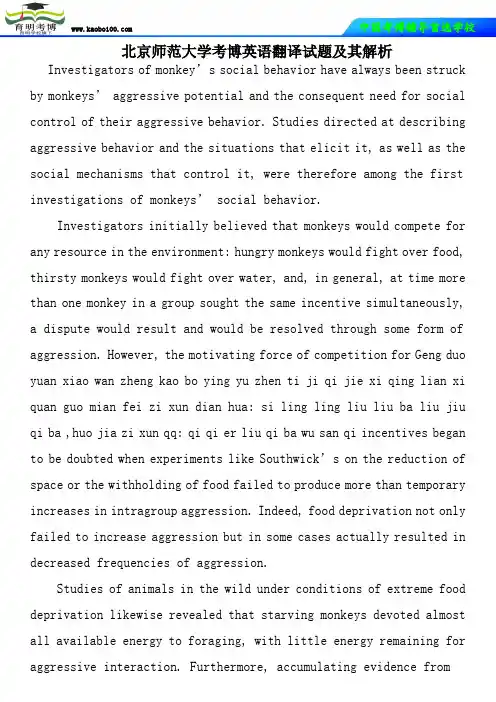
北京师范大学考博英语翻译试题及其解析Investigators of monkey’s social behavior have always been struckby monkeys’aggressive potential and the consequent need for socialcontrol of their aggressive behavior.Studies directed at describingaggressive behavior and the situations that elicit it,as well as thesocial mechanisms that control it,were therefore among the firstinvestigations of monkeys’social behavior.Investigators initially believed that monkeys would compete forany resource in the environment:hungry monkeys would fight over food,thirsty monkeys would fight over water,and,in general,at time morethan one monkey in a group sought the same incentive simultaneously,a dispute would result and would be resolved through some form ofaggression.However,the motivating force of competition for Geng duoyuan xiao wan zheng kao bo ying yu zhen ti ji qi jie xi qing lian xiquan guo mian fei zi xun dian hua:si ling ling liu liu ba liu jiuqi ba,huo jia zi xun qq:qi qi er liu qi ba wu san qi incentives beganto be doubted when experiments like Southwick’s on the reduction ofspace or the withholding of food failed to produce more than temporaryincreases in intragroup aggression.Indeed,food deprivation not onlyfailed to increase aggression but in some cases actually resulted indecreased frequencies of aggression.Studies of animals in the wild under conditions of extreme fooddeprivation likewise revealed that starving monkeys devoted almostall available energy to foraging,with little energy remaining foraggressive interaction.Furthermore,accumulating evidence fromlater studies of a variety of primate groups,for example,the study conducted by Bernstein,indicates that one of the most potent stimuli for eliciting aggression is the introduction of an intruder into an organized group.Such introductions result in far more serious aggression than that produced in any other types of experiments contrived to produce competition.These studies of intruders suggest that adult members of the same species introduced to one another for the first time show considerable hostility because,in the absence of a social order,one must be established to control interanimal relationships.When a single new animal is introduced into an existing social organization,the newcomer meets even more serious aggression.Whereas in the first case aggression establishes a social order,in the second case resident animals mob the intruder,thereby initially excluding the new animal from the existing social unit.The simultaneous introduction of several animals lessens the effect,if only because the group divides its attention among the multiple targets.If,however,the several animals introduced a group constitute their own social unit,each group may fight the opposing group as a unit;but,again,no individual is subjected to mass attack,and the very cohesion of the groups precludes prolonged individual combat.The submission of the defeated group,rather than unleashing unchecked aggression on the part of the victorious group,reduces both the intensity and frequency of further attack.Monkey groups therefore seem to be organized primarily tomaintain their established social order rather than to engage in hostilities per se.1.The author of the text is primarily concerned with[A]advancing a new methodology for changing a monkey’s social behavior.[B]comparing the methods of several research studies on aggression among monkeys.[C]explaining the reasons for researcher’s interest in monkey’s social behavior.[D]discussing the development of investigators’theories about aggression among monkeys.2.Which of the following best summarizes the findings reported in the text about the effects of food deprivation on monkeys’behavior?[A]Food deprivation has no effect on aggression among monkeys.[B]Food deprivation increases aggression among monkeys because one of the most potent stimuli for eliciting aggression is the competition for incentives.[C]Food deprivation may increase long-term aggression among monkeys in a laboratory setting,but it produces only temporary increase among monkeys in the wild.[D]Food deprivation may temporarily increase aggression among monkeys,but it also leads to a decrease in conflict.3.The text suggests that investigators of monkeys’socialbehavior have been especially interested in aggressive behavior among monkeys because[A]aggression is the most common social behavior among monkeys.[B]successful competition for incentives determines the social order in a monkey group.[C]situation that elicit aggressive behavior can be studied in a laboratory.[D]most monkeys are potentially aggressive,yet they live in social units that could not function without control of their aggressive impulses.4.The text supplies information to answer which of the following questions?[A]How does the reduction of space affect intragroup aggression among monkeys in an experimental setting?[B]Do family units within a monkey social group compete with other family units for food?[C]What are the mechanisms by which the social order of an established group of monkeys controls aggression within that group?[D]How do monkeys engaged in aggression with other monkeys signal submission?5.Which of the following best describes the organization of the second paragraph?[A]A hypothesis is explained and counter evidence is described.[B]A theory is advanced and specific evidence supporting it iscited.[C]Field observations are described and a conclusion about their significance is drawn.[D]Two theories are explained and evidence supporting each of them is detailed.[答案与考点解析]1.【答案】D【考点解析】本题是一道中心主旨题。
2003年考博英语题
历年考博英语题2003年一、Directions:21. ____ for the timely investment from the general public, our company would not be so thriving.A. Had it not beenB. Be it notC. Were it notD. Should it not be答案:A. Had it not been22. There have been numerous novel _____ in the curriculum of the university this semester.A. inspirationB. innovationC. intersectionD. irrigation答案:B. innovation23. The teacher said the most important thing is to construct a_____ argument in writing a paper.A. colonialB. closetC. coherentD. cautious答案:C. coherent24. In the early times, people had the_____ that the sun moved round the earth.A. notationB. notionC. junctionD. inflation答案:B. notion25. It’s difficult to break down the ______ which separates different classes.A. badgeB. bandageC. bronzeD. bruise答案:A. badge26. Having no job and no children, the old woman had to live on the _____ allowance.A. miseryB. misfortuneC. militantD. miserly答案:D. miserly27. The professor can hardly find sufficient grounds ____his arguments in favor of the new theory.A. which to base onB. to base on whichC. on which to baseD. which to be based on答案:C. on which to base28. There is a real possibility that these animals could be frightened, ____a sudden loud noise.A. being thereB. should be thereC. there wasD. there having been答案:B. should be there29. The monument is ____ to the memory of soldier killed in the defence of the countryA. dedicatedB. delegatedC. degeneratedD. degraded答案:A. dedicated30. As long as we maintain independence and keep the ___in our own hands, we may be successful.A. narrativeB. initiativeC. authoritativeD. cumulative答案:B. initiative31. An urgent social challenge in the future will be to ensure that science and technology develop ____ in this direction.A. inclusivelyB. cohesivelyC. exclusivelyD. emperically答案:C. exclusively32. They lose their way in the forest, and ____ made matter worse was that night began to fall.A. thatB. whatC. itD. which答案:B. what33. The success of some of the most important concepts in physics was_____ to these mathematical systems.A. obligedB. distributedC. contributedD. attributed答案:D. attributed34. The western culture has pervaded every aspect of our daily life, and this ____ will change our outlook and way of life.A. by turnsB. at every turnC. in turnD. in return答案:D. in return35. Ocean don’t ____ divide the world____ unite it ; they serve to unite countries rather than to divide them.A. as much…asB. so much…asC. as many…asD. as well…as答案:B. so much…as36. It will be safer to walk on the streets without carrying large amounts of cash; virtually all financial___ will be conducted by computer.A. transmissionsB. transformationsC. transactionsD. transitions答案:C. transactions37. One of the responsibilities of the Coast Guard is to make sure that all ships ____ follow traffic rules in busy harbors.A. skillfullyB. safelyC. obedientlyD. currently答案:C. obediently38. The rive is already ___ its banks of excessive rainfall, and the city is threatened with a likely flood.A. flush withB. level inC. flat onD. parallel to答案:A. flush with39. Nowadays advertising costs are no longer in reasonable____ to the total cost of the product.A. connectionB. correspondenceC. correlationD. proportion答案:D. proportion40. The survival____ of some wild animals is not very high as they are ruthlessly hunted for their skins.A. rateB. degreeC. ratioD. scale答案:A. rate二、Reading comprehension41. Carnegie was able to develop his vast industrial fortune_____.A. with the act of five enterprise system.B. through large loans from the American government.C. because the American government had special tariffs to protect the American steel and iron industry.D. because he had relatives in the English steel industry.答案:C. because the American government had special tariffs to protect the American steel and iron industry.42. Carnegie followed his ancestors’ footsteps______.A. by developing a large industrial company.B. in caring for and improving benefits for the worker and the poor.C. by furthering Spencer’s Philosophy.D. by being a follower of social Darwinism.答案:B. in caring for and improving benefits for the worker and the poor.43. The industry Carnegie was not concerned with was______.A. the manufacturing steelB. the transporting of the finished product.C. the movement of raw materialsD. the lumber business答案:D. the lumber business44. Carnegie’s trips to England_____.A. were poorly for pleasure and visiting relatives.B. introduced him to charitist ideals which would influence his life.C. helped him gain steel contracts with the British industrialists.D. led him to believe that the industrial future would be with steel.答案:D. led him to believe that the industrial future would be with steel.45. which happened first?A. The foundation of the Carnegie Steel Co.B. the introduction of charitist idealsC. the foundation of the J.Edgar Thomson Steel Mills.D. Andrew Carnegie’s trips to Great Britain.答案:B. the introduction of charitist ideals46. we may conclude from the passage that a painting by an artist who has been influenced by other artists______.A. might be called an example of craft , not art.B. must be considered an imitation ,not an original work.C. might still be considered an original work.D. cannot properly be rated on an “originality scale”答案:C. might still be considered an original work.47. The author specifically mentions his dissatisfaction with the fail of dictionaries to______.A. distinguish clearly between art and craft.B. indicate that originality is a matter of degreeC. recognize that a reproduction may be true artD. mention that a work of art must be original答案:B. indicate that originality is a matter of degree48. The author suggests that an “originality scale” might be used to_____.A. distinguish an original work from a copy.B. determine the artistic greatness of a workC. show that originality is always relativeD. explain the difference between art and craft答案:C. show that originality is always relative49. According to the author, the aim of the artist and the aim of the craftsman are ____.A. quite different from one anotherB. more or less practical in natureC. both basically artisticD. difficult to define答案:D. difficult to define50.which of the following statement would the author be least likely to make in talking about a great painting?A. the painter is more than a good craftsmanB. the painting has considerable artistic significanceC. the painting has a strange, unusual qualityD. the painters owe nothing to other painters答案:D. the painters owe nothing to other painters51. people turn their eyes eagerly to the sea____.A. to look for cheap oilB. with a strong wish to take out more oil out of it bottomC. to enjoy their artificial islandsD. to try to find the best site for storing their oil products答案:B. with a strong wish to take out more oil out of it bottom52. the distinguishing feature of the Selmer method is______.A. that the concrete platform legs are cast at an angleB. that the mold is raised on jacksC. that the jack will be built in the concrete and form part of the leg being castD.that the mold can be constructed at an incline of up to 15 degrees答案:C. that the jack will be built in the concrete and form part of the leg being cast53. in order to increase the stability of a deep sea production platform each of its reinforced concrete legs should be made____.A. inclined outwards at an angle of up to 15degrees with the vertical lineB. inclined outwards at an angle of up to the sea levelC. inclined inwards at an angle of up to 15degrees with the vertical lineD. inclined inwards at an angle of up to the sea level答案:D. inclined inwards at an angle of up to the sea level54. slip casting is a construction technique______.A. which is invented by Ingenior F.Selmer A/S of OsloB. which is otherwise called the Selmer methodC. which is used to solely to produce large-scale tripod-legged platformsD. which is widely used in reinforced concrete work答案:B. which is otherwise called the Selmer method55. the advantage of the Selmer method over other methods in building oil production platform is ______.A. that the construction work can be cheaper and easierB. that the platform can last safely through the severest ocean stormsC. that the platform can operate at a greater depthD. both B and C答案:A. that the construction work can be cheaper and easier56. this article ______.A. describes the origin of a concept which is a part of our hesitage.B. explains the reasons behind the loyalty oathC. opposes the law which requires a witness to tell the truthD. explains why a man should be forced to testify against himself.答案:A. describes the origin of a concept which is a part of our hesitage.57. Lilburne refused to testify at his own trial because he______.A. was unwilling to testify on matter s of which he was accusedB. believe he would be forced to testify about crimes not charged against him.C. was really guiltyD. was innocent of the charge答案:B. believe he would be forced to testify about crimes not charged against him.58. the immunity from testifying against oneself_____A. did not become law until the Bill of Right was writtenB. became law in the nineteenth centuryC. was common in England before the end of seventeenth centuryD. is a universally accepted law答案:C. was common in England before the end of seventeenth century59. as a result of Lilburne’s claim_______A. a man cannot testify in his own defenseB. a man is protected from furnishing evidence against himselfC. a man is considered guilty until he is proven innocentD. the accused cannot be tried twice for the same crime答案:B. a man is protected from furnishing evidence against himself60. which of the following is implied in the passage?A. the oath which one takes to tell the truth was used against the accused with devastating effectB. the Fifth Amendment is a hindrance to law enforcementC. we owe some of our liberties to the courage of unknown men.D. Lilburne was guilty.答案:C. we owe some of our liberties to the courage of unknown men.61. the languages of uncivilized groups as compared to Western languages are limited in ______.A. sound patternsB. vocabulariesC. grammatical structuresD. both B and C答案:B. vocabularies62.The author says that professional linguists recognize that_______.A. western languages are superior to Eastern languagesB. all languages came from grunts and groansC. the hierarchy of languages is difficult to understandD. there is no hierarchy of languages答案:D. there is no hierarchy of languages63. the article states that grunt-and-groan forms of speech are found____.A. nowhere todayB. among the Australian aboriginesC. among Eastern culturesD. among people speaking “backward” languages答案:A. nowhere today64. According to the author, languages, whether civilized or not, have _____.A. the potential for expanding vocabularyB. their own sound patternsC. an ability to transfer idealsD. grammatical structure答案:A. the potential for expanding vocabulary65.which of the following is implied in the passage?A. the study of languages has discredited anthropological studiesB. the study of language has reinforced anthropologists in their view that there is no hierarchy among cultureC. the study of language is the same as the study of anthropologistsD. the study of language casts a new light upon the claim of anthropologists答案:B. the study of language has reinforced anthropologists in their view that there is no hierarchy among culture66. by diverting some or all of the money spent on preparations for war to peaceful purpose, all of the following would occur EXCEPT____A. taxes would be reduceB. education could be improvedC. science could be focused on improving human welfareD. the population explosion could be controlled答案:D. the population explosion could be controlled67. Schools at present time often have to make use of_____A. untrained teachersB. poor buildingsC. lies to promote hatred of possible enemiesD. a tiny fraction of the missiles答案:C. lies to promote hatred of possible enemies68. the problem of undernourishment will become more critical because______.A. there is inadequate shippingB. of the population explosionC. of lack of irrigationD. the American surplus will be used up in the relief of famine答案:B. of the population explosion69. in the first paragraph, “predicament”means_____.A. predictionB. expenditureC. difficultyD. investment答案:C. difficulty70. the adjective that best describes this author is ______A. pessimisticB. pragmaticC. utopianD. radical答案:B. pragmatic71. this piece of writing is ____-.A. preface to a course bookB. a professor’s advice to teachersC. the record of an introductory speechD. from a school announcement答案:A. preface to a course book72. to read this book______.A. previous courses in chemistry are necessaryB. a good mastery of biochemistry is essentialC. one needn’t have studied chemistry beforeD. one must first review his high school courses答案:C. one needn’t have studied chemistry before73. the author feels that previous books for a similar course_____A. are too simpleB. are unbalancedC. are full of mistakesD. are too difficult答案:B. are unbalanced74. in the author’s experience, the students are most interested in______A. inorganic chemistryB. organic chemistryC. biochemistryD. chemistry as a whole答案:C. biochemistry75. paragraph 4 suggests that one thing characteristic of this book is its____A. simplicity in presentationB. vividness of the languageC. thoroughness in the fieldD. adaptation to various needs答案:D. adaptation to various needs三、translation1. I give my boss a printout of the data I have entered so that he can check for errors。
北京师范大学博士入学英语试题与答案详解(2012年)
北京师范大学2012年博士入学英语试题与答案详解一、试题部分Part I: Listening Comprehension(略)Part:Reading ComprehensiveDirections: There are six passages in this part. Each of the passages is followed by five questions or unfinished statements. For each of them there are four choices marked A,B,C and D. Choose the best one and mark your answer on the ANSER SHEET.Passage OneIn 1900 the United States had only three cities with more than a million residents-New York, Chicago, and Philadelphia. By 1930,it had ten giant metropolises. The newer ones experienced remarkable growth, which reflected basic changes in the economy.Line the population of Los Angeles(114000 in 1900)rose spectacularly in the early decades of the twentieth century, increasing a dramatic 1400 percent from 1900 to 1930.A number of circumstances contributed to the meteoric rise of Los Angeles. The agricultural potential of the area was enormous if water for irrigation could be found, and the city founders had the vision and dating to obtain it by constructing a 225-mile aqueduct, completed in 1913, to tap the water of the Owens River. The city had a superb natural harbor, as well as excellent rail connections. The climate made it possible to shoot motion pictures year-round; hence Hollywood. Hollywood not only supplied jobs; it disseminated an image of the good life in Southern California on screens all across the nation. The most important single industry powering the growth of Los Angeles, however, was directly linked to the automobile. The demand for petroleum to fuel gasoline engines led to the opening of the Southern California oil fields, and made Los Angeles North America's greatest refining center.Los Angeles was a product of the auto age in another sense as well: its distinctive spatial organization depended on widespread private ownership of automobiles. Los Angeles was a decentralized metropolis, sprawling across the desert landscape over an area of 400 square miles. It was a city without a real center. The downtown businessdistrict did not grow apace with the city as a whole, and the rapid transit system designed to link the center with outlying areas withered away from disuse. Approximately 800,000 cars were registered in Los Angeles County in 1930, one per 2.7 residents. Some visitors from the east coast were dismayed at the endless urban sprawl and dismissed Los Angeles as a mere collection of suburbs in search of a city. But the freedom and mobility of a city built on wheels attracted floods of migrants to the city.21. What is the passage mainly about?( )A. The growth of cities in the United States in the early 1900'sB. The development of the Southern California oil fieldsC. Factors contributing to the growth of Los AngelesD. Industry and city planning in Los Angeles22. The author characterizes the growth of new large cities in the United States after 1900 as resulting primarily from ( )A. new economic conditionsB. images of cities shown in moviesC. new agricultural techniquesD. a large migrant population23. The word "meteoric" in line 6 is closest in meaning to ( )A. rapidB. famousC. controversialD. methodical24. According to the passage, the most important factor in the development of agriculture around Los Angeles was the ( )A. influx of "new residents to agricultural areas near the cityB. construction of an aqueductC. expansion of transportation facilitiesD. development of new connections to the city's natural harbor25. The visitors from the east coast mentioned in the passage thought that Los Angeles ( )A. was not accurately portrayed by Hollywood imagesB. lacked good suburban areas in which to liveC. had an excessively large populationD. was not really a single cityPassage TwoImagine eating everything delicious you want with none of the fat. That would be great , wouldn’t it?New “fake fat” products appeared on store shelves in the United Stat es recently, but not everyone is happy about it. Makers of the products, which contain a compound called olestra, sayfood manufacturers can now eliminate fat from certain foods, Critics, however, say that the new compound can rob the body of essential vitamins and nutrients and can also cause unpleasant side effects in some people. So it is up to consumers to decide whether the new fat-free products taste good enough to keep eating.Chemists discovered olestra in the late 1960s, when they were searching for a fat that could be digested by infants more easily. Instead of finding the desired fat, the researchers created a fat that can’t be digested at all.Normally, special chemicals in the intestines “grab” molecules of regular fat and break them down so they can be used by the body. A molecule of regular fat is made up of three molecules of substances called fatty acids.The fatty acids are absorbed by the intestines and bring with them the essential vitamins A, D, E and K. When fat molecules are present in the intestines with any of those vitamins, the vitamins attach to the molecules and are carried into the bloodstream.Olestra, which is made from six to eight molecules of fatty acids, is too large for the intestines to absorb. It just slides through the intestines without being broken down. Manufacturers say it’s that ability to slide unchanged through the intestines that makes olestra so valuable as a fat substitute. It provides consumers with the taste of regular fat without any bad effects on the body. But critics say olestra can prevent vitamins A, D, E, and K from being absorbed. It can also prevent the absorption of carotenoids, compounds that may reduce the risk of cancer, heart disease, etc.Manufacturers are adding vitamins A, D, E and K as well as carotenoids to theirproducts now. Even so, some nutritionists are still concerned that people might eat unlimited amounts of food made with the fat substitute without worrying about how many calories they are consuming.26. We learn from the passage that olestra is a substance that ( )A. contains plenty of nutrientsB. renders foods calorie-free while retaining their vitaminsC. makes foods easily digestibleD. makes foods fat-free while keeping them delicious27. The result of the search for an easily digestible fat turned out to be ( )A. commercially uselessB. just as anticipatedC. somewhat controversialD. quite unexpected28. Olestra is different from ordinary fats in that ( )A. it passes through the intestines without being absorbedB. it facilitates the absorption of vitamins by the bodyC. it helps reduce the incidence of heart diseaseD. it prevents excessive intake of vitamins29. What is a possible effect of olestra according to some critics? ( )A. It may impair the digestive system.B. It may affect the overall fat intake.C. It may increase the risk of cancer.D. It may spoil the consumers’ appetite.30. Why are nutritionists concerned about adding vitamins to olestra? ( )A. It may lead to the over-consumption of vitamins.B. People may be induced to eat more than is necessary.C. The function of the intestines may be weakened.D. It may trigger a new wave of fake food production.Passage ThreeA “scientific” view of language was dominant among philosophers and linguistswho affected to develop a scientific analysis of human thought and behavior in the early part of this century. Under the force of this view, it was perhaps inevitable that the art of rhetoric should pass from the status of being regarded as of questionable worth (because although it might be both a source of pleasure and a means to urge people to right action, it might also be a means to distort truth and a source of misguided action) to the status of being wholly condemned. If people are regarded only as machines guided by logic, as they were by these “scientific” thinkers, rhetoric is likely to be held in low regard; for the most obvious truth about rhetoric is that it speaks to the whole person. It presents its arguments first to the person as a rational being, because persuasive discourse, if honestly conceived, always has a basis in reasoning. Logical argument is the plot, as it were, of any speech or essay that is respectfully intended to persuade people. Yet it is a characterizing feature of rhetoric that it goes beyond this and appeals to the parts of our nature that are involved in feeling, desiring, acting, and suffering. It recalls relevant instances of the emotional reactions of people to circumstances—real or fictional—that are similar to our own circumstances. Such is the purpose of both historical accounts and fables in persuasive discourse:they indicate literally or symbolically how people may react emotionally, with hope or fear, to particular circumstances. A speech attempting to persuade people can achieve little unless it takes into account the aspect of their being related to such hopes and fears.Rhetoric, then, is addressed to human beings living at particular times and in particular places. From the point of view of rhetoric, we are not merely logical thinking machines, creatures abstracted from time and space. The study of rhetoric should therefore be considered the most humanistic of the humanities, since rhetoric is not directed only to our rational selves. It takes into account what the “scientific” view leaves out. If it is a weakness to harbor feelings, then rhetoric may be thought of as dealing in weakness. But those who reject the idea of rhetoric because they believe it deals in lies and who at the same time hope to move people to action, must either be liars themselves or be very naive;pure logic has never been a motivating force unless it has been subordinated to human purposes, feelings, and desires, and thereby ceasedto be pure logic.31. According to the passage, to reject rhetoric and still hope to persuade people is( )A. an aim of most speakers and writers.B. an indication either of dishonesty or of credulity.C. a way of displaying distrus t of the audience‘s motives.D. a characteristic of most humanistic discourse.32. It can be inferred from the passage that in the late nineteenth century rhetoric was regarded as ( )A. the only necessary element of persuasive discourse.B. a dubious art in at least two ways.C. an outmoded and tedious amplification of logic.D. an open offense to the rational mind.33. The passage suggests that a speech that attempts to persuade people to act is likely to fail if it does NOT ( )A. distort the truth a little to make it more acceptable to the audience.B. appeal to the self-interest as well as the humanitarianism of the audience.C. address listeners‘ emotions as well as their intellects.D. concede the logic of other points of view.34. Which of the following persuasive devices is NOT used in the passage?( )A. A sample of an actual speech delivered by an oratorB. The contrast of different points of viewC. The repetition of key ideas and expressionsD. An analogy that seeks to explain logical argument35. Which of the following best states the author‘s main point about logical argument?( )A. It is a sterile, abstract discipline, of little use in real life.B. It is an essential element of persuasive discourse, but only one such element.C. It is an important means of persuading people to act against their desires.D. It is the lowest order of discourse because it is the least imaginative.Passage FourExtraordinary creative activity has been characterized as revolutionary, flying in the face of what is established and producing not what is acceptable but what will become accepted. According to this formulation, highly creative activity transcends the limits of an existing form and establishes a new principle of organization. However, the idea that extraordinary creativity transcends established limits is misleading when it is applied to the arts, even though it may be valid for the sciences. Differences between highly creative art and highly creative science arise in part from differences in their goals. For the sciences, a new theory is the goal and end result of the creative act. Innovative science produces new propositions in terms of which diverse phenomena can be related to one another in more coherent ways. Such phenomena as a brilliant diamond or a nesting bird are relegated to the role of data, serving as the means for formulating or testing a new theory. The goal of highly creative art is very different: the phenomenon itself becomes the direct product of the creative act. Shakespeare's Hamlet is not a tract about the behavior of indecisive princes or the uses of political power, nor is Picasso's painting Guernica primarily a propositional statement about the Spanish Civil War or the evils of fascism. What highly creative artistic activity produces is not a new generalization that transcends established limits, but rather an aesthetic particular. Aesthetic particulars produced by the highly creative artist extend or exploit, in an innovative way, the limits of an existing form, rather than transcend that form.This is not to deny that a highly creative artist sometimes establishes a new principle of organization in the history of an artistic field: the composer Monteverdi, who created music of the highest aesthetic value, comes to mind. More generally, however, whether or not a composition establishes a new principle in the history of music has little bearing on its aesthetic worth. Because they embody a new principle of organization, some musical works, such as the operas of the Florentine Camerata, are of signal historical importance, but few listeners or musicologists would include these among the great works of music. On the other hand, Mozart's The Marriage of Figaro is surely among the masterpieces of music even though its modest innovationsare confined to extending existing means. It has been said of Beethoven that he toppled the rules and freed music from the stifling confines of convention. But a close study of his compositions reveals that Beethoven overturned no fundamental rules. Rather, he was an incomparable strategist who exploited limits--the rules, forms, and conventions that he inherited from predecessors such as Haydn and Mozart, Handel and Bach--in strikingly original ways.36.The author considers a new theory that coherently relates diverse phenomena to one another to be the ( )A. basis for reaffirming a well-established scientific formulation.B. byproduct of an aesthetic experience.C. tool used by a scientist to discover a new particular.D. result of highly creative scientific activity.37.The passage supplies information for answering all of the following questions EXCEPT: ( )A. Has unusual creative activity been characterized as revolutionary?B. Did Beethoven work within a musical tradition that also included Handel and Bach?C. Is Mozart's The Marriage of Figaro an example of a creative work that transcended limits?D. Who besides Monteverdi wrote music that the author would consider to embody new principles of organization and to be of high aesthetic value?38. The author regards the idea that all highly creative artistic activity transcends limits with--- ( )A. deep skepticismB. strong indignationC. marked indifferenceD. moderate amusement39. The author implies that an innovative scientific contribution is one that ( )A. is cited with high frequency in the publications of other scientistsB. is accepted immediately by the scientific community.C. does not relegate particulars to the role of data.D. introduces a new valid generalization.40. Which of the following statements would most logically conclude the last paragraph of the passage? ( )A. Unlike Beethoven, however, even the greatest of modern composers, such as Stravinsky, did not transcend existing musical forms.B. In similar fashion, existing musical forms were even further exploited by the next generation of great European composers.C. Thus, many of the great composers displayed the same combination of talents exhibited by Monteverdi.D. By contrast, the view that creativity in the arts exploits but does not transcend limits is supported in the field of literature.Passage FiveCultural norms so completely surround people, so permeate thought and action, that we never recognize the assumptions on which their lives and their sanity rest. As one observer put it, if birds were suddenly endowed with scientific curiosity they might examine many things, but the sky itself would be overlooked as a suitable subject; if fish were to become curious about the world, it would never occur to them to begin by investigating water. For birds and fish would take the sky and sea for granted, unaware of their profound influence because they comprise the medium for every fact. Human beings, in a similarly way, occupy a symbolic universe governed by codes that are unconsciously acquired and automatically employed. So much so that they rarely notice that the ways they interpret and talk about events are distinctively different from the ways people conduct their affairs in other cultures.As long as people remain blind to the sources of their meanings, they are imprisoned within them. These cultural frames of reference are no less confining simply because they cannot be seen or touched. Whether it is an individual neurosis that keeps an individual out of contact with his neighbors, or a collective neurosis that separates neighbors of different cultures, both are forms of blindness that limit what can be experienced and what can be learned from others.It would seem that everywhere people would desire to break out of the boundaries of their own experiential worlds. Their ability to react sensitively to a wider spectrumof events and peoples requires an overcoming of such cultural parochialism. But, in fact, few attain this broader vision. Some, of course, have little opportunity for wider cultural experience, though this condition should change as the movement of people accelerates. Others do not try to widen their experience because they prefer the old and familiar, seek from their affairs only further confirmation of the correctness of their own values. Still others recoil from such experiences because they feel it dangerous to probe too deeply into the personal or cultural unconscious. Exposure may reveal how tenuous and arbitrary many cultural norms are; such exposure might force people to acquire new bases for interpreting events. And even for the many who do seek actively to enlarge the variety of human beings with whom they are capable of communicating there are still difficulties.Cultural myopia persists not merely because of inertia and habit, but chiefly because it is so difficult to overcome. One acquires a personality and a culture in childhood, long before he is capable of comprehending either of them. To survive, each person masters the perceptual orientations, cognitive biases, and communicative habits of his own culture. But once mastered, objective assessment of these same processes is awkward since the same mechanisms that are being evaluated must be used in making the evaluations.41. The examples of birds and fish are used to ( )A. show that they, too, have their respective culturesB. explain humans occupy a symbolic universe as birds and fish occupy the sky and the seaC. illustrate that human beings are unaware of the cultural codes governing themD. demonstrate the similarity between man, birds, and fish in their ways of thinking42. The term "parochialism" (Line 3, Para. 3) most possibly means ( )A. open-mindednessB. provincialismC. superiorityD. discrimination43. It can be inferred from the last two paragraphs that ( )A. everyone would like to widen their cultural scope if they canB. the obstacles to overcoming cultural parochialism lie mainly in people’s habit ofthinkingC. provided one’s brought up in a culture, he may be with bias in making cultural evaluationsD. childhood is an important stage in comprehending culture44. Which of the following statements is TRUE according to the passage? ( )A. Individual and collective neurosis might prevent communications with others.B. People in different cultures may be governed by the same cultural norms.C. People’s visions will be enlarged if only they knew that cultural differences exist.D. If cultural norms are something tangible, they won’t be so confining.45. The passage might be entitled ( )A. How to Overcome Cultural MyopiaB. Behavioral Patterns and Cultural BackgroundC. Harms of Cultural MyopiaD. Cultural Myopia-A Deep-rooted Collective NeurosisPassage SixWhen you leave a job with a traditional pension, don't assume you've lost the chance to collect it. You're entitled to whatever benefit you've earned——and you might even be entitled to take it now. “A lot of people forget they have it, or they think that by waiting until they're 65, they'll have a bigger benefit,” says Wayne Bogosian, president of the PFE Group, which provides corporate pre-retirement education.Your former employers should send you a certificate that says how much your pension is worth. If it's less than $ 5,000, or if the company offers a lump-sum payout, it will generally close your account and cash you out. It may not seem like much, but $5,000 invested over 20 years at eight percent interest is $23,000. If your pension is worth more than $ 5,000, or your company doesn't offer the lump-sum option, find out how much money you're eligible for at the plan's normal retirement age, the earlier age at which you can collect the pension, the more severe penalty for collecting it early. You'll probably still come out ahead by taking the money now and investing it.What if you left a job years ago, and you're realizing you may have unwittingly left behind a pension? Get help from the Pension Benefit Guaranty Corporation. It has an online search tool that has helped locate $47 million in lost benefits for more than 12,000 workers.If you have a traditional pension, retiring early costs more than you might expect. Most people assume you take a proportional cut for leaving before your plan's normal retirement age. For example, you might think that if you need to accrue 30 years of service and you leave three years early, you'd get a pension 90 percent of the full amount. But that's not how it works. Instead, you take an actuarial reduction, determined by the employer but often around five percent a year, for each year you leave early. So retiring three years early could leave you with only 85 percent of the total amount.When you retire early with a defined-contribution plan, the problem is you start spending investments on which you could be earning interest. If you retire when you're 55, for example, and start using the traditional pension then, by age 65 you'll have only about half of what you would have had if you'd kept working until 65.46. When one leaves a job with a traditional pension, ( )A. he tends to forget that he has the pensionB. he has no right to ask for the pensionC. he'll have a bigger benefit than if he waits until the age of 65D. he has a specified worth of pension47. If one leaves early before his plan's normal retirement age, ( )A. he'll take 90 percent of the total amount of his pensionB. he'll have half of his pension paymentsC. he'll have his pension payment reduced by 5% a yearD. he'll have only 85 percent of his full pension48. If one retires early with a defined-contribution plan, he is expected to ( )A. earn less interest.B. be better off than with a traditional pension.C. start investment immediately.D. get less Social Security benefits.49. Which of the following can be used as the subtitle for the last three paragraphs?( )A. Your Payout Is Not Guaranteed.B. The Retirement Dilemma.C. Leave Early, Lose Big.D. Take the Pension with You.50. Which of the following is NOT true? ( )A. If one leaves 3 years early on a 30-year-service basis, he won't get a pension worth 27/30ths.B. It pays to get an early retirement if one understands how retirement pension plan works.C. The Pension Benefit Guaranty Corporation helps the retiree to recover last benefits.D. If one keeps his expenses within his retirement framework, he won't be severely affected.Part III. Translation and WritingPart A TranslationTranslate the following into Chinese:Blacks have traditionally been poorly educated -- look at the crisis in urban public schools -- and deprived of the sorts of opportunities that create the vision necessary for technological ambition. Black folkways in America, those unspoken, largely unconscious patterns of thought and belief about what is possible that guide aspiration and behavior, thus do not encompass physics and calculus. Becoming an engineer -- unlike becoming a doctor or a lawyer or an insurance salesman -- has not been seen as a way up in the segregated black community. These folkways developed in response to very real historical conditions, to the limited and at best ambivalent interactions between blacks and technology in this country. Folkways, the "consciousness of the race," change at a slower pace than societal conditions do -- and so a working strategy can turn into a crippling blindness and self-limitation.Translate the following into English:“失落之城”马丘比丘坐落在秘鲁热带山地森林,直到1911 年才被美国探险家海勒姆-宾厄姆发现。
北京师范大学考博英语真题常见的一些代词及其用法
北京师范大学考博英语真题常见的一些代词及其用法连接代词:连接代词包括who,whom,whose,what,which,that。
其中除what外,其他连接代词也可作关系代词,其区别在于连接代词引导的是主语从句、宾语从句、表语从句和同位语从句等名词性从句,而关系代词引导的是定语从句。
(一)引导主语从句例句:That the sun and not the earth is the center of our planetary system was a difficult concept to grasp in the Middle Ages.分析:该句是复合句,that the sun and not the earth is the center of our planetary system在句中充当主语。
译文:太阳是我们行星系的中心(而不是地球)这一概念在中世纪是很难让人明白的。
需要各大院校历年考博英语真题及其解析请加扣扣七七二六七八五三七或二八九零零六四三五一,也可以拨打全国免费咨询电话四零零六六八六九七八享受考博辅导体验。
例句:It may be said that the measure of the worth of any social institution is its effect in enlarging and improving experience;but this effect is not a part of its original motive.(2009年第46题)分析:该句是由转折连词but连接的并列句,其中第一个分句中it作形式主语,真正的主语是that the measure of the worth...,of any social institution是worth的后置定语,in enlarging and improving experience 是its effect的后置定语。
北京师范大学2008年考博英语真题和答案
2008年北京师范大学博士研究生入学考试英语试题SECTION IPart A1. Until the constitution is____, the power to appoint ministers will remain with the president.A) Corrected B) amended C) remedied D) revised2. Several experts have been called in to plan ____ for boating, tennis, refreshments and children’s games in the projected town park.A) equipment B)instruments C)implement D)facilities3. You can try ___with the landlord for more time to pay the money.A) pleading B) requesting C)demanding D)dealing4. His sprained ankle ____ his chances of wining the tournament.A) damaged B) broke C)ruined D)demolished5. When he realized he had been ____ to sign the contract by intrigue, he threaten to start legal proceedings to cancel the agreement.A) elicited B)excited C)deduced D)induced6. While attempting to look into the case, ____.A) he found it was difficult B)the case was difficultC) it happened that the case is difficult C) difficult as the case7. ____ you cannot pick me up at the airport, please call me immediately.A) in order that B)in the event that C)if only D)unless8. It is impossible that the brain, ____, will be replaced by computer.A) as we know B)which we know C)we know that D) we know9. it’s more difficult to solve a probl em than ____.A) a question is found B) finding a questionC) that of finding a question D) to find a question10. ____ in doing an examination, the time passed by quickly.A) Being absorbed B) Having been absorbedC) When they were absorbed D) Be absorbedPart B11. It is the interaction between people, rather than the events that occur in their lives, that are(is) the main focus of social psychology.12. Although we had been present at roughly the same time, Mr. Brown saw thesee) from the way I saw it.13. Should John resign and Henry succeed him, we would have had (would have) a more vigorous leadership.14. Historically, no artists have presented clearer or the more(more) complete records of the development of human culture than sculptors have.15. Although the police are given considerable authority by society to enforce its laws, they get a relatively low salary as compared with that of other occupational groups16. Thirteen hundred medical professionals, have been trained to treat drug dependency, attended the annual convention sponsored by a society.17. More than three years after moving from Australia to this remote point of England, we are still learning how things have done(are done) here.18. There that children in language classrooms learn foreign languages any better than adults in similar classroom situations.19. When he speaks at banquets, he makes a point of going into the kitchen and20. Other guests at yesterday’s opening, which was broadcast alive (live) by the radio station, included the princess and her husband.Part CScience writer must 21 information regarding scientific events. In this capacity, they make the information clearer and more understandable and help readersto coordinate fresh information 22 the knowledge they already have 23 they can relate it to personal circumstances. Science journalism also means making reader curious and entertaining them. Entertainment is the most successful didactic form. Journalists supply readers 24 material for further education and opinion-formation, because, in a society 25 terms like growth, market economy and full employment are filled with new meanings and basic technical innovation such as microelectronics and genetic engineering also makes 26 to the reader fields of knowledge hitherto 27 to him, conveys the fascination of science and 28 readers to follow discussions and controversies between experts.Do the popular science publications accomplish all this? If one analyzes the science magazines 29 to, one comes to the conclusion that science journalism has reached a high degree of maturity and finds the necessary reader 30.21. A. elect B. filter C. choose D. select22. A. to B. for C. with D. by23. A. so that B. in order that C. in the fact that D. on condition that24. A. for B. with C. on D. about25. A. on which B. by which C. in which D. of which26. A. access B. accessible C. accessary D. accessory27. A. know B. known C. unknow D. unknown28. A. makes B. helps C. enables D. unable29. A. let B. referred C. related D. concerned30. A. acceptance B. to accept C. acceptable D. acceptantSECTION IIPassage 1In the late 20th century, information has acquired two major utilitarian connotations. On the one hand, it is considered an economic resource, somewhat on par with other resources such as labor, material, and capital. This view stems from evidence that the possession, manipulation, and use of information can increase thecost-effectiveness on many physical and cognitive processes. The rise in information-processing activities in industrial manufacturing as well as in human problem solving has been remarkable. Analysis of one of the three traditional divisions of the economy, the service sector, shows a sharp increase in information-intensive activities since the beginning of the 20th century. By 1975 these activities accounted for half of the labor force of the United States, giving rise to the so-called information society.As an individual and societal resource, information has some interesting characteristics that separate it from the traditional notions of economic resources. Unlike other resources, information is expansive, with limits apparently imposed only by time and human cognitive capabilities. Its expansiveness is attributable to the following: (1) it is naturally diffusive; (2) it reproduces rather than being consumed through use; and (3) it can be shared only, not exchanged in transactions. At the same time, information is compressible, both syntactically and semantically. Coupled with its ability to be substituted for other economic resources, its transportability at very high speeds, and its ability to impart advantages to the holder of information, these characteristics are at the base of such societal industries as research, education, publishing, marketing, and even politics. Societal concern with the husbanding of information resources has extended from the traditional domain of libraries and archives to encompass organizational, institutional, and governmental information under the umbrella of information resource management.The second perception of information is that it is an economic commodity, which helps to stimulate the worldwide growth of a new segment of national economies —the information service sector. Taking advantage of the properties of information and building on the perception of its individual and societal utility and value, this sector provides a broad range of information products and services. By 1992 the market share of the U. S. information service sector had grown to about $ 25 billion. This was equivalent to about one-seventh of the country’s computer market, which, in turn, represented roughly 40 percent of the global market in computers in that year.However, the probably convergence of computers and television (which constitutes a market share 100 times larger than computers) and its impact on information services, entertainment, and education are likely to restructure the respective market shares of the information industry before the onset of the 21st century.31. The first paragraph is mainly about ______.A) The remarkable rise in information-processing activities.B) a sharp increase in information-intensive activitiesC) information as an economic resourceD) the birth of information society32. which of the following is NOT a characteristic of information?A) information can be condensedB) information can be consumed through use.C) information can be shared by many peopleD) information can be delivered at very high speed33. The characteristics of information are ______ those of other economic resourcesA) same with B) different fromC) contrary to D) opposite to34. According to this passage, the market share of _______.A) the U.S. information service sector was equivalent to 40 percent of the global market shareB) the U.S. information service sector was about one-seventh of the global market shareC) computers in the United States had reached about $ 3.5 billion by 1992.D) computers in the United States is much smaller than that of television35. which would be the most appropriate title for the passage?A) information SocietyB) Characteristics of informationC) Two major utilitarian connotationsD) information as a Resource and commodityPassage 2Pity those who aspire to put the initials PhD after their names. After 16 years of closely supervised education, prospective doctors of philosophy are left more or less alone to write the equivalent of a large book. Most social-science postgraduates have still not completed their theses by the time their grant runs out after three years. They must then get a job and finish in their spare time, which can often take a further three years. By then, most new doctors are sick to death of the narrowly defined subject which has blighted their holidays and ruined their evenings.The Economic and Social Research Council, which gives grants to postgraduate social scientists, wants to get better value for money by cutting short this agony. It would like to see faster completion rates: until recently, only about 25% of PhD candidates were finish ing within four years. The ESRC’s response has been to stop PhD grants to all institutions where the proportion taking less than four years is below 10%; in the first year of this policy the national average shot up to 39%. The ESRC feels vindicated in its toughness, and will progressively raise the threshold to 40% in two years. Unless completion rates improve further, this would exclude 55 out of 73 universities and polytechnics-including Oxford University, the London School of Economics and the London Business School.Predictably, howls of protest have come from the universities, who view the blacklisting of whole institutions as arbitrary and negative. They point out that many of the best students go quickly into jobs where they can apply their research skills, but consequently take longer to finis their theses. Polytechnics with as few as two PhD candidates complain that they are penalized by random fluctuations in student performance. The colleges say there is no hard evidence to prove that faster completion rates result from greater efficiency rather than lower standards or less ambitious doctoral topics.The ESRC thinks it might not be a bad thing if PhD students were more modest in their aims. It would prefer to see more systematic teaching of research skills and fewer unrealistic expectations placed on young men and women who are undertakingtheir first piece of serious research. So in future its grants will be given only where it is convinced that students are being trained as researchers, rather than carrying out purely knowledge-based studies.The ESRC can not dictate the standard of thesis required by external examiners, or force departments to give graduates more teaching time. The most it can do is to try to persuade universities to change their ways. Recalcitrant professors should note that students want more research training and a less elaborate style of thesis, too.36. By the time new doctors get a job and try to finish their theses in spare time .A) their holidays and evenings have been ruined by their jobs.B) most of them are completely tired of their subjectC) most of them have got some fatal diseasesD) most of their grants are running out37. Oxford University would be excluded out of those universities that receive PhD gr ants from ESRC, because the completion rate of its PhD students’ theses within four years is lower than _______A) 25% B) 39% C) 55% D) 10%38. Which is not arguments against ESRC’s policy ?A) All the institutions on the blacklist are arbitrary and negative, which will inevitably result in howls of protests.B) Faster completion rates may result from lower standards or less ambitious doctoral topics rather than efficiency.C) it takes some good students longer to finish their theses because they go more quickly into jobs where they can apply their research skills.D. polytechnics students’ performances vary unpredictably and penalty based on theses completion rate is not justified.39. The ESRC would prefer _______A) that PhD students were less modest in their aimsB) that more students were carrying out knowledge-based studiesC) more systematic teaching of research skillsD) higher standards of PhD students’ these and more ambitious doctoral topics40. what the ESRC can do is to _____A) force departments to give graduates more teaching timeB) try to persuade universities to change their waysC) dictate the standard of thesis required by external examinersD) notify students they want less elaborate style of thesisPassage 3Practically speaking, the artistic maturing of the cinema was the single-handed achievement of David W. Griffith (1875-1948). Before Griffith, photography in dramatic films consisted of little more than placing the actors before a stationary camera and showing them in full length as they would have appeared on stage. From the beginning of his career as a director, however, Griffith, because of his love of Victorian painting, employed composition. He conceived of the camera image as having a foreground and a rear ground, as well as the middle distance preferred by most directors. By 1910 he was using close-ups to reveal significant details of the scene or of the acting and extreme long shots to achieve a sense of spectacle and distance. His appreciation of the camera’s possi bilities produced novel dramatic effects. By splitting an event into fragments and recording each from the most suitable camera position, he could significantly vary the emphasis from camera shot to camera shot.Griffith also achieved dramatic effects by means of creative editing. By juxtaposing images and varying the speed and rhythm of their presentation, he could control the dramatic intensity of the events as the story progressed. Despite the reluctance of his producers, who feared that the public would not be able to follow a plot that was made up of such juxtaposed images, Griffith persisted, and experimented as well with other elements of cinematic syntax that have become standard ever since. These included the flashback, permitting broad psychological and emotionalexploration as well as narrative that were not chronological, and the crosscut between two parallel actions to heighten suspense and excitement. In thus exploiting fully the possibilities of editing, Griffith transposed devices of the Victorian novel to film and gave film mastery of time as well as space.Besides developing the cinema’s language, Griffith immensely broadened its range and treatment of subjects. His early output was remarkably eclectic: it included not only the standard comedies, melodramas, westerns, and thrillers, but also such novelties as adaptations from Browning and Tennyson, and treatments of social issues. As his successes mounted, his ambitions grew, and with them the whole of American cinema. When he remade Enoch Arden in 1911, he insisted that a subject of such importance could not be treated in the then conventional length of one reel. Griffith’s introduction of the American-made multi-reel picture began an immense revolution. Two years later, Judith of Bethulea, an elaborate historic philosophical spectacle, reached the unprecedented length of four reels, or one hour’s running time. From our contemporary viewpoint, the pretensions of this film may seem a trifle ludicrous, but at the time it provoked endless debate and discussion and gave a new intellectual respectability to the cinema.41. the suthor suggests that Griffith film innovations had a direct effect on all of the following EXCEPT ______A) film editing B) camera work C) scene composing D) sound editing42. it can be inferred from the passage that passage that before 1910 the normal running time of a film was _____.A) 15 minutes or less B) between 15 and 30 minutesC) between 30 and 45 minutes D) between 45 minutes and 1 hour43. it can be inferred from the passage that Griffith would be most likely to agree with which of the following statements?A) the good dirctor will attempt to explore new ideas as quickly as possibleB) the most important element contributing to a film’s success is the ability ofthe actorsC) the camera must be considered an integral and active element in the creatin of a filmD) the cinema should emphasize serious and sober examinations of funfamental human problems.44. the author’s attitude toward photography in the cinema befo re Gritffith can best be described as ______.A) sympathetic B) nostalgic C) amused D) condescending45. the primary purse of the passage is to _______A) discuss the importance of Griffth to the development of the cinemaB) describe the impact on cinema of the flashback and other editing innovationsC) deplore the state of American cinema before the advent of GritffithD) analyze the changes in the cinema brought by the introduction of the multi-reel filmPassage 4In the early 1950’s historians who stu died pre-industrial Europe (which we may define here as Europe in the period fro, roughly 1300 to 1800) began, for the first time in large numbers, to investigate more of the pre-industrial European population than the 2 or 3 percent who comprised the political and social elite: the kings, generals, judges, nobles, bishops and local magnates who had hitherto usually filled history books. One difficulty, however, was that few of the remaining 97 percent recorded their thoughts or had them chronicled by contemporaries. Faced with this situation, many historians based their investigations on the only records that seemed to exits: birth, marriage, and death records. As a result, much of the early work on the non-elite was aridly statistical in nature; reducing the vast majority of the population to a set of numbers was hardly more enlightening than ignoring them altogether. Historian still did not know what these people thought or felt.One way out of this dilemma was to turn to the records of legal courts for here the voices of the non-elite can most often be heard, as witnesses, plaintiffs, anddefendants. These documents have acted as “a point of entry into the mental world of the poor.” Historians such as Le Roy Ladurie have used the documents to extract case histories, which have illuminated the attitudes of different social groups (these attitudes include, but are not confined to, attitudes toward crime and the law) and have revealed how the authorities administered justice. It has been societies that have had a developed police system and practiced Roma law, with its written depositions, whose court records have yielded the most data to historians. In Anglo-Saxon countries hardly any of these benefits obtain, but it has still been possible to glean information from the study of legal documents.The extraction of case histories is not, however, the only use to which court record may be put. Historians who study pre-industrial Europe have used the records to establish a series of categories of crime and to quantify indictments that were issued over a given number of years. This use of the records does yield some information about the non-elite, but this information gives us little insight into the mental lives of the non-elite. We also know that the number of indictments in pre-industrial Europe bears little relation to the number of actual criminal acts, and we strongly suspect that the relationship has varied widely over time. In addition, aggregate population estimates are very shaky, which makes it difficult for historians to compare rates of crime per thousand in one decade of the pre-industrial period with rates in another decade. Given these inadequacies, it is clear why the case history use of court records is to be preferred.46. which of the following did most historians who studied pre-industrial Europe do before the early 1950’s, according to the author?A) they failed to make distinctions among members of the pre-industrial European political.B) they used investigatory methods that were almost exclusively statistical in nature.C) they inaccurately estimated the influence of the pre-industrial European political and social elite.D) they confined their work to a narrow range of the pre-industrial European population.47. it can be inferred from the passage that much of the early work by historians on the European non-elite of the pre-industrial period might have been more illuminating if these historians had ____A) used different methods of statistical analysis to investigate the non-eliteB) been more successful in identifying the attitudes of civil authorities, especially those who administered justice, toward the non-eliteC) been able to draw on more accounts written by contemporaries of the non-elite that described what these non-elite thoughtD) relied more heavily on the personal records left by members of the European political and social elite who lived during the period in question48. the author mentions Le Roy Ladurie(in paragraph 2) in order to ________A) given a example of a historian who has made one kind of use of court recordsB) cite a historian who has based case histories on the birth, marriage, and death records of the non-eliteC) gain authoritative support for the view that the case history approach is the most fruitful approach to court records.D) point out the first historian to realize the value of court records in illuminating the beliefs and values of the non-elite49. According to the passage, which of the following is true of indictments for crime in Europe in the pre-industrial period?A) they have, in terms of their numbers, remained relatively constant over timeB) their problematic relationship to actual crime has not been acknowledged by most historians.C) they are not a particularly accurate indication of the extent of actual criminal activity.D) their importance to historians of the non-elite has been generally overestimated.50. the passage would be most likely to appear as part of _____A) a book review summarizing the achievements of historians of the European aristocracyB) an essay describing trends in the practice of writing historyC) a textbook on the application of statistical methods in the social scienceD) an article urging the adoption of historical methods by the legal profession. SECTION IIIPart AMany people in industry and the Services, who have practical experience of noise, regard any investigation of this question as a waste of time; they are not prepared even to admit the possibility that noise affects people. On the other hand, those who dislike noise will sometimes use most inadequate evidence to support their pleas for a quieter society. This is a pity, because noise abatement really is a good cause. and it is likely to be discredited if it gets to be associated with bad science.What is needed in the case of noise is a study of large numbers of people living under noisy conditions, to discover whether they are mentally ill more often than other people are. The United States Navy, for instance, recently examined a very large number of men working on aircraft carriers: the study was known as Project Anehin. It can be unpleasant to live even several miles from an aerodrome. But neither psychiatric interviews nor objective tests were able to show any effects upon these American sailors. This result merely confirms earlier American and British studies: if there is any effect of noise upon mental health it must be so small that present methods of psychiatric diagnosis cannot find it. That does not prove that it does not existPart B1. 科学技术是第一生产力。