
仁爱版八年级英语上册Unit3Topic1SectionA
学习目标
• 1. 掌握粗体部分的新单词,以及词组 • 2. 学会表达自己的爱好的词组。 • 3. 记熟表达自己兴趣爱好的句型,
• • • • • • • • • •
New words and phrases: hobby [`hɔbi]业余爱好 poem [`pəuim]诗 recite poems 背诗 maybe [`meibi:]adv.也许 pet[pet]宠物 walk a pet dog 遛狗 collect [kə`lekt]收集 collect stamps集邮 plant [plɑ:nt] n.植物; vt.种植 plant flowers / plant trees 种花、植树 be interested in 对……感兴趣 be fond of 喜欢
4. I like ________ sleeping . 5. I like ______ poems . reciting
6. I am fond of______ . acting
7. I ______ preferplaying soccer.
自学指导
1.朗读1a对话 2.在P55-56中划出下列短语并翻译 go fishing____________read stories________ • recite poems_________ fly kites__________ • walk a pet dog _______collect stamps _______ • climb mountains _____ go traveling_________ • plant flowers ________go swimming_________ • go to the movie theater ______________ • What’s your hobby?______________ • What do you often do in your free time? ______
maybe是副词,意为“可能”“大概”,一般用在句首 。
4. (2)change (名词)改变 ;零钱 eg: Here’ s your change. 给你的零钱。 武平发生了很大的变化。 Great changes took place in WuPing.
Listen to 1a and choose the correct answer.
in his free time / in his spare time 我经常在空闲时间去旅游。 I often go traveling
____________________________. in my free time/in my spare time
Key points:
2, a lot
W
H
go to the movie theater
H
love reciting poems
W
enjoy listening to music watch DVDs at home
H
A. walk a pet dog B. listen to music C. collect stamps 4 D. plant flowers E. climb mountains F. fly kites G. go traveling 6 H. go swimming
New words
1, hobby [`hɔbi]业余爱好 my hobby 我的爱好 张志文的爱好是睡觉。
Zhang Ziwen`s hobby is sleeping.
刘文杰的爱好是钓鱼。
Liu Wenjue`s hobby is going fishing.
李源的爱好是读书和听音乐。
Li Yuan`s hobbies are reading books and listening to music.
I can use:
喜欢做…… … love doing … … like doing … … enjoy doing … … prefer doing … 喜欢做某事,都是V-ing
… be fond of doing …
… be interested in doing …
一共6种表达
I can say:
New words
6,be fond of (doing) [fɒnd] 喜欢 江尚豫喜欢英语。 Jiang Shangyu is fond of English. 我喜欢读书。 I am fond of reading books.
New words
7,pet [pet] n. 宠物 一只宠物狗 a pet dog 溜宠物狗 walk a pet dog be interested in/fond of 张海洋喜欢溜宠物狗。 Zhang Haiyang is interested in walking a pet dog. Zhang Haiyang is fond of walking a pet dog.
Collecting different expressions with similar meanings will help you in your talking and writing.
2. I am interested in _______________ playing basketball .
Watch the flash of 1a, then write H for Helen’s hobbies and W for Wen Wei’s . Then write the phrase for each picture.
视频1a-P55
W
go fishing enjoy reading stories
许多,大量 放在动词后 a lot = very much 他告诉我许多关于他的业余爱好。 a lot about his hobbies. He had told me ___________ 拓展: a lot of / lots of a lot of=lots of表示”许多的“, 可以修饰可数名词复数和不可数名词。 放在名词前
Why not go out and do some outdoor activities? Maybe I need a change.
New words
8, collect [kə`lekt] vt. 收集 收集邮票;集邮 collect stamps 叶楚敏喜欢集邮。 be interested in/fond of Ye Chumin is interested in collecting stamps. Ye Chumin is fond of collecting stamps. 9,plant [plɑ:nt] n.植物; vt.种植(过去式:planted ) plant flowers / plant trees 种花、植树
New words
5, be interested in (doing) 对…感兴趣,喜欢… 陈锦慧对英语感兴趣。 Chen Jinhui is interested in English. 笑笑和妙妙都喜欢听音乐 。 Xiao Xiao and Miao Miao are interested in listening to music.
What are Helen and Wen Wei talking
about ? B. ★
A. Going to the movie theater.
Their hobbies.
C. Outdoor activities.
Read 1a and fill in the blanks. Helen and Wen Wei are talking about fishing their hobbies. Wen Wei enjoys ______, reading stories and listening _______ to music. He gets great ____ fun from these activities. reciting poems and Helen enjoys _________ watching _________ movies. She goes to the movie theater a lot and also _______ rents DVDs ________ and watches them at home.
根据图片说英语词组
fly kites
go swimming
go hiking
plant flowers
listen to music
read books
1. What do you often do in your free time ?
在你的空闲时间你经常干什么?
在某人的空闲时间
in one’s free time Eg. e time
What do you often do in your free time?
在你的空闲时间你经常干什么?
I often go fishing.
Hobbies
collect stamps walk listen a topet music dog climb mountains
What does she/he often do in her /his free time? She /He often…
3, Why not go out and do some outdoor activities ? do some outdoor activities 做些户外活动
Why not do sth 为什么不…(用于提建议)
Eg. 赵狄诺你为什么不去钓鱼呢? Why not go fishing Zhao Dinuo ? 谢燊明为什么不听听音乐呢? Why not listen to music Xie Shenming ?
仁爱版八年级英语上册 Unit 3 Topic 1 Section A 课件(共21张PPT)全
7. I _pr_ef_er___ playing soccer.
Summarize the ways of talking about hobbies!
1. I love singing and playing the guitar. 2. I am interested in playing basketball. 3. I enjoy dancing to music. 4. I like sleeping. 5. I like reciting poems. 6. I am fond of acting. 7. I prefer playing soccer.
different hobbies. I like…
Different ways of talking about hobbies:
…love/enjoy/like/prefer/am interested in/am fond of …
Written work
提升练习
Use the sentence patterns we just have learned to write a passage about your group members’ hobbies.
视频1a-P55
go fishing
enjoy reading stories
go to the movie theater
love reciting poems enjoy listening to music watch DVDs at home
Read 1a and fill in the blanks.
1. I love _si_ng_in_g___and playing the guitar.
仁爱版八年级上英语Unit3Topic1练习题
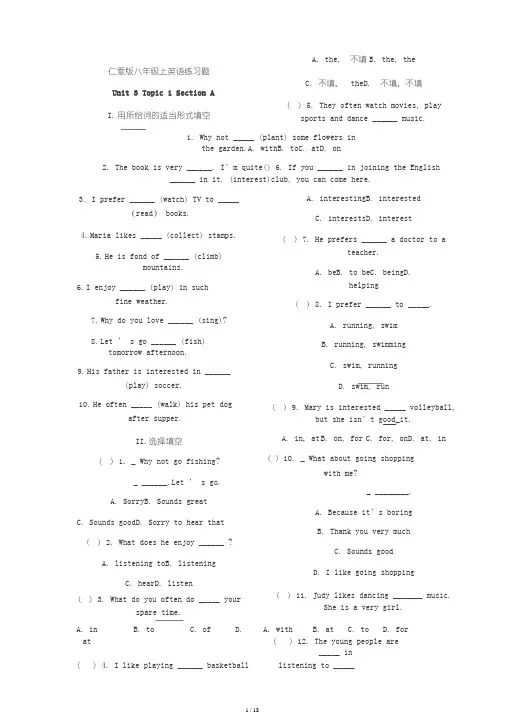
仁爱版八年级上英语练习题Unit 3 Topic 1 Section A I.用所给词的适当形式填空A. the, 不填B. the, theC. 不填,theD. 不填,不填( ) 5. They often watch movies, play sports and dance ______ music.1. Why not _____ (plant) some flowers inthe garden.A. withB. toC. atD. on2. The book is very ______. I’m quite() 6. If you ______ in joining the English______ in it. (interest)club, you can come here.3. I prefer ______ (watch) TV to _____(r ead) books.4.Maria likes _____ (collect) stamps.5.He is fond of ______ (climb)mountains.6.I enjoy ______ (play) in suchfine weather.7.Why do you love ______ (sing)?8.Let ’ s go ______ (fish)tomorrow afternoon.9.His father is interested in ______(play) soccer.10.He often _____ (walk) his pet dogafter supper.II.选择填空( ) 1. _ Why not go fishing?_ ______.Let ’ s go.A. SorryB. Sounds greatC. Sounds goodD. Sorry to hear that( ) 2. What does he enjoy ______ ?A. listening toB. listeningC. hearD. listenA. interestingB. interestedC. interestsD. interest( ) 7. He prefers ______ a doctor to ateacher.A. beB. to beC. beingD.helping( ) 8. I prefer ______ to _____.A. running, swimB. running, swimmingC. swim, runningD. swim, run( ) 9. Mary is interested _____ volleyball,but she isn’t good_it.A. in, atB. on, forC. for, onD. at, in ( ) 10. _ What about going shoppingwith me?_ ________.A. Because it’s boringB. Thank you very muchC. Sounds goodD. I like going shopping( ) 3. What do you often do _____ yourspare time. ( ) 11. Judy likes dancing _______ music.She is a very girl.A. inB. toC. ofD. A. with B. at C. to D. for at ( ) 12. The young people are_____ in( ) 4. I like playing ______ basketball listening to _____but stories.I don ’ t enjoy playing _____piano. A. interest,interestingB. interesting, interestingC. interested, interestD. interested, interesting( ) 13. Tim enjoys ______, But Tomprefers ______ sports.A. swimming, playingB. swimming, playC. to swim, to playD. swimming, playing( ) 14. My brother is interested _____playing sports.A. onB. inC. toD. at( ) 15. What things does he love____?A. listen toB. listeningC. listenD. listening to()16.Why _____ go out for a walkaftersupper?A. notB. didn ’ tC.doesn ’ tD.don’t()17.______ is myfavorite.A. Play basketballB. Listen to musicC. Playing the pianoD. Playing the soccer( ) 18. What does he do _____ hersparetime?A. onB. inC. forD. of( ) 19. _ Would you like _____shoppingwith me?_ I ’ d love to.A. goB. goesC. to goD.goingA. askB. to askC. askingD.asked( ) 21. Mr. Smith is fond of _____.A. travelB. to traveledC.traveling D. traveled( ) 22. ______ I am wrong.A. MaybeB. May beC. MayD. Can( ) 23. He used to ______ mountains.A. climbB. climbsC.climbing D. climbedIII.根据首字母及提示完成句子1.These paintings are very v ______.2.He often goes f ______ with hisfather on weekends.3.Liu Fang likes c ______ stampsvery much.4.My brother u ______ to get up early.5.Most boys are i ______ in playing sports.6.I often go to the movie theater in my s______ time.7.Would you like t p _______ flowerswith me?V.完型填空We oftenliketo 1 this game inourclassroom. We sitin acircle 2ourchairs.Theteachergives 3of us abigredflower.Theteachersays,“ Begin!He”beats a drum and the students pass the flower4one student’hands5anotherstudent ’ s hand very quickly. Theflower goes round and round the circle.Then the teacher says, “ 6 ! ”He stopsbeating the drum.And the student who has the flower7his hand is going to the middle of the circle to() 20. Why not _____ her to come?---8 a song or say somethinginteresting to9! After that we are going tobegin the10again.( ) 1.A. take B. doC. playD. make( ) 2. A. down B. on C. around D.at( ) 3. A. each B. ones C. every D. one( )4. A. from B. of C. inD.to( ) 5. A. for B. with C. to D. on( ) 6. A. BeginB.Start C. End D.Stop( ) 7. A. at B. on C. inD. with( ) 8. A. sing B. make C. say D. hear( ) 9. A. them B. her C. us D. him( )10. A. class B.game C. song D.flowerVI.短文填空A hobby is an interesting way of doing what you like in your s____ time.There are so many d_____ hobbies for different people to choose. Some hobbies are very popular, while others are quite u_____. You may choose one for yourself that you are mosti____.You may enjoy c_____ things, such as stamps, foreign coins, etc. If you like to work w_____ your hands, you may enjoy paper cutting( 切割 ) and model m_____. Or you may enjoy creative(有创造的 ) hobbies, like planting. Many people prefer the activities o_____ totheactivities inside, like sailing, ridingand so on, which they can enjoy withothers.W_____ you live, there is always a hobby for you to choose. The hobby willgive you many hours of pleasure and makeyour s_____ time interesting.I.根据首字母及提示完成句子1.I often go climbing in my s_____ time.2.Playing basketball every day is my______ (爱好)3. I’m very busy so I don’t have time to doany o______ activities.4.We can learn a lot about people,history and s______.5.She u______ to be very shy.6.I used to listen to rock music,but now I h______ it. I p______light music.7.We don ’ t have enough books. Twostudents have to s_____ one.8.We can learn a lot about people,history and s_____ events from stamps.9.The old paintings are of great v____.10.People ’ s estsinter are c_____all the time.II.用所给词的适当形式填空1.Let ’ s go ______ (swim).2.He used to ______ (watch) TVevery evening.3.I hated _____ (live) in the city.4. The film is very ______ (interest). I’m______ (interest) in it.5.Collecting coins is ______ (value).6.Going skating in winter must be great_____ (funny).7.Keeping pets can keep people _____(happiness).8.What are your _____ (hobby).9.The little boy is _____(interest) in playing sports.10.My mother often teaches me ____ Unit 3 Topic 1 Section B_____ Russian.11.Nobody teaches _____ English.He teaches _____. (he)12.One of the _____ (sing) was verygood.III.句型转换1.You must be right. ( 改为否定句 )2.People have hobbies because hobbiescan bring them knowledge.(提问)3.I like swimming better than climbing mountains. (改为同义句)4.Her father is fond of fishing. (改为同义句)5.In the past, he was a historyteacher. (改为同义句)6.My hobby is collecting telephonecards.(提问)7.She is having a walk with a pet dogright now. (改为同义句)8.We often learn some knowledge fromhis talking. ( 改为否定句 )9.Nobody teaches me English. Iteach myself. (改为同义句)10.I used to go swimming duringthe summer vacation.(改为一般疑问句)11.His paintings are very beautiful.(改为同义句)12.Some of them are very valuable.(改为同义句)13.Her hobby is climbing mountains.(提问)14.Glad to meet you. (改为同义句)15.In the past, the old man was ahistory teacher.16.He used to go swimming in theriver. ( 改为否定句 )17.She used to get up early in the morning.(改为一般疑问句)V.根据汉语提示完成句子1.我过去对绘画知之甚少I used to ______ _______ _______paintings.2.比起打篮球,我更喜欢在教室看书I prefer ______ books in the classroom to______ basketball.3.多么漂亮的邮票啊_______ _______ stamps!4.我的兴趣一直在变化My ______ are changing ______ ____________.5.集邮肯定很有趣______ stamps ______ ______ great funVI.选择填空( ) 1. _____ great fun!A. What aB. WhatC. How aD. How( ) 2.Kang Kang used _____ soccerbutnow he does ’ t.A.playing B. to playC. playsD. played( ) 3. _ _________._ I used to collect stamps.A. What do you use to do?B. What did you used to do?C. What did you use to do?D. What did you use to?( ) 4. They all had _____ atJim ’ sbirthday party.A. funB. a funC. funsD. funny( ) 5. Some stamps are of great____.So collecting stamps is greatfun.A. valuableB. valueC.valued D. valuing( ) 6. Hobbies can _____ ushappiness,friendship and knowledge, so we have hobbies.A. tooB.bringC.get D.take( ) 7. I never see ______.A. such a beautiful placeB. such beautiful a placeC. such beautiful placedD. such a beautiful places( ) 8. Some people like _____ pets,_____dogs, cats andpigs.A. keep, such asB. to keep, suchC. keeping, suchD. keeping, such as() 9. _ Who taught you to ride abike?_ ______. I taught myself.A. AnybodyB. SomeoneC. NobodyD. Somebody( ) 10. My mother ______ me _____cooknoodles yesterday.A. taught, forB. taught, toC. teaches, /D. teach, to( ) 11. Collecting stamps can help melearn _____.A. a lotB. a lot ofC.little D. many() 12. Don ’ t ask me togo. I’ mnot interested _____.A. inallB. after allC. atall D. ofall( ) 13. I used to know _____ about soccer,but now I never miss any important soccer games.A. a lotB. fewC. muchD. little( ) 14. Oh dear, you walked such a longway on such a hot day. You ____be very tired.A. canB. mustC. mayD.should( ) 15. There _____ a tall tree behind thehouse.A. used to havingB. use to beingC. used to beD. used to have( ) 16. Let Harry play with your toys.Clare, you must learn to ______.A. supportB. careC. shareD. spareVII.找出与 I 栏相应的答语I() 1. Pleased to see you( ) 2. Do you enjoy reciting poems?( ) 3. Is Wang Lingling fond ofdancing?( ) 4. Did Sellina use to eat vegetables?( ) 5. She usedn’t to play sports.( ) 6. Collecting stamps must be greatfun!( ) 7. This book is of great value. ( ) 8. Why do you like collecting dolls?( ) 9. What’s your hobby?( ) 10. My daughter is interested inlearning English.IIA. Keeping a pet dog.B. But now she does.C. Yes, it’s very valuable.D. Yes, she is.E. It certainly is.F. Yes, I do.G. No, she didn’t.H. That’s goodI. Because they are very cute.J. Glad to meet you.Unit 3 Topic 1 Section CI.用所给单词的适当形式填空1.This is a _____ (day) newspaper andyou can read it every day.2.She used _____ (keep) a pet dog.3.Hobbies gives us _____ (happy) and_____ (friend).4.I love collecting _____ (paint),because they are very beautiful.5.The girl is really clever. Sheteaches_____ (her) to dance. No one teachesher.6.I used to _____ (shop) with my mother.7.Mr. Ming teaches _____ (he)English every day.8._____ (watch) TV too much is badfor your health.9.Listening to music can bring us _____(happy).10.I often help my mother do some______(clean).11.What about _____ (drink) aglass of milk?12.Hobbies can bring us _____(knowledge)13.Do you like collecting _____ (paint)14.Hobbies can help people relax after their_____ (day) work.II.完成下列各句的翻译1.爱好帮助人们在日常的工作之后放松心情。
仁爱版八年级英语Unit 3Topic 1 Section A 说课稿
仁爱版八年级英语Unit 3Topic 1 Section A 说课稿各位读友大家好,此文档由网络收集而来,欢迎您下载,谢谢仁爱版八年级英语Unit3Topic1SectionA说课稿定安县实验中学陈英兰我说课的内容是仁爱版教材八年级英语(上册)第三单元TopicI中的SectionA。
这一单元描述hobbies,每个话题都是与学生日常生活息息相关的内容。
第一话题Ilovecollectingstamps不单是谈论有关集邮方面的爱好,还有听音乐、做运动等。
这极大地丰富了同学们的业余生活,通过谈论彼此的兴趣爱好,既学到了知识,又加深了师生之间的感情。
下面,我将从本节课的指导思想,教学目标。
重难点的确立与突破,教学过程设计等几方面简单加以阐述:一、指导思想:从新课标的理念出发,贯彻面向全体学生,以学生的终身发展为本的指导思想。
对原教材内容重新加以处理。
力求对教学过程精心设计,采用任务型教学途径,全方位调动学生学习英语的积极性,培养他们的综合语言运用能力。
二、教学目标依据课标要求,根据本课的教学内容,针对八年级学生的特点及认知规律,确定本节的教学目标为:1、知识与技能目标:①学会关于兴趣、爱好方面的词汇②了解感叹句③能够运用语言谈论自己及他人的兴趣和爱好。
2、情感目标:有兴趣听英语、说英语、唱歌曲、做游戏,乐于模仿,敢于开口,积极参与,团结协作。
3、学习策略目标:能热情地与他人合作。
共同完成学习任务;主动向老师和同学请教;注意力集中;积极地运用所学英语进行表达和交际。
三、教学重点及难点1、教学重点:学生能够运用各种方式谈论兴趣、爱好、并初步认识感叹句2、教学难点:usedto的用法四、教学过程1、课前热身,师生同唱一首歌:(调动学生的积极性,拉近师生的距离)(热身)Themorewegettogether2、复习love,like,prefer,enjoy+v-ing 结构,为新课作准备①教师简介家人的兴趣爱好mysisterlikesdancing,butshedoesn’tlovesinging,②师生对话谈论喜欢做的事情,反复应用whatdoyoulove/like/enjoy/preferdoing?巩固用法,增进师生间了解.3、导入:根据对话内容,教师表达SwimmingisA’’①大标题:学生猜出“hobby”含义,然后老师口述:IlikesingingandIalsoenjoyplayingtabletenn isSingingandplayingtabletennisareourhobb ies②小标题教师拿出部分收集的邮票,边让学生看,边表达,collectingstampsismyhobby,导入Topic1标题。
仁爱英语八年级上册Unit3,Topic1,SectionA公开课教案
T eaching Plan for Junior Eight,Unit3,T opic 3What were you doing at this time yesterdaySectionATime:1st,DecClass Four,Grade EightT eacher:Xiao Chunqing, Jinjiang First Middle SchoolⅠ.Teaching Objectives:1.Learn some new words:shower, radio, roast,duck,2. Learn the past continuous tense:(1) —What were you doing at this time yesterday?—I was taking a shower.(2) —What were you doing from seven to nine yesterday morning?—I was learning English.(3) —Were you playing computer games?—Yes, I was./No, I wasn’t.(4) What was he/she doing at nine o’clock last Sunday morning?3. Go on learning some useful expressions on making a telephone call:(1) This is Maria speaking.(2) May I speak to Jane?(3) Hold the line, please.Ⅱ. Teaching Important PointsThe past continuous tense.Ⅲ.Teaching Difficult Points(1).How to apply the past continuous tense flexibly to describe specific activities.(2).How to improve students’ oral English.IV. Teaching aidspictures/the tape recorder/slides/toy telephones/photosV. Teaching ProcedureStep 1 Review&Lead inShow the students some photos of their classmates.Ask the students to use the present continuous tense to answer the questions according to the pictures.After that,have a brainstorming to naturally transit to the past continuous tense.Step 2 Presentation1.Listen to the tape and answer the questions.2. Read after the tape,fill in the blanks and underline the important words,phrases and sentences.3. Give the students some minutes to read the dialogue by themselves and ask some students to act out the dialogue in pairs.Step 3 PracticeA guessing game.Ask the students to use their imagination to guess what was he/she doing in the pictures.Step 4 ConsolidationAsk and answer in pairs after the example.Step 5 SummaryLead the students to have a quick looking back on the teaching content in this period.Step 6 HomeworkMake a survey about your group members 'activities at different times last Sunday morning.Talk about it with your group members to find who has spent the most interesting Sunday and then report it to your class.Time What were you doing?7:00—8:00 a.m.8:00—9:00 a.m.9:00—10:00 a.m.10:00—11:00 p.m.Section BThe main activities are 1a, 1c and 2a. 本课重点活动是1a, 1c 和2a. Ⅰ.Teaching aims and demands 教学目标 1. Learn some new words and useful phrases:agree, pleasant, agree with sb., handsome, useful, sad, make faces, laugh 2. Learn some useful sentences: (1)I thought it was just so-so. (2)I thought he was very brave! (3)It ’s nothing serious.(4)Miss Wang was angry with me.3. Go on learning the past continuous tense:(1)—What were you doing at this time last night? —I was watching a Harry Potter movie.(2)Because I made faces and made my classmates laugh when she was giving us a lesson.(3)You weren ’t listening to the teacher.4. Learn to express agreement and disagreement: —I think classical music is pleasant. I agree with you. / Yes, I think so. I don ’t agree. / No, I don ’t think so. I think it ’s boring. Ⅱ. Teaching aids 教具—挂图/课件/录音机/小黑板/卡片Ⅲ. Five-finger Teaching Plan 五指教学方案Step 1 Review 第一步复习(时间:6分钟)通过创设情景,表演对话复习过去进行时,导入新课。
仁爱版八年级上册Unit3Topic1What’syourhobbySectionA优秀教学案例
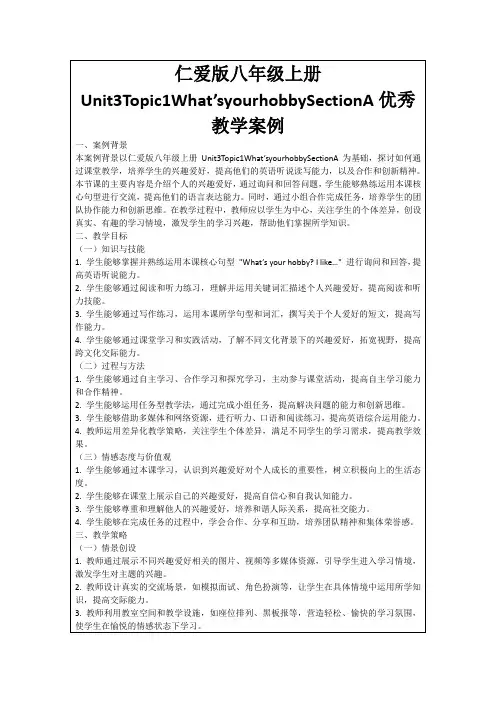
三、教学策略
(一)情景创设
1.教师通过展示不同兴趣爱好相关的图片、视频等多媒体资源,引导学生进入学习情境,激发学生对主题的兴趣。
2.教师设计真实的交流场景,如模拟面试、角色扮演等,让学生在具体情境中运用所学知识,提高交际能力。
仁爱版八年级上册Unit3Topic1What’syourhobbySectionA优秀教学案例
一、案例背景
本案例背景以仁爱版八年级上册Unit3Topic1What’syourhobbySectionA为基础,探讨如何通过课堂教学,培养学生的兴趣爱好,提高他们的英语听说读写能力,以及合作和创新精神。本节课的主要内容是介绍个人的兴趣爱好,通过询问和回答问题,学生能够熟练运用本课核心句型进行交流,提高他们的语言表达能力。同时,通过小组合作完成任务,培养学生的团队协作能力和创新思维。在教学过程中,教师应以学生为中心,关注学生的个体差异,创设真实、有趣的学习情境,激发学生的学习兴趣,帮助他们掌握所学知识。
(四)总结归纳
1.教师引导学生回顾本节课所学的知识和技能,帮助他们进行知识梳理和归纳。
2.教师通过提问和总结,强调本节课的重点和难点,确保学生能够理解和掌握。
3.教师给出本节课的课堂作业,让学生巩固所学知识,提高实际应用能力。
(五)作业小结
1.教师提醒学生按时完成作业,并强调作业的重要性,培养学生的自律和责任感。
3.教师鼓励学生提出问题,培养学生的批判性思维和独立思考能力,使学生在探究过程中不断成长。
(三)小组合作
1.教师将学生分成小组,根据小组特点和能力,分配不同难度的任务,使学生在合作中互补、共进。
2.教师指导学生明确分工,鼓励学生发挥各自优势,培养学生团队协作能力和责任意识。
仁爱版八年级英语上册Unit3Topic1SectionA教学设计

1.教师给出讨论话题,如:“What do you want to do in the future?”,让学生分组进行讨论。
2.学生在小组内运用本节课所学的词汇和语法,分享自己的未来计划,同时倾听他人的想法。
3.各小组选代表进行汇报,其他小组成员给予评价和反馈。
(四)课堂练习
1.教师设计不同类型的练习题,如填空、选择、改错等,让学生巩固所学知识。
5.家庭互动:鼓励学生与家人分享本节课所学内容,让家人参与讨论,共同完成一份关于家庭未来计划的短文。
6.预习作业:布置下一课时的预习任务,要求学生提前了解下节课的主题,预习相关词汇和语法,为课堂学习做好准备。
教师应在学生提交作业后,及时给予评价和反馈,鼓励学生发挥潜能,不断提高英语水平。同时,关注学生在作业中的表现,了解学生的学习需求,为下一节课的教学做好准备。
4.树立自信心,勇于表达自己的观点和需求,敢于面对挑战,克服困难。
二、学情分析
八年级学生经过前一阶段的学习,已经具备了一定的英语基础,包括词汇量、语法知识和听说读写技能。在此基础上,针对本章节的学习,学情分析如下:
1.学生在上一单元学习了描述人物特征、兴趣爱好等话题,为本章节讨论日常生活、工作和学习中的需求、喜好等打下良好基础。
2.安排口语练习,如角色扮演、小组讨论等,让学生在实际语境中运用所学词汇和语法。
3.针对不同学生的学习需求,提供分层练习,使每位学生都能在练习中找到适合自己的难度。
(五)总结归纳
1.教师引导学生总结本节课所学的词汇、语法和句型,巩固知识。
2.学生分享自己在课堂上的收获和感悟,提高课堂参与度。
3.教师对学生的表现给予评价和鼓励,强调学习英语的重要性,激发学生的学习动力。
仁爱版八年级英语上Unit3Topic1SectionA教学设计
3、情感态度与价值观
1)、能够与同伴积极合作,参与课堂活动,大胆实践,共同完成学习任务。
2)、能形成广泛的兴趣爱好,活泼开朗的个性和对生活、未来的积极态度。
3)、学生在宽松活泼的课堂气氛中,始终保持着浓厚的学习兴趣,体会到学习英语与使用英语的成就感和乐趣,增强自信心。
5)、能在教师的指导下实行简单的采访活动并形成书面表达。
2、过程与方法
1)、学生积极主动参与各项课堂活动,利用观察、发现、分析、归纳等方法理解语言规律,边学边用,活学活用。
2)、学生采用自主学习和小组合作学习的方法并与小组合作伙伴使用角色扮演的方法熟练掌握课文对话。
3)、通过师生对话、两两对话、小组交流等形式让学生体验交际性英语教学过程,掌握英语听说的基本方法,体验合作学习的快乐。
2)、初始水平:此前学生已完成七年级上、下册以及八年级第一、二单元的系统学习。学生已有过学习、体会合作学习的经历,具有良好的合作意识和团队精神。喜欢游戏、比赛等多种刺激同时作用的学习方式。但是初二学生两极分化现象凸显,学习水平也参差不齐。
3)、信息素养:初二学生已经有了一定的信息素养,能够从书本、电视、网络等多种渠道获取信息,但信息的加工、提取、使用的水平还较弱。他们对感兴趣的事物有较强的获取信息的欲望。
number the pictures.
Check the answers
5. Lead the Ss to
read and master the
new phrases.
1. Think and guess
the meanings of new
phrasesaccording to
Unit1+Topic1+Section+A课件+2022-2023学年仁爱版八年级英语上册
[dʒɔɪn] v.
[tiːm] n.
practice ['præ ktɪs] v.
Before the game, we practiced quite a lot with
classmates.
[kwaɪt] adv.
Because we know practice makes perfect. (熟能生巧)
Listen again and mark T (True) or F (False). Circle the key words.
1. Michael is going to play football. ( )
2. Michael doesn’t like· playing basketball,
Many... are going to join the... We are going to practice...
Many students came and cheered us
on.
In the end(最后), we won the game. be going to+ V原形
—What are you going to do this weekend? —I’m going to...
同……进行一场篮球赛
1.Find more English words about sports.(积累生词:词义、音标)
2.Recite 1a. 3.Finish the workbook(SA)练习册。
2 Make a dialog with your partner, using the following sentences.
run-running ski-skiing(滑雪)
Unit 3 Topic 1 Section A 课件仁爱版英语八年级上册
4. I like
_s_l_ee_p_i_n_g_.
6. I am fond of____a_c_ti.ng
7. I _p_r_e_f_e_r playing soccer.
love doing sth like doing sth enjoy doing sth prefer doing sth be interested in be fond of
6
What are their hobbies? 录音3a-P56
collect stamps
walk a pet dog listen to music climb moutains
A7
B3
F1
C5
plant flowers go travling go swimming fly kites
D2
S2: I love/like/enjoy/prefer/am interested
in/am fond of ...
S2:What do you often do in your free time?
S1: I often...
walk a pet dog plant flowers go traveling
2
n.业余爱好;嗜好 hobby [ˈhɒbi]
v.背诵;朗诵
recite [rɪˈsaɪt]
n.诗;韵文
poem [ˈpəʊɪm]
adv.可能,或许
maybe ['meɪbi]
adj.喜爱的;爱好的 fond [fɒnd]
n.宠物;宝贝
pet
[pet]
v.收集;搜集
collect [kə'lekt]
仁爱版英语八年级上册Unit3topic1sectionA教学设计
1.教师引导学生总结本节课所学的重点知识,如一般现在时态的用法、新词汇和短语、重点句型等。
2.让学生分享在本节课中的收获和感悟,以及对未来学习的期望。
3.教师针对学生的总结进行补充和归纳,强调本节课的重点和难点,为课后复习和巩固提供指导。
五、作业布置
为了巩固本节课的学习成果,培养学生的自主学习能力,特布置以下作业:
-小组讨论:将学生分成小组,讨论并分享个人的日常活动,促使他们在实际语境中运用一般现在时态。
-角色扮演:设计情景剧,让学生扮演不同角色,通过角色扮演加深对重点词汇和句型的记忆。
-听力练习:播放与本节课话题相关的听力材料,让学生在听的过程中获取关键信息,提高听力理解能力。
2.创设真实语境,让学生在实践中突破难点。
4.利用多媒体教学资源,提高学生的学习兴趣和参与度。
-图片和视频:展示与话题相关的图片和视频,激发学生的学习兴趣,增强课堂教学的趣味性。
-互动游戏:设计互动游戏,让学生在游戏中巩固所学知识,提高学习效果。
5.加强课后跟踪评价,了解学生的学习效果,及时调整教学策略。
-课后作业:布置与课堂内容相关的作业,巩固学生对重点知识的掌握。
-家长与孩子共同完成一份关于家庭活动的英文海报,鼓励孩子运用所学知识,提高英语实际运用能力。
5.预习作业:
-预习下一课的内容,提前了解新词汇和短语,为新课的学习做好准备。
-尝试总结一般现在时态的用法,为新课的学习打下基础。
2.学会使用一般现在时态描述个人的日常活动和习惯,如:“I go to school by bus every day.”
3.能够理解和运用本课中的重点句型,如:“What do you usually do in the morning?”, “I usually have breakfast and read English.”