
北师大版(2019)英语必修 第三册 Unit 8 Green Living-Lesson 3 “White Bikes” on the Road 课件
Exercise
2. The house will look bright with white _pa_i_n_t. The old man asked, “Who _p_a_in_t_e_d all these on my wall?”
Exercise
3. You should wash your cup and p_l_a_c_e it on the table. This is a great _p_l_ac_e_ for holiday.
Exercise
Complete the sentences with the correct form of the words from the words we just talked about. 1. Jason _p_ed_a_l_le_d_ down the road to his school. He put his foot down on the _p_e_d_a_l_s_.
Focus on language
… Back in the 1960s, a group of cycling fans painted hundreds of bikes white and placed them in many areas around Amsterdam to ... returned with a computer tracking system to record its every move ... the idea of “shared bikes” has now peddled its way around the world. I need a can of red paint.
Para. 1 Amsterdam — City of Bicycles Para. 2-5 Development
Para. 6 Future?
Read for specific information
Para. 2-4 Where did the idea of “white bikes” start? How has it been developing since then?
Where will bike-sharing go in China? You decide.
Read for deep understanding
Young people, such as the students, will determine how successful bike-sharing will be like in the future by deciding whether or not and how much they want to use it. Whether shared bikes will bring the most benefits to us depends on the action of everyone of us!
Dig deeper
What makes “white bikes” successful in Amsterdam?
Factors influencing bike-sharing: environment management technology morality/awareness
Where will bike-sharing go in China? You decide.
However, those bikes w__e_r_e_s_to_l_e_n_ within weeks!
In 1999, the shared bikes returned to Amsterdam with ac_o_m_p_u_t_e_r_tr_a_c_k_in__g_s_y_st_e_m_ to record its every move and were designed with b_r_i_g_h_t colors.T_h__a_n_k_s_t_o the effort of many people, the idea of “shared bikes” has now p_e_d_a_l_l_ed_ its way around the world.
government officials shared bike companies the general public …
Group work
What can they do to help bike-sharing go smoothly in Beijing?
Group A: government officials Group B: shared bike companies Group C: the general public Group D: …
Unit 8 Green Living Lesson 3 “White Bikes” on the
Road
Lesson 3 “White Bikes” on the Road Period 1
Warm up
• Have you tried shared bikes? • What are their advantages and disadvantages?
That’s all about …
Thanks for listening.
Dig deeper—discussion
Share with your partner: What does the writer mean by saying “Where will bike-sharing go in China? You decide.”?
starting point
problems
When
Where
consequ ences
When Where
…
•… •… • problem
Starting point
When Where
•… • consequence
•… •…
When Where
Group work
Suppose you are docents at the Museum of Shared Bikes, try to introduce the development of shared bikes to the visitors.
Exercise
Focus on language
… Back in the 1960s, a group of cycling fans painted hundreds of bikes white and placed them in mnaanmyeaorfeaans aorbojuecntd/aAtmhisntge?rdam to ... returned with a caonmapcuttioern?tracking system to record its every move ... the idea of “shared bikes” has now peddled its way around the world.
Word Builder
place paint track record move
return pedal
n. /ˈrekɔːd/
Verbs & Nouns
ilar words do you know?
benefit, transport, increase, …
convenient →popular
Read for general idea
• Check your prediction. • Choose the best title: A. Amsterdam — the City of Bicycles B. The Return of “White Bikes” C. “White Bikes” on the Road
Can you guess in which city the idea of “shared bikes” was born?
Read the 1st para. • Why was the idea born in this city?
flat parking places bicycle paths
Verbs or Nouns?
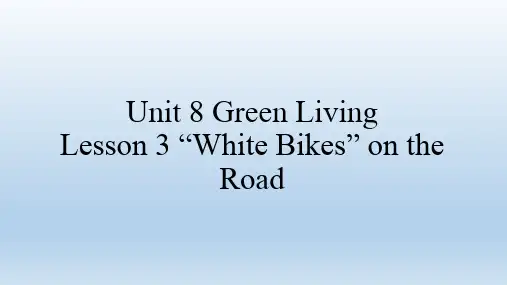
1. They placed them in many areas of Amsterdam. an action Leave the bike in place where you finish your journey. an object/a thing
2. … computer tracking system to record its every move! an object/a thing Please move it to a proper parking place.
Skill builder Understanding development of events Find the starting point of the events. Find when and where the events developed. Find the problems and consequences of the development.
Student A: Amsterdam Student B: in the 1960s Student C: 1999 Student D: nowadays
1. Refer to your flow chart; 2. Welcome to … To talk
about … we cannot miss Amsterdam because …
Lesson 3 “White Bikes” on the Road Period 2
Green+Living+Lesson+3+White+Bikes+on+the+Road+教学设计
北师大版(2019)必修第三册Unit 8 Green LivingLesson 3 White Bikes on the Road本节课的教材分析:本节课程是北师大版(2019)必修第三册Unit 8 Green Living Lesson 3 "White Bikes" on the Road。
该课程主要涉及到城市绿色出行和共享自行车这一主题。
教材主要包括一篇名为《白色自行车》的文章,内容介绍了荷兰阿姆斯特丹市的共享自行车项目和该项目对于城市居民的影响。
文章内容生动有趣,有助于激发学生对于绿色出行的兴趣,并了解共享自行车这一环保出行方式。
教学目标:1.了解共享自行车项目的背景和概述。
2.理解共享自行车对城市居民的影响。
3.讨论自行车共享项目可能带来的挑战和解决方案。
4.提高学生的阅读理解能力和跨文化交流能力。
教学重点:1.学习词汇和短语,如"green transport"、"cycle path"、"traffic congestion"等。
2.理解文章中的主要观点和细节。
3.讨论共享自行车项目的益处和挑战。
教学难点:1.帮助学生理解文章中的生词和复杂句子。
2.引导学生进行深入思考和讨论,增强其跨文化交流能力。
学情分析:学生为高一年级学生,已掌握了基本的英语词汇和语法知识。
他们对环保和城市生活问题有一定的了解。
然而,他们的阅读理解能力和跨文化交流能力有待提高。
因此,在教学过程中,需要适当辅助学生理解课文内容,培养他们的阅读和讨论能力。
教学策略:1.使用多媒体工具,如图片和视频,引入课题,激发学生的学习兴趣。
2.设计合作学习活动,提高学生的参与度和互动性。
3.鼓励学生自主思考和解决问题,培养其批判性思维和创新能力。
教学方法:1.预习导入:通过观看视频或图片,引导学生思考和讨论有关城市交通和环保的问题,激发学生的学习兴趣。
Unit 8 Green Living 大单元说课课件-高中英语北师大版(2019)必修第三册

A Survey Report(写 作,1课时)
6 教学过程
一 单元主题与内容:人与自然-环境保护
Topic Talk Lesson1 Roots and Shoots Lesson2 Greening the desert Lesson3 "White bikes" on the road Writing Workshop Viewing Workshop Reading Club1
4 教学重难点
教学重点
1.掌握与“绿色生活”有关的词汇与短语;了解 并运用非谓语作状语、表语、补语等。
2.获取、梳理、概括、整合“根与芽”组织、易 解放的故事、“阿姆斯特丹白色自行车”的发展 历程、共的基本结构,探究其与主 题意义的关联,批判、批评作者的观点,加深对 主题意义的理解。
(2)正确运用动词-ing形式和动词-ed形式、名动同形词,同源 同形词,使用正式语气的句型提出问题。
(3)完成一篇关于环境保护的调查报告。 (4)观看“太阳能”的视频,思考如何继续开发和利用太阳能。 (5)用本单元所学语言,表达自己的环保态度,思考可以采取 的措施。
素养目标:
(1)学习关于“绿色生活”的词汇和句型,名词,动词同形现象,学 会使用动词-ing形式和动词-ed形式定语,状语,表语和宾语补足语,了 解演讲稿和说明文的基本结构,读懂并能口头介绍“根与芽”组织,易 解放的故事,“白色自行车”的发展历程、共享单车的应用等。
Unit 8 Green Living
大单元说课PPT
汇报人:XXX
汇报时间:XXX
目录
1
文本分析
2
学情分析
新教材高中英语UNIT8GREENLIVINGLESSON3课件北师大版必修第三册
高中英语 必修第三册 UNIT 8 GREEN LIVING
◆单句写作 (1) Ms Li___h_a_s_ _c_o_m__e_ ___u_p__ ___w_i_th_(已经想出) a few songs to help the shy students with social dialogue. (2) The designer says he __c_a_m__e ___u_p__ __w_i_t_h_ (想出) the idea after watching people get wet on streets in Russia. (3) In order to finish the task on time,many pieces of good advice __c_a_m_e_ ___u_p__ (提出)at the meeting. (4) A great number of/A great many good ideas came u(p大量的好主意被提出来)at this education conference to improve the students’ study. ◆选词填空:come up/come up with (5) Your name came up in our conversation twice. (6) She came up with a few tips on a healthy diet.
高中英语 必修第三册 UNIT 8 GREEN LIVING
◆单句语法填空 (1) The train disappeared from view and I knew my best friend would never come back. (2) The image shows the gas,dust,and stars that swirl around the black hole before disappearing(disappear) into it. (3)[2017·全国Ⅲ卷]By the 1920s,wolves had practically disappeared (disappear) from the Yellowstone area. ◆单句写作 (4)_T_h_e_ir__m_ i_su_n_d_e_r_s_ta_n_d_in_g__d_is_a_p_p_e_a_re_d(他们的误解消除了) after a long talk. (5) She was amazed that the creature suddenly __d_is_a_p_p_ea_re_d__f_r_o_m__si_g_h_t_/v_i_e_w___ ( 从视线中 消失了). (6) The car finally _d_i_sa_p_p_e_ar_e_d____in_t_o__ __d_a_r_k_n_e_ss___ (消失在黑暗中).
北师大版(2019)英语必修-第三册-Unit-8-Green-Living-Lesson-3-“W
an object/a thing
… Back in the 1960s, a group of cycling fans painted hundreds of bikes white and placed them in many areas around Amsterdam to ...In 1999, the shared bikes returned with a computer tracking system to record its every move ...Thanks to the effort of many people, the idea of “shared bikes” has now pedalled its way around the world.
That’s all about …
Thanks for listening.
Dig deeper—discussion
Share with your partner: What does the writer mean by saying “Where will bike-sharing go in China? You decide.”?
convenient →popular
Read for general idea
• Check your prediction. • Choose the best title: • A.Amsterdam — the City of Bicycles • B.The Return of “White Bikes” • C. “White Bikes” on the Road
北师大版(2019)英语必修 第三册 Unit 8 Green Living Lesson 1 Ro
Unit8Green LivingLesson1Roots and Shoots【教学目标】Students will be able to1.read and talk about Roots&Shoots,an educational organisation2.read for general understanding3.read for specific information and answer questions on details4.learn about and practise parallel structures5.give a presentation about Roots&Shootsplete a summary of the text【教学重难点】1.reading for specific information2.giving a presentation about an educational organisation【教学过程】1.Pair Work:Talk about the pictures on page52.In pairs,students answer the three questions about the pictures.Remind students that there are consequences to every action.What are the consequences of each action in the pictures?2.Read the first paragraph and discuss.(1)Ask students to silently read the first paragraph of the text.(2)Encourage students to read for general understanding and to use context to understand difficult vocabulary.(3)In pairs,students discuss the three questions.Encourage students to underline the parts in the text that support their answers.(4)Review the answers as a class.3.Read the rest of the text and complete.(1)Discuss the table.(2)In pairs,students read the article and underline the general sentence for each paragraph.This will help students to better understand the text... (3) Then students use their understanding of the text to complete the table.(4) Review the answers as a class.4. Read again and answer.(1) Read the questions. Students try to recall the answers with reference to the text.(2) In small groups, students discuss the questions after reading the text.(3) Each group presents their group’s answers to the class and gathers any interesting ideas.5. Group Work: Present Roots & Shoots(1) In groups, students discuss the information on Roots & Shoots(2) A scribe can note information.(3) Groups can allocate one section to each member of the group, so they can give a jointpresentation.(4) Students can include other information or research.(5) Support low level students by providing sentence frames for them to complete in order toanswer the questions.(6) Each group presents their information.6. Group Work: Think and share.(1) In small groups, students scan the text for the first question to find examples to support theiranswers.(2) List the writing techniques found in the text, on the board: examples, repetition, quotations, acolloquial style.(3) Explain what colloquial style is, i.e., ordinary language used by common people in everydaylife which can convey the writer’s message more clearly.(4) Put students in small groups and allocate one technique to each student. They should then scanthe text to find at least one example. Have groups review their findings and then share their answerswith the class.(5) Help any struggling students by giving them the paragraph number where each example islocated.(6) Invite groups to work together on finding another title for the text and point out that it shouldbe a catchy one that would cause a reader to read the text. Hold a class vote on the best title.7. Group Work: Underline parallel structures and discuss why the writer uses them.(1) In groups, students analyse the use of words and syntax. Students underline each pattern in a.different color, e.g., “… say you leave the tap running while you brush your teeth” and “How can itmatter if I leave one little tap running”.(2) Using these examples, students discuss why the writer makes use of repetition.a. Does it help your understanding of the text if key phrases are repeated?b. How do you feel reading repeated words/phrases?8. Complete the summary.(1) Read sentence frames. Explain any difficult words.(2) Students complete the sentence frames with a phrase in the box. Students can scan the text tofind the information they need.(3) Invite students to work on their own and check the answers in pairs.(4) Check the answers this way as a class.9. Match words and functions.(1) Read the Grammar summary section on page 95. Explain that -ing and -ed form of verbs havevarious uses and go through the examples, ensuring that students understand different functions.(2) Point out that the difference between the adjective/attributive and the adjective/predicative isthat the former goes before the noun while the latter comes after a verb.(3) Read the text.(4) Allow students to independently match the words with the functions.(5) Review the answers in pairs and then as a class.10. Complete the text with the correct form of the verbs.(1) Students read the sentence frames. Then complete the spaces either with the - ing or -ed formof the given verbs.(2) Read out loud the text and pause before each space for students to call out the correct answerin chorus.(3) Then ask for volunteers to identify the function of the verb forms in each case.11. Persuade people to join Roots & Shoots(1) In pairs, students choose one of the three people. Each pair works on some strong argumentsto persuade the person to join Roots & Shoots . Ask students to base their arguments on what they haveleant so far and on the reading text.(2) Invite students to role -play a dialogue where one is the person in doubt and the other is thevolunteer who is trying to persuade them.。
Unit+8+Green+Living+语言点讲义 高中英语北师大版(2019)必修第三册

Unit 8 Green LivingLesson 1 Roots and shoots1.solution n. [C] 解决办法solve vt.解决;解答(难题等)a solution to..………的解决办法find/offer/seek/put forward a solution 找到/提供/寻找/提出解决办法You can't solve anything by just running away.2.balance n. 平衡vt./vi 保持平衡,立稳balanced adj.平衡的,均衡的keep a balance between A and B 在A和B之间保持平衡keep/lose one’s balance某人保持/失去平衡a balanced diet均衡的饮食Though she is very successful,she finds it hard to keep a balance between her businesses and her family life.尽管她很成功,但她发现很难保持事业和家庭生活的平衡。
3.harmony n. [U]融洽;和睦in harmony with与......和睦相处Devoted to keeping a lasting peace, we must live in harmony with one another.为了维护持久和平,我们必须和睦相处。
4.bothered adj.担心的;烦恼的not be bothered to do sth懒得做某事bother sb with sth为某事打扰或麻烦某人I am not bothered to get involved in his business.我懒得去管他的事情。
I don’t want to bother you with my problem.我不想让你因为我的问题而担心。
Unit8GreenLiving作业设计高中英语北师大版
北师大版(2019)高中英语必修第三册Unit 8 Green Living校本作业设计单元整体作业设计说明:本单元的话题为“人与自然”主题下的“环境保护”,主要围绕“绿色生活”话题展开,以多种形式的语篇呈现“树立环保意识认识绿色生活、践行环保举措开启绿色生活、关注环保现状倡导“绿色生活”单元主题意义,内容涉及“Justmeism”的危害及“Roots and Shoots”的作用和意义、易解放及其创办的公益组织对沙漠绿化的贡献、阿姆斯特丹的“White Bikes”的发展历程及中国特色的共享单车的兴起和其影响、实地调查居民环保现状撰写调查报告并提出建议性意见、了解太阳能这一绿色能源的作用并开启新能源绿色生活的探索、通过介绍瑞典和非洲对废物处理的不同做法启发人们思考自身居住地废物利用的办法及空气污染等三大环境问题的现状等,引导学生思考,探索绿色生活方式,树立环保意识,加入环保行动,关注环保现状。
单元整体作业设计,始终坚持以单元大观念为核心设计理念,以“认识绿色生活”、“践行绿色生活”、“倡导绿色生活”为设计主线,深层次地挖掘单元各语篇之间的主题与语言两大方面的内在联系,设计以主题为引领,语篇为依托,融语言、文化和思维为一体的学习活动,学生通过个人、组织、政府等不同层面对绿色生活认识和做出的努力,到应用所学语言撰写调查报告,再到对不同国家环境问题处理方式进行评价,不断地提高思维层次和语言能力;通过层层递进的学习活动,引导学生深层次、多角度地探究主题意义,正确认识绿色生活,践行绿色生活,倡导绿色生活,确保英语学科核心素养落地课堂,充分发挥英语学科的育人功能,落实立德树人的根本任务。
Part 1: 词汇部分(改编)I.单词填空(根据句意,用所给单词的适当形式或者翻译所给单词的汉语意思,使得句意完整、通顺,逻辑合理)1.Dark green leaves are a good (indicate) of healthy roots.Dark green leaves are a good(indicate) of healthy roots.2.China is strongly dissatisfied with and (firm) opposes Japan’s decision to releasecontaminated(受污染的) nuclear wastewater into the Pacific Ocean.3.Building an idea of a (share) future will take a long time.4.He (involve) in a heated discussion last night.5.Ray was getting very bored and (bother) about the idea that he might lost his job.6.A (全球的) environmental meeting is going to be held here.7.We should (回收利用) glass from old bottles.8.You need a good sense of (平衡) to ride a bicycle.9.These conclusions must have some (基础) in reality.10.The (运输) of goods by air is very expensive.答案:1.indication 2. firmly 3. shared 4. was involved 5. bothered 6. global 7. recycle 8. balance9. foundation 10. transport设计意图:巩固课中所学的词汇、表达,结合已有的背景知识,旨在考查学生对于词汇的正确运用以及句子基本结构的分析能力,并在新的情境中运用相关语言传递意义的能力。
Unit8GreenLivingTopicTalk教学设计高一下学期英语北师大版
北师大版(2019)必修第三册Unit 8 Green LivingTopic Talk教材分析:本节课程是北师大版(2019)必修第三册Unit 8 Green Living Topic Talk,属于高一英语教材中的一节课。
本节课主要讲述了关于绿色生活的话题。
教材篇章围绕着绿色生活的重要性展开,并提供了相关的阅读、听力和口语练习。
教学目标:1. 知识与技能目标:了解绿色生活对保护环境以及人们健康的重要性;学习并掌握与绿色生活相关的词汇和表达方式;提高阅读、听力和口语的理解和表达能力。
2. 过程与方法目标:培养学生的合作精神和创造力,通过小组讨论活动提高学生的思维能力和口语表达能力。
3. 情感态度与价值观目标:培养学生对环境保护的认识和意识,引导学生积极参与绿色生活,并培养学生的环保意识。
教学重点:1. 学习与绿色生活相关的词汇和表达方式,如reduce waste, conserve energy等。
2. 提高学生的阅读、听力和口语理解和表达能力。
教学难点:1. 学生表达自己在日常生活中如何实践绿色生活的方法和经验。
2. 学生理解并进行讨论绿色生活对个人和社会的重要性。
学情分析:学生为高一年级学生,他们对环保已经有一定的认识,在此基础上需要进一步培养他们的环保意识。
学生普遍具备一定的阅读和听力水平,但在口语表达方面可能存在一定的难度。
教学策略:采用任务型教学法,通过提出问题和讨论引导学生积极参与到绿色生活话题中,激发学生学习的兴趣,培养学生的合作精神和创造力。
教学方法:1.让学生在预习阶段提前了解一些与绿色生活相关的内容,如新闻、文章等,激发学生对话题的浓厚兴趣,互相交流和分享。
2.组织小组讨论活动,让学生在小组中讨论自己对绿色生活的理解和实践,并鼓励他们提出自己的看法和建议。
3.通过听力和口语练习,提高学生对话题的理解和表达能力,培养学生的听说能力。
4.激励学生用英语书写关于绿色生活的短文或演讲稿,展示他们对于环保的认识和意识。
北师大版(2019)必修第三册Unit 8 Green Living Lesson 1 Roots
Reading material:Roots & ShootsMost people suffer from what is known as “just-me-ism”. What is that? Well, say you leave the tap running while you brush your teeth, leave a light on when you go out or you drop a piece of litter and can’t be bothered to pick it up. You know that all those things are wrong, but so what? “What difference can it possibly make?” you say to yourself. “ There are millions of people in the world and I'm just me. How can it matter if I leave one little tap running, one little light on or leave a little piece of liter on the road? And anyway, no one will know. Of course, it wouldn't matter if there were just a few people in the world. But just think of all the millions of people saying to themselves: “ it doesn't matter. it's just me. And anyway, no one knows.” Millions of gallons of water would be wasted; millions of lights would be left on; millions of pieces of litter would be dropped. And all of this would be very harmful.To inspire young people to take action for the environment, animals and their community, Roots & Shoots was established. This institute was set up in the early 1990S by Dr. Jane Goodall, a scientist who’s the world’s best known expert on wild chimpanzees. In addition to her research, she has been whole-heartedly committed to the environmental protection. The whole purpose of Roots & Shoots is to educate young people, from pre-schoolers to university students, so they can help to build a future that is secure and live together In peace with nature.The organization is called Roots & Shoots because roots move slowly under the ground to make a firm foundation, and shoots seem small and weak but they can break open brick walls to reach the light. The roots and shoots are you, your friends and young people all around the world. Hundreds and thousands of roots and shoots can solve the problems, change the world and make it a better place to live in.Do you think you help to make the world a better place when you make a sad person smile, when you make a dog wag its tail and when you water a thirsty plant? One cheered-up person, one happy dog, one flowering plant and you. That's what Roots & Shoots is all about: the value and importance of each individual--- human, animal or plant. Dr. Jane Goodall believes that the most important thing is that: “Every individual matters. Every individual has a role to play. Every individual makes a difference.” You get to choose: Do you want to use your life to make the world a better place for people, animals and the environment? Do you want to make Roots & Shoots rooted in everyone's heart? Do you want to be a part of a community for a shared future? You cannot be absent.Learning sheets:Roots & ShootsPresenter: C. H. J. 2023.5Learning Objectives:* make predictions according to recordings, pictures or articles* focus on the needed details and comprehend it carefully* admire the reading material and appreciate it in multi-dimensionLearning procedure:Step One: Lead-in.From what you listened and saw, what do you want to say?What?How?Why? & What?Step Two: Fast-reading & Careful-reading ---- reading Exercise OneRoots & ShootsPara11 What is “Just-me-ism”?2 Why is “Just-me-ism” a problem?3 Do you have any suggestions on how to solve the problem?Para 41 The contribution Roots & Shoots makes to society2 Why does Dr. Jane Goodall believes that Roots & Shoots can help solve the “Just-me-ism”?3 The function of the two quotes from Dr. Jane Goodall?Step Three:An outline of the textTest what you have learnt from the passage.Complete the summary with the correct form of the words and phrases below.harmful individual institute just-me-ism live in peace with involvetake action a firm foundation break open brick walls leave the tap running Roots & Shoots is an established in the early 1990s by Dr. Jane Goodall. It is called Roots & Shoots because roots move slowly under the ground and although shoots seem small and weak, they can .The purpose of roots and shoes is to educate young people who suffer from . Those people who don't think their actions such as while brushing their teeth can have negative effects on the environment. In fact, these actions are very .Therefore, Roots & Shoots hopes to millions of young people in building a secure future so that we can nature. Dr. Jane Goodall believes every matters. What we need to do is and act together to make the world a better place.Step Four: Deep reading to answer challenging questions.--reading Exercise Two1.What’s the function of questions in Para 1?2.Which word can best describe Dr. Jane Goodall?3.How does para. 4 develop? And why?A.By listing figures.B. By giving examples.C.By making comparison.D. By using parallel style.4.Can you guess the writing purpose of this text?5.Through our active and diverse learning, the genre of this passageis .Step Five: Present your harvest of this lesson and give us a presentation.1 somebody with the firm belief “Just-me-ism”:2 one participant in the institute “Roots & Shoots”:3 you after learning this passage:Step Six: Assignment:1 Write a debate report about the result of your discussion on personal choice when facing “just-me-ism”.2 Choose one dimension to further understand this article and present what you have learnt.Feedback:Complements: Deal with the reading materials in multi-dimensional ways.A summaryRoots & Shoots is an institute established in the early 1990s by Dr. Jane Goodall. It is called Roots & Shoots because roots move slowly under the ground making a firm foundation and although shoots seem small and weak, they can break open brick walls.The purpose of roots and shoes is to educate young people who suffer from just-me-ism. Those people who don't think their actions such as leaving the taprunning while brushing their teeth can have negative effects on the environment. In fact, these actions are very harmful .Therefore, Roots & Shoots hopes to involve millions of young people in building a secure future so that we can live in peace with nature. Dr. Jane Goodall believes every individual matters. What we need to do is take action and act together to make the world a better place.A grammar cloze testRoots & Shoots is an institute 1 (establish) in the early 1990s by Dr. Jane Goodall.It is called Roots & Shoots because roots move slowly under the ground 2 (make) a firm foundation and 3 shoots seem small and weak, they can break open brick walls.The purpose of Roots & Shoots is 4 (educate) young people who suffer from just-me-ism. Those people who don't think their 5 (action) such as leaving the tap 6 (run) while brushing their teeth can have negative effects on the environment. In fact, these actions are very harmful .Therefore, Roots & Shoots hopes to involve millions of young people in7 (build) a secure future so that we can live 8 peace with nature. Dr. Jane Goodall believes every individual 9 (matter). What we need to do is take action and act together 10 (make) the world a better place.Roots & Shoots is an institute 1estalished (establish) in the early 1990s by Dr. Jane Goodalll.It is called Roots & Shoots because roots move slowly under the ground 2making (make) a firm foundation and 3although shoots seem small and weak, they can break open brick walls.The purpose of Roots & Shoots is 4to educate (educate) young people who suffer from just-me-ism. Those people who don't think their 5 actions (action) such as leaving the tap 6 running (run) while brushing their teeth can have negative effects on the environment. In fact, these actions are very harmful .Therefore, Roots & Shoots hopes to involve millions of young people in7 building (build) a secure future so that we can live 8 in peace with nature. Dr. Jane Goodall believes every individual 9 matters (matter). What we need to do is take action and act together 10to make (make) the world a better place.CorrectionRoots & Shoots is a institute established in the early 1990s by Dr. Jane Goodall. It is called Roots & Shoots because roots move slow under the ground making a firm foundation but although shoots seem small and weak, they can break open brick wall.The purpose of Roots & Shoots is to educate young people which suffer from just-me-ism. Those people who don't think our actions such as leaving the tap running while brush their teeth can have negative effects on the environment. In fact, these actions are very harmful .Therefore, Roots & Shoots hopes to involve millions young people in building a secure future so that we can live in peace with nature. Dr. Jane Goodall believes every individual matter. That we need to do is take action and act together to make the world a better place.Roots & Shoots is an institute established in the early 1990s by Dr. Jane Goodall. It is called Roots & Shoots because roots move slowly under the ground making a firm foundation andalthough shoots seem small and weak, they can break open brick walls.The purpose of Roots & Shoots is to educate young people who suffer from just-me-ism. Those people who don't think their actions such as leaving the tap running while brushing their teeth can have negative effects on the environment. In fact, these actions are very harmful .Therefore, Roots & Shoots hopes to involve millions of young people in building a secure future so that we can live in peace with nature. Dr. Jane Goodall believes every individual matters. What we need to do is take action and act together to make the world a better place.Reading comprehensionBSagarika Sriram was 10 years old when she started reading newspaper stories about a planet in trouble, one of which was about turtles with plastic in their stomachs. Sagarika knew she needed to do something. First, she joined a group which organized cleanup campaigns in her home city, Dubai. "The group helped me understand what an individual can do and how I can really make a difference," she says.Then Sagarika created Kids for a Better World. It's a digital platform which has brought together nearly 10,000 youths from all over the world with the goal to create a greener world. Sagarika is now 16. She's part of a growing number of young climate activists. "We're the generation that is going to face the results if the climate crisis is not dealt-with," she says. She believes even an individual actions create a “ripple effect”. Sngarika says this can build motive and can move things in the right direction.Kids for a Better World is for people aged 8 to 16. It teaches them about what they can do to reverse climate change. They can grow food,plant trees,collect recyclables and avoid using plastic bags. "This is the information which can help change our future," Sagarika says.Dubai is a desert metropolis. Growing up there has made Sagarika very aware of the need for action. Her city faces the risk of rising temperatures and its water supply is decreasing. She believes young people can bring attention to these environmental challenges.Sagarika is all about small actions,but she has big plans. She'd like to go to college in California.While she's there, she'll continue being an activist. She'll also be running Kids fora Better World. She hopes to inspire others to fight for a greener planet. Others have inspired her. "We're creating our own system of inspirational change-makers, she says.1.What can we learn about the turtles in the newspaper story?A.They were tied by plastic.B.They were made of plastic.C.They enjoyed eating plastic.D.They mistook plastic for food.2. What does Sagarika want to do through her actions?A. To have an influence on others.B.To expand her digital platform.C. To organize cleanup campaigns.D.To become a young climate activist3. What does the fourth paragraph mainly tell us?A.What can help change our future.B.What people should do at present.C What Kids for a Better World does.D.What courses are taught on the platform.4.Which of the following words can best describe Sagarika?A.Generous and friendly.B.Strong-willed and inspirational.C.Brave and smart.D.Noble-minded and careful.CLive with roommates? Have friends and family around you? Chances are that if you're looking to live a more sustainable lifestyle, not everyone around you will be ready to jump on that band wagon.I experienced this when I started switching to a zero waste lifestyle five years ago, as I was living with my parents, and I continue to experience this with my husband, as he is not completely zero waste like me. I've learned a few things along the way though, which I hope you'll find encouraging if you're doing your best to figure out how you can make the change in a not-always-supportive household.Zero waste was a radical lifestyle movement a few years back. I remember showing my parents a video of Bea Johnson, sharing how cool I thought it would be to buy groceries with jars, and have so little trash! A few days later, I came back with my first jars of zero waste groceries, and my dad commented on how silly it was for me to carry jars everywhere. It came off as a bit discouraging.Yet as the months of reducing waste continued, I did what I could that was within my own reach. I had my own bedroom, so I worked on removing things I didn't need. Since I had my own toiletries(洗漱用品),I was able to start personalising my routine to be more sustainable. I also offered to cook every so often, so I portioned out a bit of the cupboard for my own zero waste groceries. Perhaps your household won't entirely make the switch, but you may have some control over your own personal spaces to make the changes you desire.As you make your lifestyle changes, you may find yourself wanting to speak up for yourself if others comment on what you're doing,which can turn itself into a whole household debate. If you have individuals who are not on board, your words probably won't do much and can often leave you feeling more discouragedSo here is my advice:Lead by action.1.What do the underlined words"jump on that bandwagon"mean in the first paragraph?A.Share an apartment with you.B.Join you in what you're doing.C.Transform your way of living.D.Help you to make the decision.2. What was the attitude of the author's father toward buying groceries with jars?A.He disapproved of it.B.He was favorable to it.C.He was tolerant of it.D.He didn't care about it.3.What can we infer about the author?A.She is quite good at cooking.B.She respects others' privacy.C.She enjoys being a housewife.D.She is a determined person.4.What is the text mainly about?A.How to get on well with other family members.B.How to have one's own personal space at home.C.How to live a zero waste lifestyle in a household.D.How to control the budget when buying groceries.Writing假如你是学生会主席李华,学校正在组织一次以“保护环境,人人有责”为主题的征文活动,并在英文网站上同步发行,请你短文投稿。
北师大2019新版高中英语必修三UNIT 8 GREEN LIVING 单词表
UNIT 8 GREEN LIVING默写Topic Talktap /tæp/ n. 龙头; 阀门tissue /ˈtɪʃuː/ n. 纸巾ocean /ˈəʊʃn/ n. 海洋, 大海smog /smɒɡ/ n. 雾霾desert /ˈdezət/ n. 沙漠global /ˈɡləʊbl/ adj. 全球的, 全世界的industrial /ɪnˈdʌstriəl/ adj. 工业的extinction /ɪkˈstɪŋkʃn/ n. 灭绝solution /səˈluːʃn/ n. 解决, 解决办法electricity /ɪˌlekˈtrɪsəti/ n. 电transport /ˈtrænspɔːt/ n. 交通运输系统, 运输方式recycle /ˌriːˈsaɪkl/ vt. 再利用, 回收利用battery /ˈbætri/ n. 电池carbon /ˈkɑːbən/ n. 碳balance /ˈbæləns/ n. 平衡do my part for sth 尽自己所能做某事flat /flæt/ n. 一套公寓房, 一套住房. adj. 平坦的Lesson 1 ROOTS AND SHOOTSroot /ruːt/ n. 树根shoot /ʃuːt/ n. 芽, 苗; 嫩枝. vt. 射中; 射击bothered /ˈbɒðəd/ adj. 担心的; 烦恼的not be bothered to do sth 懒得做某事just-me-ism n. 以自我为中心gallon /ˈɡælən/ n. 加仑*take action 采取行动institute /ˈɪnstɪtjuːt/ n. 机构; 研究院chimpanzee /ˌtʃɪmpænˈziː/ n. 黑猩猩*firm /fɜːm/ adj. 坚实的; 稳固的foundation /faʊnˈdeɪʃn/ n. 基础; 地基brick /brɪk/ n. 砖, 砖块all around the world 全世界wag /wæɡ/ vi. & vt. (狗)摇(尾巴)*involve /ɪnˈvɒlv/ vt. 参与; 包含Lesson 2 GREEMING THE DESERTposter /ˈpəʊstə(r)/ n. 海报founder /ˈfaʊndə(r)/ n. 创办人, 创始者profit /ˈprɒfɪt/ n. 盈利, 利润pm /ˌpiː ˈem/ n. 下午organiser /ˈɔːɡənaɪzər/ n. 组织者, 安排者union /ˈjuːniən/ n. 联合会*contented /kənˈtentɪd/ adj. 满意的; 满足的occur /əˈkɜː(r)/ vi. 发生make sb’s dream come true (使)某人梦想成真agriculture /ˈæɡrɪkʌltʃə(r)/ n. 农业proposal /prəˈpəʊzl/ n. 建议, 提议region /ˈriːdʒən/ n. 地区, 区域slim /slɪm/ adj. 微小的; 苗条的; 薄的survival /səˈvaɪvl/ n. 继续生存, 幸存rate /reɪt/ n. 比率, 率quote /kwəʊt/ n. 引文, 引用(的话)headstone /ˈhedstəʊn/ n. 墓碑overcome /ˌəʊvəˈkʌm/ vt. 克服(困难); 控制(感情) determination /dɪˌtɜːmɪˈneɪʃn/ n. 决心; 毅力work through 调整(情绪)former /ˈfɔːmə(r)/ adj. 以前的, 从前的current /ˈkʌrənt/ adj. 当前的, 现时的county /ˈkaʊnti/ n. 县ordinary /ˈɔːdnri/ adj. 普通的; 平常的Lesson 3 “WHITE BIKES” ON THE ROADparking /ˈpɑːkɪŋ/ n. (车辆等的)停放therefore /ˈðeəfɔː(r)/ adv. 因此; 由此path /pɑːθ/ n. 小径, 小道come up with 想出, 想到disappear /ˌdɪsəˈpɪə(r)/ vi. 消失, 不见tracking /ˈtrækɪŋ/ n. 跟踪destination /ˌdestɪˈneɪʃn/ n. 目的地;终点pedal /ˈpedl/ vi. & vt. 骑; n. 踏板*Writing Workshop A SURVEY REPORTresident /ˈrezɪdənt/ n. 居民official /əˈfɪʃl/ n. 官员, 高级职员. adj. 公务的; 官方的attitude /ˈætɪtjuːd/ n. 看法; 态度diagram /ˈdaɪəɡræm/ n. 图解, 示意图percentage /pəˈsentɪdʒ/ n. 百分比,百分率take part (in) 参加cut back on 削减, 缩减disposable /dɪˈspəʊzəbl/ adj. 一次性的, 用完即丢弃的*packaging /ˈpækɪdʒɪŋ/ n. 包装盒(瓶、袋), 包装材料plastic /ˈplæstɪk/ adj. 塑料制的honey /ˈhʌni/ n. 蜂蜜butter /ˈbʌtə(r)/ n. 黄油, 牛油yoghurt /ˈjɒgə(ː)t/ n. 酸奶container /kənˈteɪnə(r)/ n. 容器majority /məˈdʒɒrəti/ n. 大多数air conditioning n. 空调系统sum /sʌm/ vt. 概括, 总结to sum up 总之indicate /ˈɪndɪkeɪt/ vt. 表明; 显示Reading Club 1landfill /ˈlændfɪl/ n. 废弃物填埋场clean-burning adj. 清洁焚烧的waste-to-energy adj. 以垃圾作为能源的footwear /ˈfʊtweə(r)/ n. 鞋类Reading Club 2annually /ˈænjuəli/ adv. 每年; 一年一度地near-surface adj. 近地表的build-up /ˈbɪld ʌp/ n. 增长; 加强pollutant /pəˈluːtənt/ n. 污染物flooding /ˈflʌdɪŋ/ n. 水灾, 洪水泛滥overflow /ˌəʊvəˈfləʊ/ vi. & vt. 满是, 有许多; 泛滥说明:带*号的词为《普通高中英语课程标准(2017年版)》必修和选择性必修以外词汇。