
【物理化学上册完整习题答案】第五版高等教育出版社
物理化学第五版课后习题答案

第十二章胶体化学12-1 如何定义胶体系统?总结胶体系统的主要特征。
答:(1) 胶体定义:胶体系统的主要研究对象是粒子直径d至少在某个方向上在1-100nm之间的分散系统。
(2) 胶体系统的主要特征:溶胶系统中的胶粒有布朗运动,胶粒多数带电,具有高度分散性,溶胶具有明显的丁达尔效应。
胶体粒子不能透过半透膜。
[注] 溶胶系统中的胶粒的布朗运动不是粒子的热运动,且只有溶胶才具有明显的丁达尔效应。
12-2 丁铎尔效应的实质及产生的条件是什么?答:丁铎尔现象的实质是光的散射作用。
丁铎尔效应产生的条件是分散相粒子的直径小于入射光波长、分散相与分散介质的直射率相差较大。
12-3 简述斯特恩双电层模型的要点,指出热力学电势、斯特恩(Stern)电势和ζ电势的区别。
答:斯特恩认为离子是有一定大小的,而且离子与质点表面除了静电作用外还有范德华力。
(1) 在靠近质点表面1~2个分子厚的区域内,反离子受到强烈地吸引而牢固地结合在质点表面,形成一个紧密地吸附层-斯特恩层,(2) 在斯特恩层,非离子的电性中心将形成一假想面-斯特恩面。
在斯特恩面内电势呈直线下降的变化趋势,即由质点表面的ϕ0直线下降至处的ϕs,ϕs称为斯特恩电势;(3) 其余的反离子扩散地分布在溶液中,构成双电层的扩散层部分。
在扩散层中,电势由ϕs降至零。
因此斯特恩双电层由斯特恩层和扩散层构成;(4) 当固、液两相发生相对运动时,紧密层中吸附在质点表面的反离子、溶剂分子与质点作为一个整体一起运动,滑动面与溶液本体之间的电势差,称为ζ电势。
热力学电势ϕ0是质点表面与液体内部的总的电位差,即固液两相之间双电层的总电势。
它与电极∕溶液界面的双电层总电势相似,为系统的热力学性质,在定温定压下,至于质点吸附的(或电离产生的)离子在溶液中活度有关,而与其它离子的存在与否无关。
斯特恩电势ϕs是斯特恩面与容液本体的电势差,其值与集中在斯特恩层里的正负离子的电荷总数有关,即与双电层的结构状态有关。
《物理化学》高等教育出版(第五版)第八章

《物理化学》高等教育出版(第五版)第八章-CAL-FENGHAI-(2020YEAR-YICAI)_JINGBIAN第八章化学动力学(2)练习题一、判断题:1.碰撞理论成功处之一,是从微观上揭示了质量作用定律的本质。
2.确切地说:“温度升高,分子碰撞次数增大,反应速度也增大”。
3.过渡状态理论成功之处,只要知道活化络合物的结构,就可以计算出速率常数k。
4.选择一种催化剂,可以使Δr G m> 0的反应得以进行。
5.多相催化一般都在界面上进行。
6.光化学反应的初级阶段A + hv-→P的速率与反应物浓度无关。
7.酸碱催化的特征是反应中有酸或碱存在。
8.催化剂在反应前后所有性质都不改变。
9.按照光化当量定律,在整个光化学反应过程中,一个光子只能活化一个分子,因此只能使一个分子发生反应。
10.光化学反应可以使Δr G m> 0 的反应自发进行。
二、单选题:1.微观可逆性原则不适用的反应是:(A) H2 + I2 = 2HI ; (B) Cl· + Cl· = Cl2;(C) 蔗糖 + H2O = C6H12O6(果糖) + C6H12O6(葡萄糖) ;(D) CH3COOC2H5 + OH-=CH3COO-+ C2H5OH 。
2.双分子气相反应A + B = D,其阈能为40 kJ·mol-1,有效碰撞分数是6 × 10⁻⁴,该反应进行的温度是:(A) 649K ;(B) 921K ;(C) 268K ;(D) 1202K 。
3.双分子气相反应A + B = D,其阈能为50.0 kJ·mol-1,反应在400K时进行,该反应的活化焓≠∆mrH为:(A) 46.674 kJ·mol-1;(B) 48.337 kJ·mol-1;(C) 45.012 kJ·mol-1;(D) 43.349 kJ·mol-1。
第五版物理化学第一章习题答案
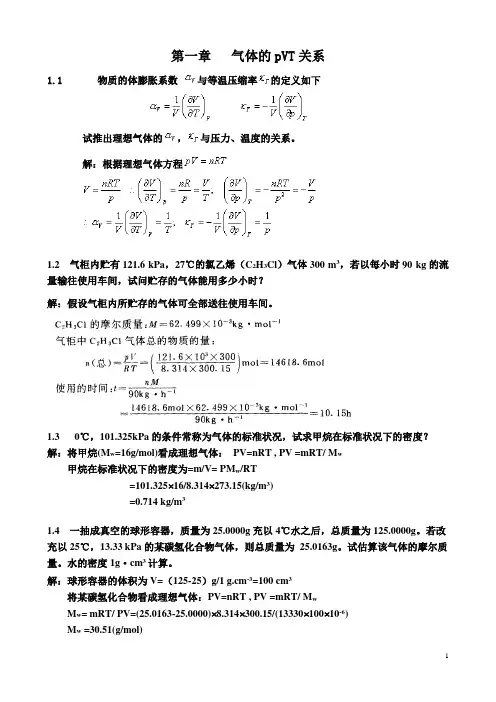
第一章气体的pVT关系1.1 物质的体膨胀系数与等温压缩率的定义如下试推出理想气体的,与压力、温度的关系。
解:根据理想气体方程1.2 气柜内贮有121.6 kPa,27℃的氯乙烯(C2H3Cl)气体300 m3,若以每小时90 kg的流量输往使用车间,试问贮存的气体能用多少小时?解:假设气柜内所贮存的气体可全部送往使用车间。
1.3 0℃,101.325kPa的条件常称为气体的标准状况,试求甲烷在标准状况下的密度?解:将甲烷(M w=16g/mol)看成理想气体:PV=nRT , PV =mRT/ M w甲烷在标准状况下的密度为=m/V= PM w/RT=101.325⨯16/8.314⨯273.15(kg/m3)=0.714 kg/m31.4 一抽成真空的球形容器,质量为25.0000g充以4℃水之后,总质量为125.0000g。
若改充以25℃,13.33 kPa的某碳氢化合物气体,则总质量为25.0163g。
试估算该气体的摩尔质量。
水的密度1g·cm3计算。
解:球形容器的体积为V=(125-25)g/1 g.cm-3=100 cm3将某碳氢化合物看成理想气体:PV=nRT , PV =mRT/ M wM w= mRT/ PV=(25.0163-25.0000)⨯8.314⨯300.15/(13330⨯100⨯10-6)M w =30.51(g/mol)1.5 两个容积均为V 的玻璃球泡之间用细管连结,泡内密封着标准状态下的空气。
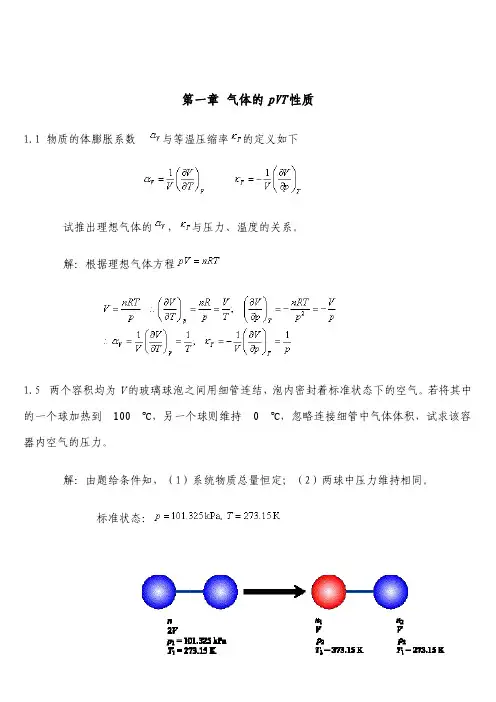
若将其中的一个球加热到 100℃,另一个球则维持 0℃,忽略连接细管中气体体积,试求该容器内空气的压力。
解:由题给条件知,(1)系统物质总量恒定;(2)两球中压力维持相同。
标准状态:因此,1.6 0℃时氯甲烷(CH 3Cl )气体的密度ρ随压力的变化如下。
试作p p-ρ图,用外推法求氯甲烷的相对分子质量。
1.7 今有20℃的乙烷-丁烷混合气体,充入一抽成真空的200 cm3容器中,直至压力达101.325 kPa,测得容器中混合气体的质量为0.3897 g。
《物理化学》第五版(天津大学物理化学教研室 著)课后习题答案 高等教育出版社
由于汽缸为绝热,因此
2.20 在一带活塞的绝热容器中有一固定的绝热隔板。隔板靠活塞一侧为 2 mol,0 C 的
单原子理想气体 A,压力与恒定的环境压力相等;隔板的另一侧为 6 mol,100 C 的双原子
理想气体 B,其体积恒定。今将绝热隔板的绝热层去掉使之变成导热板,求系统达平衡时的
T 及过程的
与温度的函数关系查本书附录,水
的比定压热容
。
解:300 kg 的水煤气中 CO(g)和 H2(g)的物质量分别为
300 kg 的水煤气由 1100 C 冷却到 100 C 所放热量
设生产热水的质量为 m,则
2.18 单原子理想气体 A 于双原子理想气体 B 的混合物共 5 mol,摩尔分数
,始态温
(1)
(2)
的;
(3)
的;
解:(1)C10H8 的分子量 M = 128.174,反应进程
。
(2)
。
(3) 2.34 应用附录中有关物资在 25 C 的标准摩尔生成焓的数据,计算下列反应在 25 C 时 的 及。
解:将气相看作理想气体,在 300 K 时空气的分压为
由于体积不变(忽略水的任何体积变化),373.15 K 时空气的分压为
由于容器中始终有水存在,在 373.15 K 时,水的饱和蒸气压为 101.325 kPa, 系统中水蒸气的分压为 101.325 kPa,所以系统的总压
第二章 热力学第一定律
解:该过程图示如下
设系统为理想气体混合物, 则
1.17 一密闭刚性容器中充满了空气,并有少量的水。但容器于 300 K 条件下大平衡时,容 器内压力为 101.325 kPa。若把该容器移至 373.15 K 的沸水中,试求容器中到达新的平衡时 应有的压力。设容器中始终有水存在,且可忽略水的任何体积变化。300 K 时水的饱和蒸气 压为 3.567 kPa。
[物理化学[上册]完整习题的答案解析]第五版高等教育出版社
![[物理化学[上册]完整习题的答案解析]第五版高等教育出版社](https://360docs-1393072327.cos.ap-beijing.myqcloud.com/e8ac5f6ab52acfc789ebc9d3.webp)
第一章 气体pVT 性质1-1物质的体膨胀系数V α与等温压缩系数T κ的定义如下:1 1TT p V p V V T V V ⎪⎪⎭⎫⎝⎛∂∂-=⎪⎭⎫ ⎝⎛∂∂=κα 试导出理想气体的V α、T κ与压力、温度的关系? 解:对于理想气体,pV=nRT111 )/(11-=⋅=⋅=⎪⎭⎫⎝⎛∂∂=⎪⎭⎫ ⎝⎛∂∂=T TVV p nR V T p nRT V T V V p p V α 1211 )/(11-=⋅=⋅=⎪⎪⎭⎫ ⎝⎛∂∂-=⎪⎪⎭⎫ ⎝⎛∂∂-=p p V V pnRT V p p nRT V p V V T T T κ 1-2 气柜内有121.6kPa 、27℃的氯乙烯(C 2H 3Cl )气体300m 3,若以每小时90kg 的流量输往使用车间,试问贮存的气体能用多少小时?解:设氯乙烯为理想气体,气柜内氯乙烯的物质的量为mol RT pV n 623.1461815.300314.8300106.1213=⨯⨯⨯== 每小时90kg 的流量折合p 摩尔数为13353.144145.621090109032-⋅=⨯=⨯=h mol M v Cl H C n/v=(14618.623÷1441.153)=10.144小时1-3 0℃、101.325kPa 的条件常称为气体的标准状况。
试求甲烷在标准状况下的密度。
解:33714.015.273314.81016101325444--⋅=⨯⨯⨯=⋅=⋅=m kg M RT p M V n CH CH CHρ 1-4 一抽成真空的球形容器,质量为25.0000g 。
充以4℃水之后,总质量为125.0000g 。
若改用充以25℃、13.33kPa 的某碳氢化合物气体,则总质量为25.0163g 。
试估算该气体的摩尔质量。
解:先求容器的容积33)(0000.10010000.100000.250000.1252cm cm V l O H ==-=ρn=m/M=pV/RTmol g pV RTm M ⋅=⨯-⨯⨯==-31.301013330)0000.250163.25(15.298314.841-5 两个体积均为V 的玻璃球泡之间用细管连接,泡内密封着标准状况条件下的空气。
《物理化学》高等教育出版(第五版)第十章可 逆 电 池

第十章 可 逆 电 池一、判断题:1.电池(a) Ag,AgCl|KCl(aq)|Hg 2Cl 2,Hg 与电池(b) Hg,Hg 2Cl 2|KCl(aq)|AgNO 3(aq)|Ag 的 电池反应可逆。
2.恒温、恒压下,Δr G > 0的反应不能进行。
3.电池Zn|ZnCl 2(aq)|AgCl(s)|Ag 在25℃、p ө下可逆放电2F 时放热23.12 kJ ,则该电池反应:Zn + 2AgCl(s) -→ ZnCl 2 + 2Ag 的m r H ∆(298K) = -23.12 kJ·mol -1。
4.Zn 2+ + 2e -→ Zn ,φ1ө,m rG ∆(1);½Zn 2++e → ½Zn,φ2ө,m r G ∆(2)。
因 φ1ө=φ2ө, 所以有:m rG ∆(1) = m r G ∆(2)。
5.Fe 2+ + 2e → Fe,φ1ө,m rG ∆(1) ;Fe 3+ + e→ Fe 2+,φ2ө,m r G ∆(2); (1) + (2),得:Fe 3+ + 3e → Fe,φ3ө,m r G ∆(3)。
则:m rG ∆(3) = m r G ∆(1) + m r G ∆(2),φ3ө=φ1ө +φ2ө。
6.2H ++ 2e -→ H 2,φ1ө与2H 2O + 2e → H 2 + 2OH -,φ2ө,因它们都是氢电极反 应,所以φ1ө = φ2ө。
7.对于电极Pt |Cl 2(p )|Cl - 其还原电极电势为:222Cl 2Cl /Cl Cl /Cl P = ln 2P Cl RT F a ϕϕ----θθ8.对于电池Pt|H 2|H 2SO 4(aq)|O 2|Pt , 其电池反应可表示为:H 2(g) + ½O 2(g) -→ H 2O(l),E 1ө,m rG ∆(1) 或2H 2(g) + O 2(g) -→ 2H 2O(l),E 2ө,m rG ∆(2)。
第五版物理化学习题答案
第三章热力学第二定律??卡诺热机在的高温热源和的低温热源间工作。
求(1)?热机效率;(2)?当向环境作功时,系统从高温热源吸收的热及向低温热源放出的热。
解:卡诺热机的效率为?????? 根据定义3.2 卡诺热机在的高温热源和的低温热源间工作,求:(1)?热机效率;(2)? 当从高温热源吸热时,系统对环境作的功及向低温热源放出的热解:(1) 由卡诺循环的热机效率得出(2)3.3 卡诺热机在的高温热源和的低温热源间工作,求(1)热机效率;(2)当向低温热源放热时,系统从高温热源吸热及对环境所作的功。
解: (1)(2)3.4 试说明:在高温热源和低温热源间工作的不可逆热机与卡诺机联合操作时,若令卡诺热机得到的功r W 等于不可逆热机作出的功-W 。
假设不可逆热机的热机效率大于卡诺热机效率,其结果必然是有热量从低温热源流向高温热源,而违反势热力学第二定律的克劳修斯说法。
证: (反证法)?? 设 r ir ηη>不可逆热机从高温热源吸热,向低温热源放热,对环境作功则逆向卡诺热机从环境得功从低温热源吸热向高温热源放热则若使逆向卡诺热机向高温热源放出的热不可逆热机从高温热源吸收的热相等,即总的结果是:得自单一低温热源的热,变成了环境作功,违背了热力学第二定律的开尔文说法,同样也就违背了克劳修斯说法。
3.5 高温热源温度,低温热源温度,今有120KJ的热直接从高温热源传给低温热源,求此过程。
?????? 解:将热源看作无限大,因此,传热过程对热源来说是可逆过程??? 不同的热机中作于的高温热源及的低温热源之间。
求下列三种情况下,当热机从高温热源吸热时,两热源的总熵变。
(1)?可逆热机效率。
(2)?不可逆热机效率。
(3)?不可逆热机效率。
解:设热机向低温热源放热,根据热机效率的定义???? 因此,上面三种过程的总熵变分别为。
??已知水的比定压热容。
今有1 kg,10℃的水经下列三种不同过程加热成100 ?℃的水,求过程的。
物理化学第五版课后习题答案
第七章 电化学7-1.用铂电极电解CuCl 2溶液。
通过的电流为20 A ,经过15 min 后,问:(1)在阴极上能析出多少质量的Cu ? (2) 在阳阴极上能析出多少体积的27℃, 100 kPa 下的Cl 2(g )? 解:(1) m Cu =201560635462.F⨯⨯⨯=5.527 g n Cu =2015602F⨯⨯=0.09328 mol(2) 2C l n =2015602F⨯⨯=0.09328 mol 2C l V =00932830015100.R .⨯⨯=2.328 dm 37-2.用Pb (s )电极电解Pb (NO 3) 2溶液,已知溶液浓度为1g 水中含有Pb (NO 3) 21.66×10⁻²g 。
通电一段时间,测得与电解池串联的银库仑计中有0.1658g 的银沉积。
阳极区溶液质量为62.50g ,其中含有Pb (NO 3) 21.151g ,计算Pb 2+的迁移数。
解: M [Pb (NO 3) 2]=331.2098考虑Pb 2+:n 迁=n 前-n 后+n e=262501151166103312098(..)..--⨯⨯-11513312098..+0165821078682..⨯=3.0748×10⁻³-3.4751×10⁻³+7.6853×10-4 =3.6823×10⁻⁴ mol t +(Pb 2+)=4436823107685310..--⨯⨯=0.4791考虑3N O -: n 迁=n 后-n 前=11513312098..-262501151166103312098(..)..--⨯⨯=4.0030×10⁻³ molt -(3N O -)=4440030107658310..--⨯⨯=0.52097-3.用银电极电解AgNO 3溶液。
通电一段时间后,阴极上有0.078 g 的Ag 析出,阳极区溶液溶液质量为23.376g ,其中含AgNO 3 0.236 g 。
物理化学答案_上册_高教_第五版(Answer _ _ on physical chemistry of higher education _ Fifth Edition)
物理化学答案_上册_高教_第五版(Answer _ _ on physical chemistry of higher education _ Fifth Edition)Chapter 1 gasPVTNature1.1 material expansion coefficientIsothermal compression rateThe definition is as followsTest the introduction of ideal gas,Relationship with pressure and temperature.According to the ideal gas equation1.5 two glass balls with V volume are connected by a small tube, and the bubbles are sealed with standard air. If soA ball is heated to 100 degrees C, while the other ball is maintained at 0 degrees C. The volume of the gas in the pipe is neglected and the container is soughtInternal air pressure.Solution: from the question to the condition, (1) the total mass of the system is constant; (2) the pressure remains the same in the two ball.Standard state:Therefore,As figure 1.9 shows, the container area partition, both sides are at the same pressure of hydrogen and nitrogen, two are regarded as idealGas.Page(1) when the temperature in the container is kept constant, the separator is removed and the volume of the barrier itself is negligibleSeek the pressure of two gases mixed.(2) is the molar volume of H2 and N2 equal before and after the separation of the separator?(3) after the separation of the separator, the partial pressure of H2 and N2 in the mixture gas and the volume of their respective parts are severalSolution: (1) after isothermal mixingThat is, under the above conditions, the mixing pressure of the system is considered.(2) how is the molar volume of a component in a mixed gas defined?(3) according to the definition of volumeFor partial pressure1.11 atmospheric pressure air in a autoclave at room temperature for safety during the experiment and the use of pure nitrogen at the same temperatureThe steps are as follows: nitrogen is sent to the kettle until it is 4 times as high as the air, and then the mixture gas is discharged from the tank until it is recoveredCompound atmospheric pressure. Repeat three times. The mole fraction of oxygen contained in the gas is obtained when the final exhaust gas reaches the normal atmospheric pressure.Analysis: every time after the nitrogen gas, the gas returned to the atmospheric pressure P, and the mole fraction of the mixed gas remained unchanged.Before the first charge of nitrogen, the mole fraction of oxygen in the system isAfter nitrogen, the mole fraction of oxygen in the systembyThen,. Repeat the process above, nAfter secondary nitrogen, the mole fraction of the system is,therefore.1.13 there are 0 degrees C, 40.530 kPa N2 gas, using ideal gas equation of state and van, der, Waals equation calculationIts molar volume. The experimental value is.Solution: the equation of state of ideal gas is usedPageUsing van, der, and Waals calculations, look-up tables are known for N2 gas (Appendix seven)MatLab fzero function is used to obtain the solution of the equationDirect iteration can also be used,Take initial valueIterate ten timesAt 1.1625 degrees C, saturated acetylene gas saturated with water (i.e., the partial pressure of the steam in the mixture is saturated at the same temperature)And vapor pressure) the total pressure is 138.7 kPa and is cooled to 10 DEG C at constant total pressure, which condenses some of the water vapor into water. Try to seek forThe amount of material that condenses in the cooling process of each mole of dry acetylene gas. Saturated vapor of water at 25 C and 10 degrees CThe pressures are 3.17 kPa and 1.23 kPa, respectively.Solution: the process is illustrated as followsIf the system is an ideal gas mixture, then1.17 a tightly packed rigid container filled with air and witha small amount of water. But containers are in great balance at 300 K conditions, containersThe internal pressure is 101.325 kPa. If the container is moved to boiling water of 373.15 K, try to achieve a new equilibrium in the containerSome pressure. There is always water in the container, and any volume change of water can be neglected. 300 K the saturated vapor pressure of waterFor 3.567 kPa.Solution: when gas phase is regarded as ideal gas, at 300 K, the partial pressure of air isPageAs the volume is constant (ignoring any change in volume of water), the partial pressure of the air at 373.15 K isSince there is always water present in the container, the saturated vapor pressure of water at 373.15 K is 101.325 kPaThe partial pressure of water vapor is 101.325 kPa, so the total pressure of the systemPageThe second chapter is the first law of thermodynamics2.5 the initial state is 25 ~ C, 200 kPa, 5 mol of an ideal gas, by way of a, B two different ways to the same final.By way of a, the adiabatic expansion to -28.47 degrees C, 100 kPa, the steps of the workThe constant volume heats up to the pressure200 kPa the final step of heat. Pathway B is a constant pressure heating process. Seeking ways of Band.Solution: first determine the initial and final systemFor the way B, his work isAccording to the first law of thermodynamics2.64 mol of an ideal gas, the temperature increased by 20 degrees CValue.Solution: according to the definition of enthalpy2.102 mol an ideal gas,.The initial state is 100 kPa, 50 DMThreeThe constant volume heating increases the volume of pressure As large as 150 DMThreeConstant pressure cooling reduced the volume to 25 DMThree. Seeking the whole process.Solution: the process is illustrated as followsPageBecauseThen,Yes, ideal gasandIt's just a function of temperatureThe approach involves only constant volume and constant pressure processes, so it is convenient to calculate the workAccording to the first law of thermodynamicsThe 2.13 known 20 DEG C liquid ethanol (C2H5OH, l) of the expansion coefficientIsothermal compression rateDensityMolar heat capacity at constant pressure. Seek 20 DEG C, liquid ethanol.Solution: the second law of thermodynamics can prove that the relationship between constant pressure molar heat capacity and constant volume molar heat capacity is as follows2.14 volume is 27 mThreeA small heating element is arranged in the insulating container, and a small hole is communicated with the atmosphere of the 100 kPa,To maintain constant air pressure in the vessel. The heating device is used to heat the air in the apparatus from 0 DEG C to 20 DEG CHow much heat is given to the air in the container?. Known air.If the air is an ideal gas, the temperature of the air in the container will be uniform during heating.Solution: in this problem, the pressure of the air in the container is constant, but the mass of the material varies with the temperaturePageNote: cannot be applied in the above questionsAlthough the volume of the container is constant. This is because, fromThe air out of the hole will do the work to the environment. The work done is as follows:When the temperature is T, the system temperature is increased by dT, and the mass of the air discharged from the container isWork doneThat's exactly what it's worthandThe difference in heat calculated.2.15 volume is 0.1 MThreeAn insulating partition board is arranged in the constant volume closed container, wherein the sides are respectively 0 DEG C, 4 mol Ar (g) and150 degrees C, 2 mol Cu (s). The partition removed, the system reaches heat balance, temperature and process for final t.Known: molar heat capacity at constant pressure of Ar (g) and Cu (s)Respectively asandAnd assume that they do not change with temperature.Here is the diagram belowIt is assumed that the insulation wall is in close contact withthe copper block, and the volume of copper block varies with temperatureThe process can be viewed as a constant volume process, thereforePageIt is assumed that gas can be regarded as an ideal gas,Then,The temperature of the water gas at the outlet of the 2.16 water gas producer is 1100 degrees C, and the mole fractions of CO (g) and H2 (g) are 0.5.If 300 kg of water gas is cooled from 1100 C to 100 C per hour, and heated by the recovered heat, the water temperature is caused by25 degrees C rise to 75 degrees C. Seek the quality of hot water produced per hour. Molar constant heat capacity of CO (g) and H2 (g)TemperatureFunction relations, book, appendix, waterSpecific heat capacity at constant pressure.Interpretation: the mass fraction of CO (g) and H2 (g) in 300 kg water gas is respectively300 kg of water gas from 1100 degrees C to 100 degrees C cooling heatThe quality of producing hot water is m2.18 monatomic ideal gas A in a mixture of diatomic ideal gas B, a total of 5 mol, mole fractionInitial statetemperaturePressure. The mixture is insulated against constant external pressureExpand toEquilibrium state. For the final temperatureAnd process.Solution: the process is illustrated as followsAnalysis: because of the adiabatic process, the change ofthermodynamic energy in process is equal to the form of work between the system and environmentThe energy exchanged by the potential. Therefore,PageMonatomic moleculeDiatomic moleculeSince the ideal gases, U and H, are only functions of temperature, so2.19 there is an insulating partition in the insulated container of the piston in the vicinity. The sides of the bulkhead are 2 mol and 0 C respectivelyGas A and 5 mol, 100 degrees C diatomic ideal gas B, two gas pressure is 100 kPa. Pressure dimension outside the pistonRemain unchanged at 100 kPa. This will be removed from the container plate, the two kinds of gas mixture to reach an equilibrium state. The temperature for the final and TProcedural.Solution: the process is illustrated as followsIt is assumed that the insulation partition plate is replaced by a heat conduction baffle plate, then the heat balance is removed, and then the clapboard is removed to make the mixture mixedPageThe work is convenient because of the constant external pressureSince the cylinder is insulated,2.20 there is a fixed insulated partition in the insulated container of the piston in the area. The bulkhead is single C with 2 mol and 0 DEG C on the piston sideThe sub ideal gas A is equal to the constant ambient pressure; the other side of the barrier is 6 mol, 100 C diatomicThink of gas B, whose volume is constant. The insulating layer of the insulating partition is removed so that it becomes a heat conducting plate and the system is T when it reaches equilibriumAnd process.Solution: the process is illustrated as followsObviously, in the process, A is constant voltage, and B is constant volume, thereforePageIbid., first seeking meritSimilarly, due to cylinder insulation, the first law of thermodynamics2.235 mol diatomic gas from the initial state of 300 K, 200 kPa, first reversibly reversibly expanded to a pressure of 50 kPa, at adiabaticThe inverse compression pressure of 200 kPa to the final state. For the final temperature and the whole process of Tand.Solution: the process is illustrated as followsBe sureThe adiabatic equation of state can be applied to second steps onlyPairs of diatomic gasesthereforeSince the U and H of ideal gases are only functions oftemperature,PageThe whole process is convenient because the second step is adiabatic. The first step is constant temperature reversible2.24 it is proved that the absolute value of the slope of the adiabatic reversible line is greater than that of the constant temperature reversible line at the point where the ideal gas p-V diagram takes placeRight value.According to the adiabatic equation of ideal gas,have toTherefore. Therefore, the hot wireThe slope isConstant temperature lineThe slope is. BecauseTherefore, adiabatic reversibleThe absolute value of the slope of the line is greater than the absolute value of the constant temperature reversible line.2.25, the insulated and constant volume cylinder is provided with an adiabatic ideal piston without friction, and the left and the right sides of the piston are respectively50 DMThreeThe monatomic ideal gases A and 50 DMThreeDiatomic ideal gas B. The two gases are 0 C, 100 kPa. A gasAn electric heating wire with negligible volume and heat capacity is arranged in the inner part. Now, after energized, slowly heating the left gas A, so that the push pistonCompress the right gas B to the final pressure to 200 kPa. O:(1) the final temperature of gas B.Page(2) the work obtained by gas B;.(3) the final temperature of gas A.(4) the heat obtained by the gas A from the electric wire.Solution: the process is illustrated as followsBecause of the slow heating, B can be regarded as undergoing an adiabatic reversible processSolution of the first law of thermodynamicsThe final A gas temperature is the ideal gas state equation solving,Treat A and B as whole, W = 0, therefore2.25 in an insulated vessel with a piston, there is a solid substance of 4.25 mol and 5 mol, a monatomic ideal gas, B, substance APageA. Initial temperaturePressure. This is gas BFor systems, reversible expansion toSystematicAnd process.Solution: the process is illustrated as followsWhen A and B are regarded as systems, the process is an adiabatic reversible process. Assume the following (1) solidsThe volume of B does not vary with temperature; (2) for solid BThen,thusFor gas BPage2.26 known water (H2OlSaturation vapor pressure at 100 CAt this temperature and pressureEnthalpy of vaporization. Make the 1 kg water vapor coagulate at 100 degrees C and 101.325 kPaForming liquid water. Set up ideal gas equation of state.Solution: the process is reversible phase change2.28 it is known that the melting point of ice under 100 kPa is 0 degrees C, at this point the specific enthalpy of heat of ice is hotJ - G-1.Average waterheat capacity at constant pressure. 0.1 kg, 0 degrees C in 1 kg, 50 degrees C, in an adiabatic vesselThe ice after the final temperature system. The heat capacity of the vessel is not considered in the calculation.Solution: the rough estimate shows that the final temperature of T system should be higher than 0 DEG Ctherefore2.29 it is known that the melting point of ice under 100 kPa is 0 degrees C, at this point the specific enthalpy of heat of ice is hotJ - G-1.Water and iceAverage heat capacity at constant pressureRespectively asand. Present 1 kg 50 in an adiabatic vesselWater C degrees C degrees kg degrees -20 ice 0.8 degrees. O:(1) the final temperature.(2) the quality of the final water and ice.Solution: 1 kg, 50 degrees C water cooling, 0 degrees C exothermic0.8 kg -20 degrees C ice warming caused by 0 degrees C endothermicHeat is needed when melted completelyPageTherefore, only part of the ice melted. So the final temperature is 0 ~ C. AIce melting of g,Is thereThe quality of the system ice and water, respectively2.30 steam boilers are continuously injected with water of 20 degrees C, heated and evaporated to 180 degrees C, saturated steam pressure as1.003 MPa of water vapor. The amount of heat needed to produce 1 kg of water vapor.Known: waterMolar enthalpy of vaporization at 100 CWater levelMean molar heat capacity at constant pressureSteamMolar constant heat capacity and temperatureSee Appendix for function.Solution: the process is considered as a constant pressure processThe initial and final system), respectively.and. Insertion of equilibrium phase change pointWhen the steam is regarded as an ideal gas, the enthalpy of the process becomes10 DEG C by the following three differentThe process heats up to 100 degrees C of water, asking for a process.(1) the system contacts with the heat source of 100 C.(2) the system contacts the heat source of the 55 degree C to the heat balance, and then contacts with the heat source of 100 C.(3) the system contacts the heat source of 40 degrees C and 70 degrees C to the heat balance, and then contacts with the heat source of 100 C.Solution: the entropy is the state function, and the entropy of the system changes the same in three casesIn the process, the heat obtained by the system is heat released by a heat source, so that3.8 known nitrogen (N2gThe molar heat at constant pressure is a function of temperatureThe initial state is 300 K, 100 kPa, the 1 mol N2 (g) is placed in the heat source of 1000 K, and the following is requiredPageProcess (1) by constant pressure process; (2) when the constant volume process reaches equilibrium state.Solution: in the case of constant pressureIn constant volume, nitrogen (N2gAs ideal gasbodytakeInstead of all of the aboveYou can obtain the required quantitiesThe 3.9 initial state is,A diatomic ideal gas, 1 mol, changed in the following waysTo,The final. Seek steps and ways.(1) reversible expansion at constant temperature;(2) cool down the constant volume until the pressure drops to 100 kPa, and then heat up to the constant pressure;(3) expand first by adiabatic expansion until the pressure drops to 100 kPa, and then heat up to constant pressure.Solution: (1) reversible expansion of an ideal gas at constant temperature, DU = 0, thereforePage(2) calculate constant volume cooling until the pressure drops to 100 kPa, the temperature of the system is T:(3) similarly, the heat expands reversibly to a temperature of T: when the pressure drops to 100 kPaAccording to the equation of state of ideal gas adiabatic process,The thermodynamic quantities are calculated as follows2.122 mol diatomic ideal gas from the initial state 300 K, 50 DMThreeHeat the constant volume to 400 K, then heat it up to a constant pressureVolume increased to 100 DMThreeAsking for the whole process.Solution: the process is illustrated as followsPageFirst calculate the final temperatureTherefore,Two important formulasIdeal gas3.17 consists ofThe monatomic gas A is a mixture of 10 mol with ideal gas mixtures of diatomic gas B,Beginning stateAdiabatic reversible compression toEquilibrium state. Process seeking.Solution: the process is illustrated as followsPageThe adiabatic reversible equation of state for a mixed ideal gas is derived as followsEasy to getPage3.18 ideal mixture of monatomic gas A and diatomic gas B, 8 mol, consisting ofBeginning.state. Irreversible expansion to the final volume of this insulation against the constant pressureTheEquilibrium state. Process seeking.Solution: the process is illustrated as followsTo determine the final temperature, adiabatic processTherefore3.19 atmospheric pressure, 100 g, 27 C of water and 200 g, 72 degrees C of water in an insulated container mixed, the final water temperature TEntropy change of process. Specific heat at constant pressure of known water.Solution: the procedure is illustrated as followsPageIn the 321 adiabatic constant volume vessel, there is an insulating pressure bulkhead, with 200 K of 2 mol and 50 DM on the side of the partition boardThreeMonatomicThink gas A, and the other side is 3 mol, 400 K, 100 DMThreeDiatomic ideal gas B. Insulating partitions in a container todayThe way, A and B mixed gas gas balance. Process seeking.Solution: the process is illustrated as followsThe final temperature of the T system can be solved as followsEntropy change of the systemPageNote: for ideal gases, the presence of one component does not affect the other components. The final A and BVolume is the volume of the container.In the 322 adiabatic constant volume vessel, there is an insulating pressure bulkhead, with N2 (g) on both sides of the bulkhead. One side volume was 50 DMThreeThere is200 K N2 (g) 2 mol; the other side volume was 75 DMThreeWithin 500 K of N2 (g) 4 mol; N2 (g) can be considered as idealgas.This will be removed from the adiabatic partition in the container, allowing the system to achieve the equilibrium state. Process seeking.Solution: the process is illustrated as followsThe same problem, the final temperature of T is determined as followsAfter the first step, the volume of the two part isThat is, in addition to the partition, the 2 and final state of the same, soPagePay attention to the comparison between the 21 and the 22 questions.3.23 at atmospheric pressure, the melting point of ice is 0 degrees C, than the enthalpy of fusionConstant pressure hot melt of water. In an insulated vessel, there is 1 kg, 25 degrees C water, and 0.5 kg, 0 DEG C are added to the vesselThis is the beginning of the system. Seeking the equilibrium of a system; a process.Solution: the process is illustrated as followsThe process is considered as a constant pressure adiabatic process. As a result of 1 kg, water of 25 degrees C is cooled to 0 degrees CCan only lead toThe ice melts, therefore3.27 it is known that the melting point of ice at normal pressure is 0 degrees C, and the molar enthalpy of meltingBenzeneMelting point is 5.51 degrees C, molar melting enthalpy. Molar determination of liquid water and solid benzeneThe heat capacities areand. Today there are two containers surrounded by insulation, 0 C in a containerPageThe 8 mol H2O (s) is balanced with 2 mol H2O (L) and another container is 5.51 mol C6H6 (L) and 5 mol C6H6 (s) into 5 CBalance. The two containers are contacted to remove an insulating layer between the two containers so that the two container reaches a new equilibrium state. Process seeking.Solution: a rough estimate shows that 5 mol C6H6 (L) is completely solidified and will cause the 8 mol H2O (s) to melt completelyThe process is illustrated as followsThe total process is constant pressure adiabatic process,Therefore3.28 put a small glass bottle containing 0.1 mol ether (C2H5) 2O (L) into the volume of 10 DMThreeVacuum container with constant volume and airtightPageConstant temperature in the constant temperature trough at35.51 C. 35.51 C is the boiling point of ether at 101.325 kPa. Given this conditionMolar enthalpy of vaporization of diethyl ether. Now break the small glass bottle and the ether evaporates to equilibrium.seek(1) the pressure of ether vapor;(2) process.Solution: ether vapor is regarded as ideal gas due to constant temperatureThe changes in the state functions are calculated as followsIgnore the volume of the liquid etherThe 3.30. volume was 20 DMThreeThe closed vessel has 2 mol H2O gas liquid equilibrium. 80 degrees C, 100 degrees C saturation of the waterAnd vapor pressure, respectivelyandMolar enthalpy of vaporization of water at 25 CThe average pressure and molar heat capacities of water and water vapor at 25 ~ 100 degrees C are respectivelyand. Modern systemThe constant volume heating from 80 C to 100 C. Process seeking.Solution: first estimate 100 degrees C, whether there is liquid water in the system. There is only water vapor in the final stateThe quality is nbeObviously, only a portion of the water evaporation, the final is still the gas-liquid equilibrium. Therefore, the following process:Set the following channelsPageThe first and fourth steps are reversible phase change, the second step is constant temperature change of liquid water, and the third step is constant of liquid waterPressure changing temperature. The molar evaporation heat of water at 80 degrees C and 100 degrees C is first obtained3.31. O2 (g) is a function of the molar heat at constant pressure with temperaturePageThe standard molar entropy of O2 (g) under 25 degrees C is known. Seek O2 (g)Moore's entropy at 100 C and 50 kPa.Solution: by formulaknow3.32. if the molar heat capacity of each substance in the chemical reaction is expressed asTry to deduce the chemical reactionStandard molar reaction entropyAnd temperature T。
【物理化学上册完整习题答案】第五版
物理化学上册完整习题答案第五版第一章热力学基础习题一(a)热容量定义为物体单位质量或单位物质量的温度升高所需的热量。
它的单位是J/(g·°C)。
(b)热容量可以用以下公式来计算:Q = mcΔT,其中Q表示热量,m表示物体的质量,c表示物质的比热容,ΔT表示温度变化。
(c)水的比热容是4.18 J/(g·°C)。
(a)焓的定义是在恒定压力下,物体单位质量的温度升高所需的热量。
焓可以用以下公式来计算:H =Q/m,其中H表示焓,Q表示热量,m表示物体的质量。
(b)焓变是指在化学反应或物理过程中,物体单位质量的焓的变化。
1.辅助函数的作用是简化热力学计算过程。
它可以帮助我们计算焓、熵和自由能等。
习题二1.当物体从低温区域向高温区域传递热量时,热量会按照热流从高温区域传递到低温区域。
这个现象符合热力学第一定律,即能量守恒定律。
2.传送速率可以通过热传导定律来计算。
热传导定律可以用以下公式表示:Q = kA(ΔT/Δx),其中Q是传输的热量,k是热传导系数,A是传输的面积,ΔT是温度差,Δx是传输的距离。
3.传热的三种途径是热传导、热对流和热辐射。
习题三1.升华是指固体直接从固体相转变为气体相的过程,而不经过液体相。
凝华是指气体直接从气体相转变为固体相的过程。
2.溶解度是指溶质在溶剂中溶解所达到的最大浓度。
溶解度可以受到温度、压力和溶剂性质等因素的影响。
3.相变是指物质在一定条件下从一个相态转变为另一个相态的过程。
常见的相变包括融化、凝固、汽化、液化、升华和凝华。
第二章热力学函数习题一(a)熵是描述系统无序程度的物理量。
它的单位是J/(mol·K)。
(b)熵的变化可以通过以下公式计算:ΔS = Q/T,其中ΔS表示熵的变化,Q表示热量,T表示温度。
(a)熵增定律是指在孤立系统中,系统熵总是增加或至少保持不变。
(b)熵增定律可以用以下公式表示:ΔStotal =ΔSsystem + ΔSsurroundings ≥ 0,其中ΔStotal表示系统和周围环境的总熵变化,ΔSsystem表示系统的熵变化,ΔSsurroundings表示周围环境的熵变化。