
六年级上册英语全部知识点
Lesson 1 At the airport一、单词:suitcase(复数)suitcases, arrive(过去式)arrived, live(单三)lives, want(单三)wants,come(现在分词)coming,five(序数词)fifth二、课文重难点:1. at表示“在某处”,一般指较小的比较具体的地点。
如at school 、at home2. This is “这是某某”这句型在这里用来介绍他人。
This is my friend.3. want 想要want to do sth. 想干某事如:I want to go home.我想回家。
4. What time is it now? It’s 11:30.现在几点了?现在11:30.5. Did you have a good trip? Yes,thanks.你旅行愉快吗?是的,谢谢。
6. Let’s go home./ Let me help you.让我们回家。
让我帮助你。
7. learn English 学英语Lesson 2 Jenny’s house一、单词:kitchen, room, bathroom, bedroom, living room二、课文重难点:1. This is / That is / These are/ Here is/ Here are2. What’s in the bedroom? 卧室里有什么?3、second floor 二楼Lesson 3 Making breakfast一、单词:refrigerator(fridge), sink水槽,make(现在分词)making(过去分词)made, dish(复数)-dishes,cook(现在分词)-cooking、stove炉子二、课文重难点:1. Time for breakfast.= It’s time for breakfast.早餐时间到了。
2. It’s time for sth./ It’s time to do sth.是做什么的时间了。
3. Would like sth./ Would like to do sth.想要什么。
想要做什么。
4. What would you like for breakfast / lunch/supper? I would like…5. Breakfast is ready. wash dishes make breakfast/lunch/supper6. in the kitchen / refrigerator /sink on the stove / tableLesson 4 Making supper一、单词:dry-wet, dirty-clean,eat-ate二、课文重难点:1. What’s for supper?晚餐有什么?2. What are you doing? / We are washing hands. 你正在做什么?我们正在洗手。
What are they doing?3. You can dry your dishes. / The dishes are dry.4. Let’s wash the dishes.让我们洗盘子吧。
5. May I help you? Sure.我可以帮你吗?当然。
Lesson 5 In the living room 一、单词:watch(现分)-watching, sit(现分)-sitting, read(现在分词)-reading, write(现在分词)-writing, do(现在分词)-doing, play(现在分词)---playing,二、课文重难点:1.watch TV / read the newspaper/write a letter2.What else can you find in the living room?3. Do you like this show? Yes,I do/No,I don’t.4. in the corner. Everyone in the living room is quiet.Lesson 7 On the school bus一、单词:always,usually, sometimes, never, bus stop, bus driver, school bus三、课文重难点:1. 祈使句:Don’t go there./ Don’t forget your umbrellas.2. 频率副词用法:一般都放在行为动词之前,助动词和情态动词之后。
如:He never wears dresses./ I never walk.1. I live too far from school. on the school bus.2. Do you usually go to school by …?Lesson 8 Li Ming meets Jenny’s class一、单词:same(反义词)different,subject,class,math\science\art\PE\music, have lunch\supper\breakfast二、课文重难点:1. Where are you from?I am from China.你来自哪里?我来自中国。
2、what subjects do you have in your school?we have math...3、How many classes do you have each school day? Three classes in the morning and two in the afternoon.Lesson 9 Mr.Wood teaches a lesson 一、单词:temperature, shape(形状), line, circle, square, triangle,degree(复数)degrees,hot(反义词)cold,outside(反义词)inside,ill、healthy健康的三、课文重难点:1. How’s the weather today? It’s rainy.今天天气怎样?多雨。
2. What’s the temperature? It’s ten degrees.气温多少度?十度。
3. What’s your favourite shape? My favourite shape is acircle.4. How many lines make a triangle? Three.Lesson 10 How many are there?一、单词:man(复数)---men, woman(复数)---women, child(复数)---children二、课文重点、难点:1. This is a …/ These are (some/many) …That is a …/Those are …2. Here is a …/ Here are (some/many) …3. How many pens are there? There are ten pens。
Lesson 11 Always do your homework!一、单词:wear(同音词)where。
two(同音词)too二、课文重难点:1. Do you always…? / Does he usually…?2. walk to school / help his mother / ride my bike / do your homework3. the same questions/ by bus / take the bus4. Let’s put…for…/ Let’s put…in…5、in Canada / on a rainy day / read a book / sing a song6、How many triangles do you see?Lesson 13 Seasons 一、单词:spring, summer, fall(autumn), winter, scarf, ice, winter clothes、leaf(复数)---leaves, rain(形容词)rainy, wind(形容词)windy, sun(形容词)sunny, snow(形容词)snowy,cloud(形容词)cloudy三、课文重点、难点:1. What a hot, sunny day!多么热、晴朗的天啊!put on / takeoff2,put on 表示穿的动作,wear表示“穿着”的状态。
如:Please put on your sweater. / He wears a red jacket today.3. There are four seasons in a year.4. I like the rain, but I don’t like to get wet.5. What do you wear in winter / spring / summer / fall?Lesson 14 Snow! It’s winter!一、写单词:ski(现在分词)skiing, teach(对应词)learn,outside(反义词)inside, forget(过去式)forgot, put(现在分词)putting、skate滑冰、ski滑雪二、课文重点、难点:1. November ninth 九月九日2. Jenny and Li Ming are getting ready for school.3. Snow is falling.4. Look out (of) the window! 朝窗外看!5. What do you like to do in winter?6. I like to skate on the ice. / I like to ski on the snow.7. Can you skate? / Can you teach me?8. I want to go outside to play in the snow.9. Why? Because it’s cold outside.10. Let’s go outside! / Let’s go inside!11. There he comes.吆,他来了。
/ There! 瞧Lesson 15 Winter fun 一、单词:snowman(复数) snowmen, snowball(复数)snowballs,stick(复数)sticks, rock(复数)rocks, small(比较级)smaller二、课文重点、难点、疑点解析:1. Do you know what a snowman is?2. make a face / make a big ball of snow / make snowmen /make a snowman3. put…on…/ put…on top I think I can.4. What else do you do in winter in China?5. I have two sticks for his arms.6. A is smaller than B.Lesson 16 A skating lesson一、单词:think, teach,fall down二、课文重点、难点:1. a skating lesson / a skiing lesson. 滑冰课、滑雪课2. Can you skate forwards?3. a pair of skates. / put on your skates. / put them on.4. Danny is walking forwards / backwards.5. turn around6.Li Ming skates backwards slowly.7.stand up / come on / fall down8. teach sb to do sth. You learn fast.Lesson 17 I like all seasons一、会说会读会写单词:fun, favourite二、课文重点、难点:1. What’s your favourite …?2. I like to do sth.我喜欢去做某事。
人教版六年级上册英语知识点汇总
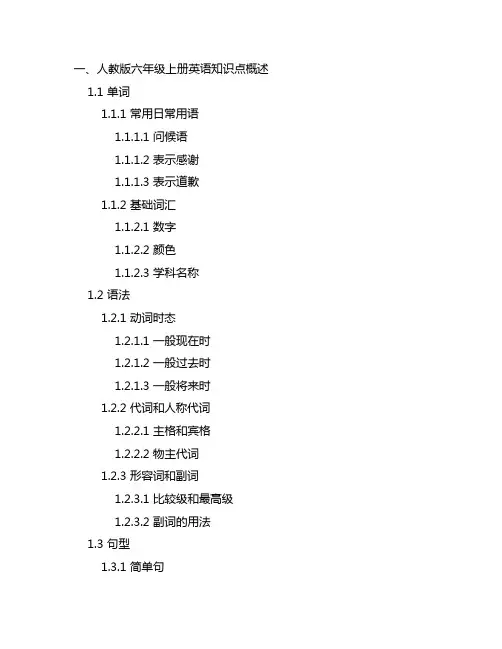
一、人教版六年级上册英语知识点概述1.1 单词1.1.1 常用日常用语1.1.1.1 问候语1.1.1.2 表示感谢1.1.1.3 表示道歉1.1.2 基础词汇1.1.2.1 数字1.1.2.2 颜色1.1.2.3 学科名称1.2 语法1.2.1 动词时态1.2.1.1 一般现在时1.2.1.2 一般过去时1.2.1.3 一般将来时1.2.2 代词和人称代词1.2.2.1 主格和宾格1.2.2.2 物主代词1.2.3 形容词和副词1.2.3.1 比较级和最高级1.2.3.2 副词的用法1.3 句型1.3.1 简单句1.3.1.1 肯定句1.3.1.2 否定句1.3.1.3 疑问句1.3.2 复合句1.3.2.1 并列句1.3.2.2 定语从句1.3.2.3 状语从句二、人教版六年级上册英语知识点详解2.1 单词2.1.1 常用日常用语2.1.1.1 问候语问候语是指在英语日常交际中用于打招呼和示好的常用词汇,包括Hello、Hi、Good morning、Good afternoon等等。
2.1.1.2 表示感谢表示感谢的常用词汇有Thank you、Thanks a lot、Thank you very much等,用于表达对别人的帮助或礼物表示感激之情。
2.1.1.3 表示道歉表示道歉的词汇包括I'm sorry、Excuse me、Pardon等,在日常生活中,用于向别人道歉或请求对方让步的场合。
2.1.2 基础词汇2.1.2.1 数字数字是英语基础词汇的重要部分,包括基本的数字表达方式和计量单位,如one、two、three等,以及hundred、thousand等。
2.1.2.2 颜色颜色是描述事物外观的重要词汇,在日常交流中也经常用到,包括red、blue、yellow等常见颜色词汇。
2.1.2.3 学科名称学科名称涉及到人们日常生活和学习工作的方方面面,包括mathematics、music、art等,是学习英语时必须掌握的词汇。
六年级上册英语重点知识点归纳
六年级上册英语重点知识点归纳1.六年级上册英语重点知识点归纳篇一museum博物馆bookstore书店cinema电影/院turn转弯hospital医院left向左post office邮局science科学right向右straight笔直地crossing十字路口2.六年级上册英语重点知识点归纳篇二by乘bus公共汽车onfoot步行plane飞机taxi出租车ship(大)船subway地铁train火车slow慢的stop停下always总是,一直usually通常often经常sometimes有时候never从来不3.六年级上册英语重点知识点归纳篇三Wait!等一等!Hooray太好了!I see. 我明白了。
Go at a green light 绿灯行Stop at a red light 红灯停Wait at a yellow light 黄灯等4.六年级上册英语重点知识点归纳篇四How do you go to school? 你怎么去上学?Usually I go to school on foot. Sometimes I go by bus.通常我步行去上学。
有时候骑自行车去。
How can I get to Zhongshan Park ? 我怎么到达中山公园?You can go by the No. 15 bus. 你可以坐15路公共汽车去。
I am far from school now. 我现在离学校很远。
5.六年级上册英语重点知识点归纳篇五tomorrow明天film电影supermarket超市trip旅行tonight在今晚evening晚上/傍晚next week下周comic连环画杂志dictionary词典word单词postcard明信片visit拜访6.六年级上册英语重点知识点归纳篇六What about you?你呢?Here they are!它们在这儿!Can I help you?我能帮助你吗?Sounds great!听起来很棒!Have a good time!玩得开心!You too.你也是7.六年级上册英语重点知识点归纳篇七What are you going to do on the weekend? 你周末打算做什么?I'm going to visit my grandparents this weekend? 这个周末我打算去看望我的外祖父母。
小学六年级英语上册知识点整理
小学六年级英语上册知识点整理1.语法知识点- 时态:一般现在时、一般过去时、一般将来时- 句型:陈述句、疑问句、否定句、祈使句- 提问:特殊疑问词的使用(What。
Where。
When。
Why。
Who。
Whose。
How等)- 动词:动词的基本形式、动词的过去式、动词的进行时- 名词:可数名词、不可数名词、单数形式和复数形式的变化- 形容词:形容词的基本形式、形容词的比较级和最高级- 副词:副词在句中的位置- 介词:常用介词的使用(in。
on。
at。
by。
with等)- 冠词:冠词的使用(a。
an。
the)- 连词:and。
but。
or的使用2.词汇知识点- 数字:1-100的基本数字表达,以及相关的算术运算词汇- 天气:常见的天气词汇(sunny。
rainy。
windy等)- 季节:春、夏、秋、冬四个季节的英文表达- 颜色:常见的基本颜色词汇(red。
blue。
green等)- 学科:英语、数学、音乐等学科的英文表达- 动物:常见的动物名称(dog。
cat。
bird等)- 蔬菜和水果:常见的蔬菜和水果名称(carrot。
apple。
banana 等)- 地点:常见的地点名称(school。
park。
supermarket等)- 人物:常见的人物角色(teacher。
student。
friend等)3.日常用语知识点- 问候与回应:常用的问候语和回应语(Good morning。
How are you?等)- 自我介绍:自我介绍的基本句型和常用词汇- 家庭成员:家庭成员的英文表达(father。
mother。
brother等)- 个人信息:年龄、姓名、国籍等个人信息的英文表达- 时间:表达时间的基本句型和常用词汇(hour。
minute。
o'clock等)- 打电话用语的基本句型和常用词汇- 交通工具:常见的交通工具名称(bus。
car。
bike等)- 食物和饮品:常见的食物和饮品名称(rice。
六年级英语上册重点知识归纳
六年级英语重点知识归纳六年级英语上册重点知识归纳一、一般现在时1.概念:表示经常性、习惯性的动作,常与always等连用。
2. 用法:(1)常见的动词:go,come,leave,play,do,watch,see,read,study,write等。
(2)动词的第三人称单数:以o,e,s,x,ch,sh结尾的动词加es,辅音字母加y的动词,把y去掉。
如:goes,ives,buys,plays,watchs, sees, reads,writhes。
(3)句型:肯定句:主语+动词原形+其他主语+be+其他否定句:主语+don’t+动词原形+其他主语+be+not+其他一般疑问句:Do+主语+动词原形+其他?特殊疑问句:疑问词+do+主语+动词原形+其他?二、现在进行时1.概念:表示正在发生的动作。
2.用法:(1)常见的动词:be,run,walk,dance,eat,write,watch,see,read等。
(2)结构:主语+be+动词的ing+其他肯定句:主语+be+动词的ing+其他否定句:主语+don’t+动词原形+其他一般疑问句:Be+主语+动词原形+其他?特殊疑问句:疑问词+be+主语+动词原形+其他?三、一般过去时1.概念:表示过去发生的动作或存在的状态。
2.用法:(1)常见的动词:go,come,leave,play,do,watch,see,read,study,write等。
(2)动词的过去式:以ow,ay,io结尾的动词加ed,如:grew, cleaned,adopted。
其他结尾的动词减去词尾的e再加上ed,如:went-went-went,offered-offered-offered。
(3)句型:肯定句:主语+动词过去式+其他主语+was/were+其他否定句:主语+don’t/didn’t+动词原形+其他主语+was/were+not+其他一般疑问句:Did+主语+动词原形+其他?特殊疑问句:疑问词+did+主语+动词原形+其他?四、现在完成时1.概念:表示过去发生的动作对现在造成的影响或结果。
(完整版)六年级英语上册知识归纳

六年级英语上册知识点归纳Un it 1 How can I get there?重点单词:scie nee 科学museum博物馆post office 邮局bookstore 书店cinema电影院hospital 医院crossing 十字路口turn转弯left向左ask问in teresti ng 有趣的Italian意大利restaura nt 餐馆GPS全球卫星定位系统好词搭档turn left向左转next to挨着pizza比萨饼feature 特点turn right向右转go straight 直走post office 邮局street大街;街道get到达follow跟着far较远的tell告诉go straight 直行in front of...在...前面n ear the park 在公园附近on DongfangStreet在东方大街pet hospital宠物医院Beihai park北海公四Italian restauran埴大利餐馆Palace Museum故宫博物院scienee museum科学博物馆重点句子:1、Where is the museum shop?博物馆的商店在哪儿?It ' s near the door.在大门附近。
2、How can we get there? 我们怎么到那儿?Turn left at the bookstore. 在书店左转。
3、I want to buy a postcard. 我想买一张明信片。
4、I ' II ask.我去问问。
5、a talki ng robot! 一个讲话机器人。
6、What a great museum! 好棒的一家博物馆!7、There is a pet hospital in my city. 在我的城市有一家宠物医院。
8、Wu Yifan and Robin are looking at some robots. 吴一凡和罗宾正在看一些机器人。
六上英语必背知识点
六上英语必背知识点六年级英语上册必背知识点一、重点单词there be 结构:表示“某处有某物”。
其中,“there be”是结构助动词,表示存在关系。
家庭成员的称呼:例如“grandfather”(爷爷)、“grandmother”(奶奶)、“father”(爸爸)、“mother”(妈妈)、“uncle”(叔叔)、“aunt”(阿姨)等。
学科类单词:如“math”(数学)、“english”(英语)、“science”(科学)等。
季节类单词:如“spring”(春天)、“summer”(夏天)、“fall”(秋天)、“winter”(冬天)等。
序数词:如“first”、“second”、“third”等。
二、重点句型there be 结构句型:“There is/are + 名词 + 地点/时间状语.”表示“某处有某物”。
询问对方家庭成员的句型:“Who’s that man/woman?”“He/She is my ...”询问对方喜欢的季节的句型:“What’s your favorite season?”表示建议和请求的句型:“Let’s ...!”“What about ...?”“Shall we ...?”表示时间和日期的句型:“What time is it?”“It’s ...”“What day is it?”“It’s ...”三、语法点there be 结构:表示存在关系,其中be动词的形式根据主语的不同而有所变化。
名词的复数形式:英语中名词有单数和复数形式,单数形式表示一个物品,复数形式表示多个物品。
动词的第三人称单数形式:“does”和“doesn’t”的使用。
现在进行时态:“be + 现在分词”表示正在进行的动作或状态。
人教版PEP英语六年级上册知识点归纳
Unit 1 How can I get there?1. 名词: science 科学 museum 博物馆 bookstore 书店 cinema 电影院 hospital 医院 crossing 十字路口2. 动词: turn 转弯3. 副词: left 左 right 右 straight 笔直地4. 短语: post office 邮局1. 名词: sir 先生 restaurant 餐馆 pizza 比萨饼 street 大街;街道 GPS 全球(卫星)定位系统2. 动词: ask 问 feature 特点 get 到达 gave(give 的过去式) 供给;交给 follow跟着tell 告知3. 形容词: interesting 好玩的 Italian 意大利的 far 较远的1. — Where is the cinema? 电影院在哪儿?— It ’ns e xt to the bookstore. 紧挨着书店。
2. How can we get there?我们怎么到那儿?3. Turn left at the bookstore. Then turn right at the hospital.到书店左转。
然后到医院右转。
留意:要留意介词的固定搭配。
Turn left/right at the … 到……左/右转。
Get off at the … 在……下车。
一、核心词汇二、了解词汇三、核心句型It’s on the left/right.在左/右边。
Walk/Go straight for …minutes.步行/直走……分钟。
It’seast/west/south/north of the …在……东/西/南/北边。
It’sfar from the …距离……远。
四、了解句型1.Is there a …?……有……吗?拓展: there be 句型(1)主要用以表达“某处(某时)有某人(某物)”,其根本句型为“There+be 动词+名词+介词短语+其他.”There is a football under the chair. 椅子下面有一个足球。
(精心归纳总结)六年级英语上册重点知识
他喜欢猜字谜和远足吗?
—Yes, he does.是的,他喜欢。
句型
1.询问爱好的句型
固定句型:What is/are +one’s+ hobby/hobbies? (……有什么爱好?)
答语:人+like(s) doing…(……喜欢做……)
—She is a nurse.她是一名护士。
2.用句型“Where does+主语(第三人称单数)+work?”询问某人的工作地点。用句型“主语(第三人称单数)+works +(表示地点的)介词短语。”回答。如:
—Where does your father work?你爸爸在哪儿工作?
—He works in a car factory.他在一家汽车工厂工作。
wash clothes洗衣服draw pictures画画
make a snowman堆雪人go for a picnic去野餐
句子
1.—What are you going to do tomorrow?你明天打算做什么?
—I’m going to have an art lesson.我要上美术课。
5. Some children go to school on foot in Munich, Germany.
在德国慕尼黑,一些孩子们步行上学。
句型
1.询问出行方式的句型及答语。
用How do you come/go (to)…?句型询问,用I come/go (to)+地点+ on foot/ by bike/ by car…句型作答。
六年级上册英语1-4单元必考知识点总结
Unit 3 What are you going to do?
一.词汇 'next week 下周
newsp叩er 报纸
this morning 今天上午
comic book漫画书
Time: (时间)
this afternoon 今天下午 this evening今天晚上
magazine 杂志 dictionary 字典
make kites (making kites )制作风筝 colLect stamps (collecting stamps)集邮
三单
Live (lives)居住,住 teach (teaches)教 go (goes)去 watch (watches)看 read (reads)读
其他show (展览)
(交通工具前加by,表示乘坐但步行要用on foot)
三会一
fifth第五 difference 不同 country 国家 right右边的 Australia澳大利亚 if如果
remember 记住 same相同的 mean意思是
side 边 however 但是 must必须
find找到 every每个所有的 drive驾驶
do (does) pen pal(笔友)
dear (亲爱的)
look(看上去)fun(快乐,乐趣)
with(同…)
三、重点句型:
1 .询问某人的爱好:
---------- What's your hobby?你的爱好是什么?
-----------1 Like collecting stamps.我喜欢集邮 2 .表示征求别人意见:
我坐飞机去。
■ ----------- How does your father go to work? ----------- He goes to work by subway.
英语六年级上册必考知识点
英语六年级上册必考知识点一、单词拼写1. 熟记并掌握课本中出现的所有单词的拼写。
2. 多做单词拼写练习,培养熟练的拼写能力。
二、语法知识1. 时态:掌握一般现在时、一般过去时、一般将来时的用法和构成。
2. 名词:熟悉可数名词和不可数名词的用法,以及单数和复数的规则变化。
3. 代词:掌握人称代词、物主代词、指示代词和不定代词的用法。
4. 形容词:理解形容词作用、形容词的比较级和最高级的构成。
5. 副词:掌握副词的用法,如修饰动词、形容词和副词本身的比较级。
6. 介词:熟悉常用的介词及其用法,如表示时间、地点和方式等。
7. 动词:了解动词的原形、过去式和过去分词的构成规则。
8. 人称代词和动词的一致性:掌握人称代词与动词之间的一致关系。
三、句型转换1. 肯定句转变为否定句和疑问句:掌握否定句和一般疑问句的构成规则。
2. 一般疑问句转变为肯定句和否定句:掌握回答一般疑问句的肯定和否定形式。
四、阅读理解1. 熟练阅读课本中的短文,并理解主旨内容。
2. 掌握从短文中获取关键信息的技巧,如寻找细节和推理等。
3. 培养阅读理解的速度和准确性,多做阅读练习。
五、写作能力1. 能够运用学到的基础词汇和语法知识,写出简单的句子和段落。
2. 培养表达思想的能力,逐渐提高写作的准确性和流畅性。
六、听力技巧1. 听力理解:提高听力的准确性和处理信息的能力。
2. 听写能力:提高听写的准确性和速度,注意拼写正确。
以上就是英语六年级上册必考的知识点汇总,希望同学们在备考过程中能够重点关注这些内容,加强基础,提高自身的英语水平。
祝大家取得好成绩!。