
人教版八年级英语上册Unit 2《How often do you exercise》PPT课件
次).
5.Cheng shops about t_h_r_e_e__t_im__e_s a week(每周三次).
Ask and Answer
Ask your partner like this: 1. How often do you eat sweets? 2. How often do you play tennis?
What does he / she usually do on weekends?
He / She usually … always … sometimes … often …
What does he / she usually do on weekends?
He / She usually … always … sometimes … often …
go to the movies
use the Internet
watch TV read
play the piano go shopping
dance
play tennis
1a
Look at the picture.Make a list of the weekend activities.
• sometime • some time • sometimes • some times
某个时间 一段时间 有时 几次
I sometimes go to school by bus. I will go to America sometime this year. I have been to the Great Wall for some times. I watched TV for some time last night.
根据汉语提示完成句子。
1.Cheng watches TV about _tw__i_c_e_a__w__e_e_k(一周两次). 2.The reporter reads news stories every day (每天读
新闻故事) at school.
3.Cheng goes to the movies (看电影)once a month. 4.The reporter exercises about t_w__ic_e__a__m_o__n_t_h(每月两
➢ Key sentences:
1. — What do you usually do on weekends? — I often go to the movies.
2. — How often do you watch TV? — I watch TV every day.
➢ The adverbs of frequency
bc
d
a
e
What do you usually do on weekends?
I often go to the movies.
1. help with housework 4. read (a book)
2. watch TV
5. go shopping
3. exercise
频度副词
always usually
…
How often do you go shopping?
We shop / go shopping once a week.
How often do you go to the movies? I go to the movies once a month.
How often do you exercise?
I exercise twice a week.
How often do you use the Internet?
I use the Internet twice a week.
Practice
2c
How often do you do these activities? Fill in the chart and then make conversations.
go to the movies
do housework
play tennis
play the piano exercise
go shopping
watch TV use the Internet
read
What do you usually/offendo on weekends? I usually … often … sometimes … always …
Adverbs of Frequency
dance
play
skate
badminton
play football
swim
always usually
play basketball
often
sometimes
hardly ever never
Do you know their difference?
• once a week / month
一周/一个月一次
• twice a week / month
一周/一个月两次
• three times a week / month 一周/一个月三次
• once or twice a week / month 一周/一个月 一次或两次
how often “多久一次”, 常用来询问某一动作 或事情发生的频率。
2d Role-play the conversation.
Practice
Role-play
A: Hi, … are you … next week?
B: …next week … for me.
A: Really? How come?
B: I have… lessons.
A: What … are you learning?
“次数”的表达方法
一次 once, 两次 twice, 三次或三次以上用基数词加上 times,
three times, five times, one hundred times. 表示“……几次”的表达方法是: once a day / a week / a month / a year twice a day / a week / a month / a year three times a day / a week / …
Practice
1c
bc a
d e
What do you usually do on weekends? I often go to the movies.
A: What do you do on weekends? B: I usually watches TV. A: Do you go shopping? B: No, I never goes shopping.
e. __2_ read
once a month
twice a month
2b Listen again. Match the activities in 2a with how often Cheng Tao does them.
Activities a. ___ go to the movies b. ___ watch TV c. ___ shop d. ___ exercise e. ___ read
-- How often does your mother travel?
-- Once a year. 回答:never (从不) ……
once a day/week(一天/周一次) twice a week/month (一周/月一次)
three/four/five/six … times a month / year 一月/年 三/四/五/六……次
2a Listen. Cheng Tao is talking about how
often he does thes activies. Number the activities [1-5] in the order you hear them.
How often do you watch TV?
often
sometimes
hardly ever never
100% 80% 60% 40% 总是 通常 经常 有时
20% 0 很 少 , 从不 几乎不
根据汉语提示完成句子。
1._H__o_w___o_f_t_e_n__(多久一次) do you watch TV? 2.Tom_i_s__h_a_r_d__l_y___(几乎不) late for school. 2.She__u_s_u__a_l_ly_____(通常) goes to school at 7 o'clock.
How often every day once a week twice a week three times a week once a month twice a month
How often do you …? does he / she …?
• every day / night
每天/每夜
Activities watch TV
How often every day
use the Internet
read English books
go to the movies
exercise
Make conversations. What do you usually do …? How often do you …?
1b Listen and write the activities next to the correct frequency words.
人教版英语八年级上册 Unit 2 How often do you exercise
Unit 2How often do you exercise?
Section B (1a—1e)
一、教学目标
1.熟练掌握重点单词和短语:junk food,coffee,health,be good for,want sb. to do sth.
2. 能够听懂和日常饮食、其他生活习惯有关的对话信息,并能根据信息判断生活习惯健康与否。
3. 能够使用频度副词及How often谈论日常生活习惯话题。
4.合理安排自己的生活,养成良好的生活习惯和饮食习惯,享受健康的生活。
二、教学重点及难点
重点:
能够听懂和日常饮食、其他生活习惯有关的对话信息,并能根据信息判断生活习惯健康与否。
难点:
能够使用频度副词及How often谈论日常生活习惯话题。
三、教学过程
四、板书设计
Unit 2How often do you exercise?
Section B (1a—1e)
Words and phrases:junk food,coffee,health,be good for,want sb. to do sth. How to keep healthy:
A good eating habit.
Exercise often.
Get enough sleep.。
人教版英语八年级上册Unit 2《How often do you exerciseol》教学设计

人教版英语八年级上册Unit 2《How often do you exerciseol》教学设计一. 教材分析人教版英语八年级上册Unit 2《How often do you exercise》主要讲述了关于频率疑问词how often的用法,以及一般现在时的表达方式。
通过本节课的学习,学生能够掌握频率疑问词how often,并能用一般现在时表达自己的生活习惯。
教材中包含了丰富的语言实践活动,如听力、口语、阅读和写作,有助于学生全面提高英语水平。
二. 学情分析八年级的学生已经具备了一定的英语基础,能够听懂并运用一般现在时。
但部分学生对频率疑问词how often的用法还不够熟练,因此在教学中需要重点强调。
此外,学生对生活话题的讨论感兴趣,有利于激发学习积极性。
三. 教学目标1.知识目标:–能够正确使用频率疑问词how often。
–能够用一般现在时表达自己的生活习惯。
2.能力目标:–提高学生的听说读写能力,熟练运用本节课所学知识进行交流。
3.情感目标:–培养学生热爱生活、注重锻炼的良好习惯。
四. 教学重难点•频率疑问词how often的用法。
•一般现在时的表达方式。
•正确运用频率疑问词how often进行提问和回答。
•如何运用一般现在时表达自己的生活习惯。
五. 教学方法1.情境教学法:通过设定生活场景,让学生在实际语境中练习英语。
2.交际教学法:鼓励学生积极参与课堂互动,提高口语表达能力。
3.任务型教学法:通过完成小组任务,培养学生的合作精神和团队意识。
4.反馈评价法:及时给予学生反馈,鼓励学生自主发现问题并改正。
六. 教学准备1.教材:人教版英语八年级上册。
2.课件:制作与本节课相关的内容,包括图片、视频等。
3.练习题:针对本节课的内容,设计听、说、读、写等方面的练习。
4.教学设备:投影仪、音响等。
七. 教学过程1.导入(5分钟)–教师通过提问学生日常生活中喜欢的事物,引出本节课的主题——生活习惯。
人教新目标版英语八上Unit 2《How often do you exercise》(Period

人教新目标版英语八上Unit 2《How often do you exercise》(Period 4)教学设计一. 教材分析人教新目标版英语八上Unit 2《How often do you exercise》(Period 4)的主要内容是围绕频率副词和一般现在时进行交际。
通过本节课的学习,学生能够掌握频率副词的用法,询问和回答关于日常活动的一般现在时问题。
教材以实际生活场景为背景,让学生在真实语境中学习英语,提高他们的语言运用能力。
二. 学情分析八年级的学生已经掌握了基本的英语语法知识和一定数量的词汇,具备了一定的听、说、读、写能力。
但是,学生在使用英语进行实际交流时,往往会出现表达不准确、语法错误等问题。
因此,在教学过程中,需要关注学生的个体差异,充分调动他们的学习积极性,提高他们的语言运用能力。
三. 教学目标1.知识目标:学生能够掌握频率副词的用法,正确运用一般现在时进行交际。
2.能力目标:学生能够在真实语境中运用英语进行交流,提高他们的语言运用能力。
3.情感目标:培养学生热爱生活、关注健康的意识,使他们养成良好的生活习惯。
四. 教学重难点1.重点:频率副词的用法和一般现在时的交际运用。
2.难点:频率副词在实际语境中的准确运用,以及一般现在时在实际交际中的运用。
五. 教学方法1.情境教学法:通过生活场景的展示,让学生在真实语境中学习英语。
2.交际法:引导学生进行实际交际,提高他们的语言运用能力。
3.任务型教学法:通过完成具体任务,让学生在实践中掌握知识。
六. 教学准备1.教学课件:制作涵盖本节课主要内容的教学课件。
2.教学素材:准备相关的生活场景图片、视频等教学素材。
3.作业布置:提前为学生布置相关的预习作业。
七. 教学过程1.导入(5分钟)利用图片或视频展示一些运动场景,引导学生谈论日常生活中喜欢的运动。
教师提问:“What sports do you like?”,学生回答:“I like playing basketball.”等。
人教版八年级上册英语Unit2How often do you exercise知识点

Unit2 How often do you exercise? Section A1.How often do you exercise? 你多久做一次运动?2.how often多久一次,对频率提问,如:always,everyday ,once a weekhow long多长时间,对“for+一段时间”或”,“since+时间段+ago”等时间短语提问how far 多远,对距离提问how soon 多久,对“in+一段时间“提问3.exercise v 锻炼exercise n.锻炼(不可数);体操,练习题(可数)do exercise =do sports= play sports做运动do morning exercises 做早操do eye exercises 做眼保健操4.What do you usually do on weekends? 你在周末做什么?5.频度副词always总是,一直>usually通常,经常>often常常,经常>sometimes 有时>hardly ever= almost not几乎从不>never 从不,决不【注】:频度副词用在实义动词之前,系动词、助动词、情态动词之后。
6.(1)some time一段时间,做时间状语It takes sb some time to do sth 做某事花费某人多长时间(2)sometime adv 在某个时候I hope to visit the USA sometime in the future.(3) some times 名词词组,“几次,几倍”(4)sometimes=at times 有时(一般现在时的标志词)7.on weekends =on the weekend= on Saturday and Sunday 在周末on weekdays= from Monday to Friday 在工作日8.hardly ever 几乎从不hard (1)adv 努力地,猛烈地work hard 努力工作study hard 努力学习(2) adj. 困难的,艰难的=difficult◆It’s hard/difficult for sb to do sth 做某事对某人来说是困难的【拓展】hardly adv “几乎不,从来不”,表否定意义9.twice a week 一周两次once = one time一次twice= two times两次三次或三次以上用:“基数词+times”three times 三次four times 四次three or four times 三到四次10.go shopping 去购物do some shopping 购物11.help with housework帮助做家务(1)help sb. (to) do sth=help sb. with sth 帮助某人做某事(2)help oneself to…请随便吃/喝(3)can’t help doing sth 情不自禁做某事12.go to the movies = go to the cinema = see the film 去看电影13. at least = not less than至少;不少于at most至多14. use the Internet 上网15.What’s your favorite program?=What program do you like best?你最喜欢的节目是什么?16.every day 每天= each day 做状语,放在句末,对其提问用how ofteneveryday = daily adj. 每天的,作定语,修饰名词,放在名词之前He exercises every day. 他每天都锻炼。
人教版八年级上册Unit 2 How often do you exercise? 语法知识突破
人教版八年级上册Unit 2 How often do you exercise?语法知识突破人教版英语八年级上册第二单元Unit 2 How often do you exercise 语法知识突破在英语学习中,语法学习,既是一个重点,也是一个难点,每个单元的设计都是围绕一定话题,突破语法和句子知识展开的。
接下来,我们来呈现一下人教版英语八年级上册第二单元的语法如何突破?从标题看语法本单元的标题是:How often do you exercise 从标题可以看出,本单元主要谈论“频率”问题,所以,话题就是“关于日常活动的频率”,既然是询问频率,就牵涉到关于如何询问频率?如何表达频率?等一系列的问题。
语法突破:如何询问频率?英语里面,当我们要询问对方“多久做一次某事”的时候,要用“how often”来询问频率,表示“多久一次”,例如:How often do you exercise 你多久锻炼一次?How often do they go out for a picnic 他们多久出去野炊一次?从Grammar focus看语法。
语法部分从基本句型”What do you usually do “引入,通过回答,给我们展示了频率副词always , often, sometimes等的用法。
接下来,用How often do you go to the movies 再次引出频率副词的用法以及如何表示“次数”。
让我们先看语法中的句子。
What do you usually do on weekends I always exercise.What do they do on weekends They often help with housework.What does she do on weekends She sometimes goes shopping.How often do you go to the movies I go to the movies maybe once a month.How often does he watch TV He hardly ever watches TV.Do you go shopping No , I never go shopping.当询问某人周末通常做什么的时候,用到频率副词usually,它的位置“be动词的后面,行为动词的前面”。
初中英语八年级上册Unit 2 How often do you exercise课件
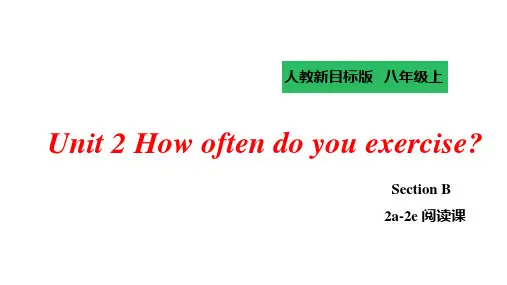
1.Jack sleeps just 6 hours every day. 2.He eats junk food very often, and he never drinks milk. 3.He hardly ever exercises.
How to keep healthy?
Eat healthy food. Exercise often. Have lots of sleep. Be happy. Help others. …
人教新目标版 八年级上
Unit 2 How often do you exercise?
Section B 2a-2e 阅读课
Lead in
1.Lisa sleeps eight hours every night. 2.She eats a good breakfast and she exercises every day. 3.She never eats junk food.
The answers to our questions about watching television were also interesting. Only two percent of the students watch TV one to three times a week. Thirteen percent watch TV four to six times a week. And eighty-five percent watch TV every day! Although many students like to watch sports, game shows are the most popular. It is good to relax by using the Internet or watching game shows, but we think the best way to relax is through exercise. It is healthy for the mind and the body. Exercise such as playing sports is fun, and you can spend time with your friends and family as you play together. And remember, “old habits die hard”. So start exercising before it’s too late!
人教新目标版英语八上Unit 2《How often do you exercise》(Period
人教新目标版英语八上Unit 2《How often do you exercise》(Period 5)教学设计一. 教材分析人教新目标版英语八上Unit 2《How often do you exercise》(Period 5)的主要内容是围绕频率副词进行问答,学会用英语询问别人的锻炼习惯,并能够用恰当的频率副词回答。
本节课的主要目标是让学生掌握频率副词的用法,以及如何用英语询问和描述别人的锻炼习惯。
二. 学情分析学生在学习本节课之前,已经掌握了基本的日常交际用语,能够进行简单的自我介绍和询问他人信息。
但是,对于频率副词的用法以及如何用英语询问和描述别人的锻炼习惯还不够熟练。
因此,在教学过程中,需要注重频率副词的讲解和练习,以及锻炼习惯的描述。
三. 教学目标1.能够听懂、会说、会读频率副词:always, usually, often, sometimes,rarely, never。
2.能够用英语询问别人的锻炼习惯,并能用恰当的频率副词回答。
3.能够描述自己的锻炼习惯,并能够询问他人的锻炼习惯。
四. 教学重难点1.频率副词的用法。
2.如何用英语询问和描述别人的锻炼习惯。
五. 教学方法1.交际法:通过模拟真实场景,让学生在实际语境中学习和使用频率副词和锻炼相关的词汇。
2.任务型教学法:通过完成各种任务,让学生在实践中学习和运用英语。
3.小组合作学习:通过小组讨论和互动,提高学生的参与度和积极性。
六. 教学准备1.教学PPT:包括频率副词的图片、例句、练习题等。
2.练习册:配合PPT进行练习。
3.教学录音机:用于播放听力材料。
4.教学视频:用于播放相关场景的视频。
七. 教学过程1.导入(5分钟)通过播放一段关于人们锻炼的视频,引导学生谈论人们的锻炼习惯。
教师提问:“How often do you exercise?”,让学生用中文回答,同时板书频率副词:always, usually, often, sometimes, rarely, never。
2017人教新目标版英语八上Unit 2《How often do you exercis
Does Tina have good habits?
Yes. No. I don’t know.
Does Bill have good habits?
Yes. No. I don’t know.
1d Listen again. Fill in the blanks in the survey.
热狗对我们的健康有坏处。
1a. Match the words with the pictures.
a
b
c
d
e
f
Check the answers!
1. __b__ junk food 4. ____c_ vegetables
2. ___a__ milk
5. ____f_ sleep
3. ___e__ fruit 6. ____d_ coffee
nine
4.How often do you drink milk? 5.How often do you eat junk food? 6.How often do you drink coffee?
every day 2 or 3 times a week never
nine
never 3 or 4 times a week 4 times a day
healthy: unhealthy:
healthy: salad, soup, broccoli, milk , dumpling, onion, mushroom, milk, fruit, vegetables unhealthy:
cola, hot dog, potato chips, fried chicken, hamburger, junk food, coffee, chocolate
人教新目标版英语八上Unit 2《How often do you exercise》(Period
人教新目标版英语八上Unit 2《How often do you exercise》(Period 3)教学设计一. 教材分析人教新目标版英语八上Unit 2《How often do you exercise》第三课时,主要围绕频率副词进行问答,引导学生学会在适当的情境中询问和描述别人的锻炼习惯。
本课时通过听力、口语、阅读和写作等多种形式,让学生在实际语境中运用频率副词,提高他们的语言运用能力。
二. 学情分析学生在学习本课时已经掌握了基本的日常交际用语,具备一定的听说读写能力。
但部分学生在实际运用频率副词时,可能会出现混淆和错误。
因此,在教学过程中,教师需要关注学生的个体差异,有针对性地进行辅导。
三. 教学目标1.知识目标:学生能够掌握频率副词的用法,正确询问和描述别人的锻炼习惯。
2.能力目标:学生能够在实际情境中运用频率副词,提高口语交际能力。
3.情感目标:培养学生热爱锻炼、养成良好的生活习惯。
四. 教学重难点1.重点:频率副词的用法和实际运用。
2.难点:在特定情境中,正确运用频率副词进行问答。
五. 教学方法1.任务型教学法:通过设置各种实际情境,让学生在完成任务的过程中运用频率副词。
2.交际法:引导学生进行角色扮演、小组讨论等互动活动,提高口语交际能力。
3.情境教学法:创设生活情境,让学生在实际语境中学习、运用频率副词。
六. 教学准备1.教学材料:人教新目标版英语八上教材、多媒体设备。
2.教学辅助材料:录音机、磁带、课件。
3.教学场地:教室。
七. 教学过程1.导入(5分钟)教师通过提问学生日常生活中喜欢的运动,引导学生谈论锻炼习惯,为新课的学习营造轻松愉快的学习氛围。
2.呈现(5分钟)教师展示本课时的图片,引导学生观察并说出图片中人物的锻炼方式。
然后教师提问:“How often do they exercise?”,让学生回答。
3.操练(10分钟)教师播放录音,学生跟读并模仿语音语调。
人教版八年级上册英语知识点梳理Unit 2 How often do you exercise
Unit 2 How often do you exercise?Section A:1.how often多久一次(向频度副词或表示频度的短语提问)how long多长时间(向表示一段时间的状语提问);多长(向长度提问)how soon多快;多久以后(向表示将来时态的时间提问)how many多少(后接可数名词复数)how much多少(后接不可数名词;还可以用于询问价格或重量。
)how old多大岁数(向年龄提问)how far多远(向距离提问)How come ?怎么会呢?怎么回事?2. take exercise = exercise = do exercise 锻炼do exercises 做练习do morning exercises 做早操do eye exercises做眼保健操play sports = do sports = have sports 做运动3. make a list of列出......的清单make a list of the weekend activities 列出周末活动的清单4. hardly ever 几乎不at times = sometimes=from time to time 有时sometime某个时候some time 一段时间some times 几次5. watch cartoons on TV在电视上看动画片watch a movie / see a film 看电影watch games 看比赛read books / magazines / newspapers看书/杂志/报纸6. (1)Once upon a time 从前(2)at once 马上(3)Once the sun sets, the air turns cold.一旦at once马上once a month 一个月一次twice a year 一年两次three times a week 一个星期三次7. match…with... 把......和......相连;把......和......相匹配8. be free有时间;有空;免费的be free to do sth.随意做某事;自由自在地做某事in one’s free time在某人的空闲时间9. be full for sb.对于某人来说忙或安排很满be full of充满;装满=be filled with10. have dance and piano lessons上舞蹈课和钢琴课swing dance 摇摆舞11. stay up = sit up 熬夜12. at least至少;不少于;起码at most至多;不超过13. be too busy 太忙了'be busy with sth.忙于某事be busy (in) doing sth.忙于做某事14. add... to...给......添加......add up to 总计15. according to 根据/ 视......而定16. ask sb. about sth. 询问某人有关某事ask sb. for sth.向某人要某物ask sb. to do sth.要求某人做某事17. go online上网;上线surf the Internet / surf online 网上冲浪18. be surprised at sth.对某事感到惊讶be surprised to do sth.惊讶地做某事19. for fun好玩;开玩笑地(不是认真地)20. the answers to our questions我们问题的答案the key to the door这门的钥匙。