
深圳 七年级下英语期末总复习-语法
七年级下英语期末总复习Chapter 1 语法冠词Ⅰ. 用a / an / the填空,不需要则填“/”。
1. Susan and Alice study in _________ same class.2. Here is _________ white pencil box. Is _________ pencil box yours?3. Tom always has milk for _________ breakfast.4. There is _________ “s” and _________ “u” in the word “sun”.5. I prefer playing _________ basketball to playing _________ piano.6. Is _________ sun bigger than _________ moon?7. June 1st is _________ Children’s Day.8. _________ Browns will move to Shenzhen next week.9. Shanghai is one of _________ most beautiful cities in China.10. He studied abroad and lived with _________ American family.11. _________ girl in white is _________ actor.12. My father always travels by _________ train.13. — Excuse me, where is _________ Children’s Hospital?—It’s right over there opposite _________ bank.14. He is always _________ first to arrive school.15. — Do you know _________ girl with a pair of sunglasses?— You mean _________ one on the left?Ⅱ. 单项选择( ) 1. Eric has ______ e-dog and its name is Hobo.A. aB. anC. theD. /( ) 2. There is ______ apple tree in my garden. It’s over 10 years old.A. theB. aC. anD. /( ) 3. Could you tell me ______ answer to this problem? I can’t work it out.A. aB. anC. theD. /( ) 4. — Do you know ______ lady in blue? — Yes. She is our maths teacher.A. theB. aC. anD. /( ) 5. This is ______ car I bought yesterday. Isn’t it ______ nice one?A. the; theB. a; aC. the; aD. a; theChapter 2 语法现在进行时Ⅰ. 用所给动词的适当形式完成句子。
1. He _________ (come) soon.2. Tom _________ (fly) to Beijing tonight.3. Look! David _________ (play) chess with his teacher.4. Linda and Ann _________ (have) lunch now.5. Miss Li _________ (leave) for Shanghai tomorrow afternoon.Ⅱ. 单项选择( ) 6. — Where is Tom now? — He ____ an e-mail to his friend in his room.A. writesB. writingC. is writingD. write( ) 7. — Jack, why are you under the bed? — I ___ my football. Where is it, do you know?A. am findingB. am looking forC. look forD. find( ) 8. Jim, with his friends, ________ a bus in front of the school gate now.A. is waiting forB. are waiting forC. waits forD. wait for( ) 9. — Look! Lucy _________ badminton.—That can’t be Lucy. She seldom _________ badminton.A. plays; playsB. plays; is playingC. is playing; is playingD. is playing; plays ( ) 10. — ___ all the children ___ in the room? — No, one of them ____ to the music.A. Are; singing; are dancingB. Is; singing; is dancingC. Are; singing; is dancingD. Is; singing; are dancingChapter 3 语法指示代词单项选择( ) 1. _______ are chickens and ______ are ducks.A. This; thatB. These; thoseC. That; thisD. This; these( ) 2. The climate (气候) in Shenzhen is better than _______ in Beijing.A. itB. thisC. thatD. those( ) 3. The students in Grade Three are taller than _______ in Grade One.A. itB. thisC. thatD. those( ) 4. Keep _______ in mind. Don’t forget it.A. theyB. theseC. thisD. Those( ) 5. — John, someone is waiting for you at the gate of our school. — Who is ____?A. heB. sheC. itD. theyChapter 3 语法名词Ⅰ. 用括号内所给单词的适当形式填空。
1. A horse has four _________ (foot).2. Two _________ (policeman) are walking in the street.3. The little girl has two __________ (tooth) already.4. There are five __________ (Chinese) and three __________ (German) in the class.5. They have two __________ (library), but we have only one.6. — How many __________ (box) are there in the room?— There are two.7. There are some __________ (shelf) in the reading room.8. Look! Two __________ (monkey) are fighting for food over there.9. I like eating __________ (potato) and __________ (tomato).10. It is said that eight __________ (glass) of water a day can help you keep fit.Ⅱ. 单项选择( ) 1. There are three ________ assistants in that ________ shop.A. women; shoeB. woman; shoeC. woman; shoesD. women; shoes ( ) 2. —I’d like something to read.—OK. Here’s some ________.A. CDsB. pencilsC. photosD. books( ) 3. — Are there any ________ on the farm? — Yes, there are some.A. horseB. duckC. chickenD. sheep( ) 4. — What would you like to drink, ________ or orange? — Orange, please.A. hamburgerB. chipC. teaD. bread( )5. There are few _____ in the fridge. Let’s go and buy some carrots and cabbages.A. meatB. fruitC. vegetablesD. bread( ) 6. Mum, I’m hungry. Would you please give me some ________?A. breadB. dumplingC. clothesD. sandwich( ) 7. — They are thirsty. Will you please give them ________? — Of course.A. some bottles of watersB. some bottles of waterC. some bottle of waterD. some bottle of waters( )8. —Are they _____? —_____, they are.A. crocodiles ; NoB. crocodile; NoC. crocodile ; YesD. crocodiles ; Yes ( )9. Sarah often eats a _____ of rice at noon.A. bottleB. bowlC. jarD. /( )10. —Are there _____ students on the playground? —Yes, there are _____.A. any; someB. some; anyC. any; anyD. some; someChapter 4 语法代词I. 用所给代词的适当形式填空。
七年级英语下学期期末语法总复习

初一下学期期末语法总复习一、现在进行时概念:表示现阶段或说话时正在进行的动作及行为。
例:The woman is talking to the doctor.时间状语:now, at this time, these days, etc.基本结构:am /is/are +doing否定形式:am /is/are +not +doing.一般疑问句:把be动词放于句首。
现在进行时的用法:1)现在进行时表示现在正在进行的动作。
例如:What are you doing?2)表示感觉,愿望和状态的某些动词,如have, be, hear, see, like等词一般不用进行时。
二、现在进行时与一般现在时的区别:A、辨“个性”一般现在时表示经常性或习惯性的动作,以及主语的特征或状态。
1.表示主语现在的状态或特征。
例如:Lily is at work.I am a teacher.We have a very good relationship with our parents.2.表示经常性或习惯性动作。
例如:My father goes to work by bike every day.I always leave home for school at 6:30.3. 表示主语现在具有的性格或能力等。
She loves to get together with her friends.Ann Wang writes good English but does not speak well.4.表示自然现象,普遍真理,客观存在或科学事实。
例如:Sunday is the first day of the week.Shanghai lies in the east of China.The earth moves around the sun.现在进行时表示现在或现阶段正在进行的动作。
例如:1. 表示现在(指说话人说话时)正在发生的事情We are waiting for you at the moment.2. 表示现阶段正在进行或发生的动作President Hu is visiting in the USA these days.B、辨结构一般现在时的结构是:主语+动词原形或动词的第三人称单数形式+……(谓语动词通常用动词原形。
期末复习之重点句型汇总牛津深圳版英语七年级下册
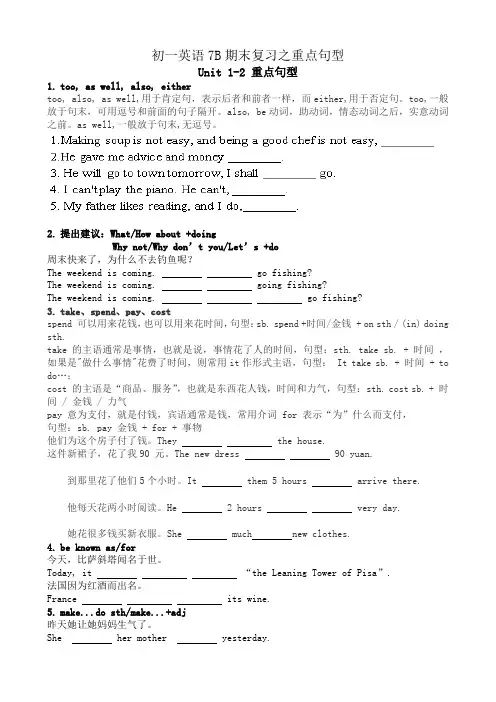
初一英语7B期末复习之重点句型Unit 1-2 重点句型1.too, as well, also, eithertoo, also, as well,用于肯定句,表示后者和前者一样,而either,用于否定句。
too,一般放于句末,可用逗号和前面的句子隔开。
also, be动词,助动词,情态动词之后,实意动词之前。
as well,一般放于句末,无逗号。
2.提出建议:What/How about +doingWhy not/Why don’t you/Let’s +do周末快来了,为什么不去钓鱼呢?The weekend is coming. go fishing?The weekend is coming. going fishing?The weekend is coming. go fishing?3.take、spend、pay、costspend 可以用来花钱,也可以用来花时间,句型:sb. spend +时间/金钱 + on sth / (in) doing sth.take 的主语通常是事情,也就是说,事情花了人的时间,句型:sth. take sb. + 时间,如果是"做什么事情"花费了时间,则常用it作形式主语,句型: It take sb. + 时间 + to do…;cost 的主语是“商品、服务”,也就是东西花人钱,时间和力气,句型:sth. cost sb. + 时间 / 金钱 / 力气pay 意为支付,就是付钱,宾语通常是钱,常用介词 for 表示“为”什么而支付,句型:sb. pay 金钱 + for + 事物他们为这个房子付了钱。
They the house.这件新裙子,花了我90 元。
The new dress 90 yuan.到那里花了他们5个小时。
It them 5 hours arrive there.他每天花两小时阅读。
He 2 hours very day.她花很多钱买新衣服。
语法填空(题型解读+期末真题专题过关) 七年级英语下学期期末考点大串讲(牛津深圳版)(原卷版)
专题09 语法填空(题型解读+期末真题专题过关)2022-2023学年七年级英语下学期期末考点大串讲(牛津深圳版)(原卷版)【题型解读】一.语法填空题型特征语法填空题一共有10个空,其中有6~7个空考查实词,括号内有给出相关的词,另外的3~4个空为考查虚词,不给出相关的词。
此题型主要考查学生对语法和词法知识的掌握和运用。
要注意不同词性的构词法,学会分析空格里的词在句子中的成分也很重要。
二.解题思路1.有单词提示类①.要先从词性考虑,一般名词考查单数或复数形式和名词的所有格。
②.人称代词考查主格,宾格,形容词性物主代词或名词性物主代词,反身代词和不定代词等。
③.形容词和副词考查三级的变化或形副之间的转换。
④.动词考查时态,语态和非谓语动词等用法。
⑤.数词考查基数和序数的区别或复数的用法。
2.无提示类一般考查冠词,介词和连词。
①.冠词要看后面名词的读音开头是否是元音,另外,是否是特指等情况。
②.连词相对最难,要从上下文判断,首先判断是并列句还是从句。
并列句则考虑并列连词and,or,but,so,either...or, neither...nor等。
如果是从句,再判断是什么样的从句。
另外,要根据句子的意思,句子成分,时态等确定关联词。
有时也可能考查到连接副词besides,however,therefore等。
③.介词主要考查基本介词用法和介词的相关固定搭配等。
【期末真题专题过关训练】As for her future, Yang Hui said, “I hope to stand up and walk one day. I want ___60___ (make) my dream come true.”7.(2022春·广东深圳·七年级深圳中学校考期末)阅读下面短文,在空格处填入一个适当的词或使用括号中词语的正确形式填空。
Do you know why water is valuable? Here are some ___61___ (fact) about water. First, about 70% of the human body ___62___ (be) water. That means water makes up 70% ___63___ the human body. Second, most of the water in the world is not ___64___ (drink) although oceans cover about 75% of the Earth. Third, Groundwater may be drinkable, but it is not easy ___65___ (find) clean and safe groundwater. ___66___ (four), if water drips from your tap every ten seconds, you’ll waste about 315 litres of water a year. That’s enough to fill two baths! Last but not least, taking ___67___ bath uses twice as much water as taking a shower. If you take a shower, you___68___ (save) up to 400 litres a week.So, it’s time for us to save water! Always keep the tap off while ___69___ (brush) your teeth. Take a shower instead of a bath. Don’t waste ____70____ pollute it.8.(2022春·广东深圳·七年级统考期末)阅读下面短文,在空格处填入一个适当的词或使用括号中所给词语的正确形式填空,并将答案写在答题卡规定的位置上。
重要语法反身代词和复合不定代词(知识梳理+专题过关) -七年级英语下学期期末考点大串讲(牛津深圳版)
专题07 重要语法反身代词和复合不定代词(知识梳理+专题过关)2022-2023学年七年级英语下学期期末考点大串讲(牛津深圳版)(原卷版)【知识梳理】反身代词表示某人自己的代词叫作反身代词,它有人称和数的变化。
【用法】1.反身代词作动词或介词的宾语,表示动作反射到动作执行者本身。
一般放在动词或介词的后面作宾语。
如:Be careful with that knife or you will cut yourself! 用那把刀要当心,否则你会弄伤自己的!She must be very proud of herself. 她一定对自己感到非常自豪。
2.反身代词作主语或宾语的同位语,强调某人做某事不需要别人的帮助,自己独自来完成。
一般放在主语或宾语的后面,或放在句末。
如:I myself can carry the box. 我自己能扛这个箱子。
He asked you to finish it yourself. 他叫你独自完成它。
3.反身代词用于一些固定搭配中。
如:by oneself独自enjoy oneself玩得开心teach oneself自学think to oneself心里想make oneself at home别拘束talk to oneself自言自语复合不定代词【定义】some-, any-, every-, no-都能与-body, -one, -thing一起构成代词,这些代词叫做复合不定代词。
【例句】1.I saw somebody / someone / something last night.2.There isn’t anybody / anyone / anything here.3.There is nobody / no one / nothing here.4.Did you see anybody / anyone / anything last night?5.Nothing is important to me.6.I find something interesting about colours.【结论】用法:(1)从例句1中可以看出,some-构成的不定代词用于肯定句;(2)从例句2、4中可以看出,any-构成的不定代词用于否定句或疑问句;(3)从例句2、3中可以看出,否定句有两种表达方式,即not any- = no-,如not anybody = nobody, not anything = nothing;(4)从例句5中可以看出,复合不定代词作主语时,谓语动词用单数形式;(5)从例句6中可以看出,形容词修饰复合不定代词时,形容词要置于其后。
深圳初一下英语知识点汇总
深圳初一下英语知识点汇总一、基本语法知识点初一下学期的英语课程主要包含了一些基本的语法知识点,下面我们将逐步介绍这些知识点。
1. 一般现在时态一般现在时态用于描述经常发生的动作、习惯、事实或真理。
例如:•I go to school every day.(我每天上学。
)•The sun rises in the east.(太阳从东方升起。
)2. 一般过去时态一般过去时态用于描述过去发生的动作或状态。
例如:•We watched a movie last night.(我们昨晚看了一场电影。
)•She lived in London for two years.(她在伦敦住了两年。
)3. 现在进行时态现在进行时态用于描述正在进行的动作。
例如:•They are playing soccer in the park.(他们正在公园里踢足球。
)•I’m studying for the exam.(我正在备考。
)4. 一般将来时态一般将来时态用于描述将来发生的动作或事件。
例如:•We will have a party next week.(下周我们将举办一个派对。
)•She is going to visit her grandparents tomorrow.(她明天打算去看望她的祖父母。
)二、词汇知识点除了基本的语法知识点外,初一下学期的英语课程还包括了一些常用的词汇知识点。
1. 动词动词是句子中最重要的词之一,用来描述动作或状态。
例如:•I eat breakfast every morning.(我每天早上吃早餐。
)•She is sleeping.(她正在睡觉。
)2. 名词名词是用来表示人、事物、地方或概念的词。
例如:•My sister is a teacher.(我妹妹是一名教师。
)•I went to the park yesterday.(我昨天去了公园。
)3. 形容词形容词用来描述名词的特征或性质。
七年级下册英语知识点深圳
七年级下册英语知识点深圳深圳七年级下册英语知识点深圳作为一座现代化大都市,英语在其中扮演着不可替代的重要角色,无论是在工作还是生活中。
而对于深圳的初中生们来说,英语学习更是重中之重。
为了帮助同学们更好地学习英语,本文将为大家介绍深圳七年级下册英语知识点。
一、语法1. 一般现在时用法:表示经常性、习惯性的动作或状态。
结构:主语 + 动词原形(第三人称单数要加s)例如:He usually goes to school by bus.2. 现在进行时用法:表示当前正在发生的动作。
结构:主语 + am/is/are + 动词-ing例如:They are playing basketball in the park now.3. 一般过去时用法:表示过去的某个时间发生的动作或状态。
结构:主语 + 动词过去式例如:I watched a movie last night.4. 句型转换将陈述句变为一般疑问句,需要将助动词提到主语前,即将be 动词、情态动词或者助动词放在主语前,然后用疑问词疑问。
否定句的转换则是在助动词前面加上not。
例如:He is a teacher. → Is he a teacher?5. 形容词和副词的比较级和最高级形容词比较级的构成方法一般是在原形后面加-er或者在原形前面加more。
而形容词最高级则是在原形后面加-est或者在原形前面加most。
例如:big → bigger → biggest副词的比较级和最高级的构成方式和形容词类似。
例如:slowly → more slowly → most slowly二、词汇1. 服饰常见的服饰有T-shirt(T恤)、jeans(牛仔裤)、jacket(夹克)、sneakers(运动鞋)等。
2. 交通工具常见的交通工具有bus(公交车)、subway(地铁)、taxi(出租车)、bike(自行车)等。
3. 数字数字是英语中最基础的词汇,常见的数字有0-10,20,30,40,50,60,70,80,90和100。
期末语法总结牛津深圳版(广州沈阳通用)英语七年级下册
牛津深圳版英语七年级下册语法总结目录一、定冠词和零冠词二、专有名词和连词三、反身代词和方位介词四、现在进行时五、表示数量的不定代词六、情态动词七、祈使句和感叹句八、时间状语从句第一单元定冠词和零冠词一、定冠词的用法1.特指上文提到过的、特定的人或事物,或谈话双方都知道的人或事物I have a cat. The cat is white我有一只猫。
这只猫是白色的Pass me the book, please请把那本书递给我2.用于自然界中表示独一无二的事物前The sun was shining brightly as we sailed down我们顺流而下时阳光很灿烂Man travelled to the moon scores of years ago几十年前人类就登上了月球3.用于序数词、表特指的比较级或形容词、副词最高级前This was the first time I was on a train这是我第一次乘火车The greatest talkers are always the least doers言语的巨人往往是行动的侏儒4.用于表示演奏的乐器名词前The boy of no more than four can play the piano very beautifully这个不过4岁的男孩钢琴弹得很好5.用于姓氏的复数形式前,表示全家人或夫妇两The Smiths went on a roundtheworld trip史密斯一家去环球旅游了The Whites are waiting for their daughter怀特夫妇正在等待他们的女儿6.用在某些由普通名词构成的专有名词及表示海洋、河流、山脉、群岛、国家和党派的专有名词前I have never been to the Great Wall我从未去过长城7.用于表示方位、地点、时间的名词前In every country the sun rises in the east太阳不分国别,永远升自东方We sometimes play football in the afternoon我们有时下午踢足球二、零冠词的用法1.表示泛指意义的物质名词、抽象名词、专有名词前通常不用冠词Happiness is a direction, not a place幸福是一个方向,不是一个地点China is one of the largest countries in the world中国是世界上最大的国家之一2.复数名词表示一类人或事物时,其前通常不用冠词Mistakes are often the best teacher错误常常是最好的老师3.表示星期、月份、季节和节日等名词前通常不用冠词Autumn is the harvest season of the year秋天是一年中收获的季节On Christmas Day the children often get presents from their parents在圣诞节,孩子们通常能收到父母给的礼物We go to school from Monday to Friday我们从星期一到星期五都上课4.在学科、语言、三餐、棋类名词和球类运动名词前不用冠词We learned arithmetic at primary school我们在小学学算术Do you have lunch at home or at school?你在家还是在学校吃午饭?I enjoy playing chess我喜欢下国际象棋Do you like playing basketball or rugby?你喜欢打篮球还是打橄榄球?5.by与表示交通工具的名词连用,表示一种交通方式时,名词前不用冠词Now many people want to travel by plane现在很多人想坐飞机旅行6.名词前已有指示代词、物主代词、不定代词或名词所有格等修饰时,不用冠词I like this picture better我更喜欢这幅画This is my address. Let’s keep in touch这是我的地址。
深圳牛津版七年级下英语期末语法总复习
深圳牛津版七年级下英语期末语法总复习深圳牛津版七年级下英语期末语法总复习Chapter 1 语法冠词Ⅰ. 用a / an / the填空,不需要则填“/”。
1. Susan and Alice study in _________ same class.2. Here is _________ white pencil box. Is _________ pencil box yours?3. Tom always has milk for _________ breakfast.4. There is _________ “s” and _________ “u” in the word “sun”.5. I prefer playing _________ basketball to playing _________ piano.6. Is _________ sun bigger than _________ moon?7. June 1s t is _________ Children’s Day.8. _________ Browns will move to Shenzhen next week.9. Shanghai is one of _________ most beautiful cities in China.10. He studied abroad and lived with _________ American family.11. _________ girl in white is _________ actor.12. My father always travels by _________ train.13. —Excuse me, where is _________ Children’s Hospital?—It’s right over there opposite _________ bank.14. He is always _________ first to arrive school.15. — Do you know _________ girl with a pair of sunglasses?— You mean _________ one on the left?Ⅱ. 单项选择( ) 1. Eric has ______ e-dog and its name is Hobo.A. aB. anC. theD. /( ) 2. There is ______ apple tree in my garden. It’s over 10 years old.A. theB. aC. anD. /( ) 3. Could you tell me ______ answer to this problem? I can’t work it ou t.A. aB. anC. theD. /( ) 4. — Do you know ______ lady in blue? — Yes. She is our maths teacher.A. theB. aC. anD. /( ) 5. This is ______ car I bought yesterday. Isn’t it ______ nice one?A. the; theB. a; aC. the; aD. a; theChapter 2 语法现在进行时Ⅰ. 用所给动词的适当形式完成句子。
Module 2 重点词汇短语句型归纳+专题过关七年级英语下学期期末考点大串讲(牛津深圳版)
专题02 Module 2 重点词汇短语句型归纳+专题过关2022-2023学年七年级英语下学期期末考点大串讲(牛津深圳版)(原卷版)Unit3 重点词汇短语句型归纳一.重点词汇及词形变换1.help v./n. 帮助--- helpful adj.有用的2.apologize v. 道歉---apology n. 道歉3.safe adj.安全的---safety n.安全4. finally(=in the end=at last)终于;最后---final adj.最后的5.act v.扮演---actor/actress n.男/女演员6.sleep v./n.睡觉/睡眠---asleep adj.睡着的---sleepy adj. 犯困的,想睡觉的7. mean v.(meant 过去式)---meaning n. 意义---meaningful adj. 有意义的8.lead v. 带领---led(过去式)---leader n. 领导人9.act v. 扮演(角色)---actor n. 演员,男演员---actress n. 女演员--action n. 行为,行动10. appear v. 出现---disappear v. 消失---appearance n. 出现,外貌二、重点短语1. arrive at/in=get to 到达2. by oneself 自己3. lead sb. to sw. 领某人到某处4. fall asleep 入睡5. wake up 醒来6. get down 趴下,蹲下7. fire engine 消防车8. be welcome to sw. 欢迎到某处9. allow sb. to do sth. 允许某人干某事10. apologize to sb.=say sorry to sb.向某人道歉11. some time later 一会儿之后12. start doing sth.=begin doing sth. 开始做…13. start to do sth.=begin to do sth. 开始做…14. from under the door 从门下面15. with one’s help 在某人的帮助下16. next to=beside 在…旁边17. get sb. out of… 把某人从某处弄出来18. bark at sb. 对着某人吠叫19. come over 走过来20. radio programme 广播节目21. appear on TV 出现在电视上22. feel proud of oneself 以自己为自豪23. help oneself to sth. 随便吃…24. talk to oneself 自言自语25. stay at sw. 待在某处26. at the bottom of a mountain 在山脚下27. on the morning of the second day在第二天早晨28. find one’s way 找到路29. see sb. doing sth. 看见某人正在干…30. as soon as… 一…就…31. save one’s life 救某人的命32. step on the beach 踏上海滩33. a guide dog导盲犬34. a rescue dog 搜救犬三、同义词1. arrive at/in=get to到达2. by oneself=without others’ help独自3. apologize=say sorry 道歉4.lead sb. to…=take sb. to…领某人到某处5.blind=not able to see 瞎的,看不见的6. wake up=stop sleeping 醒来7. allow sb. to do sth.=let sb. do sth. 允许某人干某事8. appear=show up/come 出现9. finally=at last=in the end 最终,最后10.helpful=useful 有用的,有帮助的四、重点句子1. 欢迎您入住,但是很抱歉这里不允许宠物入内。
期末语法重点内容2020-2021学年牛津深圳版英语七年级下册
七年级英语下册重点语法内容Unit1 必考语法冠词冠词分为不定冠词(a, an),定冠词(the),和零冠词。
I. 不定冠词的用法:1. 指一类人或事,相当于a kind of ; A plane is a machine that can fly.2. 第一次提及某人某物,非特指; A boy is waiting for you.3. 表示“每一”相当于every,one; We study eight hours a day.4. 表示“相同”相当于the same; We are nearly of an age.5. 用于人名前,表示不认识此人或与某名人有类似性质的人或事; A Mr. Smith came to visit you when you were out.6. 用于固定词组中; a couple of, a bit, once upon a time, in a hurry, have a walk, many a time7. 用于quite, rather, many, half, what, such之后; This room is rather a big one.8. 用于so(as, too, how)+形容词之后。
She is as clever a girl as you can wish to meet.II. 定冠词的用法:1. 用于世上独一无二的事物名词前; the universe, the moon, the Pacific Ocean2. 表示说话双方都了解的或上文提到过的人或事; Would you mind opening the door?3. 用于乐器前面; play the violin, play the guitar4. 表示“一家人”或“夫妇”;the Greens, the Wangs5. 用于序数词和形容词副词比较级最高级前; He is the taller of the two children.6. 上文提到的事物,再次提到; I have a pen, the pen is very beautiful.7. 用于方位名词,身体部位名词,及表示时间的词组前; He patted me on the shoulder.8. 用于国家党派等以及江河湖海,山川群岛的名词前; the United States, the Communist Party of China, the FrenchIII. 零冠词的用法:1. 专有名词,物质名词,抽象名词,人名地名等名词前; Beijing University, Jack, China, love, air2. 名词前有this, my, whose, some, no, each, every等限制; I want this book, not that one. / Whose purse is this?3. 球类,棋类名词前; He likes playing football/chess.4. 与by连用表示交通工具的名词前; by train, by air, by landUnit2 必考语法专有名词(1) 专有名词可表示的名称:人名如:Jenny地名如:China节日名称如:the Spring festival星期名称如:Sunday月份名称如:May组织机构名称如:the Red Cross书籍报刊名称如:China Daily(2) 注意事项:①一般情况,专有名词的第一个字母大写,前面不能用不定冠词“a”或“an”,通常没复数形式。