
外研版英语七年级上册Starter M1-4 知识复习[1]
StarterM1 My teacher and my friends1. ---Good morning/afternoon!---Good morning/afternoon!(Good morning:早晨6:00—中午12:00;Good afternoon:午后—太阳落山前;Good night:晚上睡觉前的问候语)2. my name’s……=my name is……/ I am……我的名字是……/ 我是……本句是常用于回答what’s your name?Eg:---What is your name?---My name is Mike. / I am Mike.3. Miss\Mr.\Mrs的区别:一般用于未婚女子的姓氏之前Mr.: 一般用于男性姓氏之前Mrs: 一般用于已婚女性姓氏之前4. 26个英文字母大小写及发音:Aa [ei] Bb [bi:] Cc [si:] Dd [di:] Ee [i:] Ff [ef] Gg [d3i:] Hh [eit∫] Ii [ai] Jj [dʒei] Kk [kei] Ll [el] Mm [em] Nn [en] Oo [əu] Pp [pi:] Qq [kju:] Rr [ɑ:] Ss [es] Tt [ti:] Uu [ju:] Vv [vi:] Ww [′dʌblju:]Xx [eks] Yy [wai] Zz [zi:][zed]5. sorry? 请再说一遍,好吗?sorry 后用问号,表示因为自己没有听清楚对方的话,希望对方再说一遍。
后用句号,表示对自己所做的不恰当的事表歉意,请求对方原谅。
6. can you spell it, please ? 你能拼写下吗?此句为由can引导的一个一般疑问句,其回答用yes/no来回答【拓展】陈述句→一般疑问句(1)若在陈述句中有be(is/am/are)、情态动词(can),则将be(is/am/are) 、情态动词(can)提前,句号变问号;(2)若陈述句中无be(is/am/are)、情态动词(can),则需要借助do/does,将do/does提前,句号变问号。
Eg:(1) He is a student. →Is he a student?(2)I like apples. →Do you like apples?〖注意点〗1.在陈述句中如果有第一人称时,变为一般疑问句后需要把第一人称改为第二人称;2. 若陈述句中无be(is/am/are)、情态动词(can)且主语是第三人称时,需要借助does,将does提前后要把动词变为原形(do/does+动词原形)7. ---How are you?---Well. / Fine, thank you. / thanks.How are you用于询问对方的身体状况,在回答后除了表示感谢,还要反问对方身体如何,可以用”And you”Eg:---How are you?---I am fine, thank you. And you?---I’m fine, too. Thanks.〖注意点〗若询问的人称不一样,其中be的选择也不一样Eg:---How is your mother? ---She is fine, thank you.8. This is……这是……。
(1) This is……常用于介绍他人(2) This is……可以用于电话用语,表示“我是……”9. Nice to see/meet you. / Glad to see/meet you.此句用于两人初次见面,其回答也用该句,但是句末加上“,too.”Eg:---Nice to meet you!---Nice to meet you, too.10. It’s time to+动词原形到了做……的时候for+名词Eg:It’s time to get up.It’s time for dinner.11. see you tomorrow. 明天见。
see you……的变体形式:see you next week./ see you later. / see you on Monday.M2 My English lesson1. Stand up, please! 起立。
其反义词为Sit down, please!当回答Sit down时,用thank you 表示感谢。
2. put up your hand 举手open your book 打开书本→close your book【拓展】put up 还有“粘贴”之意Eg:Can you put up the picture on the wall?3. listen 听(可单独使用,以提醒对方注意,如果需要对方听…时,须加上介词to,即listen to+名词)Eg:Listen to the music! Listen to me!〖总结〗以上三句都是祈使句,祈使句的特点:(1) 以动词原形为开头;(2) 通常省略主语(此处的主语通常是you);(3) 若需表示否定,可在前面加don’t ; 表示请求时,可加上please.4. ---Are you a new student here?---Yes, I am.〖复习〗陈述句转化为一般疑问句的要点5. what class are you in?此句为疑问词what与名词连用构成的特殊疑问句,what还可以与time/color/grade等名词连用,常用句型:what+n.+be/do/does+主语+其他?Eg:What time is it now?What color do you like?What grade are you in?6. Mr. Chen’s class名词所有格构成形式:当表示人或事物的所属关系时,即表示“……的”,在英语中用’s表示Eg:This is Jim’s father.My friend’s name is Tom.7. 数字1—20(基数词):one two three four five six seven eight nine ten eleven twelve thirteen fourteen fifteen sixteen seventeen eighteen nineteen twenty 8. what’s your telephone number?此句是what引导的特殊疑问句,语序为what+be+主语+其他?Eg:What are you doing now?---What’s your ID number?---It is……9. ---How old are you?---I am+数词How old +be+人称代词/名词?【注意】若询问的人称不一样,其中be的选择也不一样。
Eg:---How old is he? ---He is ten years old.---How old is your sister? ---She is fourteen.10. ---How many +可数名词复数are there?---There are/is+数词【拓展】how much+不可数名词is there? 表示提问数量how much+be+名词/代词? 表示提问价格Eg:---How much is it? ---It is +价格.---How much are they? ---They are +价格.How much bread do you want?11. ---What’s ten and five?---It’s fifteen.M3 My English book1. ---What’s this in English? 这个用英语怎么说?(in+语言)---It is……What +be+主语?是用来询问sth的一个特殊疑问句(注意回答时要把this→it) 2. a/an的用法:用于以辅音因素开头的单词前:a book/desk/mapan:用于以元音因素开头的单词前:an apple/orange/English book3. write it on the blackboard:在……上。
常指与物体表面有接触the:此处指说话双方都知道的人或事物【拓展】定冠词the的常见用法:(1)表示特指的人或事物;please give me the book on the desk.(2)指双方都知道的人或事物;(3)前面已提到,第二次再次提到的人或事物;He has a bag. The bag is blue.(4)指世界上独一无二的事物;the moon/the sun(5)用于江、河、湖、海等某些专有名词前;the Yellow River;the Great Wall(6)用于弹奏的乐器之前;play the piano(但是球类前不用任何冠词:playfootball/basketball)(7)用于习惯用语或固定搭配之前:in the morning4. How do you spell “pencil”? (= Can you spell “pencil”?)此句是由how引导的特殊疑问句(2) do作为助动词,放在特殊疑问词之后〖复习〗一般疑问句的构成:(1) Be/Can+主语+其他? Are you a new student here? / Can you sing?(2) 助动词(Do/Does)+主语+其他? Do you like swimming?特殊疑问句:特殊疑问词+一般疑问句?Eg:What is this?What can I do for you?〖注意〗一般疑问句的回答要用Yes/No;而特殊疑问句不能。
5. of course 当然可以=Sure / All right.6. I don’t know.此句常用于你不知道回答别人的问题时。
可在最前面加上Sorry / I’m sorry.7. this:这;这个。
指离说话人较近的人或事物。
that:那;那个。
指离说话人较远的人或事物。
8. ---Thank you!---You are welcome. 不用谢(不客气)。
此外you’re welcome=That’s all right. / That’s ok.来表示不客气。
9. ---What colour is+主语? 主语是什么颜色的?---It is+颜色【拓展】orange n. 橘子,橙子(可数名词)橘子汁(不可数名词)adj. 橙色的10. help sb (to) do sth = help sb with sth 帮助sb做sthEg:I often help my mother do housework.M4 My everyday life1. ---What day is it today? 今天星期几?(询问周几)---It is +星期此句是由what day引导构成的一个特殊疑问句【拓展】(1) 一周七天的表达及缩写:Monday(Mon.) Tuesday (Tue.) Wednesday (Wed.) Thursday (Thur.) Friday (Fri.)Saturday (Sat.) Sunday (Sun.)(2) ---What’s the date today? 今天是几号?(询问日期)---It is September 20th.2. write it in your book. 把它写在你的本子上write sth in……多指写在本子上或书,但是要表达写在黑板,墙壁,地面上时,常用write sth on……(Write it on the blackboard)3. What day is your favourite day? = What day do you like best? 你最喜欢周几?favourite 此处作形容词,表示“最喜欢的”,后接名词Eg:Mr. Chen is my favourite teacher. = My favourite teacher is Mr. Chen.Cat is his favourite animal. = His favourite animal is cat.4. ---what is the weather like today? 今天天气怎么样?---It is+天气【拓展】(1) spring—warm summer—hot autumn—cool winter—cold(2)询问天气的另一种问法:---How is the weather today? ---It is+天气(3) weather为不可数名词,不能用a/an修饰(4) 在季节或地点前面用介词inWhat’s the weather like in Jinhua in summer?(5) 表示天气的形容词:warm/hot/cool/cold/sunny/cloudy/windy等5. ---What is your favourite sport? 你最喜欢的运动是什么?---My favourite sport is +运动6. Let’s play football after school. 让我们放学后去踢足球吧(1) Let’s+动词原形(2) play+球类/ play the +乐器(play basketball / play the piano)(3) after school 放学后7. Good idea! 好主意(常用于对别人提出的建议表示赞同)idea作可数名词,表示“主意,想法”Eg:I have a good idea.8. Let’s go swimming on Wednesday.去游泳类似的表达:go boating 去划船go shopping 去购物go fishing 去钓鱼(2) 星期之前用介词on【拓展】介词on/in/at的用法:on:用在星期或具体的某一天之前On Monday / On October 1stin:用在年份、月份、世纪、四季及泛指的早上,中午和晚上in 2013/ in October/ in the morning/ in springat:多用于表示具体的钟点之前at three o’clock9. like doing sth 喜欢做sthEg:I like play football.。
新外研版初一上StarterModule1-4笔记
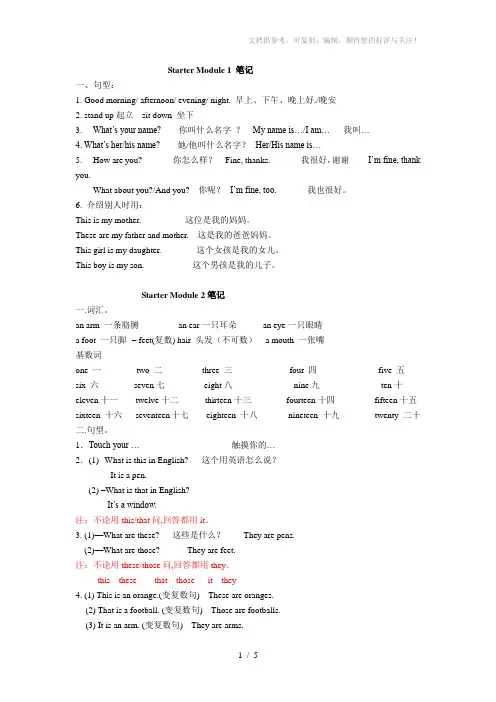
Starter Module 1 笔记一、句型:1. Good morning/ afternoon/ evening/ night. 早上、下午、晚上好./晚安2. stand up起立---sit down 坐下3. ---What’s your name?你叫什么名字?---My name is…/I am…我叫…4. What’s her/his name? 她/他叫什么名字?--Her/His name is…5. ---How are you? 你怎么样?---Fine, thanks. 我很好,谢谢--I’m fine, thank you.---What about you?/And you? 你呢?--I’m fine, too. 我也很好。
6. 介绍别人时用:This is my mother. 这位是我的妈妈。
These are my father and mother. 这是我的爸爸妈妈。
This girl is my daughter. 这个女孩是我的女儿。
This boy is my son. 这个男孩是我的儿子。
Starter Module 2笔记一.词汇。
an arm 一条胳膊an ear一只耳朵an eye一只眼睛a foot 一只脚--– feet(复数) hair 头发(不可数) a mouth 一张嘴基数词one 一two 二three 三four 四five 五six 六seven七eight八nine九ten十eleven十一twelve十二thirteen十三fourteen十四fifteen十五sixteen 十六seventeen十七eighteen 十八nineteen 十九twenty 二十二.句型。
1.Touch your … 触摸你的…2.(1)--What is this in English? 这个用英语怎么说?---It is a pen.(2) –What is that in English?--It’s a window.注:不论用this/that问,回答都用it。
1.1 Starter Modules1-4【核心词汇】(解析版)七年级英语上册(外研版)
Starter Modules 1-4教材核心词汇知识链接及典例解读教材原句My name's Miss Zhou,我是周老师。
背例句学搭配My name is Gina Smith. Gin is my first name or given name. Smith is my last name or family name.我的名字是吉娜,史密斯,吉娜是我的名字,史密斯是我的姓氏。
The name of my dog is Coco.我的狗的名字是科科。
固定搭配①first name = given name名字①last name = family name姓氏①the name of.. ...的名字联想拓展①英文名字的书写方式:名在前,姓在后。
除了名和姓之外,英美人还有中间名(middle name),放在名和姓之间。
例如Jenny Elizabeth Smith。
①中文姓名的英语书写方式:用拼音、姓和名之间分开,姓在E前,名在后,姓和名的首字母要大写。
例如:单姓两个字的名字Li Bai,单姓三个字的名字Bai Juyi,复姓三个字的名字Zhuge Liang,复姓四个字的名字Ouyang Shanshui。
Note:full name全名pen name笔名典例解读1.This is Alan Brown. Alan is his ______ .A.first name B.middle name C.last name【答案】A【详解】句意:这是艾伦.布朗,艾伦是他的名字。
考查名词短语。
A. first name,名字;B. middle name中间名;C. last name姓。
在西方人的名字中,前面是名,后面是姓,根据This is Alan Brown.可知艾伦是他的名字,故答案选A。
2.. 你不确定对方是否是Andy,你问道: “____”A.Are you Andy ?B.What’s your name ?C.You’re Andy, right ?D.A and C【答案】D【详解】你不确定对方是否是Andy,你问道: “____”A. Are you Andy ? 你是安迪吗?B. What’s your name ?你叫什么名字?C. You’re Andy, right ? 你是安迪,对吗?根据句意故选D教材原句Fine,thanks, Lingling.很好,玲玲,谢谢。
外研版英语七年级上册Starter1-4重点知识精讲+练习(无答案)

外研版英语七年级上册S t a r t e r1-4重点知识精讲+练习(无答案) -CAL-FENGHAI-(2020YEAR-YICAI)_JINGBIANStarter M1-4教学内容:一、课前导入二、知识点梳理1. class /klɑ?s/n.班级,同学,课eg:Class One 一班; have classes 上课【考点】当意为“同学”,作主语时,作为整体时谓语动词用单数形式,考虑其成员时谓语动词可用复数形式。
eg:The whole class are very bright. 全班同学都很聪明。
2. Miss/m?s/n.小姐;老师eg:Hello, Miss Wang.你好,王老师。
【考点】Miss,Mrs,Ms,Mr的用法典例精讲:This is ________.She is my English teacher.A.Mr Li B.Li Mr C.Miss Li D.Li Miss3. can/k?n/ v.aux.能,能够eg:I can play basketball.我会打篮球。
【考点】can后接动词原形。
eg:I can speak English.我会讲英语。
【重点】含有can的句子变否定句时,在can后加not。
eg:I can't speak English.我不会讲英语。
【难点】一般疑问句及其肯定、否定回答句式:—Can+主语+动词原形+...—Yes,主语+can./No,主语+can't.eg:—Can you speak English你会讲英语吗—Yes,I can./No,I can't.是的,我会。
/不,我不会。
典例精讲:汉翻英____________________________________________. 我哥哥会打篮球。
4. thanks/θ??ks/int.谢谢eg:Thanks for your help.感谢你的帮助。
外研版英语七年级上册Starter Module1-4 知识点总结
Starter Module1-4 知识点总结Module 1 My teacher and my friends【短语归纳】1. good morning 早上好2. good afternoon下午好3. thank you谢谢你4. my teacher我的老师5. my friend我的朋友6.Miss Zhou 周老师【用法集萃】1. I'm…… 我叫……2. My name's… 我叫……3. Hello, class. 同学们好。
4. This is…这是5. It's time to do sth. 到做某事的时间了.6. His/Her name's…他的/她的名字是……【典句必背】1. What's your name, please? 清问你叫什么名字?2. Can you spell it, please? 你能拼写一下吗?3. —How are you? 你好吗?—Fine. thank you.我很好.谢谢你。
4. Nice to meet you. 见到你很高兴。
5. It's time to go now. 现在到走的时间了。
6. See you tomorrow. 明天见。
Module 2 My English lesson【短语归纳】1. sit down坐下2. put up举起3. stand up起立4. a new student一名新学生5. in Class 3在三班6. telephone number电话号码7. how many多少【用法集萃】1. Mr Chen's…陈老师的……2. What's your... number?你的……号码是什么?3. How old+be+... ?……多大了?4. How many+可数名词复数+are there?有多少……【典句必背】1. Are you a new student here?你是这里的一名新学生吗?、.2. —what class are you in?你在一个班里?—I'm in Class3. Mr Chen's class.我在三班.陈老师的班。
外研版英语七年级上册StarterM14知识复习1
StarterM1 My teacher and my friends1. ---Good morning/afternoon!---Good morning/afternoon!(Good morning:早晨6:00—中午12:00;Good afternoon:午后—太阳落山前;Good night:晚上睡觉前的问候语)2. my name’s……=my name is……/ I am……我的名字是……/ 我是……本句是常用于回答what’s your name?Eg:---What is your name?---My name is Mike. / I am Mike.3. Miss\Mr.\Mrs的区别:一般用于未婚女子的姓氏之前Mr.: 一般用于男性姓氏之前Mrs: 一般用于已婚女性姓氏之前4. 26个英文字母大小写及发音:Aa [ei] Bb [bi:] Cc [si:] Dd [di:] Ee [i:] Ff [ef] Gg [d3i:] Hh [eit∫] Ii [ai] Jj [dʒei] Kk [kei] Ll [el] Mm [em] Nn [en] Oo [əu] Pp [pi:] Qq [kju:] Rr [ɑ:] Ss [es] Tt [ti:] Uu [ju:] Vv [vi:] Ww [′dʌblju:]Xx [eks] Yy [wai] Zz [zi:][zed]5. sorry? 请再说一遍,好吗?sorry 后用问号,表示因为自己没有听清楚对方的话,希望对方再说一遍。
后用句号,表示对自己所做的不恰当的事表歉意,请求对方原谅。
6. can you spell it, please ? 你能拼写下吗?此句为由can引导的一个一般疑问句,其回答用yes/no来回答【拓展】陈述句→一般疑问句(1)若在陈述句中有be(is/am/are)、情态动词(can),则将be(is/am/are) 、情态动词(can)提前,句号变问号;(2)若陈述句中无be(is/am/are)、情态动词(can),则需要借助do/does,将do/does提前,句号变问号。
初一上英语(外研版)预备级starter-m1m4知识汇总
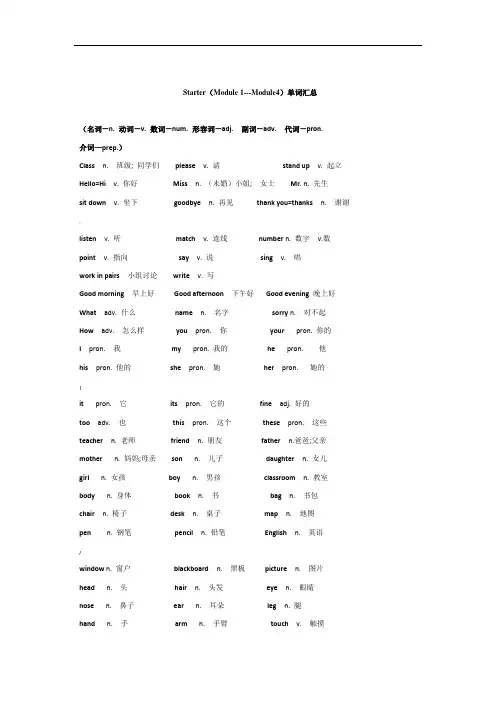
Starter(Module 1---Module4)单词汇总(名词—n. 动词—v. 数词—num. 形容词—adj. 副词—adv. 代词—pron.介词—prep.)Class n. 班级; 同学们please v.请stand up v. 起立Hello=Hi v. 你好Miss n. (未婚)小姐; 女士Mr. n.先生sit down v. 坐下goodbye n. 再见thank you=thanks n.谢谢-listen v. 听match v. 连线number n. 数字v.数point v. 指向say v. 说sing v. 唱work in pairs小组讨论write v. 写Good morning 早上好Good afternoon下午好Good evening晚上好What adv. 什么name n. 名字sorry n. 对不起How adv. 怎么样you pron. 你your pron. 你的I pron. 我my pron. 我的he pron. 他his pron. 他的she pron. 她her pron. 她的|it pron. 它its pron. 它的fine adj. 好的too adv. 也this pron. 这个these pron. 这些teacher n. 老师friend n. 朋友father n.爸爸;父亲mother n. 妈妈;母亲son n. 儿子daughter n. 女儿girl n. 女孩boy n. 男孩classroom n. 教室body n. 身体book n. 书bag n. 书包chair n. 椅子desk n. 桌子map n. 地图pen n. 钢笔pencil n. 铅笔English n. 英语/window n. 窗户blackboard n. 黑板picture n. 图片head n. 头hair n. 头发eye n. 眼睛nose n. 鼻子ear n. 耳朵leg n. 腿hand n. 手arm n. 手臂touch v. 触摸foot n.(复数feet)脚、足mouth n. (复数mouthes)嘴巴one num. 一two num. 二three num. 三four num. 四five num. 五six num. 六seven num. 七eight num. 八nine num. 九;ten num. 十eleven num. 十一twelve num. 十二dog n. 狗cup n. 杯子computer n. 电脑cat n. 猫how many多少colour n. 颜色;v. 给……上色spell v. 拼写apple n. 苹果banana n. 香蕉bird n. 鸟black n. 黑色blue n. 蓝色cat n. 猫flower n. 花red n. 红色;adj.红色的green n. 绿色it‘s = it is它是white n. 白色tree n. 树yellow n. 黄色thing n. 事情,事物food n. 食物where adv. 哪里;coat n. 大衣,外套chair n. 椅子bed n. 床cap n. 帽子on prep. 在……之上in prep. 在……里面Mum n. 妈妈shoe(复数shoes)n. 鞋子my adj. 我的under prep. 在……下面favourite adj. 最喜欢的your adj. 你的cake n. 蛋糕Dad n. 爸爸egg n. 蛋fish n. 鱼meat n. 肉noodle n. 面条pear n. 梨rice n. 米饭do 助动词,无实义work n. 工作work in pairs 两人合作student n. 学生?now adv. 现在Dance(v.) 跳舞read(v.) 读书run(v.) 跑sing (v.) 唱歌swim (v.) 游泳walk(v.) 散步,步行Hobby(n.) 爱好listen to music听音乐play computer games玩电脑游戏play football踢足球watch television看电视Cook (v.) 煮饭draw (v.)画画type (v.) 打字Drive a car开车p lay the piano弹钢琴ride a bike骑自行车speak English讲英语write Chinese写汉字Can(情态动词)能,会but (连词) 但是Weather (n.)天气Autumn (n.)秋天spring (n.)春天summer (n.) 夏天winter(n.)冬天cool (adj.) 凉爽的warm (adj.)暖和的cold (adj.)冷的hot (adj.)热的London伦敦New York纽约Hong Kong香港Beijing北京Harbin哈尔滨—重点句型汇总Module 1 重点句型1.问候语:Good morning./ Good afternoon. / Good evening.1.提问别人的名字:What’s your name-----My name is Miss Li.(或者I am Miss Li.)2.问候对方的礼貌用语:How are you-----I am fine, thank you. ( 或者Fine, thanks.);3.介绍亲朋好友给新朋友认识:This is my mother/teacher/friend.She’s/ He’s my friend.This boy/girl is my friend.Module 2 My classroom and my body询问事物:(单数) What is this in English --It's a classroom.询问事物:(复数) What are these (in English) --They're legs.询问数量:How many maps are there (单数)--There is a map.How many desks are there (复数)--There are ten desks.《Module 3 重点句型提问物体颜色: What colour is the tree (主语为名词单数)---- It is green.What colour are the flowers (主语为名词复数)----They are blue.提问某个单词如何拼读:How do you spell "green"----G-R-E-E-N.询问物体的方位、地点:Where is my coat (主语为名词单数)(----It is on the chair.Where are my shoes(主语为名词复数)----They are under the bed.提问他人喜好:What's your favourite food----My favourite food is cake.What's your favourite sport----I like swimming.{Module 4提问喜欢的运动:What’s your favourite sport---- I like football.提问喜欢不喜欢一项活动:Do you like football----Yes, I do. I like football.Do you like watching television---- No, I don’t. I like playing basketball.提问爱好:What’s your hobby(----I like singing.表示某人能够做某事:I can ride a bike .表示某人不能做什么:I can’t drive a car.提问别人能做什么:Can you cook----Yes, I can. /No, I can’t.提问天气:What’s the weather like in spring/summer/autumn/winter ---- It’s warm/hot/cool/cold.Starter重点、难点知识汇总-Module1—2个字母的书写规则以及5个元音字母。
外研版七上 Starter Modules 1—4知识点与练习
Starter Modules 1—4语法精选1. 缩略词HB硬黑CD光盘BBC英国广播公司P停车NBA(美国)全国篮球协会kg千克S小号M中号L大号UFO不明飞行物CCTV中国中央电视台2. a cat一只猫英语中a和an为不定冠词,用在单数可数名词之前,表示“一”。
在辅音音素开头的单数可数名词前加a,在元音音素开头的单数可数名词前加an。
如:a key一把钥匙 a map一张地图a pen一支钢笔 a cup一只杯子a ruler一把尺子an apple一个苹果an orange一个橙子3. a white cat一只白色的猫这里white意为“白色的”,是形容词,修饰名词,放在名词前面。
如:a red apple一个红色的苹果an orange orange一个橘色的橙子句法精析1. ①Good morning! 早上好!②Good afternoon! 下午好!③Good evening! 晚上好!问候语,根据时间进行不同的问候,答语和问候一样。
2. ①Hello, Daming!你好,大明!②Hi, Lingling! 你好,玲玲!问候语,是朋友、熟人之间非正式的问候。
3. —Can you spell it, please?请问你会拼写它吗?—Yes, L-I-N-G-L-I-N-G, Lingling.是的,L-I-N-G-L-I-N-G,玲玲。
(1)询问姓名拼写的一般疑问句,先用yes或no回答,如果回答为yes,再用连字符连接大写字母来拼写,最后写出此单词。
要求对方拼写的句子还有:①Spell it, please.请把它拼写一下。
②How do you spell it?你怎么拼写它?(2)can后用动词原形。
4. —How are you?你身体好吗?—Fine, thank you. How are you?我很好,谢谢。
你好吗?—Fine, thanks.我很好,谢谢。
外研社七年级上册英语starter1-4复习课件
12. 球类之前不加任何冠词,所以打球一般是play+球类。 比如:play basketball,
9
练练,改写下面的句子 1.I am a student. ( 改为一般疑问句,并作
肯定回答) 2.He is a doctor . ( 改为一般疑问句,并作
肯定回答) 3They are friends. ( 改为一般疑问句,并
作肯定和否定回答) 4.He can play basketball. ( 改为一般疑问
10. 问别人最喜欢的运动是什么一般用: What’s your favourite sport?/What sport do you like best?我们说过favourite=like …bes2t0.
11. Let’s (let us) do sth. 就是让我们一起做某事,后面动 词用原形。比如: Let’s play basketball. 让我们一起打篮球。Let 常用来表 示建议,类似的结构有
are.\No,they aren't. 4.Can he play basketball?Yes,he
can.\No,he can't. 5.Does she playing table tennis? Yes,she does.\No,she doesn't.
11
3. 当问别人在几班,一般用:What class are you in? 回答: I am in Class Two. 问别人是几年级:What grade(年级) are you in? 回答:I am in Grade One. 我是一年级。 4. 当问别人的电话号码是多少,一般用: What’s your telephone number?或 What’s your number? 或:What‘s the number of your telephone? 回答:My number is…./ It’s……
外研版七年级上册英语各单元语法知识预习复习提纲(全面!)
外研版七年级上册英语各单元语法知识预习复习提纲Starter Module 1Ⅰ.Useful expressions:Good morning /afternoon Thank you my teacher my friend Miss ZhouI’m…My mane’s …Hello ,class This is …His /Her name is …Nice to meet you It’s time to do sth See you tomorrow How are you?Fine ,thank you What’s your name, please ?Can you spell it ,please ? It’s time to go now .Ⅱ.GrammarsHello 做感叹词,你好是答招呼语和问候的话,一般用于熟人和朋友之间,也可用于陌生人之间,语气比较随便,可单独使用,一方说hello对方也用hello来回答,也可加呼语,但用逗号分开。
和它相近的用法有hi, hey . hello 也可用于引起注意常用在打电话时,相当于喂good morning 早上好。
是人们在早上或上午见面时比较正式的问候语,答语仍为good morning . 在非正式的场合,如果是朋友家长或熟人之间见面可省略good , 只用morning 来互相问候。
goodbye 用做感叹词,再见!是英语里比较正式的告别用语。
在实际生活中一般用于与陌生人或年长的人告别,它的缩略形式byebye 或bye 可以用于比较随便的口语中,回答时只要重复一下即可。
Miss 小姐,老师一般用于未婚女子的姓前Mrs 夫人一般用于已婚女子姓或丈夫姓氏前Mr 先生一般用于男子姓氏前Ms 小姐,女士一般用于不知道婚否的女子姓前,现在Ms 应用更广些。
中国人的名字译成英语时,习惯上按汉语拼音来拼写,姓在前,名在后,书写时姓和名分开写,而且二者的首字母要大写,若名字部分有两个字时,应连在一起写,只将第一个字母的首字母大写即可。
外研社七年级英语上册starter-Module1-4知识点总结
外研社七年级英语上册starter-Module1-4知识点总结Module 1: ___1.ClassWhen referring to classmates。
use the plural form "classes." When referring to a specific class。
use the singular form "class." For example。
"Good morning。
class" (referring to a specific class) and "We are in the same classes" (referring to classmates).2.GreetingsIn English。
the proper way to address someone is to use a___ from the name or title。
For example。
"Good morning。
Mum." Other common greetings include "Good afternoon," "Good evening," and "Good night." To ask how someone is doing。
you can say "How are you?" and respond with "I'm fine。
thank you。
And you?" Other common greetings include "How do you do?" and "How is it going with you?" When meeting someone for the first time。