
动词过去分词不规则变化表(现在完成时)
动词过去式与过去分词不规则变化(初中版)
动词原形+过去式+过去分词(1) AAA型(动词原形、过去式、过去分词同形)
cost(花费)cost cost
cut(割)cut cut
hit(打)hit hit
hurt (伤害)hurt hurt
let(让)let let
put(放)put put
read (读)read read
spread (伸展/ 传播)spread spread
(2) AAB型(动词原形与过去式同形)
beat(跳动)beat beaten
(3) ABA型(动词原形与过去分词同形)
become(变成)became become
come(来)came come
run(跑)ran run
(4) ABB型(过去式与过去分词同形)
dig(挖)dug dug
get(得到)got got
hang(吊死)hanged hanged
hang(悬挂)hung hung
hold(抓住)held held
lay (产卵) laid laid
shine(照耀)shone shone
sit(坐)sat sat
win (赢)won won
meet(遇见)met met
keep (保持)kept kept
sleep(睡)slept slept
sweep(扫)swept swept
feel(感觉)felt felt
flee (逃跑) fled fled
smell(闻)smelt smelt
leave(离开)left left
build(建设)built built
lend(借出)lent lent
send (传送) sent sent
spend(花费)spent spent
sink (沉下) sunk /sank snuk /sunken lose (丢失)lost lost
burn (燃烧)burnt burnt
learn(学习)learnt /learned learnt /learned mean(意思是)meant meant
catch(抓住)caught caught
teach(教) taught taught
bring(带来)brought brought
fight (战斗) fought fought
buy(买)bought bought
think(想)thought thought
hear (听见)heard heard s
ell(卖)sold sold
tell(告诉)told told
say(说)said said
find(找到) found found
feed ( 养) fed fed
have/has(有) had had
make(制造) made made
stand(站)stood stood
smell (闻)smelled /smelt smelled /smelt stick (粘贴 /刺) stuck stuck
spell (拼写) spelt/spelled spelt/spelled spit (吐唾沫)spat spat
understand(明白) understood understood
(5) ABC型(动词原形、过去式与过去分词三者不同形)begin(开始)began begun
drink(喝)drank drunk
hide (躲藏)hid hidden
ring(铃响)rang rung
sing (唱)sang sung
swim(游泳)swam swum
blow(吹)blew blown
draw (画)drew drawn
fly(飞)flew flown
grow(生长)grew grown
know(知道)knew known
throw(投掷)threw thrown
show(出示)showed shown
break(打破)broke broken
choose(选择) chose chosen
forget(忘记) forgot forgotten (forgot) freeze (结冰/凝固)froze frozen
speak(说)spoke spoken
wake(醒)woke woke
drive(驾驶)drove driven
eat(吃)ate eaten
fall(落下)fell fallen
give(给)gave given
rise(升高)rose risen
take(取)took taken
mistake(弄错) mistook mistaken
ride(骑)rode ridden
write(写)wrote written
do(做)did done
go(去)went gone
lie(平躺)lay lain
see(看见)saw seen
wear (穿)wore worn
be ( am, is, are )(是)was, were been。
复习复习现在完成时

动词过去分词 的规则变化规律
双写+ed
注:以一个辅音字母结尾 的重读闭音节词,双写最
后一个辅音字母+ed
study studied studied
carry carried carried
变y为i,+ed
try tried tried
注:以辅音字母+y结尾, 变y为i,+ed.
play played played enjoy enjoyed enjoyed stay stayed stayed
ABA型
(原形与过去 分词相同)
take go do see is/am
/are
took taken
went gone
did
done
saw seen
was been
/were
ABC型 (三种都不一样)
the West Lake
the Great Wall
A: I have been to the West Lake.
直接+ed
注:以元音字母+y结尾, 直接+ed.
写出下列动词的过去式和过去分词:
原形 过去式 过去分词 shut shut shut
动词过去分词 的不规则变化
cut cut cost cost
cut cost
AAA型 (三种都一样)
put put
put
make have keep find buy
Have you ever loved somebody So much it makes you cry Have you ever needed something so bad You can't sleep at night Have you ever tried to find the words But they don't come out right Have you ever Have you ever Have you ever been in love Been in love so bad You'd do anything To make them understand Have you ever had someone Steal your heart away You'd give anything To make them feel the same
初三英语《现在完成时》PPT课件

What has happened to the USA in the last 350 years?
注意点一: 现在完成时与一般过去时的用法比较 现在完成时表示过去的动作一直延续到现在甚至会继续下去或表示 过去的动作对现在造成的影响;一般过去时表示动作发生的时间在 过去。现在完成时属于现在时态范围,因此,不能和表示过去的时 间状语连用。 如:yesterday, last night, two weeks ago等 试比较: The plane has arrived . 飞机已经来了。(说明现在的情况:飞机 在这儿) The plane arrived a quarter ago. 飞机是一刻中以前来的。(强 调动作发生的时间在过去) I have taught here for fifteen years. 我在这儿已经教了十五年。 (表示十五年前的动作一直延续到现在,还可能会继续。) I taught here for a year. 我过去在这儿教过一年。(表示“我“现 在已经不在这儿任教了)
((√×))
He has joined the League member for two years. ( ×)
√ He has been a League member for two years. ( )
他已入团两年了。
The man has been dead for several years. The man has died for several years. 这个人已经死了几年了。
练习:用have(has) been 或have(has) gone 填空 A: Where __1__ Li Fei __1__? B: He __2__ to Hainan Island. A: How long __3__ he __3___ there? B: He ___4__ there for three days. A: When will he come back , do you know? B: I’m afraid he won’t come back recently. A: Could you tell me the way to Hainan Island? B: Sorry, I __5__ never __5__ there. A: How many times __6__ Li Fei __6___ to that place? B: He __7__ there only once.
初中不规则动词现在完成时表

初中不规则动词现在完成时表1.引言不规则动词是英语中一类特殊的动词,它们的过去式、过去分词和现在分词形式与一般规则不同。
本文旨在介绍初中学生在使用不规则动词时如何正确地使用现在完成时态。
现在完成时表示动作或状态发生在过去并延续到现在,常与表示经验、经历或重要性的时间状语连用。
2.不规则动词现在完成时表下表列出了常见的不规则动词在现在完成时态下的形式:不规则动词。
| 过去式。
| 过去分词。
| 现在完成时形式。
|be。
| was / were。
| been。
| have / has been。
|e。
| became。
| e。
| have / has e |begin。
| began。
| begun。
| have / has begun。
|break。
| broke。
| broken。
| have / has broken |bring。
| brought。
| brought。
| have / has brought| choose。
| chose。
| chosen。
| have / has chosen | do。
| did。
| done。
| have / has done。
|drink。
| drank。
| drunk。
| have / has drunk。
| eat。
| ate。
| eaten。
| have / has eaten。
|find。
| found。
| found。
| have / has found。
| give。
| gave。
| given。
| have / has given。
| go。
| went。
| gone。
| have / has gone。
| have。
| had。
| had。
| have / has had。
|know。
| knew。
| known。
| have / has known。
| make。
| made。
| made。
| have / has made。
| see。
动词过去式,过去分词变化一览表
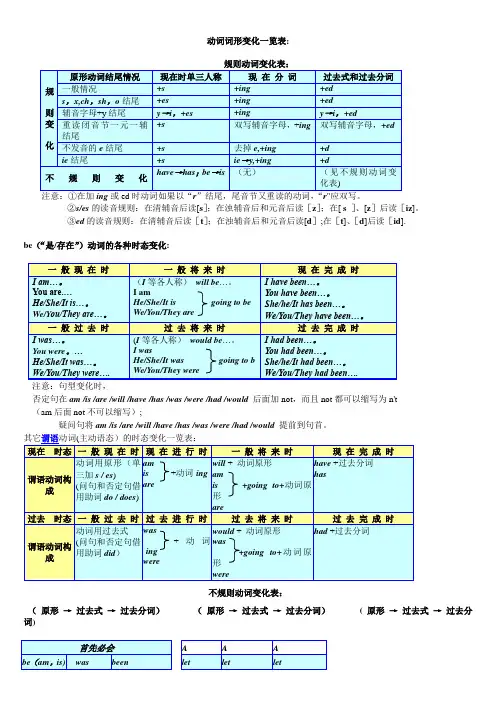
③ed 的读音规则:在清辅音后读[t];在浊辅音后和元音后读[d];在[t]、[d]后读[id].
be(“是/存在”)动词的各种时态变化:
一般现在时
一般将来时
现在完成时
I am…。
You are.… He/She/It is…。 We/You/They are…。
一般过去时
(I 等各人称) will be…。
sold
stand
stood
stood
understand understood understood
dig
dug
dug
shine
shone
shone
win
won
won
get
got
got
forget
forgot
forgot/forgotten
buy
bought bought
bring
brought brought
形
are
过去 时态 一 般 过 去 时 过 去 进 行 时
过去将来时
过去完成时
动词用过去式 was
谓语动词构 (问句和否定句借
成
用助词 did) -ing were
would + 动词原形
had +过去分词
+ 动 词 was
+going to+ 动 词 原
形
were
不规则动词变化表:
( 原形 → 过去式 → 过去分词) 词)
B drank swam
drove wrote
lent sent spent
built spilt spoilt smelt left slept kept felt swept met meant said laid paid should must might could would
八年级动词不规则变化表

八年级动词不规则变化表一、AAA型(原形、过去式、过去分词同形)1. cost - cost - cost.- 例句:The book cost me ten yuan.(一般现在时)- The car cost him a lot of money last year.(一般过去时)2. cut - cut - cut.- 例句:He cut his finger just now.(一般过去时)- She has cut the paper into pieces.(现在完成时)3. hit - hit - hit.- 例句:The ball hit the window.(一般过去时)- They have hit the target many times.(现在完成时)4. hurt - hurt - hurt.- 例句:I hurt my leg yesterday.(一般过去时)- He has hurt his back.(现在完成时)5. let - let - let.- 例句:Let me help you.(一般现在时)- She let her sister play with her toys last week.(一般过去时)6. put - put - put.- 例句:Put your book on the desk.(一般现在时)- He put on his coat and went out.(一般过去时)7. read - read - read.- 注意:read的过去式和过去分词读音为[red]。
- 例句:I read a book yesterday.(一般过去时)- She has read this novel three times.(现在完成时)二、ABA型(原形与过去分词同形)1. become - became - become.- 例句:He became a teacher last year.(一般过去时)- She has become very popular.(现在完成时)2. come - came - come.- 例句:He came to school late yesterday.(一般过去时)- They have come to realize the importance of English.(现在完成时)3. run - ran - run.- 例句:He ran very fast in the race.(一般过去时)- She has run out of money.(现在完成时)三、ABB型(过去式与过去分词同形)1. bring - brought - brought.- 例句:He brought his book to school yesterday.(一般过去时)- She has brought some flowers for her mother.(现在完成时)2. build - built - built.- 例句:They built a house last year.(一般过去时)- The workers have built many tall buildings in this city.(现在完成时)3. buy - bought - bought.- 例句:I bought a new pen yesterday.(一般过去时)- She has bought a lot of clothes this month.(现在完成时)4. catch - caught - caught.- 例句:The police caught the thief last night.(一般过去时)- He has caught a cold.(现在完成时)5. dig - dug - dug.- 例句:They dug a hole in the garden.(一般过去时)- The workers have dug a well.(现在完成时)6. feel - felt - felt.- 例句:I felt very happy yesterday.(一般过去时)- She has felt much better since she took the medicine.(现在完成时)7. fight - fought - fought.- 例句:They fought against the enemy bravely.(一般过去时)- The soldiers have fought for their country.(现在完成时)8. find - found - found.- 例句:He found his wallet under the bed.(一般过去时)- She has found a new job.(现在完成时)9. get - got - got/gotten.- 例句:I got a letter from my friend yesterday.(一般过去时)- He has got a lot of knowledge from books.(现在完成时,美式英语常用gotten)10. hang - hung - hung(悬挂);hang - hanged - hanged(绞死、吊死)- 例句:He hung a picture on the wall.(一般过去时,悬挂)- The murderer was hanged.(一般过去时,绞死)11. have - had - had.- 例句:I had a great time yesterday.(一般过去时)- She has had a lot of experience.(现在完成时)12. hear - heard - heard.- 例句:I heard a strange noise last night.(一般过去时)- He has heard the news already.(现在完成时)13. hold - held - held.- 例句:He held a meeting yesterday.(一般过去时)- She has held this position for a long time.(现在完成时)14. keep - kept - kept.- 例句:He kept his promise.(一般过去时)- She has kept this book for two weeks.(现在完成时)15. lay - laid - laid.- 例句:She laid the baby on the bed.(一般过去时)- The hen has laid many eggs.(现在完成时)16. lead - led - led.- 例句:He led the team to victory.(一般过去时)- She has led a hard life.(现在完成时)17. leave - left - left.- 例句:He left school early yesterday.(一般过去时)- She has left her hometown.(现在完成时)18. lend - lent - lent.- 例句:I lent him my book yesterday.(一般过去时)- She has lent some money to her friend.(现在完成时)19. lose - lost - lost.- 例句:He lost his keys yesterday.(一般过去时)- She has lost her way.(现在完成时)20. make - made - made.- 例句:He made a model plane yesterday.(一般过去时)- She has made a lot of friends.(现在完成时)21. mean - meant - meant.- 例句:What did he mean?(一般过去时)- This word has meant different things in different contexts.(现在完成时)22. meet - met - met.- 例句:I met my old friend in the street yesterday.(一般过去时)- She has met many difficulties.(现在完成时)23. pay - paid - paid.- 例句:He paid ten yuan for the book.(一般过去时)- She has paid all her debts.(现在完成时)24. say - said - said.- 例句:He said he was happy.(一般过去时)- She has said goodbye to her parents.(现在完成时)25. sell - sold - sold.- 例句:He sold his old bike yesterday.(一般过去时)- She has sold all her paintings.(现在完成时)26. send - sent - sent.- 例句:I sent a letter to my mother yesterday.(一般过去时)- She has sent some gifts to her friends.(现在完成时)27. shine - shone - shone(发光、照耀);shine - shined - shined(擦亮)- 例句:The sun shone brightly yesterday.(一般过去时,发光)- He shined his shoes this morning.(一般过去时,擦亮)28. sit - sat - sat.- 例句:He sat on the chair.(一般过去时)- She has sat here for an hour.(现在完成时)29. sleep - slept - slept.- 例句:I slept well last night.(一般过去时)- She has slept for ten hours.(现在完成时)30. smell - smelt - smelt(也可smelled - smelled)- 例句:The flowers smelt sweet.(一般过去时)- The food has smelt strange.(现在完成时)31. speak - spoke - spoken.- 例句:He spoke at the meeting yesterday.(一般过去时)- She has spoken English for many years.(现在完成时)32. spell - spelt - spelt(也可spelled - spelled)- 例句:He spelt the word wrong.(一般过去时)- She has spelt this word correctly.(现在完成时)33. spend - spent - spent.- 例句:He spent two hours doing his homework yesterday.(一般过去时)- She has spent a lot of money on clothes.(现在完成时)34. stand - stood - stood.- 例句:He stood at the door.(一般过去时)- She has stood there for a long time.(现在完成时)35. sweep - swept - swept.- 例句:She swept the floor yesterday.(一般过去时)- They have swept the classroom.(现在完成时)36. teach - taught - taught.- 例句:He taught us English last year.(一般过去时)- She has taught in this school for five years.(现在完成时)37. tell - told - told.- 例句:He told me a story yesterday.(一般过去时)- She has told the truth.(现在完成时)38. think - thought - thought.- 例句:I thought he was right.(一般过去时)- She has thought about this problem.(现在完成时)39. understand - understood - understood.- 例句:I understood his meaning.(一般过去时)- She has understood the situation.(现在完成时)40. win - won - won.- 例句:Our team won the game yesterday.(一般过去时)- He has won many prizes.(现在完成时)四、ABC型(原形、过去式、过去分词都不同形)1. be - was/were - been.- 例句:I was at home yesterday.(一般过去时,第一人称单数)- They were at school last week.(一般过去时,第三人称复数)- She has been to Beijing.(现在完成时)2. begin - began - begun.- 例句:He began to study English last year.(一般过去时)- She has begun a new project.(现在完成时)3. blow - blew - blown.- 例句:The wind blew strongly yesterday.(一般过去时)- The leaves have been blown away.(现在完成时,被动语态)4. break - broke - broken.- 例句:He broke the window yesterday.(一般过去时)- The cup has been broken.(现在完成时,被动语态)5. choose - chose - chosen.- 例句:He chose a red pen.(一般过去时)- She has chosen to study abroad.(现在完成时)6. do - did - done.- 例句:I did my homework yesterday.(一般过去时)- She has done a lot of work.(现在完成时)7. draw - drew - drawn.- 例句:He drew a picture yesterday.(一般过去时)- She has drawn many beautiful pictures.(现在完成时)8. drink - drank - drunk.- 例句:He drank a glass of water just now.(一般过去时)- She has drunk too much wine.(现在完成时)9. drive - drove - driven.- 例句:He drove to work this morning.(一般过去时)- She has driven for three hours.(现在完成时)10. eat - ate - eaten.- 例句:I ate an apple yesterday.(一般过去时)- She has eaten her lunch.(现在完成时)11. fall - fell - fallen.- 例句:He fell off his bike yesterday.(一般过去时)- Leaves have fallen from the trees.(现在完成时)12. fly - flew - flown.- 例句:The bird flew away.(一般过去时)- She has flown to Paris.(现在完成时)13. forget - forgot - forgotten.- 例句:I forgot my book yesterday.(一般过去时)- He has forgotten his password.(现在完成时)14. give - gave - given.- 例句:He gave me a book yesterday.(一般过去时)- She has given a lot of help to others.(现在完成时)15. go - went - gone.- 例句:He went to the park yesterday.(一般过去时)- She has gone to Shanghai.(现在完成时,表示“去了还没回来”)16. grow - grew - grown.- 例句:The tree grew taller last year.(一般过去时)- She has grown into a beautiful girl.(现在完成时)17. know - knew - known.- 例句:I knew him two years ago.(一般过去时)- She has known the truth.(现在完成时)18. lie - lay - lain(躺、位于);lie - lied - lied(说谎)- 例句:He lay on the bed all day yesterday.(一般过去时,躺)- The town lies by the river.(一般现在时,位于)- He lied to me.(一般过去时,说谎)- She has lied many times.(现在完成时,说谎)19. ride - rode - ridden.- 例句:He rode a horse yesterday.(一般过去时)- She has ridden a bike for years.(现在完成时)20. ring - rang - rung.- 例句:The bell rang just now.(一般过去时)- She has rung the doorbell.(现在完成时)21. rise - rose - risen.- 例句:The sun rose early this morning.(一般过去时)- The price has risen.(现在完成时)22. run - ran - run.- 例句:He ran to school this morning.(一般过去时)- She has run in the park for a long time.(现在完成时)23. see - saw - seen.- 例句:I saw a movie yesterday.(一般过去时)- She has seen the Great Wall.(现在完成时)24. show - showed - shown/showed.- 例句:He showed me his new phone yesterday.(一般过去时)- She has shown great interest in art.(现在完成时)25. sing - sang - sung.- 例句:She sang a song yesterday.(一般过去时)- He has sung this song many times.(现在完成时)26. sink - sank - sunk.- 例句:The ship sank last night.(一般过去时)- The stone has sunk to the bottom of the river.(现在完成时)27. speak - spoke - spoken.- 例句:He spoke at the meeting yesterday.(一般过去时)- She has spoken English for many years.(现在完成时)28. steal - stole - stolen.- 例句:The thief stole my wallet yesterday.(一般过去时)- He has stolen many things.(现在完成时)29. swim - swam - swum.- 例句:I swam in the pool yesterday.(一般过去时)- She has swum across the river.(现在完成时)30. take - took - taken.- 例句:He took my book yesterday.(一般过去时)- She has taken some photos.(现在完成时)31. throw - threw - thrown.- 例句:He threw the ball far away.(一般过去时)- She has thrown away the rubbish.(现在完成时)32. wake - woke - woken.- 例句:I woke up early this morning.(一般过去时)- She has woken the baby.(现在完成时)33. wear - wore - worn.- 例句:He wore a new shirt yesterday.(一般过去时)- She has worn this dress many times.(现在完成时)34. write - wrote - written.- 例句:I wrote a letter yesterday.(一般过去时)- She has written a book.(现在完成时)。
现在完成时
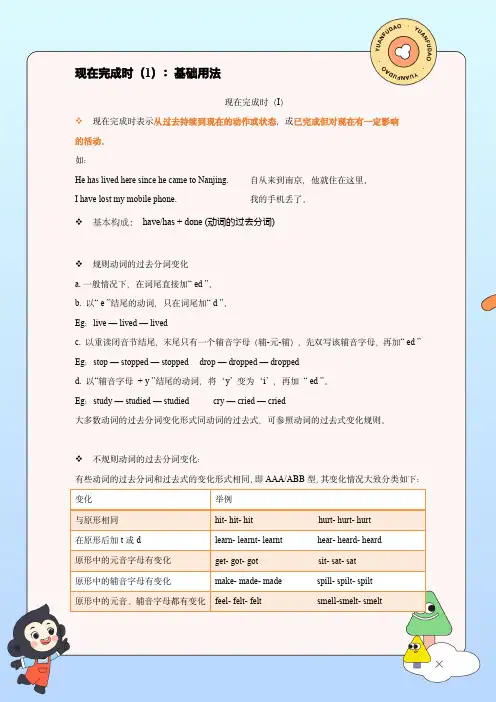
现在完成时(1):基础用法现在完成时(I)现在完成时表示从过去持续到现在的动作或状态,或已完成但对现在有一定影响的活动。
如:He has lived here since he came to Nanjing.自从来到南京,他就住在这里。
I have lost my mobile phone.我的手机丢了。
基本构成:have/has+done(动词的过去分词)规则动词的过去分词变化a.一般情况下,在词尾直接加“ed”。
b.以“e”结尾的动词,只在词尾加“d”。
Eg:live—lived—livedc.以重读闭音节结尾,末尾只有一个辅音字母(辅-元-辅),先双写该辅音字母,再加“ed”Eg:stop—stopped—stopped drop—dropped—droppedd.以“辅音字母+y”结尾的动词,将‘y’变为‘i’,再加“ed”。
Eg:study—studied—studied cry—cried—cried大多数动词的过去分词变化形式同动词的过去式,可参照动词的过去式变化规则。
不规则动词的过去分词变化:有些动词的过去分词和过去式的变化形式相同,即AAA/ABB型,其变化情况大致分类如下:变化举例与原形相同hit-hit-hit hurt-hurt-hurt在原形后加t或d learn-learnt-learnt hear-heard-heard原形中的元音字母有变化get-got-got sit-sat-sat原形中的辅音字母有变化make-made-made spill-spilt-spilt原形中的元音、辅音字母都有变化feel-felt-felt smell-smelt-smelt有些动词的过去分词和过去式的变化不同,即ABA/ABC型,其变化大致分类如下:变化举例与原形相同come-came-come run-ran-run原形中的元音字母有变化ring-rang-rung sing-sang-sung在原形上加en eat-ate-eaten fall-fell-fallen在原形上加n see-saw-seen give-gave-given在过去式上加n steal-stole-stolen break-broke-broken 原形、过去式和过去分词差异较大do-did-done go-went-gone现在完成时(2):时间状语常与现在完成时连用的时间状语:1.already,yet,still,never,ever,just,before...2.for+一段时间,since+时间点3.recently,lately,so far...4.in the past two years...例句:He has already taken first prize twice.他已经拿过两次一等奖了。
中考英语语法-现在完成时高频考点(附动词过去分词变化表)
中考语法| 现在完成时高频考点(附动词过去分词变化表)现在完成时的基本结构肯定句:主语+have/has+动词的过去分词+其他否定句:主语+have/has+not+动词的过去分词+其他一般疑问句:Have/Has+主语+动词的过去分词+其他特殊疑问句:特殊疑问词+一般疑问句(have/has+主语+过去分词+其他)现在完成时的用法1. 现在完成时用来表示过去已经完成的动作对现在造成影响或后果。
也就是说,动作或状态发生在过去但它的影响现在还存在,强调的是现在。
I have already posted the photo.我已经邮寄出了照片。
与此种用法连用的时间状语时一些模糊的过去时间状语,如already(肯定句句中), yet(否定句/疑问句句尾), just, before, recently,still, lately,never等。
2. 现在完成时也可用来表示动作或状态发生在过去某一时刻,持续到现在并且有可能会继续持续下去。
He has lived here since 1978.自从1978年以来,他一直住在这儿。
(动作起始于1978年,一直住到现在,可能还要继续住下去。
)此种用法常与for(+时间段),since(+时间点或过去时的句子)连用。
谓语动词必须是延续性动词。
有些瞬间动词可变为延续动词:go out—be outfinish—be overopen—be opendie—be deadbuy—havefall ill—be illcome back—be backcatch a cold—have a cold现在完成时常见考法对于现在完成时的考查,多以单选、句型转换或词语运用的形式考查学生在具体语境中灵活运用时态的能力。
在考试中,会让大家判断是否该用现在完成时,或者是考查“瞬间动词”不能与表示一段时间的状语连用”这一知识点。
【典型例题】His father _____ the party since 1978A.joindB.has joinedC.was inD.has been in答案:D解析:本题考查学生对现在完成时的熟练掌握。
现在完成时态结构
last week and she _h_a_s_r_e_a_d_ (read) it already. 7. Mr. Smith _h_a_s_n_’_t__fi_n_i_sh_e_d_ (not finish) his work yet. 8. Miss Brown, we _h_a_v_e__f_in_i_s_h_e_d(finish) cleaning our
11. — Have you ever _b_e_e_n_t_o_(be) an amusement park?
— Yes, I have. I went to Fun Times Amusement Park last year.
5. Has Jack lost his key? (做肯定回答) ___Y_e__s___, he ___h__a_s___.
I have had breakfast.
我吃过早饭了.
I have ever visited Beijing before. 我曾经去过北京.
I have ever been to Boracay before.我曾经去过长滩岛.
Let's try.
go — went — gone
put — put — put
win — won — won
eat — ate — eaten
give — gave — given
lose — lost — lost
make — made — made write — wrote — written finish — finished — finished
现在完成时讲解(含讲解及习题)
现在完成时讲解(含讲解及习题)现在完成时讲解一、构成:肯定式:主语+ 助动词have/has + 动词的过去分词.疑问式:助动词Have/Has + 主语+ 动词的过去分词?否定式: 主语+ 助动词have/has + not + 动词的过去分词.过去分词规则变化:a)一般情况下,直接加ed, (work---worked,water---watered, finish---finished等;)b)以“辅音字母+ y”结尾的动词, 把y 变成i 再加ed, (carry-- -carried study---studied等;)c)以辅+元+辅结尾且中读的动词,要双写最后一个辅音字母,再加ed。
(stop---stopped,shop---shopped)d)以不发音的e结尾的动词,只加d (过去分词不规则变化表:二、用法:用法一:表示过去(已经、曾经或从未)发生的某一动作对现在造成的影响或结果。
标志词:①already, ②never, ③ever, ④just, ⑤yet, ⑥before,⑦once/twice/数字+ times例:I have cleaned my room. 我已打扫了房间(房间现在是干净的,不需要打扫了)They have left. --他们已经离开了,也就是说现在他们人不在这里I have never had a car (我从未有过汽车。
)I have been there twice.a)already 往往用于肯定句,用在疑问句时表示强调或加强语气;yet 用于否定句和疑问句。
He has already left here. 他已经离开这里了。
Has he already left here? 他(真的)已经离开这里了吗?(表示加强语气)My teachers haven’t had breakfast yet. 我的老师们还没有吃早饭。
Have you written to your parents yet? 你已经给你父母写过信了吗?b)never 是否定词,表示“从来没有”,而ever 表示“曾经”We have never been to the Great Wall. 我们从来没有去过长城。
英语语法-现在完成时
—No, he _h_a_s_g_o_n_e_t_o_ the school library. He left five minutes ago.
Exercise
做过,泛泛而谈,标志词,用现在完成时 做过,有明确的过去时间,用一般过去时
It is + 时间段 since +一般过去时的句子.
1. 他的爷爷已经去世2年了。 It is 2 years since his grandpa died.
2. Nick 参军3年了. It is 3 years since Nick joined the army.
3. 他离开深圳好长时间了。 It is a long time since he left Shenzhen. 4. 这本书我已借了4个月了. It is 4 months since I borrowed the book .
3) I’ve just finished Oliver Twist. 我刚看完《雾都孤儿》这本书。
现在完成时构成 have/ has + done (过去分词)
原形-过去式ed-过去分词ed pick → picked → picked wish → wished → wished
like → liked → liked phone→ phoned → phoned
She hasn’t told us the news yet. 3. The rain has already stopped. (改一般疑问句)
Has the rain stopped yet? 4. I have waited here for two hours. (划线提问)