
外研版七年级下册Module 1 词汇和语法知识点归纳及练习题(附答案)
外研版七年级下册Module 1 词汇和语法知识点归纳词汇知识点1. 辨析 every day 和 everydayevery day 是副词词组,在句子中间做状语,表示“每天,天天”。
e.g.: We speak English every day.everyday是形容词,在句子中只做定语,表示“日常的,每天的”。
e.g.: Let’s learn some everyday English.2.People often lose things when they’re traveling or when they’re in a hurry.人们在旅行中或匆忙时常丢东西。
in a hurry的意思是“匆匆忙忙地”,是一个介词短语,hurry动词短语用“hurry up”来表示“赶快,赶紧”,还有“(there’s) no hurry”,意思是“不忙,不必着急,有充裕时间……”。
例:We must hurry up if we want to be there on time.如果想准时到那里的话,我们就必须动作快点。
There is no hurry, so do it slowly and carefully.不必赶时间,要慢慢地,认真地完成任务。
in a hurry 匆忙 = hurriedlyhurry to + 地点匆忙去……hurry to do sth. 匆忙去做……Hurry up! 快点3.a lot of 许多(后跟可数名词复数或不可数名词)a lot of =lots ofmany 后跟可数名词复数much 后跟不可数名词4. find 过去式是 foundlook for 强调寻找的过程 I am looking for your gloves.我正在找你的手套。
find 强调寻找的结果 I find your gloves.我找到你的手套。
5. hundred 是一个确数,表示“一百”hundreds of 是一个概数,表示“好几百,许许多多”当 hundred 前面有一个具体的数词时,hundred 不变为复数。
例:two hundred cows 两百头奶牛当 hundred 与 of 连用时,它后边的名词和它本身都用复数。
例: hundreds of cows 几百头奶牛hundreds of ... 数以百计的thousands of ... 数以千计的millions of ... 数百万的billions of ... 数十亿的以上为模糊表达方式(注意:s和of 共存亡)a hundred / two hundred / several hundred 一百/两百/几百6.leave的用法1)表示“离开”例:Nancy wants to be a doctor when she leaves school. 南希毕业后想当一名医生。
2) 表示“把(某人或某物)留在(某处)”leave sth. + 地点状语例:I often leave the kids with Susan. 我经常把孩子们留给苏珊(照顾)。
3) 表示“留到,停留”例:Leave it another week, then tell he’ll have to decide.把此事再放一周,到时告诉他必须做出决定。
语法知识点代词包括人称代词、物主代词、不定代词、指示代词、疑问代词、反身代词、it用法。
其中人称代词的用法是重中之重,它包括主格和宾格,人称代词主格在句子充当主语;人称代词的宾格在句中充当动词、介词的宾语或表语。
如:--Who is that boy?--He is Tom.物主代词的用法(表示所属关系,包括形容词性物主代词的用法和名词性物主代词的用法):1.形容词性物主代词在句子中作定语修饰名词,不单独使用。
2.名词性物主代词常用来代替前面已提及的名词,相当于“形容词性物主代词+名词”。
3.名词性物主代词可用在of后面作宾语,相当于“of+名词所有格”,表示带有部分概念或者有一定的感情色彩。
如:--Whose bag is that?--It is mine.练习题(一)一、用所给单词的正确形式填空。
1. My pen is ________ (lose). I am looking for it.2. My sweater is green. ________ (she) is yellow.3. I have ________ (hundred) of storybooks in my study.4. —Whose ________ (pig) are those?—They’re Lily’s.5.This wallet isn’t mine. It’s ________ ( Mary ).6.There is no hurry, so do it (careful).7.Look! A man (get) on the bus.二、完成句子1. 从现在起你就是一名学生了。
You are a student ________ ________ _______.2. 请小心水,它很烫。
Please ________ ________ _______ the water. It’s too hot.3. 王老师正匆忙地去上班。
Mr Wang is going to work ________ ________ _______.4. 托尼正在找他的蜡笔。
Tony is ________ ________ his crayons.5. 首先,我有一个好消息要告诉你们。
________ ________ _______, I have good news to tell all of you.三、根据句意从方框中选择恰当的词填空,有的需要变换形式,每词限用一次。
1. Mr Green’s son is ill, he takes him to the hospital ____________.2. The farmer keeps ___________ pigs on his farm.3. The man’s wallet is lost, he _____________ it.4. Mike has a nice ____________, he often uses it to call his pen friend.5. Mr Smith is waiting for his friends _____________.练习题(二)一.单项选择1. This is ______ key and that is ______ eraser.A. a; aB. a; anC. an; aD. an; an2. —_______ is this pen?—It’s mine.A. WhatB. WhoseC. WhereD. How3. Every year, ______ people go to visit the factory.A. a thousand of B thousands C. thousand of D. thousands of4. —Here is a schoolbag. Whose is it?—Oh, it’s _______. Thank you.A. myB. mineC. meD. I5. — Is this ______ ruler?—No. _______ is over there.A. her; HerB. her; HersC. hers; HersD. hers; Her6. Please be ______ with your key. Don’t lose it again.A. careB. carefulC. carelessD. caring7. Can you see my wallet? I can’t ______ it now.A. findB.foundC. look forD. look at8. —Is this yellow schoolbag Tom’s?—No, it isn’t. ______ is black.A. MineB. HisC. HersD. Yours9. Is this ______ watch? Call Jim ______ 458-6458.A. your; atB. you; atC. your; inD. you; in10. My brother often hurries ______ breakfast in the morning.A. haveB. hasC. to haveD. having11. My grandpa often told _____ interesting stories.A. IB. meC. myD. mine12. The meeting will begin ________ 4:30 this afternoon. Don’t forget it.A. onB. inC. atD. for13. --- Can you come and play with us this evening?--- I’d love to, ___________I have a lot of homework to do.A. andB. soC. orD. but14. Spring is coming and there ________ flowers everywhere.A. isB. areC. wasD. were15. --- __________ are all these together?--- 425 yuan.A. How muchB. How manyC. How longD. How often二. 完形填空Li Lei is a student in Beijing Junior High School. Now he can’t find his 1 , Li Li. Please help him 2 her. Li Li is five years old. She 3 speak Chinese. 4 she can also speak some English. Li Li is short (矮的). She is 1.1 meres 5 . She 6 short black hair, big 7 eyes, a small nose and wide mouth. She is 8 a blue dress and 9 orange cap. If you meet her, please call Li Lei. 10 telephone number is 965-3187.1. A. Sister B. teacher C. mum D. brother2. A. Find B. found C. finding D. to found3. A. doesn’t B. can’t C. can D. mustn’t4. A. Or B. And C. but D. So5. A. short B. long C. big D. tall6. A. is B. have got C. are D. has7. A. black B. white C.purple D. blue8. A. with B. at C.in D. for9. A. a B. an C. the D. /10. A. His B. He C. Him D. Her练习题(三)一.单项选择1.There is ________ basketball here. Do you like playing _________ baseball?A.a; a B.a; / C.the; the D.a; the2. Is that __________ camera in the lost and found box?A.he B.him C.his D.he’s3. Mr Wang __________ a bus now. His phone _______.A.is get, is lose B.is getting, is lostC.is getting, is losing D.is getting, is lose4. People often ________ things when they’re busy.A. loseB. lostC. losesD. losing5. ________ kilos of sausages do you find?A. How muchB. How manyC. HowD. How’s6. __________ bikes are blue.A.Tom and Jim B.Tom and Jim’sC.Tom’s and Jim’s D.Tom’s and Jim7. Don’t talk here. Grandparents ___________.A. sleepB. is sleepingC. are sleepingD. sleeps8.The boy often ________ the key to the bike in his bedroom when he goes to school.A. leaveB. leavesC. forgetsD. forget9. -Lucy, you speak Chinese very well.-Oh, really? __________.A.Thank you B.I’m sorry C.That’s OK D.You’re welcome10. -__________ do you do? -I am a doctor.A. HowB. WhyC. WhereD. What11. It’s nine o’clock now. ______ the students ______ a music class?A. Do, haveB. Are, haveC. Are, havingD. Do, having12. They run to the bus ______________.A. in hurriesB. in a hurryC. in hurryD. in hurry13. -__________. Are these your orange gloves?-No. I don’t know _______ it is.A. Excuse me; whoB. Excuse me; whoseC. Sorry; whoD. Sorry; whose14. Is the man _______ tea or _______ ice cream?A. drinks, eatsB. drink, eatC. drinking, eatingD. to drink, to eat15. Do you have__________ to tell me?A. anything newB. something newC. something newD. new something二. 完形填空Michael worked in a big company. He was very__1___ all day because he had lots of things to do.One morning, Michael didn't feel___2___ .So he went to see his doctor. The doctor asked him a lot, and looked him over ___3____.Then he left the room, and ____4___with three different bottles of pills(药丸).Looking at Michael , he says,''_______ the green pill with a glass of water when you wake up. Take the blue pill _______ a big glass of water after you eat lunch. Then just _______ going to bed, take the red pill with ________ big glass of water.Michael was very ______ , he took so much medicine and asked the doctor, "Well, doctor, _______ on earth is wrong with me?"The doctor answered, "Michael , you're not drinking enough water."1.A. happy B. sad C. busy D.free2.A. well B. good C. nice D. easy3.A. helpfully B. successfully C. carefully D. beautifully4.A. took back B. waited for C. looked back D. came back5.A. Eat B. Take C. Get D. Drink6.A. from B. in C. with D. on7.A. after B. before C. if D. though8.A. some B. the other C. other D.another9.A. surprised B. exciting C. surprising D.excited10.A.how B. what C. when D.where三. 阅读理解AHello!On the morning of July 2nd, I was careless and left my backpack in the reading-room of our school. There were three English books, a pencil-case, my keys and my school card in it. I lost my school card. So I couldn’t enter or go out of our sc hool without the card. If I can’t find the keys to the bike, I can’t go home. If you find it, please send it to the library assistant or to me. I need it this afternoon. Many thanks to you!I am in Class 9, Grade 3 on the fourth floor of our school. My telephone number is 732- 5665.Julia根据短文内容,选择正确的答案。
外研版七年级英语下册各模块语法知识汇总+专项练习
外研版七年级英语下册各模块语法知识汇总+专项练习M1 形容词性和名词性物主代词专项练物主代词分为两种:形容词性物主代词和名词性物主代词。
形容词性物主代词不能单独使用,后面必须跟名词,例如:We are doing our XXX(我们正在做家庭作业。
)名词性物主代词则具有名词的性质,可以单独使用,例如:My shirt is black。
but yours is white.(我的衬衫是黑色的,但你的是白色的。
)名词性物主代词也可以具有“形容词性物主代词+名词”的作用,例如:Whose comb is it。
It’s hers.(hers=her+comb)下面是物主代词的对照表:物主代词 | 形容词性 | 名词性 |我的 | my | XXX |你的 | your | yours |他的 | his | his |她的 | her | hers |它的 | its | its |我们的 | our | ours |你们的 | your | yours |他们的 | their | theirs |需要注意的是,名词性物主代词可指一件东西,也可指很多件东西,需要根据上下文来决定。
例如:选择填空:1.This is my teapot。
It’s not __________。
(your/ yours)2.My hairdryer is on the desk。
Where’s ____________?(her/ hers)3.___________ hairdryer is not on the table。
___________ is there。
(Her/ Mine)4.Whose calculator is it?It’s __________。
It’s __________ XXX)5.Are they ___________ (your/ yours) combs。
Yes。
they’re _________(our/ ours).用所给词的适当形式填空:1.That is not _________ kite。
初中英语 外研版七年级(下)Module 1 Lost and found 重要知识点检测及答案

Module 1 重要知识点检测I.Key vocabulary:1.橡皮擦2.钱包3.录像带4.紫色的5.仔细的6.照相机7.丢下;遗忘8.出租车9.机场10.千 11.奇怪的 12.鸭13.香肠 14.失去 15.发现;找到II.Key phrases:1.首先;第一2.例如3.从现在开始4.看5.移动电话6.寻找7.成百上千 8.匆匆忙忙9.此时此刻 10.……的名字11.小心(对待)……12.一副手套13. 失物招领箱/处III.Key sentence structures:1.这是谁的包?bag is ?2.他们是你的吗?Are they ?3.欢迎大家回到学校!school,everyone!4.这有一个紫色的钱包。
a wallet.5.同学们,从现在开始请小心保管你们的物品。
Everyone, please your things .6.人们在旅行时或者匆忙间经常丢失东西。
People often things when they’re or when they’re .7.他们把东西遗忘在飞机、火车、公共汽车和出租车上。
They things planes,on trains, on buses and .8.你正在寻找十五公斤香肠吗?Are you fifteen of ?9.请致电托尼:8574 9326。
Please Tony 8574 9326.10.这就是机场和火车站都有失物招领办公室的原因。
there are lost and found offices at airports and stations.Module 1 重要知识点检测答案I.Key vocabulary:1.橡皮擦eraser2.钱包 wallet3.录像带tape4.紫色的purple5.仔细的 careful6.照相机 camera7.丢下;遗忘leave8.出租车taxi9.机场airport 10.千thousand 11.奇怪的strange 12.鸭duck 13.香肠sausage 14.失去 lose 15.发现;找到findII.Key phrases:1.首先;第一first of all2.例如 such as / for example3.从现在开始from now on4.看look at5.移动电话mobile phone6.寻找look for7.成百上千hundreds of8.匆匆忙忙in a hurry9.此时此刻at the/this moment 10.……的名字the name of11.小心(对待)……be careful with12.一副手套a pair of gloves13.失物招领箱/处 lost and found box/officeIII.Key sentence structures:1.这是谁的包?Whose bag is this ?2.他们是你的吗?Are they yours ?3.欢迎大家回到学校!Welcome back to school,everyone!4.这有一个紫色的钱包。
最新外研版英语七年级下Module1语法及单词专项练习有答案
英语外研版七下M1语法及单词专项练习(答案)Module1 Lost and found语法、单词专项训练51题一、语法专项训练—单项选择31题【例】She wants to go there_____taxi.A. onB.inC.byD.with【参考答案】C。
1.There_____ some flowers on my English teacher’s desk,but there_____only one on my math teacher’s desk.A.have;isB.have;hasC.are;isD.are;are2.I have ______interesting book.A.aB.anC.theD.\3.—Is this your notebook?—No,it isn’t. Ask Bill.he is looking for_____.A.mineB.yoursC.hersD.his4.—Do you eat ____fruit and vegetables evenyday?—Yes,I like them_____.A.a lot ;a lot ofB. a lot of; a lotC. a lot of; a lot ofD. a lot; a lot5.There are_____ students in Grade One in our school.A.hundredsB.hundredC. hundreds ofD. hundred of6.We_____ the blackboard,but we can____ nothing.A.look;seeB.look at;watchC.look at;seeD.see;look at7. He_____his pen in the pencil-box,but he can’t____it.A.look for;findB. looks for;findsC. finds; look forD. looks for;find8. Can you help me _____some cleaning.A.doB. doesC. inD. for9.—What about____a rest?—Ok,let’s go out and have a walk.A.to takeB.takesC.hersD.taking10. I don’t sleep_____at night .I often feel tired.A.wellB. niceC.fineD. good11._____smoke here,dad.A.don’t beB. Don’tC. No to beD. Be not12.—Is this ____ruler?—No,____ is over there.A.her;HerB. her;HersC. hers; HersD. hers;Her13. ____T-shirt is over there?—It’s Dick’s uncle’s.A.WhoB.WhoesC. whatD.where14.—Excuse me,are there ____new shoes?—No,they aren’t._____are black over there.A.your ;mineB. my; yourC. her; herD.mine; yours15.—Is this umbrella yours?—No,it’s LiLei’s.____ is in_____school bag.A.Mine;myB. My; MineC. Yours; yourD. Your;yours16.—____do you speak English so well?—Because I practice it with my partner everyday.A.WhyB.WhenC.Who17.There are two desks,six chairs and many_____things in the room.A.the otherB.otherC. anotherD.others18.My mother is taking_____our teacher.A.onB.inC. toD.at19.The volunteers sent_____books to a mountain village school on Children’s Day.A.two hundreds ofB. two hundred ofC. two hundredsD. two hundred20.My friend Frank sings well,and he is _____good at playing guitar.A.notB. alsoC.yetD. too21.The boy ofen _____his homework at home.A.forget B .forgets C.leave D. leaves22.What on _____desk?A.boy’s B .boy C.the boy D. the boy’s23.LiMing is a good _____.A.friend of me B . friend of mine C.mine friend D. my friend24.That’s not my bag,It’s_____.A.Tom’s B . Tom C.her D. you25. This is not my shirt,It’s_____.A. her B .his C.your D. you26.The asked_____ some questions______English.A.me;ahoutB.I;aboutC.I;withD.me;with27. These are mybook.Where are_____?A.their B .theirs C.my D. your28.This is a photo of _____ family,may I have one of_____?A. your’s;myB.my;yoursC.your;myD.yours;mine29.This isn’t _____ football,Tom,you left _____at school.A. you;yourB.your;yoursC.yours;yourD.your;you30.—I can’t find my dictionary,may I use ____?—sure,Here you are.A. youB.yourC.yoursD.yourself31.She wants to go there_____taxi.A. onB.inC.byD.with二、单词拼写专项训练20题1.Tom is colouring the picture with a purple_____(蜡笔).2.Where are my pencil and_______(橡皮擦),Yaoyao?3.Mary find a______(钱包)in the classroom.4.Lingling red ______(手套)are in the lost and found box.5.My favourite colour is_______(紫色).6.—Excuse me,is this your new car?—Yes, it is _____(我的).7.This toy isn’t Kate’s._______(她的)is on the bed.8.—Ican’t_______(找到)my bag ,Where is it?—It’s on your bed9.Be ________(小心)when you corss the road.10.she always listens to the teacher_______(仔细)in class11.I go to Beijing by_______(飞机).12.We are on the way to the_______(机场).We are going to fly to Beijing.13.There are nearly four_________(百)students in our grade.14.This place had __________(千)of tourists on china Tourism Day this year.15.There’s a_________(奇怪的)man in the room16.Look!There is a small _______(船)over there.17.He left home in a_______(匆忙)and forgot to turn off the light this morning.18.a man is looking for his_________(照相机).19.Please don’t put the_______(香肠)in the saucer.20.I want to go there by________(出租车)参考答案一、语法专项训练31题1-5 CBDBC 6-10CDACA11-15BBBAA 16-20ABCDB21-25DDBAB 26-31ABBBCC二、单词拼写专项训练20题1.crayon2.eraser3.wallet4.glove5.purple6.mine7.hers8.fing9.careful 10.careful 11.plane 12.airport 13.hundred 14.thousand 15.strange16.boat 17.hurry 18.camera 19.sausage 20.taxi。
外研版英语七年级下册module 1---2知识点汇总+练习题
外研版英语七年级下册module 1---2知识点汇总+练习题MODULE1一、词汇。
1. listen 听(强调动作)hear 听见(强调结果)I listened carefully but I heard nothing. 我仔细听但什么也没听到2.on a (school) trip 旅行3. have a good time = enjoy oneself 玩的愉快4. take pictures = take photos 照相5. lie in the sun躺在阳光下lie on the beach 躺在沙滩上躺下【动】She is lying on her back. 她正仰卧着。
位于【动】London lies on the River Thames 伦敦位于泰晤士河畔说谎【动】You are lying to him! 你在对他说谎。
eg: Look! The boy ________on the bed and reading a book.A. is lyingB. lyingC. liesD. lie6. send sb. a postcard 寄给某人一张明信片send sth. to sb. = send sb. sth.7. anyway 无论如何(转移话题)8. buy some presents 买礼物buy sth. for sb. = buy sb. sth.9. enjoy sth. 喜欢某物enjoy oneself = have a good/ greattime 玩的开心enjoy/ like doing sth. 喜欢做某事10. at this moment=now 此时此刻(现在进行时)11. leave work 下班be at work 上班He is at work. = He is working12. wait for buses 等公共汽车run for trains 赶乘火车(地铁)13. have afternoon tea 喝下午茶14. watch a ballet 看芭蕾see friends 看望朋友get dressed = dress oneself 穿衣;打扮eg: The boy can’t dress himself.15. call home 给家里打电话call sb. = give sb. a call= phone sb.二、语法。
外研版七年级下册Module 1(重点词句语法+语法专项训练+基础知识巩固训练+培优提升训练)
Module 1语法专项练习(Module 1)一、单选题1.The wild animals are in danger now. Let's protect __________.A. theyB. themC. theirD. theirs2.I bought a present for ________. I hope you like ________.A. your; thisB. yours; thatC. you; itD. you; one3.—Mary, is that girl in a red skirt our new roommate? —Yes. Let's go and say hello to ____________.A. sheB. hersC. her4.After-school activities help students gain more skills and teach_______to care about others.A. meB. youC. them5.Put the ingredients in the bowl and ________ please.A. mix them upB. mix it upC. mix up themD. mix up it6.There are some vegetables on the plate. Could you ________?A. cut up itB. cut up themC. cut it upD. cut them up7.________ is always sad to say goodbye to someone you love.A. ItB. ThisC. ThatD. One8.—Judy, is that boy with glasses __________new classmate?—Yes. Let's say hello to ____________.A. we; heB. us; himselfC. ours; hisD. our; him9.—Do you like _______? —Yes, I like ______very much.A. apple; themB. apples; itC. apples; theseD. apples; them10.My father has two basketballs and three soccer balls. But he doesn't play_______.A. themB. usC. meD. her11.—Do Kate and Sally like ______? —Yes, _______do.A. carrot; weB. carrot; theyC. carrots; weD. carrots; they12.—I think Mom can help_______. —OK. Let's ask her for help.A.meB. themC. itD. us13. —Is this new bag ? —No, it’s .A. his; hisB. his; hersC. yours; myD. hers; your14. Can I use ________ pen? ________ isn't here.A. you; IB. your; MyC. yours; MineD. your; Mine15. —My sister can't find her eraser.—Is the one on Jack's desk ________?A. sheB. herC. she'sD. hers16. —Here’s a postcard for you, Jim!— Oh, ________ is from my friend, Mary.A. heB. itC. sheD. it’s17. Between you and ________, he is not a real friend.A. meB. IC. heD. his18. Jim’s book is new. What about ______?A. yourB. himC. herD. mine19. schoolbag is beautiful. But is more beautiful.A. Jims’; myB. Jim’s; mineC. Jim’s; meD. Jims’; I20. — Excuse me. Is the camera ?— Oh, yes. I am looking for everywhere. Thank you very much.A. you; itB. your; oneC. yours; itD. yours; one21. ________are in the same class. We are good friends.A. Her and meB. She and IC. Me and sheD. I and her22. —Pandas are ________ favourite animal.—What are ________?A. her; yoursB. your; herC. hers; yoursD. yours; hers23. —Is this ________schoolbag?—No, ________ is on the sofa.外研版七年级下册A. yours; mineB. yours; myC. your; mineD. your; my24. These are my books. Where are ?A. theirB. theirsC. myD. your25. Miss Yang is English teacher. This dress is .A. we; sheB. we; herC. our; herD. our; hers二、语法填空1.After a busy morning at work, lunchtime gives ___________(I)a chance to do many things, such as exercise, read and watch TV.2.Miss Li teaches ___________ (they) English.3.Please call___________ (he) back after school.4.He plays volleyball with___________ (we) after school.5.Let's watch___________ (they) on TV.6.This is Miss Wang, she teaches ___________(we) English.7.Is that car yours? Yes, it is ___________. (I)8.Mike's hobby is playing basketball. ___________ is listening to the music. (I)9.That black and white dog is ___________ (my).10. Mr Yang is __________(we) teacher.___________(him) is from Beijing. __________(his) teaches_________(our) English.11. Look,there is a cat.__________(they) is Lily's._______(it) name is Mimi.12. Let_________(I) tell _________(she) about________(he) life at school.13. This is _________(they) room.Where is ________(our)?14. Don't use the eraser._________ is _________(me).15. The lady under the tree is ____________(me) aunt.___________(her) often sings with ___________(she) husband.基础知识巩固练习(Module 1)一、单选题( )1. schoolbag is new. But is old.A. My; Jim’sB. Mine; Jim’sC. Me; Jim’sD. I; Jim’s( ) 2. _______ mother usually cooks for ________ at the weekend.A. Lily and Nick; theirB. Lily’s and Nick’s; themC. Lily and Nick’s; theirD. Lily and Nick’s; them ( )3. Look, these are ___________bicycles. They are modern and cool.A. Jim and Tom’sB. Jim’s and TomC. Jim’s and Tom’sD. Jim and Tom( )4. —Is this maths book Betty's?—Yes, it's ________. Here is ________ name.A. her; herB. him; hisC. hers; herD. hers; hers( )5. —_______ is this pen?—It’s mine.A. WhatB. WhoseC. WhereD. How( )6. —gloves are these?—Sorry. I don’t know.A. WhoB. WhomC. WhoseD. Who’s( )7. Here ________ my gloves. Would you like to try them on?A. isB. haveC. areD. has( )8. —Do you eat ________ vegetables every day?—Yes, I like them ________.A. a lot; a lot ofB. a lot of; a lotC. a lot of; a lot ofD. a lot; a lot( )9. There are ________ of students in our school, but only ________ of them live in the school.A. hundreds; two hundredsB. hundred; two hundredsC. hundreds; two hundredD. hundred; two hundred( )10. A man is talking to a woman________ the lost and found office.A. toB. inC. atD. on( )11. This is ______ key and that is ______ eraser.A. a; aB. a; anC. an; aD. an; an( )12. Hurry up, _________ you will be late for class.A. andB. orC. butD. so( )13. Boys and girls, please welcome Tony ________ our class.A. toB. atC. inD. of( )14. —May I use your ________? I want to take some photos of the flowers. —Sure. Here you are.A. crayonB. computerC. watchD. camera( )15. —What are you doing?—I’m my mobile phone. I can’t it.A. finding; findB. looking; findC. looking for; findD. looking for; look for( )16. Do you have__________ to tell me?A. anything newB. something newC. something newD. new something( )17.—__________. Are these your orange gloves? —No. I don’t know _______ it is.A. Excuse me; whoB. Excuse me; whoseC. Sorry; whoD. Sorry; whose( )18. There is ________ basketball here. Do you like playing _________ baseball?A. a; aB. a; /C. the; theD. a; the( )19. Please be careful my iPhone X! It’s too expensive.A. byB. onC. atD. with( )20. There are vegetables, fruit, meat and many ________things in the supermarket.A. otherB. the othersC. anotherD. others( ) 21. Simon is ________his lost dog. Can you help him________ it?A. looking for; findB. finding; look forC. look for; findD. find; look for ( ) 22. It's very cool in Harbin in summer, so ________ people come here for vacation.A. thousands ofB. thousand ofC. two thousandsD. two thousand of ( ) 23. May I use your dictionary, Mary? I always ________mine at home.A. leaveB. chooseC. saveD. forget( ) 24. Water is very dangerous sometimes. So we must be careful _____ it.A. ofB. withC. toD. in( ) 25. We couldn't buy anything because ________of the shops were open.A. allB. bothC. nothingD. none( )26. The boy lost his favourite dog. That's ________ he looks sad.A. whatB. whyC. becauseD. how( )27. I have a new ______ . I can put my money in it.A. gloveB. walletC. eraserD. camera( )28. —It is raining . —Don’ t ______ until(直到) the rain stops.A. runB. stayC. comeD. leave( )29. Mr. Wang often ________ his dictionary in the library.A. leavesB. forgetsC. takesD. brings( )30. It’s not nec essary to find a friend who is the same you.A. inB. asC. toD. from( )31. Bill likes playing________basketball,but he doesn’t like playing________piano.A. the,theB. /,theC. the,/D. /, /( )32. __________ two boys are Mr Green's sons.A. ThisB. TheseC. ThatD. They( )33. __________ is Mr White and __________ is my father.A. This;thoseB. That;theseC. These;theseD. This;this ( )34. Look! is my green and blue sports bag and I like very much.A. This; itB. It; thisC. It; thatD. This; that ( )35. My mum can English very well. Now she’ s a story to my little brother.A. talk; sayingB. speak; tellingC. tell; talkingD. say; speaking ( )36. Tom his camera everywhere, but he can’t it.A. looks for; findB. looks for; look forC. finds; findD. finds; look for ( )37. —This is my lost watch. Thank you very much.—________.A. Don't say soB. The same to youC. Don't thank meD. You're welcome ( )38. — Here is a purple wallet. Is it yours?— Yes, it is. .A. That’s OKB. You’re welcomeC. Thank youD. That’s all right二、根据首字母、句意及汉语提示写出所缺的单词1. Be __________(小心的)not to be late for school again.2. __________(谁的)blouse is this? Is it yours?3. Look at your __________(手表), please. What’s the time now?4. This is Betty. The beautiful bike is __________(她的).5. Tony takes some photos with a new __________(相机).6. __________(数以千计的)of people come to visit Mount Tai every day.7. I lost my __________(钱包), so I don’t hav e any money now.8. Mother wants to buy a pair of __________(手套)for my birthday.9. How many __________(橡皮擦)have you got, Daming?10. The bookshop is next to the bus station. You can __________(找到)it easily.11. Be __________(小心), and don’t give the tiger any food.12. The story is very __________(奇怪的). I can’t believe it.13. Students often use __________(蜡笔)to draw pictures in art class.14. — Where are you going?— To the __________(机场). I want to take a plane to Shanghai.15. Tom doesn’t like the __________(香肠).16. It’s very __________ (奇怪). I don’t know it.17. It’s very far from our hotel to the station, you’d better take a __________ (出租车).18. Mr. Green _____________ (忘了带) his umbrella on the bus.19. We found three _____________ (鸭子) at the Lost and Found Office.三、用所给单词的正确形式填空1. These are my ____________ (eraser).2. Can you ____________ (find) the old map of the city?3. It's easy ____________ (lose) things when travelling.4. Is that blue bag ____________ (you)?5. There are different kinds of____________ (wallet) in the shop.6. These ____________(be not) his pens. ____________ (he) are black.7. My new book is in the ____________(lose) and ____________(find) box.8. Look!Here is a pair of ____________ (glove).9. There ____________ (be) a pair of gloves on the desk.10. —What are you ____________ (look) for?—I'm looking for my eraser.11. ____________ (thousand) of people visit the Great Wall every day.12. I want to buy five ____________ (kilo) of apples.13. Tom often ____________ (leave) his homework at home when he goes to school in a hurry.四、句型转换1. That's Daming's bag. (对画线部分提问)________ ________ ________ that?2. The young people on the bus come from Australia. (改为一般疑问句)________ the young people on the bus ________ ________ Australia?3. I think the watch is Lisa's. (改为否定句)I ________ ________ the watch __________ Lisa's.4. Some flowers are here for our teachers. (改为同义句)__________ __________ some flowers for our teachers.5. These are your gloves. (改为同义句)These __________ are__________.6. There is a picture book in Ben’s bag.(改为同义句)Ben ______ a picture book in _______ bag.7. There are some oranges and eggs on the table. (改为单数形式)________ ______ ______ orange and _______ egg on the table.8. Tom always runs into the classroom hurriedly.(改为同义句)Tom always runs into the classroom __________ __________ __________.9. Are these your ducks?(作肯定回答)__________, ___________________.10. We go to Yantai by boat.(对画线部分提问)__________ __________ you go to Yantai?11. I buy fifteen kilos of beef.(对画线部分提问)__________ __________ __________ of beef do you buy?12. We are looking for our cameras, too.(改为同义句)We are __________ __________ for our cameras.培优提高训练(Module 1)一、完型填空Bags of LoveLast year, I worked in a middle school near my mother's house, and I stayed with her for a month. During that time, I helped her do some housework and buy some1.After the first week, I noticed that the food was2very quickly. Then I began keeping an eye on my mum. To my surprise, I found that she would put some of the food into a paper3and go out with it at about nine every morning. And finally, I decided to follow her. I saw her taking the food to the street children. She would also4 a lot of time talking and playing with them.One day, I talked to a neighbor and found out that my mum was well-known in the area. The children were very friendly with her and even thought of her as their own5. Then it hit me — why wouldn't she want to tell me about it? Was she worried that I would stop buying food6I found it out?When my mum got home, I gave her a big hug. I told her she didn't need to keep it a7from me. And she told me something about the children. Some of them lived with an old lady in a small house. Others8on the street. For years, she was helping the poor street children by giving them food. After she told me everything, I was so moved by how selfless(无私的)she was. She helped others in need. As her son, I was so9of my mum.I10to buy food for my mum after that. But I always added one more bag for her other children.1.A. drinks B. clothes C. food D. fruit2.A. cleared out B. sold out C. thrown away D. eaten up3.A. bag B. box C. case D. basket4.A. take B. pay C. cost D. spend5.A. mother B. teacher C. sister D. friend6.A. although B. unless C. if D. before7.A. secret B. day C. joke D. present8.A. played B. ran C. cried D. slept9.A. surprised B. tired C. afraid D. proud10.A. stopped B. refused C. continued D. hated二、阅读理解AWhen talking about picking a right school, a mother and teacher gave some pieces of advice.In the latest issue (期) of Youth magazine, the mother shared the school advice she gave her daughters with young people across the country."I've told my daughters many times that I don't want them to choose a name," the mother said. "I don't want them to think, ‘Oh, I should go to these top schools.' We live in a country with hundreds of excellent universities. So the first question is: what's going to work for me?""When it was time to prepare for picking schools, nobody around me believed I could get into Xiamen University. But through hard work I finally made it," she continued. "So, my second piece of advice is: believe in yourself, no matter what other people might say. Once your goal is set, you only need to try your best to make it come true.""The last piece of advice is not to be worried even if your dreams don't come true. As I've said above, there are so many good universities out there. So it's important for everybody to understand that you can always find a university that gives you a great education."1.The mother shared her advice .A. with her studentsB. with her husbandC. in Youth magazineD. in Xiamen University2.To explain her second piece of advice, the mother gave .A. a story of her daughtersB. a story of her ownC. some different reasonsD. some different ideas3.We can learn from the last paragraph that .A. we can realize our dream through hard workB. the name of the university isn't the most importantC. it's not necessary to care what other people might sayD. more than one university can give us a good education4.The best title of the passage may be "".A. Colorful University LifeB. Best School EducationC. A Report on University BuildingD. Advice on School PickingBMr. Guo is a teacher from Xi'an. He asked his students to hand in their homework through the QR code(二维码). "We spent an hour or two in class learning how to generate(产生)the codes, and in the end everything gets easier," said Guo. "When students finish the homework, they keep it on WeChat. Then, each student makes his own QR code and gives it to me. So I can check their work anywhere using my computer or telephone."The QR codes can be sent to Mr. Guo by email, QQ and WeChat. When Guo scans(扫描) his students' QR codes, their homework appears on his phone. He finds that their homework becomes more creative, with many pictures, music and even videos.Guo's students like the new way and think it is interesting. "We are living in the information age. Many students like to work with computers, which makes learning more fun," said Tingting, a student of Guo's."The paper is not easy to keep, but the code is easy to keep and share," Guo said. "It is worth trying to use new technology in education. Education itself is a kind of creation. I don't want my students to fall behind the times."However, some parents are worried. They are afraid that their children will spend too much time on computers and less time communicating with teachers. But in fact, it's unnecessary. Students still need to look up information in books and write it down when they do their homework. They only use the code when they hand in their work, which doesn't take them too much time. Also for teachers, it allows them to check the students' work at any time. And it's also an easy way to share homework with other students.1.According to the passage, students can keep their homework on .A. WeChatB. QQC. emailD. blog2.Guo's students think the new way is .A. strangeB. boringC. interestingD. unnecessary3.What does "It" in Paragraph 4 refer to(指代)?A. The paper is not easy to keep.B. Keeping and sharing the code easily.C. Trying to use new technology in education.D. Education itself is a kind of creation.4.Some parents are worried, because they think their children will .A. talk with teachers face to faceB. spend too much time on computersC. not like the new way of handing in homeworkD. find the QR codes too difficult to useCWhat will the life be like in the future? Maybe no one knows because we never know what will happen in the future. But it's very interesting to make some predictions. Here are some exciting predictions.LanguagesEnglish should still be the most popular language, but Chinese should be the second. Now, many foreign people are studying Chinese as their second language. In the future, many other languages will disappear.WaterWater will become as expensive as oil because many rivers will disappear. We will have to save water and pay more for clean water.Education and ScienceStudents won't go to school. They will stay at home and study online. Students from all over the world may study together on the Internet. We may eat more genetically modified (转基因) food. And more robots will be around us. Lots of dangerous work will be done by them.TravelMore people will travel in their own country. Travelling in different countries will be more expensive and will take more time. Travelling by bus, by ship or by train may become very popular. Of course, flying may be the most popular.LivingPeople will live and work under the sea. Perhaps there will be big towns, factories and farms under the sea, too. Everyone will carry a pocket computer. The computer will give people all the answers to all their questions.1. What are many people learning as their second language now?A.Chinese.B.English.C.Japanese.D.French.2. Why will water become expensive according to the passage?A.Because more people will need water.B.Because there will be more water pollution.C.Because many rivers will disappear.D.Because oil will be cheaper.3. Travelling _____ will be the most popular.A.by busB.by shipC.by trainD.by plane4. Which is TRUE according to the passage?A.Chinese will be the most popular language.B.We have to save oil and pay more for oil.C.People don't like genetically modified food at all.D.Students can stay at home and study on the Internet.5. The main idea of the passage is about _____.A.the school lifeB.the life in the futurecation and scienceD.the most popular languageDEvery morning my father buys a newspaper on his way to work. Every evening my mother looks through magazines at home. And every night, I look at the posters with photos of David Beckham and Yao Ming on my bedroom wall before I go to sleep. Can we imagine life without paper or print?Paper was first created about 2,000 years ago, and has been made from silk, cotton, bamboo, and, since the 19th century, from wood. People learned to write words on paper to make a book. But in those days, books could only be produced one at a time by hand. As a result, they were expensive and rare. And because there weren’t many books, few people learned to read.Then printing was invented in China. When printing was developed greatly at the beginning of the 11th century, books could be produced more quickly and cheaply. As a result, more people learned to read. After that, knowledge and ideas spread quickly.Today information can be received online, downloaded from the Internet rather than found in books, and information can be kept on CD-ROMs or machines such as MP3 players.Computers are already used in classrooms, and newspapers and magazines can already be read online. So will books be replaced by computers one day? No, I don’t think the Yao Ming p oster on my bedroom wall will ever be replaced by a computer two metres high!1.What does the writer do before he goes to sleep’?A. He reads books.B. He reads newspapersC. He looks through magazinesD. He looks at the posters on the wall.2.When was paper first created?A. About 2.000 years ago.B. In the 19th century.C. About 1.000 years ago.D. In the 11th century.3.Why were books expensive and rare before the invention of printing?A. People could not read.B. People could not write words on paper.外研版七年级下册C. People could not find silk, cotton or bamboo. D People could only produce books one at a time by hand4.What happened after books became cheaper?A. People didn’t want to buy books.B. Printing was invented in China.C. Knowledge and ideas spread quickly.D. The Internet was introduced to people soon5.What is the writer’s opinion about books and computers’?A. People won’t need books any moreB. Books won’t be replaced by computers.C. People prefer to find information in books.D. Computers have already replaced books.三、词汇运用A)根据括号中所给单词的中文意思完成短文。
外研社七年级下英语Module1-3知识点总结
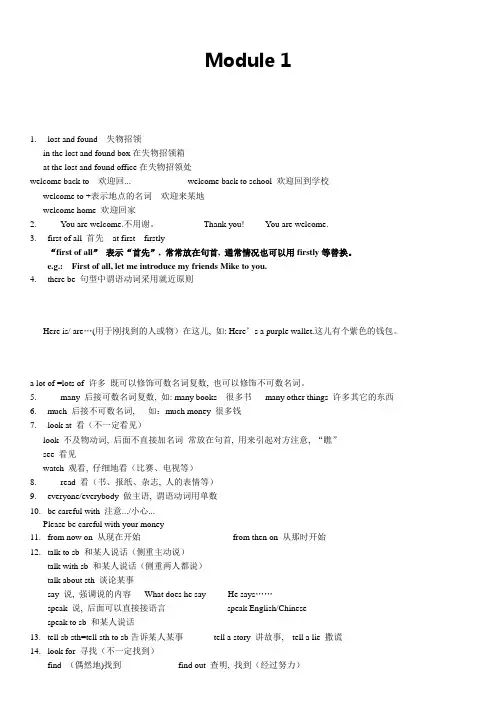
Module 11.lost and found 失物招领in the lost and found box在失物招领箱at the lost and found office在失物招领处welcome back to 欢迎回... welcome back to school 欢迎回到学校welcome to +表示地点的名词欢迎来某地welcome home 欢迎回家2.You are welcome.不用谢。
--Thank you! -- You are welcome.3.first of all 首先at first firstly“first of all”表示“首先”, 常常放在句首, 通常情况也可以用firstly等替换。
e.g.: First of all, let me introduce my friends Mike to you.4.there be 句型中谓语动词采用就近原则Here is/ are…(用于刚找到的人或物)在这儿, 如: Here’s a purple wallet.这儿有个紫色的钱包。
a lot of =lots of 许多既可以修饰可数名词复数, 也可以修饰不可数名词。
5.many 后接可数名词复数, 如: many books 很多书many other things 许多其它的东西6.much 后接不可数名词, 如:much money 很多钱7.look at 看(不一定看见)look 不及物动词, 后面不直接加名词常放在句首, 用来引起对方注意, “瞧”see 看见watch 观看, 仔细地看(比赛、电视等)8.read 看(书、报纸、杂志, 人的表情等)9.everyone/everybody 做主语, 谓语动词用单数10.be careful with 注意.../小心...Please be careful with your money11.from now on 从现在开始from then on 从那时开始12.talk to sb 和某人说话(侧重主动说)talk with sb 和某人说话(侧重两人都说)talk about sth 谈论某事say 说, 强调说的内容What does he say He says……speak 说, 后面可以直接接语言speak English/Chinesespeak to sb 和某人说话13.tell sb sth=tell sth to sb告诉某人某事tell a story 讲故事, tell a lie 撒谎14.look for 寻找(不一定找到)find (偶然地)找到find out 查明, 找到(经过努力)search 搜索, 调查look over检查look after =take care of 照顾look forward to 期盼,期待look forward to sth./doing sth.期待某事或做某事15.get on the bus 上公交车get off the bus 下公交车16.in a hurry 匆忙地hurry up=come on 快点儿hurry to do sth 匆忙做某事hundreds of 几百的, 成百上千的(大约数加s, 加of)two hundred (具体数不加s, 不加of)同样用法还有thousand、million、billion17.every day 每天everyday 每天的(形容词, 后面接名词)16.at the moment=at this moment=now 此时此刻, 现在at that moment=then 在那时such as 例如, 后面不加逗号后接名词或v.ing形式for example 例如, 后面加逗号后接句子17、帮助某人做某事help sb (to)do sth =help sb with sthleave sth.+地点把某物忘记或落在某地18、by bus/train/plane/bike = on a bus/train/plane/bike(buses/trains/planes/bikes)by car\taxi = in a car/taxi(cars/taxis)这是由疑问词whose引导的一个特殊疑问句。
(含12套)七年级英语下册1-12模块语法知识汇总及对应练习附答案新外研版
(12套)新外研版七年级英语下册1-12模块语法知识汇总及对应练习附答案Module 1 Lost and found语法精选1. whose 谁的whose意为“谁的”,是表示所有关系的疑问词. 其用法如下:(1)可以用来对名词所有格或形容词性物主代词进行提问. 如:This is Tina’s/her hat.→Whose hat is this?(2)可以用来对名词性物主代词进行提问. 如:These pencils are mine.→Whose are these pencils?2. hundred与hundreds ofhundred是一个确数,表示“一百”;hundreds of是一个概数,表示“好几百的;许许多多的”. 当hundred前面有一个具体的数词时,hundred不变为复数. 如:①two hundred cows两百头奶牛②Hundreds of people come here ev ery day.每天都有许多人到这里来.注意:当hundred与of连用时,它后面的名词和它本身都用复数. 如:hundreds of cows几百头奶牛3. such as 比如;例如such as意为“比如;例如”,用于引出多个例子. 如:I like some animals such as lions and monkeys. 我喜欢一些动物,比如狮子和猴子.注意:for example也意为“比如;例如”,用来举例说明某一论点或情况,一般只举同类人或物中的“一个”为例,作插入语,可位于句首、句中或句末. 如:①For example, air is invisible.例如,空气是看不见的.②He, for example, is a good student.例如,他就是个好学生.③Many boys like playing basketball. Take me, for example.许多男孩喜欢打篮球. 就拿我来说吧.句法精析1. I think it’s Betty’s. 我想这是贝蒂的.I think (that)+一个完整的句子,构成含有宾语从句的主从复合句. 如:I think you can join an English language club to practise speaking English.我认为你可以加入一个英语俱乐部去练习说英语.以I/We think...作主句,后跟宾语从句时,如果从句为否定句,一般要将其否定转移到主句,即否定转移. 如:I don’t think your sister will come tomorrow.我认为你姐姐明天不会来的.2. At the moment, there are also some strange things at the New York City Lost and Found Office.现在,在纽约失物招领处还有一些奇怪的东西.(1)at the moment意为“此时此刻;现在”,相当于now,常用于现在进行时态,可放在句首或句末. 如:He is playing football at the moment.现在他正在踢足球.(2)strange作形容词,意为“奇怪的”,在句中常作定语或表语. 作表语时常用于“It’s strange+that 从句”,意为“奇怪的是……”. 如:①What a strange idea!多么奇怪的想法!②It’s strange that you don’t know him.奇怪的是你不认识他. 语法精讲 名词性物主代词英语中的物主代词,如下表:(1)人称代词的主格在句子中作主语.(2)人称代词的宾格在句子中作动词或介词的宾语,be 动词后作表语. (3)名词性物主代词=形容词性物主代词+名词. 试题精编一、根据句意及汉语提示完成句子1. At the (飞机场), she helps a man find his daughter.2. Some students go to school by (船).3. He meets many str ange people and things at the lost and found (室;处).4. There are ten kilos of (腊肠) at the lost and found office.5. Linda lost her wallet in a (匆忙).6. There are (百) of people in the park on Sunday.7. My favourite animals are (鸭子).8. — (为什么) do you like doing sports? —Because it can help me keep healthy.9. The man is so (认真的) that he asks me so many questions. 10. I went to Beijing by (飞机) last week.形式人称 主格宾格形容词性 物主代词 名词性物 主代词 单数第一人称 I me my mine 第二人称 you you your yours 第三人称he she ithim her it his her its his hers its 复数第一人称 we us our ours 第二人称 you you your yours 第三人称theythemtheirtheirs二、用适当的代词填空1. Ann is my aunt. We often visit .2. These new houses are so nice. are very expensive.3. My desk is over there. This is not .4. Mike is my classmate. is good at PE.5. We are in the same class. classroom is big and nice.6. That’s a cat. name is Mimi.7. Sam and Peter, look at hands. They are so dirty.8. Mary likes red clothes. The skirt may be .9. Look!The dog is running everywhere. dog is it?10. Our new shoes are very comfortable. What about ?三、选词填空who lose her care purple1. It’s not my bag. Let me ask Lingling, maybe it’s .2. pen is this?3. Mary’s shoes are .4. Mr Smith is talking to a boy at the and found office.5. Is this your sweater, Tom? Please be with your things.四、句型转换1. People often lose things when they are in a hurry. (对画线部分提问)people often things?2. There are also a lot of animals at the lost and found office. (改为同义句)There a re animals at the lost and found office .3. There are some strange things at the lost and found office. (改为否定句)There strange things at the lost and found office.4. He is looking for his phone, camera and watch. (改为复数句)They looking for phones, cameras and .5. These gloves are my father’s. (改为一般疑问句,并作否定回答)—gloves your father’s?— , .五、语法填空阅读下面短文,按照句子结构的语法性和上下文连贯的要求,在空格处填入一个适当的词或使用括号中词语的正确形式填空(每空不多于2个单词).Dear friends,We are ver y happy to see 1 (thou-sand) of people go to the Voice of China. Thank you for your help, the big parties 2 (be) great. 3 now there are too many things here. You leave some of your things, like the4 (watch), the cameras and even ID cards and so on. You can do like these.5 (one), you can call the number 234 5678. Then we send6 (you) back. Also you can ask the police7 help. Finally, you can come to the sports centre. The workers here may tell you how to find8 (they).But we want 9 (say), please look after your things 10 (good) next summer!The Voice of China参考答案Module 1一、1. airport 2. boat 3. office 4. sausag es 5.hurry6. hundreds7. ducks8. Why9. careful 10. plane二、1. her 2. They 3. mine 4. He 5. Our6. Its7. your8. hers9. Whose 10. yours三、1. hers 2. Whose 3. purple 4. lost 5. careful四、1. When do, lose 2. lots of, too 3. aren’t any 4.are, their, watches5. Are these, No, they aren’t五、1. thousands 2. are 3. But 4. watches 5. First6. yours7. for8. them9. to say 10. WellModule 2 What can you do?语法精选1. play the piano弹钢琴(1)定冠词the用于西洋乐器前. 类似的还有:play the violin拉小提琴. 如:I’d like to join the Music Club because I can play the piano.我想加入音乐社团是因为我会弹钢琴.(2)中国乐器名词前不与冠词连用. 如:play erhu拉二胡(3)进行球类运动、下棋前面不用冠词. 如:play voll eyball打排球play football踢足球play chess下棋2. worry about担心worry about=be worried about担心. 如:①Don’t worry about your Chinese.别担心你的中文.②Don’t worry about your son.=Don’t be worried about your son.不要担心你的儿子.3. be good at在……方面做得好;擅长be good at中的at表示“在某方面”,其后可接名词、代词或动词?鄄ing形式,其近义词组为do well in.含有good的其他搭配:(1)be good for...意为“对……有好(益)处”,其反义词组是be bad for...,意为“对……有害”. 其中,for意为“对于;就……而论”. 如:Eating an apple a day is good for you.=It’s good for you to eat an apple a day.每天吃一个苹果对你有好处.(2)be good to...意为“对……友好(和善)”,相当于be kind to...,其中to用于引出对象. 如:The young should be good to the old.年轻人应该对老人和善.句法精析I think she’d like to join the Dance Club because she can dance really well.我认为她想加入舞蹈俱乐部,因为她跳得真的很好.would like意为“想要”,其语气比like婉转些. 其用法如下:(1)后面接名词或代词,表示具体要某样东西. 如:①I’d like two sweaters for my daughters.我想给我的女儿们买两件毛衣.②Would you like one of these mooncakes?你想要一块这样的月饼吗?(2)后面接动词不定式,表示“愿意;喜爱”,常用于有礼貌地提出邀请、请求或建议. 如:①I would like to be your c lass monitor.我想当班长.②Would you like to come to supper?你愿意来吃晚饭吗?(3)当主语是第一人称时,would可与should换用,它们都可以缩写为’d,并且like也可换成love. 如:①I’m sure he would love to come.我确信他愿意来.②I should like the red one.我喜欢这个红色的.(4)would like后面可以用动词不定式作宾语补足语. 如:I’d like you to meet my parents too.我想要你也见见我的父母.语法精讲情态动词can的用法(1)表示能力(如体力和脑力方面),意为“能;会”. 如:Can you speak English?你会讲英语吗?(2)表示请求或允许,多用在口语中,意为“可以;能”. 用于疑问句表示提出要求,用于否定句表示不允许. 如:①Can I help you?我能帮助你吗?②You can’t play basketball.你不能玩篮球.(3)表示可能. 如:①He can be at home now.他现在可能在家.②The moon can’t always be full.月亮不可能常圆.试题精编一、根据句意及汉语提示完成句子1. Gina likes art very much. She wants to join the Art (俱乐部).2. The key(关键) to happiness is to(选择) happiness.3. I do sports every day to keep (健康的) and healthy.4. We choose Harry as our (班长) at the class meeting.5. I (承诺) to help him with chemistry.二、用所给词的适当形式填空1. Lei Feng is always ready (help) others.2. Betty promises (send) me a nice postcard when she comes back to En gland.3. I’d like (be) a PE monitor because I enjoy sports.4. The boy often helps his mother do (clean) at home.5. Pleas e tell me how (learn) English well.6. Mike can’t speak Chinese (good).7. He us maths, he is a good .(teach)8. I can run (real) fast.9. Look!They are (choose) the new monitor.10. Tom is really fit and (health).三、用can或can’t填空1. — you sing?—Yes, but I sing well.2. — I help you?—I want a pair of shoes.3. — you play the piano?—Sorry, I , but I dance.4. Mary ri de a bike, me too!5. I believe that we are wrong.四、用适当的介词填空1. Where’re the new clubs this term?2. I can pl ay the piano. What you, Lily?3. —I can’t play football well.—Don’t worry it. Let me help you.4. Jane is good playing football, so she can join the Football Club.5. What’s the board?五、句型转换1. They can drive a car. (改为否定句)They a car.2. They want to join the Dance Club. (改为同义句)They the Dance Club.3. She can play badminton very well. (对画线部分提问)she very well?4. I’d like to play football. (对画线部分提问)What you do?5. Mike can play basketball well. (改为一般疑问句,并作否定回答)— Mike basketball well?— , .六、语法填空阅读下面短文,按照句子结构的语法性和上下文连贯的要求,在空格处填入一个适当的词或使用括号中词语的正确形式填空(每空不多于2个单词).My name is Joe. Do you want 1 (know) my hobby(爱好)? I like music very much. There are many 2 (club) in our school and I want to join the Music Club.Lisa and Linda are 3 (I) friends. Lisa is a girl 4 she likes playing chess very much. She wants to join the Chess 5 (club). Do you know Linda’s hobby? Well, let me 6 (tell) you. Linda’s favourite sport is7 (swim). But she 8 (not) want to join the Swimming Club. She wants to join the Music Club. 9 ? Because she wants to be in the same club as me.David is 10 my friend. He likes English and he wants to join the English Club.参考答案Module 2一、1. Club 2. choose 3. fit 4. monitor 5. promise二、1. to help 2. to send 3. to be 4. clean ing 5.to learn6. well7. teaches, teacher8. really9. choosing 10. healthy三、1. Can, can’t 2. Can 3. Can, can’t, can 4. can 5. can’t四、1. for 2. about 3. about 4. at 5. on五、1. can’t drive 2. would like to join 3. What can, do 4. would, like to5. Can, play, No, he can’t六、1. to know 2. clubs 3. my 4. and 5. Club6. tell7. swimming8. doesn’t9. Why 10. alsoModule 3 Making plans语法精选1. have a picnic 去野餐have a picnic意为“去野餐”. 在英语中,经常用have+(a)+n. 组成词组. 如:have a look at 看一看have breakfast/lunch/supper 吃早/午/晚饭have classes/lessons 上课have a meeting 开会have a rest 休息一会儿2. else 其他的;别的else作形容词,意为“其他的;别的”,常与疑问代词连用. 如:①What else did he say?他还说了些什么?②Who else is coming?还有谁要来?other与else的区别:(1)other作形容词,意为“其他的”,一般放在被修饰词的前面. 如:①Do you have any other questions?你还有其他的问题吗?②I’ll come with two other students.我将会和其他两个学生一起来.(2)else作副词,意为“其他;另外”,通常放在疑问副词的后面;作形容词,意为“其他的;别的”,通常放在疑问代词或不定代词的后面. 如:①Ask somebody else to help you.请求其他人来帮助你吧.②Where else can I go?我还能去别的什么地方吗?3. alone 单独(的);独自(的)alone既可作形容词,也可作副词,意为“单独(的);独自(的)”. 如:①He is alone at home. 他独自在家.②If you don’t want to go alone, I’ll go with you. 如果你不想一个人去,我和你一起去.alone与lonely的区别见下表:如:I was travelling alone in the lonely mountain. I didn’t feel lonely though I was alone.我独自在荒凉的山上旅行. 虽孤身一人,但我并不感到孤独.句法精析1. I’m loo king forward to the football match tomorrow.我期待着明天的足球赛.look forward to意为“期待;盼望”,后面接名词或动名词(v.-ng). 如:I’m looking forward to my holiday.我盼望着假期的到来.2. Usually I spend the summer holiday at home, but this year is going to be very differ-ent because I’m g oing on a summer camp in Sydney, Australia.通常过暑假我都待在家里,但是今年将不同,因为我打算去澳大利亚的悉尼参加夏令营.spend作动词,意为“花费;度过”. 其过去式为spent. 如:He spent 100 yuan in the shop yesterday.昨天他在商店里花了100元.spend的常用结构:(1)spend money on sth. 花钱买某物. 如:He spent 10 yuan on the book.他买这本书花了10元.(2)spend time (in) doing sth. 花时间做某事. 如:I spent an hour (in) mending the bike.我花了一小时修理这辆自行车.语法精讲一般将来时:be going to这是一种固定结构,它后面要接动词原形,用来表示按计划或安排要发生的动作,有时也可以表示推测将要或肯定会发生的动作,有“准备;打算”的意思.be going to的用法:(1)含有be going to结构的句子中往往有表示将来的时间状语. 如:this afternoon, tomorrow, nextweek等.(2)be going to结构中的be动词很少用原形,它一般有三种形式,即:am, is, are. 当主语是第一人称单数时用am;当主语是第三人称单数时用is;当主语是其他人称时用are.(3)含be going to的句子变否定句和一般疑问句的方法:由于句子中有be动词,在be动词(am, is, are)的后面加上not就构成了否定句;把be动词(am, is, are)放到句首,在句末加问号就构成了一般疑问句. 其答语为:Yes, 主语+am/is/are.或No, 主语+isn’t/aren’t./No, I’m not..(4)there be句型的be going to结构为:There is/are going to be...(注意:句型中going to 后面的be动词不能改为have),常用来表示将有某事发生. 如:There is going to be a football match next Saturday in our school.下周六我们学校将有一场足球比赛.试题精编一、根据句意及汉语提示完成句子1. They are going to have a (野餐) this Saturday.2. At week ends, my parents always stay at home and do some (家务).3. Who (另外) wants me to help?4. There is (没有东西) in the box.5. Many (迷) are going to the airport to meet the movie star.6. The boys are going to watch the footbal l match and (为……欢呼) the players.7. There are eleven (选手) in a football team.8. We all (希望) to celebrate the Spring Festival with a traditional family dinner.9. Don’t be (迟到) for school, children.10. Monday is the (第二) day of a week.二、用所给词的适当形式填空1. Emily would like (visit) the Palace Museum.2. I have an (Australia) pen friend. Her name is Jenny.3. We can go (sightsee) around the city after the meeting.4. I enjoyed (I) at the party last night.5. We’re looking forward to (go) to Disneyland with our parents.三、用am/is/are going to填空1. Who have a piano lesson on the weekend?2. My mother and I do some shopping next Sunday.3. —What you do tomorrow?—I clean my car.4. My son’s hair is too long. He have a haircut at the weekend.5. There be two football matches on our playground.四、用方框中所给单词或短语的适当形式填空two have a picnic meet Australia funplan help with stay at else late1. I usually housework at home.2. The students are going to next week.3. I’m going to make a for my study next year.4. I’m so busy that I have no time to my grandparents at the station.5. Betty is going to home and watch TV alone.6. We have an teacher. Her name is Jenny.7. I get up on Sunday.8. Is there anything you want me to buy?9. It is great to spend a day in Disneyland.10. February is the month of the year.五、句型转换1. He is going to watch TV tomorrow evening. (改为一般疑问句)he watch TV tomorrow evening?2. They are going to play in the park this weekend. (改为否定句)They play in the park this weekend.3. I’m going to go shopping with my mother this weekend. (对画线部分提问)this weekend?4. Lucy is looking forward to going to Beijing Zoo because she likes pandas. (对画线部分提问)Lucy going to Beijing Zoo?5. —Are the four boys going to cheer the players this eveni ng? (作肯定回答)— , .6. She plays the piano every evening. (用this evening改写句子)She the piano .7. Mary often goes sightseeing with her friends. (改为同义句)Mary often some with her fr iends.8. I plan to see a movie this Saturday. (改为同义句)I see a this Saturday.六、用一般将来时be going to连词成句1. Friday, what, do, next, he(?)2. have, we, a, on, picnic, morning, Sunday(.)3. I, email, check, my(.)4. they, a, cake, make(?)5. Lucy, France, in, travel(.)七、语法填空阅读下面短文,按照句子结构的语法性和上下文连贯的要求,在空格处填入一个适当的词或使用括号中词语的正确形式填空(每空不多于2个单词).People call John “Mr Going-to-do”. Why?1 he always says he is going to do something, but he never 2 (do) it.“I’m going 3 (clean) my house today,” he says, 4 “I’m going to wash my car tomorrow,” or “These trees in front of my house 5 (be) too big. I’m going to cut them down next week.”Mr Smith usually says, “Are you going to do 6 (something) John?” He knows John is7 going to clean his house, or wash his car, or cut down any trees. Then he says, “Well, excuse 8 , John. I’m going to do some work in the house.” And he does.Mr and Mrs Smith often say to 9 (they) only child Dick, “Are you going to do anything? Then do it. 10 (not) be another ‘Mr Going-to-do’.”参考答案Module 3一、1. picnic 2. housework 3. else 4. nothing 5.fans6. cheer7. players8. hope9. late 10. second二、1. to visit 2. Australian 3. sightseeing 4. myself 5. going三、1. is going to 2. are going to 3. are, going to, am going to 4. is going to5. are going to四、1. help with 2. have a picnic 3. plan 4. meet 5.stay at6. Australian7. late8. else9. fun 10. second五、1. Is, going to 2. aren’t going to 3. What are you going to do4. Why is, looking forward to5. Yes, they are6. is going to play, this evening7. does, sig h tseeing 8. am going to, movie/film六、1. What is he going to do next Friday?2. We are going to have a picnic on Sunday morning.3. I am going to check my email.4. Are they going to make a cake?5. Lucy is going to travel in France.七、1. Because 2. does 3. to clean 4. or 5. are 6.anything7. not/never 8. me 9. their 10. Don’tModule 4 Life in the future语法精选1. need 需要need意为“需要”,既可用作实义动词,也可用作情态动词. need用作实义动词时,它的单数第三人称形式为needs,后面可跟名词、代词和带to的不定式等作宾语. 如:The boy doesn’t need help.这个男孩不需要帮助.need用作情态动词时,后面跟动词原形. 如:They needn’t water the flowers again.他们不再需要浇花.2. in twenty years’ time二十年之后“in+一段时间”表示“一段时间之后”,常用于将来时. 可以用 how soon 来提问. 如:—How soon will you be back?你多久回来?—In a week.一个星期之后.3. not only...but also... 不仅……而且……not only...but also...是一个连词词组,意为“不仅……而且……”,连接两个并列成分. 当连接两个并列的主语时,谓语动词要和邻近的主语在人称和数上保持一致. 如:①H e can not only dance but also sing.他不仅会跳舞而且会唱歌.②Not only John but also his parents are going to watch the basketball match tomorrow.不仅是约翰,而且他的父母也将去看明天的篮球赛.4. as well 也as well表示“也;又”,常用于句尾. 如:The little girl sings, and plays the piano as well.这个小女孩既会唱歌,也会弹钢琴.句法精析1. They can ask their teachers questions by Internet, telephone or email.他们可以通过互联网、电话或电子邮件向老师提问.by表示方式,意为“用;靠;通过”. 如:Send it by air mail.用航空邮件寄吧.2. Computers won’t be able to do that.计算机无法胜任.be able to意为“能够;会;胜任”. 相当于can,但是be able to可以用于更多的时态中. 如:I’m able to swim.=I can swim.我会游泳.3. Teachers won’t use chalk on a black board and students won’t use pens and paper, or erasers any more!老师们将不再用粉笔在黑板上写字,学生们也将不再使用钢笔、纸或橡皮!not...any more意为“不再”. 如:I won’t do that any more.我再也不那样做了.语法精讲一般将来时:will如果我们想描述将来的事情或表达对未来的预测等,可以用一般将来时表达,它的构成形式是:will+动词原形. 如:①There will be a computer on every desk in the future.未来每张桌子上都将有一台电脑.②It will rain tomorrow.明天将要下雨.③We will go to school on foot.我们将步行去上学.will的否定形式和疑问形式:(1)一般将来时的否定形式,是在 will 后面加 not 或用 won’t. 如:There will not be a computer on every desk in the future.=There won’t be a computer on every desk in the future.未来每张桌子上都将没有一台电脑.(2)这个时态的一般疑问句形式,是将will提到句首,并在句尾使用问号. 肯定回答用will,否定回答用缩略式won’t.试题精编一、用所给词的适当形式填空1. What you (do) after you leave here?2. Students are able to (use) computers well.3. you (buy) a car next year?4. There (not be) a party next Friday.5. I have a lot of books (read).6. We don’t need (ask) them fo r help.7. I’m looking forward to (spend) the summer holiday at my grandmother’s home.8. She is new here, and we know (something) about her.二、用方框中所给的形容词填空different free heavy hot interesting warm sm all difficult long light1. The radio says there i s going to be a rain in the evening, so we won’t go out tonight.2. and bright colours make people happy and act ive.3. No one wants to walk outside on such a summer day.4. People wear clothes in winter.5. Nothing is if you try your best.6. The dress is very beautiful, but it’s too for me.7. Linda likes English. She thinks it’s .8. I’m going to spend a holiday with my family members.9. —Are you now?—No, I’m helping my mother with housework.10. There are kinds of flowers in this park.三、句型转换1. We clean our classroom every day. (用tomorrow改写句子)We our classroom .2. People will use the sun to heat their homes.(改为一般疑问句,作否定回答)— people the sun to heat their homes?— , .3. Linda is ten years old. (用next year改写句子)Linda eleven years old next year.4. My mother is going to visit England because she likes European culture. (对画线部分提问)your mother going to England?5. He will see his parents twice a week. (对画线部分提问)he see his parents?四、语法填空阅读下面短文,按照句子结构的语法性和上下文连贯的要求,在空格处填入一个适当的词或使用括号中词语的正确形式填空(每空不多于2个单词).Mr Wu is having a class in Class Five. He is asking students 1 (think) about their future life. Different students have different 2 (idea).Zhang Wei thinks people will live in the sea 3 fish. Because in the future, people4 (use) organic silicon (有机硅) to breathe (呼吸) in the sea. And people will buil d cinemasand schools in5 sea. Then they can see doctors and go to school. He thinks life in the sea will be very6 (interest) and co mfortable.Luo Li thinks every family will have a car. And 7 (this) cars will fly in the sky. People will drive cars to 8 (they) offices.Wang Kai thinks machines like robots will do work for people, 9 people will have more free time to enjoy life. He thinks people will have short winter holidays 10 long summer holidays, because the summer will be very long.参考答案Module 4一、1. will, do 2. use 3. Will, b uy 4. won’t be5. to read6. to ask7. spending8. nothing二、1. heavy 2. Light 3. hot 4. warm 5. difficult6. small7. interesting8. long9. free 10. different三、1. will clean, tomorrow 2. Will, use, No, they won’t 3. will be4. Why is, visit5. How often will四、1. to think 2. ideas 3. like 4. will use 5.the6. interesting7. these8. their9. so 10. butModule 5 Shopping语法精选take, spend, cost与paytake, spend, cost和pay都可以表示“花费”,但用法却不尽相同:(1)take后面常跟双宾语. 常见用法:It takes sb.+时间+to do sth.,表示“某人花了多少时间做某事”. 如:It took them three years to build this road.他们用了三年时间建了这条路.(2)spend的主语必须是人. 有以下两种用法:①spend time/money on sth. 表示“在……上花费时间/金钱”. 如:I spent two hours on this maths problem.我在这道数学题上花了两个小时.②spend time/money (in) doing sth. 表示“花费时间/金钱做某事”. 如:They spent two years (in) building this bridge.他们花了两年时间造这座桥.(3)cost的主语是物或某种活动,还可以表示“值”. 其用法如下:sth. cost(s)(sb.)+金钱,表示“某物花了(某人)多少钱”. 如:A new computer costs a lot of money.买一台新电脑要花一大笔钱.(4)pay的基本用法是:①pay (sb.) money for sth. 表示“付钱(给某人)买……”. 如:I have to pay t hem 20 pounds for this room each month.我每个月要付给他们20英镑的房租.②pay for sth. 表示“付……的钱”. 如:I have to pay for the lost book.我不得不赔付遗失的书的钱.③pay for sb. 替某人付钱. 如:Don’t worry!I’ll pay for you.别担心!我会替你付钱的.句法精析How much meat do you want?你想要多少肉?How much+不可数名词+一般疑问句?是用来询问东西(不可数名词)的数量. 如:How much rice is there in the bag?袋子里有多少稻米?与how有关的句式:(1)初次见面双方都使用的寒暄语. 如:How do you do? 你好!(2)询问健康状况. 如:How are you? 你好吗?(3)询问年龄. 如:How old is your younger brother?你弟弟多大了?(4)询问数量.①how many修饰可数名词复数. 如:How many women teachers are there in your school? 你们学校有多少名女老师?②how much修饰不可数名词. 如:How much water is there in the bottle?瓶子里有多少水?(5)询问次数. 如:How many times have you been to Beijing?你去过北京多少次?(6)询问价格. 如:How much is the book? 这本书多少钱?(7)询问方式、手段或方法. 如:How do you usually go to school?你通常怎样去学校?(8)询问天气情况. 如:How is the weat her in Shanghai?上海的天气怎么样?(9)询问程度和感想. 如:①How fast does she run?她跑得有多快?②How do you like the book?你觉得这本书怎么样?(10)询问意见或打算. 如:How about going out for a walk?出去散散步怎么样?(11)询问距离. 如:How far is it from your home to your school?从你家到你们学校有多远?(12)询问时间.how long问时间的长短;how soon问多久之后将发生某个动作. 如:①How long are you going to stay there?你打算在那儿待多长时间?②How soon will your father come back?你爸爸多久回来?注意:how long也可以问物体的长度. 如:How long is the bridge? 这座桥有多长?(13)询问频率. 如:How often does your brother play computer games?你哥哥多久玩一次电脑游戏?语法精讲特殊疑问句(1)定义:以疑问词开头,对句中某一成分提问的句子叫特殊疑问句.(2)常用的疑问词有:what(什么), who(谁), whose(谁的), which(哪个), when(什么时候), where(哪里), how(怎样), why(为什么)等.(3)特殊疑问句的语序①疑问词(作主语)+谓语动词+其他?如:Who is singing in the room?谁正在房间里唱歌?②疑问词+一般疑问句?如:How do you like these sausages?你觉得这些香肠怎么样?注意:回答特殊疑问句时,不能用yes/no,而是问什么答什么,也可以简略回答.试题精编一、根据句意及汉语提示完成句子1. We all wish to (收到) many nice presents on our birthdays.2. It’s (安全的) for you to stay at home alone.3. The shop is (营业的) on Sundays.4. Can you tell me some (优势) of being tall?5. If you (比较) the two things, you can find out which is better.6. You can send it to me by (邮寄).7. There are some different kinds of (产品) in our shop.8. I have (几个) good friends in China.9. You can get it three days (以后).10. I can’t find my pen (在任何地方).二、用方框中所给单词的适当形式填空sale look may shop post several l ater out price take1. Could you please the letter for me on your way to school?2. There are answers to this question.3. Mr Wang is coming back .4. We will go and buy some fruit.5. They run of the classroom into the playground.6. —You worried. What’s the matter?—My mother is ill.7. —Which one will you ?—The yellow one.8. — I ask you a question?—Of course.9. The of the bag is two hundred yuan.10. All of the clothes are on . You can buy them at low prices.三、补全对话(每空词数不限)1. — can I do you?—I’d like to buy a T-shirt for my son.2. — does he like?—He likes white.3. — do you take?—Small.4. —M ay I try it on?— .5. — would you like?—Half a kilo.6. — are they?—Thirty-eight yuan a kilo.7. — lemons are there on the table?—There are seven lemons on the table.8. — is it from your house to school?—I don’t know.9. — do you get up every day?—At 6:30.10. — will you stay there?—For seven days.四、句型转换1. Can I help you, please? (改为同义句)I for you?2. What’s the price of the meat? (改为同义句)is the meat?3. My favourite foo d is rice. (对画线部分提问)your favourite food?4. This is Mr Zhang’s computer. (对画线部分提问)is this?5. I often go to see my grandparents on Sunday. (对画线部分提问) you often go to se e your grandparents?6. The park is near the hospital. (对画线部分提问)the park?7. Mr Green will go to Hong Kong by plane. (对画线部分提问)Mr Green go to Hong Kong?8. I’d like Size S. (对画线部分提问)you like?9. He wants to join the Music Club. (对画线部分提问)does he want to join?10. How much do you want? (改为同义句)How much you ?五、语法填空阅读下面短文,按照句子结构的语法性和上下文连贯的要求,在空格处填入一个适当的词或使用括号中词语的正确形式填空(每空不多于2个单词).Li Lei is a student in Class Two, Grade1 (seven). He likes football verymuch. He often2 (play) it after school. And he often goes home late. His home is near the school.His mother3 (not) worry about him.One Sunday morning, Li Lei goes to a shop 4 his mother. The shop is very big.5 are many things in it. They get some 6 (thing). Then his mother says to Li Lei, “7 do you want?”“I want to buy a red dress,” says Li Lei. “8 red dress?” asks hismother. “You are a boy. You can’t9 (wear) a red dress.” Li Lei smiles, “OK. Pleaseget me some football shirts.”10 an interesting story!Don’t you think so?参考答案M odule 5一、1. receive 2. safe 3. open 4. advantages pare。
word完整版)新外研版七年级英语下册各单元语法总复习练习及答案
word完整版)新外研版七年级英语下册各单元语法总复习练习及答案Module 1语法:名词性物主代词在英语中,人称代词和物主代词是非常重要的。
人称代词分为第一人称、第二人称和第三人称。
物主代词分为形容词性物主代词和名词性物主代词。
一、选择填空1.这些是钢笔,那些是铅笔。
(that。
this。
those)2.XXX昨天病了。
这就是他缺席学校的原因。
(That,Those。
These)3.这些衬衫中哪些是XXX的?(These。
this。
that)4.这张桌子是我的,那张是她的。
(those。
this。
that)5.北京的地图比天津的地图好。
(this。
that。
these)6.他的名字是XXX。
她是一名厨师。
(He。
Her。
His) (She。
He。
His)7.我的姑妈是一名护士。
她工作非常努力。
(I,My,XXX) (She。
He。
Her)8.请给我指路。
(me。
I。
XXX)9.这些书不是我的。
它们可能是她的。
(my。
XXX。
I) (They。
It。
Its) (her。
hers。
your)10.让我告诉她如何做。
(I。
me。
mine) (her。
she。
hers)二、选择填空1.每个人都应该尽力而为。
(its。
ones。
his。
their)2.她是我的好朋友。
(She。
mine) (Her。
mine) (She。
my) (Hers。
my)1.What can you do。
I can lift this box。
but I can't lift that heavy chair.2.Can he read Chinese?——No。
he can't read Chinese。
but he can read.3.Can you stand in front of the door。
Then I can see you.4.Did XXX dishes。
Yes。
she did.5.I can see some spoons。
外研版七下新1---6模块知识点以及习题(word文档物超所值)
形容 词性 物主 代词
名词 性物 主代 词
• (二)重点短语:1) 欢迎回到学校 welcome back to school
• 2)首先,第一 first of all 3)失物招领箱 lost and found box
• 4)许多东西 a lot of things 5) 看… look at
Module 1 Lost and found
Unit 1 Whose bag is this?
1. Everyone, please be careful with your things from now on.
be careful with 的意思是
。
e.g. Be careful with that knife, or you’ll cut yourself.
数+of,如: millions of 汉语意思是 “
”。
eg. Thousands of visitors come to our school for a visit every year.
试一试:Some scientists think that it will take
years to make robots do most
7. Is this ________ (他的)football? Yes, it is. It’s ________. (他的)
2
8. Is this _______ (我的)watch?
Yes, it is. It’s ________.(你的)
9. Are these________ (Betty) crayons? Yes, they’re ________ crayons.
外研版英语七年级下册Modules1-12知识点总结
七年级下复习资料M1---M12Module 11、人称代词归纳(必背)Eg:This is my book.=The book is mine. 名词性物主代词=形容词性+名词Please help me. 动词后面接宾格2、whose 疑问代词提问:Whose tapes are these?Whose+名词+be动词+代词?回答:They’re mine. 代词+be动词+名词性物主代词.Whose bag is it? 此时的whose是形容词性物主代词。
Whose is this bag? 此时的whose是名词性物主代词。
3、welcome back to+地点欢迎回到某地Welcome to+地点欢迎到某地来Welcome sb to+地点欢迎某人到某地来4、everyone 每个人(指人)后面不能接ofevery one 每个人或物(根据上下文,可指人也可指物)后面可以接of Eg:every one of us我们中每个人5、first of all=at first = firstly 首先6、lost and found box 失物招领箱7、here’s、here’re句型,其后be动词的形式由后面的名词决定Eg:Here is a book. Here are some books.8、be careful with sth. 仔细保管某物9、from now on从现在开始 from then on 从那时开始10、watch 手表(名词);观看(动词)Watch 观看(电视,电影,比赛等) Look 看(表示动作,后接at) See 看见(强调结果) Read 看(看书、报纸,杂志等)11、lost and found office 失物招领办公室(前面用介词at)12、look for寻找(强调动作) find找到(强调结果)13、get on上(公交车,飞机,轮船,火车等)get off下(公交车,飞机,轮船,火车等)Get in上(小轿车) get out of 下(小轿车)14、lose 动词,丢失,失败 lost(lose的过去式,同时lost也作为形容词,意为丢失的)Eg:I lost my way。