
(外研版)三年级英语下册课件_Module_4_Unit_2(1)
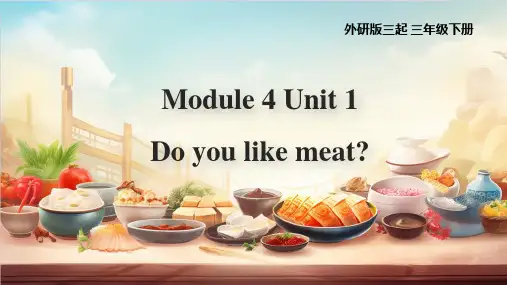
Module 4 Unit 1 (课件)-三年级英语下学期(外研版三起)
我喜欢面条。
是的,我喜欢。
Listen, point and find "Do you like...?"
艾米,你喜欢鱼吗? 不,我不喜欢。
但是我喜欢肉。
Listen, point and find "Do you like...?"
我喜欢牛奶。
1. 表达自己喜欢某事物的句型: I like + 事物名称.
【第三人称单数形式】 passes 【拓展】pass+某人+某物=pass+某物+to+某人 把某物递给某人 【例句】 Please pass me the book. = Please pass the book to me.
请把那本书递给我。
Vocabulary
/raɪs/ n. 米饭(不可数名词)
能用 Yes, I do.或 No, I don't.回答问题。
Vocabulary
/mi:t/ n. 肉(不可数名词)
【例句】don't like meat.我不喜欢肉。 【注意】meat是不可数名词,没有复数形式。 【巧记】m+ eat (吃) = meat(肉)
Vocabulary
/pa:s/ v. 传送,传递
【例句】I like rice. 我喜欢米饭。 【拓展】a bowl of rice 一碗米饭 【注意】rice是不可数名词,没有复数形式。
Vocabulary
/mʌm/ 妈妈
【同义词】mom/mother【对应词】dad 爸爸 【注意】mum和dad主要用于口语中,而mother和father则常用于正式场合 或书面语中。 【例句】This is my mum.这是我的妈妈。
三年级英语下册Module1Unit2《I’mgoingtohelpher》 优秀课件1(新版)外研版(一起)

四、完形填空,根据所给单词的正确形式 填入空中 be , help ,quiet,loud, shy, is,clever ,make,nice,another,I Hi,everybody.My name's Nancy,I___ am a nine-year-old girl.I have many friends.This nice is Mary,she's very____,but she's a bit ____.She always______people.I have got shy helps clever another ____friend,he is Mark.He's very_____,he make can____e-cards.This weekend I'm going do are to____my homework.They____going to help ___. me
Some boys are playing basketball.Some girls are playing ping-pong.Some old men are playing Chinese chess(象棋)under the tree.How happy they are !Do you think so? 1.Some boys are playing ping-pong. F 2.Some girls are playing basketball. F 3Some women are playing Chinese chess. F 4.They are very happy. T
一、根据首字母填空。 elpful 1,I'm h______,I can help you.( 乐于助人的) 2,This little girl c____ an't do her Maths.(不能) 3,I’m going to h_____ her.(帮助) elp lus 4,What's ten p_____ eleven?(加上) ore 5,And one m___?( 再一个) ood (好的) 6,This little girl is g____. 7,This little girl is b____( 坏的) ad 8,This little boy is______.( naughty 淘气的) shy 9,This little boy is_______.( 害羞) ice 10,This little boy is n______.( 好的)
外研版(一起)三年级下册《 Unit 2 》 同步练习卷(1)
外研版(一起)三年级下册《Module 4 Unit 2 Thirteen fourteen fifteen》小学英语-有答案-同步练习卷(1)一、判断每组划线单词部分的读音,相同的打“√”,不同的打“×”.1. 判断每组划线单词部分的读音,相同的打"√",不同的打"×".clo________ pi________2. 判断每组划线单词部分的读音,相同的打"√",不同的打"×".f________m f________mer________3. 判断每组划线单词部分的读音,相同的打"√",不同的打"×".fourt________n f________l________4. 判断每组划线单词部分的读音,相同的打"√",不同的打"×".p________r b________r________5. 判断每组划线单词部分的读音,相同的打"√",不同的打"×".________pple w________sh________6. 判断每组划线单词部分的读音,相同的打"√",不同的打"×".n________neteen w________de________7. 判断每组单词画线部分的读音,相同的打"√",不同的打"×"Ma________s ________ank________8. 判断每组划线单词部分的读音,相同的打"√",不同的打"×".________fraid ________lways________9. 判断每组划线单词部分的读音,相同的打"√",不同的打"×".gr________t br________kfast________10. 判断每组划线单词部分的读音,相同的打"√",不同的打"×".yell________ n________二、将正确的数词写在括号里.将正确的数词写在括号里.(1)thirteen________(2)thirty________(3)twenty________(4)nineteen________(5)eighteen________将正确的数词写在括号里(1)fifteen________(2)fourteen________(3)forty﹣six________(4)thirty﹣seven________(5)twelve________三、找出每组词中不同种类的单词.找出每组词中不同种类的单词.()A.lionB.tigerC.pear找出每组词中不同种类的单词.()A.SamB.zooC.Amy找出每组词中不同种类的单词.()A.treeB.appleC.peach找出每组词中不同种类的单词.()A.sevenB.sixteenC.lunch找出每组词中不同种类的单词.()A.bookB.toyC.pen找出每组词中不同种类的单词.()A.whereB.howC.long找出每组词中不同种类的单词.()A.farmB.schoolC.fruit找出每组词中不同种类的单词.()A.parkB.naughtyC.loud找出每组词中不同种类的单词.()A.cakeB.breadC.pear找出每组词中不同种类的单词.()A.teacherB.farmerC.thirteen四、按对话的顺序将1-10的序号写在括号里.按对话的顺序将1﹣10的序号写在括号里.________Hello, this weekend we're going to a fruit farm.________Great! What will we do?________But I don't like apples.________Yes, we will.________We'll pick fruit. We'll pick apples.________What other fruit will we pick?________We'll pick peaches.________Will we pick pears, too?________We'll have a good time.________That's great!五、选择正确的答语.选择正确的答语.从B栏中选出A栏句子的正确译文.weekend, this, we, going, are, to, the, fruit, farm,(.)________pandas, I, see, lots of, will, at, the, zoo,(.)________children, pears, will, pick, on, the, farm,(.)________we, pick, will, twenty, pears,(.)________will, have, breakfast, you, at, seven,(?)________八、根据汉语提示完成句子(注意个别词的变化).根据汉语提示完成句子I'm________ (恐怕), we can't see all________ (桃子).根据汉语提示完成句子I________ (有13个) apples in my bag.根据汉语提示完成句子Sorry, I________ (感觉累了). Let's go home.根据汉语提示完成句子This Saturday we'll________ (摘水果) on the farm.根据汉语提示完成句子________ (多少) apples will you eat? Three.九、仿写句子(每个句子仿写2个).仿写句子(每个句子仿写2个)例句:(1)I like eating ________. I have ________ apples.________________例句:(2)Will you ________? Yes, I will. / No, I won't.________________例句:(3)We'll ________ We ________________________例句:(4)How many ________? There are ________.________________十、选词填空.选词填空.pick apples Oranges pears peaches fruitHi, I'm Lingling. We are going to go to a fruit farm this weekend. We'll pick (1)________. Dad will pick (2)________. He likes apples. Mum will pick (3)________. Peaches are her favorite fruit. What about me?(4)________ are my favorite fruit. But I won't (5)________ (摘) oranges. They haven't got oranges at this farm. So I will pick some (6)________.十一、根据短文内容,选择正确的选项.根据短文内容,选择正确的选项.We're at the supermarket. Look, there are so many fruit here! There are 17 pears. There are 15 apples. There are 16 peaches. There are 14 oranges. There are 18 lemons. There are 14 watermelons. There are 19 pineapples. We want to buy them!(1)There are________ apples.A. fifteenB. fourteenC. thirteen.(2)There are________ peaches.A. seventeenB. sixteenC. fourteen.(3)There are________ lemons.A. fourteenB. eighteenC. nineteen.(4)There are________ pineapples.A. twentyB. nineteenC. eighteen.参考答案与试题解析外研版(一起)三年级下册《Module 4 Unit 2 Thirteenfourteen fifteen》小学英语-有答案-同步练习卷(1)一、判断每组划线单词部分的读音,相同的打“√”,不同的打“×”.1.【答案】ck,ck√【考点】国际音标【解析】clock钟,pick选择.【解答】考查字母组合ck在单词中发音.字母组合ck在单词clock中发[k],字母组合ck在单词pickr中发[k],发音相同.故答案为:√.2.【答案】ar,ar,√【考点】国际音标【解析】farm农场,farmer农民.【解答】考查字母ar在单词中发音.字母ar在单词farm中发[a:],字母ar在单词farmer中发[a:],发音相同.故答案为:√.3.【答案】ee,ee,√【考点】国际音标【解析】fourteen十四,feel觉得.【解答】考查元音字母组合ee在单词中发音.元音字母组合ee在单词fourteen中发[i:],元音字母组合ee在单词feel中发[i:],发音相同.故答案为:√.4.【答案】ea,ea,√【考点】国际音标pear梨,bear熊.【解答】考查元音字母组合ea在单词中发音.元音字母组合ea在单词pear中发[eə],元音字母组合ea在单词bear中发[eə],发音相同.故答案为:√.5.【答案】a,a,×【考点】国际音标【解析】apple苹果,wash洗.【解答】考查字母a在单词中发音.字母a在单词apple中发[æ],字母a在单词wash中发[ɒ],发音不相同.故答案为:×.6.【答案】i,i,√【考点】国际音标【解析】nineteen十九,wide宽的.【解答】考查字母i在单词中发音.字母i在单词nineteen中发[aɪ],字母i在单词wide中发[aɪ],发音相同.故答案为:√.7.【答案】th,th,√【考点】国际音标【解析】Maths数学,thank谢谢.【解答】考查字母组合th在单词中发音,字母组合th在单词Maths中发[θ],字母组合th在单词thank中发[θ],两个单词中字母组合th发音相同.故答案为:√.8.【答案】a,a,×【考点】国际音标略【解答】×9.【答案】ea,ea,×【考点】国际音标【解析】great伟大的,breakfast早餐.【解答】考查元音字母组合ea在单词中发音.元音字母组合ea在单词great中发[eɪ],元音字母组合ea在单词breakfast中发[e],发音不相同.故答案为:×.10.【答案】ow,ow×【考点】国际音标【解析】略【解答】×二、将正确的数词写在括号里.【答案】13,30,20,19,18【考点】单词、词组【解析】(1)thirteen 13.(2)thirty 30.(3)twenty 20.(4)nineteen 19.(5)eighteen 18.【解答】考查单词翻译.(1)13.thirteen译为:13.故答案为:13.(2)30.thirty译为:30.故答案为:30.(3)20.twenty译为:20.故答案为:20.(4)19.nineteen译为:19.故答案为:19.(5)18.eighteen译为:18.故答案为:18.【答案】15,14,46,37,12单词、词组【解析】略【解答】15 14 46 37 12三、找出每组词中不同种类的单词.【答案】C【考点】类别分类【解析】略【解答】C【答案】B【考点】类别分类【解析】A.Sam人名;B.zoo动物园;C.Amy人名.【解答】本题考查类别分类.A.Sam人名;B.zoo动物园;C.Amy人名.Sam和Amy是人名,zoo是地点名词.故选:B.【答案】A【考点】类别分类【解析】tree树木;apple苹果;peach桃子.【解答】本题考查类别分类.tree树木,植物名词;apple苹果,水果名词;peach桃子,水果名词;B、C都是水果名词,A是植物名词,选项A与其它几个不同类.故选:A.【答案】C【考点】词性分类【解析】A.seven七;B.sixteen十六;C.lunch午餐.【解答】本题考查词性分类.A.seven七;B.sixteen十六;C.lunch午餐.seven和sixteen 是基数词,lunch是三餐名词.故选:C.【答案】B【考点】类别分类【解析】book书本;toy玩具;pen钢笔.【解答】本题考查类别分类.book书本,文具名词;toy玩具,玩具名词总称;pen钢笔,文具名词;A、C都是文具名词,B是玩具名词总称,选项B与其它几个不同类.故选:B.【答案】C【考点】词性分类【解析】A.where在哪;B.how怎样;C.long长的.【解答】本题考查词性分类.A.where在哪;B.how怎样;C.long长的.where和how是疑问副词,long是形容词.故选:C.【答案】C【考点】类别分类【解析】farm农场;school学校;fruit水果.【解答】本题考查类别分类.farm农场,地点名词;school学,地点名词校;fruit水果,水果名词总称;A、B都是地点名词,C是水果名词总称,选项C与其它几个不同类.故选:C.【答案】A【考点】词性分类【解析】A.park公园;B.naughty淘气的;C.loud大声的.【解答】本题考查词性分类.A.park公园;B.naughty淘气的;C.loud大声的.naughty和loud是形容词,park是名词.故选:A.【答案】C【考点】类别分类【解析】cake蛋糕;bread 面包;pear梨.【解答】本题考查类别分类.cake蛋糕,食物名词 bread 面包,食物名词;pear梨,水果名词;A、B都是食物名词,C是水果名词,选项C与其它几个不同类.故选:C.【答案】C【考点】词性分类【解析】A.teacher教师;B.farmer农民;C.thirteen十三.【解答】本题考查词性分类.A.teacher教师;B.farmer农民;C.thirteen十三.teacher和farmer是职业名词,thirteen是基数词.故选:C.四、按对话的顺序将1-10的序号写在括号里.【答案】1,2,4,6,3,7,8,5,9,10【考点】对话排序【解析】嗨,这周我们准备去水果园.太棒了,我们做什么呢?但是我不喜欢苹果.是的,我们会.我们要摘水果,我们打算摘苹果.我们还会摘其它水果吗?我们会摘桃子.我们也会摘梨吗?我们会玩得很开心.真好!【解答】本题主要考查对话排序.由题干可知,先由Hello,this weekend we're going to a fruit farm引起对话,然后感叹并且提问Great! What will we do?接着回答We'll pick fruit.We'll pick apples,再反馈But I don't like apples,并且询问Will we pick pears,too?回答Yes,we will.再提问What other fruit will we pick?回答We'll pick peaches.最后总结We'll have a good time并且感叹That's great.故答案为:1→2→4→6→3→7→8→5→9→10.五、选择正确的答语.【答案】B,A,F,C,G,E,D,H,J,I【考点】固定搭配【解析】(1)书包里有多少支钢笔?十三支钢笔.(2)这些是什么?它们是桃子.(3)让我们去田里吧.好的.(4)什么时候了?三点了.(5)他是一个淘气的孩子吗?是的,他是.(6)你在做什么?我在洗苹果.(7)这周末你计划做什么?我准备去动物园.(8)她将会摘许多苹果吗?不,她不会.(9)三十加二十是多少?是五十.(10)他们会来吃早餐吗?是的,他们会.【解答】(1)B.考查特殊疑问句.问句How many pens are there in the bag意思为:书包里有多少支钢笔?答语回答有多少支.B选项Thirteen pens意思为:十三支钢笔.符合题意,故选:B.(2)A.考查特殊疑问句.问句What are these意思为:这些是什么?答语回答具体是什么东西.A选项They are peaches意思为:它们是桃子.符合题意,故选:A.(3)F.考查祈使句.Let's go to the farm句意为:让我们去田里吧.答语回答自己的想法.F选项OK意思为:好的.符合题意,故选:F.(4)C.考查特殊疑问句.问句What's the time意思为:什么时候了?答语回答具体时间.C选项 It's three意思为:三点了.符合题意,故选:C.(5)G.考查一般疑问句.问句Is he a naughty child意思为:他是一个淘气的孩子吗?答语回答yes或者no.G选项Yes,he is意思为:是的,他是.符合题意,故选:G.(6)E.考查特殊疑问句.问句What are you doing意思为:你在做什么?答语回答正在做的事情.E选项I'm washing apples意思为:我在洗苹果.符合题意,故选:E.(7)D.考查特殊疑问句.问句What will you do this weekend意思为:这周末你计划做什么?答语回答准备做的事情.D选项I'll go to the zoo意思为:我准备去动物园.符合题意,故选:D.(8)H.考查一般疑问句.问句Will she pick lots of apples意思为:她将会摘许多苹果吗?答语回答yes或者no.H选项No,she won't意思为:不,她不会.符合题意,故选:H.(9)J.考查特殊疑问句.问句What's thirty plus twenty意思为:三十加二十是多少?答语回答五十.J选项It's fifty意思为:是五十.符合题意,故选:J.(10)I.考查一般疑问句.问句Will they come and have breakfast意思为:他们会来吃早餐吗?答语回答yes或者no.I选项Yes,they will意思为:是的,他们会.符合题意,故选:I.六、从B栏中选出A栏句子的正确译文.【答案】E,F,G,I,A,C,J,H,D,B【考点】英译汉【解析】略【解答】(1)﹣(2)EFGIA (3)﹣(4)CJHDB七、连词成句(注意标点符号、大小写).【答案】This weekend we are going to the fruit farm.【考点】连词成句【解析】这个周末我们将要去果园.【解答】考查连词成句.这是一个陈述句.时间状语This weekend"这个周末"开头.主语we"我们".一般将来时态,结构是be going to.这里用are going to"将要"后跟地点the fruit farm"果园".定冠词the表示特指,修饰名词短语fruit farm.故答案为:This weekend we're going to the fruit farm.【答案】I will see lots of pandas at the zoo.【考点】连词成句【解析】我将会在动物园里看到很多熊猫.【解答】考查连词成句.这是一个陈述句.主语I"我".情态动词will"将会"后跟动词原形see"看到".lots of"很多"修饰名词复数pandas"熊猫"做宾语.at the zoo"在动物园"状语.故答案为:I will see lots of pandas at the zoo.【答案】Will children pick pears on the farm?【考点】连词成句【解析】略【解答】Will children pick pears on the farm?【答案】We will pick twenty pears.【考点】连词成句【解析】略【解答】We will pick twenty pears.【答案】Will you have breakfast at seven?【考点】连词成句【解析】你将在七点吃早餐吗?【解答】考查连词成句.根据问号可知,原句是一般疑问句.情态动词Will"将"开头.主语you"你".谓语动词用原形have.have breakfast"吃早餐"固定搭配.at seven"在七点"状语.故答案为:Will you have breakfast at seven?八、根据汉语提示完成句子(注意个别词的变化).【答案】afraid,peaches【考点】翻译能力【解析】恐怕我们看不到所有的桃子.【解答】考查翻译填空.根据题干:英语中"恐怕"用afraid表示,"桃子"用peach表示,all后面跟名词复数.故答案是:afraid ,peaches.【答案】have got thirteen【考点】翻译能力【解析】我包里有十三个苹果.【解答】考查翻译填空.根据题干:英语中表示"有"用have got,十三个用thirteen表示,句子时态是一般现在时,主语是I.故答案是:have got thirteen.【答案】feel tired【考点】翻译能力【解析】略【解答】feel tired【答案】pick fruit【考点】翻译能力【解析】这个星期六我们将在农场采摘水果.【解答】考查翻译填空.根据题干:英语中表示"摘"用pick,水果用fruit表示,放在will后面跟动词原形.故答案是:pick fruit.【答案】How many【考点】翻译能力【解析】你要吃多少个苹果?三个.【解答】考查翻译填空.根据题干:英语中表示"多少"用how many.故答案是:How many.九、仿写句子(每个句子仿写2个).【答案】apples,fourteen,I like eating oranges. I have twenty oranges.,I like eating bananas. I have eleven bananas.,go to the fruit farm,Will you play basketball? Yes, I will. / No,I won't.,Will you go camping? Yes, I will. / No, I won't.,pick peaches.,won't pick bananas.,We'll buy pears. We won't buy grapes.,We'll peel apples. We won't peel pineapples.,pens are there in your pencil﹣box,four,How many books are there in your schoolbag?There are ten.,How many basketballs are there on the playground? There are six.【考点】仿写,造句【解析】(1)我喜欢吃苹果.我有十四个苹果.我喜欢吃桔子.我有二十个桔子.我喜欢吃香蕉.我有十一个香蕉.(2)你会去水果农场吗?是的,我会的./不,我不会的.你会打篮球吗?是的,我会的./不,我不会的.你要去野营吗?是的,我会去的./不,我不会去的.(3)我们会摘桃子.我们不会摘香蕉.我们要买梨.我们不买葡萄.我们会削苹果皮.我们不削菠萝皮.(4)你的铅笔盒里有几支钢笔?有四支.你的书包里有多少本书?有十本.操场上有多少篮球?有六个.【解答】考查仿写.(1)根据例句I like eating apples.I have fourteen apples.我喜欢吃苹果.我有十四个苹果.仿写部分要替代"apples"名词的复数和"fourteen"数字.故填:I like eating oranges.I have twenty oranges.I like eating bananas.I have eleven bananas.(2)根据例句Will you go to the fruit farm?Yes,I will. / No,I won't.你会去水果农场吗?是的,我会的./不,我不会的.仿写部分要替代" go to the fruit farm"表述活动部分.句子结构是一般将来式的一般疑问句和其否定和肯定回答.故填:Will you play basketball?Yes,I will./ No,I won't.Will you go camping? Yes, I will./ No,I won't.(3)根据例句We'll pick peaches.We won't pick bananas.我们会摘桃子.我们不会摘香蕉.仿写部分要替代" pick peaches"表述活动部分及"won't pick bananas".句子结构是一般将来式.故填:We'll buy pears.We won't buy grapes.We'll peel apples.We won't peel pineapples.(4)根据例句How many pens are there in your pencil﹣box?There are four.你的铅笔盒里有几支钢笔?有四支.仿写部分要替代"pens are there in your pencil﹣box"及回答部分"four".故填:How many books are there in your schoolbag?There are ten.How many basketballs are there on the playground? There are six.十、选词填空.【答案】fruit,apples,peaches,Oranges,pick,pears【考点】选词填空【解析】你好,我是玲玲.我们打算这周末去一个水果农场.我们将会摘水果.爸爸将会摘苹果,他喜欢苹果.妈妈将会摘桃子,桃子是她最喜欢的水果.我呢?橙子是我最喜欢的水果.但是我不会摘橙子.在这个农场没有橙子.所以我会摘一些梨.【解答】(1)fruit.考查名词.本文时态为一般现在时,讲述了玲玲一家去果园摘水果的经历.空格处应填写:水果fruit.故答案为:fruit.(2)apples.考查名词.根据He likes apples.可知爸爸喜欢苹果,所以爸爸将会摘"苹果",对应apples.故答案为:apples.(3)peaches.考查名词.根据Peaches are her favorite fruit.可知妈妈喜欢桃子,所以妈妈将会摘"桃子",对应peaches.故答案为:peaches.(4)oranges.考查名词.根据空格处为一句话首单词,首字母应大写,可知此处应选填Oranges.再由后句中oranges可知,我最喜欢"橙子",对应Oranges.故答案为:Oranges.(5)pick.考查动词.根据后句Peaches are her favorite fruit.可知农场没有橙子,因此我不能摘橙子."摘"pick,won't后用动词原形.故答案为:pick.(6)pears.考查名词.根据前文可知,果园里没有我最喜欢的橙子,我只能摘另外一种水果,只剩下pears"梨".故答案为:pears.十一、根据短文内容,选择正确的选项.【答案】ABBB【考点】文中细节【解析】我们在超市.看,这里有这么多水果!有17个梨.有15个苹果.有16个桃子.有14个橘子.有18个柠檬.有14个西瓜.有19个菠萝.我们都想买下来!【解答】(1)A.根据文中关键句"There are 15 apples."可知有15个苹果,故选:A.(2)B.根据文中关键句" There are 16 peaches"可知有16个桃子,故选:B.(3)B.根据文中关键句"There are 18 lemons"可知有18个柠檬,故选:B.(4)B.根据文中关键句"There are 19 pineapples"可知有19个菠萝,故选:B.。
外研版三年级英语下册Module4Unit1Doyoulikemeat课件
Role play
以小组为单位练习对话,并表演。 1. Read the dialogue. 合作朗读。 2. Role play the dialogue. (含有表情、语气、动作表演对话。)
Listen, fill and say.
Do you like
__fi_s_h_?
_Y_e_s_, _I_d_o_.
Practice. 两人一组,先将图片的名称写下来,然后任意指出一
物进行如下对话练习。
noodles milk Do you like…?
meat
fish
rice
Yes, I do./ No, I don’t.
课堂练习 一、连线题。
meat milk rice fish
二、按要求写句子。 1. I like rice. (改为一般疑问句)
_D_o__y_o_u_l_ik_e__r_ic_e_?____ 2. I like fish. (对画线部分提问)
_W__h_a_t_d_o__y_o_u_l_ik_e_?_
三、选择题
1. I _C__ milk.
A. no like
B. not like
C. don’t like
2. —Here you are. —____C___.
Module 4
Unit 1 Do you like meat?
Listen and chant.
I like yellow. I like blue.
I like green. Do you like them too?
Let’s watch.
Free talk.
—Do you like green/ red…? —Yes/ No. —Do you like pandas/ monkeys…? —Yes/ No. —Do you like meat(肉)/ milk(牛奶)…? —Yes/ No.
外研版小学英语三年级第二册Module4Unit2教材内容全解
外研版小学英语三年级第二册Module4Unit2教材内容全解Module4Unit2教材内容全解Module4 Unit2 Does Lingling like oranges?玲玲喜欢橙子吗?1.Listen,point and say.听一听,指一指,说一说。
【课文全译】Do you like meat? 你喜欢肉吗?Yes,I do. 是的,我喜欢。
Do you like noodles? 你喜欢面条吗?Yes,I do. 是的,我喜欢。
Do you like apples? 你喜欢苹果吗?Yes,I do. 是的,我喜欢。
Do you like milk? 你喜欢牛奶吗?Yes,I do. 是的,我喜欢。
【课文注解】①Do you like meat?Yes,I do.你喜欢吃肉吗?是的,我喜欢。
此句是一般现在时一般疑问句,用来询问某人是否喜欢某样东西。
句型结构:助动词(Do/Does)+主语+谓语动词+其他?肯定回答:Yes,主语(人称代词)+助动词(do/does)。
否定回答:No,主语(人称代词)+助动词(don’t/doesn’t)。
例如:——Do you like apples?你喜欢苹果吗?——No,I don’t.不,我不喜欢。
——Does your father like football?你父亲喜欢足球吗?——Yes,he does.是的,他一个红苹果,an apple tree一棵苹果树,apple juice苹果汁,the apple of my eye 我的掌上明珠,例如:Do you like apples?你喜欢苹果吗?【辨析记忆】Do you like apples?你喜欢苹果吗?该句中的apples用了复数,泛指一类,也可以说成Do you like an apple?(你喜欢苹果吗?),但不能说成Do you like apple?【思考】1)Do you like noodles?一句中noodles能否说成a noodle?2)Do you like meat?和Do you like milk?两个句子中meat和milk能不能说成meats和milks?能不能说成a meat和a milk?2.Listen and say.听一听,说一说。
(三起点)外研版三年级英语下册《Module2_Unit1_名师教案【山东威海】》

基于课程标准的教学设计—《They’re monkeys.》外研版小学英语三年级下册Module2 Unit1《They’re monkeys.》【教学内容】外研版小学英语三年级下册Module2 Unit1《They’re monkeys.》【课标解读】(Curriculum interpretation)《义务教育英语课程标准(2011年版)》小学英语新课程标准要求:三年级的小学生能根据听到的词句识别或指认图片和实物,能根据指令做事情,能在图片及动作的提示下,听懂简单的小故事并能够做出反应,能根据图文说出简单的单词或短句,并能够根据录音模仿记忆英语,并最终达到简单的角色表演,根据新课标的以上语言技能目标,结合新课标对于本节课的教学内容的阐述,在设计本节课时,注重学生语言应用能力的培养,在整体构思、内容安排、活动设计和教学方法上,与学生的生活实际紧密相连,真正体现语言的交际功能,同时,也把知识和技能目标融会在了教学设计的任务过程之中,从而体现英语新课标提出的把话题---功能---结构---任务结合起来的总思路,为培养学生运用英语进行交流打下良好的基础。
通过解读课标,本节课要使学生达到以下几个方面目标:学习动物话题范围内的八个新单词,本课要求学生能在听的过程中,从语句中辨别出单词:fat, tiger, lion, elephant, monkey, zoo;能在句子中正确使用单词:they, monkey, tiger, lion, fat;能跟录音,在语句中正确朗读单词:tiger, monkey, lion, elephant。
灵活运用句型:What’s this? It’s a …What are they? They’re …在语法上要了解名词的单复数以及了解英语简单句的复数形式和表意功能等。
【教材分析】(Text description)本节课是新标准小学英语(三起)第二册第二模块第一单元《They’re monkeys.》。
外研版(三起)三年级英语下册教案
Module 1 Unit 1 It’s the ABC songs。
Teaching aim:Describing the alphabetsTeaching importance and difficulty: alphabetsV ocabulary: favourite, song。
Letters:A—-ZTeaching steps:一、Warming up:1。
Sing songs:Good morning! Please stand up!二、Revisions: Free talk1。
T: Hello,…,how are you? S1:….2。
T: Hi, good morning! What’s your name?S2:….How old are you?…3. T:Hello, …,how are you? S3:…。
Point to the window,please. …Point to the door,please. …4。
T:Hi, good morning!S4:….What’s this ?…。
What colour is it ?….T:Oh, yes, it's …。
Do you like …? I like …,too. We can also say,My favourite colour is …. What’s your favourite colour?你最喜欢的颜色是什么?启发学生用It’s ….来回答问题。
教授新词favourite.再问:What's your favourite song? 你最喜欢的歌曲是什么?教授新词song。
三、New lessons:1. T : My favourite song is the ABC song. OK, today we’ll learn the new lesson: Module 1 Unit 1 It’s the ABC song。
2024年新外研版三年级上册英语课件 Unit 4 第2课时 (Start up)
do you make it?
Amy 现在感受如何呢?
令人惊讶的
What does Daming say? Let+宾语+动词原形(+其他).
_L_e_t_m__e_s_h__o_w__yo__u_.
let型祈使句
Ok. That’s great!
给……看
Watch and check
2 Read again and tick( ). How many ropes are in a Chinese knot?
a beautiful girl She’s beautiful.
Listen and fill in
How is the Chinese knot?
It’s _b_e_a__u_t_if_u_l_!
This is a _C_h_i_n_e_s_e_k_n_o__t .
Wow! What is it?
Unit 4 Fun with numbers
第2课时
Start up
外研版·三年级上册
Compose a new song
Count, count, count with me!
How many _____can you see?
No
__Ima_ge __, _____, _____!
No
No
_____, __Im_age__, ___Imag_e _!
谢谢 大家
five, six, seven, eighlve...
Ask and answer, then complete the form.
2
4
2
6
3
5
Summary
三年级英语下册-Module-4-Unit-1《Do-you-like-meat》教案-外研版(三起)
Step 2. Presentation
1.T: Oh, so exciting. I like morning exercises. So what about you?(任
指一生)What do you like?(师引导学生用课前准备的图片或实物回答:I like……
3.教师播放CD-Rom片,了解课文对话。
(设计意图:英语教学的目的在于运用,这里通过创设一个超市
购物的情境,让学生亲身体验,培养学生学以致用的习惯和热爱英语的情感.)
Step 4. Practice
(课件):呈现一个食物转盘,教师先做
程
物上时,教师提问某个同学。如
Do you like bananas?
Yes, I do .
Pass me the bananas, please .
Here you are.
Thank you.
示范后,让两个小组的同学做传球游戏,随着音乐的停止,一生模仿老师的对话与另一名同学进行对话。
(设计意图:换一种新游戏增强学生学习英语的兴趣。)
Step5.Summary
用提问的方式总结这节课所学内容。
(设计意图:采用喜闻乐见的游戏形式,复习了上节课所学的句型I like……,集游戏与趣味性为一体,让学生带着好奇心学习了本课的单词,调动了学生的积极性,使学生乐学、爱学。)
Step 3.Learning the text
1.操练单词
2.教学句子Pass me……Here you are .
T(做口渴状):I’m thirsty . Pass me the milk, please.(师做手势,引起学生的注意。)
外语教学与研究出版社(外研版)三年级下册小学英语全册课件PPT
What’s your favourite colour? My favourite colour is _____.
What’s your favourite My favourite _______ is _____.
What is this? It’s a monkey.
What are they? They are monkeys.
4.What colour is the rabbit’s leg in the second picture?
1.Who is doing the magic? A panda.
2.What animals can you see? A panda and a rabbit.
3.What colour is the rabbit’s leg in the first picture? White.
--What colour are they? --They are pink.
--What’s your favorite colour? --My favorite colour is red.
--What’s your favorite colour? --My favorite colour is orange.
HOMEWORK:
Unit 2 My favorite colour is yellow.
--What colour is it? --It is yellow.
--What colour is it? --It is green.
--What colour are they? --They are blue.