
人教版 英语八年级下册 Unit 2 I'll help to clean up
Phrases
make some plans 制定一些计划 work in an old people’s home 在老人之家工作 help out with 帮助解决难题 tell stories about the past and how things used to be 讲过去的经历和过去的生活样子 care for old people 关心老年人
1. What’s Helen doing? She is making some plans to work in an old people’s home this summer.
2. What should we do for the old people? We should listen to them and care for them.
What is an “old people’s home”? What do you think of the life there? What can we do for the old people there? old people’s home 老人之家(养老院)
2d Listen and answer the following questions.
探究点三 Language points
1. You could help clean up the city park. 你可以帮助清理城市公园。 (1)动词help后可以接动词不定式作宾语或宾语补足语,这时不定式的标志to可以省略 也可以保留:help sb. (to) do sth.; help sb.with sth. 帮助某人做某事
H: That sounds interesting. T: Yeah, a lot of old people are lonely.
We should listen to them and care for them. H: You’re right. I mean, we’re all going to be old one day, too.
探究点二 Listening
Listen and number the ways the boy and girl could help others.
_3_ The girl could visit the sick kids in the hospital to cheer them up. _2_ The boy could give out food at the food bank. _4_ The girl could volunteer in an after-school study program to teach kids. _1_ The boy could help to clean up the city parks.
used to 曾经;曾
e.g. 她曾经是我十分贴心的一位 朋友。 She used to be a very close friend of mine.
Role-play the conversation.
H: Hi, Tom. I’m making some plans to work in an old people’s home this summer. T: Really? I did that last summer! H: Oh, what did they ask you to help out with? T: Mm … things like reading newspapers to the old people, or just talking to them. They told me stories about the past and how things used to be.
teach kids in an after-school study program
work as a volunteer teacher in the mountainous areas
take care of the old people in the old people’s home
and ask them to come.
2c Make a conversation using the information in 2a and 2b.
A: We need to come up with a plan for the City Park Clean-Up Day. B: Let’s have lunch first. A: No, we need to start now. Clean-Up Day is only two weeks from now.
Unit 2 I'll help to clean up the city parks.
Section A (1a-2d)
Read and learn
Words and expressions
Lead in
What does the picture symbolize? It symbolizes volunteering.
2a Listen and check the things they are going to do to tell people about it.
√
√
√
put up signs
call up students
advertise on TV
hand out notices
advertise in newspapers
当表示“坏的”时也可以作定语 an ill boy 8. volunteer to do v. 志愿效劳;主动贡献 9. come up with 提出 想出 = think up想出 10. put off doing v.推迟做(某事) 我们决定把会议推迟到下个月。
We decided to put off the meeting to /till
/until next month.
11. put up 张贴;举起 她把海报贴起来了。 She put up the posters. 如果有问题请举手。 Put up your hands if you have questions.
12. call up 打电话 make a phone call = give sb. a call/ring = ring sb. (up)/telephone/phone sb.
你必须给起居室进行彻底的打扫。
Clean-Up Day 清洁日
3. cheer (sb.) up 使(某人)高兴、振作 如:cheer me up 使我高兴 他讲笑话使我高兴。
He told jokes to cheer me up. cheers 干杯,欢呼(c.n) cheer on 打气,加油 4. homeless adj. 无家可归的 a homeless boy 一个无家可归的男孩
now.We can’t _p_u__t __ _o_f_f__ making a plan.
3. We could _p_u_t__ __u_p__ signs. 4. Let’s make some notices, too.Then I’ll h__a_n_d_
them__o_u_t__ after school. 5. We could each _c_a_l_l__ ___u_p__ 10 students
5. hand out 分发 hand out books
6. give out 分发 ,散发 give out sth. to sb. 分…... 给某人
7.give away 赠送 捐赠 give away sth. to … give away money to kids
7. sick adj. 生病的 作表语、定语 ill adj. 生病的 作表语 ,不能作定语
探究点一 New phrases Other ways you could help people:
help to clean up the city parks
cheer up the sick kids in the hospital
give out food to homeless people at the food bank
3. A: I’d like to cheer __u_p__ sick kids. B: You could __v_i_si_t_ them in the hospital.
4. A: I’d like to help kids _w__it_h_ their schoolwork. B: You could __v_o_lu_n_t_e_e_r_ in an after-school study program.
A group of students are planning a City Park Clean-Up Day. What are some things you can do to tell people about it?
a City Park Clean-Up Day 城市公园清洁日
Listening
Listen again and fill in theቤተ መጻሕፍቲ ባይዱblanks.
1. A: I’d like to _w__o_r_k_ outside. B: You could help _c_le_a_n_ __u_p__ the city parks.
2. A: I’d like to __h_e_l_p_ homeless people. B: You could give _o_u__t _ food at the food bank.
在课后学习小组做志愿者
1c Practice the conversation in the picture above.Then make other conversations using the information in 1b.
人教新目标八年级英语下册Unit 2 I’ll help to clean up the city
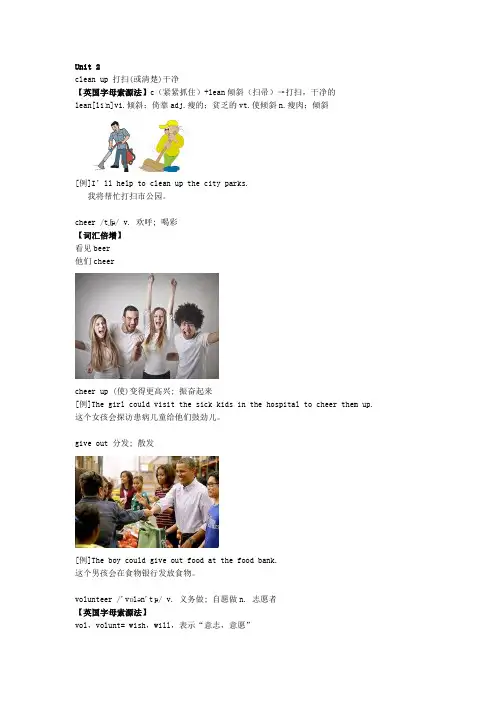
Unit 2clean up 打扫(或清楚)干净【英国字母索源法】c(紧紧抓住)+lean倾斜(扫帚)→打扫,干净的lean[liːn]vi.倾斜;倚靠adj.瘦的;贫乏的vt.使倾斜n.瘦肉;倾斜[例]I’ll help to clean up the city parks.我将帮忙打扫市公园。
cheer /tʃɪə/ v. 欢呼; 喝彩【词汇倍增】看见beer他们cheercheer up (使)变得更高兴; 振奋起来[例]The girl could visit the sick kids in the hospital to cheer them up. 这个女孩会探访患病儿童给他们鼓劲儿。
give out 分发; 散发[例]The boy could give out food at the food bank.这个男孩会在食物银行发放食物。
volunteer /'vɒlən'tɪə/ v. 义务做; 自愿做n. 志愿者【英国字母索源法】vol,volunt= wish,will,表示“意志,意愿”volunteer n 志愿者(volunt+eer人→意愿的人→志愿者)voluntary a 志愿的,自愿的(volunt+ary)[例]The girl could volunteer in an after-school study program to teach kids. 这个女孩会在一个课外学习项目中担任自愿者来教孩子。
come up with 想出; 提出(主意、计划、回答等)[例]We need to come up with a plan for the City Park Clean-UP Day.我们需要就市公园清扫日的活动做出计划。
put off 推迟[例]We should put off the meeting.我们得推迟会议。
sign /saɪn/ n. 标志; 信号[例]We could see signs.我们能看见标志。
人教版八年级英语下册Unit2I’llhelptocleanupthecityparks

(三)情感态度与价值观
1.环保意识:学生能够认识到环境保护的重要性,树立环保意识,积极参与环保活动。
2.社会责任感:学生能够理解个人行为对社会的影响,树立社会责任感,为保护环境贡献自己的力量。
3.团队合作:学生在小组合作中,学会互相尊重、倾听他人意见,培养团队合作精神。
四、教学内容与过程
(一)导入新课
1.教师通过展示一组城市公园环境优美和环境污染的对比图片,引发学生对环境保护的思考,进而导入本节课的主题:“I’ll help to clean up the city parks.”
2.教师提问:“What do you think of these pictures? Why is it important to protect the environment?”学生回答问题,教师总结环保的重要性,为学习新课做好铺垫。
难点:在实际语境中,正确运用一般将来时,并与其他时态进行区分。
3.阅读理解:提高学生对文章的整体把握和细节理解能力是本章节的重点。学生需要能够理解文章的主旨,提取关键信息,并分析作者的观点和态度。
难点:对文章深层含义的理解和推理能力的培养。
4.口语表达和写作能力:培养学生的口语表达和写作能力是本章节的重点。学生需要在小组讨论和写作中,运用所学知识表达自己的观点和建议。
3.任务型教学法:设计真实的任务,如小组调查、环保行动计划等,让学生在实际操作中运用所学知识,提高综合语言运用能力。
4.分层教学:针对学生的个体差异,教师应设计不同难度的教学活动,使每个学生都能在课堂上获得成就感,提高学习积极性。
5.拓展阅读:鼓励学生在课后阅读更多关于环保的文章,提高阅读量,拓展知识面。
人教版八年级英语下册Unit2I’llhelptocleanupthecityparks
4.设想四:多媒体辅助教学。利用多媒体手段,如视频、图片等,展示环保活动、志愿服务的场景,让学生直观地感受英语在实际生活中的运用。此外,还可以通过多媒体手段,提高学生的听力水平。
目的:引导学生关注现实生活中的环保问题,激发他们的责任感和使命感。
教师在布置作业时,要注重作业的针对性和实用性,使学生在完成作业的过程中,能够真正巩固所学知识,提高综合语言运用能力。同时,作业要具有一定的开放性和挑战性,激发学生的学习兴趣,培养他们的创新精神和团队合作能力。通过本次作业,希望学生能够将课堂所学与实际生活相结合,为我国的环境保护和志愿服务事业贡献自己的力量。
2.重难点二:词汇和短语的掌握。本节课涉及一些与环保、志愿服务相关的词汇和短语,如“cleanup”,“volunteer”,“make a difference”等。学生需要熟练掌握这些词汇和短语,以便在口语表达和写作中运用。
3.重难点三:听力技巧的提升。本节课的听力部分要求学生能够听懂并理解与本课相关的对话和短文,获取关键信息。提高学生的听力技巧,使他们能够应对不同场景的英语对话,是本节课的教学难点。
5.设想五:课后实践作业。布置与课堂内容相关的课后实践作业,如让学生设计一份关于环保活动的宣传单,或采访家人、朋友关于志愿服务的看法。这样既能巩固课堂所学,又能培养学生的社会责任感。
6.设想六:评价与反馈。采用多元化的评价方式,如小组互评、教师评价等,对学生的学习过程和成果进行评价。及时给予学生反馈,帮助他们找到自己的不足,提高学习能力。
人教版八年级英语下册Unit2I’llhelptocleanupthecityparks.SectionA(3a3c)教学设计
人教版英语八年级下册Unit2I'llhelptocleanupthecityparks

(一)教学重难点
1.重点:一般将来时态的运用,以及环保相关词汇和表达方式的学习。
-学生需要通过实际语境来巩固一般将来时态的用法,如计划、预测等。
-环保词汇和表达方式的学习是本单元的核心,需要学生在理解的基础上能够熟练运用。
2.难点:
-将一般将来时态与环保话题结合,进行自然的语境交流。
3.实践作业:
-参与一次实际的环保活动,如公园清洁、植树等,记录活动过程和感受,以图文形式进行展示。
-加入学校的环保社团或志愿者团队,积极参与环保公益活动,将所学知识付诸实践。
4.预习作业:
-预习下一节课的相关内容,提前了解与环保相关的其他时态和词汇。
-搜集有关环保的新闻、故事或案例,为下一节课的课堂讨论做准备。
-针对学生的难点和错误,进行有针对性的辅导和纠正。
-激励学生在课后参与环保活动,将课堂学习与生活实践相结合。
四、教学内容与过程
(一)导入新课
在本环节中,教师将通过以下步骤引导学生进入新课:
1.展示图片:呈现城市公园环境变化的对比图片,包括干净整洁的公园和被污染的公园,引发学生对环境保护的关注。
2.提问互动:向学生提问:“Do you like clean and beautiful parks? Why?”,让学生思考并回答,进而引出环保话题。
3.鼓励学生积极参与环保活动,为改善环境贡献自己的力量。
4.提醒学生课后复习所学内容,为下一节课的学习做好准备。
五、ቤተ መጻሕፍቲ ባይዱ业布置
为了巩固本节课的学习内容,确保学生对一般将来时态和环保相关词汇的掌握,特布置以下作业:
1.书面作业:
-完成课本Section B 2a-2e的练习题,强化对一般将来时态的运用。
人教版英语八年级下册Unit2《I’llhelptocleanupthecitypark》说课稿

人教版英语八年级下册Unit 2《I’ll help to clean up the city park》说课稿一. 教材分析人教版英语八年级下册Unit 2的主题是“I’ll help to clean up the city park”,通过本节课的学习,学生将掌握一般将来时的用法,学会如何表达将来的计划和承诺。
教材内容丰富,包括听力、口语、阅读和写作等方面,旨在培养学生的综合语言运用能力。
此外,本节课还涉及了环保意识的教育,引导学生关注环境保护,培养他们的社会责任感和公民意识。
二. 学情分析八年级的学生已经具备了一定的英语基础,能够听懂并运用一般现在时、一般过去时和一般将来时。
但在实际运用中,部分学生对时态的掌握还不够熟练,容易混淆。
此外,学生的词汇量和语法知识有限,对于一些复杂句型的理解和运用还需加强。
因此,在教学过程中,教师需要关注学生的个体差异,针对不同层次的学生进行有针对性的指导。
三. 说教学目标1.知识目标:学生能够掌握一般将来时的用法,学会如何表达将来的计划和承诺。
2.能力目标:学生能够听懂、会说、会读、会写关于将来的计划和承诺的句子。
3.情感目标:学生能够关注环境保护,培养他们的社会责任感和公民意识。
四. 说教学重难点1.教学重点:一般将来时的用法,如何表达将来的计划和承诺。
2.教学难点:一般将来时的句子结构,以及如何正确运用相关词汇和语法知识。
五. 说教学方法与手段1.教学方法:采用任务型教学法、情境教学法和交际法,引导学生参与课堂活动,提高他们的语言运用能力。
2.教学手段:利用多媒体课件、图片、卡片等辅助教学,创设真实情境,激发学生的学习兴趣。
六. 说教学过程1.导入:通过展示城市公园的图片,引导学生谈论自己对公园的印象和感受,引出本节课的主题。
2.新课呈现:讲解一般将来时的用法,展示相关句子和例句,让学生感知和理解一般将来时的结构。
3.操练环节:通过听力练习、角色扮演、小组讨论等形式,让学生在实际语境中运用一般将来时。
人教版八年级英语下册Unit2I’llhelptocleanupthecityparks

3.培养学生积极向上的生活态度,鼓励学生勇于面对挑战,为实现自己的目标而努力。
4.增强学生的社会责任感,让学生明白作为公民应该承担的责任,为构建和谐社会贡献自己的力量。
本教学设计以人教版八年级英语下册Unit 2“I’ll help to clean up the city parks”的Section A 2a-2d内容为载体,旨在通过丰富多样的教学活动,提高学生的英语听说能力和语言运用能力,同时培养学生的环保意识和责任感。在教学过程中,教师应关注学生的个体差异,充分调动学生的积极性,使学生在轻松愉快的氛围中学习英语,实现知识、能力、情感态度的全面发展。
7.评价与反馈:采用多元化的评价方式,包括自评、互评和教师评价,及时给予学生反馈,鼓励学生反思学习过程,不断进步。
四、教学内容与过程
(一)导入新课
1.教师展示一系列城市公园环境整治前后的对比照片,引导学生观察并发表自己的看法。
-教师提问:“What do you think of these pictures? Can you find any differences between these two situations?”
4.听力训练:采用交互式听力教学模式,鼓励学生边听边预测,听后进行讨论和复述,提高学生的听力理解能力和信息处理能力。
5.口语交流:创设真实的语言环境,如模拟志愿者招募活动,让学生在实际的情景中练习口语,提高口语表达能力。
6.情感教育:通过讨论志愿者活动的意义,激发学生的社会责任感,培养他们积极参与社会公益活动的意识。
- How can we encourage more people to participate in volunteer activities?
人教版八年级英语下册Unit2I'llhelptocleanupthecityparks
2.学生在语言表达方面存在一定学生准确、流畅地表达思想;
3.部分学生对团队合作、自主探究等学习方法尚不熟悉,需要教师在教学中逐步引导和培养;
4.学生在情感态度上,对参与社会公益活动有热情,但可能缺乏实际行动,教师应引导学生将所学知识运用到实际生活中;
5.反馈性:教师应及时批改作业,给予学生反馈,指导学生改进学习方法,提高学习效果。
4.布置课后作业,要求学生运用所学知识编写一段关于参与环保活动的对话或短文,巩固所学内容。
五、作业布置
为了巩固本节课所学知识,特布置以下作业:
1.完成课本练习册中与本节课相关的一般将来时态和情态动词can的练习题,强化语法知识点的掌握。
2.结合实际生活,编写一段关于自己参与环保活动的对话或短文,使用一般将来时态和情态动词can表达自己的意愿和计划。要求内容丰富、语言流畅,字数不少于80词。
4.学生在教师的引导下,用一般将来时态和情态动词can进行简单的对话练习,巩固所学知识。
(三)学生小组讨论
1.教师将学生分成小组,要求每组讨论以下问题:“What can we do to help clean up the city parks? How can we encourage others to join us?”。
c.自我评价:引导学生进行自我反思,培养自主学习能力;
d.同伴评价:鼓励学生相互评价,提高团队合作能力和人际交往能力。
四、教学内容与过程
(一)导入新课
1.教师通过展示城市公园美景前后的对比图片,引发学生对环保话题的关注,并提出问题:“How can we make our city parks cleaner and more beautiful?”,让学生思考并讨论。
人教版八年级英语下册Unit2I’llhelptocleanthecityparks
4.教师引导学生学习Section 2b-2e,让学生了解更多的志愿活动内容,并拓展相关词汇。
(三)学生小组讨论
1.教师将学生分成小组,让他们讨论以下问题:“If you were a volunteer, what would you like to do?”
5.学生对于情感态度与价值观的培养有较高的需求,需要教师在教学过程中关注并引导。
因此,在本章节的教学过程中,教师应充分关注学生的个体差异,采用差异化教学策略,激发学生的学习兴趣,提高他们的英语素养和社会实践能力。同时,注重培养学生的情感态度与价值观,使他们在学习英语的过程中,不断提升自身综合素质。
三、教学重难点和教学设想
(4)实施分层教学,关注学生的个体差异,满足不同学生的学习需求。
2.教学过程:
(1)导入:通过展示与志愿活动相关的图片或视频,引导学生关注社会问题,激发学习兴趣。
(2)新知识学习:讲解重点词汇和短语,让学生通过例句、练习等方式掌握用法;结合听力训练,提高学生对关键信息的捕捉能力。
(3)实践环节:组织学生进行角色扮演,模拟真实的志愿活动场景,让学生在实际情境中运用所学知识,提高口语表达能力。
2.能够熟练运用一般将来时态描述未来的计划和打算,如“I will help to clean the city parks.”
3.能够通过听力训练,提高获取信息、处理信息的能力,抓住对话中的关键信息点。
4.能够运用所学知识,进行角色扮演,模拟真实的志愿活动场景,提高口语表达能力。
5.能够通过小组合作,培养学生的团队协作能力和沟通能力。
(一)教学重难点
1.重点:
(1)掌握Section 2a-2e中的重点词汇和短语,并能熟练运用。
Unit2I‘llhelptocleanupthecityparks.知识点人教版八年级英语下册
9.put off doing推迟做某事
10.put up signs/notices张贴标语/通知
11.make some notices制作一些布告
12.make some plans制定计划
13.call sb. up给某人打;征召
23. I can't use my arms or legs well, so normal things like answering the telephone, opening and closing the doors, or carrying things are difficult for me.
11. Last year, she decided to try out for a volunteer afterschool reading program.
12. But you can see in their eyes that they're going on a different journey with each new book
e.g. Tell himnot to be late.
3.不定式作宾语:
(1)一些动词后常跟动词不定式作宾语,这类动词有agree, decide, forget, remember, fail, hope, wish, expect, learn, try, plan, refuse, want, need, choose, start, begin,help等。
13. For example, we can make plans to visit sick children in the hospital or raise money for homeless people.
人教版八年级下册Unit 2 I'll help to clean 课件(共18张PPT,内嵌视频)
how?
when?
In my free time, I like to ... I plan to ... I’m going to ...
I’m free to help in/on ...
Thank you!
help at a hospital
Pre-writing
Work in groups and discuss the structure of the application.
How can you be a volunteer of Olympic Games?
Write a self-recommendation letter.(自荐信)
Dear …,
引出话题
❶ I want to …/I hope to…/…/I volunteer to…/I’d like to… ❷ I’m writing to you about volunteering at/in/as….(职业名)
What
❶ I’m interested in…./ In my free time, I like/love….
想做的原因 (First….Finally)
when 做工作的时间
I’m free/available/时间介词 to….
结尾
…(署名)
❶ I will get a strong feeling of satisfaction when I help others. ❷ Volunteering could make me happy and helping others is helping ourselves. ❸ volunteering here is a dream come true for me.