
misunderstand意思的用法总结
misunderstand意思的用法总结
misunderstand在初中英语中是比较重点的,那它的意思和用法你们都掌握了吗?今天给大家带来了misunderstand的意思用法,希望能够帮助到大家,一起来学习吧。
misunderstand的意思
vt. 误会,误解,曲解
变形:过去式: misunderstood; 现在分词:misunderstanding; 过去分词:misunderstood;
misunderstand用法
misunderstand可以用作动词
misunderstand的基本意思是“误会〔解〕”,用作及物动词,可接名词、代词或以疑问词引导的从句作宾语,还可接以动词不定式充当补足语的复合宾语。
misunderstand可用于被动结构。
misunderstand的过去式、过去分词均为misunderstood。
misunderstand用作动词的用法例句
They pretend to misunderstand my complaint.他们假装误解了我的投诉。
His remarks show that he misunderstood my position on the question.他的话说明他误解了我在这一问题上的立场。
He wrote her a letter for fear she misunderstand him.他给她写了封信,免得她误会。
misunderstand例句
1.I think the couple misunderstand each other.我认为这对夫妇未能真正互相了解。
2.I dont want any misunderstanding between us.我不希望我们之间有任何误会。
3.Dont misunderstand what Im trying to say.别误解我要说的话。
4.He was misunderstood notwithstanding his good intentions.虽然他的意图是好的, 但是仍然被误解了。
5.A trivial misunderstanding caused a breach between them.小小的误会引起了他们之间的不和。
6.There seems to be a misunderstanding between us.我们之间好像有些误解。
7.We try to preclude any possibility of misunderstanding.我们努力排除任何误解的可能性。
8.My concern for their well-being was misunderstood as interference.我关心他们的幸福,却被误解为多管闲事。
9.True visionaries are often misunderstood by their own generation.真正有远见卓识者往往受同时代人的误解。
10.I said nothing of the kind. She completely misunderstood me.我根本没有那么说,她完全误解了我的意思。
11.Her poor French often lead to misunderstandings when she visits France.她的法语很差劲,因而她访问法国时常引起误会。
12.They appear to have misunderstood me.他们似乎误解了我。
13.These criticisms are based on misunderstanding.这些评论完全是出于误解。
14.The trouble ensued from this misunderstanding.这些麻烦是由此误会而产生的。
15.The quarrel originated in a misunderstanding.争吵是由于误解而引起的。
16.The speaker failed to put his ideas over clearly enough so that some misunderstanding arose."发言者没有把自己的观点解
释得十分清楚,因而引起了一些误解。
"
17.Thats clearly an misunderstanding.那无疑是个误会了。
18.I misunderstood her meaning.我误解了她的意思。
19.I don’t want any misunderstanding.我不希望有任何误解。
20.It is the misunderstanding and misdoing of the philosophy to make the medical philosophy become unnecessary with the medicine.使哲学成为医学多余是那种对哲学的错误理解和做法。
“误会”可不光是misunderstand,还有个说法竟和“脚”有关?!
老外说“误会某人”
英文表达
只有misunderstand someone 么?
1. 表达“误会某人”一种意想不到的说法↓get off on the wrong foot foot [?u?t] n.
英文释义。
misunderstand的用法和短语例句
misunderstand的用法和短语例句misunderstand有误解;误会;不了解等意思,那么你知道misunderstand的用法吗?下面跟着店铺一起来学习一下,希望对大家的学习有所帮助!misunderstand的用法:misunderstand的用法1:misunderstand的基本意思是“误会〔解〕”,用作及物动词,可接名词、代词或以疑问词引导的从句作宾语,还可接以动词不定式充当补足语的复合宾语。
misunderstand的用法2:misunderstand可用于被动结构。
misunderstand的用法3:misunderstand的过去式、过去分词均为misunderstood。
misunderstand的常用短语:用作动词 (v.)bid fair (v.+adv.)bid for (v.+prep.)bid in (v.+adv.)bid on (v.+prep.)bid up (v.+adv.)misunderstand的用法例句:1. I'm not saying what he did was good, don't misunderstand me.别误会,我并不是说他所做的是好事。
2. She no longer feared that they should misunderstand her.她不再害怕他们会误解她了.3. Don't misunderstand what I'm trying to say.别误解我要说的话.4. " I never misunderstand Ashley, " Melanie replied quietly, though her lips were trembling." 我永远不会误解艾希礼, " 媚兰冷静地回答, 尽管她的嘴唇在颤抖.5. Don't misunderstand me / what I'm trying to say.别误解我[我要说的话].6. Let there be no mistake about it, ie Don't misunderstand me.不要误解我的意思.7. I think the couple misunderstand each other.我认为这对夫妇未能真正互相了解.8. She had dared her daughter - in - law to misunderstand.她曾挑逗她儿媳妇对此产生误解.9. I don't want anybody to misunderstand this lunacy.我不想任何人去误解这个精神病.10. His remarks show that he misunderstand my position on the question.他的话说明他误解了我在这一问题上的立场.11. Can not stand to misunderstand and wrong, became not bosom friend.经不起误会和冤枉, 就成不了知心朋友.12. He speaks so clearly as not to be misunderstand.他把话说得清清楚楚使人不至于误会.13. He speak so clearly as not to is misunderstand.他把话说得清清楚楚使人不致于误会.14. She doesn't express her thoughts with precision, so people oftenmisunderstand her.她表达自己的思想不够精确, 因此别人常常误解她的意思.15. In my eyes, these students totally misunderstand the true meaning of love.我觉得这些人误解了爱的真正意义.。
逆构词法的例子
逆构词法的例子逆构词法是一种语法相关的语言学分析方法,通过对单词的逆构进行分析,可以探索其构成和含义,并深入了解语言的结构。
逆构词法常常被应用于词汇学、语义学和语法学等领域,通过逆构分析,我们可以揭示单词背后隐藏的意义和内涵。
逆构词法的基本原理是将一个单词逆转并分解成可能的组成部分。
逆构的方式可以是音素的逆转,也可以是字母的逆转。
通过逐步逆构单词,我们可以发现这些组成部分的含义和用法。
下面,我们将通过几个实际的例子来说明逆构词法的应用。
例子一:逆构词法分析单词“unhappy”在逆构词法分析中,我们首先将单词逆转,得到“yppahnu”。
然后,我们可以逐步分解这个逆转后的单词。
1.首先,我们注意到“y” 是一个后缀,通常用于形容词的转化。
所以,我们可以将“y” 分离出来,得到“ppahn”。
2.接着,我们注意到“pp” 是一个较为常见的单词部分,表示“很” 或“非常” 的意思。
所以,我们可以将“pp” 分离出来,得到“ahn”。
3.最后,我们可以进一步分离“ahn”,得到“ah” 和“n”。
我们可以发现,“ah” 是一个表示否定的前缀,而“n” 是一个名词的后缀。
通过逆构词法的分析,我们可以得到以下结果:1.“unhappy” 可以被逆构为“ppahn” 和“ah”。
2.“pp” 表示“很” 或“非常” 的意思。
3.“ah” 是一个表示否定的前缀。
4.“n” 是一个名词的后缀。
因此,我们可以得知“unhappy” 的含义是“很不开心” 或“非常不快乐”。
例子二:逆构词法分析单词“misunderstand”接下来,我们尝试逆构词法分析另一个单词“misunderstand”。
首先,我们将单词逆转,得到“dnatsrednu”。
然后,我们可以逐步分解这个逆转后的单词。
1.首先,我们注意到“d” 是一个表示否定的前缀。
所以,我们可以将“d”分离出来,得到“natsrednu”。
2.接着,我们发现“nu” 是一个常见的否定后缀。
misunderstand用法

Misunderstand用法1.简介本文将介绍"mi su nde r st an d"这个单词的用法及相关语境,帮助读者更好地理解、记忆和运用该词汇。
2.基本定义"m is un de rs ta nd"是一个英文动词,意为“误解;误会”。
常用形式包括mi su nd er st ood(过去分词)和mis u nd er st an di ng(名词)。
3.用法示例3.1动词用法-T he te ac he rm is und e rs to od my qu es tio n.(老师误解了我的问题。
)-D on't mi su nd er sta n dm e,Iw as on ly jok i ng.(别误会我,我只是在开玩笑。
)-H eo ft en mi su nd ers t an ds he ri nt en tio n s.(他经常误解她的意图。
)3.2名词用法-T he re wa sa mi su nde r st an di ng be tw een u s,bu tw ec le ar edi t up.(我们之间有一个误会,但我们解决了。
)-M a ny co nf li ct sa ris e fr om mi su nd er sta n di ng sb et we en dif f er en tc ul t ur es.(许多冲突源于不同文化之间的误解。
)4.搭配词汇-C om mo nl ym is un der s to od(常见的误解)-S er io us mi su nd ers t an di ng(严重误会)-C le ar up mi su nd ers t an di ng s(消除误解)-C au se am is un de rst a nd in g(引起误解)5.用法注意-M is un de rs ta nd通常是一个及物动词,需要有宾语。
初中常用的前缀后缀
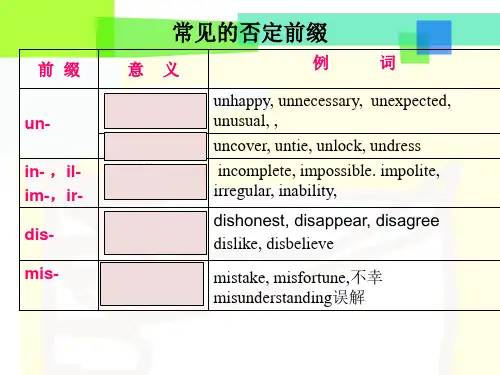
-less 表示否定
careless,endless,useless
-ous 有某种特征的 nervous,dangerous
-y 表示天气或特征 dirty,rainy
-ly 有某种特征的 friendly -ive 有某种特征的 active,expensive
抽象名词和集体名词的后缀
-age marriage, luggage, postage邮费
有/多... 的,想...的
cloudy, sunny, funny, sleepy
有...的, 有...特征的
tired, interested, learned博学
由...构(制)成的
wooden, woolen
...方向的
eastern, western, southern
有...性质的,...形状的
从事某工作的物 conductor导体
其他名词后缀
前缀 -ing -ion/ -tion/ -sion -ment
-ness
-ure -th
意义 状态
动作;过程
性质;状态 性质;状态 状态 性质,状态
例词 feeling,reading
action, decision, pollution, pronunciation
com-,con-, 共同,和 cor-,col-
co-
联合、共同
例词 asleep, along, aloud, alive, across, abroad在国 外,aboard 在船/火车/飞机上 comment, collect,
co-worker, coexist
1.再一次,重新 renew, reborn, rebuild,
构词法 mis

构词法mis
摘要:
1.介绍构词法
2.解释mis
正文:
1.介绍构词法
构词法是指通过词语的组合和变化来形成新词的方法。
在英语中,构词法是一种常见的语言现象,它使得英语词汇更加丰富多彩。
通过构词法,我们可以将两个或更多的词语组合在一起,形成一个新的词语,也可以通过改变一个词语的形式,来形成一个新的词语。
2.解释mis
mis 是一个常见的前缀,它的意思是“错误地”、“不正确地”。
在英语中,mis 常常用于构成新的词语,比如misunderstand(误解)、mislead(误导)、misjudge(误判) 等。
通过添加mis 前缀,我们可以将一个词语的意义进行改变,从而形成一个新的词语,表达更加精确的意思。
例如,单词“judge”意为“判断”,添加mis 前缀后,形成“misjudge”,意为“误判”。
这里,mis 前缀使得“judge”的意义发生了改变,从而形成了一个新的词语,表达更加精确的意思。
构词法和前缀mis 是英语中常见的语言现象,它们使得英语词汇更加丰富多彩,表达更加精确的意思。
mistake的用法和搭配

mistake的用法和搭配一、常见的mistake用法分析错误是人类成长和学习过程中不可避免的一部分。
在日常生活和工作中,我们会犯下各种不同类型的错误。
正确地理解并运用“mistake”的用法和搭配对于提高语言表达准确性至关重要。
本文旨在介绍“mistake”的常见搭配和正确使用方法。
1. 常见用法之一:make a mistake“make a mistake”是我们最为熟悉且常用的mistake搭配之一。
“make”在这里表示主动行为,意为“犯错”,通常指因个人原因而产生的错误。
例如:- She made a mistake in her calculations.(她在计算中犯了一个错误)2. 常见用法之二:a common mistake当我们想要强调某个错误是普遍存在、常见的时候,可以使用“a common mistake”。
例如:- One common mistake when learning a new language is relying too heavily on translated phrases.(学习新语言时一个常见错误就是过度依赖翻译的短语)3. 常见用法之三:mistake for“mistake for”表示将某物误认为另外一种事物或人,往往因相似性或混淆而产生。
例如:- I mistook her for my sister because they look alike.(因为她们长相相似,我把她误认为了我的姐姐)4. 常见用法之四:make the same mistake当我们要表达某人或某个团体在连续的时间段里反复犯同样的错误时,可以使用“make the same mistake”。
例如:- He keeps making the same mistake of arriving late to meetings.(他一直重复着迟到开会的同样错误)5. 常见用法之五:learn from mistakes“learn from mistakes”意味着我们能够通过分析和认识自己所犯下的错误,并从中吸取教训。
misunderstanding的用法 -回复
misunderstanding的用法-回复"Misunderstanding的用法"是指在日常用语中,我们如何使用这个词以及理解其含义。
本篇文章将详细解释misunderstanding的意义、相关词汇和短语的用法,以及提供一些实际例句来帮助读者更好地理解和运用这个词。
首先,我们来解释一下misunderstanding的意思。
Misunderstanding 是一个名词,意为误解、误会或不理解。
当人们对某个信息或情况产生错误的理解或解释时,就会发生misunderstanding。
这种误解可能是因为信息不清晰、交流不畅或个人观点的差异而导致的。
因此,misunderstanding可以发生在不同的领域,如个人关系、商业交往或跨文化交流中。
在日常用语中,我们可以使用一些词汇和短语来描述和强调misunderstanding。
下面是一些常见的表达方式:1. Cause/lead to misunderstandings:引起/导致误解例如:Lack of communication can cause misunderstandings between friends.缺乏沟通可能导致朋友之间的误解。
2. Clear up/resolve a misunderstanding:消除/解决误解例如:We need to clear up this misunderstanding before it causes further problems.在进一步引起问题之前,我们需要消除这个误解。
3. Have a misunderstanding with someone:与某人发生误解例如:I had a misunderstanding with my colleague, but we talked it out and resolved the issue.我和同事之间有过一次误解,但我们进行了交流并解决了问题。
“别误会”用英语怎么说?dontmistake?
“别误会”用英语怎么说?dontmistake?言语、举止生活里诸多摩擦总是难免有所误会如何解释?“别误会”怎么说?1我们说“别误会”其实意思就是“别误解我的意思”,我刚刚说的话可能你会觉得有别的意思,但是我想让你知道我没有那层意思,就会用到这个说法。
“误解”的英语就是misunderstand,错误的理解所以“别误解我”最直白的说法就是Don't misunderstand me.You can say don't misunderstand me when you want tocorrect a wrong impression that you think someone may have got about what you are saying.当你想让别人改变对你所说的话的错误印象时,你可以说don't misunderstand me。
例:I'm not saying what he did was good, don't misunderstand me.别误会,我并不是说他所做的是好事。
2除了上边这个翻译外,其实口语中还有一种更方便的说法:Don't get me wrong.get 在这里表示理解口语中常用 I get it 表示“我理解了”get me 表示“理解我”wrong 在这里是副词,表示“错误地”所以,Don't get me wrong.即:别误会,别理解错了。
said when you think someone might not understand what you say, or be upset by it当你认为某人可能不理解你说的话,或对你说的话感到不安时,就说Don't get me wrong例:Don't get me wrong - I'd love to come, but I'm too busy next week.别误会——我确实想来,但是我下个礼拜太忙了。
英语单词的前缀后缀总结大全
英语单词的前缀后缀总结大全英语中常见的前缀和后缀有很多,下面是一些常见的前缀和后缀总结:常见前缀:1. un-: 表示"不",如:unhappy(不开心的),unfair(不公平的)2. dis-: 表示"否定",如:disagree(不同意),dislike(不喜欢)3. in-: 表示"不",如:inactive(不活跃的),inaccurate(不准确的)4. re-: 表示"再次",如:replay(重播),reopen(重新开放)5. pre-: 表示"在之前",如:preheat(预热),preorder(预订)6. post-: 表示"在之后",如:postpone(推迟),postwar(战后的)7. mis-: 表示"错误",如:misunderstand(误解),mislead(误导)常见后缀:1. -s/-es: 表示复数形式,如:dogs(狗),watches(手表)2. -ed: 表示过去式或过去分词,如:worked(工作过的),watched(看过的)3. -ing: 表示进行时或现在分词,如:running(跑步),waiting(等待)4. -ly: 表示副词形式,如:quickly(快速地),happily(开心地)5. -er/-or: 表示某种职业或工具,如:teacher(教师),actor (演员)6. -tion/-sion: 表示名词形式,如:information(信息),decision(决定)7. -able/-ible: 表示"能够"或"可能的",如:comfortable(舒适的),visible(可见的)这只是一些常见的前缀和后缀,还有许多其他前缀和后缀没有列举出来。
misunderstanding用法
misunderstanding用法一、基本用法“misunderstanding”是名词,意为误解、误会。
它可以在句子中作主语、宾语等。
例如:1. The misunderstanding between them led to a big fight.(作主语,表示他们之间的误解导致了一场大的争吵。
)2. We need to clear up this misunderstanding.(作宾语,我们需要消除这个误会。
)二、固定搭配1. “clear up a misunderstanding”(消除误解)- I tried my best to clear up the misunderstanding with my friend.(我尽我所能去消除和我朋友之间的误解。
)- She finally cleared up the misunderstanding at work.(她终于消除了工作中的误解。
)2. “cause a misunderstanding”(引起误解)- His strange behavior caused a misunderstanding among his classmates.(他奇怪的行为在他的同学中引起了误解。
)- That word can easily cause a misunderstanding if you don't use it properly.(如果你不恰当地使用那个词,很容易引起误解。
)3. “a misunderstanding arises”(产生误解)- A misunderstanding arises when people don'tmunicate well.(当人们没有好好交流时就会产生误解。
)- A misunderstanding arises between the two lovers.(这对恋人之间产生了误解。