
山东省德州市2020年七年级英语上册 Module 5 My school day导学案(无答案)(新版)外研版
Module 5 My school day一.语法:行为动词的一般现在时(1)1.结构;主语+v原形/be+其他2. 肯定句We ___ our homework every day.否定句 We ___ ___ our homework every day.疑问句___ our homework every day? Yes, We ___ ./No, We ___.二.重点易错单词:1. 开始v.___ /start2. 科目课程n.__【拓展】lesson=c__表示一节课3.有趣的adj.__4.困难的adj.__ (同义词_____)(名词___)对应词easy三.重点短语:(每空一词)1.忙于(做)某事 be busy______ _____ /______ ______2.在周末_____ _____ 在工作日_____ ______3.回家_____到家_______ home4.和某人一起吃早餐______ ____ ____sb5.上语文课_____ ____6.一刻钟7:15___ ____ ____ _____8:45____ _____ _____ _____7.休息_____ ____ _____ 8.和…交谈_____ ____四.重点句型: (每空一词)1.What’s the time?=What time is it? 请问几点了?其答语为:It’s _____ to two. (1:58)/ (3:20)two ____ three.2.What are our_____ on Monday?= What lessons do we_____ on Monday?周一我们上什么课呢?3.I love history and I am____ ____ it. It is my____ ____ ____it is very interesting .我喜欢和擅长历史,因为它很有趣,所以是我最喜欢的科目4.We ____meat and rice____ vegetables or hamburgers 我们吃肉还有带蔬菜的米饭或汉堡。
五.综合填空: 基础篇Hi!This is my school day.I get up at six o’clock in the morning .I have (1)b____ at ten past seven. After breakfast I go to school by(2)b____. Our class (3)b___ at eight o’clock, and we have four lessons in the morning. I have lunch in the dining hall at twelve o’clock. And (4)t___ I have a break .And I (5)c____ with my friends (6)F ____ 1:30 to 3:50p.m.,I have three lessons like Music, Art, Science and PE. My(7) f____ subject is PE. I often play football with my classmates on the playground.I leave school and go home at five o’clock. I often help my mother (8)d_____ some housework. I like (9)w____ TV. But I only watch it at (10)w_____. After dinner, I begin to do my homework. I go to bed at half (11)p___ nine. I love my school life,busy but good fun!提高篇:It’s Sunday today. I am very happy (1)b_____ I don’t go to school t oday.I can have a good rest and watch an (2)i_____ movie. But in the morning, my mother comes into my room. She says:“(3)G____ up ,darling! Your classes will (4)b______at eight o’clock. You only have fifteen (5)m_____ to have breakfast.” “What?Classes? Mum, it’s Sunday today!” My mother (6)a______,“ Of course I know ,Iwant you to study geography in the morning and study (7)a____ in the afternoon.I know you like drawing . After the classes ,I can go (8)s_____ with you for yourclothes !” But I say:” No,Mum ,I don’t think they are (9)d______ subjects forme ,so I don’t want such a (10)b_____ weekend! I want to relax!”六.阅读理解 AB.B.Li Lin goes to bed after 9:00 o’clock.C.Li Lin usually has dumplings for lunch.D.Li Lin doesn’t l ike golf.B My friend Lucy often gets up at seven o’clock in the morning. After breakfast she goes to school at half past seven. The lessons start at eight. She has four lessons in the morning and two in the afternoon. She has lunch at school. After school she often plays tabletennis with me. In the evening she watches TV, then she does herhomework. She goes to bed at half past ten.1.Lucy goes to school __________ . A. at 7: 45 B. at 7:30 C. at 6: 45 D.6:152. How many classes does she have every day? A. Four. B. Two. C. Six. D.Eight3. Where does she have lunch?A. At home.B. At school.C. In a shop.D.At theairport4. She often __________ after school.A. plays table tennisB. plays footballC. plays basketballD.plays golf5.In the evening she __________.A. watches TVB. does her homeworkC. watches TV and does her homeworkD.I don’t know.CTom comes from Australia. He is now staying in Beijing with his family. Everyday he gets up at about six thirty and has breakfast at seven o’clock. Then he leaveshome at seven fifteen. He gets to school at seven forty- five. His first class beginsat eight. There are four lessons in the morning. Morning classes are over at elevenfifty, and he has lunch ten minutes later.Afternoon classes begin at one thirty. There are two lessons in the afternoon.They are over at three ten. Tom stays at school for another hour to play games, andhe gets home at about four thirty.Tom usually has supper at six. In the evening he does his homework. Sometimeshe watches TV. He goes to bed at about ten.1. Tom comes from _________. A. England B. Canada C. America D.Australia2. It takes Tom __________ to get to school every day.A. two hoursB. half an hourC. fifteen minutesD. an hour3. Tom usually has lunch at __________. A. 11: 50 B. 12: 00 C. 12:10 D. 12: 204. Tom does his homework _______. A. in class B. at school C. in a park D. athome5. Tom has __________ lessons every day. A. six B. four C.eight D. two七.补全对话。
2020年秋七年级英语上册Module5MyschooldayUnit3Languageinuse(
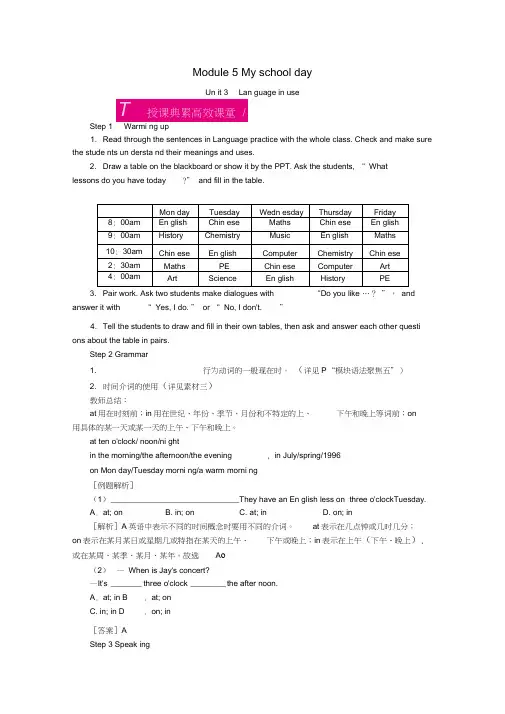
Module 5 My school dayUn it 3 Lan guage in use1. Read through the sentences in Language practice with the whole class. Check and make sure the stude nts un dersta nd their meanings and uses.2. Draw a table on the blackboard or show it by the PPT. Ask the students, “ Whatlessons do you have today ?” and fill in the table.3. Pair work. Ask two students make dialogues with “Do you like …?”,and answer it with “ Yes, I do. ” or “ No, I don't. ”4. Tell the students to draw and fill in their own tables, then ask and answer each other questi ons about the table in pairs.Step 2 Grammar1. 行为动词的一般现在时。
(详见P “模块语法聚焦五”)2. 时间介词的使用(详见素材三)教师总结:at用在时刻前;in用在世纪、年份、季节、月份和不特定的上、下午和晚上等词前;on用具体的某一天或某一天的上午、下午和晚上。
at ten o'clock/ noon/ni ghtin the morning/the afternoon/the evening , in July/spring/1996on Mon day/Tuesday morni ng/a warm morni ng[例题解析](1)_____________________________ T hey have an En glish less on three o'clock T uesday.A. at; onB. in; onC. at; inD. on; in[解析]A英语中表示不同的时间概念时要用不同的介词。
2020年秋七年级英语上册Module5Myschoolday基础练习新版外研版
Module5 My school day基础练习一、单项选择1. I five books and my brother two books.A. have; haveB. has; hasC. have; hasD. has; have2. We any Chinese classes on Friday.A. are havingB. aren't havingC. don't haveD. are have3. The boat like a duck.A. isn't lookB. don't lookC. doesn't lookD. doesn't looks4. We a Chinese class today. We an Englishclass now.A. aren't having; are havingB. don't have; haveC. aren't having; haveD. don't have; are having5. Hearrived Shanghai 9:30 March 5.A. at; in; atB. to; on; atC. in; on; atD. in; at; on6. --- Does Mary have P.E. Friday?--- No, she doesn't. She has P.E. the afternoon of Monday and Thursday.A. on; inB. on; onC. in; onD. on; at7. Lily and Mary like to learn Chinese?A. DoB. DoesC. IsD. Are8. Does Amy music?A. likes listening toB. like listeningC. like listening toD. likes to listen to9. The English for “8:30” is .A. eight past halfB. half to eightC. half past eightD. eight thirteen10. She often at twelve o'clock.A. eat lunchB. have lunchC. has lunchD. eats breakfast11. I don't a tennis racket, but Kate one.A. have; haveB. has; hasC. have; hasD. has; have12. Millie Beijing now.A. don't live inB. doesn't lives inC. don't lives inD. doesn't live in13. I used to be crazy about the film when I was young, but I itthat way any more.A. don't feelB. didn't feelC. haven't feltD. hadn't felt14. --- Look, there is a lot of litter in the river.--- Yes, people say that 80 per cent of fish in this river live long.A. doesn'tB. don'tC. isn'tD. aren't15. Linging's aunt will meet her theairport Saturday morning.A. in; onB. on; atC. at; onD. on; on16. His birthday is September 1st. And my birthday isalso that month.A. in; onB. in; atC. on; inD. on; at17. he a ping-pong ball bat?A. Does; hasB. Do; haveC. Does; haveD. Do; has18. --- your sister her room?--- Yes, but not often.A. Are; cleaningB. Does; cleanC. Are; cleanD. Do; cleans19. The train from Shanghai will arrive .A. in quarter past sixB. in a quarter past sixC. at quarter past sixD. at a quarter past six •20. --- When do you usually breakfast?--- At seven thirty.A. goB. haveC. cleanD. get21. My father a baseball bat. But he aping-pong bat.A. have; hasB. has; doesn't haveC. have; don't haveD. has; doesn't has22. In the 1960s, the Beatles were Mr. Green's favorite singers, but nowhe like them.A. don'tB. doesn'tC. didn'tD. /23. He like reading the book.A. isB. doesn'tC. don'tD. do24. They their homework in the evening.A. don't doB. don'tC. do notD. not do25. Let's meet the shopping center seventhirty.A. in; atB. at; inC. on; atD. in; on二、单词拼写(单句首字母填空)26. It is ten o'clock in the evening and I want to go to s .27. Jane is b . She can't go to the movies with you.28. Mum often tells us to w hands before each meal.29. W what I do, then you try.30. Math(数学) is very d for me, so I don't like it.31. Mr. Zhang is a good teacher. He always makes his classes i .32. At school we study many s such as English, Chinese, maths and so on.33. China is a great country(国家) with a long(长的) h .34. In g lessons, we can learn much about many famous places.35. My little brother loves telling jokes and she never stops t .36. If you take some s pills, you will sleep well.37. The traffic during the rush hour is much b than usual.38. I often help my mother w the dishes.39. He doesn't play sports, and he only w them.40. The third question is the most d of the three.三、单词拼写(根据中文提示拼写单词)41. When the farmers were growing rice in the fields, suddenly it (开始) to rain.42. --- Let's play computer games.--- That sounds (有趣的).43. After getting up, he usually (洗) his face with cold water.44. I don't like math because they are very (难).45. The Lion King is such an interesting cartoon film that it is worth (看) a second time.46. I want to be a reporter because I enjoy (交谈) with people.47. We have six (课) every day.48. We have two (地理) classes every week.49. I have porridge and eggs for (早餐).50. Jason often does his (作业) at 8:00 in the evening.答案一、单项选择1. C2. C3. C4. D5. D6. B7. A8. C9. C 10. C11. C 12. D 13. A 14. B 15. C16. C 17. C 18. B 19. D 20. B21. B 22. B 23. B 24. A 25. A二、单词拼写(单句首字母填空)26. sleep27. busy28. wash29. Watch30. difficult31. interesting32. subjects33. history34. geography35. talking36. sleeping37. busier38. wash39. watches40. difficult三、单词拼写(根据中文提示拼写单词)41. began42. fun/interesting43. washes44. difficult45. watching46. talking47. lessons48. geography49. breakfast50. homework。
七年级英语上册 Module 5 My school day Unit 1 I love hist
七年级英语上册Module 5 My school day Unit 1 I love history同步练习(新版)外研版编辑整理:尊敬的读者朋友们:这里是精品文档编辑中心,本文档内容是由我和我的同事精心编辑整理后发布的,发布之前我们对文中内容进行仔细校对,但是难免会有疏漏的地方,但是任然希望(七年级英语上册Module 5 My school day Unit 1 I love history同步练习(新版)外研版)的内容能够给您的工作和学习带来便利。
同时也真诚的希望收到您的建议和反馈,这将是我们进步的源泉,前进的动力。
本文可编辑可修改,如果觉得对您有帮助请收藏以便随时查阅,最后祝您生活愉快业绩进步,以下为七年级英语上册Module 5 My school day Unit 1 I love history同步练习(新版)外研版的全部内容。
Module 5 My school day Unit 1Ⅰ。
根据句意及首字母提示补全单词。
1.He likes to have g______,because he can know about many countries。
2.He is g______ at P.E。
3.What a______ going fishing this afternoon?4.The boys like NBA and they often t______ about it.5.At 8∶00 am,lessons b______.Ⅱ.写出下列时间的英语表达形式(用倒读和正读两种写法)。
1.12∶18 ________________________2.5∶30 ____________ ____________3.7∶20 ________________________4.9∶55 ________________________5.10∶10 ________________________Ⅲ.单项选择.1.I like the lessons ______ Friday afternoon.A.at B.in C.about D.on2.Bill and Jane go to school ______ half past seven。
山东省德州市第七中学七年级英语上册 Module 5 My school day综合学案(无答案)(新版)外研版

My school day【学习目标】1、熟练掌握本节课的词汇及短语。
2、行为动词的用法。
3. 能够熟练运用行为动词介绍自己一天的学校生活。
【学习重点】行为动词的用法。
【课前预习】1.短语起床 ____________在上午7点半 _____________吃早饭 _________紧挨着我的家 _________去上学 ____________ 开始上课 __________上三节课 ________休息 ___________去操场 __________吃午饭 ___________在餐厅 _________ 回家________________看电视 _________ 吃晚饭 _______做作业 _____________上床睡觉 _____________和我的朋友聊天 ______________________写出下列句子今天星期几?今天星期一。
__________________________.上午九点钟我们上英语课。
____________________________.下午三点半我上一节化学课。
___________________________.历史是我最喜爱的课。
____________________________.【综合测试】一、词汇运用(Ⅰ)根据句意及首字母提示完成单词1. I usually go to school at h__________ past seven.2. How many l__________ do you have on Monday?3. Class is over. Let’s have a b__________.4. Her sister’s f avourite s__________ is art.5. I like listening to music. What a__________ you?(Ⅱ)用所给词的适当形式填空6. We don’t have any __________ (lesson) on Sundays.7. The teache r is very busy. He often _________ (sleep) at half past e leven.8. I can __________ (pla y) football, but Burt can’t.9. What__________ he usually __________ (do) after school?10. You can’t go to bed until (直到) you finish __________ (do) your homework.二、单线选择1. We have __________ English class __________ Monday morning.A. an; inB. a; onC. a; inD. an; on2. We have geography __________ two o’clock in the afternoon.A. atB. inC. onD. from3. I like art, __________ I don’t like maths.A. andB. butC. orD. because4. What __________ you __________ for lunch?A. have; haveB. do; hasC. do; haveD. does; have5. —__________ eating some fish for supper?—Sorry, I don’t like it.A. Let’sB. Would you likeC. What aboutD. Shall we6. I like coffee __________ milk in it.A. withB. inC. haveD. of7. My teacher often __________.A. talk to IB. talk to meC. talks to myD. talks to me8. My brother does __________ homework every day.A. manyB. anyC. muchD. a lots of9. I often have a __________ day at school, but I am very happy.A. freeB. busyC. goodD. bad10. —Does P otter like playing computer games?—No, he __________. He only likes reading books.A.isn’tB. don’tC. doesn’tD. didn’t11. I sometimes help my mom with her housework ________ Saturdays.A. atB. inC. onD. to12. --- __________ does your mother go to work?--- At eight ten.A. HowB. WhereC. What timeD. When time13. --- What day is it today?--- It’s _______.A. MondayB. March 19thC. half past tenD. The evening14. I often talk _______ my brother.A.. onB. /C. toD. For15. I like history ________ it’s interesting.A. soB. becauseC.andD. But16.---When do you go to school every day?--- ________ seven o’clock _______ the morning.A. On; inB. In; atC. At; inD. To; on17. --- _______ is the magic show?--- In the evening.A. HowB. WhereC. WhenD. What18. We have ______ breakfast at home every day.A. /B. aC. theD. an19. We have chemistry on ________.A. MayB. TuesdayC. nine o’clockD. the morning20. We like hamburgers ______ eggs.A. withB. fromC. toD. of21. I go to Beijing _______ a cold morning.A. inB. onC. toD. at22. He comes in _________ sits down.A. andB. butC. soD. or23. They _____ their ________ at nine o’clock.do; homeworks B. do; homework C. does; homework D. does; homworks24.It’s five o’clock. Let’s ________.A. go bedB. go for schoolC. go homeD. go to home25. I have PE ______ the afternoon of Tuesday.A. inB. atC. onD. for三、完成句子1. ——现在几点钟了?— __________ __________ __________ __________ now?——九点钟了。
2020七年级英语上册 Module 5 My school day(语法篇)试题 (新版)外研版

Module 5语法篇__________________________________________________________________________________ __________________________________________________________________________________1.熟练掌握一般现在时的陈述句形式2.熟练掌握时间介词的用法和时间的表达方式一、一般现在时的陈述句形式一般现在时表示经常性或习惯性的动作或状态。
1. 一般现在时的肯定、否定及疑问句式。
(1) 肯定句:主语+动词原形+其他.He runs every morning.(2) 否定句:主语+don’t+动词原形+其他.I don’t know his name.(3) 一般疑问句:Do+主语+动词原形+其他?肯定回答:Yes, 主语+do.否定回答:No, 主语+don’t.—Do you like maths?—Yes, I do./No, I don’t.(4) 特殊疑问句:疑问词+do+主语+动词原形+其他?When do you have Chinese?2. 在一般现在时中,行为动词前不能有连系动词be。
We don’t go to school on Saturday.3. do除用作助动词之外,还可用作行为动词,意为“做”。
将含有do one’s homework, do housework等短语的肯定句变为否定句时,不能在原句谓语动词do后只接加not,而是应在do前加don’t或doesn't。
They don’t do their homework in the mornin g.二、时间介词in, on, at用法1. at常用来表示在某点时间,即“在几点几分;在某一时刻”。
如:She usually gets up at 6:00 in the morning. 她通常早上6点起床。
2020七年级英语上册 Module 5 My school day词句精讲精练 (新版)外研版
Module 5 My school day词句精讲精练词汇精讲1. subject1)subject 为可数名词,意为“学科”。
例如:What’s your favorite subject? 你最喜欢哪一科?拓展:subject 还可以表示“主题、题目、话题”,也可以表示语法中的“主语”的意思。
例如:What’s the subject of the passage?这篇短文的主题是什么?2)中小学常见的科目有:Chinese 语文 art 美术 music 音乐 English 英语 science 科学 history 历史 geography 地理 biology 生物 physics 物理chemistry 化学 computer 计算机2. havehave作为动词,有have和has两种形式, has用于第三人称的单数,have用于其他人称及复数。
have的词义很多,常用以下几种:1)have作为“吃”讲时,常与三餐构成动词词组:have breakfast/lunch/supper 吃(早饭/午饭/晚饭);作为“喝”讲时,构成短语have a drink(=drink)。
2)作为“进行,举行”讲时,构成如下短语:have a lesson 上课 have a birthday party 举办生日宴会3)作为“有“讲时,构成:have a yellow bag(有一黄色的包);have a big nose(有一大鼻子)4)作为“经历”讲时,构成:have a good time(玩得开心)= have fun;have a summer holiday 过暑假拓展:动词have与不同的词结合表示不同的含义。
例如:have a meeting 开会 have aparty 举行聚会have breakfast 吃早饭 have alook 看一看have a class 上课 have a goodtime 过得愉快have a talk 交谈 have aswim 游泳have a rest 休息一下 have awalk 散步have a game 进行一次比赛 have apicnic 吃野餐3. difficult/interesting这两个词都是形容词,描述某物的性质或特征,经常放在be动词后面作表语。
七年级英语上册 Module 5 My school day Unit 2 We start wor
Module 5 Unit2 We start work at nine o’clock.●Teaching objectives:1)To identify information from the description of a school day .2)To be able to order the pictures according to the reading material.3)To write about one’s school day .4)To learn to join simple sentences with and then .●Important points in teaching:1)To identify information from the description of a school day .2)To be able to order the pictures according to the reading material.3)To learn to join simple sentences with and then .●Difficult point in teaching:To write about one’s school day .● Teaching aids:PPT, blackboardTeaching proceduresStepⅠLeading-in1)Greeting.2)Brainstorming.Ss speak out the phrases about “my school day”.Purpose of design:To warm up the Ss and prepare them for reading.StepⅡ Pre-reading1)Talk about the activities we do every day by showing pictures.2)Learn the phrases together.3)Talk about the six pictures in part 1.4)Listen to tape and put the pictures in order.StepⅢ While-reading1)Read the passage.2)Match the times with the pictures in Activity 1.3)Check the answers.(Guide the Ss to show the answers in complete sentences .)e.g I have lunch at half past twelve.4) Underline the correct expressions.(Activity 3.)5)Complete the table about Alex Greenall’s school day.StepⅣ Post-reading1)Guide the Ss to look at the sentences.☆I get up at seven o’clock. I go to school at eight o’clock.☆I get up at seven o’clock,and then go to school at eight o’clock.2)Join the sentences with and then .3)Work in pairs .Talk about your school day.I get up at half past six. We start work at ...Purpose of design: To encourage the Ss to use what they have learnt in this lesson .4)Write about e the expressions in Activity 3 to help you .5)Ask some Ss to show their “school day”.Ⅴ.Homework.1.Write a short passage about your school day.2.Exercise book P41-P42.3.Preview U3.2。
七年级英语上册 Module 5 My school day Unit 1 I love histo
plete activity 4 .
plete the exercise about timeexpressions.
They have English, Chinese, PE and geography.
2.Read the conversation complete the exercise .
3.Repeat the tape .
Consolidation
The whole class
1.Get the Ss to complete activity 4 .
The whole class
Show different time .
Try to give the time expressions like this :
It’s 7 o’clock . It’s 20 past 8 . It’s 20 to 11 .
Listening and read
The whole class
What are they ?
What’s your favorite subject ? Why ?
2.Teach the time expressions :
T : Look at the school timetable again. What time do the classes begin ?
Open your books . Look at activity 1 . Listen to the tape and repeat . ( Write down form of the time expressions on the Bb.
2020年秋七年级英语上册 5 My school day Unit 1 I love history2
I love history第二课时(Activity 4-Activity 7)Step 1:Have a dictationGet the students to write the words and phrases in Unit 1,check them if they have grasped the usages of the points.Step 2:Warming-up1.Read the conversation in Activity 3.2.Answer the questions.(1)Do they have English on Monday morning?(2)How many lessons do they have every day?(3)What's Tony's favourite subject?3.Ask some students to answer the questions,then check the answers.Step 3:Practice1.Read the words in the box and the sentences aloud in Activity 4.because,difficult,favourite,interesting,lesson,subject History is Betty's (1)________ subject.She likes it (2)________ it's very (3)________.Tony's favourite (4)________ is Chinese.There are Chinese,science,IT and maths (5)________ on Monday morning,but for Tony,maths is (6)________.2.Have the students complete the passage with the correct form of the words from the box.3.Ask some students to show their answers,then check the answers.Keys:(1)favourite (2)because (3)interesting (4)subject (5)lessons (6)difficult4.Ask the students to read the passage aloud.Step 4:Pronunciation1.Play the recording once without stopping in Activity 5.2.Play the recording again and stop at the end of each line.Ask the whole class to repeat.3.Ask the students to practice the sounds in pairs.Step 5:Speaking1.Show the timetable of a school day.2.Have the students look at the questions in Activity 6.Then answer the questions.1)When is your geography lesson?2)When is your English lesson?3)When is your Chinese lesson?3.Ask the students to work alone and write down the answers on the paper.4.Ask them to check their answers with the whole class.5.Work in pairs.Talk about your lessons in Activity 7.1)Go through the language in the substitution table with the class.2)Ask students to ask and answer in pairs.A:What time is your art lesson?B:I have art at…A:Do you like art?B:Yes,I do,but…What about you?Step 6:Homework1.Revise all the key points in this Unit.2.Finish off the workbook exercises.Blackboard DesignUnit 1I love history.(Activity 4-Activity 7)1.She likes it because it's very interesting.2.There are Chinese,science,IT and maths lessonson Monday morning,but for Tony,maths is difficult.1。
七年级英语上册 Module 5 My school day Unit 2 We start wor
Module 5 My school dayWe start work at nine o'clock.Unit 2Step 1Warming up1.Write different time of the day for some of students' routines on the blackboard.2.Draw pictures next to the times on the black board or bring in pictures showing these daily activities( e.g. get up/have breakfast/go to school/start work/have lunch/go home/play football/go to bed).3.Have the students match the routines with the time. Then let the students write sentence with the help of the sentences in Activity 3 I get up at half past seven.I have breakfast at eight o'clock.Step 2Reading1.Ask the students to read through the passage and put the pictures in the right order individually, then check with a partner.2.Elicit the right order of the pictures from the whole class. Have a student read out a section and another say which picture he is talking about.Step 3WritingWrite about yourself. Use the expressions in Activity 3 to help you.I get up at half past seven.We have lunch at half past twelve.I watch TV in the evening.I do my homework in the evening.I go to sleep at ten o'clock.…Then join the sentences with and, then.Step 4Language points(详见学案部分)1.get up 起床2.sleep v. 睡觉n.睡觉3.busy adj. 忙的;繁忙的4.At eleven o'clock, we have a break in the playground and I talk to my friends.在十一点钟,我们在操场上短暂休息,我和朋友们说话。