
新外研版四年级英语下册Module6 Unit2 Was it a big city then参赛教案
课
题
Was it a big city then ? 第2 课时
教学目标掌握重点词汇:college
学习重点句型:Was it a big city then? Yes ,it was./No, it wasn’t.
重点难点教学重难点:能够运用由Was 引导的一般疑问句及其回答。
教法预设讲授法、讨论法、练习巩固法、讲演结合法
教学设计
教学内容教师活动学生活动时间分配
Step 1 :Greetings
Step 2 Review
Step3:New lesson (1) lead in and new words
(2) new sentences
Step4:Practice
Step5:Summary
Step6:Homework T:Class begins
T:Good morning,boys and girls
R eview the main knowledge of
last lesson
Show a pictureofmyhometown.It’s
a small village.(讲授village)
Look at this picture about
shenzhen.Yes,it is.
Now let me guess,was it a big
city then ?
Look at another picture about
shenzhen.(展示出一张过去深圳的
照片)
在练习部分设计一个游戏环节,
Let me guess.可以让学生互相猜自
己过去拥有的物品或者家里曾经养
过的动物。
询问第三人称单数过去怎么样句
型:
Was +第三人称单数(it/he/she...)+形
容词?回答:Yes,it/he/she... was.
No,it/he/she... wasn't.
S:stand up
Good morning
Vivi.
(每日一句)
A nswer the
questions
S:village.
Ss:Shenzhen
is big city.
Ss:Yes,it
was.
Ss:It was a
small village
then.
S1:I have a
cat.
S2:Was it
fat ?
S1:Yes,it
was
1min
2min
2min
5min
(15min)
(10min)
5min
5min
课后反思。
小学英语外研版四年级下册《Module6Unit2》教案
四年级下册Module 6教案单元重点:1.学习新词village。
2.能够灵活运用句型Was...? Yes, it was./ No, it wasn’t.询问过去的情况并做出回答。
3.学生能运用is, was对比现在和过去的变化。
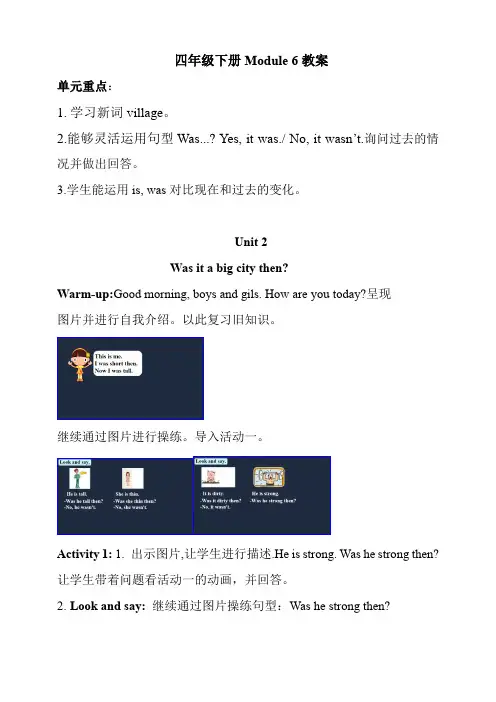
Unit 2Was it a big city then?Warm-up:Good morning, boys and gils. How are you today?呈现图片并进行自我介绍。
以此复习旧知识。
继续通过图片进行操练。
导入活动一。
Activity 1: 1. 出示图片,让学生进行描述.He is strong. Was he strong then? 让学生带着问题看活动一的动画,并回答。
2.Look and say:继续通过图片操练句型:Was he strong then?Activity 2: 1. Lingling’s grandpa is old too. He was young then. Where is he in this photo?提出问题并播放活动2视频。
2.通过课件出示图片回答以上问题,并通过图片和视频让学生了解深圳这个城市。
3.通过图片提出新问题:Was it a big city then? 学生回答后,让学生了解过去的深圳。
4.利用图片学习village, town, city,country.并让学生进行造句。
最后总结:There are lots of villages, towns, cities in China. I love China. I love our country.Homework:1. Retell the text 2. Copy the text.。
外研版三起点四年级英语下册Module6Unit2、Was、it、a、big、city、then课件12

2. Her hair _w_a_s__short then. Now her hair ___is___long. 3. He w__a_s_thin then. Now he __is___fat.
4.She w__a_s_short then. Now she __is__tall.
a. were b. was c. did 2. ____you at the park yesterday? a. Is b. Are c. Were 3. ____ you at school now?
a. Is b. Are c. Were
小结:你学到了什么?
Homework
以手抄报的形式画一画你家 乡的变化。通过对话,向大 家介绍一下你家乡的情况。 用对话的形式写在手抄报上。
Buckingham Palace
Where is it?
They are in London. London is a big city.
Shenzhen Do you know this city?
It’s a big city now. but was it a big city 30 years ago?
Module 6 Unit 2 Was it a big city then?
Read the text and talk about the answers in your groups.
Who was he in the picture? Where is he? How about Shenzhen now? How about Shenzhen then?
外研版三起点四年级英语下册Module6Unit2、Was、it、a、big、city、then课件17

A :Was it …yesterday? B :Yes, it was. / No, it wasn’t.
sunny cloudy windy cold hot
Module 6
Unit 2 Was it a big city then?
fat short tall big young fast(快的)
thin (瘦的) long long small old slow (慢的)
Shenzhen Shenzhen is a big city now.
Was it a big city then? No, it was a very small village then.
short tall fat thin cute naughty cool
A :Was she …then?
B :Yes, she was. / No, she wasn’t.
short tall fat thin cute naughty cool
A :Was he …then? B :Yes, he was. Were they…? Yes, they were. /
No, they weren’t.
A:Were you at…yesterday? B : Yes, I was. / No, I wasn’t.
park school home cinema zoo supermarket
A : Were you …then? B :Yes, I was. / No, I wasn’t.
(乡村)
Was it…then? Yes, it was./ No, it wasn’t.
英语外研新标准(三起)四年级下册-Module6 Unit 2 Was it a big city

英语外研新标准(三起)四年级下册-Module6 Unit 2 Was it abig city then教案教学目标1.学习并掌握本课时中所涉及的重点单词和短语:first, then, theater, museum, post office等;2.能够听懂、理解并运用四会词汇进行表达,并能够描述画面;3.尝试使用一般过去时谈论过去的事情;4.提高学生们的听说能力,鼓励他们进行交际,并且能够与他人进行简单的交流。
教学重点1.学生们能够熟练使用一般过去时谈论过去的事情;2.提高学生们的听说能力;3.能够描述画面。
教学难点1.让学生们能够熟练地使用一般过去时,描述过去的画面;2.增加学生们的表述能力。
教学过程Step 1 Revision1.让学生观看一个小动画片,让他们回忆五幅图片的故事情节;2.让学生结合上课的内容,使用英语描述动画片的故事情节。
Step 2 Lead-in1.让学生回忆自己去过哪些城市;2.让学生结合自己的经历,说出城市的特点和魅力。
Step 3 Presentation1.教师出示几幅图片,让学生们仔细观察;2.教师播放一小段视频片段,呈现出过去与现在的城市;3.教师向学生们介绍过去城市中出现的建筑和设施并解释其含义。
Step 4 Explanation1.让学生了解一般过去时的用法和特点;2.帮助学生们掌握一般过去时的构成和变化;3.让学生们更深入地理解一般过去时的使用范围。
Step 5 Practice1.让学生们小组讨论视频片段中的画面;2.让学生使用一般过去时描述画面;3.让学生互相交流,讨论他们对所描述的画面的理解。
Step 6 Summary1.让学生进行小结,掌握学习内容;2.教师进行学习总结。
Step 7 Homework1.让学生们写一篇关于他们所在城市的文章,并使用一般过去时描述其历史变迁。
课后反思本课时的教学目标主要是培养学生们的听说能力,让他们尝试使用一般过去时谈论过去的事情,并提高他们的表述能力。
外研版四年级Module 6 Unit 2 Was it a big city then 课件
13、He who seize the right moment, is the right man.谁把握机遇,谁就心想事成。2021/8/12021/8/12021/8/12021/8/18/1/2021
• 14、谁要是自己还没有发展培养和教育好,他就不能发展培养和教育别人。2021年8月1日星期日2021/8/12021/8/12021/8/1
•
young
naughty
Was she fat? No, she wasn’t.
Was it strong? Yes, it was.
Was it tall? Yes, It was.
Was she young? No, she wasn’t.
Let’s chant
I was fat, but now I’m thin. I was slow, now I’m fast. I can win. I was a baby, but now I’m big. I was cute, now I’m not. I’m an old pig.
Unit 2 Was it a big city?
fat
big
员躬亲共做; 要学生 学的知 识,教 职员躬 亲共学 ;要学 生守的 规则, 教职员 躬亲共 守。2021/8/12021/8/1Sunday, August 01, 2021
• 10、阅读一切好书如同和过去最杰出的人谈话。2021/8/12021/8/12021/8/18/1/2021 4:20:05 AM
• 11、一个好的教师,是一个懂得心理学和教育学的人。2021/8/12021/8/12021/8/1Aug-211-Aug-21
• 12、要记住,你不仅是教课的教师,也是学生的教育者,生活的导师和道德的引路人。2021/8/12021/8/12021/8/1Sunday, August 01, 2021
Module6Unit2Wasitabigcitythen?(教案)-英语四年级下册

外研版四年级下册英语Module 6《Unit 2 Was it a big city then?》教案一、教材分析:本节课的教材为外研版四年级下册Module 6《Unit 2 Was it a big city then?》。
本单元主要介绍了一个城市的变化,并通过对话活动让学生练习运用Was it...?句型描述城市的变化。
教材内容贴近学生的生活实际,能够引发学生的兴趣和思考,培养学生的口语交际能力。
二、教学目标:知识目标:1. 能够听、说、认读单词"village"。
2. 能够运用句型"Was it...? Yes, it was. No, it wasn't."描述人或物的变化。
能力目标:1. 能够运用句型"Was it...? Yes, it was. No, it wasn't."句型描绘人或物的变化。
2. 通过对话活动,提高学生英语口语交际能力。
3. 培养学生在合作中学习英语的能力。
情感目标:1. 通过小组合作,培养学生的合作意识,开展愉快的交际活动。
2. 了解深圳的变化后,增加对祖国的热爱,提升自尊心。
三、教学重难点教学重点:1. 能够运用"Was it...? Yes, it was. No, it wasn't."句型描绘人或物的变化。
教学难点:1. 熟练运用"Was it...? Yes, it was. No, it wasn't."句型描绘人或物的变化。
四、学情分析:学生是四年级的学生,他们已经学习了一些基础的英语知识,能够进行简单的问答和口语表达。
他们对自己的生活环境和城市的变化有一定的观察和认识。
通过本节课的学习,可以增加学生对城市变化的了解,培养他们的口语表达能力和团队合作能力。
五、教学过程:Step 1: Warmup (热身)1. Greet the students and sing a song about cities together.Teacher: Good morning, everyone! I hope you're all excited for today's lesson. Let's start by warming up with a fun song about cities. (The teacher sings a song like "Big City Life" or "Empire State of Mind," encouraging students to join in and sing along.)2. Show pictures of different cities and ask the students if they know the names of the cities.Teacher: Now, let's take a look at some pictures ofdifferent cities from around the world. Raise your hand if you can identify any of these cities. (The teacher shows pictures of famous cities such as New York City, Paris, Tokyo, and Beijing.)Student 1: I know that one! It's New York City!Teacher: That's correct! Great job, Student 1. Can anyone identify the others?Step 2: Presentation (呈现)1. Introduce the new word "village" and teach its pronunciation and meaning.Teacher: Today, we're going to learn a new word: "village." Repeat after me: "village."Students: Village.Teacher: Excellent! A village is a small munity or settlement in a rural area. It's usually smaller than a city and has fewer buildings and people. Can you think of any examples of a village?Student 2: My grandparents live in a village. It's called Green Valley.Teacher: That's a great example, Student 2! Green Valley sounds like a lovely village.2. Show pictures of a village and a city, and ask thestudents to describe the differences between them.Teacher: Now, let's pare a village and a city. Take a look at these pictures. What differences do you notice between them?Student 3: In the village picture, I see lots of trees and fields, but in the city picture, there are tall buildings and busy streets.Teacher: That's correct, Student 3! Villages are often surrounded by nature, with more open spaces, while cities have more buildings and a busier atmosphere. Well done!Step 3: Practice (练习)1. Teach the sentence pattern "Was it a big city then?" and model the pronunciation and intonation.Teacher: Now, let's learn a sentence pattern we can use to talk about changes in places. Repeat after me: "Was it a big city then?"Students: "Was it a big city then?"Teacher: Great! Pay attention to the rising intonation at the end of the sentence. Let's practice saying it together a few times.2. Divide the students into pairs. One student asks the question, and the other answers using "Yes, it was." or "No, it wasn't." based on the picture shown.Teacher: Now, I'll pair you up. Student A, you will ask the question, and Student B, you will respond based on the picture I show you. Let's begin!(Student A and B practice asking and answering questions using the sentence pattern and the pictures provided by the teacher.)3. Conduct roleplay activities in pairs. Students take turns asking and answering questions about the changes in different places.Teacher: Now, let's take the roleplay activity a step further. I want you to imagine that you're talking to someone who has lived in a certain place for a long time. Ask questions about how that place has changed over the years. Practice with your partner and try to use the sentence pattern we just learned.(Students engage in roleplay activities, asking and answering questions about the changes in different places.) Step 4: Consolidation (巩固)1. Play a game called "Guess the Place." Show pictures of different places and describe them using the sentence pattern. Students guess the name of the place.Teacher: It's time for a fun game called "Guess the Place."I will describe a place using the sentence pattern we learned. Your task is to guess the name of the place. Are you ready?(The teacher shows pictures of various places and describes them using the sentence pattern. Students take turns guessing the names of the places.)2. Have a class discussion about the changes in their own city or town. Encourage students to share their observations and opinions.Teacher: Now, let's shift our focus to our own city or town. Raise your hand if you've noticed any changes in your hometown. What are some of the changes you've observed?(Student 4 raises hand.)Student 4: In my town, they built a new shopping mall last year. It used to be an empty field before.Teacher: That's an interesting change, Student 4. Anyone else?(Encourage students to share their observations and opinions about the changes in their own city or town.) Step 5: Group Activity (小组活动)1. Divide the class into small groups andgive each groupa picture of a city at different times. Students discuss and describe the changes in the city using the sentence pattern.Teacher: Now, let's work in small groups. I will give each group a picture of a city at different times. Take a few minutes to discuss and describe the changes you notice in the city using the sentence pattern we learned. Be ready to share your findings with the class.(Students form groups, receive the pictures, and discuss the changes in the city depicted in the images.)2. Each group presents their picture and descriptions to the class.Teacher: It's time for each group to present their findings. Group 1, please start and share your picture and describe the changes you observed in the city.(Group 1 presents their picture and descriptions, followed by other groups.)Step 6: Summary and Closure (总结和结束)1. Review the sentence pattern "Was it...? Yes, it was. No, it wasn't." with the whole class.Teacher: Before we conclude today's lesson, let's review the sentence pattern we learned. Repeat after me: "Was it...?"Students: "Was it...?"Teacher: Excellent! Now, let's practice using it. I will say a statement, and you respond with either "Yes, it was" or"No, it wasn't."(The teacher provides statements, and students respond using the sentence pattern.)2. Review the new word "village" and its meaning.Teacher: We also learned a new word today. What was that word?Students: Village.Teacher: Great! And what does it mean?Students: A small munity or settlement in a rural area.Teacher: Well done, everyone!3. Summarize the main points of the lesson and encourage students to share their feelings about the topic.Teacher: Today, we explored the differences between villages and cities, learned how to talk about changes in places using the sentence pattern "Was it...?", and discussed the changes in our own city or town. Now, I'd like to hear from each of you. How do you feel about the topic of changes in cities and villages?(Encourage students to share their feelings and reflections on the topic.)Teacher: Thank you all for your active participation today.I hope you enjoyed the lesson and gained a better understandingof cities, villages, and the changes that occur in different places. See you next time!六、板书设计:Title: Was it a big city then?Sentence pattern:Was it...? Yes, it was. No, it wasn't.Words:village七、教学反思:本节课通过引导学生描述城市的变化,培养了他们的口语交际能力和团队合作能力。
(三起点)外研版四年级英语下册《Module6 Unit2__教案》
Unit2 参考教案一、教材版本:外研版(三年级起点)四年级下册。
二、教学目标:1、能听、说、认、读单词: collage.2、学习重点句型:Was it a big city then? /Yes ,it was./No, it wasn’t.三、教学重点:会说句子:Was it a big city then? /Yes ,it was./No, it wasn’t.四、教学难点:能够在生活中灵活运用运用由Was/were 引导的一般疑问句及其回答。
五、课前准备:1、教师准备与本节课相关的的单词卡片和图片;2、教师准备上课所用的课件;3、教师准备本节课所需的音频;4、教师准备本节课所需的动画。
六、教学过程:Step1: Warming up(热身)建议用时:2—3分钟活动一:唱一唱老师播放动画歌曲学生看动画跟唱。
活动二:口语练习教师就所学过的内容,让学生进行交际练习,目的是巩固学生对语言的运用。
Step2: Presentation(呈现新课)1.新课导入建议用时:3—4分钟活动三:听一听老师播放本课配套的第一部分的课文录音,听完一遍之后再次播放让学生跟读。
最后,教师让学生自设话题模仿本部分句子。
2.课文学习建议用时:3—4分钟教师播放课文第二部分Listen and say的课文录音,学生先跟读后由教师领读并讲解。
最后播放一遍录音让学生完成PPT上面的填空练习。
给学生一定时间自由朗读,之后教师挑选学生站起来自由设立情景,按照课文内容编造对话。
3. 学习新单词建议用时:2—3分钟教师给学生讲解第二部分文中出现的新单词,接着播放单词录音,让学生跟读单词。
同时给学生展示单词卡片。
Step3:Let’s play (趣味操练)活动四:看一看,答一答建议用时:3—4 分钟教师播放PPT课件上关于课文第三部分Point ask and answer的图片内容,教师讲解图中所给例句的问答,让学生自己按照例句,以后面三幅画为情景,进行对话问答练习。
外研英语四年级下优质教案:Module6 Unit2 Was it a big city then(1)
Unit2 Was it a big city then? 教学目标:1、掌握重点词汇:village2、学习重点句型:Was it a big city then?Yes, it was. /No, it wasn’t.3、能够运用由Was 引导的一般疑问句及其回答。
教学重点:1、掌握重点词汇:village2、学习重点句型:Was it a big city then?Yes, it was. /No, it wasn’t.教学难点:能够运用由Was 引导的一般疑问句及其回答。
教学准备:多媒体、图片、单词卡教学过程:1. Greeting2. ReviewStep 2: Presentation1. New wordShow a picture of my hometown.T: Look! It’s a small village.(讲授village)2. New sentencesLook at this picture about Shenzhen.T: Is it a big city?S: Yes, it is.T: Now let me guess, was it a big city then? Look at another picture about Shenzhen. (展示出一张过去深圳的照片)S: No, it wasn’t.询问第三人称单数过去怎么样句型:Was +第三人称单数(it/he/she...)+形容词?回答:Yes, it/he/she... was.No, it/he/she... wasn’t.Step 3: Teacher-student interaction1、设计一个游戏环节,Let me guess.可以让学生互相猜一猜自己过去拥有的物品或者家里曾经养过的动物。
2、学唱歌曲<I was fat>。
Step 4: Homework1、将本课重点句型抄写三遍。
外研版四年级下册英语 Module6 Unit2 课件
Summary
能听、说、认 读单词
village
用于询问过 去的情况
—Was it a big city then? —Yes, it was. /No, it wasn’t. —Was he strong then? —Yes, he was.
Module 6 Unit 2
Was it a big city then?
外研英语 四年级 下册
Learning goals
✔ 能听懂,会说,并初步运用词汇:
village
✔ 能听懂、会说,并运用句型:
1.—Was he strong then? —Yes, he was.
2. —Was it a big city then? —Yes, it was. /No, it wasn’t.
Point, ask and answer
Was she tall?
tall?
No, she wasn’t. She was short.
Point, ask and answer
Was he naughty?
naughty?
Yes, he was.
Point, ask and answer
Were the young?
点击,播放视频
Listen and chant
I was fat, but now I’m thin. I was slow. Now I’m fast. I can win. I was a baby, but now I’m big. I was cute. Now I’m not. I’m an old pig.
外研版四年级下册英语Module-6-Unit-2-Was-it-a-big-city
3. ____ you at school now?
a. Is b. Are c. Were
Buckingham Palace
Where is it?
They are in London. London is a big city.
Shenzhen Do you know this city?
It’s a big city now. but was it a big city 30 years ago?
is 4.She was ____short then. Now she ____tall.
5. Theywere ____naughty then. Now they_____cute. are
Matching The queen was beautiful.
Shenzhen is a big city.
Listen and read after the tape. Then retell the text.
pairwork
Were you at home yesterday? Yes, I was. No, I wasn’t.
Point, ask and answer.
Was it fat?
Module 6
Unit 2 Was it a big city then?
Read the text and talk about the answers in your groups.
Who was he in the picture? Where is he? How about Shenzhen now? How about Shenzhen then?
They were naughty.