
PEP小学六年级英语下册知识点归纳及练习[1]
Book 6B Unit 1 How tall are you?一、词汇tall ----- taller 高的----更高的than 比short ----- shorter 矮的/短的----更矮的/更短的cm 厘米long ------ longer 长的----更长的meter 米形容词strong------ stronger 强壮的----更强壮的ton 吨adj. old ------ older 老的/旧的----更老的/更旧的size 号码young------ younger 年轻的-----更年轻的feet 脚small------ smaller 小的----更小的think 想wear 穿辅+元+辅--------双写最后一个辅音字母+er others even 甚至big-----bigger 大的-----更大的tail 尾巴thin-----thinner瘦的-----更瘦的little 小的fat-----fatter 胖的------更胖的lobster 龙虾shark 鲨鱼辅音字母+y -----改y为i +er deep 深的happy-----happier 开心的-----更开心的seal 海豹heavy-----heavier 重的------更重的squid 鱿鱼funny-----funnier 滑稽的------更滑稽的sperm whale抹香鲸killer whale虎鲸二、重点句型⑴问年龄,身高,体重等How old are you? How tall are you? How heavy are you?---- I’m _______ (years old). ------ I’m ______ cm tall. ------- I’m ______ kg .⑵问物品的情况:① How large is your room? 你的房间有多大?It’s __________ m2 (square meters.) 有_______ 平方米。
②How long is your bed?你的床有多长?It’s _________cm long. 有______厘米长。
③How big are your feet? 你的脚有多长?I wear size ______.我穿_______码的鞋。
⑶形容谁比谁更……am①… be is ( even/much ) …er than …aree.g. I am taller than you. 我比你高。
I am 4 cm taller than your brother.我比你弟弟高4cm .I am taller and stronger than your brother.我比你的弟弟更高更壮。
Jack is even stronger than his father. Jack 甚至比他爸爸还壮。
Zhang Peng and John are much younger than Mr.Green.张鹏和John 比Mr. Green 要年轻多了。
有用的句型:1.Which monkey do you like? 你喜欢哪一只猴子?I like the yellow one. 我喜欢黄色的那只。
2.I think the little monkey is only 40 cm tall. 我想那只小猴只有40cm 高。
3.Its tail is about 38 cm long. 它的尾巴约有38cm.4. A sperm whale is ____________ than a killer whale in its length.Exercise For Unit 1一、写出下列各句中的形容词的对应词。
1.I don’t like the smaller dog. I like the _____________ one.2.Jack and John are twin brothers(孪生兄弟),but they are very different: Jackis tall and strong, but John is _________ and __________.3.My older brother is even y_______________ than you.4.Yesterday I was happy. But today I am much ___________ .二、根据首字母和句意填空。
1. W_______ elephant do you like ? I like the baby elephant.2. W________ is taller than you in your class. Chen Ming is.3. I t___________ you can go back home now.4. A sperm whale h________50 teeth. And i__________ tail is usually 8 meters long.5. A killer whale can j____________ out of water.三、根据实际情况回答问题:1. How old are you?_______________________________________________________________2. How tall are you ?_______________________________________________________________3. How heavy are you ?________________________________________________________________4.How heavy are you?_________________________________________________________________5.How many students are there in your class?__________________________________________________________________6.How much is your English book?____________________________________________________________________四、组词成句。
1、 are, you, than, shorter, me._____________________________________________2、you’re, than, me, 4cm, taller._____________________________________________3、I’m, than, you, one, year, older._____________________________________________4、heavy, how, you, are?______________________________________________5、I’m, than, bigger and stronger, you .______________________________________________Unit 2 What’s the matter, Mike?必背词汇:have a fever (发烧)tired (疲劳的)have a cold (感冒)excited(兴奋得)have a sore throat (喉咙痛)angry(生气的)表示身体have a toothache (牙痛)表示情绪sad (悲伤的)不适的have a headache (头痛)心情happy (高兴得)hurt (疼痛)bored (无聊的)sore (疼得)其他:feel(感觉)sick(有病的)nose(鼻子)know(知道)worry (担心)medicine (药)drink (喝)stay (在,逗留)better(更好的)soon (立刻,不久)trip (旅行)fail (失败)pass(传递)重点句型:1.A:What’s the matter? 你怎么啦?B: I have a toothache. 我牙痛。
2.A: How do you feel ? 你感觉怎样?B:I feel sick. 我觉得不舒服。
3.A:How does she/he feel? 她/他感觉如何?B:She/ He is tired. 她/他累了。
4.You look so happy. 你看起来如此高兴。
5.A:I failed the math test. 我数学考试失败了。
B:I’m sorry to hear that. 听到这个消息我很难过。
6.How are you ? You look so excited. 你怎么了?你看起来很兴奋。
7.If you have a fever ,you might have athe flu.如果你发烧,你可能得了流感。
8.Don’t worry! If you are sick,see the doctor.不要担心!如果你病了,去看医生。
9.Take some medicine and drink hot drinks.吃些药和热饮料。
10 Stay in bed for a few days. You will feel better soon.卧床休息几天,你很快就会好起来。
Exercises for unit 2一.完成句子。
1. A:?B:I fell sick.2. A: ?B: I have a toothache.3. A:?B: Amy feels happy.4.A: I failed the math test.B: .5. A: ?B: I am excited.二.按实际情况回答问题。
1.H ow do you feel today?2.H ow heavy are you ?3.H ow tall is your father ?三.选择适当的词填到横线上。
pick , sad, Sunday, rain, happy, picnicclouds, watch, trip, says, stayToday is . I’m very because my parents and Iare going on a . We are going to the West Lake. I’m going toup leaves there. We are going to have a ,too. But now theare in the sky. It is going to . My mother : ― We can’t go out now. We have to at home !‖Oh, dear! I’m very . And I have to TV all day.四.阅读理解。
PEP小学六年级英语下册复习语法知识及配套习题
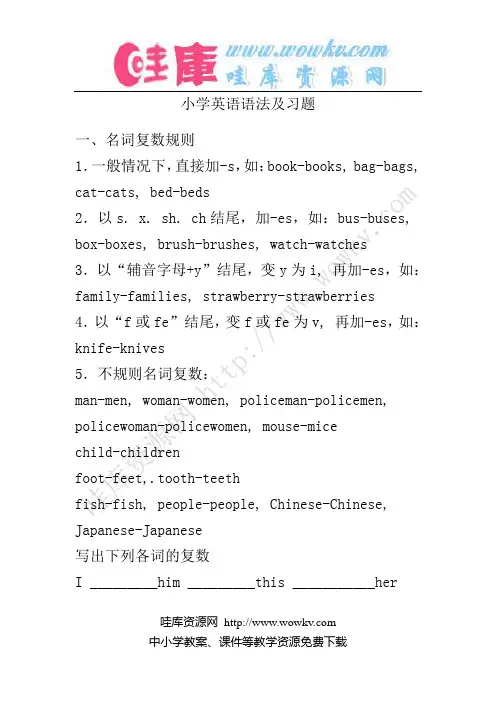
小学英语语法及习题一、名词复数规则1.一般情况下,直接加-s,如:book-books, bag-bags, cat-cats, bed-beds2.以s. x. sh. ch结尾,加-es,如:bus-buses, box-boxes, brush-brushes, watch-watches3.以“辅音字母+y”结尾,变y为i, 再加-es,如:family-families, strawberry-strawberries4.以“f或fe”结尾,变f或fe为v, 再加-es,如:knife-knives5.不规则名词复数:man-men, woman-women, policeman-policemen, policewoman-policewomen, mouse-micechild-childrenfoot-feet,.tooth-teethfish-fish, people-people, Chinese-Chinese, Japanese-Japanese写出下列各词的复数I _________him _________this ___________her哇库资源网______watch _______child _______photo ________diary ______day________ foot________ book_______ dress________tooth_______ sheep ______box_______ strawberry _____thief _______yo-yo ______ peach______ sandwich ______man______ woman_______paper_______ juice___________ water________ milk________ rice__________tea__________二、一般现在时一般现在时基本用法介绍【No. 1】一般现在时的功能1.表示事物或人物的特征、状态。
最新PEP人教版小学英语六年级下册单元知识清单总结(全册)
英语 人教PEP版 六年级下册 Unit 1
【情景再现】 周一,迈克询问埃米昨天做什么了,我们来读一
读他们的对话: Mike:What did you do yesterday? Amy:I watered the flowers. 译文: 迈克:你昨天做什么了? 埃米:我浇花了。
英语 人教PEP版 六年级下册 Unit 1
译文:
英语 人教PEP版 六年级下册 Unit 1
埃米:迈克昨天高兴吗?
萨拉:不,他不高兴。
埃米:为什么?
萨拉:因为他奶奶生病了。
埃米:听到这个我很难过。
【提醒】在英语中,表示尺码大小时,常用“size+数 字”结构,这和中文表达方式相反。
英语 人教PEP版 六年级下册 Unit 1
4.含有实义动词的一般过去时的一般疑问句 【原文呈现】
英语人教pep版六年级下册unit1知识拓展动词过去式的不规则变化小学阶段我们学了以下动词过去式的不规则变化我们把它们按规律进行分类方便同学们记忆
单元知识清单课件
人教PEP版
六年级 下册
英语 人教PEP版 六年级下册 Unit 1
Unit 1 单元重难点
1.如何询问身高 【原文呈现】 How tall are you? 你有多高? I’m 1.65 metres. 我身高1.65米。
英语 人教PEP版 六年级下册 Unit 1
【重点释疑】 常用于询问对方发生了什么,表达对他人的关
心,意为“怎么了?”因为要询问的是过去发生的事, 所以用“happen”的过去式“happened”,意为 “发生”。
英语 人教PEP版 六年级下册 Unit 1
【情景再现】 小明看见小芳胳膊上挂着绷带,上前与她交谈: Xiaoming:What happened?
PEP小学小学六年级下册的英语学习知识点学习汇总
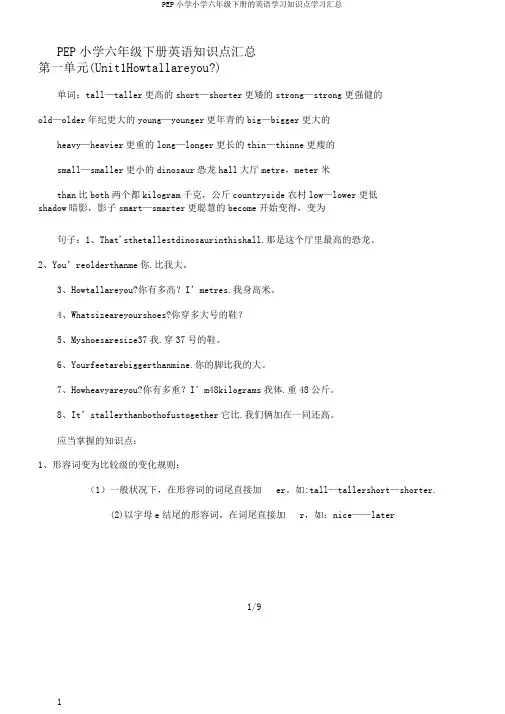
PEP小学六年级下册英语知识点汇总第一单元(Unit1Howtallareyou?)单词:tall—taller更高的short—shorter更矮的strong—strong更强健的old—older年纪更大的young—younger更年青的big—bigger更大的heavy—heavier更重的long—longer更长的thin—thinne更瘦的small—smaller更小的dinosaur恐龙hall大厅metre,meter米than比both两个都kilogram千克,公斤countryside农村low—lower更低shadow暗影,影子smart—smarter更聪慧的become开始变得,变为句子:1、That'sthetallestdinosaurinthishall.那是这个厅里最高的恐龙。
2、You’reolderthanme你.比我大。
3、Howtallareyou?你有多高?I’metres.我身高米。
4、Whatsizeareyourshoes?你穿多大号的鞋?5、Myshoesaresize37我.穿37号的鞋。
6、Yourfeetarebiggerthanmine.你的脚比我的大。
7、Howheavyareyou?你有多重?I’m48kilograms我体.重48公斤。
8、It’stallerthanbothofustogether它比.我们俩加在一同还高。
应当掌握的知识点:1、形容词变为比较级的变化规则:(1)一般状况下,在形容词的词尾直接加er。
如:tall—tallershort—shorter.(2)以字母e结尾的形容词,在词尾直接加r,如:nice——later1/9(3)以重音尾,且尾只有一个音字母的,先双写个音字母,再加er.如:big—biggerthin—thinnerfat—fatter(4)以音字母加y尾的双音形容,先yi,再加er。
人教PEP英语六年级下册U1-U4全册知识清单(考点梳理)
Unit 1 How tall are you?一、核心词汇互为反义词的比较级:shorter更矮的/更短的—taller更高的/longer更长的older更年长的—younger更年轻的thinner更瘦的—stronger更强壮的/heavier更重的bigger 更大的—smaller 更小的拓展词汇——形容词比较级:1. 形容词比较级一般情况下直接在原级词尾加-er。
如:clean —cleaner;2. 以不发音的e结尾的单词直接加-r。
如:large —larger nice —nicer;3. 以“辅音字母+ y”结尾的单词变y为i,再加-er。
如:easy —easierbusy —busier happy —happier funny —funnier;4. 以重读闭音节结尾的单词,要先双写词尾的辅音字母,再加-er。
如:red —redder fat —fatter sad —sadder;5. 不规则变化。
如:good —better bad —worse many —more little —less6. 多音节词和部分双音节词则在词前加more。
如:beautiful —more beautiful exciting —more exciting二、了解词汇dinosaur恐龙hall大厅metre米(美式英语: meter) than比both两个都kilogram千克;公斤countryside乡村lower(low的比较级)更低地shadow阴影;影子smarter(smart的比较级)更聪明的become开始变得;变成三、核心句型1. —How tall are you?你有多高?—I’m 1.64 metres. 我身高1.64米。
2. —What size are your shoes, Mike?迈克,你穿多大号的鞋?—Size 7. 7号。
3. —How heavy are you?你体重多少?—I’m 48 kilograms. 我体重48公斤。
pep六年级下册知识点归纳总结
pep六年级下册知识点归纳总结PEP(人教版小学英语)六年级下册是小学英语学习的最后一个学期,知识点相对较多,需要系统性的总结和归纳。
本文旨在对PEP六年级下册的知识点进行归纳总结,以帮助学生复习和掌握这些重要的知识内容。
一、单词和词组1. 数字:数数词、序数词(1-100)例:one, two, three, four, five, six, seven, eight, nine, ten, eleven, twelve, thirteen, fourteen, fifteen, sixteen, seventeen, eighteen, nineteen, twenty, thirty, forty, fifty, sixty, seventy, eighty, ninety, one hundred;first, second, third, fourth, fifth, sixth, seventh, eighth, ninth, tenth2. 时间词:days of the week, months of the year例:Monday, Tuesday, Wednesday, Thursday, Friday, Saturday, Sunday;January, February, March, April, May, June, July, August, September, October, November, December3. 季节和天气:seasons and weather例:spring, summer, autumn, winter;sunny, cloudy, rainy, windy, snowy4. 学科词汇:subject words例:Chinese, English, math, science, art, music, P.E.5. 学校用品:school supplies例:desk, chair, book, pencil, pen, ruler, eraser, backpack6. 动作动词:action verbs例:run, walk, jump, skip, swim, dance, sing, read, write, draw, paint7. 食物:food例:apple, banana, orange, cake, bread, milk, juice, water, rice, noodles8. 喜好:likes and dislikes例:like, love, enjoy, dislike, hate, don't mind9. 家庭成员:family members例:father, mother, brother, sister, grandfather, grandmother10. 动物:animals例:dog, cat, bird, fish, rabbit, panda, tiger, elephant, giraffe二、句型和语法1. 英文问句的基本结构:疑问词 + 助动词 / be动词 / 助动词 + 主语+ 动词 + 其他?例:What is your name? Are you a student? Can you speak English?2. 一般现在时:主语 + 动词原形(第三人称单数要加-s)例:I like ice cream. She likes dancing.3. 一般过去时:主语 + 动词过去式例:I watched a movie yesterday. He played soccer last weekend.4. 现在进行时:主语 + am/is/are + 动词-ing例:I am reading a book. They are playing basketball.5. 情态动词can表示能力、许可:主语 + can + 动词原形例:I can swim. Can I go to the restroom?6. 情态动词should表示建议、应该:主语 + should + 动词原形例:You should brush your teeth every morning.7. 物主代词:my, your, his, her, its, our, their例:This is my pencil. That is your book.8. 形容词比较级:原级 + -er / more + 形容词 + than例:He is taller than me. She is more beautiful than her sister.9. 数量词:a few, a little, many, much例:I have a few friends. We have a little time.10. 不可数名词和可数名词的用法例:I have some water. I have two apples.三、阅读理解技巧1. 阅读短文时要注意关键词和上下文的联系,提高阅读理解能力。
新人教版(PEP)小学英语六年级下册各单元知识点总结
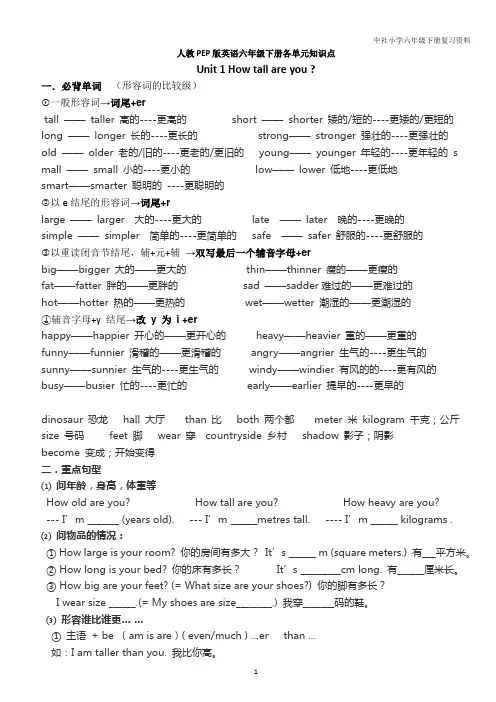
人教PEP版英语六年级下册各单元知识点Unit 1 How tall are you ?一.必背单词(形容词的比较级)①一般形容词→词尾+ertall ——taller 高的----更高的short ——shorter 矮的/短的----更矮的/更短的long ——longer 长的----更长的strong——stronger 强壮的----更强壮的old ——older 老的/旧的----更老的/更旧的young——younger 年轻的----更年轻的s mall ——small 小的----更小的low——lower 低地----更低地smart——smarter 聪明的----更聪明的②以e结尾的形容词→词尾+rlarge ——larger 大的----更大的late ——later 晚的----更晚的simple ——simpler 简单的----更简单的safe ——safer 舒服的----更舒服的③以重读闭音节结尾,辅+元+辅→双写最后一个辅音字母+erbig——bigger 大的——更大的thin——thinner 瘦的——更瘦的fat——fatter 胖的——更胖的sad ——sadder难过的——更难过的hot——hotter 热的——更热的wet——wetter 潮湿的——更潮湿的④辅音字母+y 结尾→改y 为i +erhappy——happier 开心的——更开心的heavy——heavier 重的——更重的funny——funnier 滑稽的——更滑稽的angry——angrier 生气的----更生气的sunny——sunnier 生气的----更生气的windy——windier 有风的的----更有风的busy——busier 忙的----更忙的early——earlier 提早的----更早的dinosaur 恐龙hall 大厅than 比both 两个都meter 米kilogram 千克;公斤size 号码feet 脚wear 穿countryside 乡村shadow 影子;阴影become 变成;开始变得二.重点句型⑴ 问年龄,身高,体重等How old are you? How tall are you? How heavy are you?--- I’m _______ (years old). --- I’m ______metres tall. ---- I’m ______ kilograms .⑵ 问物品的情况:① How large is your room? 你的房间有多大?It’s ______ m (square meters.) 有___平方米。
(完整版)新版PEP小学小学六年级下册知识点总结
(完整版)新版PEP小学小学六年级下册知识点总结六年级英语下册知识点梳理Unit 1 How tall are you?一、单元内容简析:本单元内容的中心话题是询咨询人或事物的年龄、身高、分量以及长度并作比较。
内容涉及恐龙、猴子以及鲸类的比较,学生之间在年龄、身高和体重方面的比较。
三、本单元难点:1、数字的读法,含有“厘米、千克”单位的读法。
如百以上164:one hundred and sixty-four,学生也许读的时候百后别知加“and”,还有千的读法:thousand,小数的读法等。
2、形容词比较级的用法与变化形式,哪些要双写,哪些要把y变i成再加er,到底在啥事情下变比较级要加上more。
3、代词的用法,特殊是名词性物主代词的用法。
四、易考点与易错点:1、词语类:①四会词语在听力部分听写或笔试部分按照汉意写词语。
②按要求写词语:变比较级funny,heavy,big,thin;long的名词,foot,tooth复数,heavy(heavier)的反义词light(er)③very修饰原级,much修饰比较级。
例如:He is very tall. He is much taller than you.2、语法、句型类:①How引导的别同特别疑咨询句:How be sb.?(咨询某人状况),Howtall/heavy/old be sb./sth?(询咨询身高、体重、年龄)How long/big/large be---?(咨询多长、多大)How many/much(咨询数量、价格)。
②比较级的运用,一定要是相同内容或类不才能够举行比较,这是学生最易出错和混淆娥地点。
例如:Mike’s legs are longer than (John),假如学生翻译会直截了当填写John,然而一分析就别难发觉应该和John的腿作比较的,因此应该是John’s。
再比如My hair is longer than (she).假如别认真分析大多数学生都会错填成:she,her,然而填hers才是正确的。
人教版PEP六年级下册英语第一单元知识点+测试二(含答案)
人教版PEP六年级下册英语第一单元知识点+测试二(含答案)【重点词汇】tall------ taller 高的----更高的short ------ shorter 矮的/短的----更矮的/更短的long----- longer 长的----更长的strong------ stronger 强壮的----更强壮的old ------ older 老的/旧的----更老的/更旧的young------ younger 年轻的----更年轻的small------ small 小的----更小的heavy------heavier 重点----更重的thin ------ thinner 瘦的----更瘦的low------ lower 低地----更低地smart------smarter 聪明的----更聪明的big-----bigger 大的-----更大的happy-----happier 开心的-----更开心的thin-----thinner 瘦的-----更瘦的heavy-----heavier 重的------更重的fat-----fatter 胖的------更胖的funny-----funnier 滑稽的------更滑稽的dinosaur 恐龙hall 大厅than 比both 两个都meter 米kilogram千克;公斤size 号码feet 脚wear 穿countryside乡村shadow 影子;阴影become变成;开始变得【重点句型】⑴问年龄:How old are you? ----- I’m _______ (years old).问身高:How tall are you? ---- I’m ______meters tall.问题中:How heavy are you? ---- I’m ______ kilograms .⑵问物品的情况:①How large is your room? 你的房间有多大?It’s __________ m2 (square meters.) 有_______ 平方米。
六年级pep英语下册知识点
六年级pep英语下册知识点Pep英语是中国小学英语教材中的一套教材,在六年级下册中,涵盖了许多重要的知识点。
本文将就六年级Pep英语下册的知识点进行详细的论述,以帮助学生巩固所学内容。
第一部分:语法知识点1. 一般现在时:一般现在时用于表示经常性的或普遍真理的动作。
例如:I play football every Sunday.2. 一般过去时:一般过去时用于表示过去发生的动作或状态。
例如:She watched a movie last night.3. 现在进行时:现在进行时表示现在正在发生的动作。
例如:He is playing basketball now.4. 一般将来时:一般将来时表示将来要发生的动作或存在的状态。
例如:We will go to the park tomorrow.5. 情态动词:情态动词用于表示许可、可能、必须等情态。
例如:Can I borrow your pen?第二部分:词汇知识点1. 动词:动词是指表示一种物理或心理动作、存在或状态的词语。
例如:play, read, swim等。
2. 名词:名词是指用来表示人、事物、地方、抽象概念等的名词。
例如:cat, book, China等。
3. 形容词:形容词是用来描述名词的特征或状态的词语。
例如:beautiful, happy, tall等。
4. 副词:副词是用来修饰动词、形容词或其他副词的词语,表示时间、地点、程度等。
例如:quickly, here, very等。
第三部分:阅读技巧1. 阅读理解:阅读理解是指通过阅读文章,理解文章的含义和提出相关问题。
在解答问题时,需要仔细阅读文章,理解文章的主旨,找出关键信息。
2. 问题解答:在阅读理解中,学生需要根据问题从文章中寻找答案。
解答问题时可以使用关键词定位法,即在文章中找到与问题相关的关键词,然后在该位置附近找到答案。
3. 阅读技巧:阅读技巧包括预测、略读、精读等。
六年级下册英语pep知识点
六年级下册英语pep知识点六年级下册英语PEP(人教版小学英语)是中国小学六年级学生学习英语的课本,本文将从语法、词汇和听力等方面总结一些重要的知识点。
一、语法知识点1. 一般现在时:表示经常性、习惯性的动作或真理;例如:The sun rises in the east.(太阳从东方升起)2. 一般过去时:表示过去发生的动作或存在的状态;例如:I visited my grandparents last weekend.(上周末我拜访了我的祖父母)3. 现在进行时:表示现在正在进行或发生的动作;例如:She is dancing in the living room.(她正在客厅里跳舞)4. 现在完成时:表示过去某个时间开始的动作一直持续到现在或刚刚结束的动作;例如:I have lived in this city for five years.(我在这个城市住了五年了)5. 情态动词:包括can, may, must, should等,用来表示能力、请求、推测等;例如:You should finish your homework before watching TV.(你应该在看电视之前完成作业)6. 过去进行时:表示过去某个时间点正在进行的动作;例如:He was studying when the phone rang.(电话响的时候他正在学习)二、词汇知识点1. 动词短语:如look after, take care of, go shopping等,表达一系列的动作;例如:My sister can help me look after my pet dog.(我的姐姐可以帮我照顾我的宠物狗)2. 形容词比较级和最高级:比较两个或多个人或事物的程度;例如:This book is more interesting than that one.(这本书比那本书更有趣)3. 常见的时间状语:表示时间的副词或介词短语,如yesterday, last week, in the morning等;例如:I met my best friend yesterday in the park.(昨天我在公园里碰到了我最好的朋友)4. 数词:表示数量的词语,包括基数词和序数词;例如:There are thirty students in our class.(我们班有三十个学生)5. 复合名词:由两个或更多的词组合而成的名词;例如:I bought a new basketball for my brother.(我给我弟弟买了一个新篮球)三、听力知识点1. 听力材料:根据录音内容选择正确的答案、填写信息、补全对话等;例如:Listen to the conversation and answer the question.(听对话并回答问题)2. 听力技巧:注意听力材料中的关键词,抓住关键信息;例如:What is the boy's favorite subject?(这个男孩最喜欢的科目是什么?)3. 听力对话:根据对话内容回答问题,了解对话中人物的身份、活动、愿望等;例如:Where are the students going for their class trip?(学生们去哪里进行班级郊游?)总结:六年级下册英语PEP的知识点主要涵盖了语法、词汇和听力等方面,通过学习这些知识点,学生将能够掌握英语的基本语法结构,丰富词汇量,并提高听力理解和口语表达能力。