
英语人教版八年级下册Unit 1 Reading
Unit1 What’s the matter ?第二课时section A (3a-4c) 教学设计一、设计理念《英语课程标准》中明确指出,教材的设计理念之一是注重素质教育,体现语言学校对学生发展的价值,义务教育阶段英语课程的主要目的是为学生的发展综合语言运用能力打基础,为他们继续学校英语和未来发展创造有利条件,课程的总目标是通过英语学习使形成初步的综合语言能力,促进心智发展,提高综合人文素养。
综合语言运用能力的形成建立在语言技能、语言知识、情感态度、学习策略和文化意识等方面整体发展的基础之上语言技能和语言知识是综合语言运用能力的基础;文化意识有利于正确地理解语言和得体地使用语言;有效地学习策略有利于提高学习效率和发展自主学习的能力;积极的情感态度有利于促进主动学习和持续发展。
这五个方面相辅相成,共同促进学生综合语言运用能力的形成与发展。
本节课以学生学习兴趣、特点及学习水平为出发点,旨在创设一个有趣,富于启发思维的教学情景,激发学生学习兴趣,让学生快乐地投入到学习活动中,从而学习运用语言的能力。
二、课标分析人教版八年级下册Unit 1 What’s the matter ? 本单元的话题是健康与急救,主要学习有关伤病几处理建议的表达方式。
教材利用公交司机停车救人的故事对学生进行品德教育,学习助人为乐的精神。
情感态度价值观的教育意义深刻。
本节课是阅读课,阅读是获取信息、发展阅读能力、掌握语言、培养深层学习兴趣的重要手段,使学生成为独立的阅读者,能够利用工具书,理解所读材料的词汇、句子意思、句子之间的意思、文章深层的意思;能抓住大意,进行推测,理解作者意图,达到阅读目的。
因此,从阅读角度上看,这一单元在本学期乃至整个初中阶段的教学中具有特殊的地位和作用。
新课标指出英语对于国家发展的价值:是作为一个和平发展的大国,中国承担着重要的历史使命和国际责任与义务。
英语作为全球使用最广泛的语言之一,已经成为国际交往和科技、文化交流的重要工具,为提高我国整体国民素养,培养具有创新能力和跨文化交际能力的人才,提高国家的国际竞争力和国民的国际交流能力奠定基础。
对学生发展的价值:学习英语不仅有利于他们更好的了解世界,学习先进的科学文化知识,传播中国文化,增进他们与各国青少年的相互沟通和理解,还能为他们提供更多的接受教育和职业发展的机会;帮助他们形成开放、包容的性格,发展跨文化交流的意识与能力,促进思维发展,形成正确的人生观、价值观和良好的人文素养。
本课的教学围绕是健康与急救的话题,设置各种场景,创设条件,让学生在学习新知识的同时,学会用英语准确的表达,以实现本课在整个课程价值中的首要地位。
三、教材分析本单元的话题是健康问题,健康是一切活动的保障,本节课的话题出自Unit1 What ’ s the matter?(section A),主要让学生认知表示身体部位的单词以及部分疾病的表达方法,学会谈论自己及他人的健康状况,能针对健康问题提出合理化建议。
在具体教学中我对教材内容进行了整合,把Grammar Focus 和4a---4c提到前面来,再用图片导入3a。
我还对教材做了适当的修改和扩充,使内容更贴近生活,让学生有更多的发挥空间。
Section A侧重健康问题及提出相关建议,借此学习、训练相关的语言结构。
教材是以What’s the matter ?为中心话题,描述身体不适和提出建议展开,学习和运用“What’s the matter ?”和“What should…do?”让学生学会描述身体的不适和提出建议,本课教材内容与学生的实际生活密切相关,易于引出学生运用简单的英语进行交际和交流,在学习活动中,学生通过交换对身体不适的描述及建议,促进学生之间和师生之间的情感交流,增进情谊。
本节课的主要内容是新目标英语八年级下册第一单元第二课时,教材利用公交司机停车救人的故事,训练、发展学生的阅读技能,学习更多相关的语言描叙,为后面的语法总结与学习提供更多铺垫,并通过课堂讨论进行情感态度价值观的教育,情感态度价值观的教育意义深刻。
在本阶段的教学过程中,教师应多想办法引导学生注意如何用英语表达身体不适,学会使用含有动词have 及hurt的表达方式。
若学生能顺利掌握这一内容,无疑会给后续Grammar Focus 和Section B两部分的学习带来极大的便利。
第二课时主要学习的内容是3a—3c 这一部分旨在训练、发展学生的阅读能力,所选短文故事性强。
对于这类文章,阅读中关注情节发展的先后顺序往往可以有效地促进对文章的理解。
此外,短文的标题和插图也是辅助课文教学的重要资源,让学生们通过对标题和插图的讨论来深化课文学习。
活动4a---4c 这三项活动看似互不相关,但实际上是按“用词→造句→交流”的过程来引导学生逐步掌握本单元的语法内容,因此将它们连贯开展。
四、学情分析(一)学生情况八年级的学生对英语已经有了一定的基础,但是具有过渡性和动荡性的心理特点。
八年级的学生虽然没有升学的压力,但是翻开八年级课本,老师们都有一个明显的感觉:与七年级知识相比,八年级的知识内容要深得多﹑难得多。
同学们在学习方面面临着更大的挑战,有的学生因此产生了畏难情绪,感觉学习吃力,上课听不懂﹑跟不上,由此失去了学习的兴趣,时间一长甚至破罐破摔,放弃了学习。
这也是八年级生学习方面两极分化的重要原因。
八年级处于两极分化的突出时候,学生差异较大,因此在任务设计上我注重分层,检查不同层面上学生对主要问题的掌握情况,面向全体,充分调动每个学生的积极性。
但由于这个阶段的学生活泼好动,好奇心较强,再加上本节课又是他们从未接触过的有关健康的话题及新闻阅读,在学习中,他们更喜欢从游戏中或活动中学习,所以在课堂设计上我十分注意生动活泼但不幼稚,发扬传统但不古板。
这样更能提高他们的学习兴趣,让他们更轻松地掌握英语知识。
今年我所带两个班大部分同学学习积极性较高,能较好地完成学习任务,但个别学生学习习惯不是很好,整体水平不够理想,两班中绝大部分同学都能跟上现有的进度,上课发言积极,部分同学表现的比较出色,但也有个别同学的理解能力和接受能力不尽人意,学习成绩极不理想。
从课堂上看,他们的注意力不能长时间集中,很容易分心,作业和试卷上的错误比较多,对于老师的问题一问三不知,在今后的教学过程中对这些孩子要特别注意。
(二)采取教学措施1. 培养学生运用英语进行思维,训练智力,发展能力。
达到培养其创作思维和发散思维的目的。
2. 创设情景,营造英语氛围,充分发挥学生学习的主动性。
在整个对话教学中,学生积极主动参与教学活动,充分的发挥了学生的主动性,从而达到教师“导”与学生“演”的最佳结合。
3.因材施教,帮助学生树立学习信心。
4.听、说、读、写、译五技并举,全面提高学生的素质。
五、教学目标(一)知识目标:1. 1. Grasp the words and phrases::passenger, off, get off, to one’s surprise, onto, trouble , hit, right away, get into2. Grasp the structure:1) At 9:00 a.m. yesterday, bus No.26 was going along Zhonghua Road when the driver saw an old man lying on the side of the road.2) He expected most or all of the passengers to get off and wait for the next bus.3) To his surprise, they all agreed to go with him.4) Thanks to Mr Wang and the passengers, the doctors saved the man in time.(二)技能目标:能运用“get off, to one’s surprise, right away, get into等动词短语。
(三)情感态度:培养学生乐于助人的精神。
(四)教学重难点分析:1掌握这些短语动词的构成和用法:get off, to one’s surprise, right away, get into2理解3a和学会基本句型:1) At 9:00 a.m. yesterday, bus No.26 was going along Zhonghua Road when the driver saw an old man lying on the side of the road.2) He expected most or all of the passengers to get off and wait for the next bus.3) To his surprise , they all agreed to go with him.4.) Thanks to Mr Wang and the passengers, the doctors saved the man in time.本课Section A分为两个课时比较合适,第一课时:1a—2d, 第二课时:3a—4c;都为新授课;本课时既是前面所学知识的巩固和拓宽,又是后面新知识的铺垫。
六、教学方法:1.恰当运用多媒体辅助教学,提高课堂效率增加趣味性。
2.以学生为中心,开展Role play, Guessing game, Pair work, Group work等英语教学活动。
3.注重分层教学,尊重差异,让不同层次的学生都能参与,获得成就感。
4.评价方法的合理使用,充分调动学生的积极性。
七、教学过程Step1 Play a guessing game 4cWhat’s the matter with me? You have a _____.What should I do? You should_______.开展4c活动前,教师务必先解释活动要求(必要时可采用肢体示范),确认学生理解后给他们分组。
由组里每人设想一种不适或伤害,并以哑剧进行肢体表演,其他同学逐一就如何不适、如何引起以及对应的建议等内容与表演者进行交流。
教师在巡视指导的过程中应注意观察,在心中就各组表现做出评价。
活动后期对表现优秀的小组或个人给予表扬肯定,并可请一、两组登台,进行汇报表演,供其他学生学习借鉴。
用于表述疾病及事故伤害的语言特征(设计思路:由学生每人设想一种不适或伤害,并以哑剧进行肢体表演,其他同学逐一就如何不适、如何引起以及对应的建议等内容与表演者进行交流,更能引起学生的共鸣。
人教版英语八年级下册Unit1知识点

人教版英语八年级下册U n i t1知识点(总12页)--本页仅作为文档封面,使用时请直接删除即可----内页可以根据需求调整合适字体及大小--Unit 1An. 建议,忠告,劝告(1)advice是不可数名词,表示“一条建议”“两条建议”“一些建议”可用:a piece of advice;two piece of advice;some advice(2)advice作名词时的常用搭配:①ask sb. for advice征询某人的建议②give sb. some advice= give some advice to sb.给某人提出一些建议③give advice on sth.在某方面给出建议④take (follow) one’s advice接受某人的建议. He often gives us some advice.=He often gives some advice to us.他经常给我们一些建议。
★例题:Your ______ is very helpful. I guess I’ll take it.A. secretB. adviceC. promiseD. purpose答案:B 秘密;建议;承诺;目标。
由下句“我想我会采纳。
”可知“你的建议很有用”。
’s the matter怎么了(1)该句用来询问对方所遇到的麻烦,或医生及护士询问病人身体情况,常与with连用,后跟sb./sth.,意为“某人或某物怎么了?”.——What’s the matter (with you) (你)怎么了——I lost my pen./I have a cold. 我把我的钢笔弄丢了。
/我感冒了。
(2)“(你)怎么了?”各种常见表达:What’s the matter (with you)=What’s the trouble (with you)=What’s the problem(with you)=What’s wrong (with you)=What’s up?=What happened?★例题:——Nick is not at school. _______——He has a cold.A. Who’s thatB. What’s the matterC. How old is heD. How much is it答案:B 句意:——Nick没来上学。
Unit1What'sthematterSectionB2a-2cReading教案
4.写作练习:根据所给情景,编写一段关于询问和描述身体不适的对话。
二、核心素养目标
《Unit 1 What's the matter? Section B 2a-2c Reading》
本节课的核心素养目标为:
1.语言能力:培养学生阅读理解能力,掌握描述身体不适的词汇和句型,提高英语口语表达能力,能够流利地运用所学知识进行实际场景对话。
在实践活动环节,分组讨论和角色扮演活动让学生们将所学知识运用到实际场景中,提高了他们的英语口语表达能力。不过,我也发现有些小组在讨论过程中存在依赖性,个别成员参与度不高。针对这一问题,我计划在接下来的课堂中,加强对小组讨论的引导,确保每位学生都能积极参与。
学生小组讨论环节,大家围绕“身体不适表达方式在实际生活中的应用”展开讨论,提出了很多有创意的想法。但在引导讨论过程中,我发现部分学生对于开放性问题的回答还不够深入。为此,我将在后续教学中,继续提高问题的质量,引导学生深入思考,提升他们的思维品质。
2.思维品质:通过分析、归纳文章内容,培养学生的逻辑思维和批判性思维,使其能够自主总结语言规律,形成知识体系。
3.文化意识:让学生了解并尊重不同文化背景下人们对身体不适的表达方式,培养跨文化交际意识。
4.学习能力:激发学生的学习兴趣,培养其合作学习、探究学习的能力,提高自主学习效率。
三、教学难点与重点
-在阅读过程中,教师引导学生关注文章中的关键信息,如:人物、地点、事件等,帮助学生理解文章内容。
-针对语法结构,教师可以通过例句展示,让学生明白主语为第三人称单数时,动词需要使用第三人称单数形式。
四、教学流程
(一)导入新课(用时5分钟)
人教版英语八年级下册 Unit1_教材解读
Unit1 名师教材解读1. Textbook Analysis教材解读本单元以“健康与急救(Health and first aid)”为话题,围绕健康问题,学会表达伤病疼痛,正确地给予急救建议。
Section A在内容上侧重健康问题,从身体部位的名称,伤病名称的词汇入手,句型上把握“What’s the matter (with...)? I have a cold/fever/...”。
语法上重点突出表达身体不适的句型结构,包括学会使用含有动词have, hurt的表达方式及情态动词should表达建议。
在情感态度方面,3a-3c 部分利用公交司机停车救人的故事来发展学生阅读技能,扩展学生学习相关语言表述的同时,通过课堂讨论进行情感态度价值观的教育。
Section B在话题上,从Section A中侧重围绕健康问题谈论疾病及不适转向对事故伤害,急救(first aid)的讨论。
在语言上,进一步综合训练和巩固Section A中所学语言重点,但是更加丰富了词汇及相关表述。
按照教材内容,也可以特别对急救的步骤和顺序进行训练。
在技能上,综合了听说能力,突出阅读训练。
在教学策略上,要引导学生利用作者对事件先后顺序的发展描述来理解整篇内容。
在情感上,引导学生学会面对生活中的困难及陷入困境时,要坚强、独立、勇敢、果断、理智。
像Section B长文章中的主角一样,树立抓住哪怕是一丝希望也永不言放弃的精神,热爱生活,珍惜生命。
1.1Section A 1a 活动1a是Lead-in部分。
旨在通过复习绝大部分学生以前学习过的关于身体各部位的词汇,为下面的身体不适的表达法做准备。
学生对本部分词汇有一定的基础,可通过直观手段学习该部分的词汇,对发音做纠正。
如果部分词汇有困难,教师及时处理这部分后,即可过渡到身体不适的表达,从已知到新知。
1.2Section A 1b-1c 活动1b-1c是Listening and speaking部分。
人教版八年级英语下册Unit1_SectionB(2a-2e)名师课件

__5__ Aron did not give up after the accident
and keeps on cliБайду номын сангаасbing mountains today.
__4__ He wrote a book about his experience. __3__ Aron lost half his right arm from the 2003 accident.
• On the day, Aron’s arm was caught under a 2000-kilo rock that fell on him when he was climbing by himself… After that, he climbed down the mountain to find help.
Accidents or problems
fall down
hurt our back or arm
get sunburned
hit by a ball
cut ourselves
mountain climbing have problems breathing
2a
Accidents or problems can sometimes happen when we do sports. Write the letter of each sport next to
冒险 n. (交通)事故;意外遭遇
Words and expressions
situation kilo rock
run out (of) knife
cut off blood mean get out of
2020春七彩课堂人教版初中英语八年级下册教学课件Unit 1 Section A 3a-3c
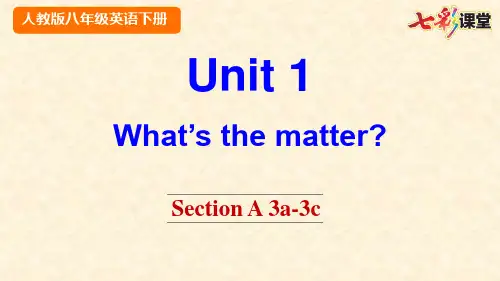
helped him move the man __o_n_t_o__ the bus. __T__h_a_n_k__s_t_o__ these people, the man was saved in
2. Did the passengers think Wang Ping did the right thing? How do you know?
Yes, they did. Because they went with him together.
UNIT 1 SECTION A
3. Do you agree that people often do not help others because they don’t want to get into trouble ? Why or why not?
人教版八年级英语下册
Unit 1
What’s the matter?
Section A 3a-3c
UNIT 1 SECTION A
➢ Objectives
To read and learn about the story of the bus driver—Wang Ping.
To learn to help people when they’re in trouble.
road and a woman next to him shouting for help. He
stopped the bus without _t_h_i_n_k_i_n_g__t_w_i_c_e__. He got off and asked the woman __w_h__a_t_ happened. She said that the man had a heart _p__r_o_b_l_e_m__ and should go to the
2020-2021学年 人教版八年级英语下册 Unit 1 阅读理解专题训练(含答案)
人教版八年级英语下册Unit 1 阅读理解专题训练姓名:__________ 班级:__________学号:__________阅读理解(共5大题;每小题4分,共100分)(一)It's important for us to be healthy. But how can we keep healthy? First,you should eat fruit and vegetables three or four times a week. Then eat some tofu every day because it's good for people, both the young and the old. Milk is also necessary(必要的),especially for women. So you should have milk twice a day. It can help you to be strong. Next, doing more exercise is better. You can do morning exercises or evening exercises. After supper you should take a walk.(1)You should eat_______ three or four times a week.A.fruit and fishB.vegetables and muttonC.tofuD.fruit and vegetables(2)Tofu is good for ______.A.young peopleB.old peopleC.young and old peopleD.students(3)Why do people have milk? ()A.It's delicious.B.It's a kind of drink.C.It's bad for you.D.It can help you keep strong.(4)You should have milk.A.four times a dayB.five times a weekC.twice a dayD.twice a week(5)The passage mainly tells us__________.A.how to keep healthyB.what health isC.why health is importantD.how often you can eat tofu(二)I love to go biking! Two years ago I bought an exercise bike(健身脚踏车).But soon I got bored with being at home, so I bought a used bike and started going for short rides.Now I plan day trips in my neighborhood.When you drive a car, you miss many things.It's surprising how much more you can see when you're biking.—MaggieMy favorite thing to do on the weekend is to go to the beach.The beach is beautiful all through the year.I usually drive there.If the weather is cold;I wear some warm clothes and go for long walks on the beach.When the weather is hot,I enjoy swimming or lust lying in the sun.一Barbara On the weekend I like to read books.If the weather is nice.I'll take a good book to the park and stay there reading for hours.I think there's nothing as enjoyable as reading a good book.一Bill Weekends are for going hiking(徒步旅行)with my parents.We live near some beautiful mountains.Sometimes we camp out at night.We really enjoy cooking dinner over a campfire and spending a night under the stars!一Sara (1)Maggie bought an exercise bike .A.one month agoB.two months agoC.one year agoD.two years ago(2)How does Barbara usually go to the beach? ()A.By bus.B.By car.C.By subway.D.By bike.(3)Bill thinks reading books is .A.difficultB.easyC.interestingD.boring(4)On the weekend;Sara likes to go hiking with her .A.grandparentsB.parentsC.brothersD.sisters(5)What question may the four children answer? ()A.What do you like to do on the weekend?B.What do you think of your weekend life?C.Where do you usually go on the weekend?D.Who do you like to spend a weekend with?(三)It's important for us to be healthy. Everybody wants to be healthy. But how can we keep healthy? Here is some useful advice. First, you should eat fruit and vegetables three or four times a week. There are some kinds of vitamins our bodies need. We should not eat too much meat. Then eat some tofu every day because it's good for people, both the young and the old. Milk is also necessary(必要的), especially for women. So you should have milk twice a day. It can help you tobe strong. Next, doing more exercise is better. You can do morning exercises or evening exercises. After supper you should take a walk.(1)How often should we eat fruit and vegetables? ()A.Once or twice a day.B.Two or three times a day.C.Three or four times a week.D.Three or four times a month.(2)Tofu is good for .A.young peopleB.old peopleC.studentsD.young and old people(3)We should have twice a day.A.fruitkC.tofuD.vegetables(4)To be healthy we can NOT .A.do morning exercisesB.do evening exercisesC.take a walk after supperD.eat too much mean(5)The passage mainly tells us .A.how to keep healthyB.what health isC.why health is importantD.how often you should exercise(四)Last Friday, I agreed to meet some friends at 6:00 p.m. in a coffee shop.The weather was sunny, so I decided to walk there.I arrived ten minutes early.I ordered a cup of coffee and sat watching people.There were some boys playing football on the street, and a small boy was running after the ball as it rolled (滚) across the road.Suddenly (突然), there came a car.It was going very fast.When the driver saw the boy in his way, he braked (刹车) hard.But it was too late…The small boy was lying on the street witho ut moving.To everyone's surprise, the car didn't stop.It drove away quickly.People ran to the boy.There was a cut on the boy's head and he lost a lot of blood.The coffee shop owner (主人) telephoned the police.Soon an ambulance (救护车)arrived and took the boy to the hospital.At 6:30 p.m., the police arrived and started questioning people.About half an hour later, they asked me to go to the police station because I saw everything.I gave them all the information I knew because I really wanted them to catch the driver.I didn't leave the police station until 8:00 p.m. After that I went home because I didn't feel like talking to anyone.The next day, the boy's parents called me to say thanks.They also told me their boy was fine and the driver was in the police station now.(1)Where was the writer at 5:50 p.m. last Friday? ()A.At home.B.On the street.C.In a coffee shop.D.In the police station.(2)Who called the police? ()A.The writer.B.The boy's friends.C.The boy's parents.D.The coffee shop owner.(3)The writer left the police station at p.m.A.6:30B.7:00C.7:30D.8:00(4)Which is the right order of the following events? ()①The writer ordered a cup of coffee.②There was a cut on the boy's head.③A car came very fast.④The writer got a call from the boy's parents.⑤The writer went back home.A.①②⑤③④B.①③②⑤④C.③②①⑤④D.③①②④⑤(5)How might the writer feel at the end of the story? ()A.Happy.B.Tired.C.Worried.D.Popular.(五)Medical experts say most Americans do not get enough sleep.They say more Americans need to take a nap—that is to rest for a short period in the middle of the day.They give people advice to sleep lightly before continuing with other activities.The experts say naps might improve health by reducing pressure.Some European and Latin American companies have supported the idea of napping for many years.They ask people to leave work,go home and have a nap before returning.In the United States,some companies let workers rest simply in their offices.They believe this can help workers make fewer mistakes and also increase the amount of work that a person can do.Sleep experts say it is likely that people make more mistakes at work than at other times.They say people should not carry out important tasks when they feel sleepy.And they say the best thing to do is to take a nap.About twenty minutes of rest is all you need.Experts say this provides extra energy and can increase your effects until the end of the day.But experts said that a nap should last no more than twenty to thirty minutes.A longer nap will put the body into deep sleep and waking up will be difficult.(1)This passage is probably taken from ________.A.a story bookB.a posterC.a science fictionD.a medical magazine (2)What's the best way to increase workers' effects? ()A.Talking with friends.B.Doing relaxing exercise.ughing,smiling and crying.D.Having a rest for twenty or thirty minutes.(3)What will happen to the workers if they keep on working without any rest? ()A.They will get a lot of money.B.They will fail in their jobs and even cause a lot of trouble.C.They will live a happy life in the future.D.They will feel better after finishing everyday jobs.(4)The meaning of the underlined word “reducing” in the first paragraph is________.A.加大B.缓解C.产生D.制造(5)The passage mainly talks about ________.A.taking a nap during the dayB.the disadvantages of taking a napC.Americans who don't have a nap during the weekendsD.the advantages of deep sleep答案1. (1)D(2)C(3)D(4)C(5)A2. (1)D(2)B(3)C(4)B(5)A3. (1)C(2)D(3)B(4)D(5)A4. (1)C(2)D(3)D(4)B(5)A5. (1)D(2)D(3)B(4)B(5)A。
Unit 1 第5课时 Section B【阅读课】八年级英语下册课件(人教版)
breathe v. 呼吸
Fish can not breathe out of water. 鱼离开水就不能呼吸。
sunburned adj. 晒伤的
climber n. 登山者
accident n. (交通)事故; 意外遭遇 rock n. 岩石
knife n. 刀
control n. & v. 限制;约束;管理
__n_e_ve_r_g_iv_e_u_p__ EventsO: n April 26, 2003, he had a serious ______m_o_u_n_ta_in_c_li_m_b_in_g_a_cc_id_e_n_t in Utah.
_M_a_yb_e_h_e_us_e_d _to_____________
Situation 2: His water __ra_n__ o_u_t__.
Decision 2: He would do something to _s_av_e____ his own life.
How
First, he used his _k_n_i_fe___ to cut off half his right arm. Then, he ___b_a_n_d_a_ge_d_himself _w_i_th_ his left arm. After that, he c_l_im_b_e_d__ down the mountain to find help.
exciting
relaxing
dangerous
mountain climber
take risks(冒险) lose your life
tiring/….
Sometimes climbing mountains means taking risks.
人教版八年级下册英语教案unit1
人教版八年级下册英语教案unit1就英语教学过程而言,英语教案要充分体现开放性和动态生成性,从而赋予课堂教学以灵活性和多元性品格;下面是小编为大家精心整理的人教版八年级下册英语教案unit1,仅供参考。
人教版八年级下册英语教案unit1范文课题:Unit One What’s the matter? Period 1 Section A (1a-2d)一、Teaching date:二:学情及教学内容分析:主要讨论的话题是询问某人的健康状况以及遇到麻烦的表达方法。
本单元涉及到大量的表示人体部分的单词以及关于身体某部位不舒服的短语。
此外,本单元还涉及到党当人身体不适时,医生、朋友或亲人提出的意见的表达法。
本单元共有阅读类文章两篇,文章的主体时态都为一般过去时。
主要句型为.What’s the matter with…?”“What should I/ you/ he/ she/they… do?” “I/ you/ he/ she/they should do…?” “I have a headache/stomachache/toothache.” “Does she/he/ have a fever/cold/toothache…?”总的来说,本单元的相关语法知识并不难。
教学目标:三:教学目标:1. 语言知识目标:1) 能掌握以下单词以及短语:matter, sore, have a cold, foot, neck, stomach, throat, fever, lie, lie down, rest, cough, toothache, headache, break, hurt, enough water, take breaks away from, all weekend, take one’s temperature, in the same way, go to a doctor, see a dentist,2) 能熟悉以下句型:What’s the matter with…?”“What should I/ you/ he/ she/they… do?”“I/ you/ he/ she/they should do…”2. 情感态度价值观目标:教会学生关心他人,培养同学间团结、友善的精神。
人教版(新目标)初中英语八年级下册Unit 1
人教版(新目标)初中英语八年级下册Unit1Unit1 Whats the matter?Unit1 知识梳理【重点单词】matter [?m?t?] v. 重要,要紧,有关系Whats the matter? 怎么了?出什么事了?sore [s?:(r)] adj. 疼痛的,酸痛的have a cold 感冒stomach [st?m?k] n. 胃,腹部stomachache [st?m?ke?k] n. 胃痛,腹痛have a stomachache 胃痛foot(复数feet) [fu:t] n. 脚neck [nek] n. 颈,脖子throat [rt] n. 喉咙fever [fi:v?] n. 发烧,发热lie [la?] v. 躺,平躺lie down 躺下rest [rest] n. 剩余部分,其余;放松,休息cough [k?f] n. v. 咳嗽X-ray [eksre?] n. X光,X射线toothache [?tu:e?k] n. 牙痛take ones temperature 量体温headache [?hede?k] n. 头痛have a fever 发烧break [bre?k] n. v. 休息,暂停;打破take breaks (take a break)休息hurt [h?:t] v. 伤害,损害,使受伤passenger [p?s?nd] n. 乘客,旅客off [?f] adv. prep. 离开(某处);从去掉get off 下车to ones surprise 使惊讶,出乎意料onto [nt?] prep. 向,朝trouble [?tr?bl] n. 麻烦,烦扰,问题hit [hit] n. v. 碰撞,打,打击right away 立即,马上get into 陷入,参与herself [h?:?self] pron. 她自己,她本身(she的反身代词)bandage [b?nd?d?] n. v. 绷带;用绷带包扎sick [s?k] adj. 患病的,不适的knee [ni:] n. 膝盖nosebleed [?nzbli:d] n. 鼻出血breathe [bri:e] v. 呼吸sunburned [?s?nb?:nd] adj. 晒伤的ourselves [ɑ:?selvz] pron. 我们自己(we的反身代词)climber [?kla?m?(r)] n. 登山者be used to 习惯于适应于risk [r?sk] n. v. 风险,危险;冒险take risks (take a risk) 冒险accident [ksid?nt] n. 意外事件;事故situation [?sitju?ein] n. 状况,形式,情况kg=kilogram [?k?l?gr?m] n. 公斤,千克rock [r?k] n. 岩石run out (of) 用尽,耗尽knife [naif] n. 刀,餐刀cut off 切除blood [bl?d] n. 血mean [mi:n] v. 意味着,意思是,意欲get out of 离开,从出来importance [?m?p?:tns] n. 重要性decision [d?sn] n. 决心,决定,抉择control [k?ntrl] v. 控制,支配,操纵be in control of 掌管,管理spirit [sp?r?t] n. 勇气,意志death [de] n. 死亡give up 放弃nurse [n?:s] n. 护士【重点短语】1.have a fever 发烧2.have a cough 咳嗽3.have a toothache 牙疼4.talk too much 说得太多5.drink enough water 喝足够的水6.have a cold 受凉;感冒7.have a stomachache 胃疼8.have a sore back 背疼9.have a sore throat 喉咙痛10. take risks 冒险11.hot tea with honey 加蜂蜜的热茶12.see a dentist 看牙医13.get an X-ray 拍X 光片14.take one s temperature 量体温15.put some medicine on sth. 在上面敷药16. give up 放弃17. sound like 听起来像18. all weekend 整个周末19. in the same way 以同样的方式20. go to a doctor 看医生21. go along 沿着走22. on the side of the road 在马路边23. shout for help 大声呼救24. without thinking twice 没有多想25. get off 下车26. have a heart problem 有心脏病27. to one s surprise 另某人惊讶的是28. thanks to 多亏了;由于29. in time 及时30. make a decision 做出决定31. get into trouble 造成麻烦32. right away 立刻;马上33. because of 由于34. get out of 离开;从出来35. keep on doing sth. 继续或坚持做某事36. put a bandage on sth. 用绷带包扎37. fall down 摔倒38. feel sick 感到恶心39. have a nosebleed 流鼻血40. cut his knee 割伤他的膝盖41. put her head back 把她的头向后仰42. have problems breathing 呼吸困难43. mountain climbing 登山运动44. be used to doing sth. 习惯做某事45. run out (of) 用完;用尽46. so that 以便47. so...that... 如此以至于...48. be in control of 掌管;管理49. in a difficult situation 在闲境中【重点句型】1. Whats the matter with you?= Whatthe trouble with you?= Whats wrong with you? 你怎么了?2. What should she do? 她该怎么办呢?3.Should I take my temperature? 我应该量一下体温吗?4.You should lie down and rest. 你应该躺下休息一会儿。
Unit1SectionB2b课件2021-2022学年人教版英语八年级下册
Who country be interest in be used to
Aron Ralston America mountain climbing taking risks
Aron Ralston is an American man who is interested in mountain climbing. As a mountain climber, Aron is used to taking risks. This is one of the exciting things about doing dangerous sports. There were many times when Aron almost lost his life because of accidents. On April 26, 2003, he found himself in a very dangerous situation when climbing in Utah.
Of making good decisions Of being in control of life 7. What spirit does Aron have? Of never giving up Of taking risks
2e Put the sentences in the correct order.
5. What did Aron do after the accident? 6. What does “between a rock and hard place”mean?
DbpmRsAAleioaeotrffuoacoctwaenenrktre”eilta,oliewahonfnlneasdledsvitonhafeobriganfHettdhdhfteyahoeiarooserdtsueuhaairPmr.wmcsmleaapeeln,covhnsherepao.tesavitTrwn“esihcbtertieeoaeostsmtowmemAfeateamroeakobnnaegnoksea?oaitbknrLdoeogeecuicnctagtk’gilsooslaeoitfinohnd.ddniIanBndatkeedhtchthiaawfiatibfssreiciodcoebouunnoutlsoltia,dtk, and of being in control of one’s life. His love for mountain climbing is so great that he kept on climbing mountains even after this experience.