
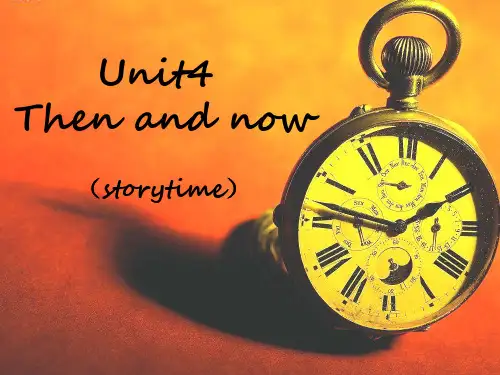
Unit 4 Then and now story time六年级英语
Six years ago
Mike could read and draw, but he could not wad English, ride a bike Now he he can many things. and play the football.
Then
Now
write ---wrote
The change of communications 通讯的变化
Twenty years ago, Mr Brown wrote letters to his friends. He used the telephone at home and in the office 随处,到处 to call people. Now he has a mobile phone and he can call people anywhere. He also writes emails.
• chats (聊天) with her e-friends on the QQ
• writes emails to her e-friends ……
Mr Brown
Then
Twenty years ago wrote letters to friends used the telephone at home and in the office
The changes of ability 1.能力的变化
The changes of making friends 5.交友的变化
……
The changes of communications 2.通讯的变化 … years ago I The changes of getting news 3.获得新闻的变化 My father My mother My___ _ The changes of doing shopping 4.购物的变化 20 30 20 Then Now
The world changes us.
Homework
1. Read Story time.
2. Retell Story time by P38. 3. Finish the workbook: Period1, Unit4.
e-friend 网友
全世界
has e-friends from all over the world
Who are they?
Mr Brown
Grandpa
Mrs Brown
Watch, match and say
A
看视频找出哪个是以前的他们, 并告诉大家是几年前?
twenty years ago
Mr Brown B
twenty years ago
Grandpa C
thirty years ago
Read and write
Learning tips 1. 细阅读文章第三、四段 2. 边读边划相关的动词词组 3. 完成P38后两张表格
Mrs Brown
Then
Twenty years ago, buy的过去式 made friends at school
from bought things The change of making friends shops 交友的变化
Now
writes emails uses the mobile phone write ---wrote anywhere
Twenty years ago, Mr Brown wrote letters to his friends. 随处,到处 He used the telephone at home and in the office to call people. Now he has a mobile phone and he can call people anywhere. He also writes emails.
read newspapers
Thirty years ago, Mike’s grandpa listened to th and read newspapers for news. Now he can rea watch news on the Internet. He reads e-books
Mrs Brown
Read and answer
Mr Brown
Then
What did Mr Brown do twenty years ago?
Now
What does Mr Brown do now?
Learning tips 1. 细阅读文章第二段 2. 边读边划相关的动词词组
Mr Brown
I couldn’t …then(那时候), but I can … now.
Six years ago, Mike could read and draw, but he could not write. Now he can do many things.
Twenty years ago, Mr Brown wrote letters to his friends. He used the telephone at home and in the office to call people. Now he has a mobile phone and he can call people anywhere. He also writes emails.
Grandpa
Then
Thirty years ago, listened to the radio
read/e/ 过去式
Now
reads and watches 电子书 news on the Internet reads e-books
新闻
The change of getting news 获得新闻的变化
Thirty years ago, Mike’s grandpa listened to the radio and read newspapers for news. Now he can read and watch news on the Internet. He reads e-books too. Twenty years ago, Mrs Brown made friends at school. She bought things from shops. Now she has e-friends from all over the world. She does shopping on the Internet too.
couldn’t cook took photos in the shop went to work by bike
can cook takes photos anywhere goes to work by e- bike
Try to retell
We change(改变) the world.
Unit 4 Then and now
(Story time)
What couldn’t he do then(那时候)?
What can he do now?
What could he do six years ago?
Mike
What can he do now?
The change of ability 能力的变化
Now
has e-friends from all over the world does shopping on the The change of doing shopping Internet 购物的变化
Twenty years ago, Mrs Brown made friends at She bought things from shops. Now she has e-f from all over the world. She does shopping on t Internet too.
译林新版《英语》六(上)Unit 4 Then and now Story time

近期,在一次以“小学英语思维导图教学模式的建构与实践”为主题的研讨活动中,笔者有幸观摩了两节同题异构的小学六年级英语课。
两节课分别由不同地区的两位教师执教,他们向我们展示了各具特色、风格迥异的精彩课堂,给我们留下了非常深刻的印象,同时也引发了笔者深度的反思。
主要教学环节展示如下表:一、一样的热身,不一样的导入课前热身能够帮助教师在较短的时间内集中学生的注意力,调动学生的积极性,激发学生的学习兴趣。
课例一中教师通过让学生欣赏歌曲,观看自己过去的照片,从听觉与视觉方面着手,逐步引入句型:Twenty years ago,I could.../Icouldn’t...同时引导学生运用句型“...years ago,I could/couldn’t...”介绍自己过去的情况,强化句型。
课例一中教师利用学生对教师真实的生活、爱好、家庭等情况的好奇,于无声中引入一般过去时,做到了未成曲调先有声。
课例二则在欣赏过去与现在生活变化的视频之后,直奔主题Then and now。
随后通过游戏进行Story time板块的词汇教学,有效地弱化学生学习的难度。
紧接着训练学生运用“Then,we used the...”“Now,we have the...”进行过去与现在生活的对比,抛出问题“Whose lives changed?”,引出课文的学习“Mike’s family members’lives changed.”。
课例二中整个教学过程简洁明快,直入主题Then and now,没有太多的兜兜转转。
不管是课例一中逐步引导学生谈过去的变化,还是课例二中直接进行现在与过去的对比,这两节课都巧妙地利用多种导入方式调动学生学习的积极性,让“课前热身”这一小环节发挥作用,让学生在不同的活动中乐于参与、乐于表达。
二、一样的思维导图,不一样的切入方式思维导图作为教学工具,能够使教学删繁就简,突出重点,提高学生的学习效率。
两位教师都在课堂中使用了思维导图,但其切入点不同。
译林英语六年级上册第四单元Unit4 Then and Now (Story time)
?
What could Mike do?
Mike
?
s
d
can
w ?
r
Mike could read and draw, but he could not write.
Mike
The change of ability 能力的变化
Six years ago Mike could read and draw, but he could not write. Now he can do many things.
Internet too.
What are the changes in the text ? Tick them out.
1
2
the way to go travelling(出行)
the way to contact(联系) people
the way to make friends the way to do shopping the way to have a rest the way to get news People are changing.
They were eggs two days ago.
They are cute chicks.
Байду номын сангаас and
A
B
判断照片中的物品属于“过去”还 是“现在”,属于“过去”就大声 说“then”,属于“现在”就大声 说“now”。 Then Now
a mobile phone
It’s a book without paper. It has a screen(屏幕). You can carry it with you. What’s this?
新pep六年级下册unit4-then-and-nowpartc-story-time
eat meet dishes more humans live
see
had
good
cavemen
-
Try your best!
I . They cooked their food.( 否定句) They didn’t cook their food. 2. There were many trees. (一般疑问句) Were there many trees? 3. We should help the earth. (一般疑问句) Should you help the earth? 4. Whales lived in the sea.
含有 be 动词的句型
一般现在时表示某人某物 现在的状态,性质等.eg: I am a teacher now. She(He) is a singer. We They are happy. You
一般过去时表示过去时间 内某人某物存在的状态, 性质等.eg: I was a teacher last year. She(He) was a singer. We You were happy. They
How beautiful the world was!
-
live on the earth live in the sea have a bright future heal the world
Make it a better place!
住在地球上 住在大海里 有广阔的前景 拯救世界 让它变成更好的世界!
3. 结构
主语 + 动词的过去式 + 其它
-
二.动词过去式的构成 一. 规则动词
1)一般在动词原形末尾加– ed look play start live hope use looked played started lived hoped used
《Unit 4 Then and now》Story time教学设计-《英语》六年级上册译林版三起

《Unit 4 Then and now》Story time教学设计[课题]:译林版小学英语六年级上册[教材简解]:本节课所执教的是译林小学英语六上《Unit4 Then and now》---Story time。
本单元的话题是“过去和现在”,通过对比Mike一家人-------Mike, Mr Brown, Grandpa, Mrs Brown过去与现在的学习、工作和生活等方面,呈现了个人自身的成长变化和科技对生活和工作的影响。
本节课在前三个单元的学习基础上,对一般过去时做进一步呈现,而一般现在时的句型在五年级上学期已经学过。
把两种时态放在一起对比呈现,是本课的教学难点。
在教学中,教师启发学生通过观察、对比等方式,总结归纳两种时态的用法,并尝试在正确的语境中使用。
[目标预设]:根据本单元特点及新课标对六年级学生英语学习能力的要求,本单元的教学目标定为以下几方面:知识目标:1、能听懂、会说、会读、会拼写词汇: then, mobile phone, e-book, email, anywhere,use, radio, newspaper, make friends, all over the world.2、掌握不规则动词过去式的发音及用法:can-could, write-wrote, make-made,buy-bought, read-read.3、能听懂、会说、会读和会写句型: …years ago, he/she…. Now he/she….能力目标:1、能听懂,会说,会读语篇内容并能简要复述.2、能用英语互相交流各自的成长变化。
3、能运用所学内容进行对话表演和短文写作。
情感目标:1、激发学生学习英语的兴趣,增强学生学习英语的自信心。
2、通过过去和现在的对比,感受个人的成长和社会的进步。
[教学重、难点]:1、一般过去时与一般现在时的比较和运用;2、能听懂,会说,会读并能简要复述语篇内容。
Unit 4 Then and now(Story time) (教案)-2022-2023学年英语
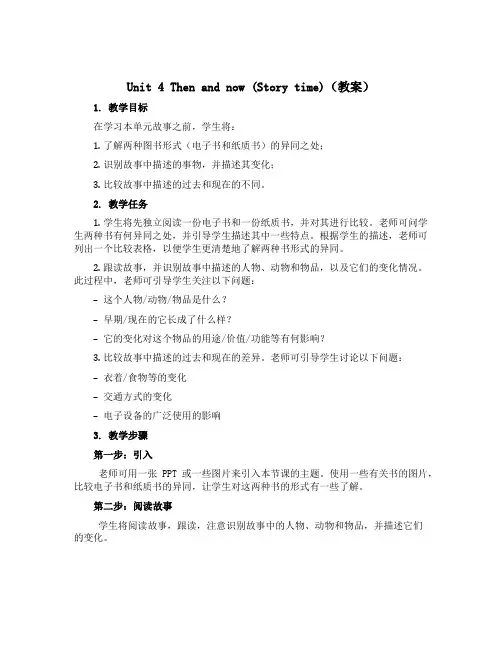
Unit 4 Then and now (Story time)(教案)1. 教学目标在学习本单元故事之前,学生将:1.了解两种图书形式(电子书和纸质书)的异同之处;2.识别故事中描述的事物,并描述其变化;3.比较故事中描述的过去和现在的不同。
2. 教学任务1.学生将先独立阅读一份电子书和一份纸质书,并对其进行比较。
老师可问学生两种书有何异同之处,并引导学生描述其中一些特点。
根据学生的描述,老师可列出一个比较表格,以便学生更清楚地了解两种书形式的异同。
2.跟读故事,并识别故事中描述的人物、动物和物品,以及它们的变化情况。
此过程中,老师可引导学生关注以下问题:–这个人物/动物/物品是什么?–早期/现在的它长成了什么样?–它的变化对这个物品的用途/价值/功能等有何影响?3.比较故事中描述的过去和现在的差异。
老师可引导学生讨论以下问题:–衣着/食物等的变化–交通方式的变化–电子设备的广泛使用的影响3. 教学步骤第一步:引入老师可用一张PPT或一些图片来引入本节课的主题。
使用一些有关书的图片,比较电子书和纸质书的异同,让学生对这两种书的形式有一些了解。
第二步:阅读故事学生将阅读故事,跟读,注意识别故事中的人物、动物和物品,并描述它们的变化。
第三步:比较过去和现在的不同之处通过故事中描述的过去和现在的场景,让学生认识到过去和现在的差异,并讨论如何使用这些变化。
第四步:回顾和评估老师可通过讨论和绘画等方式来检测学生对所学内容的理解。
4. 课堂活动活动1:阅读电子书和纸质书,并进行对比让学生阅读一本电子书和一本纸质书,并通过对比来了解两者之间的区别。
活动2:绘画每个学生都要画一幅图片,描述过去和现在的某个场景,如交通方式、城市建筑等。
活动3:制作比较表格学生将通过讨论,制作一张电子书和纸质书的比较表格,并讨论其中不同的地方。
5. 练习练习1:阅读理解阅读下面的短文,并回答问题。
1955年,公园里建了一个游泳池。
Unit4 Then and Now(Story time)(教学设计)-2022-2023学年英语

Unit4 Then and Now(Story time)(教学设计)一、教材分析《牛津小学英语》六年级上册 Unit4 Then and Now 是一节通过对话式的故事情境来学习英语知识点的课程,本单元主要讲述了两个时代的生活差距,为学生直观展示英语知识在实际生活中的应用,课程包括以下内容:•对比过去和现在生活的差异•学习使用“used to”描述过去的生活和事件•学习使用“now”描述现在的生活和事件•学习使用“going to”描述将来的计划二、教学目标本节课主要以听、说、读、写四方面的能力提升为教学目标,要求学生能够:•能听懂并模仿英语口语表达;•能够流利、准确地口头表达差异、使用“used to”、描述现在的生活和事件等;•能够理解并正确使用“going to”描述将来的计划;•能够自行撰写使用“used to”和“now”描述过去和现在的生活差异,并向同学展示自己的作品。
三、教学内容和步骤Step 1 Warm-up运用比较典型的生活场景让孩子们自行开口口头表达,利用已经掌握的日常生活词汇将学生引入到本节课的主题,激发他们的学习兴趣。
Step 2 Presentation通过对比过去和现在的生活差异,让孩子们理解英语中过去和现在时态的使用,体验不同时代的生活,在讲述中融入常用单词和词组,引导孩子们学习和掌握语言表达的技巧。
Step 3 Practice为巩固孩子们的理解和应用,分组为3-4人,让小组内自行编写有关过去和现在的生活的小故事。
时间约10分钟,以每组为单位进行依次展示,并给与几点评价,以促进孩子们的学习、互相学习、分享和交流的能力。
Step 4 Production通过自行展示他们自己的写作,对孩子们进行激励,鼓励他们自行思考生活、发现生活、分享生活,立足于英语学习和生活实践,增加他们的学术、观察和表达能力。
Step 5 Wrap up总结课堂内容,让孩子们重温本节课所学内容,并形成深刻理解,培养他们的记忆力和自信心,并为下堂课做好铺垫。
牛津译林版英语六年级上册第四单元课件story time
______
Mr Brown Then Now
He can call people anywhere A: He can call people in the office. B: He can call people n—o—m—at—ter where they are.
无论
Mr Brown
2.三年前我不会踢足球,但是现在我会了。 _T_h_r_e_e__y_e_a_rs__ __a_g_o___,Ic_o_u_l_d_n_'t_ play football.But now I__c_a_n____. 3.很久以前,迈克在学校交朋友。 Long long ago, Mike _m__a_d_e__ _f_ri_e_n_d_s___ at home. 4.现在我们可以在网上看新闻。 Now we can watch news _o_n____ t_h_e____ __In__te_r_n_e_t___. 5.二十年前我们使用电话座机给人们打电话。 Twenty years ago,we _u_s_e_d_ telephone _t_o___ _c_a_l_l ___ people.
also writes emails
Twenty years ago, Mr Brown wrote letters to his friends. He used the telephone at home and in the office to call people. Now he has a mobile phone and he can call people anywhere. He also writes emails.
Thirty years ago, Mike’s grandpa listened to the radio and read newspapers for news. Now he can read and watch news on the Internet. He reads e-books too.
Unit 4 Story time(教学设计)-六年级英语上册(译林版三起)
Unit 4 Then and now
Part6:
Summary。
故事总结。
总结归纳的过程中自然渗透给学生,尝试引导学生自主学习。
其目的是让学生进一步巩固课堂所学的知识。
Step 6 : Summary time
1.Let’s learn
(1)New words and sentences
(2)复述Story time
针对本课时设计的两个
习,对学生本课时的掌
握做一个了解,且能够
让学生及时巩固。
Part7:
Exercises。
针对本课时出示几个习题,对本课时的一个知识反馈。
Step 7: Exercise time
一、用所给单词的适当形式填空。
二、单项选择。
本环节知识的总结和归
纳,呼应教学目标的完
成和落实,情感态度教
育,让学生体会到阅读
故事的乐趣,培养学生
阅读的兴趣。
Part8:
Homework。
家庭作业,学生课上学完,课后巩固。
Homework
1.Try to read and retell the story.
2.Prepare for the debate.
3.Do the exercises.(完成本课时对应的
练习题)
作业布置落实双减政
策,减量不减质,是课堂
教学的延续和完善。
利
用课堂所学的知识训练
自己的语言运用能力,从
而提高英语的交际水
平。
板书设计:
Unit 4 Then and now
Story time。
新牛津译林苏教版六年级英语上册Unit4 Then and now Story time课件
•writes emails.
•used the _t_e_le_p_o_ne__
•has a mobile phone
at home office
and
in
theHe
can
call
people
anywhere.
A.He can call people in the office.
B.He can call people no matter where they are.(无论他们在哪儿)
learning tip: 1.默读文章,领会意思,遇到不认识的词,尝试猜测大意。 2.练习的题目与同文章的关键词是相同的,找准这些关键词。 3.字迹要规范工整。
Say in玲和苏海一样,根据刚刚填写的内容, 分别说一说Mike一家的过去和现在。 2.在说的过程中同桌可互相检查核对彼此的答案。
Choose a name for this pair of picture.
小时 候
长大 后
A. My life. B. Then and now.
Who are in this story?
Say something about the picture
仔细观察图片,尤其是每组图片的不同,尝试说一说你能从图片中 得到的信息。
Mike
then
now
six years ago
•could _r_e_a_d_and draw •can do many things
•couldn’t _w_r_it_e_
couldn’t = could not
Mr. Brown
then
now
tewenty years ago
译林英语六年级上册第四单元Unit4-story-time课件
Retell
do many things
Mr Brow2人n 一组,wusro选etde择tlheet文teter本lsep的ho其ne 中一段wh进raiste行sa me复-omb述ailiels;phone
可以用第三人称;
Mrs
Bro也w可n 以转bmo化audge成htfr第tiehnin一dgss人, ,ss称chhoop…osl …
does shopping
Grandpa thirty listened to the radio can read &watch news years ago read newspapers reads e-books
on the Internet
10
Task3: What are the changes in the text ? Tick them out. (课文中提到变化是哪些?请打√ 。)
• What could I do? • You could...
3
changed 改变
4
now
six years ago
twenty years ago
then
thirty years ago
5
Unit 4 Then and now
( Story time)
6
Now he can do many things.
29
thirty years ago
radio newspapers
30
4. Twenty years ago, Mrs Brown made friends at school. She bought things from shops. Now she has e-friends from all over the world. She does shopping on the Internet too.