
2012年版新译林初中英语七年级上册全册复习
1.be 动词的一般现在时的句式: 肯定句:主语+be+表语(n., adj.等)
e.g. He is a worker. You are thirteen. They are in the classroom.
否定句:主语+be+ not+表语
e.g. He is not a worker. You aren’t thirteen. They aren’t in the classroom. e.g. Is he a worker? Yes, he is./No, he isn’t. Are you thirteen? Are they in the classroom? Yes, they are. No, they aren’t.
四. grammar points
一般现在时(The Simple Present Tense)
1.表示现在的状态:
e.g. He’s twelve. She’s at work. 2.表经常或习惯性的动作: e.g. I get up at 6:30 every day. He reads English every morning. 3.表主语具备的性格和能力等: e.g. She likes noodles. They speak French. 4.普遍真理和自然规律: e.g. Two plus four is six. The moon goes around the earth.
• his favourite football player 34.他最喜爱的足球运动员 • . like reading books about football 35.喜欢看关于足球的书 • the newest member 37.最新来的成员 • be good at scoring goals 38. 擅长进球得分 • want to play in the next World Cup 39.想参加下一次世界杯 • look happy 40.看起来开心 • How do you say that in English 41.那个用英语你如何说 • know them well 43.很了解他们
一般疑问句:Be+主语+表语?
特殊疑问句:疑问词+be+主语?
e.g. What is he? What colour is that bird? How old are you? Where are they ?
2.实义动词的一般现在时句式: 肯定句:主语(I/We/You/They)+实义动词+其他 e.g. I stay at home on Saturdays. They have sports every day. 主语(He/She/It)+实义动词三单现形式+其他 e.g. He stays at home on Saturdays. Lucy has sports every day. 否定句:主语(I/We/You/They)+do+ not+动词原形+其他 e.g. I don’t stay at home on Saturdays. They don’t have sports every day. 主语(He/She/It)+does +not+动词原形+其他 e.g. He doesn’t stay at home on Saturdays. Lucy doesn’t have sports every day. 一般疑问句:Do+主语(I/we/you/they)+动词原形+其他? e.g. Do you stay at home on Saturdays? Do they have sports every day? Does+主语(he/she/it)+动词原形+其他? e.g. Does he stay at home on Saturdays? Does Lucy have sports every day?
• • • • • • • • •
13. 羽毛球场 14. 足球场 15. 游泳池 16. 在午餐时间 17. 带---散步 18. 看电视 19. 在周末 20. 和---放风筝 21. 为---踢(打---)
(on the ) badminton court (on the ) football field (in the )swimming pool at lunchtime take---for a walk watch TV at the weekend fly a kite with--play for---
2). It’s cold outside . _________ Put on your sweater. 3). Today , Miss Fang is ______ red. in dresses 4). Sandy often ________her sister in the morning. 4. Walk to… = go to…on foot 步行去… … e.g. My father usually walks to work. My father usually ____ ____ ____ ____ ___. goes to work on foot take the bus to …= go to … by bus 乘汽车去 e.g. Amy sometimes takes the bus to school. Amy sometimes ___ ___ ____ _____. goes to____ school by bus 5. half an hour 半小时 one hour and a half = one and a half hours 一个半小时
三. sentence patterns
1.look after = take care of e.g. 你要保管好你的衣服 look after / take care of You must __________________________ your clothes. 2. year 年, 岁 e.g. 他只是一个8岁的孩子。 eight-year-old He is only an ________________boy. 3. wear (v) 穿,戴 ,表示状态,后接服装。 put on 穿上,表示动作,后接服装。 be in 穿, 戴,表示状态 ,后接服装或颜色。 dress (v) 给---穿衣服,后接人 (n) 长裙,女服 wearing / in a white T-shirt. e.g.1). Mr. Green is __________
• 22. 用---作例子 use---as a model • 23.说得越多,学得越快 the more you speak, the faster you will learn • 24. 把---忘在家 leave---at home • 25. 从---借--borrow---from • 26. 练习说--practise saying--• 27. 用英语说--say---in English • 28. ---的答案 the answer to --• 29. 听起来极好 sound great • 30.在我祖父母家吃饭 have dinner at my grandparents’ home
特殊疑问句:疑问词+ do/does+主语+动词原形+其他? e.g. What do you want? What does she want? What time do you have lunch? What time does she have lunch? What do you do? What does she do? How do you spell it? How does he spell it?
2012年版新译林初中英语七年级上册
全册复习
2012年版新译林初中英语七年级上册
Unit 2
Unit 8 Unit 6
7Atant phrases
• 1.彼此互相介绍 introduce oneself to each other • 2.晚安 Good night. • 3. ---岁 ---years old • 4. 七年级一班 Class 1, Grade 7 • 5. 出生于--- be born (in---) • 6. 放学后 after school • 7. 来自于--come from • 8. 听音乐 listen to music • 9. 努力学习 work hard (at ) • 10. 擅长于--- be good at---(= do well in ) • 11. 喜欢玩电脑游戏 enjoy playing computer games • 12. 是---的时间 It is time for---
6. news (n).新闻,消息 不可数名词 e.g. 一条消息 a piece of news 比较:information 信息 7. say 说,讲 (后接说的内容) speak 说,讲;强调讲语言;也可用于打电话 tell 告诉 tell sb. to do sth./ tell sb. about sth. say e.g. 1).How can you ______this in English? speak 2). I can _______some English now. speak to Wu Dong ? 3). May I ________ 4). Our teacher _____ tells us to clean the classroom every day. tells 5). My grandma often ______me stories in the evenings.
牛津译林版七年级上英语期末复习全册知识点归纳
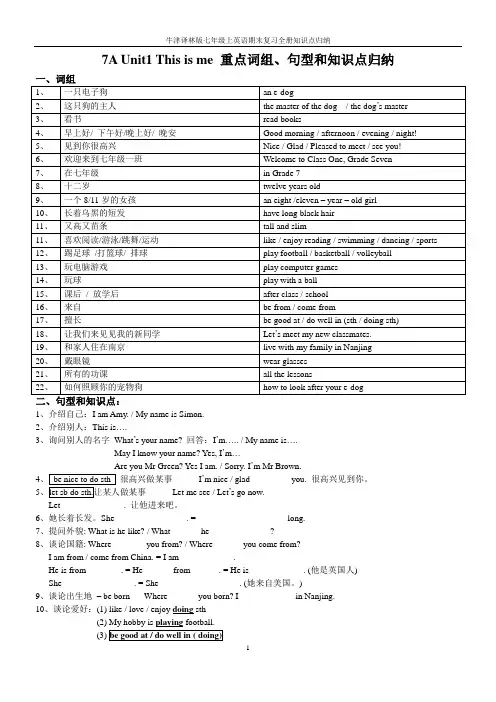
7A Unit1 This is me 重点词组、句型和知识点归纳1、介绍自己:I am Amy. / My name is Simon.2、介绍别人:This is….3、询问别人的名字What’s your name? 回答:I’m….. / My name is….May I know your name? Yes, I’m…Are you Mr Green? Yes I am. / Sorry. I’m Mr Brown.4很高兴做某事I’m nice / glad _________you. 很高兴见到你。
5Let me see / Let’s go now.Let ______________. 让他进来吧。
6、她长着长发。
She _____ _____ _____. = _______ ______ ______ long.7、提问外貌: What is he like? / What ______ he ______ _______?8、谈论国籍: Where _______ you from? / Where ______ you come from?I am from / come from China. = I am ____________.He is from _______ . = He ______ from ______. = He is ____________. (他是英国人)She ________________. = She __________________. (她来自美国。
)9、谈论出生地–10、谈论爱好:She is good at swimming. = She does well in dancing. = She ______ ______.= She is a _____ _______.注意do well in 的否定句例如:他不擅长跳舞。
新译林七年级上册英语全册知识点归纳总结
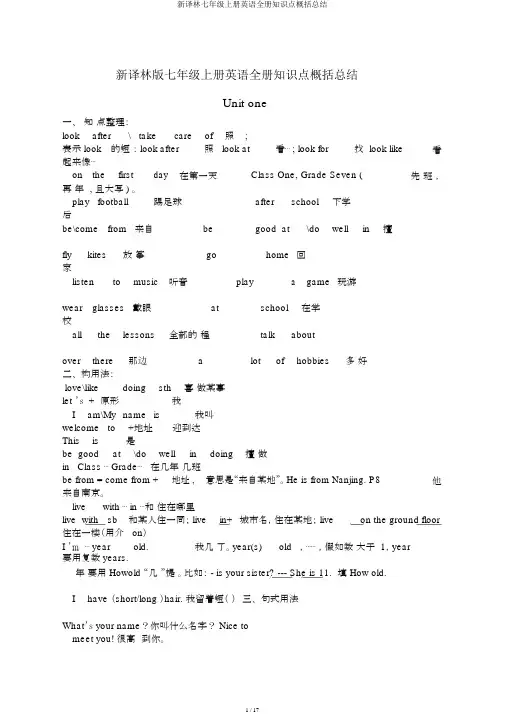
新译林版七年级上册英语全册知识点概括总结Unit one一、知点整理:look after\ take care of照 ;表示 look的短: look after照 look at看⋯ ; look for找 look like看起来像⋯on the first day在第一天Class One, Grade Seven (先班,再年 , 且大写 ) 。
play football踢足球after school下学后be\come from 来自be good at\do well in擅fly kites放筝go home回家listen to music听音play a game玩游wear glasses 戴眼at school在学校all the lessons全部的程talk aboutover there那边a lot of hobbies多好二、构用法:love\like doing sth喜做某事let ’s +原形我I am\My name is我叫welcome to+地址迎到达This is是be good at\do well in doing擅做in Class ⋯ Grade⋯在几年几班be from = come from +地址 ,意思是“来自某地”。
He is from Nanjing. P8他来自南京。
live with ⋯ in ⋯和住在哪里live with sb和某人住一同; live in+城市名,住在某地; live on the ground floor 住在一楼(用介 on)I ’m ⋯ year old.我几了。
year(s)old,⋯⋯,假如数大于 1,year要用复数 years.年要用 Howold “几”提。
比如: - is your sister? --- She is 11. 填 How old.I have (short/long )hair. 我留着短()三、句式用法What’s your name?你叫什么名字? Nice tomeet you! 很高到你。
牛津译林版七年级英语上册全套知识点复习教案汇总

牛津译林版七年级英语上册全册知识点复习教案汇总牛津译林版七年级英语上册Unit 1 This is me!知识点复习教案词组1.read this book 读这本书2.look after 照看、照料3.make friends at the new school 在新学校交朋友4.at Beijing Sunshine Secondary School 在北京阳光中学5.each other 彼此6.meet new friends 遇见新朋友7.start school 开学8.their first English lesson 他们的第一堂英语课9...years old ……岁数10.in Class 1, Grade 7 在7 年级1班11.live in Beijing 住在北京12.love reading 喜爱看书13.in the Reading Club 在读书兴趣小组14.be born 出生15.play football 踢足球16.after school 放学后e from / be from 来自18.tall and slim 高而苗条19.have long black hair 有长长的黑头发20.listen to music 听音乐21.work hard 努力学习22.be good at doing sth 擅长做某事23.enjoy doing sth 喜爱做某事24.play computer games 打电子游戏25.wear glasses 戴眼镜26.be polite and helpful 有礼貌而助人为乐27.a football field 足球场28.badminton court 羽毛球场29.swim in the swimming pool 在游泳池里游泳30.have breakfast 吃早餐31.at lunchtime 在午餐时间32.every day 每天33.take… for a walk 带……去散步34.play volleyball 打排球35.walk home 步行回家36.take a bus 乘公共汽车37.watch TV 看电视38.at the weekend 在周末39.half an hour 半小时40.fly a kite 放风筝41.my favourite football player 我最喜爱的足球运动员42.in the school football team 在学校足球队43.tall and strong 高而强壮44.dark brown eyes 深褐色的眼睛45.listen to music 听音乐46.at school 在校47.have lots of friends 有许多朋友48.play with sb 和某人一起玩49.live with my family 和我全家人住在一起重点词汇与词组,句型1. glad adj. 高兴的be glad to do sth.做某事很高兴Eg :Glad to see you . = Nice to see you.(回答)Glad/Nice to see you, too.例句:我很高兴帮你。
新牛津译林版英语七年级上册全册中考复习课件

4. I’m 12 years old.
数字 + years old常用来作表语;
数字 + -year-old常用来作定语,修饰名词。
e.g.
1) =
SShheeisieslevaenn _y_ee_ale_rsv__oel_nd_-.y__e_a_r_-o_l_d___
girl.
2) 他是个八岁的男孩。 He is __a_n__e_ig__h_t-_y_e_a_r_-_o_l_d_ boy.
4. 早上/中午/晚上好
good morning/ afternoon/evening
5. 很高兴见到你
Nice/Glad to meet you.
6.欢迎来到七年级一班。 Welcome to Class 1, Grade 7
7. 她11岁。 (两种) She is 11 years old.= She is an 11-year-old girl. 8. 他留着短发。(两种) He has short hair.= His hair is short.
★
8.One of his
9.What __i_s_Βιβλιοθήκη teachers four and
口诀: 我用am, 你用are,
is连着他她它,
凡是复数都用are.
用be动词的适当形式填空:
★1. “I” _i_s__ the ninth letter. 2. The policemen _a_re__ young. 3.The twins __a_r_e___ at home at weekends.
fly kites
18. 回家晚
go home late
19. 他来自北京吗?(两种)
译林版英语七年级上册第一、二单元总复习
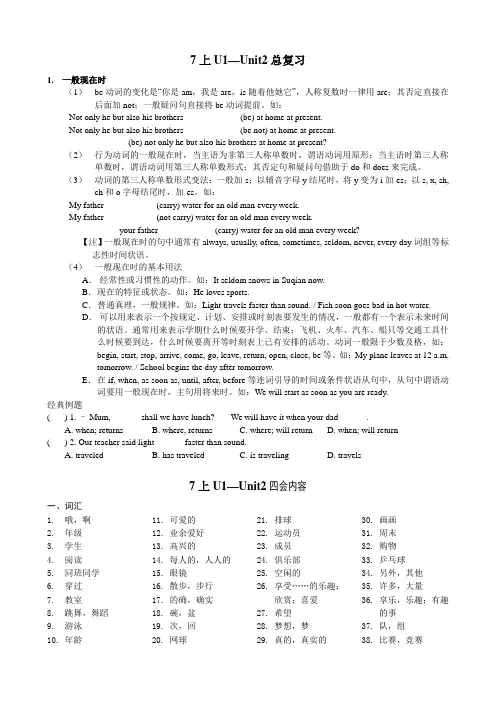
7上U1—Unit2总复习1.一般现在时(1)be动词的变化是“你是am,我是are,is随着他她它”,人称复数时一律用are;其否定直接在后面加not;一般疑问句直接将be动词提前。
如:Not only he but also his brothers ____________ (be) at home at present.Not only he but also his brothers ____________ (be not) at home at present._____________ (be) not only he but also his brothers at home at present?(2)行为动词的一般现在时,当主语为非第三人称单数时,谓语动词用原形;当主语时第三人称单数时,谓语动词用第三人称单数形式;其否定句和疑问句借助于do和does来完成。
(3)动词的第三人称单数形式变法:一般加-s;以辅音字母y结尾时,将y变为i加-es;以s, x, sh, ch和o字母结尾时,加-es。
如:My father ___________ (carry) water for an old man every week.My father ___________ (not carry) water for an old man every week.___________ your father ____________ (carry) water for an old man every week?【注】一般现在时的句中通常有always, usually, often, sometimes, seldom, never, every day词组等标志性时间状语。
(4)一般现在时的基本用法A.经常性或习惯性的动作。
如:It seldom snows in Suqian now.B.现在的特征或状态。
译林版牛津英语七年级上册期末复习知识点整理4

译林版牛津英语七年级上册期末复习知识点整理Units1--4重点知识点总结整理教师: Mr Sunn.名词v.动词vt.及物动词vi.不及物动词adj.形容词adv.副词prep.介词pron.代词conj.连词1、喜欢like / love / enjoy / be interested in / be crazy about (痴迷于)/ have fun / have a good time +doing sth.动词+doing 的还有G.doin.sth..finis.doin.sth./B.goo.a.doin.sth..d.wel.i.doin.sth.How/what about doing sth./practise doing sth.2.“四大看”read vt.看读物(read books/newspaper/magazines/a map等)loo.vi.瞧常用短语loo.at.for/around/after/out/over/upse.vt.看见,强调结..ca.se.you.watch vt.带有欣赏性的观看watch TV/ a film / a football game3.“五大穿着”Pu.o.强调“穿上”的动作eg.H.____.coa.an.goe.fo..walk.Wea. 强调“穿着”的状态;进行时态表示暂时的情况eg.Sh.i.wearin..ne.skir.now..wea.glasses Dres. (1.dres.sb..(2.dres.onesel. (3.dres.u.a. (4.ge.dressedIn (穿戴)后接颜色(或衣服), 表示状态look!Lucy is_____a red skirt and a pair of pink shoes. On 后接人指衣服穿在某人身上看出区别来。
The red coat looks nice on you.4.“四大花费”Spend: sb.(人)+ spend + 时间/金钱+ on sth.sb.(人)+ spend + 时间/金钱+(in) doing sth.pay: sb.(人)+pay + 金钱+for sth.cost: sth.(物) + cost + sb.+金钱Doing sth.costs + sb.+时间take: i.take.sb.+时间.t.d.sth.5.“三大地点副词”Home / there /here 前不加任何的介词welcome home / come here / go there6.“三大使役动词”Mak.sb.d.sth..hav.sb.d.sth..le.sb.d.sth.7、见面打招呼用语(1)Nic.t.mee.yo..(2.Gla.t.mee.yo..(3.Ho.ar.yo..(4.Ho.ar.yo.doin.?(5)How is it going ? (6)How is everything going? (7) What’s up?8、基数词+year(s)+old 表示“…岁”提问用“how old”名词性短语数词-year-old 也表示年龄, 但其为形容词性短语“前有冠词后有名(词)”Eg.Hele.i.1.year.ol..Hele.i.a.11-year-ol.girl.9、Let’s 与let us 的区别Let’.d.sth.指包括听者(对方)和说者(我们)都在内, 表示建议Let us do sth.指“让(允许)我们做某事”而听者(对方)不做, 只有“我们”做10、play+the+乐器类名词e.g.Pla.th.pianoPlay + 球类运动play+ football / play cards / play chesse.fro.Shanghai.Sh.i.fro.Shangha.. 注: 如何提问Shangha.及如何改一般疑问句12、b.goo.a.=d.wel.i..b.cleve.a..stud.sth.wellBe good at (反) be bad at do well in (反) be poor in13.介词over的用法(1)”在…正上方” There is a bridge over the river.(2)”越过” A plane flies over the house(3)”超过” There are over 20 boys in this class.(4)”结束” Class is over! / Game is over.14.every one 与everyone 辨析区别(1)Every one 可以与of 连用, 而everyone 却不能与of连用Eg.every one of the children likes playing the computer games.(2) everyone 只指人=everybody而every one 既指人又可指物共同点: 谓语动词都要用“三单”15.family 的用法: “家庭”作为整体谓语动词用“单数”He has a big family.“家人”强调成员, 是复数含义, 谓语动词用“原形”My family are at home.拓展: 集体名词有people、class、police、sheep、deer、furniture等16.all/ both/ each/every/neither/ either 的用法all (1)三者或三者以上“全部、都”(2)all + the + 名词(all the afternoon = the whole afternoon)(3)all 放在行为动词前, 名词前;be 动词后(4) all of +宾格/名词复数Both(1)两者都(2)后可跟of +宾格/名词复数Both sides of the street are grown trees.Each 指两个或两个以上“每一个”个体Each side of the street is grown trees.Ever.指许多人或事物的“全体”后接名词单.Ever.studen.i.her..所有人都在。
译林版初中英语七年级上册全册单元基础知识点、考点练习题
译林版初中英语七年级上册全册单元基础知识点、考点练习题译林版初中英语七年级上册Units 1—4 单元基础知识点、考点练习题❖重点短语默写1.读这本书2.照顾3.见见我的新同学4.擅长(做)某事5.和我的家人住在北京6.戴眼镜7.喜欢所有的课8.喜欢阅读/散步/跳舞9.打排球/网球/乒乓球10.喜欢做某事11.去游泳/散步12.我最喜欢的足球运动员13.黄河俱乐部的一名新成员14.在他的空闲时间15.变为现实,成为事实16.在周末17.家长会18.在学校门口碰面19.领某人参观20.在······的前面21.<英>在一楼22.看起来现代的/年轻的23.开会24.下课后25.起床26.步行去上学27.各种各样的书28.醒来,叫醒29.到了该做某事的时候了30.吃早饭/午饭/晚饭31.需要好好休息一下32.玩得开心33.做早操34.上课35.做课外活动36.做家庭作业37.去睡觉38.迟到39.在早上/下午/晚上40.对某人好41.互相聊天42.练习做某事43.参观博物馆44.一月一次/两次45.去野餐46.对······有害47.对世界了解很多❖重点句子翻译1.? 你的名字叫什么? (P6)2.I have . (=My hair . )我留着短发。
(P8)3.I often . 我经常放学后踢足球。
(P8)4.Her hair . (= She . )她的头发是长的。
(P8)5.He Nanjing. (= He Nanjing. )他来自南京。
(P8)6.She . (=She . )她擅长游泳。
(P13)7.I have .我在学校有一些新朋友。
(P16)8.I my bowl .我朝我的碗天走好多次。
(P18)9.He and very well.他看起来强壮并且踢足球踢得非常好。
译林版英语七年级译林版英语上册期末复习知识点大全
译林版英语七年级译林版英语上册期末复习知识点大全Ⅱ. Multiple choice1.—What cold weather!—Yes. But it’s unusual experience for us who always live in a hot city.A. an; anB. /; aC. /; anD. a; a【答案】C【解析】【详解】句意:——多冷的天气啊!——是啊,但是这对于我们这些一直生活在炎热的城市的人来说是一次不寻常的经历。
考查感叹句和冠词。
an不定冠词;a不定冠词;/零冠词。
weather为不可数名词,what引导的感叹句结构为:what+adj.+不可数名词,所以第一空不用冠词;experience意为“经历”时为可数名词,此处表示泛指的“一次”,应该用不定冠词,根据第二空横线后unusual为元音音素发音开头,可知用an,故选C。
【点睛】不定冠词a/an都可以表示泛指的“一,一个”,两者之间的区别在于:a用于辅音音素发音开头的单词前,an用于元音音素发音开头的单词前。
2.They believe they can still do the work better than last time even if they have money and people.A. little; fewB. less; fewC. little; fewerD. less; fewer【答案】D【解析】【详解】句意:他们相信即使他们的钱少了,人少了,他们仍然能比上次做得更好。
考查不定代词。
little少,修饰不可数名词;few少,修饰可数名词;less为little的比较级,fewer为few的比较级。
根据前文的than,可知要用比较级;根据money不可数,people为复数概念,故选D。
【点睛】little意为“几乎没有”,修饰不可数名词,是否定概念;few意为“几乎没有”,修饰可数名词,是否定概念;a little意为“少许”,修饰不可数名词,是肯定概念;a few意为“少许”,修饰可数名词,是肯定概念。
新译林版七年级上册英语全册知识点归纳总结
新译林版七年级上册英语全册知识点归纳总结以下是我为你准备的关于新译林版七年级上册英语全册的知识点归纳总结:第一单元:我们的学校本单元主要介绍了学校相关的词汇和句型,如school, classroom, teacher, student等。
同时,还学习了有关询问校园位置和个人信息的表达方式。
- 词汇:school, classroom, teacher, student, library, playground等第二单元:我们的课程本单元主要介绍了学校的各种课程和活动,以及表达自己课表和日常安排的方式。
学生通过学习这些内容,能够更好地了解学校的课程安排。
- 词汇:Chinese, math, English, science, geography等第三单元:我们的家庭本单元主要介绍了家庭成员、描述家庭成员特征、以及询问和回答有关家庭成员的相关问题的表达方式。
通过学习这些内容,学生能够更好地描述自己家庭的情况。
- 词汇:father, mother, brother, sister, grandparents等本单元主要介绍了城市生活中的一些词汇,如city, park, supermarket等,并通过学习如何提问和回答路线和位置的问题,帮助学生更好地适应城市生活。
- 词汇:city, park, supermarket, post office等第五单元:我们的节日本单元主要介绍了一些节日,如Spring Festival, Christmas等,并学习了表达节日祝福和邀请的方式。
通过学习这些内容,学生能够更好地了解不同的文化习俗。
- 词汇:Spring Festival, Christmas, birthday, Happy New Year等第六单元:我们的食物本单元主要介绍了食物相关的词汇和句型,如apple, banana, chicken等,并通过学习如何询问和回答关于食物的问题,帮助学生提高日常交流能力。
初中英语新译林版七年级上册Unit 1——Unit 2复习提纲(重点单词及变形+重点短语+重点句型)
七年级英语上册复习提纲Unit 1 This is me!【重点单词及变形】1.我(宾格)me -- (主格) I (我) -- (形容词性物主代词)my (我的)-- (名词性物主代词)mine (我的)2.第一(序数词)first -- (基数词) one (一)3.问候(动词)greet -- (名词) greeting (问候)4.介绍(动词)introduce -- (名词)introduction (介绍)5.我们自己(反身代词) ourselves -- (人称代词主格) we (我们)-- (宾格) us6.爱好(名词) hobby -- (复数形式) hobbies7.玩;演奏;踢 play -- (动名词形式) playing8.阅读(动词) read -- (动名词形式) reading9.她自己(反身代词) herself -- (人称代词主格) she (她) -- (宾格)her10.友好的(形容词) friendly -- (名词) friend (朋友)11.有;长着(动词) have -- (第三人称单数) has12.礼貌的(形容词) polite -- (副词)politely (礼貌地)13.好地(副词) well -- (形容词)good (好的)14.眼镜(名词) glasses -- (名词)glass (玻璃杯)15.感兴趣的(形容词)interested (修饰人) -- (形容词)interesting (令人感兴趣的) -- (名词)interest16.有帮助的(形容词) helpful -- (动词/名词) help (帮助)17.可爱的(形容词)lovely -- (动词)love (喜爱)18.游泳(动词)swim -- (现在分词)swimming19.跳舞(动词)dance -- (现在分词)dancing20.建筑物(名词)building -- (动词)build (建造)21.健康的(形容词) healthy -- (名词)health (健康)【重点短语】1.了解learn about2.来自七年一班的学生students from Class 1, Grade 7 3.自我介绍introduce oneself4.交新朋友make new friends5.欢迎来到...welcome to ...6.这是/这有...Here is/are ...7.早上好。