
华硕路由常用命令
华硕路由常用命令
华硕路由器是一种常见的网络设备,用于连接和管理网络。
在使用华硕路由器时,我们经常需要使用一些命令来配置和管理路由器。
本文将介绍一些常用的华硕路由器命令,帮助您更好地了解和使用华硕路由器。
一、登录路由器
要使用路由器命令,首先需要登录到路由器的管理界面。
华硕路由器的默认登录地址是192.168.1.1,您可以在浏览器中输入该地址来访问路由器的管理界面。
在登录界面输入正确的用户名和密码后,即可成功登录到路由器。
二、查看路由器信息
登录成功后,您可以使用以下命令来查看路由器的基本信息:
1. show version:显示路由器的固件版本和硬件信息。
2. show interface:显示路由器的接口状态和配置信息。
3. show ip route:显示路由器的路由表信息。
三、配置路由器
配置路由器是使用路由器命令的主要目的之一。
以下是一些常用的
配置命令:
1. configure terminal:进入路由器的配置模式。
2. interface interface_name:进入指定接口的配置模式,例如interface eth0表示进入以太网接口0的配置模式。
3. ip address ip_address mask:配置接口的IP地址和子网掩码。
4. no shutdown:开启指定接口。
5. exit:退出当前配置模式。
四、查看和管理路由器连接
了解和管理路由器的连接状态对网络维护和故障排除非常重要。
以下是一些常用的连接管理命令:
1. show interfaces status:显示路由器上所有接口的状态和连接信息。
2. show arp:显示路由器的ARP缓存表,包含与路由器相连的设备的IP地址和MAC地址。
3. ping ip_address:向指定的IP地址发送ICMP回显请求,用于测试与其他设备的连通性。
4. traceroute ip_address:显示到达指定IP地址的路径,可以帮
助我们找到网络连接的问题所在。
五、路由配置和管理
配置和管理路由是使用华硕路由器命令的重要部分。
以下是一些常用的路由命令:
1. ip route destination_network mask next_hop:配置静态路由,将目标网络通过指定的下一跳连接。
2. show ip route:显示路由器的路由表信息。
3. show ip protocols:显示路由器的路由协议信息。
4. clear ip route:清除路由表中的所有路由。
六、安全配置
保护路由器的安全是非常重要的。
以下是一些常用的安全配置命令:1. enable password password:设置启用密码,用于保护路由器的特权模式。
2. enable secret password:设置启用密码,优先级高于enable password。
3. service password-encryption:加密显示配置文件中的密码。
4. login block-for seconds attempts attempts within seconds:设置登录失败的封锁时间。
七、保存配置和重启路由器
在对路由器进行配置后,需要保存配置并重启路由器才能使配置生效。
以下是一些常用的保存和重启命令:
1. copy running-config startup-config:将当前运行的配置保存到闪存中。
2. reload:重启路由器。
以上是一些常用的华硕路由器命令,希望能够帮助您更好地了解和使用华硕路由器。
当然,华硕路由器还有更多的命令和功能,您可以根据具体需求进行学习和探索。
在使用命令时,务必小心操作,避免对路由器和网络造成不必要的影响。
祝您使用愉快!。
路由器常用命令

路由器1、恢复出厂设置#delete2、DHCP#service dhcpd#network ……………..(地址池)#dns-server…………...(DNS服务器)#default-router……….(网关)#client-identifier……..(分配给客户机的客户端ID)#domain-name……….(分配域名)#lease…………………(租期)DHCP路由监听技术#ip dhcp snooping enable(开启DHCP监听)#ip dhcp snooping binding <arp绑定ARP功能> <enable启动DHCP snooping 绑定><user启动DHCP绑定主机地址>#ip dhcp snooping action(设置每个端口安全动作的数量)在接口中(config-if)#ip dhcp snooping action <blackhole过滤mac地址><shutdown关闭接口>(config-if)#ip dhcp snooping trust (设置为信任端口)(config-if)#ip dhcp snooping binding(启动DHCP snooping 绑定功能)3、VRRP#interface g0/3#vrrp priority………..(配置优先级)#vrrp preempt……….(配置是否抢占)#vrrp authentication...(配置VRRP 组的认证串)#vrrp description…….(配置VRRP 组描述字符串)#v rrp associate………(配置VRRP组的虚拟IP)4、OSPF#router ospf 1……..,..(进入OSPF配置)#network 192.168.1.0 255.255.255.0 area 0…….(在该网段上使用OSPF协议,并配置区域号)#redistribute rip…….(转发路由,例如这里的RIP路由)#default-metric……..(设置引入路由的缺省路由权值)在接口中调配OSPF#ip ospf passive………(设置被动接口)#ip ospf message-digest-key 1 md5 test…………(设置并采用MD5认证,并设置口令)#ip ospf authentication message-digest…………(验证方式为MD5认证)#ip ospf cost 1………..(设置OSPF的端口开销)5、RIP#router rip .…………(进入RIP配置)#network…………….(设置RIP网络)#version……………...(设置RIP版本)#no auto-summary….(关闭自动汇总)#default-metric……...(设置引入路由的缺省路由权值)# rip md5-key 1 md5 test……….………………..(设置并采用MD5认证,并设置口令)#ip rip authentication md5…………..…………..(验证方式为MD5认证)#ip rip passive……….(设置为被动接口)6、路由重发布#redistribute ospf 1…(重发布OSPF路由)#redistribute rip…….(重发布RIP路由)# redistribute static…(重发布静态路由)#default-information originate………………….(重发布缺省路由)7、策略路由#access-list standred 1 permit 192.168.10.0 0.0.0.255(定义源地址)#route-map test…….(定义策略路由)#match ip address 1..(匹配ACL列表)#set ip next-hop 1.1.1.1…………………………...(定义下一条IP地址)#interface e1/0/1…….(进入指定接口)#ip policy route-map test…………………………(打开策略路由,指定路由映射)8、NAT#ip nat pool test 1.1.1.1 1.1.1.1 255.255.255.0……(定义转换的ip地址池)#ip access-list standard test……………………….(配置ACL)#permit any………………………………………...(允许所有)#ip nat inside source list test pool test overload….(指定本地地址、ACL、全局地址池)#ip nat inside source static 192.168.1.1 192.168.48.1(将内部本地地址的映射到内部全局地址)#ip nat outside……..(将NAT应用在外网接口)#ip nat inside………(将NAT应用在内网接口)9、VPN拨号路由器做服务器端#vpdn enable……...(启动VPN)#vpdn-group……….(创建一个VPN组)#accept-dialin……..(配置本VPDN组为NS)#protocol pptp…..(隧道使用PPTP协议,也可使用L2TP协议)#username test password 0 test…………………..(创建用户名,密码)#ip local pool vpn 1.1.1.1 1.1.1.20………………....(创建VPN接入地址池)#interface virtual-template 1...................................(引用虚拟模板)#ppp authentication pap…………………………..(加密方式为pap)#ip unnumbered f0/0……………………………....(关联内网接口)#peer default ip address pool vpn……………...…(引用VPN地址池)10、封装协议认证方#username test password 0 test……………………(用户名,密码)#encapsulation ppp(chap)………………….………(封装协议)#ppp authentication ppp(chap)……………………(启动ppp验证,并制定ppp或chap认证方式) ##aaa au then ppp default local…………………....(使用本地用户认证验证)被认证方#encapsulation ppp(chap)………………………….(封装协议)#ppp chap(pap) hostname +认证方所设置的名字#ppp chap(pap) password +认证方所设置的密码##aaa authen ppp default local…………………...(使用本地用户认证验证)。
路由器命令大全
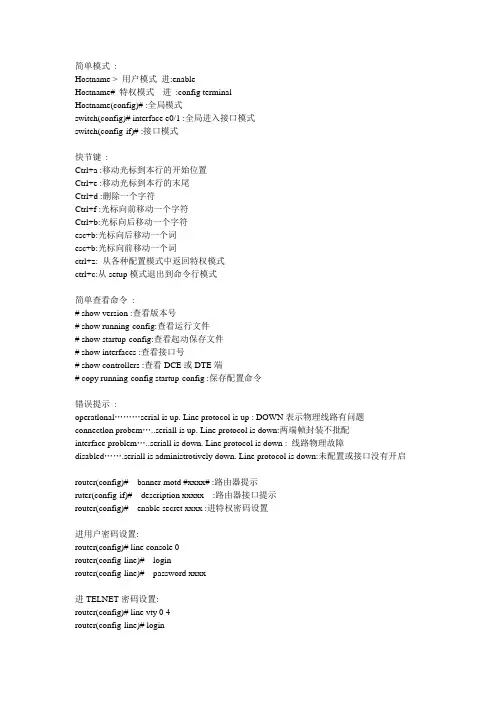
简单模式:Hostname > 用户模式进:enableHostname# 特权模式进:config terminalHostname(config)# :全局模式switch(config)# interface e0/1 :全局进入接口模式switch(config-if)# :接口模式快节键:Ctrl+a :移动光标到本行的开始位置Ctrl+e :移动光标到本行的末尾Ctrl+d :删除一个字符Ctrl+f :光标向前移动一个字符Ctrl+b:光标向后移动一个字符esc+b:光标向后移动一个词esc+b:光标向前移动一个词ctrl+z: 从各种配置模式中返回特权模式ctrl+c:从setup模式退出到命令行模式简单查看命令:# show version :查看版本号# show running-config:查看运行文件# show startup-config:查看起动保存文件# show interfaces :查看接口号# show controllers :查看DCE或DTE端# copy running-config startup-config :保存配置命令错误提示:operatlonal………serial is up. Line protocol is up : DOWN表示物理线路有问题connectlon probem…..seriall is up. Line protocol is down:两端帧封装不批配interface problem…..seriall is down. Line protocol is down : 线路物理故障disabled…….seriall is administrotively down. Line protocol is down:未配置或接口没有开启router(config)# banner motd #xxxx# :路由器提示ruter(config-if)# description xxxxx :路由器接口提示router(config)# enable secret xxxx :进特权密码设置进用户密码设置:router(config)# line console 0router(config-line)# loginrouter(config-line)# password xxxx进TELNET密码设置:router(config)# line vty 0 4router(config-line)# loginrouter(config-line)# password xxxxrouter(config)# hostname xxx :起名字router(config)# clock rate 64000 :时钟速率设置router(config)# bandwidth 64 :带宽设置router(config-if)# media-type 10baset :指明使用RJ45接口router(config-if)# ip address 192.168.0.1 255.255.255.0 :接口配置IP router(config)# ip host xxx address xxxx : 映射主机router(config)# ip name-server server-address1:指DNSrouter(config)# no ip domain-lookup : 不到网络解析命令CDP查看命令:# show cdp :查相邻设备的信息# show cdp neighbors :查相邻设备汇总信息# show cdp entry * :查相邻设备详细信息# show cdp traffic :查CDP信息包的错误# show cdp interface :查相邻设备的接口状态router(config)# no cdp run : 关闭所有CDProuter(config-if)# no cdp enable :关闭接口CDPTELNET操作:# show session :显示TELNET会话,*当前所处连接# show user :显示TELNET连接用户,*当前用户# disconnect :关闭发起TELNET# clear line number :关闭来的TELNET# ping :检验连通性# trace :检验连通性和连接的路径# <ctrl+shift+6>+x :挂起TELNET# resume 1 :回到TELNETIOS操作:跳密:Break或ctrl+Break :进入ROM monitor 模式>o/r 0x2142 :进入启动>I :回车进入router(config)# config-register 0*2102 :修改配置注册码hostname(boot)> :IOS 丢失或损坏# show flash :查FLASH中的IOS文件名和大小# copy startup-config running-config :启动备份到运行# copy running-config TFTP :运行备份到TFTP# copy startup-config TFTP :启动备份到TFTP# copy flash TFTP :IOS备份到TFTP# copy TFTP running-config :TFTP文件烤备到运行# copy TFTP startup-config :TFTP文件烤备到启动# copy TFTP flash :TFTP文件烤备到FLASH# erase start :清除NVRAM文件# erase flash :清除IOS静态路由:router(config)# ip route 192.168.1.0 255.255.255.0 218.68.45.2 :静态路由router(config)# ip route 0.0.0.0 0.0.0.0 218.68.45.1 : 缺省路由router(config)# ip classless :起用缺省路由router(config)# no ip classless :关闭缺省路由路由信息协议RIP :router(config)# router riprouter(config-router)# network 172.16.0.0router(config-router)# version 2 :使用RIP v2内部网关路由选择协议IGRP :router(config)# router igrp 100router(config-router)# network 172.16.0.0router(config-router)# variance multipiler :开启负载均衡# debup ip rip :查看路由器收发的路由更新包# show ip protocols :查看运行协议和特性# show ip route :查看路由表的正确性C : 直连网段R :学习到的路由I :学习到的路由开放最短路径优先协议OSPF :router(config)# router lspf 1/2/3…….router(config-router)# network 172.16.0.0 0.0.255.255 area 0router(config-router)# network 192.168.1.0 0.0.0.255 area 0router(config)# interface loopback 0 :回环接口(永远是up状态)router(config-if)# ip ospf priority 50 :更改优先级# show ip ospf interface fastethernet 0/0 :查看优先级router(config-if)# bandwidth 64 : 更改接口带宽router(config-if)# ip ospf cost 1 2 3……….: 更改开销router(config-if)# ip ospf authentication-key password :接口验证密码router(config-router)# area area-number authentication : 声明验证(config-if)# ip ospf message-digest-key 1 md5 7 asecret : 接口安全验证密码(config-router)# area 0 authentication message-digest : 声明安全验证# clear ip route * :清除路由表# debug ip ospf adj :查看所有OSPF事件增强型路由选择协议EIGRP :Router(config)# router eigrp 100Router (config-router)# network 10.0.0.0router(config-router)# no auto-summary :关闭有类,开启无类router(config-if)# bandwidth kilobits :逻辑改变接口带宽router(config-if)# eigrp log-neighbor-change :邻居关系变化保存到日志里# show ip eigrp neighbors :显示EIGRP邻居表# show ip eigrp interfaces :显示接口EIGRP信息# show ip eigrp rtopology :显示拓朴表的内容# show ip eigrp topology all-ainks :显示网络所有路径# debug eigrp packet :显示EIGRP所有信息包标准访问控制列表:router(config)# access-list 2 deny 192.168.1.0 0.0.0.255router(config)# access-list 2 deny 192.168.3.3 0.0.0.255router(config)# access-list 2 permit anyrouter(config-if)# ip access-group 2 out/inrouter(config)# line vty 0 4router(config-line)# access-class 2 in/out扩展访问控制列表:router(config)# access-list 101 deny tcp 192.168.2.0 0.0.0.255 192.168.1.0 0.0.0.255 eq tcp router(config)# access-list 101 deny ccp 192.168.2.0 0.0.0.255 192.168.1.0 0.0.0.255 eq ftp-adta router(config)# access-list 101 permit ip any anyrouter(config-if)# ip access-group 101 in/out命名访问控制列表:router(config)# ip access-list extended serverouter(config-ext-nacl)# permit TCP any host 192.168.1.1 eq telnetrouter(config-ext-nacl)# permit TCP any host 192.168.1.1 eq smtprouter(config-ext-nacl)# deny ip any any logrouter(config-if)# ip access-group serve outrouter(config-ext-nacl)# no permit TCP any host 192.168.1.1 eq telnet :删除语句# show ip access-lists :查看建立的访问列表# show ip interface e0 :查看接口列表方向Catalyst 交换机的配置:2950Switch# delete flash:vlan.dat :清除存在VLAN信息2950Switch# erase startup-config :清除备份配置STARUP-CONFIG2950Switch# reload :重新启动1900Switch# delete nvram :清除备份配置STARUP-CONFIGconsole线和vty线密码:switch(config)# line console 0switch(config-line)# password xxxxswitch(config-line)# loginswitch(config-line)# line vty 0 4switch(config-line)# password xxxxswitch(config-line)# login2950IP地址和网关配置:switch(config)# interface VLAN1switch(config-vlan)# ip address 192.168.1.1 255.255.255.0switch(config-vlan)# ip default gateway 192.168.1.11900IP地址和网关配置:switch(config)# ip address 192.168.1.1 255.255.255.0switch(config)# ip default gateway 192.168.1.1交换机WEB服务器配置:switch(config)# ip http serverswitch(config)# ip http port 80switch# show mac-address-table :查看MAC地址表信息switch# clear mac-address-table :手动清空MAC表添加删除静态MAC地址映射:switch(config)# mac-address-table static 0000.0000.0001 interface fastethernet0/5 vlan1 switch(config)# no mac-address-table static 0000.0000.0001 interface fastethernet0/5 vlan1端口安全配置:switch(config)# interface fastethernet 0/1switch(config-if)# port security max-mac-count 1switch# show port security :查看端口安全switch# show spantree :查看生成树协议switch(config-if)# switchport mode trunk :指明干道switch(config-if)# switchport trunk encapsulation dotlq/ISL :封装协议switch# show trunk :查看封装1900VLAN配置:1900switch(config)# vtp server :模式1900switch(config)# vtp domain xxx :域名1900switch(config)# vtp pruning enable :修剪1900switch(config-if)# trunk on :启动ISL1900switch(config)# vlan 2 name xxx :创建VLAN1900switch(config-if)# vlan-membership static 2 :应用到接口2900VLAN配置:switch# vlan databaseswitch(vlan)# vtp server : 模式switch(vlan)# vtp domain xxx : 域名switch(vlan)# vtp pruning enable : 修剪switch(vlan)# vlan 2 name xxx : 创建VLANswitch(config-if)# switchport mode trunk : 启动802.1qswitch(config-if)# switchport encapsalation salation isl :启动ISLswitch(config-if)# switchport access vlan 2 : 应用到接口switch(config-if)# no switchport accexx vlan 2 :删除VLAN# show vtp counters : 查看收发统计# show vtp status : 查看VTP配置VLAN间路由:router(config-subif)# encapsulation 802.1q :干道封装802.1Qrouter(config-if)# full duplex :启动全双工router(config)# interface fastethernet 0/0.1 :进入子接口router(config-subif)# ip address 192.168.3.1 255.255.255.0 :子接口分IP# show sppanning-tree :查看生成树协议广域网封装:router(config-if)# encapsulation hdlc :封装HDLCrouter(config-if)# encapsulation ppp :封装PPProuter(confin)# hostnamne xxx :验证前起名字router(confin)# username xxx password xxx : 验证前对方名字,密码router(confin-if)# ppp authentication chap/pap :启用验证router(confin-if)# ppp pap sent-username xxx password xxx :开启PAP router(confin-if)# ppp multilink :激活多链路PPP综合业务数字网络技术ISDN :router(confin)# interface bri 0 :进入BRI接口router(confin)# isdn switch-type basic-net3 :指定ISDN交换机类型router(confin-if)# isdn spid1 xxx :支持SPIDrouter(config-if)# encapsulation ppp/hdlc :封装PPP/hdlcrouter(confin)# hostnamne xxx :验证前起名字router(confin)# username xxx password xxx : 验证前对方名字,密码router(confin-if)# ppp authentication chap/pap :启用验证安需拨号路由技术DDR :router(confin)# ip route 10.10.0.0 255.255.0.0 10.1.0.2 :静态路由router(confin)# ip route 0.0.0.0 0.0.0.0 10.1.0.2 :缺省路由router(confin)# dialer-list 1 protocol ip permeit :允许所有IP 或:router(confin)# dialer-list 1 protocol ip sist 101 :防控表101应用到拨号表1router(confin)# access-list 101 deny tcp any any eq ftp :拒绝FTProuter(confin)# access-list 101 deny tcp any any eq telnet :拒绝TELNETrouter(confin)# access-list 101 permit ip any any :允许所有router(confin-if)# dialer-group 1 :应用到口router(confin-if)# dialer map ip 192.168.1.1 name xxx 5555 :定义呼叫信息# show bri/pri :查看接口状态# shw isdn status :查看接口信息# show dialer :查看拨号连接过程帧中继技术FRAME-RELAY :router(confin)# interface s0 :进入接口router(confin-if)# encapsulation frame-relay ietf/cisco :封装帧中继类型router(confin-if)# frame-relay interface-dlci 102 :设置DLCI号router(confin-if)# frame-relay lmi-type ansi/cisco :设置LMI类型点对点子接口:router(confin)# interface s0.1 point-to-point : 点对点子接口router(confin-subif)# ip address 192.168.1.1 255.255.255.0 : 子接口IProuter(confin-subif)# frame-relay interface-dlci 102 :设置DLCI号多点子接口:router(confin)# interface s0.1 multipoint : 多点子接口router(confin-subif)# ip address 192.168.1.1 255.255.255.0 : 子接口IProuter(confin-subif)# frame-relay map ip 192.168.1.2 201 broadcast :映射对方IP# show interface serial0 :查看接口状态# show frame-relay pvc : 查看所有PVC信息# show frame-relay lmi :查看LMI数据流量统计# show frame-relay map :查看影射条目# debug frame-relay lmi :查看能否正确信息NA T配置:Router1(config-if-bri1/0)# ip address negotiatedRouter1(config-if-bri1/0)# ip nat outsideRouter1(config-if-bri1/0)# encapsulation pppRouter1(config-if-bri1/0)# ppp pap sent-username 169 password 169Router1(config-if-bri1/0)# ppp multilinkRouter1(config-if-bri1/0)# dialer load-threshold 60Router1(config-if-bri1/0)# dialer in-bandRouter1(config-if-bri1/0)# dialer-group 1Router1(config-if-bri1/0)# dialer string 169Router1(config-if-bri1/0)# exitRouter1(config)# dialer-list 1 protocol ip permitRouter1(config)# access-list 1 permit anyRouter1(config)# ip route 0.0.0.0/0 interface bri2/0Router1(config)# ip nat onRouter1(config)# ip nat inside source list 1 interface bri 2/0Router1(config)# interface eth 0/0Router1(config-if-eth0/0)# ip address 192.168.0.1/24Router1(config-if-eth0/0)# ip nat inside(1)启动“路由和远程访问”:“开始”菜单->“程序”->“管理工具”->“路由和远程访问”。
路由器的配置命令总结

路由器的配置命令总结介绍:1.路由选择原则:子网掩码最长匹配,管理距离最小优先,度量值最小优先。
公用命令总结:1.ip route+非直连网段+子网掩码+下一跳地址配置静态/默认路由2.show ip route 查看路由表3.show protocols 显示出所有的被动路由协议和接口上哪些协议被设置4.show ip protocols 显示了被配置在路由器上的路由选择协议,同时给出了在路由选择协议中使用的定时器等信息5.show history 查看历史记录6.secondary+IP地址为接口配置第二个IP地址7.config memory 修改保存在NVRAM中的启动配置8.exec timeout 0 0 设置控制台会话超时为09.service password-encryptin 手工加密所有密码10.line aux 0 进入AUX接口11.bandwidth+数字配置带宽12.write 保存信息到NVRAM13.banner motd # +信息+ # 配置路由器或交换机的描素信息14.description+信息配置接口听描素信息15.vlan database 进入VLAN数据库模式16.vlan +vlan号+ 名称创建VLAN17.show spamming-tree vlan +vlan号查看VLA怕生成树议18.debug ip rip配置模式定义DHCP并命名为gpdxCisco2801(config)#ip dhcp pool gpdx发布地址池的网段Cisco2801 (dhcp-config)#network 192.168.1.0 255.255.255.0设置DNS地址Cisco2801 (dhcp-config)#dns-server 192.168.1.1设定网关地址Cisco2801 (dhcp-config)#default-router 192.168.1.1Cisco2801 (dhcp-config)#endRIP协议:拓扑发生变化的更新过程:先更新自己再发送给邻居定时器:路由更新定时器:默认30s路由失效定时器:默认180s抑制定时器:默认180s路由刷新定时器:默认240s负载均衡:默认是4条,最大支持6条分类有进程交换与快速交换命令:1.router rip 激活RIP协议work +直连网段发布直连网段3.interface lookback 0 激活逻辑接口4.passive-interface +接口类型+接口号配置接口为被动模式5.debug ip +协议动态查看路由更新信息6.undebug all 关闭所有DEBUG信息7.Version 版本号设置使用的RIP版本8.debug ip icmp/rip9.no ip cef 关闭快速交换10.no ip split-horizon 关闭水平分割11.Passive-interface lookback 0被动接口,不向外发送路由更新包,但是任然会接收更新包,或者是Passive-interface default12.ip rip triggered在具体接口启用触发更新,只适合串口13.查资料了解单播更新,默认是广播更新14.ip default 有类网络地址的主类地址缺省路由,这是rip 默认路由而非静态默认路由或者ip default originate15.同时配置静态路由与rip可以实现浮动静态路由16.times basic [Interval between updates] [Invalid] [holddown] [flush]更改定时器17.redistribute static 重发布18.no auto-summary 关闭自动汇总,rip1不能关闭19.ip summary-address rip 192.168.1.0 255.255.255.192 手工汇总20.关闭自动汇总可以解决路由翻转问题21.ip rip authentication mode md5/text 具体接口验证方式Key chain test 验证名称Key 1Key-string cisco 密匙Ip rip authentication key-chain test 调用22.ip class[less]设置有类路由行为或者无类路由行为OSPF协议:1.router ospf +process-ID 激活OSPF协议work+直连网段+area+区域号发布直连网段3.show ip ospf 显示OSPF的进程号和ROUTER-ID4.encapsulation+封装格式更改封装格式5.no ip admain-lookup 关闭路由器的域名查找6.ip routing 在三层交换机上启用路由功能7.show user 查看SW的在线用户8.clear line +线路号清除线路9.ip ospf hello-interval 2010.ip ospf dead-interval 6011.ip ospf network point-to-point 所有回环接口都被宣告是32位的主机路由,如果设置成点到点,则显示的是真实的子网掩码12.clear ip ospf process 重启ospf进程13.ip ospf priority 数字设置接口优先级,优先级位0的接口不参与选举14.auto-cost reference-banwidth 1000 设置参考带宽15.debug ip ospf packet 检查ospf数据分组的接收情况16.ip ospf authentication-key cisco具体接口设置明文密码17.area 0 authentication 区域0启用明文验证18.ip ospf message-digest-key 1 md5 cisco md5验证的密码与密码ID19.area 0 authentication message-digest 区域0启用md5验证20.default-information originate [always] 启用默认路由,注意只有当有默认路由时,该命令才能向外发布,加上always 则就反之分组:Hello分组(组播):1.用于发现邻居2.在成为邻居之前,必须对Hello包里的一些参数进行协商3.Hello包在邻居之间扮演着keepalive的角色4.允许邻居之间的双向通信5.用于在NBMA(Nonbroadcast Multi-access)网络上选举DR和BDR数据库状态描述包(DBD):链路状态数据库的简短描述链路状态请求包(LSR):链路状态更新包(LSU):链路状态确认包(LSAck):OSPF的网络类型OSPF定义的5种网络类型:1.点到点网络 (point-to-point),由cisco提出的网络类型,自动发现邻居,不选举DR/BDR,hello时间10s。
路由器配置常用命令
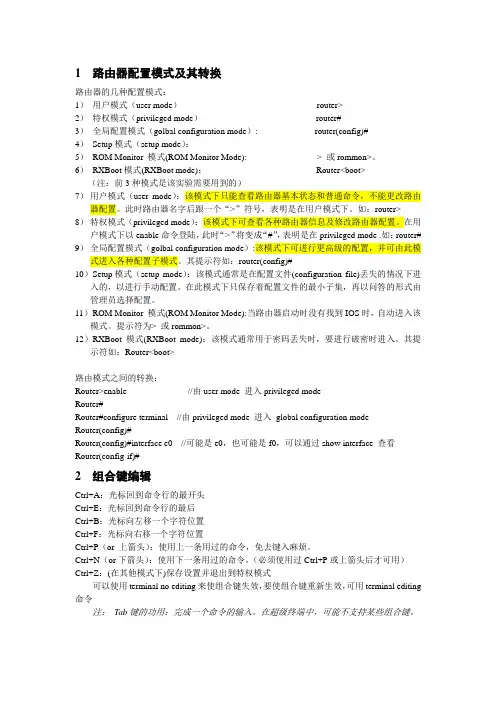
1 路由器配置模式及其转换路由器的几种配置模式:1)用户模式(user mode)router>2)特权模式(privileged mode)router#3)全局配置模式(golbal configuration mode):router(config)#4)Setup模式(setup mode):5)ROM Monitor 模式(ROM Monitor Mode): > 或rommon>。
6)RXBoot模式(RXBoot mode):Router<boot> (注:前3种模式是该实验需要用到的)7)用户模式(user mode):该模式下只能查看路由器基本状态和普通命令,不能更改路由器配置。
此时路由器名字后跟一个“>”符号,表明是在用户模式下。
如:router>8)特权模式(privileged mode):该模式下可查看各种路由器信息及修改路由器配置。
在用户模式下以enable命令登陆,此时“>”将变成“#”,表明是在privileged mode .如:router# 9)全局配置模式(golbal configuration mode):该模式下可进行更高级的配置,并可由此模式进入各种配置子模式。
其提示符如:router(config)#10)Setup模式(setup mode):该模式通常是在配置文件(configuration file)丢失的情况下进入的,以进行手动配置。
在此模式下只保存着配置文件的最小子集,再以问答的形式由管理员选择配置。
11)R OM Monitor 模式(ROM Monitor Mode):当路由器启动时没有找到IOS时,自动进入该模式。
提示符为> 或rommon>。
12)RXBoot模式(RXBoot mode):该模式通常用于密码丢失时,要进行破密时进入。
其提示符如:Router<boot>路由模式之间的转换:Router>enable //由user mode 进入privileged modeRouter#Router#configure terminal //由privileged mode 进入global configuration modeRouter(config)#Router(config)#interface e0 //可能是e0,也可能是f0,可以通过show interface 查看Router(config-if)#2 组合键编辑Ctrl+A:光标回到命令行的最开头Ctrl+E:光标回到命令行的最后Ctrl+B:光标向左移一个字符位置Ctrl+F:光标向右移一个字符位置Ctrl+P(or 上箭头):使用上一条用过的命令,免去键入麻烦。
路由器常见命令

路由器常见命令关于路由器常见命令路由器是我们常用的网络设备,在网络维护中其中十分重要的作用,但是您知道吗?路由器管理其实也是比较简单的,只要通过学习,您也可以成为网络高手,今天为大家分享一些路由器命令,在我们使用的时候,路由器命令都有哪些呢?今天的文章将给大家作详细的解答。
路由器常见命令 1一、设置对话状态设置对话状态是一台新路由器开机时自动进入的`状态,在特权命令状态使用SETUP命令也可进入此状态,这时可通过对话方式对路由器进行设置。
二、>路由器处于RXBOOT状态,在开机后60秒内按ctrl-break可进入此状态,这时路由器不能完成正常的功能,只能进行软件升级和手工引导。
三、router(config-if)#; router(config-line)#; router(config-router)#;…路由器处于局部设置状态,这时可以设置路由器某个局部的参数。
四、router>路由器处于用户命令状态,这时用户可以看路由器的连接状态,访问其它网络和主机,但不能看到和更改路由器的设置内容。
五、router(config)#在router#提示符下键入configure terminal,出现提示符router(config)#,此时路由器处于全局设置状态,这时可以设置路由器的全局参数。
六、router#在router>提示符下键入enable,路由器进入特权命令状态router#,这时不但可以执行所有的用户命令,还可以看到和更改路由器的设置内容。
网络管理员进行路由器的配置操作和命令大致上就是上面这些内容,希望对电脑爱好者与路由器学习者有所帮助,如果您觉得本文不错,记得收藏噢。
路由器常见命令 2路由器常用的命令如下:1、Router>(用户模式)、Router>enable (进入特权模式)、Router#(特权模式) 、Router#configure terminal(进入全局配置模式)、Router(config)# (全局配置模式)。
路由器基本配置命令

Copy run start
RAM
Copy start run(合并)
py Co t nt un ru ftp n( 合 并 ) ru
NVRAM
TFTP Server
常见的几种拷贝方式及其命令
s ta Co rt t ftp py tftp sta rt
Co py
py Co
p p tft tft
IOS文件管理
例:串口设置
r1(config)# interface serial 0 r1(config-if)# ip address 192.168.0.1 255.255.255.0 r1(config-if)# encapsulation ppp r1(config-if)# clockrate 64000 r1(config-if)# bandwidth 64 r1(config-if)# no shutdown r1(config-if)# ctrl+c 或者ctrl+z r1# show interface serial 0
interface serial 0 interface serial slot# / port# interface serial slot# / port adaptor# / port#
8. ip address ip-address subnet-mask 9. shutdown 10.no shutdown
配置文件、IOS文件管理
配置文件管理 copy running-config startup-config copy startup-config running-config
显示配置文件内容
Center #show startup -config Using 1392 out of 126968 bytes ! Current configuration1532 bytes : version 12.2 ! service timestamps debug datetime msec version 12.2 service timestamps log datetime msec service timestamps debug datetime msec no service password -encryption service timestamps log datetime msec ! no service password -encryption …… ! --More-Center #show running -config Building configuration ... …… --More--
路由器基本配置命令
路由器基本配置命令在网络通信中,路由器被广泛应用于连接不同的子网或网络,实现互联网的数据传输。
要使路由器正常工作,需要进行基本的配置。
本文将介绍一些常用的路由器基本配置命令,帮助读者快速了解和掌握路由器的配置过程。
一、登录路由器首先,我们需要登录路由器的管理界面,以便进行配置。
通常情况下,路由器的默认IP地址为192.168.1.1或192.168.0.1,读者可以根据自己的路由器型号来确认默认IP地址。
在浏览器的地址栏中输入路由器的IP地址,然后按下Enter键,会跳转到登录界面。
输入正确的用户名和密码,即可成功登录路由器。
二、配置路由器接口登录成功后,我们需要配置路由器的接口。
接口是路由器与其他网络设备连接的通道,通过配置接口,路由器才能正常传输数据。
以下是一些常用的配置命令:1. 接口查看命令```bashshow interfaces```该命令可以查看路由器上所有的接口信息,包括接口名称、状态、IP地址等。
通过查看接口信息,可以确认哪些接口是可用的,以及它们的IP地址等信息。
2. 配置接口IP地址命令```bashinterface fa0/0 # 进入接口配置模式ip address 192.168.1.1 255.255.255.0 # 配置接口IP地址及子网掩码no shutdown # 启用接口```以上命令将路由器的fa0/0接口配置为IP地址为192.168.1.1,子网掩码为255.255.255.0的接口,并启用该接口。
3. 配置默认网关命令```baship default-gateway 192.168.1.254```默认网关是路由器与其他网络设备进行通信的出口,需要将默认网关配置为正确的IP地址,使得数据能够正确地传输到其他网络设备。
三、配置路由接口配置完成后,我们需要配置路由,以指定数据包的转发路径。
以下是一些常用的配置命令:1. 配置静态路由命令```baship route 192.168.2.0 255.255.255.0 192.168.1.2```以上命令将192.168.2.0/24网段的数据包通过192.168.1.2这个地址进行转发。
路由器命令大全
路由器命令大全四、常用命令1. 帮助在 IOS 操作中,无论任何状态和位置,都可以键入“?”得到系统的帮助。
2. 改变命令状态任务命令进入特权命令状态 enable (可能)退出特权命令状态 disable (失去)进入设置对话状态 setup (设置)进入全局设置状态 config terminal(终端)退出全局设置状态 end (结束)进入端口设置状态 interface(接口) type(类型) slot(槽)/number 进入子端口设置状态 interface type number.subinterface(子接口)[point-to-point(点对点) | multipoint(多点)]进入线路设置状态 line(线) type slot/number进入路由设置状态 router(路由器) protocol(协议)退出局部设置状态 exit(退出)3. 显示命令任务命令查看版本及引导信息 show(显示) version(版本)查看运行设置 show running(运行)-config查看开机设置 show startup-config显示端口信息 show interface type slot/number显示路由信息 show ip router4. 拷贝命令用于 IOS 及CONFIG 的备份和升级5. 网络命令任务命令登录远程主机 telnet(远程登录) hostname|IP address(住址)网络侦测 ping hostname|IP address路由跟踪 trace(跟踪) hostname|IP address6. 基本设置命令任务命令全局设置 config terminal设置访问用户及密码 username username password password设置特权密码 enable secret(秘密的) password设置路由器名 hostname name设置静态路由 ip route(路由选择) destination(目的地) subnet (子[分支]网络)-mask(面具) next-hop(跳跃)启动IP 路由 ip routing(路由选择)启动IPX 路由 ipx routing端口设置 interface type slot/number设置IP 地址 ip address address subnet-mask设置IPX 网络 ipx network network激活端口 no shutdown(关机)物理线路设置 line type number启动登录进程 login [local|tacacs(终端访问控制器访问控制系统)server]设置登录密码 password password。
路由器常用命令
路由器常用命令路由器是网络中非常重要的设备,它将数据包从一个网络转发到另一个网络,实现网络之间的连接。
为了正确配置和管理路由器,掌握常用的路由器命令是非常重要的。
本文将介绍一些常用的路由器命令,帮助读者更好地理解和应用路由器。
一、登录路由器要使用路由器命令,首先需要登录到路由器的控制台。
登录路由器的方式通常是通过终端模拟器(例如SecureCRT、Xshell等)使用Telnet、SSH等协议远程登录到路由器。
常用的登录命令如下:1. Telnet IP地址:使用Telnet协议登录到路由器,其中IP地址是路由器的IP地址。
2. SSH IP地址:使用SSH协议登录到路由器,其中IP地址是路由器的IP地址。
登录成功后,输入用户名和密码即可进入路由器的控制台。
二、显示路由器信息登录到路由器后,我们可以使用一些命令来查看和分析路由器的各种信息。
下面是一些常用的显示命令:1. show ip interface brief:显示所有接口的状态和IP地址。
2. show running-config:显示当前运行的配置信息。
3. show version:显示路由器的软件版本和硬件信息。
4. show ip route:显示路由表的内容。
5. show arp:显示路由器ARP缓存表的内容。
三、配置路由器配置路由器是使用路由器命令的重要部分。
通过配置路由器,我们可以为它指定IP地址、设置路由表、启用协议等。
下面是一些常用的配置命令:1. configure terminal:进入全局配置模式。
2. interface 接口名称:进入接口配置模式,例如interface GigabitEthernet0/0/0。
3. ip address IP地址掩码:为接口配置IP地址和子网掩码。
4. no shutdown:开启接口。
5. ip route 目标网络目标子网掩码下一跳地址:添加一条静态路由。
6. hostname 主机名:设置路由器的主机名。
路由器配置常用命令汇总
路由器配置常用命令汇总路由器是连接网络设备的关键组件,用于将网络流量从一个网络传输到另一个网络。
配置路由器是网络管理员的重要任务之一,通过配置路由器,管理员可以确保网络安全,优化网络性能和管理网络流量。
下面是常用的路由器配置命令的汇总。
1.基本设置命令- enable:进入特权模式- configure terminal:进入全局配置模式- hostname [name]:设置路由器主机名- interface [interface-name]:进入接口配置模式- ip address [ip-address] [subnet-mask]:设置接口的IP地址和子网掩码2.接口配置命令- shutdown:关闭接口- no shutdown:启用接口- description [description]:为接口添加描述信息- speed [speed]:设置接口速率- duplex [duplex]:设置接口双工模式(全双工或半双工)3.路由配置命令- ip route [network-address] [subnet-mask] [next-hop-address]:添加静态路由- ip default-gateway [default-gateway-address]:设置默认网关- router rip:进入RIP路由协议配置模式- network [network-address]:启用RIP协议,并指定需要进行路由的网络地址4.网络地址转换(NAT)命令- ip nat inside source static [local-ip] [global-ip]:静态NAT配置- ip nat inside source list [access-list-number] interface [interface-name] overload:动态NAT配置- access-list [access-list-number] permit [source-address] [subnet-mask]:创建ACL以定义需要进行NAT转换的源地址5.防火墙配置命令- access-list [access-list-number] permit [source-address] [subnet-mask]:创建允许流量通过的ACL规则- access-list [access-list-number] deny [source-address] [subnet-mask]:创建阻止流量通过的ACL规则- interface [interface-name] ip access-group [access-list-number] in/out:将ACL应用到接口的进出方向6.路由器安全配置命令- enable secret [password]:设置特权模式密码- username [name] password [password]:创建本地用户名和密码- line vty 0 4:进入虚拟终端配置模式- login local:启用本地用户名和密码验证- service password-encryption:对密码进行加密7.服务配置命令- ip dhcp pool [pool-name]:创建DHCP地址池- network [network-address] [subnet-mask]:指定地址池所在的网络地址和子网掩码- default-router [default-gateway-address]:指定默认网关- dns-server [dns-server-address]:指定DNS服务器地址8.路由器监控和故障排除命令- show interface [interface-name]:显示接口信息- show ip route:显示路由表- show ip interface brief:显示接口摘要信息- show ip nat translations:显示NAT转换信息- ping [ip-address]:向指定IP地址发送ping命令进行连通性测试这只是一部分常用的路由器配置命令,实际使用中还有更多的命令可用于不同的路由器配置场景。