
初中英语人教版七年级下册Unit3 SectionA(1a-1c)
Unit 3 How do get to school?
Period I Section A 1a—1c
教学目标
1、能够运用以下句型进行交际:
How do you get to school?
I walk. How about you,Sally?
I ride my bike.
2、学习用how询问交通方式。
教学内容
1、学习下列词汇:train,bus,subway,take the subway,ride,bike。
2、学习用How do you get to…?及其答语来询问到某地的交通方式。
重点难点
1、熟练拼写和运用单词:train,bus,subway,ride,bike。
2、掌握和运用下列句型:
How do you get to school?
I walk.
How about you,sally?
I ride my bike.
How does Mary get to school?
She takes the subway.
教学思路
思路一:让学生以合作交流的方式,完成活动la并学习本课的重点词汇。
思路二:听力训练运用任务型教学,让学生从句型:How does Mary get to school? She takes the subway.中体会第三人称单数的动词的正确形式。
教学准备
本课英语单词挂图。
教学过程
1、情境导入
现在有许多种交通工具,所以人们从这个地方到哪个地方都非常方便,在这节课让我们学习第三单元“你乘什么样的交通工具到达学校”。
教学la(教授新单词)
⑴Free talk.
T:what,s this?(教师出示公共汽车的图片)
Students:It,s a bus.
T:I take the bus.(做出乘坐公共汽车的动作)
T:What,s this?(教师出示自行车的图片)
Students:It,s a bike.
T:I ride my bike to go to school.(做出骑车的动作)
(用同样的方法教会学生la中的动词短语)
⑵完成la的练习
⑶Practice.
T:How do you get to school?
S1:I walk.
T:How about you?
S2:I ride my bike.
(教师让两个同学进行对话表演,并板书“How do you get
to school”)
3.教学1b
⑴先让学生阅读听力材料,然后教师读听力材料,让学生听。
⑵让学生核实答案。
4、巩固和拓展
⑴小组活动。
根据录音的内容,询问他们到校的方式。
⑵教师巡视指导,提醒学生注意主谓一致的原则。
5、作业的布置
调查同组成员今天到校的方式。
板书设计。
七年级下 Unit 3Why do you like koalas(SectionA 1a-1c)
/i?ct=5033=%D0%DC%C3%A8&in=2668&cl=2&lm=-1&st=&pn=6&rn=1&di=134978158170&ln=2000&fr=&fm=hao123&fmq=1331860740546_R&ic=&s=&se=&sme=0&tab=&width=&height=&face=&is=&istype=
一、教学目标
1、知识目标:学习本课例的词汇和句型结构
1)词汇:
zoo, animal, tiger, elephant, koala, dolphin, panda, lion, penguin, giraffe, smart, cute, fun, ugly, intelligent, friendly, shy, kind of, Africa
11动物_____________12北极____________13南洲_______
14中国___________15印度_______16澳大利亚_____________________
二、翻译句子。
1.让我们先看看大象。
2.你为什么喜欢熊猫?
3.因为他们有点有趣。
4.狮子来自非洲。
Step 2.Warming up
四.教学方法
1、教法
(1)我采用《英语课程标准》倡导的任务型教学模式。让学生在教师的指导下,通过感知,体验,实践,参与和合作等方式,实现目标,感受成功。结合任务型的教学模式,在本课时适当设计了学生的邀请活动。
(2)以话题为核心,通过个人思考、小组及班级活动等不同途径,在听、说、读中使单词及句型以不同的形式反复出现,在足够的输入中,达成有效的语言输出。
Unit 3 Section A (1a~1c) 课件 2023-2024学年人教版英语七年级下册
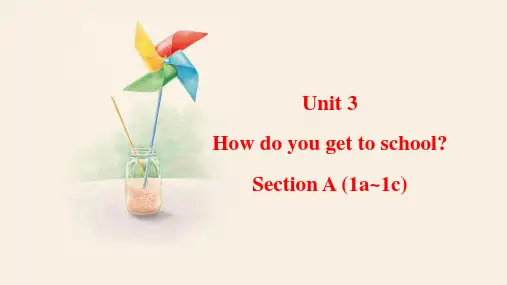
新课 导 入
bus
bike
train
car
taxi
plane
新课 导 入
ship subway
boat walk
学习目标 新知学习 重点研讨 课堂小结
当堂检测
Language Goal
➢ 1. 能记住并正确运用本课时的重点单词和短语 ➢ 2. 能听懂谈论交通方式的对话 ➢ 3. 能正确运用how引导的特殊疑问句谈论乘坐
take the bus = by bus
Unit 3 Section A (1a~1c)
运用how引导的特殊疑问句 谈论乘坐交通工具的方式; 答语常用“by+交通工具 (即没有限定词,且为单 数)”,也可用“take a/an/the/one's+交通工具”, 如果该交通工具为bike或 horse,通常用ride代替take。
的交通工具
学习目标 新知学习 重点研讨 课堂小结 当堂检测
1a Match the words with the pictures.
1.take the train _a__ 2. take the bus _d__ 3 take the subway _e__ 4. ride a bike _b__ 5. walk _c___
How does Bob get to school?
He __ta_k_e_s_t_h_e_t_ra_i_n_.
How does Mary get to school?
She__t_a_k_e_s_t_h_e_s_u_b_w_a_y_.
学习目标 新知学习 重点研讨 课堂小结 当堂检测
How does John get to school?
学习目标 新知学习 重点研讨 课堂小结 当堂检测
英语人教版七年级下册Unit3 SectionA (1a-1c)
Unit 3 How do you get to school?Section A (1a-1c)Teaching aims:1. Language aims:1) Students are able to master below words and phrases:train, bus, subway, biketake a/the train( bus. subway.). ride a/the bike.2) Students are able to master below sentences:①—How do you get to school? —I ride my bike.②—How does Mary get to school? —She takes the subway.2. Talk about how to get to places (谈论出行方式)take the bus /subway /train /taxi , ride a bike /walk .3. how引导的特殊疑问句,表示乘坐何种交通工具的方式2. Emotional education:Ss should follow the traffic rules and be careful of traffic safety. Important points:1)how question—How do you get to school? —I take the …/ride …/ walk…—How does Mary get to school? —She takes the subway.2)Key words:train, bus, subway, bike take a/the train( bus. subway.). ride a/the bike.Difficult point:1) Expressing way of the means of transportation.Teaching procedures:Step1. Warming-up and Lead in.Ss : Good morning , teacher.T: Good morning , classT: Look at the picture. What can you see? Do you like your school? I usually get to school by bike, but sometimes on foot . How do you get to school?Ss 按实际情况作答S1: I ride my bike.S2: I go by bus.S3: ………T: Very good. You’re clever. Let’s learn it.Step2. Presentation.1. T: If you are here, but your school is in Shanghai. How do you get to school?Ss: I take the bus /plane/ boat / ship / car / taxiI ride a bike / motorbikeT: Do you know any other way?2. Teacher shows pictures on the big screen .归纳出行方式和常用短语.Ask some questions about how you get to…?3. Show a picture about Part 1, on the screen.Point at girls or boys in the picture.Ask students to answer and write in the blanks.S1 : How does he / she go to school?S2 : He / She … …Step3. Work on 1a.T: Look at the picture on your book. Match the words with the picture.1.Ask Ss to finish 1a.2.Check the answer.3.Read together.Step4. Listening 1b.1. Make sure the Ss know what to do. Give them an example orally if possible.2. Read the names in the box.3. Play the tape and check the answers.Step5. Pair work.Ask two students to read the dialogue in the speech bubbles to the class. Then ask students to work in pairs. Ask and answer how students get to school in the picture.Finally ask some pairs of students to present their conversations to the class.Let some pairs act out the conversation.Step6. Homework1. Remember the new words and expressions in this period.2. Role-play the conversation after class.Blackboard design:A: How do you get to school?B1: I ride my bike.B2: I get to school by bike.A: How does Mary get to school?B1: She walks to school.B2 She gets to school on foot.。
人教版七年级英语下册Unit3 Section A(1a-1c)课件(共19张PPT)
所用教科书人民教育出版社新目标七年级英语下册书名所教年级七年级所教册次、单元Unit3How do you get to school?设计主题Section A1.整体设计思路、指导依据说明1、以学生听、说、读、写、练贯穿始终,面向全体学生、突出学生主体,尊重学生的个体差异,极大地满足同程度学生的学习需要。
2、通过各种各样的教学活动,如:自由回答、小组回答、讨论等形式,努力倡导学生积极参与,让学生在学习过程中不仅能建构知识,提高语言能力,而且通过感知、体验、实践、参与和合作探究等方式完成任务和实现目标。
3、创设真实的教学情景,使学生在真实的语境中感知英语,这样可以拓展学生学习英语和使用英语的渠道,同时也极大地提高了学生学英语的兴趣。
2.教学背景分析教学内容分析:本单元的话题涉及学生上学的交通方式,与上一个单元关于上学时间的话题紧密相连。
Section A部分展现了学生以不同的交通方式上学的场景,自然而然的将学生带入到有关彼此上学方式,出行花费时间,以及家与学校之间的距离等问题的讨论中。
1a-1c呈现了各种交通工具的名称,以及表达“使用某种交通工具”的动词搭配,如take the bus, ride the bike 等,还导入了谈论出行方式的句式。
2a-2e部分进一步深化“出行”话题,先让学生学习并掌握英语十位数和百位数的表达方式,再让学生捕捉听力对话中的数字信息,然后训练学生询问和回答两地距离和出行花费时长。
学生情况分析:上一个单元关于上学时间的话题,本单元不同的交通方式上学的场景,自然而然的将学生带入到有关彼此上学方式,出行花费时间,以及家与学校之间的距离等问题的讨论中。
3.教学目标分析1、知识目标:能谈论出行方式2、能力目标:能够熟练应用句型A; Does Jane walk to SCHOOL? B: No, she doesn’t .She goes by bike.A: Do they take the bus to school? B: No, they don’t. They walk.能正确拼读该部分的单词3、情感目标:通过交通工具的学习,了解因地域文化差别造成的出行方式的差异4.教学重点、难点分析教学重点:How do you get to school? I take the bus /ride the bike to school.How does she/he get to school? She/ He takes the bus /rides the bike to school.How far is it from your home to school? It is about forty kilometers.How long does it take? It takes twenty minutes.教学难点:交通出行的两种表达方式的转换; how,how long,how far 引导的特殊疑问句询问出行方式。
人教版七年级英语下册Unit3 Section A(1a-2d)课件

2a Listen. Peter asks his father if he can do four
things. What does his father say? Check ( ) “yes” or “no”.
Peter wants to… go out for dinner.
Peter’s father says…
Peter wan2tas .to…
Peter’s father says…
His father’s reasons
go out for dinner. Yes No
I have to do some work
go to the movies Yes No
You have to clean your room
—How do you get to school? —I ______ to schoole the bus
walk
1b Listen and write the numbers next to the
correct students in the picture.
Take out the rubbish,fold the clothes and do the dishes.
(2)Where do you think their mother is? At the supermarket.
(3)Who’s really the boss at home? Mother.
= I get to school on foot.
你学会了吗?
walk ride a bike take the subway take the train take the car take the bus take the boat
人教版七年级英语下册unit3SectionA (1a-1c)课件
3) He gets to school by bike .(同义句) He _ri_d_e_shis b_i_k_e_ to school.
4) They get to schoolb_y__su_b_w__a.y(看图填空) They __t_a_k_e_the s_u_b__w_a_yto school.
= He goes to work by subway. =He goes to work on the subway.
❖ 1. 教材1b , Listening to 1b
课堂达标
❖ 按照图画内容完成下列句子
1)I get to school by bus. (划线提问) _H__o_w___ ___d_o_ you get to school?
句型学习(B)HHoowwddooeesshheeggeot
to to
work? school?
教材1b
He rides the bike to school. = He goes to school by bike. = He goes to school on his bike.
He takes the subway to work.
=go to...on the bus
take the train (to)
=go to...by train =go to...on the train
take the subway (to)
=go to …by subway =go to …on the subway
walk (to) =go to …on foot
人教版七年级英语下册 Unit 3 SectionA 1a-1c教案
Unit 3 How do you go to school SectionA 1a-1c教案人教版英语七年级下册Teaching aims:1. Vocabulary :train, bus, subway, bike, car, boat, walk, take the train/bus, by bike/subway, ride a bike,minute.how far, kilometer2. Target language:How do you get to school? I ride my bike.How does he get to school? He walks to school.How long does it take? It takes about forty minutes.How far is it from your home to school? It’s about … kilometers.3. Talk about how to get to placesTeaching key points and difficulties:Target language:Skill aim :Listening and speaking skills.Step1.Presentation1.New words about transportation tools:train,bus,subway,bike,Ask and answer: How do you get to school?---I take/ride the…to school.Step2.SummaryHow do you get to school ? how对交通方式提问、take a bus by bus 乘坐公车take a subway by subway 乘坐地铁take a train by train 乘坐火车take a car by car 乘坐小车take a taxi by taxi 乘出租车take a boat by boat 乘坐船ride a bike by bike 骑自行车walk on foot 走路、步行Step3.Self Check 11. We've learned many ways of transportations. Now let's have a short review.Look at the words in the boxes below to form as many expressions as possible.2. Ss work in groups and try to write as many expressions as possible: take a bus, by bus, take a train, by train, take a subway, by subway, ridea bike, by bike….3. Let some Ss read their answers. Let other students add more phrases. Step4.T:How does he get to school?S:He walks./He gets to school on foot.T:How long does it take him to get from home to school?S:It takes him 25minutes.Step5.A:How far is it from your home to school?B:It’s20kilometers.Step 6. Self Check 21. Look at the chart below. Write at least five questions. Then answer the questions with the information in the chart.Step7. do some exercises.Step8.Summarize1.How do you get to school?take a bus by bus 乘坐公车take a subway by subway 乘坐地铁take a train by train 乘坐火车take a car by car 乘坐小车take a taxi by taxi 乘出租车take a boat by boat 乘坐船ride a bike by bike 骑自行车walk on foot 走路、步行2.How long does it take you to get to school ?It takes... minutes/hours.3.How far is it from your home to school?It is...kilometers. 教学反思:。
Unit3SectionA1a2c课件人教版七年级英语下册
How do you usually get to school?
在英语中,表示乘某种交通工具要用“by+交通工 具名称”这一介词短语。注:by后的名词一律用单数, 而且这一名词前一般不加冠词。如:by bike / bus/ car/ train/ motorbike/electric bike/subway by plane/air by boat/water by ship/sea 当交通工具名称前有“ a /the”时,不能再用“ by”, 要 用“on” 或 “in” 。如: on a (the) bus/bike/motorbike/electric bike/ train/subway in a plane/ship/taxi/car 但是,表示步行时,要用on foot.
2. He goes to work__in__ a car.
3. He _ta_k__e_s_the car to work.
1. Listen and write down how they get to school.
Bob---by train Mary--- by subway YangLan---on foot John---by bus
A.take B. takes C. by D. on 4.How long does it ____you to get to school? About 25 minutes. A. spend B. pay C. cost D. take
Read the following conversation ,then make a conversation like this.
ninety-nine__9_9_
one hundred and five___1_0_5____
人教版七年级英语下册Unit3SectionA(1a2c)教学设计
-在对话中正确使用一般过去时态描述过去活动;
-结合实际情境,运用所学词汇和短语进行表达。
(二)教学设想
1.针对教学重点和难点,设计以下教学环节:
-环节一:导入。通过展示学生熟悉的暑假生活照片,激发学生的兴趣,自然引入话题。
-环节二:新知呈现。结合图片和语境,引导学生学习并掌握本节课的核心词汇和短语,如"summer vacation"、"go to the mountains"等。
五、作业布置
为了巩固本节课所学知识,培养学生的语言运用能力,特布置以下作业:
1.写作练习:请学生结合本节课所学内容,写一篇关于自己暑假经历的英语短文。要求使用一般过去时态描述过去的活动,不少于80词。
2.口语练习:学生与家人或朋友进行英语对话,分享彼此的暑假经历。要求运用一般过去时态,录制一段2-3分钟的口语视频。
2.培养学生关爱家人、朋友,珍惜与亲人朋友共度时光的情感。
3.增进学生对不同文化背景的了解,培养他们的跨文化交际意识。
4.引导学生正确看待过去,学会珍惜现在,规划未来。
在教学过程中,教师应关注学生的个体差异,因材施教,使每个学生都能在原有基础上得到提高。同时,注重培养学生的合作精神、创新意识和实践能力,使他们在英语学习中获得全面发展。
3.各小组向全班展示讨论成果,教师给予评价和指导。
(四)课堂练习
1.教学活动设计:教师设计一系列课堂练习,巩固学生对一般过去时态和词汇的掌握。
-练习一:完成课本中的1b和2a,要求学生根据图片和对话内容,用一般过去时态填空。
-练习二:编写一段关于自己暑假活动的对话,要求运用一般过去时态和所学词汇。
-练习三:学生两人一组,进行角色扮演,模拟对话中的场景,进行实际操作。
人教版七年级英语下册Unit 3SectionA(1A-1C)课件
二、询问某人以某种交通方式到达某地以 及回答
Q: How do/does sb get to sw?
A: ① Sb get(s) to sw by + 交通工具.
②Sb take(s) the +交通工具 to sw.
随堂练习:
一、根据汉语写出相对应的英语。 1、 My father ___ta_k_e_s_th_e__b_u_s _(坐公共汽车) to office every day. 2、Does Jack __r_id_e__hi_s_b_ik_e__(骑自行车) to school? 3、My sister doesn’t like ___w_a_l_ki_n_g(步行). 4、What’s your favorite transportations __t_ra_i_n(火车)or ___s_ub_w__ay(地铁)?
七下 Unit 3
Period 1
1a-1c
Answer the questions
What time do you usually go to school? I usually go to school at ___.
How do you get to school? I get to school ___.
kinds of transportation
train [treɪn] n.火车
take the train 乘火车 I take the train to school.
He takes the train to school.
subway[ˊsʌbweɪ] n.地铁
take the subway 乘地铁 I take the subway to school.