
闽教版四年级上册英语各单元知识清单
闽教版四年级上册英语各单元知识清单
一:词汇过关:背诵,听写、默写
二:重点句型复习:背诵
三:课文过关:背诵
各单元重点知识汇总:
U1 Our Classroom:
1.I’m in Class One,Grade Four. 我在四年一班。
Class One,Grade Four 书写注意两点:①首字母大写②逗号
2.Look at the blackboard. 看着黑板。
blackboard:黑板(复合词,不能写成 black board)
U2 Our School
1.Who’s that girl? 那个女孩是谁?
①区分:this 这个(近) that 那个(远)
②who's= who is 是谁 whose 谁的
2. That’s Ma Li. 那是玛丽。
that’s=that is那是(可能出现在填空题)
3.She’s from Taiwan. 她来自台湾。
①she’s =she is(可能出现在填空题)
人称 be动词
② be from:来自 I am
you、we、they are
he、she、某人 is
③Taiwan 地名、国家名首字母大写
4.Which class are you in? 你在哪个班级?
I’m in Class One,Grade Four .
5.This is our playground. 这是我们的操场。
6.Wow,so many books! 哇,这么多书!
so many +名词复数。
如:so many computers so many potatoes
U3 Numbers and Animals
1.数字单词的掌握。
(重点)其中:twenty 20 常考,但错误率高。
另:表示十几的单词通常以“teen”结尾,读法“长且重”,除了eleven 十一和twelve 十二。
2. thirteen cows fourteen horses
fifteen sheep sixteen pigs
sheep 单复数同形,所以不发生变化。
还有一些不能s 的词,同学们回忆一下,并写下来吧
3.How much is seventeen and four? 17+4=?
It’s twenty-one.是21
①how much 多少(此处为求和)
②twenty-one 表示几十几的数字书写,中间有连词符。
4.Thirteen and seven is twenty.13+7=20 (听得懂英文表达的含义)
5.请同学们写下1到12的英文单词,加油!
数字的变化规律你们都会了吗?
13-19的英文单词末尾都是。
特例是和,应该怎么写呢?
()()
整十数字的英文单词末尾都是。
(20)(50)
U4Numbers and Time
1.What’s the time? 几点钟?
It’s nine thirty.9:30
It’s nine fifty. 9:50
2.thirty /forty/fifty:表示几十的单词,常以“ty”结尾,读法轻而短促。
3.20~59数字的英文表达方式需熟练。
(表示几十几的单词中间有连词符,如:twenty-five 25)
4.看到题中出现时钟时,要先将其表达的时间用“9:30”这样的方式写在题目边,利于答题。
Unit 5 Daily Activities
1.When do you get up? 你什么时候起床?
I get up at six forty-five.=At six forty-five. 我在六点四十五分起床。
(表达在某个具体时间点,用介词 at)
When do you have breakfast/lunch? 你什么时候吃早餐/午餐?
2.have的用法:have thirteen cows 有13头牛
have a sleep 睡觉
have breakfast吃早餐
3.主语为第三人称单数时动词的变化规律
如:I have lunch at 12:00. She has lunch at 12:00. I get up at 6:30 a.m. He gets up at 6:30 a.m. I go to school at 7:15 a.m. Lily goes to school at 7:15 a.m.
4.a.m 上午 p.m 下午
Unit 6 Meals
1. 一日三餐英文表达。
2. What’s for breakfast? 早餐吃什么?
3. milk bread beef 不可数名词
tomato potato 可数名词 复数:tomatoes potatoes
Have some...吃一些......
Have some milk. Have some bread.
Have some beef. Have some tomatoes.
Have some potatoes.
4. --Do you like vegetables? 你喜欢蔬菜吗?
--Yes, I do. 是的。
5. I’m full. 我饱了。
The bus is full. 公交车挤满了。
Unit 7 Christmas
1.Christmas 圣诞节 (注意首字母大写)
Merry Christmas!圣诞快乐!(注意首字母大写)
2.a Christmas tree a Christmas card (大写)
3.--What presents do you want,kids? 孩子们,你们想要什么礼物? he she 某人 have ha s
get get s
go go es
It(它)
--I want a robot/violin. 我想要一个机器人/小提琴。
4.--Do you like your presents? 喜欢你们的礼物吗?
--Yes, we do. 是的,我们喜欢。
Unit 8 The Spring Festival
1.What’s the Spring Festival? 什么是春节?
It’s Chinese New Year. 它是中国的新年。
(注意专有名词的首字母大写)
2.中国的传统节日——春节(常有的活动习俗)
How do you spend it? 你们怎么度过它的?
We make rice cakes.我们做年糕。
We make dumplings. 我们包饺子。
We have a family dinner. 我们有一个家庭聚餐。
(团圆饭)
We watch the Spring Festival Party on TV.我们在电视上看春晚。
We get some New Year’s money.我们得到一些压岁钱。
We go to the fair. 我们去逛庙会。
We go to see our friends. 我们去看望我们的朋友。
补充:
1.缩写。
who’s = who is what’s= what is
he’s/she’s=he is/she is
isn’t = is not
can’t=can not
I’m=I am
you’re/they’re=you are/they are
2.书写英文句子时,应注意首字母大写,句末要有标点符号。
例:Look at the window.
Wow,so many books!
3.人称:
I 我 my 我的 We 我们 our我们的
you 你,你们 your你的,你们的 he 他 she 她。
闽教英语四年级上册(知识点汇总)(最新整理)
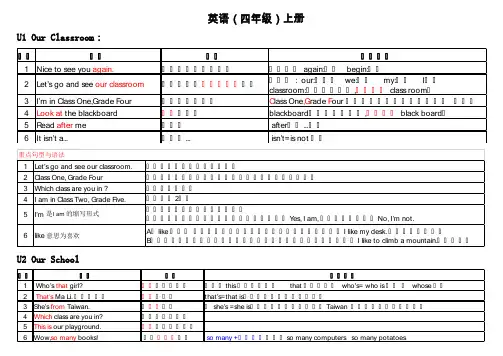
U1 Our Classroom:U2 Our SchoolU3 Numbers and AnimalsU4 Numbers and TimeUnit 5 Daily Activities序号语句意思注意要点1When do you get up?I get up at six forty-five.=At six forty-five.你什么时候起床?我在六点四十五分起床表达在某个具体时间点,用介词at2When do you have breakfast?你什么时候吃早餐? 3When do you go to school? 什么时候去上学? 4Lily get s up at 6:30 a.m.李丽早上6点半起床。
a.m 上午p.m 下午5The bus is full. 公交车挤满了乘客。
full 充满,饱的意思。
I am full. 我饱了6Get into the car.上车吧get into用于上小轿车或的士. get on the bus/train 上公交车或火车7go to bed 上床睡觉,go to sleep 睡着;go home 回家不加toUnit 6 MealsUnit 7 ChristmasUnit 8 The Spring Festival重点单词5、交通工具及日常生活:bus公共汽车car小轿车bed床铺get up 起床read ,读;阅读sleep 睡觉 get into the car上车have breakfast 吃早饭 have lunch 吃午饭have dinner 吃晚饭go home回家go to bed 去睡觉go to school去学校6、节日及活动:robot 机器人email 电子邮件family dinner 团圆饭Christmas tree圣诞树Christmas card圣诞贺卡watch TV看电视fair庙会the Spring Festival春节New Year’s money 压岁钱say happy New Years说新年好。
闽教版四年级上册英语各单元知识清单
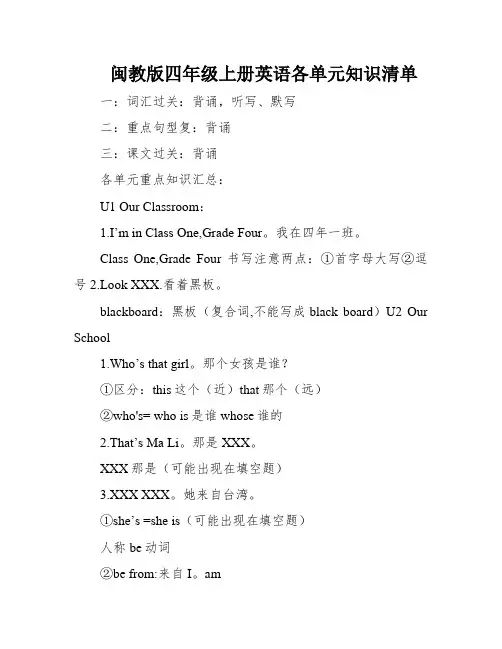
闽教版四年级上册英语各单元知识清单一:词汇过关:背诵,听写、默写二:重点句型复:背诵三:课文过关:背诵各单元重点知识汇总:U1 Our Classroom:1.I’m in Class One,Grade Four。
我在四年一班。
Class One,Grade Four书写注意两点:①首字母大写②逗号2.Look XXX.看着黑板。
blackboard:黑板(复合词,不能写成black board)U2 Our School1.Who’s that girl。
那个女孩是谁?①区分:this这个(近)that那个(远)②who's= who is是谁whose谁的2.That’s Ma Li。
那是XXX。
XXX那是(可能出现在填空题)3.XXX XXX。
她来自台湾。
①she’s =she is(可能出现在填空题)人称be动词②be from:来自I。
amyou、we、they。
arehe、she、某人is③Taiwan地名、国家名首字母大写4.Which class are you in?你在哪一个班级?I’m in。
Class One,Grade Four。
5.This is our playground.这是我们的操场。
6.Wow,so many books!哇,这么多书!so many +名词复数。
如:so many computers。
so many potatoesU3 Numbers and Animals1.数字单词的把握。
(重点)个中:twenty 20常考,但毛病率高。
另:透露表现十几的单词平日以“teen”末端,读法“长且重”,除eleven十一和twelve十二。
2.thirteen cows。
fourteen horsesfifteen sheep。
sixteen pigs1sheep单复数同形,以是不产生变革。
另有一些不克不及s的词,同砚们回想一下,并写下来吧 3.How much is seventeen and four。
四年级上册英语Unit1~Unit8知识点归纳闽教版
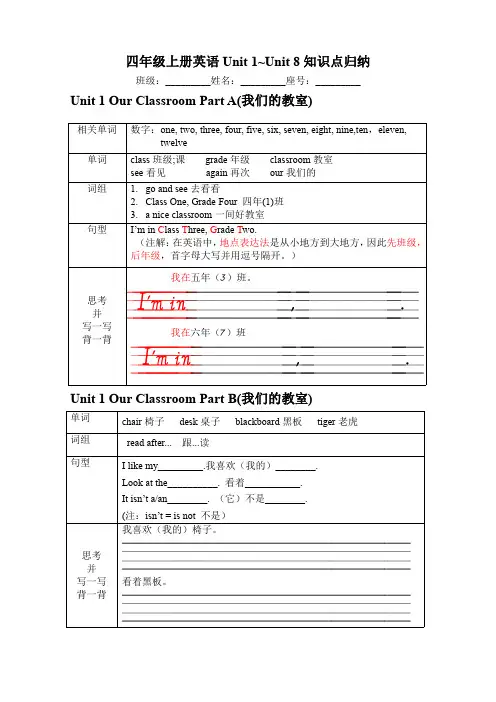
四年级上册英语Unit1~Unit8知识点归纳班级:_________姓名:_________座号:_________ Unit1Our Classroom Part A(我们的教室)Unit1Our Classroom Part B(我们的教室)单词chair椅子desk桌子blackboard黑板tiger老虎词组read after...跟...读句型I like my_________.我喜欢(我的)________.Look at the__________.看着___________.It isn’t a/an________.(它)不是________.(注:isn’t=is not不是)思考并写一写背一背我喜欢(我的)椅子。
===========看着黑板。
===========相关单词数字:one,two,three,four,five,six,seven,eight,nine,ten,eleven,twelve单词class班级;课grade年级classroom教室see看见again再次our我们的词组 1.go and see去看看2.Class One,Grade Four四年(1)班3.a nice classroom一间好教室句型I’m in C lass T hree,G rade T wo.(注解:在英语中,地点表达法是从小地方到大地方,因此先班级,后年级,首字母大写并用逗号隔开。
)思考并写一写背一背我在五年(3)班。
I’m in====,====.我在六年(7)班I’m in====,====.Unit2Our School Part A(我们的学校)单词cousin表(堂)兄弟姐妹school学校句型 1.Who’s that girl?那女孩是谁?That’s______.那是_______.2.She’s from Taiwan.她来自台湾。
3.Which class are you in?你在哪个班级?I’m in Class_______,Grade________.我在____年____班。
闽教版小学英语四年级上册Unit 1 单元知识梳理
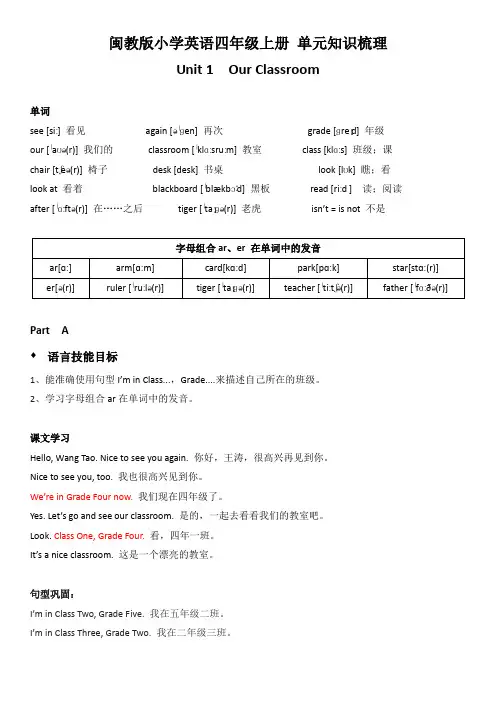
闽教版小学英语四年级上册单元知识梳理Unit 1 Our Classroom单词see [siː] 看见again [əˈɡen] 再次grade [ɡreɪd] 年级our [ˈaʊə(r)] 我们的classroom [ˈklɑːsruːm] 教室class [klɑːs] 班级;课chair [tʃeə(r)] 椅子desk [desk] 书桌look [lʊk] 瞧;看look at 看着blackboard [ˈblækbɔːd] 黑板read [riːd ] 读;阅读after [ˈɑːftə(r)] 在……之后tiger [ˈtaɪɡə(r)] 老虎isn’t = is not 不是Part A◆语言技能目标1、能准确使用句型I’m in Class...,Grade....来描述自己所在的班级。
2、学习字母组合ar在单词中的发音。
课文学习Hello, Wang Tao. Nice to see you again. 你好,王涛,很高兴再见到你。
Nice to see you, too. 我也很高兴见到你。
We’re in Grade Four now.我们现在四年级了。
Yes. Let’s go and see our classroom. 是的,一起去看看我们的教室吧。
Look. Class One, Grade Four.看,四年一班。
It’s a nice classroom. 这是一个漂亮的教室。
句型巩固:I’m in Class Two, Grade Five. 我在五年级二班。
I’m in Class Three, Grade Two. 我在二年级三班。
注意班级名称的书写方法,因其是专有名词,所以四个单词的首字母都要大写,中间逗号隔开。
Part B◆语言技能目标1、能使用句子I like....来表达自己的喜好。
课文学习I like my chair.我喜欢我的椅子。
闽教版小学英语四年级上册各单元语法知识点汇总
闽教版小学英语四年级上册各单元语法知识点Unit 1 Our ClassroomHello, Wang Tao. Nice to see you again. 你好,王涛,很高兴再见到你。
Nice to see you, too. 我也很高兴见到你。
We’re in Grade Four now.我们现在四年级了。
Yes. Let’s go and see our classroom. 是的,一起去看看我们的教室吧。
Look. Class One, Grade Four.看,四年一班。
It’s a nice classroom. 这是一个漂亮的教室。
句型巩固:I’m in Class Two, Grade Five. 我在五年级二班。
I’m in Class Three, Grade Two. 我在二年级三班。
I like my chair.我喜欢我的椅子。
I like my desk. 我喜欢我的桌子。
Hello, I’m your teacher. 你们好,我是你们的老师。
现在,看着黑板跟我读,老虎。
A tiger. 老虎。
Meow. It’s a cat. It isn’t a tiger. 喵,它是猫,不是老虎。
Ha, ha ... 哈哈……句型巩固:I like my chair. 我喜欢我的椅子。
I like my desk. 我喜欢我的桌子。
look at the blackboard. 看黑板。
look at the window. 看窗户。
单元重点:1、注意年级和班级的写法:因其是专有名词,所以四个单词的首字母都要大写,班级在前,年级在后,中间逗号隔开。
We’re in G rade F our now. 我们现在四年级了。
I’m in C lass T wo, G rade F ive. 我在五年级二班。
2、复合词:classroom是由两个具有单独意思的词class和room合并构成,这类词被称为复合词。
闽教版小学英语四年级上册知识点
闽教版小学英语四年级上册知识点Unit 1:Key words and phrases:See: to perceive with the eyesAgain: once more。
another timeGrade: a level of study in schoolOur: XXXClassroom: a room in a school where lessons take place Class: a group of students who are XXXChair: a piece of XXXDesk: a piece of furniture with a flat surface for writing on Look: to direct one'XXXLook at: to direct one's gaze towards someone or something Blackboard: a large board for writing on with chalk Read: to look at and XXXAfter: following in time。
place。
or orderTiger: a XXXNo: used to give a negative responseXXX and grammar:Let's go and see our classroom: XXX.Class One。
Grade Four: The first class in fourth grade.Which class are you in。
What class are you in?I am in Class Two。
Grade Five: I am in the second class in fifth grade.I'm: XXX "I am".Yes。
闽教版小学英语四年级(上册)单词表和知识点
重点句型与语法
What’s the Spring Festival ? 什么是春节?
It’s Chinese New Year. 它是中国农历新年。
How do you spend it ? 你们是怎么过春节的?
spend 度过
We make dumplings. 我们包饺子。
We make rice cakes. 我们做年糕。
Do you watch TV after dinner ? 你么晚饭后看电视吗?
watch 观看,watch a film, 看电影, watch a football game 看足球赛
We watch the Spring Festival Party on TV. 我们观看电视台的春节联欢晚会。
We get some New Year’s money. 我们得到一些压岁钱。
some 用于肯定句, any 用于否定句和疑问句。
She doesn’t want any bananas. 她不要香蕉。
Do you want any vegetables ? 你需要蔬菜吗?
say Happy New Year to ……向某人拜年,
say Hello to your mother. 请向你的母亲问好。
go to the fair 去逛庙会。
闽教版四年级上册英语各单元知识清单
闽教版四年级上册英语各单元知识清单Unit 1: Our ClassroomVocabulary: Memorize。
n。
and write from memory.Key sentence pattern: MemorizePassages: MemorizeXXX summary:1.I'm in Class One。
Grade Four。
Note two points when writing Class One。
Grade Four:n of the first letter;②No space after the comma.2.Look at the blackboard.Blackboard: XXX word that cannot be written as "black board."Unit 2: Our SchoolVocabulary: Memorize。
n。
and write from memory.Key XXX:1.Who's that girl。
Distinguish een "this" (near) and "that" (far).Who’s = who is。
whose = whose.2.That's Ma Li.That's = that is (may appear in fill-in-the-blank ns).3.XXX.①She's = she is (may appear in fill-in-the-blank ns).Personal be XXX:②be from: I am。
you。
we。
they are。
he。
she。
XXX.③Taiwan: Capitalize the first letter of a place or country name.4.Which class are you in?I'm in Class One。
闽教版四年级上册英语各单元知识点要点汇总
闽教版四年级上册英语各单元知识点要点汇总Unit 1: Hello- Greetings: Hello, Hi, Good morning, Goodbye, Bye- Introduction: What's your name?, My name is...- Farewell: See you later, GoodbyeUnit 2: Colors and Shapes- Colors: red, blue, yellow, green, orange, purple, pink, black, white, brown- Shapes: circle, square, triangle, rectangle, star, heartUnit 3: Family- Family members: father, mother, brother, sister, grandfather, grandmother- Possessive pronouns: my, his, herUnit 4: Numbers- Cardinal numbers: 1 to 10- Ordinal numbers: first, second, third, fourth, fifth, sixth, seventh, eighth, ninth, tenthUnit 5: Animals- Domestic animals: cat, dog, pig, rabbit, bird, fish- Wild animals: lion, tiger, elephant, giraffe, monkey, zebraUnit 6: Food and Drinks- Food: fruit, vegetable, bread, cake, hamburger, hot dog- Drinks: water, milk, juiceUnit 7: Body Parts- Body parts: head, eyes, ears, mouth, nose, hands, feet- Actions: listen, touch, taste, smellUnit 8: Daily Routines- Daily routines: get up, have breakfast, go to school, have lunch, play games, go to bed- Time expressions: morning, afternoon, eveningUnit 9: Clothes- Clothing items: shirt, pants, dress, skirt, shoes, socks- Colors: red, blue, yellow, green, purpleUnit 10: Weather- Weather conditions: sunny, rainy, cloudy, windy- Expressions: It's hot, It's cold, It's rainingUnit 11: House- Rooms: bedroom, living room, kitchen, bathroom- Furniture: bed, sofa, table, chair, bathtubUnit 12: Transportation- Modes of transportation: car, bus, train, bike, boat, airplane - Action verbs: drive, ride, flyUnit 13: Jobs- Occupations: doctor, teacher, firefighter, police officer, chef - Actions: help, teach, cookUnit 14: Holidays- Holidays: Christmas, New Year, Thanksgiving, Halloween - Activities: exchange gifts, dress up, have a meal togetherUnit 15: Countries and Nationalities- Countries: China, America, Canada, England- Nationalities: Chinese, American, Canadian, EnglishUnit 16: Time- Time expressions: year, month, week, day- Seasons: spring, summer, autumn, winterUnit 17: Sports- Sports: football, basketball, swimming, running, volleyball - Verbs: play, swim, run, jumpUnit 18: Fruits and Vegetables- Fruits: apple, banana, orange, watermelon, strawberry- Vegetables: carrot, tomato, potato, broccoli, cucumberUnit 19: School- School subjects: English, math, Chinese, science, art- School supplies: pen, pencil, book, ruler, eraserUnit 20: Body Movements- Action verbs: jump, clap, wave, dance, hop- Adverbs of manner: quickly, slowly, happily以上是闽教版四年级上册英语各单元的知识点要点汇总。
闽教版四年级上册英语各单元重要知识点归纳
闽教版四年级上册英语各单元重要知识点归纳Unit 1: Greetings- Greet and respond to greetings- Introduce oneself using "My name is..."- Identify and describe feelings using "I am happy/sad/tired/etc."- Learn basic classroom languageUnit 2: Family- Learn family vocabulary such as father, mother, brother, sister, etc.- Describe family members using possessive pronouns (my, his, her) - Talk about family activities using present continuous tense (e.g., My father is cooking.)Unit 3: Colors and Shapes- Learn colors vocabulary (red, blue, yellow, etc.)- Identify and describe shapes (circle, square, triangle, etc.)- Express preferences and choices using "I like/don't like" and "I prefer"Unit 4: Daily Routine- Talk about daily activities using simple present tense (I get up, I brush my teeth, I go to school, etc.)- Tell the time using hours and half-hours (e.g., It's seven o'clock, It's half past two, etc.)- Discuss time-related phrases such as morning, afternoon, evening, etc.Unit 5: Food and Drinks- Learn food and drinks vocabulary- Express likes and dislikes about food using "I like/don't like" and "I love/hate"- Make requests using "Can I have...?" and "May I have...?"Unit 6: Animals- Learn animal vocabulary (dog, cat, bird, etc.)- Describe animals using adjectives (big, small, cute, etc.)- Talk about where animals live (farm, house, zoo, etc.)Unit 7: Clothes- Learn clothing vocabulary (hat, shirt, pants, etc.)- Describe clothing using colors and sizes (e.g., red hat, blue shirt, big pants, etc.)- Discuss clothing preferences and weather-related clothing choicesUnit 8: Weather- Identify and discuss different types of weather (sunny, rainy, windy, etc.)- Describe current weather using phrases like "It's sunny today" or "It's raining outside."- Talk about suitable clothing for different weather conditionsUnit 9: Feelings- Express different emotions and feelings (happy, sad, angry, etc.) - Describe situations that make one feel a certain way (e.g., I feel happy when I'm with my friends.)- Discuss appropriate responses to different feelingsUnit 10: Occupations- Learn different occupations (doctor, teacher, chef, etc.)- Describe people's occupations using "He/She is a..."- Discuss interests and aspirations related to different occupations以上是闽教版四年级上册英语各单元的重要知识点归纳,希望对你有帮助!。