
牛津译林版八年级英语上册课unit5 wild animals reading(ii) (共20张PPT)
Also, giant pandas live mainly on a special kind of bamboo.
11 但是,竹林正变得越来越小。
However, the bamboo forests are becoming smaller and smaller.
11.However, we do believe that where there is Xi Wang, there is hope.
此处do believe中的do表示强调, “do/does/did+动词原形”表示强调。 例,他的确看起来像张老师。 does look like Mr. He _______ _______ Zhang. 我相信她所说的。 do believe what she I ________ _________ says.
☆3. At four months old, she weighed about eight kilograms and started to go outside for the first time.
for the first time 意为“第一次”, 如,当我7岁时,我第一次开始骑车。 began to ride At _______ seven, I ________ a bike ____ for _____ the _____ first _____. time
3 在四个月大时,她大约重8千克而且第一次开始外出。
At four months old, she weighed about eight kilograms and started to go outside for the first time.
4 八个月后,她不再是一个小婴儿,而且称得 35多公斤。
☆7. Also, giant pandas live mainly on a special kind of bamboo. live on意为“以-----为生,以------为食”, 可用于动物和人,后接食物或生活来源。 例如,羊以草为食。 live ______ on Sheep ______ grass. ☆8. Giant pandas are now in danger. in danger ; “处于危险中” _________ in trouble “处于麻烦” ______________ ; “需要中”_____________; in need “危险的”译为dangerous _____________ 例如,玩火是危险的。 Playing ________ with fire is dangerous _________.
8 悲伤地是,大熊猫要面对野外的严重的问题。
Sadly, giant pandas face serious problems in the wild.
9 例如,大熊猫生宝宝非常困难。
For example, it is very difficult for pandas to have babies.
☆4. She was not a small baby any more. not ---any more 意为“不再---”, 如,我们不再是孩子了。 more We aren’t _____ little children any _____ ____. 那个小孩不再哭了。 didn’t cry ___ any _____. more The little child _____
【堂清巩固】 1 In thebeginning _______(begin), people didn’t believe he was the famous star. 2 The people attending the meeting aremainly _____(main) young boys and girls. sadly 3 He looked ______(sad) at me with tears in his eyes. 4 The _________( 结果) of this test result was surprising. Andy came first. none 5 We have three sons but ________ (没有一个) of them is willing to visit us.
☆2。When she was born, she weighed just 100 grams and looked like a white mouse. A weigh,动词,意为“称得---,重达-----”, weighs weight 三单式_____ ,过去式______ weighed ,名词_____. 例如,这只苹果300克。 weighs 300 grams. The apple _______ weight =The apple is 300 grams in _______. is =The weight ______ of the apple ______ 300 grams. B look like “看起来像---”;be like “像---”; look“看起来---”; 区别:look like/be like+名词(短语)/代词; look+形容词 例如:看起来像一本书/她 _____________ look like a book/her ; 看起来漂亮________________ look beautiful
Eight months later, she was not a small baby any more and weighed over 35 kilograms.
5 起初,希望喝她妈妈的奶。
In the beginning, Xi Wang drank her mother ’s milk.
15 制定法律来保护大熊猫
make laws to protect pandas
16 如果我们什么事也不做,很快就没熊猫 了。 If we do nothing, soon there may be none left.
17 但是,我们相信哪里有“希望”,哪里就有 希望。
However, we do believe that where there is Xi Wang, there is hope. 18 熊猫宝宝在很小的时候容易生病死去。 It’s easy for baby pandas to get sick and die when they’re very young. 19 出生时,它很小。 It was very little at birth.
B3 Answers
1 in danger 2 very young
3 live on
5 in the wild
4 As a result
6 take action
B4 Answers
1 drank her mother’s milk
2 eat bamboo
3 100 grams
4 35 kilograms
6. Sadly, giant pandas face serious problems in the wild. A sadly是副词,意为“可惜,令人伤心地”,是 sad的副词,可置于句首,修饰整个句子,也可用 来修饰动词。 例如,可惜的事,他们昨天没来。 _______, Sadly they didn’t come yesterday. 她伤心地哭了。 sadly She cried _______. the ______ wild ; B “在野外”意为in _____ _____ wild还可以作形容词“野生的”, 如,野生动物应该呆在野外。 Wild animals should stay ______ in the wild _______ ______ _______.
☆5. In the beginning, Xi Wang drank her mother’s milk.
in the beginning意为“在最初的时候”; at the beginning of --- 意为“在------开 始的时候”, 例如,起初,我们只是同学。 In _____ the beginning ____ _________,we were just classmates. 比赛开始时,她有点兴奋。 At the _________ beginning _____ of ____ ___ the match, she was a little excited.
5 serious problems
6 have more babies
7 panda reserves 8 make laws
☆1. We called her Xi Wang.
A call在句中作动词,“call+宾语+名词 (宾语补足语)”意为“称呼,叫做”。 ---_______ What (Who\What)do you call him? ---“Baby”. B 打电话给某人 call sb.=give sb. a call _______________________
12 结果,大熊猫可能没有生存的地方或吃的食物。
As a result, pandas may not have a place to live or food to eat.
13 大熊猫正处于危险之中。
Giant pandas are now in danger.
14 我们应当立刻采取措施。
We should take action right away.
6 当她六个月大时,她开始吃竹子。
When she was six months old, she began to eat bamboo.
牛津译林版八上Unit 5 Wild animals Reading (II) 示范公开课教学课件
in the beginning
In the beginning
At the beginning
Presentation
Warming-up
Extension
Read and answer
1. What does the writer think of the problems giant pandas face in the wild? The problems giant pandas face are serious.2. Can pandas have babies easily? No. It is very difficult for pandas to have babies.3. What do giant pandas mainly live on? They mainly live on a special kind of bamboo.
b
f
d
a
c
e
Practice
Presentation
Warming-up
What problems may giant pandas like Xi Wang have in the future? What can we do to help them?
Discuss and fill
Problems
big
white mouse
baby panda
giant panda
black and white
small
appearance
Presentation
Warming-up
Extension
Age
Weight
牛津译林版英语八上Unit 5《Wild animals》(Reading1)说课稿
牛津译林版英语八上Unit 5《Wild animals》(Reading1)说课稿一. 教材分析《牛津译林版英语八上Unit 5 Wild animals》(Reading 1)讲述了关于野生动物的保护问题。
通过阅读一篇关于非洲象的文章,让学生了解非洲象的生活习性以及面临的生存困境,从而引发学生对野生动物保护的思考。
教材内容丰富,插图生动,旨在提高学生对野生动物保护的意识,培养学生关爱地球生态的责任感。
二. 学情分析八年级的学生已具备一定的英语阅读能力,对野生动物有较高的兴趣。
但在阅读长篇文章时,部分学生可能会遇到生词、长句等困难,影响阅读理解。
此外,学生对野生动物保护的认识有限,需要通过课堂引导深化其环保意识。
三. 说教学目标1.知识目标:学生能理解文章主要内容,掌握的生词和短语;2.能力目标:学生能运用所学知识进行阅读理解,提高阅读技巧;3.情感目标:学生能增强对野生动物保护的意识,培养关爱地球生态的责任感。
四. 说教学重难点1.重点:学生能理解文章主要内容,掌握的生词和短语;2.难点:学生能运用所学知识进行阅读理解,提高阅读技巧。
五. 说教学方法与手段1.教学方法:采用任务型教学法,分组合作,讨论交流;2.教学手段:多媒体辅助教学,图片、视频等资料引导学生深入理解课文。
六. 说教学过程1.导入:展示非洲象的图片,引导学生谈论对野生动物的印象,引出本课主题;2.读前预测:学生浏览文章标题和图片,预测文章内容;3.快速阅读:学生快速阅读文章,回答简单问题;4.仔细阅读:学生分组讨论,深入理解文章内容,回答较难问题;5.小组活动:学生分组进行角色扮演,模拟文章中的场景,加深对文章的理解;6.总结提升:教师引导学生总结文章主题,谈论野生动物保护的重要性;7.作业布置:学生课后写一篇关于我国野生动物保护的文章。
七. 说板书设计板书设计如下:1.课题:Unit 5 Wild animals2.阅读文章:African Elephants3.生词短语:–wildlife protection–survival–conservation–poaching–habitat destruction4.文章主题:关爱野生动物,保护地球生态八. 说教学评价1.课堂参与度:观察学生在课堂上的发言和讨论情况;2.阅读理解:检查学生回答问题的准确性;3.作业完成情况:评估学生课后作业的质量。
牛津译林版八年级上册Unit5《Wildanimals》(Reading1)说课稿
牛津译林版八年级上册Unit 5《Wild animals》(Reading 1)说课稿一. 教材分析《牛津译林版八年级上册Unit 5 Wild animals(Reading 1)》主要讲述了关于野生动物的保护问题。
通过一篇关于非洲象的阅读材料,引导学生了解非洲象的生活习性以及目前面临的生存困境。
文章语言真实自然,富有感染力,能够激发学生的学习兴趣,同时培养学生的环保意识。
本节课的内容与学生的生活实际密切相关,易于引起学生的共鸣。
二. 学情分析八年级的学生已经具备了一定的英语基础,能够运用英语进行简单的交流。
但他们在阅读理解、词汇积累以及写作方面还存在一定的困难。
因此,在教学过程中,教师需要关注学生的个体差异,善于激发学生的学习兴趣,引导他们主动探究,提高他们的阅读理解能力和环保意识。
三. 说教学目标1.知识目标:学生能够掌握文章中的重点词汇和短语,理解文章的主要内容,了解非洲象的生活习性和目前面临的生存困境。
2.能力目标:学生能够运用所学知识进行阅读理解,提高自己的阅读能力;通过讨论和写作,提高自己的表达和交流能力。
3.情感目标:学生能够树立环保意识,关注野生动物的保护问题,养成关爱自然、保护动物的良好习惯。
四. 说教学重难点1.教学重点:学生能够掌握文章中的重点词汇和短语,理解文章的主要内容,了解非洲象的生活习性和目前面临的生存困境。
2.教学难点:学生能够运用所学知识进行阅读理解,提高自己的阅读能力;通过讨论和写作,提高自己的表达和交流能力。
五. 说教学方法与手段1.教学方法:采用任务型教学法,让学生在完成任务的过程中,提高自己的阅读理解能力和表达能力。
2.教学手段:利用多媒体课件、图片等辅助教学,激发学生的学习兴趣,提高课堂效果。
六. 说教学过程1.Pre-reading:教师通过展示一些关于野生动物的图片,引导学生谈论自己喜欢的动物,激发学生的学习兴趣。
2.While-reading:教师引导学生快速阅读文章,回答一些简单的问题,帮助学生理解文章大意。
译林牛津版8A Unit 5 Wild animals Reading I 教学课件 (共34张PPT)
The growth of Xi Wang
Listen to Para1—2 carefully and try to find out the different weight of Xi Wang at different time.
Time
Weight
At birth At four months
2. The bamboo forests are becoming smaller and smaller.As a result,pandas
3.What wilWl happen to panmdaaysnwothhialveetahpelace to live bamboo forests are becomorifnoogdstomeaatl.ler
dolphin
It’s the king of the animal world. It has yellow fur and black stripes(条纹) on its body.
tiger
It’s a kind of horse
with black and white stripes on it’s body.
zebra
It’s a heavy wild animal with thick fur and sharp(锋利 的)paws. It can walk
upright(竖直地).bear
It has a long, soft tail and lives in the forests.
squirrel
months
for the first time.
She began to eat
Six months old bamboo.
八年级英语上册(牛津译林版) Unit 5 Wild animals Reading I公开课课件

Make a dialogue.
A: Hello! Miss Panda. How are you? B: Hello! Mr Tiger. I don’t feel good these days. A: What’s wrong with you? B: Because some of my friends are killed by people. They kill us for our fur. B: Do you want people to help you? A: Yes. I hope they will not buy the clothes made of our fur. B: … A: …
A riddle We are beautiful black and white animals. We look like bears. We live only in China. Our favourite food is bamboo shoots and leaves. Our greatest hope is to take a colour photo. Who are we?
12 months f
e. She weighed 100 grams.
f. She weighed 35 kilograms.
20 months a
True or false.
1. It is heasrydfor giant pandas to survive in the wild.
2. The hunters will kill the giant pandas for their bofunres.
Check the answers
1. kangaroos 2. protect 3. encourage 4. survive 5. camel
最新牛津译林初中八年级英语上册 Unit 5 Wild Animals Reading I教案
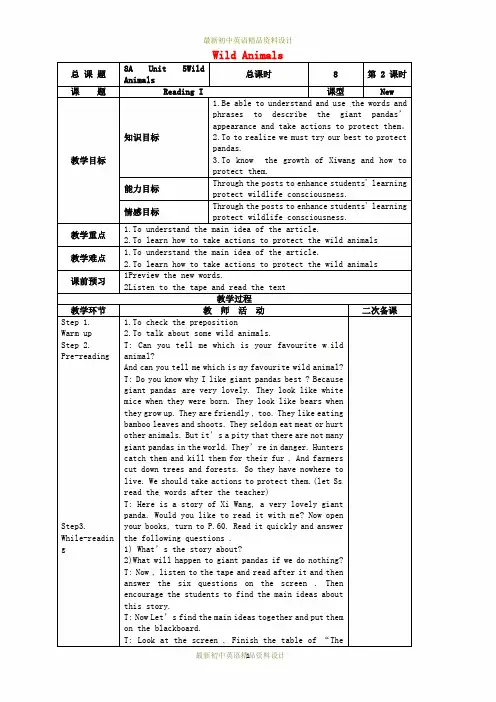
Wild Animals总课题8A Unit 5WildAnimals总课时8 第 2 课时课题 Reading I 课型New教学目标知识目标1.Be able to understand and use the words andphrases to describe the giant pandas’appearance and take actions to protect them。
2.To to realize we must try our best to protectpandas.3.To know the growth of Xiwang and how toprotect them.能力目标Through the posts to enhance students' learningprotect wildlife consciousness.情感目标Through the posts to enhance students' learningprotect wildlife consciousness.教学重点1.To understand the main idea of the article.2.To learn how to take actions to protect the wild animals教学难点1.To understand the main idea of the article.2.To learn how to take actions to protect the wild animals课前预习1Preview the new words.2Listen to the tape and read the text教学过程教学环节教师活动二次备课Step 1. Warm up Step 2. Pre-readingStep3. While-readin g 1.To check the preposition2.To talk about some wild animals.T: Can you tell me which is your favourite w ild animal?And can you tell me which is my favourite wild animal? T: Do you know why I like giant pandas best ? Because giant pandas are very lovely. They look like white mice when they were born. They look like bears when they grow up. They are friendly , too. They like eating bamboo leaves and shoots. They seldo m eat meat or hurt other animals. But it’s a pity that there are not many giant pandas in the world. They’re in danger. Hunters catch them and kill them for their fur . And farmers cut down trees and forests. So they have nowhere to live. We should take actions to protect them.(let Ss read the words after the teacher)T: Here is a story of Xi Wang, a very lovely giant panda. Would you like to read it with m e? Now open your books, turn to P.60. Read it quickly and answer the following questions .1) What’s the story about?2)What will happen to giant pandas if we do nothing? T: Now , listen to the tape and read after it and then answer the six questions on the screen . Then encourage the students to find the main ideas about this story.T: Now Let’s find the main ideas together and put them on the blackboard.T: Look at the screen . Finish the table of “The最新初中英语精品资料设计1Step4Post-readingStep5 SummaryStep6. Homework growth of Xi Wang”. Catc h more details about XiWang. T: Now please read the passage together . Then finish the exercises on P. 61 Part B And Part C.T: Now , We’ve known the giant pandas very well , They are very lovely and we love them very much . But th ere are fewer and fewer pandas in the world . They’re in danger . Do you know why? Now,work in groups and find out “What problems can a giant panda meet in its life?”Then ask some able students of each group to talk in front of the class. After that,finish the Note-making 2 on the screen.T: Discuss with your partners: What other problems will the giant pandas have? What actions can we take ?And can you have a face to face interview about pandas?Teacher makes a summary that we should take actions to protect gian t pandas.1.Write an articl e about “what’s the relationship between wild animals and human beings?”2.Finish the exercises of reading教学反思最新初中英语精品资料设计2。
牛津译林版八年级上册Unit 5《Wild animals》(Reading 1)教学设计
牛津译林版八年级上册Unit 5《Wild animals》(Reading 1)教学设计一. 教材分析《牛津译林版八年级上册Unit 5 Wild animals》的Reading 1主要介绍了大熊猫的保护以及人们为了保护大熊猫所做出的努力。
文章以故事的形式展开,让学生在了解大熊猫的同时,也能感受到人与自然和谐共生的重要性。
通过本课的学习,学生可以提高自己的阅读理解能力,学会珍惜和保护动物。
二. 学情分析八年级的学生已经具备了一定的英语基础,对于故事性的文章兴趣较高。
但部分学生在阅读理解上还存在一定的困难,需要教师的引导和帮助。
此外,学生对于野生动物的保护意识有待提高。
三. 教学目标1.知识目标:学生能够掌握文章中的关键词汇和句型,理解文章的主旨大意。
2.能力目标:学生能够运用所学知识进行阅读理解和口语表达。
3.情感目标:学生能够增强对野生动物的保护意识,培养与自然和谐共生的观念。
四. 教学重难点1.重点:学生能够掌握文章中的关键词汇和句型,理解文章的主旨大意。
2.难点:学生能够运用所学知识进行阅读理解和口语表达,提高对野生动物的保护意识。
五. 教学方法1.任务型教学法:通过设置各种任务,引导学生积极参与课堂活动,提高学生的阅读理解和口语表达能力。
2.情境教学法:创设各种情境,让学生在真实的语境中学习和使用英语。
3.情感教学法:通过文章的学习,引导学生关注野生动物的保护,培养学生的环保意识。
六. 教学准备1.教师准备:提前熟悉教材,了解文章的内容和结构,准备相关的教学材料和课件。
2.学生准备:预习文章,了解文章的大致内容,查阅生词。
七. 教学过程1.导入(5分钟)教师通过展示一些关于野生动物的图片,引导学生谈论野生动物,激发学生的学习兴趣。
然后,教师简要介绍大熊猫的特点,引出本课的主题。
2.呈现(10分钟)教师快速呈现文章的标题和图片,让学生猜测文章的内容。
然后,教师朗读文章,学生跟读并注意生词的发音。
牛津译林版英语八上Unit 5《Wild animals》(Reading1)教学设计
牛津译林版英语八上Unit 5《Wild animals》(Reading1)教学设计一. 教材分析牛津译林版英语八上Unit 5《Wild animals》(Reading 1)主要介绍了野生动物的特点、生活习性和面临的威胁。
本节课的主要内容是阅读一篇关于非洲象的阅读材料,通过阅读让学生了解非洲象的生活习性和面临的困境。
教材还包括了词汇表、阅读理解题和写作任务,旨在提高学生的阅读理解能力和写作能力。
二. 学情分析学生在学习本节课之前已经学习了动物相关的词汇和表达方式,具备一定的阅读理解能力。
然而,部分学生对野生动物的生活习性和面临的威胁了解不多,可能对阅读材料的理解存在一定的困难。
因此,在教学过程中需要关注学生的个体差异,合理调整教学难度,引导学生在课堂上积极思考和参与。
三. 教学目标1.知识目标:–掌握课文中的关键词汇和表达方式。
–理解阅读材料的主旨大意,了解非洲象的生活习性和面临的威胁。
2.能力目标:–提高学生的阅读理解能力,能够通过阅读获取和处理信息。
–培养学生的写作能力,能够运用所学知识进行写作表达。
3.情感目标:–增强学生对野生动物保护的意识,培养学生的环保意识。
四. 教学重难点•课文的理解和阅读技巧的运用。
•词汇和表达方式的掌握。
•对阅读材料深层次含义的理解。
•写作任务的完成。
五. 教学方法1.任务型教学法:通过设定具有挑战性的任务,激发学生的学习兴趣,培养学生独立思考和合作交流的能力。
2.情境教学法:创设真实、生动的情境,使学生在实际情境中学习和运用英语。
3.交际法:通过师生互动、生生互动,提高学生的口头表达能力。
4.启发式教学法:引导学生主动探索,发现问题,培养学生的自主学习能力。
六. 教学准备1.教师准备:–熟悉教材,明确教学目标和要求。
–准备相关的教学资源和素材。
2.学生准备:–预习课文,提前了解课文内容。
–准备笔记本,记录课堂笔记。
七. 教学过程1.导入(5分钟)–教师通过提问方式引导学生回顾已学的动物相关知识,激发学生的学习兴趣。
最新【牛津译林版】八年级英语上册:Unit 5 Wild animals Reading II课件
S1
S2
1. What does Xi Wang mean? It means “hope”.
2. What did she look like when she
was born?
She looked like a white mouse.
3. What could she do when she was
bear bore born
What could she do when she was 4 months old?
She started to go outside for the first time.
verbs + to-infinitives
More such words:
agree begin decide fail forget hope prepare learn remember try want plan
in the protected areas.
Challenge yourselves
Translate the following sentences into English
1.现在大多数野生动物都面临严重的问题。 Most wild animals are facing serious problems now.
Unit 5 Wild animals Reading (II)
How much do you know about Xi Wang?
What did she look like when she was born?
When she was born / At birth, it looks like a white mouse. bear vi [beə(r)] 生(小孩)
牛津译林版八年级英语上册课件《Unit5 Wild Animals》(reading 1)(共28张PPT) (1)
When the buying stops, the killing can too.
Where there is Xi Wang, there is hope. If we really do something for pandas, the world will be hopeful.
Protecting wild animals is protecting ourselves!
1.Tell something about Xi Wang to your friend. 2.Finish some exercises on the workbook.
Discussion: What action can we take to protect wild animals? Collect money to help p them. Don’t buy fur r coats any more. Stop o eating their meat. Stop t hunting them. Make the sky blue, e make the grass green. Don’t c cut down trees. Stop the farmers taking t the land. Build more reserves Make some laws to protect them
more panda reserves 2.Build _____________________. to protect pandas 3.Make laws _________________. Do you have more ways to protect giant pandas ? Plant more bamboo 4. _____________________________ Stop people cutting down bamboo forests 5.______________________________