
2019版高中英语人教版必修二课件:Unit 1 Writing
[写作要点] 1.第一段介绍讨论的主题(已给出); 2.第二段介绍有80%的学生喜欢阅读幽默的英语故事,并 说明理由; 3.第三段介绍另外的20%的学生不喜欢阅读幽默的英语故 事,并说明理由; 4.第四段表明自己的观点,并说明理由。
范文示例
Yesterday afternoon, we held a discussion about whether students like reading humorous English stories or not.
2.要做到要点完整,条理清晰。各段之间层次清楚,以使 文章显得有条理。从文章结构层次上讲,通常采用三段式。
3.正确定位时态,常用一般现在时。行文时要注意关联词 的使用,并选择使用恰当的表达方式,如复合句、反问句、祈 使句等,使文章不落俗套。
4.准确使用常用词汇与结构,使文章更地道。
[典型句式] ★文章开头常用语
1.幽默故事很难读 懂,这会使人厌烦; 2.幽默故事往往短 小,学生通过幽默故 事学到的词汇和句型 少; 3.中国学生很难体会 到故事的幽默所在。
……
注意:1.词数 100 左右; 2.短文的开头已给出,不计入总词数。 参考词汇:technique 技巧 Yesterday afternoon,we held a discussion about whether students like reading humorous English stories or not.
80% of the students are fond of reading humorous English stories.They think this kind of stories are so interesting that more and more students will be interested in English reading.Besides, not only can these stories entertain students, but also they may give them knowledge.In addition, they teach them how to use the technique of humor.
However, 20% of the students show no interest in them.They find these stories boring and hard to understand.Also, they say they learn few new words and useful sentence structures from those short English stories.More importantly, they feel it difficult for Chinese students to follow the humor in these stories.
最近,英语老师让同学们组织了一场题为“你是否喜欢阅 读幽默的英语故事”的讨论。请根据下面的讨论结果,用英语 写一篇短文。
80%喜欢
20%不喜欢
你的观点
1.这种故事内容有趣,可以 增加学生的阅读兴趣,使喜 欢阅读的同学增多; 2.以使用 的幽默技巧。
亮点点评
(1)本文思路清晰、行文流畅、过渡自然,而且熟练地使用 了一些高级句型及结构,如:第二段的第二句使用了so...that... 引导的结果状语从句,第二段的第三句使用了not only...but also...结构,且not only...位于句首,第一个分句用部分倒装。 第三段的第二句使用了“find+宾语+宾补”结构,第三段的 最后一句“they feel it...”中的it在此作形式宾语,后面的不定 式作真正的宾语。在最后一段的第二句中,“Having a laugh every day”为动名词短语作主语。
★陈述反方观点常用语 Others hold a different view/hold the opposite opinion/have different
opinions. However, the others are strongly against it.
★陈述个人观点常用语 In my opinion/As for me/Personally speaking, it is a good idea... My point of view is that... As far as I'm concerned, every coin has two sides.
Personally speaking , I enjoy reading humorous English stories.Having a laugh every day is really beneficial to people,and I think it is good for people to appreciate humor.
Writing
如何写观点对比类议论文
议论文是通过剖析事物来论述事理、发表意见或提出主张 的一种文体,要求作者通过摆事实、讲道理、辨是非确定其观 点的正确或错误,树立或否定某种观点或主张。观点对比类议 论文是从正反两方面辩证地说明某个观点。
1.观点对比类议论文的结构通常为:①提出问题;②陈述 不同的观点及其理由;③说明自己的观点。
Recently we have had a discussion/debate... Some people are in favor of... Other people are against... There are different opinions among people as to... Different people have/hold different views/opinions on this problem. ★陈述正方观点常用语 Some people hold the opinion that ... People who are for the idea think that...
Unit2+Reading+for+writing+课件高中英语人教版(2019)必修第二册
give facts
What is being done?/ What can we do?
What is the current situation?
opinion What is the meaning or importance?(negative effect&benefit) Tell the readers what you want them to think and do.
Activ.4 Learn to make a poster about an endangered animal.
Step 1: Choose one of the animals below or one of your own. Do some research to add to the animal fact sheet.
The second has a cute picture and the headline is written as if the koalas were speaking to the reader which may make them more sympathetic.
show eye-catching pictures give short but powerful headlines point out the serious/ emergent problems
panda, alligator pangolin, leopard tiger, elephant, gorilla, turtle rhino, whale, polar bear
Activ.4 Learn to make a poster about an endangered animal.
2023届高三英语一轮复习人教版(2019)必修第二册各单元主题写作课件

必修二
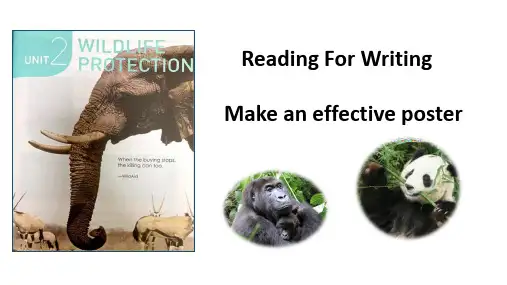
Unit 1 Cultural heritage Writing: A news report about cultural heritage protection (新闻报道) Unit 2 Wildlife protection Writing: A poster about an endangered species(倡议书) Unit 3 The internet Writing: A blog post about online safety (关于网络安全) Unit 4 History and traditions Writing: A description of a beautiful or unusual place Unit 5 Music Writing: A speech about how me
Unit 4 History and traditions
Writing: A description of a beautiful or unusual place
(2019)人教版高中英语必修一Welcome Unit-Writing 课件(part one)

[文体指导] 本单元的写作项目属于新课标中应用体类别中的“自我简 介”。这种题目要求我们对自身的客观条件,个性特征及未来的理 想目标等进行描述整合—直接交代自己的姓名、年龄、身高和就 读学校等。 2.主体(body)——介绍自己的性格特点、爱好和学习风格、并 适当说明原因。 3.结尾(ending)——写出自己对未来的理想或计划。
[妙笔成篇] ______________________________________________________ ______________________________________________________ ______________________________________________________ ______________________________________________________ ______________________________________________________ ______________________________________________________ ______________________________________________________ ______________________________________________________
Ⅱ.巧用句式语法 (一)完成句子 1.I have __a_n__o_u_t_g_o_in_g__p_e_r_s_o_n_a_l_it_y_, so I like taking part in all kinds of sports. 我性格外向,因此喜欢参加各种体育运动。(so 引导的状语从句) 2.I a_m___c_u_r_i_o_u_s_a_b__o_u_t everything new around me. 我对周围的一切新事物充满好奇。(不定代词+形容词)
2019人教版高中英语必修二Unit 1 公开课课件

4.关系代词在从句中作宾语 e.g. The book __th_a_t_/_w_h_i_c_h_/X___ I bought yesterday is on the desk.
2.where引导定语从句
where表示地点, 代替先行词并在定语从句中做_地__点__状__语_,其先行词往往是
具__体_地__点__名词place, room, mountain, airport或抽__象__地__点__名__词__如case, state,
condition, point, situation等。
9. 关系代词宜用that不用which的情况
1. 当先行词是all,much,anything,something,everything,nothing,little, few等不定代词时:
There was not much (that) we could do when it was raining. 下雨的时候我们能做的事不多。
That is all that works. 这就是所有的工作。
2. 当先行词为序数词/形容词最高级,或被序数词/形容词最高级修饰时:
The old woman, who lives on her own, has a cat for company. 这位独自居住的老妇人,养了一只猫陪伴她。
1. 我去年买了这栋房子,它有一个漂亮的花园。 The house, __w__h_ic_h__I _b_o_u_g_h_t _la_s_t _y_e_a_r _____ has a lovely garden. 2. 第一次遇见怀特先生的时候,是在我生命中一个非常艰难 的时期。 The time___w_h_e_n_I_f_ir_s_t _m_e_t_M__r._W__h_it_e____was a very difficult period of my life.
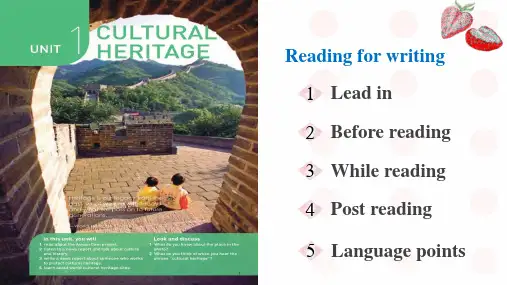
Unit 1 Reading for Writing 课件-高一英语人教版(2019)必修第二册

2. Why are so many people interested in the Mogao Caves?
3.What do you think of the researcher's opinion in the last paragraph?
Review
新闻报道是记叙文的一种,其特点是以事实为依据, 对人的经历或事实给予明确的、实事求是的报道。
A. Lead sentence (导语) B. Direct quote (直接引用语) C. Paraphrase (解释) D. Background information (背景信息) E. Reporting verbs (引述动词) F. Words to show comparison and/or contrast
what
Underline the relative clauses that the writer uses to identify the following.
things people time
things
Relative clauses makes the expression briefer and informative.
This activity was surely a great success. It not only aroused more students' interest in protecting the Great Wall ,but also made more people realize the importance of protecting other cultural relics.
success. It not only...but also ...
人教版2019高中英语必修第二册 unit1 Reading for writing
妙笔成篇
One possible version: How to Protect Traditional Chinese Culture?
In order to encourage us students to protect traditional Chinese culture, a heated discussion was held in the lecture hall of our school on April 10th.
I_t_i_s__ti_m_e__f_o_r_u_s__t_o_s_p_a_r_e__n_o__ef_f_o_r_t _t_o_p__ro_t_e_c_t_t_r_a_d_i_ti_o_n_a_l _C__h_in_e_s_e c_u_l_tu__re_.__________________________________________________
I_t__is__h_i_g_h__t_im__e__th__a_t _w__e__sp__a_re_d__n__o__e_ff_o_r_t_t_o__p_r_o_t_e_c_t _t_r_a_d_i_ti_o_n_al C__h_in__es_e__c_u_lt_u_r_e_.__________________________________________
4.It is reported that the local government will take action to protect cultural heritage in this area. 据报道当地政府将采取措施保护本地区的文化遗产。 5.With their efforts, more and more people become concerned about protecting cultural relics. 在他们的努力下,越来越多的人关心文化遗产的保护。
【课件】Unit+5Reading+for+writing+课件高中英语人教版(2019)必修第二册
Para 4 ... when we feel sad or alone.
Summary
Para.1: Introduction and topic Para.2: Problem: disease
Solution: listen to music Para.3: Feelings: ... Para.4: Hope
Give a brief summary about your experience: what you have learnt/ how it made you feel.
✓ However,music is like an old friend. Music is like sunshine. Music is like a special language that everyone can understand.
MUSIC
Learn useful expression.
强调音乐的作用,重申主题
sad or alone. During those times, music canRheelpaydoiuningthef osamr e wwaryi tthiant igt
呼吁
helped me. I hope all of you will somehow/ˈSsʌmo hnaʊ/g begin to treasure music
MUSIC
Learn for good expressions.
✓ The song made me feel so much better that from then on I began to listen to music all the time.
✓ When I knew the news, I cried with tears pouring down my cheeks like spring.
Unit 1 Vocabulary1课件-高中英语人教版(2019)必修第二册
②There were more than 300 applications (apply) for this six jobs.
③The nurse applied some medicine
to
her burn.
7. take part in 参与(某事);参加(某活动)
join 指加入某个组织成为其中一员;还可表示加入某人一起。
join in 指参加正在进行的活动。
指参加群体性活动并在其中起积极作用。part前有修饰 take part in 时,要指出席会议、婚礼、典礼; 听报告、讲座等。
◆单句填空 ①When did your brother __jo_i_n_ the army? ②Will you _j_o_in___us in the discussion? ③Come along, and__j_o_in__ the ball game. ④We'll _t_a_k_e__p_a_r_t _in__ social practice during the summer vacation. ⑤He'll _a_t_t_e_n_d_ an important meeting tomorrow.
adj.后面的;(两者中)后者的
5.___c_lu_e______ n.线索;提示
6 . __p_re_s_e_rv_e____ vt. 保 存 ; 保 护 ; 维 持 n. 保 护 区 →__p_r_es_e_r_va_t_io_n_ n.保护;保存
7.__p_r_o_m_o_t_e___ vt.促进;提升;推销;晋级→__p_r_o_m_o_t_io_n__ n.促进;提升
8.__a_p_p_______ n.应用程序;应用软件→__a_p_p_li_ca_t_io_n__ n.申 请(表);用途;运用;应用(程序) → ____a_p_p_ly____ vt.涂;敷;搽; 应用;运用 vi.申请;请求;使用;有效→__a_p_p_l_ic_a_n_t__ n.申请 人
高中英语人教版(2019) 必修第二册 Unit 1
3. Read the text again and answer the questions.
(1). Why did the Egyptian government want to attempt the building of the dam?
Inspiration 1. global community
2. team spirit
6. Retell the passage according to the chrnment asks the UN for help
They wanted to control floods and bring electricity and water to more farmers to help economic development.
(2). How were the temples and other cultural sites saved?
They were taken down piece by piece and moved to other places where they could be safe from the water.
(3). How long did it take to complete the project?
1950s time period 1959 year 1960 year 1961 year 20 time period 22 amount of something
2. Scan the text again and find out the topic sentence or key sentence of each paragraph.
2019统编人教版高中英语必修第二册unit-1《Cultural-Heritage》全单元教案教学
【2019统编版】人教版高中英语必修第二册Unit 1《Cultural Heritage》全单元备课教案教学设计Unit 1 Cultural HeritagePeriod 1 Listening and Speaking【教材分析】Listening and Speaking introduces the topic of “Take part in a youth project”.The listening text is an interview about an international youth cultural heritage protection project. More than 20 high school students from seven countries participated in the project. The reporter interviewed two participants Stephanie and Liu Bin. By listening to the text, students can understand the significance of cultural heritage protection, and teenagers can use their knowledge, combine their own interests and advantages, etc. to participate in the action of cultural heritage protection.Listening and Talking introduces the theme of “Talk about history and culture”.The listening text is a dialogue between two tourists and tour guides when they visit the Kremlin, Red Square and surrounding buildings. The dialogue focuses on the functional items of “starting a conversation”, which is used to politely and appropriately attract the attention of the others, so as to smoothly start a conversation or start a new topic. The purpose of this section is to guide students to understand the history and current situation of Chinese and foreign cultural heritage in their own tourism experiences or from other people’s tourism experiences, explore the historical and cultural values, and be able to express accurately and appropriately in oral communication.【教学目标】1. Guide students to understand the content of listening texts in terms of the whole and key details;2. Cultivate students’ ability to guess the meaning of words in listening; discuss with their peers how to participate in cultural heritage protection activities.3. Instruct students to use functional sentences of the dialogue such as “I beg your pardon, but…” “Forgive me for asking, but…” and so on to start theconversation more politely and appropriately.【教学重难点】1. Guide students to understand the content of listening texts in terms of the whole and key details;2. Cultivate students’ ability to guess the meaning of words in listening; discuss with their peers how to participate in cultural heritage protection activities.3. Enable students to use the functional items of “starting a conversation”, which is used to smoothly start a conversation or start a new topic.【教学过程】Part 1: Listening and SpeakingStep 1: Lead inThe teacher is advised to talk about the meaning of the word “Heritage”.Boys and girls, before our listening, let’s work in pairs and discuss the meaning of the word “Heritage”.What does the word “heritage” mean? Share your ideas about your understanding of it and you can use examples to illustrate your meaning.Heritage means the traditional beliefs, values, customs, etc. of a family, country or society.For example, the Great Wall is the heritage of China.Step 2: PredictionAfter their small talk, the teacher can ask students to predict what the listening text is about by looking at the pictures.The listening text is probably about how to protect a famous heritage site by some students.Step 3: Summary of the main ideaThen play the radio which is about an interview about an international youth cultural heritage protection project. And after finishing listening for the first time, the students need to solve the following tasks.1. Listen to the conversation and sum up the main idea.Youths from seven countries are working together to protect cultural relics on Mount Tai.2. Listen again and help the reporter to complete the interview notes.International youth project, 23 high school students from 7 countriesMount Tai, one of the most famous mountains in ChinaIt has been protected for more than 3,000 years.22 temples, around 1,800 stones with writing on themStep 4: Guessing the meaning of the unknown wordsListen to the conversation again and use the context to guess the meaning of the words below. Tell the reasons why you guess so.Preserve: to protectReason: the word means the same of a word I knowPromote: to help sth to happen or developReason: The word is explained by the speakerStep 5: Speaking ProjectWork in pairs or groups and role play a conversation.Suppose you are a reporter and interviewing the students who devote their time to protecting the heritage.Reporter: It is said that you are one of the volunteers to preserve the pine trees on Mount Huang. What are you guys doing?V olunteer: We are making some signs which are designed to educate people to protect the pine trees.V olunteer: Besides, we took a lot of pictures of pine trees and create an app which aims to promote people’s awareness of protecting the precious trees.Reporter: Sounds great and anything else?V olunteer: We often wear volunteer clothes and send some brochures in the park to call on more people to protect the trees.Reporter: Does your hard work pay off?V olunteer: Definitely. More and more tourists are now stopping carving names on the trees or climbing the trees.Part 2: Listening and TalkingStep1: Listen to the tape, which is about a dialogue between two tourists and a tour guide when they visit the Kremlin, Red Square and surrounding buildings for the first time, and then ask the students to solve the following tasks.1. Listen to the conversation and answer(1).Where are the speakers?On a street.(2).What are they doing?Sightseeing.2. What do you know about the Kremlin and Red Square? Listen again and complete the fact sheet.Step 2: Speaking ProjectActivity 3 on page 7.Work in groups. Choose a cultural site that you like and role-play a conversation between some tourists and their tour guide. Take turns to play the different roles.Step 3 HomeworkAccording to Activity 3, write down a conversation between the tourist and his/her guide.Unit 1 Cultural HeritagePeriod 2 Reading and Thinking【教材分析】1. This section focuses on “Understanding how a problem was solved”, which is aimed to guide students to analyze and discuss the challenges and problems faced by cultural heritage protection during the construction of Aswan Dam, as well as the solutions. On the basis of understanding, students should pay attention to the key role of international cooperation in solving problems, and attach importance to the balance and coordination between cultural heritage protection and social and economic development. Students are encouraged to face challenges actively, be good at cooperation, and make continuous efforts to find reasonable ways and means to solve problems.【教学目标】1. Enable students to understand the main information and text structure of the reading text;2. Motivate students to use the reading strategy “make a timeline” according to the appropriate text genre;3. Enable students to understand how a problem was solved;4. Enable students to understand the value of protecting cultural heritage by teamwork and global community;【教学重难点】1. Guide students to pay attention to reading strategies, such as prediction, self-questioning and scanning.2. Help students sort out the topic language about protecting cultural relics and understand the narrative characteristics of “time-event” in illustrative style3. Lead students to understand the value of protecting cultural heritage by teamwork and global community;【教学过程】1. PredictionStep 1 Predicting the main idea of the passageLook at the title and the pictures, and then predict what the passage will be about.Q: What will be talked about?Step 2: Fast reading tasksTask of the first fast reading:Read quickly and figure out the key words of each paragraph.•Paragraph 1: challenge•Paragraph 2: proposal led to protests•Paragraph 3: committee established•Paragraph 4: brought together•Paragraph 5: success•Paragraph 6: spiritTask of the second fast reading:1. Why did the Egyptian government want to build a new dam in the 1950s?2. Why did the building of the dam lead to protests?3. How did the government save the cultural relics?4. Which one can describe the project?A. Successful.B. Negative.C. Useless.D. Doubtful.5. What can be learned from the Aswan Dam project?Step 3: Careful reading tasksRead more carefully and answer the following questions.1. What do “problems” refer to and what do “solutions” refer to?2. Find out the numbers in paragraph four and explain why the author used exact numbers instead of expressions like many?3. What can you infer from “Over the next 20 years, thousands of engineers and workers rescued 22 temples and countless cultural relics”?4. What can you infer from “Fifty countries donated nearly 80 million to the project”?The project cost a lot of money.5. Before the building of the dam, what problems did the Nile River bring to theEgyptian?6. What words can you think of to describe the working process of the project?Step 4: ConsolidationDivide the passage into three parts and get the main idea of each part.Part 1 (Paragraph 1)The introduction of the topicKeeping the right balance between progress and the protection of cultural sites is a big challenge.Part 2 (Paragraphs 2-5)The process of saving cultural relics•Big challenges can sometimes lead to great solutions.•The Egyptian government wanted to build a new dam, which would damage many cultural relics.•The government turned to the UN for help.•Experts made a proposal for how to save cultural relics after a lot of efforts and the work began.•Cultural relics were taken down and moved to a safe place.•Countless cultural relics were rescued.•The project was a success.Part 3 (Paragraph 6)The summary of the textThe global community can sometimes provide a solution to a difficult problem for a single nation.Step 5: Critical thinking:1. How to deal with the construction and the protection of cultural relics?2. As students, what should we do to protect our cultural relics?Step 6: summaryStep 7 Homework:Review what we have learned and find out the key language points in the text.Unit 1 CULTURAL HERITAGEReading for Writing【教学目的与核心素养】1. Get students to have a good understanding of some features about a news report by reading the text.2. Instruct students to write a summary about a news report properly using some newly acquired writing skills in this period.3. Develop students’ writing and cooperating abilities.4. Strengthen students’ great interest in writing discourses.【教学重难点】1. Stimulate students to have a good understanding of how to a summary about a news report2. Cultivate students to write a news report properly and concisely.【教学过程】Step 1 Lead inDo you think it is necessary for us to circulate our cultural heritage to the world? Why or why not?Do we need to learn more about other countries’ cultural heritage? Why or why not?Step 2 Read to discover details concerning the main body of the news report Read the news report and then solve the questions below.1. What are the researchers and scientists trying to do?(The researchers and scientists are trying to increase knowledge and appreciation of China’s ancient cultural heritage.)2. What modern technology are they using?(They are using digital photography to record a collection of images.)3. Why are so many people interested in the Mogao Caves?(People are interested in the Mogao Caves because they have long been a meeting point for different cultures and are part of the history of many countries.)4. What do you think of the researcher’s opinion in the last paragraph?(I agree with the researcher’s opinion. Understanding our own and other cultures is a great way to understand ourselves and others.)Have the Ss discuss the questions in groups and then share their answers to the class.Step 3: Study the organization and language features1. Read the news report again and find these parts.A. Lead sentenceLanzhou, 9 August 2017. A group of researchers and scientists from China and other countries are working together ... China’s ancient cultural heritage.B. Direct quote“Appreciating one’s own cultural heritage is very important for understanding ourselves. Appreciating the cultural heritage of other countries is very important for international communication and understanding.”C. ParaphraseThey are recording and collecting digital images of cultural relics from the Mogao Caves, which were a key stop along the Silk Road throughout China’s ancient history. Nearly 500,000 high-quality digital photographs have been produced since the international project started in 1994.D. Background informationThe Mogao Caves have long been a meeting point for different cultures and are part of the history of many countries.E. Reporting verbsF. Words to show comparison and/or contrastToday, the caves are just as interactional as they were at the time when people travelled the Silk Road.2. Underline the relative clauses that the writer uses to identify the following.A. thingsThey are recording and collecting digital images of cultural relics from the Mogao Caves, which were a key stop along the Silk Road throughout China’s ancient history.B. peopleAs one researcher who is working on the project explains, “Appreciating one’s own cultural heritage is very important for understanding ourselves. Appreciating the cultural heritage of other countries is very important for international communication and understanding. ”C. timeToday, the caves are just as interactional as they were at the time when people travelled the Silk Road.Step 4 Post reading for further summary and understanding1. Why does the writer use the quote in the report?The writer uses quotes in order to make the news report more concise, authentic and persuasive.2. Explain your understanding of the sentences: “Appreciating one’s own cultural heritage is very important for understanding ourselves. Appreciating the cultural heritage of other countries is very important for international communication and understanding.”We should learn and understand our own cultures, which is vital for us to know ourselves and be proud of our profound and extensive cultural heritage. Meanwhile, we should understand and appreciate other cultures, trying to be open-minded. This way, we can deepen each other’s understanding and respect.Step 5 HomeworkWrite a news report about Li Hua who works to protect our cultural heritage using the following notes and you can add details to make the news report more concise and detailed.▪Name: Li HuaPlace: Xi’anProfession: a senior high school teacher▪wants to preserve cultural heritage:▪protect old houses▪takes photos of old buildings▪helps repair buildings▪looks for cultural relics▪ interviews old people▪ shows cultural relics to the public ▪ writes about the buildings …Section ⅤWriting关于文化遗产保护的新闻报道文体感知1.新闻报道是对最近发生的重大事件、重要人物进行简要而迅速地报道。