
高中英语Module4《Music》教案外研版选修6
of Chinese and western musical instruments and answer the following
ts “How many kinds of music do you know? ”
Then ask them to speak the general categories about music as follow:
Rock music
Popular music
Classical music
Jazz Folk music
xpress their opinions
freely.
And then, develop the Ss ’ speaking ability by practicing saying the
familiar topic as follows:
Activity 1
Work in groups of four to answer the questions and make a list of your answers:
Liang zhu (梁祝)
played by violin or Guzheng for the students to listen. Then ask them
“What kind of musical instrument is the piece of music played by?
”
Next, brainstorm ykinds of musical
music
Symphony
Traditional Chinese music
After this, continue to ask the students
“Which kind of music do you
like best? Why? ” to encourage the students to e
Activity 2
Write a short report about the music interests and habits of your group. Use these
expressions:
My favo urite kind of music is
…but Yang ’s favorite music is …
1. What is your favourite kind of music?
2. How long have you been listening to it?
3. When do you listen to music?
4. How do you listen to music?
5. Why do you listen to music?
2. Enable the students to recognize some musical instruments.
3. Arouse the students ’ interests in music.
Teaching procedures:
Speaking
Lead-in
Firstly, ask the studen
instruments do you know? ” At the same time, in ord
er to make the
students know about someEnglish vocabulary related to music, show the
students some pictures and ask them to recognize the musical
3. To develop the Ss ’ speaking ability by practicing saying the familiar
topic.
Important and difficult points:
1. Get the Ss to know about as much music knowledge as possible.
instruments as follows:
brain-storming: Are you familiar with these instruments?
piano
drum
Musical instruments
violin
erhu
After this, say to the students, “Most of you are familiar with these musical instruments. Today we ’ll know more Chinese and western musical instruments. Now let ’s know more musical instruments. ”
Module 4 Music
Teaching aims:
1. To know about some English vocabulary related to music.
2. To have a discussion about music and express their own opinions freely.
flute
Step 2. Activity 1
guitar
saxophone
Continue telling the Ss that the following photos are almost the same
with those of their book on page 31. And ask them to look at the photos
My favorite artist is
…
I ’ve been listening to music …for/since …
I like listening to music when I
’m…
Introduction
Step 1. Leading-in
Firstly, lead in by playing a piece of music
高中英语 Module 4 Music单元小结教学案 外研版选修6

Module 4 MusicNo music, no life! Music can help us relax,give life to those who are depressed and offerrelief from a day's hard work. Most people likeappreciating music or dancing to the music.Today we'll introduce a band and a pipa andguzheng soloist.The band is named Twelve Girls Band, founded in June 2001. At first it wasn't famous, but all of a sudden it became popular in Japan. Now the band has become one of the most popular groups at home and abroad. The members of Twelve Girls Band come from such famous colleges and universities as China Academy of Music and Central Conservatory of Music.Drawing upon over 1,500 years of Chinese music, the band charms the world. They have been presented with awards many times. Their records have become its fans' collections. The band honours its music heritage and shows a genuine love for all styles of music.The soloist is Liu Fang, an international music star.In addition to pipa, she also plays guzheng. She is good at playing folk songs. Meanwhile, she combines Chinese traditional music with western music. Liu Fang had a great gift for music as a child, therefore her mother sent her to play pipa. She has given concerts since 11. While playing pipa, the biggest challenge is to respect traditions and add her own style. The same is true of guzheng. Now, Liu Fang lives in Canada, where she often makes contacts with master musicians, sharing feelings and ideas with them. She's also voluntary to give some bands directions.Regarding her ambition she wants to compose music and introduce Chinese classical music to every corner of the world.没有音乐就没有生命。
外研版选修6 Module 4 music 教案
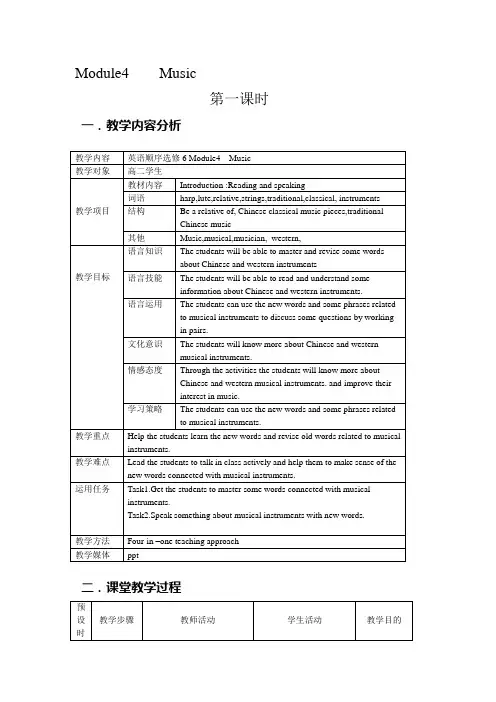
Module4 Music
第一课时一.教学内容分析
二.课堂教学过程
三.板书设计
四.教学反思
第二课时一.教学内容分析
二.课堂教学过程
三.板书设计
四.教学反思
第三课时
一.教学内容分析
二.课堂教学过程
三.板书设计
四.教学反思
第四课时一.教学内容分析
二.课堂教学过程
三.板书设计
四.教学反思
第五课时一.教学内容分析
二.课堂教学过程
三.板书设计
四.教学反思
第六课时一.教学内容分析
二.课堂教学过程
三.板书设计
四.教学反思
第七课时一.教学内容分析
二.课堂教学过程
三.板书设计
四.教学反思
第八课时一.教学内容分析
二.课堂教学过程
三.板书设计
四.教学反思
第九课时一.教学内容分析
二.课堂教学过程
三.板书设计
四.教学反思
第十课时一.教学内容分析
二.课堂教学过程
三.板书设计
四.教学反思。
外研版选修6_Module_4_music_教案-推荐下载

文化意识 The students will know more about Chinese and western musical instruments.
Help the students learn the new words and revise old words related to musical instruments.
教学难点 Lead the students to talk in class actively and help them to make sense of the new words connected with musical instruments.
对全部高中资料试卷电气设备,在安装过程中以及安装结束后进行高中资料试卷调整试验;通电检查所有设备高中资料电试力卷保相护互装作置用调与试相技互术通关,1系电过,力管根保线据护敷生高设产中技工资术0艺料不高试仅中卷可资配以料置解试技决卷术吊要是顶求指层,机配对组置电在不气进规设行范备继高进电中行保资空护料载高试与中卷带资问负料题荷试22下卷,高总而中体且资配可料置保试时障卷,各调需类控要管试在路验最习;大题对限到设度位备内。进来在行确管调保路整机敷使组设其高过在中程正资1常料中工试,况卷要下安加与全强过,看2度并22工且22作尽22下可22都能2可地护1以缩关正小于常故管工障路作高高;中中对资资于料料继试试电卷卷保破连护坏接进范管行围口整,处核或理对者高定对中值某资,些料审异试核常卷与高弯校中扁对资度图料固纸试定,卷盒编工位写况置复进.杂行保设自护备动层与处防装理腐置,跨高尤接中其地资要线料避弯试免曲卷错半调误径试高标方中高案资等,料,编5试要写、卷求重电保技要气护术设设装交备备4置底高调、动。中试电作管资高气,线料中课并3敷试资件且、设卷料中拒管技试试调绝路术验卷试动敷中方技作设包案术,技含以来术线及避槽系免、统不管启必架动要等方高多案中项;资方对料式整试,套卷为启突解动然决过停高程机中中。语高因文中此电资,气料电课试力件卷高中电中管气资壁设料薄备试、进卷接行保口调护不试装严工置等作调问并试题且技,进术合行,理过要利关求用运电管行力线高保敷中护设资装技料置术试做。卷到线技准缆术确敷指灵设导活原。。则对对:于于在调差分试动线过保盒程护处中装,高置当中高不资中同料资电试料压卷试回技卷路术调交问试叉题技时,术,作是应为指采调发用试电金人机属员一隔,变板需压进要器行在组隔事在开前发处掌生理握内;图部同纸故一资障线料时槽、,内设需,备要强制进电造行回厂外路家部须出电同具源时高高切中中断资资习料料题试试电卷卷源试切,验除线报从缆告而敷与采设相用完关高毕技中,术资要资料进料试行,卷检并主查且要和了保检解护测现装处场置理设。备高中资料试卷布置情况与有关高中资料试卷电气系统接线等情况,然后根据规范与规程规定,制定设备调试高中资料试卷方案。
研版高考英语选修6 Module 4《Music》(Introduction)word学案
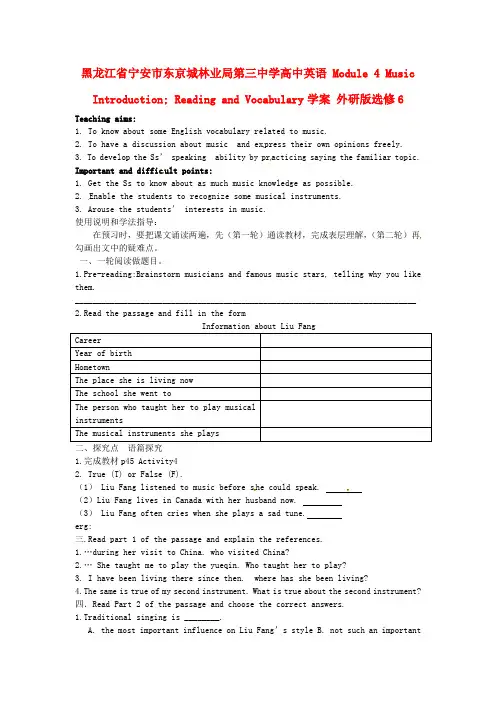
黑龙江省宁安市东京城林业局第三中学高中英语 Module 4 Music Introduction; Reading and Vocabulary学案外研版选修6Teaching aims:1. To know about some English vocabulary related to music.2. To have a discussion about music and ex press their own opinions freely.3. To develop the Ss’ speaking ability by pr acticing saying the familiar topic. Important and diffic ult points:1. Get the Ss to know about as much music knowledge as possible.2. Enable the students to recognize some musical instruments.3. Arouse the students’ interests i n music.使用说明和学法指导:在预习时,要把课文诵读两遍,先(第一轮)通读教材,完成表层理解,(第二轮)再勾画出文中的疑难点。
一、一轮阅读做题目。
1.Pre-reading:Brainstorm musicians and famous music stars, telling why you like them.______________________________________________________________________________ 2.Read the passage and fill in the formInformation about Liu Fang二、探究点语篇探究1.完成教材p45 Activity42. True (T) or False (F).(1) Liu Fang listened to music before s he could speak.(2)Liu Fang lives in Canada with her husband now.(3) Liu Fang often cries when she plays a sad tune.erg:三.Read part 1 of the passage and explain the references.1.…during her visit to China. who visited China?2.… She taught me to play the yueqin. Who taught her to play?3. I have been living there since then. where has she been living?4.The same is true of my second instrument. What is true about the second instrument? 四.Read Part 2 of the passage and choose the correct answers.1.Traditional singing is ________.A. the most important influence on Liu Fang’s styleB. not such an importantinfluence2. When people listen to her playing, _______.A. they also hear her singingB. they think they can hear singing3. Liu Fang thinks that _________.A. Chinese music is like the Chinese languageB. Chinese music and language use the same tones4. Chinese classical pieces often have poetic titles, __________.A. which is understandableB. which is very surprising5. Empty spaces in Chinese paintings _________.A. are like the silent parts of Chinese musicB. mean the pictures haveno life五.Post-reading:1.Suppose you have an interview with a mu sician, what questions will you ask?___________________________________________________________________________2.How will he or she answer your questions?______________________________________________________________________________ 六.课文回顾Liu Fang is an international music star, 1 2 her work with traditionalC hinese instruments. She has 3 4 since he was eleven. After she 5 6 the Shanghai Conservatory of Music, she 7 8 9 her hometown of Kunming and 1011 a pipa soloist of the Kunming Music and Dance Troupe. In 1996, she 12 13 Canada with her husband and she has 14 15 there since then. Since she movedto Canada, she had 16 to 17 18 19 other musical traditions and play with master musicians.反思巩固:二.写出下列单词和短语的汉语意思:1.单词(1) instrument n. (2)interview n.(3)background n. (4) challenge n..(5) combine vt. (6) interpret vt..(7) silence n.. (8)title n.(9)traditional adj.. (10) concert n.(11)conservatory n. (12)repertoire n.((13)soloist n.. ___ __ (14) technique n.(15) n. 亲戚,亲属 (16) n.特征,特性 ___________ ___ (17)n. 诗歌 (18) prep.关于(19) vt.使沮丧,使心灰意冷 (20) n.抱负,雄心2.短语:(1)由于……而出名(2)举办演奏会(3)带某人去看节目(4)民歌(5)与…相似(6)与……有密切联系(7)接触……,与……联系(8)把……介绍给(9)与……分享感受与想法(10)中国传统乐器______________ ______ (11)弹琵琶__________________________(12)赋予生命(13)在公共场合(14)master musician(15)compose music (16) be the same with3.句型:(1)In 1990, when I was 15 years old, I went to the Shanghai Conservatory of Music,where I studied the pipa and the guzheng.(P44)【译文】 1990年,我15岁的时候去了上海音乐学院。
英语:module 4《music》学案(外研版选修6).doc
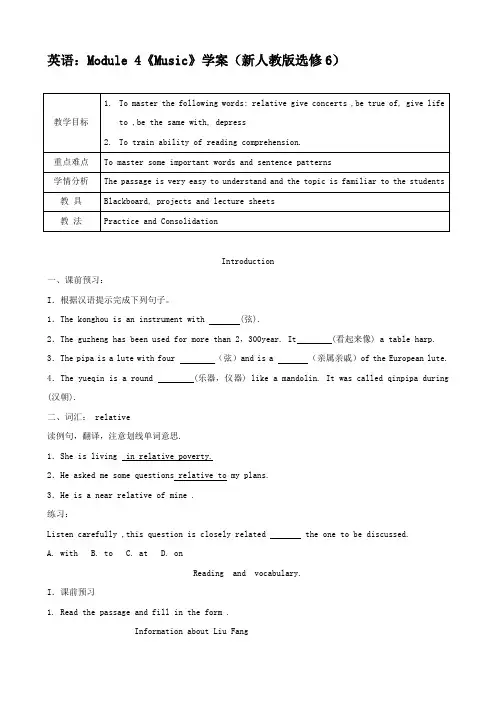
英语:Module 4《Music》学案(新人教版选修6)Introduction一、课前预习:I.根据汉语提示完成下列句子。
1.The konghou is an instrument with (弦).2.The guzheng has been used for more than 2,300year. It (看起来像) a table harp.3.The pipa is a lute with four (弦)and is a (亲属亲戚)of the European lute. 4.The yueqin is a round (乐器,仪器) like a mandolin. It was called qinpipa during (汉朝).二、词汇: relative读例句,翻译,注意划线单词意思.1.She is living in relative poverty.2.He asked me some questions relative to my plans.3.He is a near relative of mine .练习:Listen carefully ,this question is closely related the one to be discussed.A. withB. toC. atD. onReading and vocabulary.I.课前预习1. Read the passage and fill in the form .Information about Liu FangⅡ.Fill in the phrases .1.由于……而出名2.举办演奏会3.带某人去看节目4.民歌5.与……在……方面相似6.与……有密切联系7.给……带来生机8.接触……,与……联系、来往9.把……介绍给10.与……情况相同11.与……分享感受与想法III.读课文,翻译下列短语和句子1.中国传统乐器________________________________________2.强琵琶_____________________________________________3.她毕业于上海音乐学院,1993年还在那里学习弹古筝。
外研版选修六Module4《Music》word教案
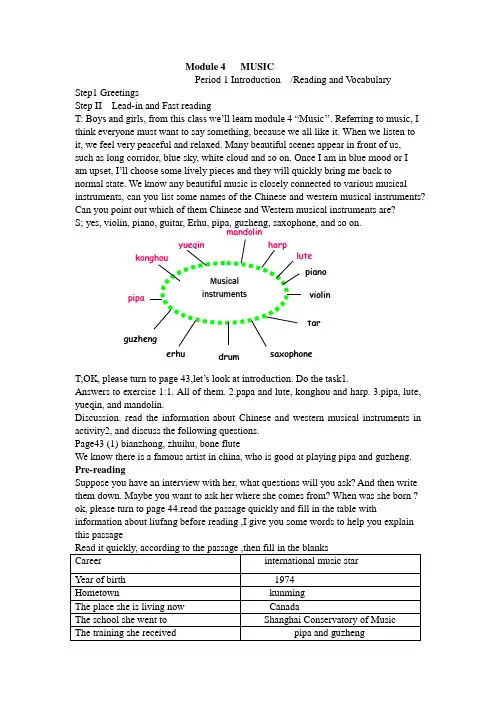
Module 4 MUSICPeriod 1 Introduction /Reading and V ocabularyStep1 GreetingsStep II Lead-in and Fast readingT: Boys and girls, from this class we’ll learn module 4 “Music’’. Referring to music, Ithink everyone must want to say something, because we all like it. When we listen toit, we feel very peaceful and relaxed. Many beautiful scenes appear in front of us,such as long corridor, blue sky, white cloud and so on. Once I am in blue mood or Iam upset, I’ll choose some lively pieces and they will qu ickly bring me back tonormal state. We know any beautiful music is closely connected to various musicalinstruments, can you list some names of the Chinese and western musical instruments?Can you point out which of them Chinese and Western musical instruments are?S; yes, violin, piano, guitar, Erhu, pipa, guzheng, saxophone, and so on.T;OK, please turn to page 43,let’s look at introduction. Do the task1.Answers to exercise 1:1. All of them. 2.papa and lute, konghou and harp. 3.pipa, lute,yueqin, and mandolin.Discussion. read the information about Chinese and western musical instruments inactivity2, and discuss the following questions.Page43 (1) bianzhong, zhuihu, bone fluteWe know there is a famous artist in china, who is good at playing pipa and guzheng.Pre-readingSuppose you have an interview with her, what questions will you ask? And then writethem down. Maybe you want to ask her where she comes from? When was she born ?ok, please turn to page 44.read the passage quickly and fill in the table withinformation about liufang before reading ,I give you some words to help you explainthis passagetar Musical instruments piano violindrum saxophone erhu guzheng lute pipa harp mandolin yueqin konghouRead the passage carefully and find the main idea of each part.PARA1: introduces Liu Fang as well as her musical training and backgroundPARA2: tells about Liu Fang’s musical influences and characteristics of Chinese classical musicPARA3: is about Liu Fang’s love for performing live and her goals as an artist. Then do the task 5.Suggested answers; soloist, technique, tune, concert, repertoire, conservatory.Post-reading finish the task 1.-4Suggested answers:1. The Queen of England 2.Her mother. 3.Canada 4.Pipa school5.To respect traditions but add her own style when playing.2.1.-5: a,b,a,a,a,3.①The atmosphere in a concert hall.②She feels lonely and depressed when there is no concert for along time③She wants to work with master musicians from othertraditions and play with them ,using elements from differentcultures to compose her own music.④She wants to compose her own music, and introduceclassical Chinese pipa and guzheng music to every corner ofthe world.4. combine,title,tune,concert,repertoire,silence,interprets5.Soloist technique,tune ,concert,repertoire, conservatorylanguage points:•1 graduate from 毕业•他去年中学毕业。
高中英语 Module 4 Music教案 外研版选修6
Module 4 Music【美文阅读】Accustomed though we are to speaking of the films made before 1927 as “silent”,the film has never been, in the full sense of the word, silent. From the very beginning, music was regarded as an indispensable(不可缺少的;绝对必要的) accompaniment(伴奏;伴随物); when the Lumiere films were shown at the first public film exhibition in the United States in February 1896, they were accompanied by piano improvisations on popular tunes. At first, the music played bore no special relationship to the films; an accompaniment of any kind was sufficient. Within a very short time, however, the incongruity(不协调;不一致;不适合) of playing lively music to a solemn film became apparent, and film pianists began to take some care in matching their pieces to the mood of the film.As movie theaters grew in number and importance, a violinist, and perhaps a cellist, would be added to the pianist in certain cases, and in the larger movie theaters small orchestras were formed. For a number of years, the selection of music for each film program rested entirely in the hands of the conductor or leader of the orchestra, and very often the principal qualification(资格,授权;条件,限制) for holding such a position was not skill or taste so much as the ownership of a large personal library of musical pieces.Since the conductor seldom saw the films until the night before they were to be shown (if indeed, theconductor was lucky enough to see them then), the musical arrangement was normally improvised in the greatest hurry.To help meet this difficulty, film distributing companies started the practice of publishing suggestions for musical accompaniments. In 1909, for example, the Edison Company began issuing with their films such indications(指示;象征;表明) of mood as “pleasant”,“sad”,“lively”. The suggestions became more explicit, and so emerged the musical cue sheet containing indications of mood, the titles of suitable pieces of music, and precise directions to show where one piece led into the next.Certain films had music especially composed for them. The most famous of these early special scores was that composed and arranged for D.W Griffith's film Birth of a Nation, which was released in 1915.【诱思导学】1.What was the film music like at first?________________________________________________________________________ 2.Which musicians gradually paid attention to film music?________________________________________________________________________ 3.How was the musical arrangement solved then?________________________________________________________________________ 【答案】 1.The music was boring and there was no special relationship to the films. 2.The violinist, the cellist, and the pianist, and in the larger movie theaters small orchestras were formed. 3.Film distributing companies started the practice of publishing suggestions for musical accompaniments.Period ⅠPreviewing(教师用书独具)●教学目标初步掌握本课文中的词汇,浅层次理解课文,了解相关的背景知识。
外研版选修六module4《music》优秀教案(重点资料).doc
外研版选修六module4《music》优秀教案(重点资料).docModule 4 MUSICPeriod 1 Introduction /Reading andVocabularyStep1 GreetingsStep II Lead-in and Fast readingT: Boys and girls, from this class we ’ll learn module 4 “Music ’’.Referring to music, I think everyone must want to say something,because we all like it. When we listen to it, we feel verypeaceful and relaxed. Many beautiful scenes appear in front ofus, such as long corridor, blue sky, white cloud and so on. OnceI am in blue mood or I am upset, I ’ll choose some lively piecesand they will quickly bring me back to normal state. We knowany beautiful music is closely connected to various musicalinstruments, can you list some names of the Chinese and westernmusical instruments? Can you point out which of them Chineseand Western musical instruments are?S; yes, violin, piano, guitar, Erhu, pipa, guzheng, saxophone, and so on.tar Musical instruments piano violin drum saxophoneerhu guzheng lute pipa harp mandolinyueqin konghouT;OK, please turn to page 43,let’s look at introduction. Do the task1.Answers to exercise 1:1. All of them. 2.papa and lute, konghou and harp. 3.pipa, lute, yueqin, and mandolin. Discussion. read the information about Chinese and western musical instruments in activity2, and discuss the following questions.Page43 (1) bianzhong, zhuihu, bone fluteWe know there is a famous artist in china, who is good at playing pipa and guzheng.Pre-readingSuppose you have an interview with her, what questions will you ask? And then write them down. Maybe you want to ask her whereshe comes from? When was she born ? ok, please turn to page 44.read the passage quickly and fill in the table with information about liufang before reading ,I give you some words to help you explain this passageRead it quickly, according to the passage ,then fill in the blanksRead the passage carefully and find the main idea of each part. PARA1: introduces Liu Fang as well as her musical trainingand backgroundPARA2: tells about Liu Fang’s musical influences andcharacteristics of Chinese classical musicPARA3: is about Liu Fang’s love for performing live and her goals as an artist.Then do the task 5.Suggested answers; soloist, technique, tune, concert, repertoire, conservatory.Post-reading finish the task 1.-4Suggested answers:1. The Queen of England 2.Her mother.3.Canada4.Pipa school5.To respecttraditions but add her own style whenplaying.2.1.-5: a,b,a,a,a,3.①The atmosphere in a concert hall.②She feels lonely and depressed when thereis no concert for a long time③ She wants to work with master musiciansfrom other traditions and play withthem ,using elements from differentcultures to compose her own music.④She wants to compose her own music, andintroduce classical Chinese pipa andguzheng music to every corner of theworld.4. combine,title,tune,concert,repertoire,silence,interprets5.Soloist technique,tune ,concert,repertoire, conservatory language points:1 graduate from 毕业他去年中学毕业。
高中英语外研版高中选修6Module4MusicModule4reading教学设计
Module 3 Music教学设计I.The analysis of the reading本模块以“Music”为话题。
学生通过本模块的学习可以了解古今中外的音乐家,提高他们的音乐欣赏水平,培养他们对音乐的评价和鉴赏能力,从而丰富学生的音乐知识,提高学生的艺术修养。
Reading and V ocabulary该部分向同学们介绍了音乐家海顿、莫扎特和贝多芬以及他们的伟大成就。
让同学们在阅读的过程中了解音乐家的奋斗历程,树立正确的人生观和价值观。
通过相关的活动,训练学生的综合语言能力。
II.The key and important points1.教学重点(1)本模块的生词和短语。
(2)弄清楚时间状语从句和过去完成时态的用法。
(3)谈论有关音乐的话题。
2.教学难点(1)学会表达对音乐的喜好。
(2)学习时间状语从句和过去完成时态。
(3)学写有关自己音乐爱好的文章。
III.Teaching Goals:1.To get Ss to master the reading skills of skimming and scanning.2.To enable Ss to talk about.some world famous musicians.3.To help Ss to learn something about Hayden,Mozart and Beethoven.IV: Teaching Procedures:Step 1.Leading-inPurpose:To activate Ss’ background knowledge about the three great musicians.Ask Ss the following questions:Q1.Can you say who the three composers in the pictures are?Q2.Do you know anything about them?Q3.What pieces of music did they compose?(图2—3—6) (图2—3—7) (图2—3—8)Step 2.While-readingPurpose:●To enable Ss to master the reading skills.●To enable Ss to get the main idea of the passage.1.SkimmingAsk Ss to skim the passage and choose the best title listed in Activity 2 on P22.Suggested Answers:The best title is Three Great Composers of the Eighteenth Century.2.Scanning(1)Ask Ss to read the passage carefully and then answer the questions in Activity 3 on P23.‘Suggested Answers:①Haydn,Mozart ②Beethoven ③Haydn ④Mozart ⑤Beethoven ⑥They all met each other·⑦Mozart,Beethoven⑧Haydn(1)Ask Ss to read the passage again,and then decide whether the following statements aretrue(T)or false (F):①Beethoven was born in Austria in 1770.( )②Haydn,whose father was a peasant,was known as,“the father of the symphony”.( )⑧It was Mozart who had a good singing voice.( )④People in Vienna were fond of Beethoven and he spent his whole life there.( )⑤Among the three composers,Haydn lived the longest in the world.( )⑥Both Mozart and Haydn were impressed by Beethoven’s musical talent.( )Suggested Answers:①F ②T ③F ④F ⑤T ⑥F(3)Answer the questions in Activity 4 on P23.Suggested Answers:①He changed the symphony into a long piece for a large orchestra.②He worked there for 30 years.③He composed more than 600 pieces of music.④At that time he was just six years old.⑤They were friends for ten years.⑥His father taught him.⑦No,he continued composing though he was deaf.Step 3.Post-readingPurpose:To enable Ss to talk about the three great musicians.?1.Pair work(1)Ask Ss to£U in the blanks according to the information given in the passage.Haydn, who was born in___ is known as “the father of the symphony”.Because he_____.He spent_____ years of his_____ working______.In______ ,he met a person named ______and Haydn was_____ by the man.Later they were friends.Mozart had _____from a very early age.So,he composed _____au his life,though his lifetime was only____ years.Also,there was a man by whom Mozart was_____ very much.He was_____,who showed great_____ in music as well.Beethoven was born in______,but Haydn encouraged him to______,where he finally became_____.Beethoven stayed there for_____.Although he became_____ during the last year of his life,but he_____.Suggested Answers:①Austria ②changed the symphony into a long piece for a large orchestra ③30④life ⑤at the court ofa prince in eastern Austria ⑥1781 ⑦Mozart ⑧impressed⑨musical talent ⑩more than 600 pieces of music ⑾35 ⑿impressed ⒀Beethoven⒁talent ⒂Germany ⒃move to Vienna ⒄famous ⒅the rest of his life ⒆completely deaf ⒇continued composing2.DiscussionHave a discussion about the following questions:(1)Had you heard of any of these composers before you read the passage?(2)Is it important to know anything about classical music?(3)Is Chinese classical music different from European classical music?。
高考英语总复习 Module 4 Music教学案 外研版选修6-外研版高三选修6英语教学案
Module 4 MusicStep 1 课前准备——模块考点自查自测1.词汇分层级识记过关2.语境活用填写过关3.经典句式背诵仿写过关4.类词巧积累事半功倍(一)分门别类攻单词——识形辨意·拓展应用(二)写用结合记短语——译写短语·语境活用(三)仿写活用练句式——经典句型·仿写背诵Step 2 课堂探究——核心考点点点突破1.重点难点考点学通练透2.归纳总结拓展开阔视野3.方法规律技巧权威点拨4.面面俱到打创高效课堂第一时段Introduction, Reading And Vocabulary 1.bine v.结合,联合[教材原句] The pipa sounds and the pauses bine to make a poetry of sound.琵琶的声音和乐曲中的抑扬顿挫结合在一起,给音乐赋予了诗的意境。
(1)bine... with/and... 把……和……结合起来bine to do sth. 联合起来做某事;联合起来促成某事be bined with 与……相结合(2)bination n. 联合;结合;混合in bination with 与……联合起来单句语法填空①If he can bine his ability ________ hard work, he should be very successful.②Several factors bined ________(harm) our friendship.③But that has to ________(bine) with services that make it more likely.单句改错④The firm is working on a new product in bine with several overseas partners.____________[答案]①with/and ②to harm ③be bined④bine→bination[思维发散] 表示“把……与……相连接”的短语还有:connect... with/to...; associate... with...; link... with/to...; relate... to...等。