
人教版 英语七年级上册 unit5单词及句型 课件
看下面这段短文,你能填出来吗?
Look! We 1 a big red house. The house has three bedrooms. It 2 a nice window. This house 3 two floors. 4 a TV in the sitting room. 5 two bathrooms in this house. 6 a table and four chairs in this house. The dining room is very big. We 7 TV in the sitting room. We have breakfast, lunch and supper in the dining room. We sleep in the bedrooms. We have a shower(洗澡) in the bathroom. The house 8 a garden. We 9 badminton in it. We love our house.
play 还可以和其他一些词搭配成短语。如: play computer games. 玩电子游戏 play sports 做运动
watch TV 看电视
watch 的用法: watch作名词时,表示“手表”, 其复数是watches. 例如:three watches watch 作动词时,表示“观看,注视”,表示看电视或看比赛。(第三人称单数 为watches) 例如: watch sports on TV. 看电视体育节目 watch a football game. 看一场足球赛 My mother often watches TV after supper. 我妈妈经常晚饭后看电视。 join the baseball club加入棒球俱乐部 join: 参加, 加入(某个组织,团体)例如: join the soccer club 加入足球俱乐部 join the Party 入党 Please join us. 一块儿参加我们的活动吧。 join the WTO 加入世贸组织
本单元应该掌握的句子
(1)Do you have a soccer ball? Yes, I do. / No, I don’t. (2)Do they have a computer? Yes, they do. / No, they don’t. (3)Does she have a ping-pong ball? Yes, she does. / No, she doesn’t . (4)Let’s play soccer. (5)That sounds good ( interesting, boring,fun, relaxing, difficult.) (6) I don’t have a basketball. (7)Volleyball is difficult. (8)He has 8 tennis rackets, 7 soccer balls and 9 volleyballs.
本单元要求熟悉的句子
(1)Ed Smith has a great sports collection. (2)She plays sports every day. (3)Let’s play computer games. (4)He only watches them on TV.
play badminton 打羽毛球 注:动词play后面接球类名称, 表示“打或 踢”,球类名 词前不加任何冠词,不可 以说play a (the) soccer .
此外,祈使句还有一种形式,即动词原形+其他成分。 例如: Listen to me carefully, please.(请专心听我讲) Be quiet, please. (请安静) Write down the new words in your notebooks.(把新单词写 在笔记本上) 祈使句的否定形式是:Don’t+动词原形+其他成分,例如: Don’t look out of the window.(不要向窗外看) Don’t be late for school again.(不要再上学迟到)
have表示所属关系。
Have “有”, 强调拥有或占有,是所属关系。 例如: I have a happy family. 我有一个幸福的家庭。 I have a backpack. 我有一个书包。 注: 谓语动词have在句中有两种形式, 即have和has. have 用于第一人称(I , we), 第二人称(you)和第三人称复数(they)或其他复数名词等;has 用于第三人称单数 (he , she, it) 或单数名词。例如: 1. I have a sister. 我有一个妹妹。 2. We have a computer.我们有一台电脑。 3.You have three pencils.你有三只铅笔。 4.They have a TV. 他们有一台电视。 5.Jim and Anna have an uncle.吉姆和安娜有一个舅舅。 6.Kate has a cousin. 凯特有一个表妹。 7.He has a new watch. 他有一块儿新手表。
本单元重点词组
(1) play baseball 打棒球 (2) play basketball 打篮球 (3) play volleyball 打排球 (4) play football/ soccer 踢足球 (5) play tennis 打网球 (6)play table tennis( ping- pong) 打乒乓球 难点:there be 与have的区别
have和has否定句和疑问句的构成:
用助动词do或does来构成, does用于第三人 称单数,does 或doesn’t 后要用动词原形have, 不 能用has.例如: 1.Do you have a TV? Yes, I do. / No, I don’t. 2.Do they have a computer? Yes, they do./ No, they don’t. 3. Does she have a tennis racket? Yes, she does. / No, she doesn’t.
there be 与have的区别:
它们都表示“有”的意思, 但句型 “There is/ are…表 示某处有某人或某物,强调的是一种客观存在; 但是have 强调的是拥有或占有, 主语一般是名词或代词,与主语是所 属关系。例如: 1.I have two brothers and a sister. 2. My sister has two toys but I have only one. 3.There is a notebook on the desk. 4. There are five pens in my pencil case. 有时there be 结构和have 可以替换。例如: There are fifty classes in our school = We have fifty classes in our school. 我们学校有50个班。
练习(完成对话,一空一词)
A: Hi, Tom! Let’s play 1 . B: 2 , Tony. But I don’t have a baseball 3 . A: Hi, Mike! Do you have a baseball bat? C: Yes, I 4 . I 5 two baseball bats. B: 6 sounds 7 ! A: OK! Let’s 8 baseball. B&C: OK! 9 go!
Unit 5
本单元应该掌握的词汇
TV, ball, basketball, soccer, ping-pong bat, tennis racket, volleyball, let, play, sport, have, has, interesting, boring, fun, difficult, relaxing
注意: 1.在生活中,当朋友提出建议时,你可以用“That sounds…+形容词” 表达你个人的观点。 赞成或同意别人的观点可用:interesting, fun, relaxing, good, wonderful… 不赞成他人观点时可用:boring, terrible, bad… 例如: A: Let’s watch TV. B: That sounds interesting.( boring) 这里that是第三人称单数, 谓语动词sound后应加s. sound在这里是连系 动词,作“听起来” 之意,后面接形容词做表语。例如: 1).Your idea sounds good. 你的主意听起来很好。 2). ---Let’s play soccer. --- That sounds wonderful.
答案: 1. baseball 2. Sorry 3. bat 4. do 5.have 6.that 7.good/interesting… 8.play
9.Let’s
阅读
Do you have a brother or a sister? Do you have two tennis rackets and a tennis ball? You can play tennis. Two people or four people can play tennis. Do you have a basketball? Do you have two brothers or sisters? Can your mother and father play? Five people can play basketball. Volleyball needs six people for each team and a volleyball. But baseball needs a big family. A baseball team has nine people. You need a baseball bat and a ball.
新人教版七年级英语上册 unit 5单词 重点句型 语法解析
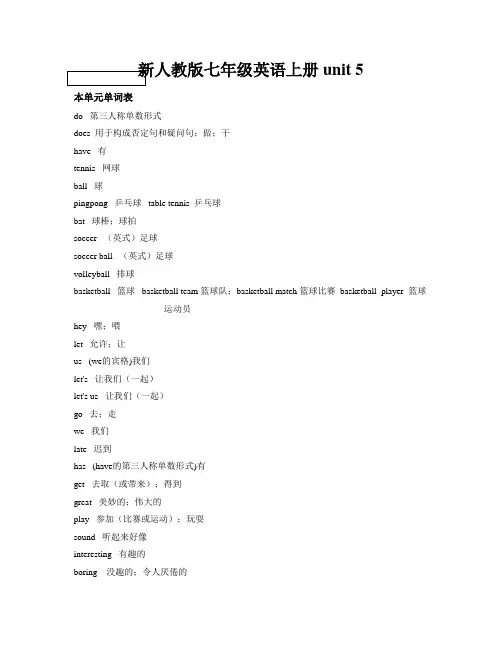
unit 5本单元单词表do 第三人称单数形式does 用于构成否定句和疑问句;做;干have 有tennis 网球ball 球pingpong 乒乓球 table tennis 乒乓球bat 球棒;球拍soccer (英式)足球soccer ball (英式)足球volleyball 排球basketball 篮球 basketball team 篮球队;basketball match 篮球比赛 basketball player 篮球运动员hey 嘿;喂let 允许;让us (we的宾格)我们let's 让我们(一起)let's us 让我们(一起)go 去;走we 我们late 迟到has (have的第三人称单数形式)有get 去取(或带来);得到great 美妙的;伟大的play 参加(比赛或运动);玩耍sound 听起来好像interesting 有趣的boring 没趣的;令人厌倦的fun 有趣的;使人快乐的n.乐趣;快乐difficult 困难的relaxing 轻松的;令人放松的watch 注视;观看TV 电视;电视机 many TVs 很多电视机watch TV 看电视same 相同的love 爱;喜爱with 和......在一起;带有;使用sport 体育运动 play/do/have sports 做运动 sports shoes 运动鞋a sports shoes 体育运动鞋them (they的宾格)他(她、它)们only 只;仅like 喜欢;喜爱easy 容易的;不费力的after 在......以后class 班级;课(近义词:lessen);等级;类别;阶段classmate 同班同学 roommate 室友 workmate 同事 deskmate 同桌schoolmate 校友Bill 比尔(男名)1.on 通过表方位的on的用法,详见unit4【解析】on可以表示“通过;使用……方式”,后面通常接表示通信工具的名词。
人教版七年级英语上册 unit 5 句式讲解及知识梳理
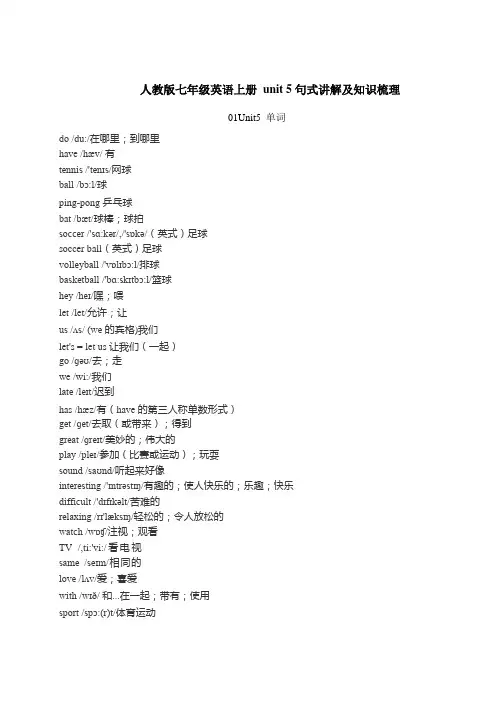
人教版七年级英语上册unit 5 句式讲解及知识梳理01Unit5 单词do /du:/在哪里;到哪里have /hæv/ 有tennis /'tenɪs/网球ball /bɔ:l/球ping-pong 乒乓球bat /bæt/球棒;球拍soccer /'sɑ:kər/,/'sɒkə/(英式)足球soccer ball(英式)足球volleyball /'vɒlɪbɔ:l/排球basketball /'bɑ:skɪtbɔ:l/篮球hey /heɪ/嘿;喂let /let/允许;让us /ʌs/ (we 的宾格)我们let's = let us 让我们(一起)go /ɡəʊ/去;走we /wi:/我们late /leɪt/迟到has /hæz/有(have 的第三人称单数形式)get /ɡet/去取(或带来);得到great /ɡreɪt/美妙的;伟大的play /pleɪ/参加(比赛或运动);玩耍sound /saʊnd/听起来好像interesting /'ɪntrəstɪŋ/有趣的;使人快乐的;乐趣;快乐difficult /'dɪfɪkəlt/苦难的relaxing /rɪ'læksɪŋ/轻松的;令人放松的watch /wɒʧ/注视;观看TV /,ti:'vi:/看电视same /seɪm/相同的love /lʌv/爱;喜爱with /wɪð/ 和...在一起;带有;使用sport /spɔ:(r)t/体育运动them /ðem/ /ð əm/他(她、它)们only /'əʊnlɪ/只;仅like /laɪk/喜欢;喜爱easy /'i:zi/容易的;不费力的after /'ɑ:ftə/在...之后class /klɑ:s/班级;课classmate/'klɑ:smeɪt/同班同学02Unit5 知识梳理Unit5 Do you have a soccer ball?【重点短语】1.have a volleyball 有一个排球2.play volleyball/tennis 打排球/网球3.have a ping-pong/table tennis 有一个乒乓球4.play ping-pong/table tennis 打乒乓球5.with our friends 和我们的朋友一起6.have a football/soccer ball 有一个足球7.play football/soccer 踢足球8.at school 在校,在上学9.play sports 做运动10.play computer games 玩电脑游戏11.watch TV 看电视12.in the same school 在同一所学校13.after class 下课后14.go to school 去上学【重点句型】1.—Do you have a ping-pong bat? 你有一个乒乓球拍吗?—No, I don’t. 不,我没有。
人教版七年级上册英语 Unit 5Section A (grammar focus - 3c) 课件

3. He has a nice hat. (用they代替he) __T__h_e_y__ ___h_a_v_e__ nice __h_a_t_s___.
questions with a partner.
A: Does Bob have a soccer ball? B: Yes, he does./ No, he doesn’t.
volleyball basketball
baseball bat baseball
eraser
tape player
10. 他们有一个篮球吗? _D_o_ they _h_a_v_e_ a basketball?
11. 是的,有。 Yes, __t_h_e_y __d_o__. 12. 没有。他们有一个排球。
_N__o_, they _d_o_n_’t_. They _h_a_v_e_ a _v_o_ll_e_y_b_a_ll_.
Write each word in the correct 3a
place in the chart.
do
does
I he they you we she it Eric
I they you we
he she it Eric
3b Fill in the blanks with do or does. Then
The music sounds beautiful. 这个主意听起来很棒。
The idea sounds great. 【拓展】
新人教版七年级英语上Unit5课件33527
2021/10/10
45
He is Mike.
He __h_a_s__ a volleyball.
D__o_e_s he h_a_v_e_ a basketball? No, he _d_o_e_s_n_’_.t
2021/10/10
46
2a Listen to the conversations and number
或--- No, he/she doesn’t. 不,他/她没有。
2021/10/10
3
2021/10/10
ቤተ መጻሕፍቲ ባይዱ
4
basketball
2021/10/10
5
baseball
2021/10/10
6
volleyball
2021/10/10
7
soccer ball
2021/10/10
8
tennis ball
2021/10/10
2
重点句型
1. --- Do you/ they have…? 你/他们有…?
--- Yes, I/they do. 是的,我/他们有。
或--- No, I /they don’t. 不,我/他们没有。
2. --- Does he/she have…? 他/她有…..? --- Yes, he/she does. 是的, 他/她有。
• Bob: __D_o____ you _h_a_v_e_ a soccer ball,Paul?
• Paul: No,I_d_o_n_.’t
• Bob: _D_o__e_s_your brother Alan ___h_a_v_e_one?.
• •
Paul: Yes,he _d_o_e_s_. __.1.want to do sth. Conversation2
Unit 5(单元解读课件)七年级英语上册(人教版)
已有基础 发展需求
存在问题 发展途径
但 是 对 于 tennis 和 volleyball 这 样的球类不太熟悉,;同时也 不太熟悉用来描述事件的性质 的 相 关 形 容 词 如 difficult, relaxing , fun 等 单 词 , 页 并 没 有系统的学习含有实义动词 have的一般疑问句。
有实义动词
ionA 2d3b
的确认物品关系和位置,不仅能够巩固在之前 学 生 学 习 语 所学的的词汇和重点结构,同时也了解真实交 法 提 供 一 个 句型:
have的一般
际中如何有礼貌地进行交流和表达。
很 好 的 语 境 ,1.-Do you have a 疑问句及其
grammar focus表格呈现了单元重点语法功能 结构,包括含有实义动词have的一般疑问句
going to do some sports about talking about
02
ownership and location of baseball and jacket.
Section A 1a-1c 01 A conversation between two students about
通过听读输入和说的输出,训练词汇和句型, 在小组对话和同桌对话中夯实所学。通过阅 读和写作练习,提升阅读和写作水平能听懂 确认物主关系的对话;能读懂介绍人物的短 文,并根据相关信息辨别人物;掌握用书面 语言的形式写失物招领和寻物启事。
制定单元目标
学习理解
感知 确认物品的所属关系表达 获取和梳理 阅读文本中心思想。 获取 听力文本里面的确认物品所 属关系。
Unit5 第1课时(Section A 1a-2d)课件 人教版英语七年级上册
A: _D__o_e_s_ Mike have a basketball? B: Yes, _h_e__d_o_e_s_____.
Exercises
I.单项选择。
1 —Does Jane have a ball?
—Yes, _______D_____
A .I am
B. it is
C. you do
1a
Match the words with the things in the picture.
1.tennis ball __a___
2.ping-pong bat __f__
3.soccer ball __c__ 4.volleyball ___e__
5.basketball __d___
6.baseball bat __b__
Does
2. Do you have a baseball racket?
bat
3. He have a bookcase.
has
4. Do you have a basketball? Yes, you have.
I
Summary
1. —Do you have a ...? —Yes, I do. I have.../ No, I don’t. I don’t have a...
A. Yes, he does.
B. No, he doesn’t.
C. No, I don’t.
Listen again and fill in the blanks.
Conversation 1: Bob: Do you have a soccer ball, Paul? Paul: _N__o_, _I_d_o_n_’_t__. Bob: Does your brother Alan _h_a_v_e_ one? Paul: Yes, he _d_o_e_s__.
人教版七年级英语上册第5单元ppt课件
Listen and check (√) the
1b description words you
hear in 1a.
1. interesting _√_ 3. fun _√_ 5. relaxing __
2. boring √__ 4. difficult √__
为深入学习习近平新时代中国特色社 会主义 思想和 党的十 九大精 神,贯彻 全国教 育大会 精神,充 分发挥 中小学 图书室 育人功 能
为深入学习习近平新时代中国特色社 会主义 思想和 党的十 九大精 神,贯彻 全国教 育大会 精神,充 分发挥 中小学 图书室 育人功 能
6. 是,她有。 _Y__e_s_, she _d_o_e_s_. 7. 没有。她有一个棒球。
_N__o_, she _d_o_es_n_’_t_. She _h_a_s_ a _b_a_s_e_b_a_ll_. 8. 他有一个足球吗?_D_o_e_s_ he _h_a_v_e_ a
为深入学习习近平新时代中国特色社 会主义 思想和 党的十 九大精 神,贯彻 全国教 育大会 精神,充 分发挥 中小学 图书室 育人功 能
Revision
Role-play the conversations with your partner.
A: Does John have a soccer ball? B: No, he doesn’t. A: Does he have a ping-pong bat? B: Yes, he does. I think he has a ping-pong
2. Linda has three volleyballs. (一般疑问句) __D_o_e_s__ Linda __h_a_v_e__ three volleyballs?
Unit5SectionA词汇精讲课件人教版英语七年级上册
Unit 5 Section A 结束
Unit 5 Do you have a soccer ball ? 单词表 (P26) hey /heɪ/ interj. 嘿;喂 let /let/ v. 允许;让 us /ʌs/ pron. (we的宾格)我们 let's=let us 让我们(一起) go /gəʊ/ v. 去;走
let v. 让;允许
注意: have的第三 人称单数形式 为has.
1.我有一个哥哥和一个妹妹. I have a brother and a sister. 2.Helen有一支钢笔. Helen has a pen. 3.他有很多书. He has many books.
tennis ball 网球
tennis racket
Practice makes perfect.
1.我们踢足球吧. Let’s play soccer. 2.你会弹钢琴吗? Can you play the piano? 3.我们经常和我的朋友一起玩. I often play with my friends.
sound v.
听起来好像
sound 为连系动词 其后跟形容词作表语,句型结构为: 主语+连系动词+表语. 1.那听起来很棒. That sounds great. 2.你的主意听起来不错. Your idea sounds good.
aux v/v. 用于构成否定句和疑问句;做;干 have /hæ v/ v. 有 tennis /'tenɪs/ n. 网球 ball /bɔ:l/ n. 球
Unit 5 Do you have a soccer ball ? 单词表 (P25) ping-pong /'pɪŋpɒŋ/ n. 乒乓球 bat /bæ t/ n. 球棒;球拍 soccer /'sɒkə(r)/ n. (英式)足球 soccer ball (英式)足球 volleyball /'vɒlibɔ:l/ n. 排球 basketball /'bɑːskɪtbɔ:l/ n. 篮球
人教版英语七年级上册unit5单词及句型
❖ B: That sounds interesting.( boring) ❖ 这里that是第三人称单数, 谓语动词sound后应加s. sound在这里是连系
动词,作“听起来” 之意,后面接形容词做表语。例如: ❖ 1).Your idea sounds good. 你的主意听起来很好。 ❖ 2). ---Let’s play soccer. --- That sounds wonderful.
❖ (7)Volleyball is difficult.
❖ (8)He has 8 tennis rackets, 7 soccer balls and 9 volleyballs.
本单元要求熟悉的句子
❖ (1)Ed Smith has a great sports collection. ❖ (2)She plays sports every day. ❖ (3)Let’s play computer games. ❖ (4)He only watches them on TV.
Unit 5
本单元应该掌握的词汇
❖ TV, ball, basketball, soccer, ping-pong bat, tennis racket, volleyball, let, play, sport, have, has, interesting, boring, fun, difficult, relaxing
have和has否定句和疑问句的构成:
❖ 用助动词do或does来构成, does用于第三人 称单数,does 或doesn’t 后要用动词原形have, 不 能用has.例如:
❖ 1.Do you have a TV? ❖ Yes, I do. / No, I don’t. ❖ 2.Do they have a computer? ❖ Yes, they do./ No, they don’t. ❖ 3. Does she have a tennis racket? ❖ Yes, she does. / No, she doesn’t.
Unit 5 Fun Clubs 单元课时课件 人教版2024英语七年级上册
My English teacher often _r_e_a_d_s_ _w_i_th__ _f_e_el_i_n_g_. 4. 杰克想在戏剧俱乐部里表演故事。
2. (2a)I can _p_l_a_y_ _th_e__ _g_u_it_a_r_. _W__h_a_t a_b__o_u_t _y_o_u_, Emma? 我会弹吉他。你呢,埃玛?
3. (2a)I'd love to, but I can't _p_la_y__ any _m_u__si_c_a_l_
(1)There _is__(be) a piece of news about the school clubs. (2)There _a_r_e_(be) five pieces of news about sports.
5. (1b)Lin Hua can _r_e_a_d_ _w_i_th__ _fe_e_l_in_g__. 林华能有感情地阅读。
Ⅳ请用以上重点短语和句型完成下列句子 1.雪莉和她妹妹开心地下中国象棋。
Shelly _p_l_a_y_s _ _C_h_i_n_e_se__ _c_h_e_s_s with her sister happily. 2. 李华擅长打乒乓球。
Lin Hua wants to join the 4. _d_r_a_m_a__/'drɑːmə/ club. A boy asks him to read some words with 5. _fe_e_l_in_g__/'fiːlɪŋ/. Lin Hua can read well. So the boy asks Lin Hua to come at 12:00 every Thursday.