
(湘少版)三年级英语下册课件how are you
湘少版三年级英语How are you 课件
这是一支铅笔吗?
• Is this a pencil?
不,它不是。它是一个书包。
• No, it is not. It is a bag.
它是一头老虎吗?
• Is it a tiger?
• No, it is not. It is a lion.
不,它不是。它是一头狮子。
• Is this a birthday cake?
Goodbye.
Have a nice day.
是的,它是。
这是一个生日蛋糕吗?
• Yes, it is.
这是一只母鸡吗?
• Is this a hen?
不,它不是。它是一只鸭子。
• No, it is not. It is a duck.
她是你的妈妈吗?
• Is she your mother?
不,她不是我的妈妈,她是我的阿姨。
• No, she is not my mother. • She is my aunt.
Unit 2 Are you Linging?
• Here you are. 给你
• boy 男孩
• girl 女孩
• baby 婴儿
• man 男人
• woman 女人
What is the difference?
•Are you eight?
你是八岁吗?
•You are eight.
是的,他是一个男人。
• Yes , he is a man.
她是一个婴儿吗?
• Is she a baby?
• No, she is not. She is a girl.
不,她不是。她是一个女孩。
她是一个女人吗?
Unit1Howareyou?(课件)湘少版英语三年级下册

New Words
see [siː] 看见 v.
I’m glad to see you. 我 很高兴见到你。
New Words
again [əˈgen] 再次 adv.
Try it again! 再试试!
New Words
fine [faɪn] 好的 adj.
—How are you? —I’m fine. 我很好。
Language Points
3. How are you? 一般用于熟人之间的问候, 表达对别人的关心。 回答可用: I'm fine. I'm OK. Very well.
See you!
1. Good morning. 意为“早上好。/ 上午好。” 主要用于早上或上午见面 时的问候。 回答也用“Good morning.”
Language Points
2. I'm glad to see you again. glad意为“高兴的”,again意 为“再次”。 用于认识的人再次见面时, 而初次见面时常用“Nice to meet you.”
New Words
too [tuː] 也 adv.
—I love you, Mum! —Me too! 我也是!
New Words
now [naʊ] 现在 adv.
It’s 11:10 now. 现在是十一点十分。
What's missing?
Let's Listen and Say
Good morning, Peter. I'm glad to see you again.
Good morning, Lingling.
How are you? I'm fine, too.
湘少版三年级下册英语How are you课件

3. How are you? 你好吗? How are you? 你好吗?(人们常用的问候语) 当熟人之间有较长一段时间没有见面,或是想知
道对方最近的工作、学习或身体状况时,都可以用这 句话。有时也可以用于比较正式地向别人打招呼。
回答: I’m fine./I’m OK. (我很好。) So so. (一般般。) Not bad. (不坏。)
Language points
1. Good morning, Peter. 早上好,彼得。 morning的意思是“早上;上午”,通常是指
中午12以前的时间段。 “Good morning.”是上午见面打招呼的常用语,
回答也用“Good morning.”。 用“Good morning.”问好时,后面 fine.
Act with your partner
Good morning. Nice to see you again.
Glad to see you, too.
Good afternoon. Nice to see you again.
Glad to see you, too.
To read at a desk.
语音知识专讲
字母e在单词中的发音规则 字母e在单词中一般发/e/。 发音要领:/e/是短元音,发音时声带振动。舌尖 抵住下齿,舌前部向上颚抬起,但比发/i/音时略低些。 双唇仍呈扁平口形,但比发/i/音时开大些。上下齿之 间可容一指。
Hello! How are you?
Hello, hello, hello! How are you? I’m glad to be with you. And you and you and you.
湘少版三年级下册英语单词中文版
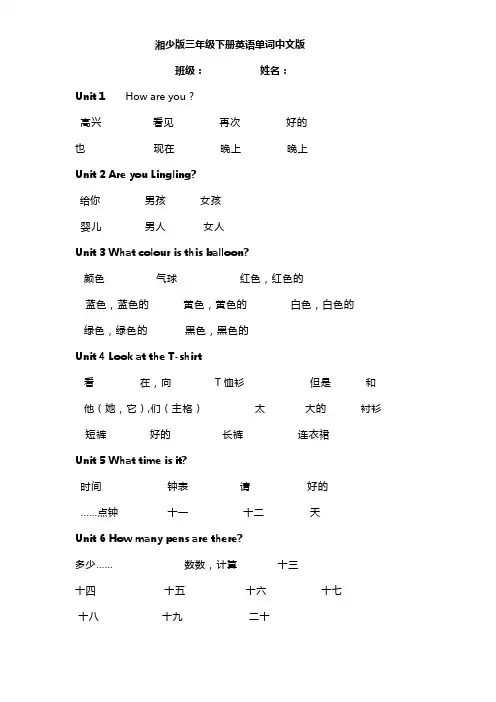
湘少版三年级下册英语单词中文版
班级:姓名:
Unit 1 How are you ?
高兴看见再次好的
也现在晚上晚上
Unit 2 Are you Lingling?
给你男孩女孩
婴儿男人女人
Unit 3 What colour is this balloon?
颜色气球红色,红色的
蓝色,蓝色的黄色,黄色的白色,白色的
绿色,绿色的黑色,黑色的
Unit 4 Look at the T-shirt
看在,向T恤衫但是和他(她,它),们(主格)太大的衬衫短裤好的长裤连衣裙
Unit 5 What time is it?
时间钟表请好的
……点钟十一十二天
Unit 6 How many pens are there?
多少……数数,计算十三
十四十五十六十七
十八十九二十
Unit 7 Is this an orang?
橘子香蕉柠檬市场
教室苹果梨子
Unit 8 I like a sunny day
晴朗的下雨的冰淇淋
冷的温暖的凉爽的热的
Unit 9 What’s the weather like?
天气像……有风的
多云的下雪的
Unit 10 Is he a farmer?
农民邮递员护士教师
医生司机
Unit 11 What’s he ?
消防员男警察
学生女警察
Unit 12 I go to school by bus
去……乘,通过公共汽车他们(宾格)轮船飞机学校自行车
火车小汽车。
寒亭区二小三年级英语下册Unit1Howareyou第1课时AB教案湘少版3
Unit 1 How are you?第1课时 A B教学目标(一)语言目标1.能听懂、会说、认读问候语“How are you?”。
2.能用“How are you?”问候他人并用“I'm fine. And you?”作出回应。
(二)应用目标1.指认并读出句型。
2.能根据不同时段运用不同的问候语。
3.能听懂会说A部分的对话和B部分的问候语。
教学重难点1.重点:能用句型问候他人并作出回应。
2.难点:如有学生将fine和five两个单词的读音相混淆,可采用Phonics拼读法帮助学生正音。
教学准备用于新授的句型条、自制教具、教学图片、录音机、教学磁带等(有条件的学校可利用幻灯片、多媒体课件)。
教学过程Step 1 热身/复习(Warming up/ Revision)1.Greetings.2.Listen to the song Hello.听三年级上册第一单元歌曲Hello,有条件的学校可从网上下载英语儿歌 Good morning。
让学生赏听,听前要求学生仔细听,听后试着说出歌中的英文单词或句子。
Lyrics:Good morning,good morning,to you and to you .Good morning,good morning, to you and to you ,Nancy,Judy and Margret,Peter,Dandy,Paul and John.Good morning, good morning, to you and to you.Step 2 新课呈现(Presentation)1.New words and sentence pattern.(1)T:Can you tell me some words or phrases in the song?S1:You.S2:Peter.S3:Good morning.…当学生说出问候语“Good morning”时,教师出示句型条贴于黑板。
湘少版-英语-三下--Unit 1 How are you?教案
Unit 1 How are you?一、教学目标能听懂、会说本课会话;能运用“How are you?”进行问候,并对此做出回应;力求在第一课堂就激发学生学习英语的兴趣。
二、教学重点及难点重点:自我介绍,运用“How are you?”向他人询问情况。
难点:根据自身的实际情况回答“I’m fine, thank you.”、“No, I’m not very well.”三、教学步骤:Step 1 Warming up 师生问候。
T: Good morning, boys and girls.S: Good morning, Miss Zhang. 用中文或动作帮助学生回忆、理解。
Step 2 Presentation and drillT: Hello, boys and girls. I am your English teacher 用动作帮助写生回忆、巩固“I am ”的意义。
T: Today we’ll learn Unit 1 “How are you?” 板书课题及主题句。
带读单词“unit”、“one”. 会话教学先教单词fine.教师指着自己对学生说:I’m fine today. 用表情来表示出自己今天很好(指身体)。
并把fine一词写在黑板上,可向学生用汉语解释fine一词意思是身体好。
3.教师反复带读fine一词并检查学生的发音.4. 教师和一个学生打招呼:Hello, how are you? 然后指着黑板上fine 一词,启发学生回答:I’m fine, thanks或I’m fine, tha nk you.5. 教师再和另一位学生重复刚才的会话.6. 让一个学生向老师打招呼并问候,如: S: Hello, Miss…… How are you T: Fine ,thanks.教师接着问候学生:How are you启发学生回答,同时教I’m fine, thank you.7. 教师把very well.写在黑板上.解释very well意思是身体好.8. 教师带读very well ,并检查学生发音.9. 师生之间进行打招呼问候,如T: Morning, boys and girls.Ss: Morning, Mr. Zhang. How are you? T: Fine, thanks. How are you? Ss: Very well, thank you.10. 同桌两人或前后两人进行会话练习.11. 听会话录音,模仿语音语调.。
Unit1Howareyou_(课件)湘少版英语三年级下册
Class begins.
上课。
I am fine.
我挺好的。
And you
你呢?
I am fine too.
我也挺好的。
Homework 作业
1. 抄写单词 和短语(英文6个,中文2个)
2. 如果你和一个朋友在几年后的一个晚上又见面了,你 们会怎么说呢?自编一段对话,写在抄写本上。
A. How old are you
B. How are you
A. Nice to meet you.
B. Glad to see you again.
晚上睡觉前,可以这样跟爸爸妈妈说:
A. Good night.
B. Goodbye.
找到它们相应的答语
Glad to see you again. How are you Good evening. Good night.
Unit 1
GGGooooodddaemfvteoenrrniniongogn
傍晚,晚上 下ห้องสมุดไป่ตู้6点到晚上睡觉前的时间
晚上睡觉分别时的道别用语
Good night
n igh t
夜晚、黑夜 晚上10点到12点这段时间
nice happy
meet
GNlaidcetotosemeeeytouyoaug.ain.
And you
你呢?
I like the dog. And you 我喜欢那只狗狗,你呢?
I like the dog too. 我也喜欢那只狗狗。
I am a boy. 我是一个男孩。
He is a boy too. 他也是一个男孩。
t oy
boy
girl
湘少版小学英语三年级下册各单元知识点梳理
Unit 1 How are you?一、单词:how 怎样well 好glad 高兴的see 看见again 再次fine 好的too 也now 现在evening 晚上night 晚上begin 开始二、句型:1.Good morning, Peter. 早上好,彼得。
2.I’m glad to see you again. 很高兴再次看到你。
3.How are you? 你好吗?4.I’m fine.And you? 我很好。
你呢?5.I’m fine, too. 我也很好。
Unit 2 Are you Lingling?一、单词:boy 男孩girl 女孩baby 婴儿man 男人woman 女人二、句型:1.Here you are.给你。
2.Are you Lingling? 你是玲玲吗?3.No, I’m not. 不,我不是。
4.Yes, I am. 是的,我是玲玲。
5.Oh,thank you.噢,谢谢你。
Unit 3 What colour is this balloon?一、单词:colour 颜色balloon 气球red 红色;红色的blue 蓝色;蓝色的yellow 黄色;黄色的white 白色;白色的green 绿色;绿色的black 黑色;黑色的grapes葡萄grass草二、句型:1.What colour is this balloon? 这个气球是什么颜色的?2.It’s red. / It’s yellow. 它是红色的。
/它是黄色的。
Unit 4 Look at the T-shirts一、单词:look 看at 在;向T-shirt T恤衫they 他(她;它)们(主格)but 但是too 太big 大的shorts 短裤nice 好的trousers 长裤dress 连衣裙coat 大衣shirt 衬衫and 和二、句型:1.Look at the T-shirt s.They’re beautiful.看这些T恤衫。
三年级下册英语说课稿-Unit 1 How are you|湘少版
三年级下册英语说课稿-Unit 1 How are you|湘少版一、教材分析本单元主要是以“How are you?”、“I’m fine, thank you”为单元核心句型,教授“happy”、“sad”、“angry”等常用情感词汇,让三年级学生了解情感表达并能熟练运用。
本单元所需的教材资源包括教科书、单词卡片、音频文件等。
二、教学目标本单元的教学目标主要包括以下几个方面:1.了解单元核心句型“How are you?”、“I’m fine, thank you”并正确运用。
2.掌握英语情感词汇如“happy”、“sad”、“angry”等。
3.能够运用所学词汇构造简单句子。
4.帮助学生通过学习情感词汇,了解情感的表达方式,并增强表达及沟通能力。
三、教学重点难点本单元的教学重点是单元核心句型的掌握并熟练应用。
教学难点则在于学生对英语情感词汇的理解和正确运用。
四、教学过程4.1 Warming up(1)Greet the students and ask “How are you today?” to arouse the students’ attention.(2)Us e the flashcards to teach “happy”, “sad” and “angry”. Show the flashcards and ask them to repeat the words after me and use their facial expressions to show the corresponding emotions.4.2 Presentation(1)Introduce “How are you?” “I’m fine, thank you.” thr oughthe help of PPT slides.(2)Ask students to recite the sentence pattern and practice with a partner.(3)Use the flashcards to play a game called “Guess my feeling”. Have some students come up to the front of the classroom and use theirfacial expressions to express happy, sad or angry and let their partners guess what emotion they are showing.4.3 Practice(1)Use the PPT slides to further drill “happy”, “sad” and “angry” with the help of situational dialogues.(2)Divide students into pairs and have them ask and answer the questions “How are you?” and “I’m fine, thank you.”(3)The teacher can walk around the classroom and ask some pairsthe same questions to check their progress.4.4 Production(1)Have students use the sentence “How are you?” and “I’m fine, thank you.” to make short dialogues with their partners.(2)Students can use the flashcards of “happy”, “sad” and “angry” to add to their dialogues and express their emotions.4.5 Summary and homework(1)Review and summarise the sentence pattern and vocabularylearned in the class.(2)Give students a piece of paper and ask them to draw themselves and write how they feel today in English.(3)Assign new vocabulary and sentence pattern to be recited, preview and prepare for the next lesson.五、教学评估(1)Use situational dialogues to evaluate whether students can use the sentence “How are you?” and “I’m fine, thank you.” correctly.(2)Observe the students’ facial expressions and responses when doing the flashcards game “Guess my feeling” to evaluate theirunde rstanding of “happy”, “sad” and “angry.”(3)Evaluate the students’ short dialogues with a partner to assess their ability to use the sentence pattern and vocabulary to express their emotions.六、教学反思在本次教学过程中,我通过使用多媒体教学、游戏互动等多种教学手段有效促进了学生们英语表达的能力。
湘少版三年级英语下册《Unit 1 How are you》
How are you?
I’m fine, thank you.
hen best desk
e - / e/
Homework
1.观看课文动画,说唱Part E, Part F, Part G。
2.回家给爸爸妈妈说唱今天所学歌谣,摹写句子 “ How are you? ”2遍。 3.预习Unit2 Part A, Part B。
调朗读并表演课文对话。
2.用今天所学问候用语和朋友相互问候。 3.预习 Unit1 PartC, PartD。
Unit 1 How are you?
第二课时
Waup
Review
Good morning.
Good afternoon.
Good evening.
eefletschantpresentationfletschantsingasongpracticeentpgldbsyfletschantgametimepractice四人一组用字母卡片任意摆出含有e发e的单词摆完后小组一起拼读出来拼完后立刻举手
Unit 1 How are you?
第一课时
Sing a song
What’s in common?
A hen in a vest,
Sitting in her nest.
Tries her best, To read at a desk.
Presentation
F Let’s Chant
你发现什么规律了吗?
e - /e/
hen vest nest best desk
一天中不同时间的问候用语: Good morning/ afternoon/ evening/ night. 再次相见的问候: I’m glad to see you again. 好久不见的问候及回答: How are you? I’m fine.