
人教版八年级上册英语unit5全单元教案
设计意图
复习学生上节课所学知识。
Step 2 Grammar Focus 1.Ask Ss to read the sentences in Grammar Focus and sum up the sentence structures. Say:Now read aloud the sentences in Grammar Focus.Then write down the sentence structures in your exercise books. 2.Explain some difficult points. Step 3 3a 1.Ask Ss to look at 3a,make a conversation and then practice it with a partner.(见课
them?Let’s talk about the shows today.(见课件)
设计意 由学生熟悉的电视节目入手,调动学生参与课堂活动的积极性,有助于对学生学
图
习兴趣的培养,为导入新课作准备。
Step 2 1a 1.First ask some students to read the shows out and translate them. 2.Ask Ss to match the TV shows with the pictures [a-g]. 3.Check the answers.(见课件) Step 3 Listening 1b 1.Listen and number the shows [1-4] in the order you hear them. 2.Check the answers.(见课件)
Ⅰ.用所给词的适当形式填空
1.Peter wants
(learn) English well.
教学过程
2.I think soap operas are boring.Let’s
(watch)a sports show.
3.—What do you plan —To surf the Internet.
(do)this evening?
4.We are having a 5.Mr.White expects
(discuss)about hobbies in class. (have)a good job.
Keys:1.to learn 2.watch 3.to do 4.discussion 5.to have
Section A(Grammar Focus-3c) an to watch tonight? 2.Do you want to watch the news? 3.What can you expect to learn from sitcoms? 课堂练习
教学 课题
Unit 5 Do you want to watch a game show? 第一课时 Section A(1a-2d)
【知识目标】
Important words:news,mind,stand,educational,plan,hope,discussion,happen,expect
4.You can expect to learn a lot from them. 【能力目标】 能正确运用目标语言谈论自己对事物的喜好并陈述原因。
教学 重难 点
【情感目标】 培养自己的爱好,处理好爱好与学习之间的关系。
重点:学会运用 What do you think of...?这一句型来谈论喜欢和不喜欢的事物。 难点:掌握动词不定式的用法。
教学过程
Step 4 Pair work 1c 1.Practice the conversation. 2.Then make your own conversations. 3.Ask some pairs to act it out. Step 5 Listening 2a & 2b 1.Listen to Lin Hui and Sally’s conversation.Number the TV shows [1-5]in the order you hear them. 2.Check the answers.(见课件)
重点句型:
1.What do you think of talk shows? 2.I don’t mind them. 3.I hope to find out what’s going on around the world. 4.You can expect to learn a lot from them. 课堂练习
教学目 标
2.Do you want to watch the news? 3.What can you expect to learn from sitcoms? 【能力目标】 能运用所学的知识来陈述自己的观点;学会谈论自己的喜好。 【情感目标】 学会谈论流行文化,了解各类电视节目的名称和自己的喜好,注意引导学生们形成 正确的文化观念。
教学重难点
动词不定式
教学过程
Step 1 Leading in T:We have learned some words and some important sentences.Do you remember them?First let’s have a dictation. (Teacher lets Ss write some important words and sentences.Then check the answers in pairs.)
件)
2.Choose a group to present the conversation. Step 4 3b 1.Ask Ss to look through 3b and then finish 3b. 2.Choose 2 or 3 students to give their answers.The teacher asks the four questions and the students say their answers separately. Step 5 3c 1.Ask Ss to read the information in the left column.Then Ss ask and answer questions like the model.Write the names in the chart. 2.Give Ss a few minutes to prepare. 3.Encourage Ss to express their opinions. Step 6 Homework Review Section A. Preview Section B. 板书设计
3.Listen plete the sentences. 4.Check the answers.(见课件)
Step 6 Pair work 2c Ask Ss to work in pairs:Ask and answer questions about the TV shows in e information that is true for you. Step 7 Role-play the conversation 2d 1.Read the conversation and try to answer the following questions. (1)What did Sarah do in class today? (2)Does Grace like soap operas? (3)What does Sarah think of soap operas? (4)Why does Sarah like the news and talk shows best? Keys:(1)She had a discussion about TV shows with her classmates. (2)Yes,she does. (3)She doesn’t mind them. (4)Because she can learn a lot from them and she hopes to be a TV reporter one day. 2.Listen to the tape and read the conversation after it. 3.Ask some pairs to act it out in class. Step 8 Homework 1.Learn the new words and phrases of this part by heart. 2.Try to act 2d out. 板书设计 Section A(1a-2d)
教学过程
Step 1 Leading in
T:What do you like doing in your free time,class?
S1:I like watching TV.
T:What kind of TV shows do you like?
S2:I like...
T:OK.Today let’s talk about them together.
( )3.My father never watches soap operas.He
them because he thinks
they’re so boring.
A.loves B.likes C.don’t mind D.can’t stand
( )4.—Nick,would you mind
Important phrases:find out,talk show(...show),plan to do sth.,go on,around the world
Important sentences:
1.What do you think of talk shows? 教 学 2.I don’t mind them. 目标 3.I hope to find out what’s going on around the world.
人教版八年级英语下册1-5单元复习教案
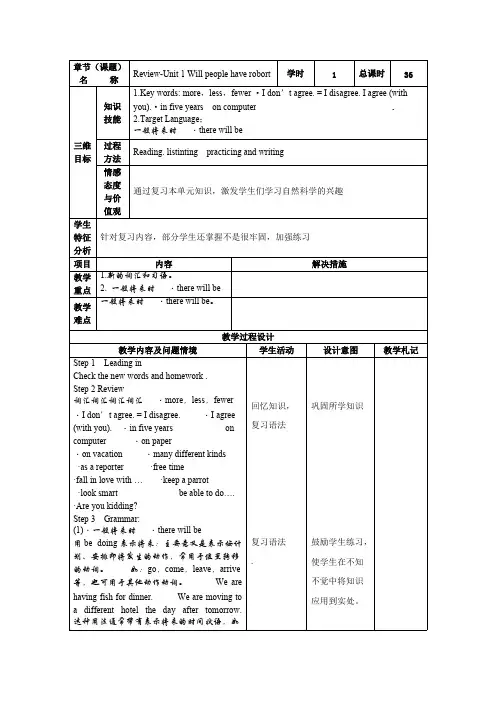
章节(课题)名 称Review-Unit 1 Will people have robort学时1总课时36知识技能1.Key words: more ,less ,fewer ·I don ’t agree. = I disagree. I agree (withyou).·in five years on computer.2.Target Language ;一般将来时 ·there will be过程方法Reading. listinting practicing and writing三维目标情感态度与价值观通过复习本单元知识,激发学生们学习自然科学的兴趣学生特征分析针对复习内容,部分学生还掌握不是很牢固,加强练习项目内容解决措施教学重点1.新的词汇和习语。
2. 一般将来时 ·there will be教学难点一般将来时 ·there will be 。
教学过程设计教学内容及问题情境学生活动设计意图教学札记Step 1 Leading inCheck the new words and homework .Step 2 Review词汇词汇词汇词汇 ·more ,less ,fewer·I don ’t agree. = I disagree. ·I agree(with you). ·in five years oncomputer ·on paper·on vacation ·many different kinds ·as a reporter ·free time·fall in love with … ·keep a parrot ·look smart be able to do…. ·Are you kidding?Step 3 Grammar:(1)·一般将来时 ·there will be用be doing 表示将来:主要意义是表示按计划、安排即将发生的动作,常用于位置转移的动词。
人教版英语八年级上册 Unit 1 全单元教案
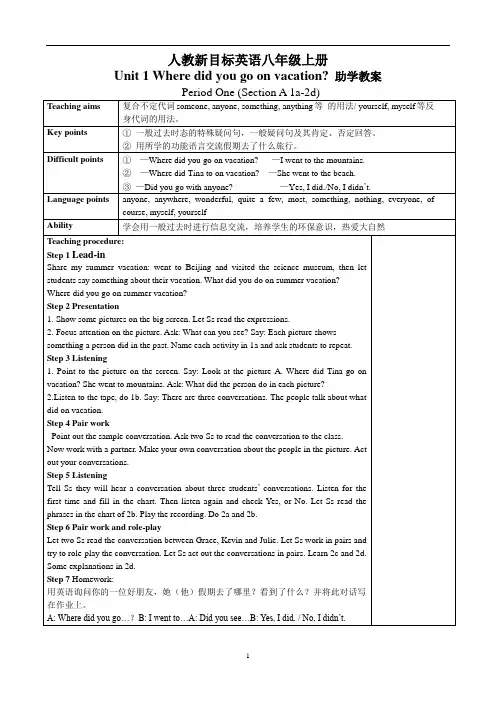
Step5Listening
Tell Ss they will hear a conversation about three students’conversations. Listen for the first time and fill in the chart. Then listenagainandcheck Yes, or No.Let Ss readthe phrases in the chart of 2b.Play the recording. Do2aand 2b.
③—Did you go with anyone?—Yes, I did./No, I didn’t.
Language points
anyone, anywhere, wonderful, quite a few, most,something, nothing, everyone, of course, myself, yourself
Key points
①一般过去时态的特殊疑问句,一般疑问句及其肯定、否定回答。
②用所学的功能语言交流假期去了什么旅行。
Difficult points
①—Where did you go on vacation?—I went to the mountains.
②—Where did Tina to on vacation?—She went to the beach.
2)阅读填空能力的提高。
Language points
最新人教版高中英语必修一unit5《nelsonmandela》全单元教案.doc
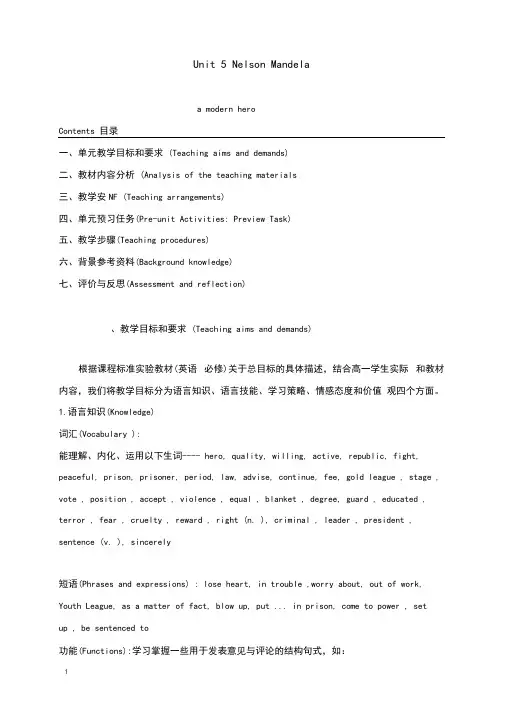
Unit 5 Nelson Mandelaa modern heroContents 目录一、单元教学目标和要求(Teaching aims and demands)二、教材内容分析 (Analysis of the teaching materials三、教学安NF (Teaching arrangements)四、单元预习任务(Pre-unit Activities: Preview Task)五、教学步骤(Teaching procedures)六、背景参考资料(Background knowledge)七、评价与反思(Assessment and reflection)、教学目标和要求(Teaching aims and demands)根据课程标准实验教材(英语必修)关于总目标的具体描述,结合高一学生实际和教材内容,我们将教学目标分为语言知识、语言技能、学习策略、情感态度和价值观四个方面。
1.语言知识(Knowledge)词汇(Vocabulary ):能理解、内化、运用以下生词---- hero, quality, willing, active, republic, fight, peaceful, prison, prisoner, period, law, advise, continue, fee, gold league , stage , vote , position , accept , violence , equal , blanket , degree, guard , educated , terror , fear , cruelty , reward , right (n. ), criminal , leader , president , sentence (v. ), sincerely短语(Phrases and expressions) : lose heart, in trouble ,worry about, out of work, Youth League, as a matter of fact, blow up, put ... in prison, come to power , setup , be sentenced to功能(Functions):学习掌握一些用于发表意见与评论的结构句式,如:1. 发表意见(Giving opinions )Why do you think so? What do you think of …? What's you opinion?agree / don't agree. I think / don't think .... I prefer .... In myopinion ....I'm afraid ....2.评论(Making comments)Good idea! That's an excellent idea .语法(Grammar):定语从句(II )(由where, when, why, 介词+ which, 介词+ whom引导的定语从句)The school where I studied only two years was three kilometres awayThis was a time when you had got to have a passbook to live in JohannesburgThe reason why I got a job was because of my hard work .•••we were put in a position in which we had either to accept we were less important, or fight the Government .The person to whomyou should be grateful for a peaceful South Africa is Nelson Mandela.扩展词汇:negative(消极的),heroine(女主角,女主人公),unwilling(不情愿的),nation(国家,民族),sacrifice(牺牲),realize (认识到),give up (放弃),riches (财富),Bible (圣经),revolution (革命),career (职业),equality (平等),fairness(公平),conflict (冲突),biography (自传),beliefs (信仰),Christianity (基督教),religion (宗教),priests (牧师),version (翻译),readable (易读的),adventure (冒险),scholar (学者),sympathy (同情),,campaign (从事活动),communist (共产主义者),injustice (不公平),oppose (反对),pilot(飞行员) , boycott (联合抵制)2.语言技能(Skills)听:在本单元的课文及练习册听力教学中,能听懂人物和事件以及它们的关系,能抓住所听语段中的关键词,正确理解话语间的逻辑关系。
人教版八年级上册英语单元教案(含教材分析)--Unit 8

Unit 8How do you make a banana milk shake?本单元的教学围绕“谈论如何制作香蕉奶昔”这一话题展开,Section A是基本语言内容的收集和学习,这一部分引导学生通过本课的语言素材进行看图说话、句型演练、实际描述和对话表演等,使学生能够正确地使用表述如何制作香蕉奶昔过程中需要用到的词组、句型,从而熟练地谈论这一话题。
Section B是知识的扩展和综合的语言运用。
在Section A的基础上,自如地谈论“如何制作三明治”,从而进一步熟练掌握有关的英语表述方式。
这些内容都是与学生日常生活紧密相关的,学生很熟悉,也乐于去说,因此在这一课题的教学过程中,应紧密联系学生生活实际,采用多种方式,以说为主,配合听的练习,最终以对话为途径,解决本课题的中心对话。
这易于引发学生运用简单的英语进行交流,对于提高学生的综合能力,特别是说的能力很有帮助。
第一课时Section A(1a-2d)Teaching Goals【教学目标】Key words:shake,blender,peel,pour,yogurt,honey,watermelon,spoon,add,finally,saltKey phrases:milk shake,turn on,cut up,one cup of yogurt,pour…into…,put…into…Key sentences:1. How do you make a banana milk shake?2. — How many bananas do we need?— We need three bananas.3. — How much yogurt do we need?—We need one cup of yogurt.Teaching Key Points【教学重点】The vocabulary:pour,yogurt,honey,watermelon,spoon,add,finally,saltTarget language:How do you make a banana milk shake?First,peel the bananas…How many bananas do we need?We need three bananas.How much yogurt do we need?We need one cup of yogurt.Teaching Difficult Points【教学难点】1. The differences between countable nouns and uncountable nouns.2. 学会使用how many和how much分别对可数名词和不可数名词的量提问。
人教版八年级下册英语教案(全册)

人教版八年级下册英语教案(全册)Unit1What’s the matter?Section A◆教材分析本单元的主题是有关于身体健康。
这个话题是关乎我们每天的日常生活,所以有必要让学生了解相关的知识。
学生将会学会如何谈论他们的健康问题以及如何给予他人建议。
◆教学目标【知识目标】描述健康问题以及如何根据别人的健康问题提建议【能力目标】1.听懂谈论健康问题的对话材料2.能根据别人的健康问题提建议3.能写出重点单词和重点句型4.能描述怎样对待健康问题。
【情感目标】通过本课的阅读,培养学生关心他人身体健康的品质,并培养学生处理紧急事件的基本能力,树立在紧急事件时互相帮助的精神.◆教学重难点◆【教学重点】1、词汇:have a stomachache,have a cold,lie down,take one's temperature,go to a doctor,get off;to one's surprise,2、句型:1.——What's the matter?——I have a stomachache.You shouldn't eat so much next time.2.——What's the matter with Ben?——He hurt himself.He has a sore back.——He should lie down and rest.【教学难点】掌握情态动词should shouldn't.的用法;学习have的用法◆课前准备◆Multimedia,group work,cooperative discussion.◆教学过程Step1.Warm up1.Look at the picture and learn the parts of the body.2.New words and phrases.Step2Presentation1.1aLook at the picture.Write the correct letter[a-m]for each part of the body.Then check the answers.2.1bFirst,lead Ss to read the five names.Then look at the picture.Number the names1-5.’sFinally, check the answers.3. 1cDivide two Ss into a pair to make conversations. Finally, invite several pairs to act outfor the class.Step 3 Practice1. 2aTell Ss there are five conversations. In each conversation the person says what goingon with them. Listen carefully and number the pictures.Play the tape. Then check the answers.2. 2bAsk Ss to listen to the recording again to match the problems with the advice.Play the recording again. Then check the answers.3. 2cAsk Ss to make conversations using the information in 2a and2b. Give them enoughtime to do this task. Later , invite several pairs to present their conversations to theclass.Step 4 Consolidation1. 2dFirst, ask Ss to have a fast reading of the conversation to get the main idea.Then, lead Ss to read the conversation sentence by sentence, explain some languagepoints.Finally, divide Ss into pairs to practice role-playing the conversation.2. 3aFirst, read the passage quickly and answer the question.Then,lead Ss to read the passage and analyse the key points.Finally,read together.3.3bRead the passage again and check the things that happened in the story3cDiscuss the questions with a partner.4.Grammar focusFirst,lead Ss to read the sentences.Then,prompt Ss to analyse the use of model verb should.After that,explain the grammar together.5.4aAsk Ss to fill in the blanks.Then,invite some Ss to present their answers.6.4bAsk Ss to circle the best advice for these health problems,then add their own advice.After that,invite some Ss to present their advice.7.4cOne student mimes a problem.The other students in your group guess the problem and give advice.Step5Language pointsStep6HomeworkMake a conversation about health problems and giving advice.Unit1What’s the matter?Section B◆教材分析本单元的主题是有关于身体健康。
人教版新目标九年级英语Unit5第五单元全单元教案教学设计

人教版新目标九年级英语Unit5单元教案Unit 5 What are the shirts made of?Section A (1a-2d)学习目标1.重点单词:chopstick,coin,fork,blouse,silver,glass,cotton,steel,fair,grass,leaf,produce,widely,process,pack2.重点短语:be made of,be made in,be made from,as far as sb. know,be known for3.重点句式:What are the shirts made of?—This ring looks nice.Is it made of silver?—Yes,and it was made in Thailand.What is the painting made from?How is tea produced?As far as I know,tea plants are grown on the sides of mountains. People say that tea is good for both health and business! 学习重点1.重点短语和句型2.一般现在时态和一般过去时态的被动语态学习难点一般现在时态和一般过去时态的被动语态自主学习一、预习课本P33-34新单词并背诵,完成下面的汉译英。
1.筷子________ 2.硬币________3.叉子________ 4.衬衫________5.银器________ 6.玻璃________7.棉花________ 8.钢铁________9.展览会________ 10.草地________11.叶子________ 12.生产________13.普遍地________ 14.加工________15.包装________二、认真预习1a-2d找出下列短语和句型。
人教版新目标英语八年级下册Unit 5 写作教学案
八年级下册Unit 5 What were you doing when the rainstorm came?写作教学案(教师使用)【话题】难忘的事件(Unforgettable events)【写作目标】能运用本单元所学的语法(过去进行时)及语言材料,完成写作叙述过去发生的事情。
【课前任务】一、写出下列短语。
1、昨晚2、在那时3、昨天这个时候4、大雨5、乌云6、离开参考答案:st night 2. at that time 3. this time yesterday 4. heavy rain 5.dark clouds 6.go away二、根据汉语意思完成下列句子。
1、昨天晚上迈克来的时候我正在写作业。
I my homework when Mike last night..2、安正在看电视时,她父亲回来了。
While Ann TV, her father home.3、我敲门的时候你在干什么?What you when I ________ at the door?4、我去看她的时候她不是在打扫房间。
She the room when I to see her.5、我昨天晚上回来时,妈妈正在厨房做饭。
_______ I came back yesterday evening,my mother in the kitchen .参考答案:1. was doing ,came 2. was watching, came 3. were , doing ,knocked 4. wasn’t cleaning ,went 5.When ,was cooking三、写出与本话题有关的词汇和句型。
常用词汇:on the way to… , go up to , leave for , fall asleep, die down , be late for,…经典句型:1.What were you doing at eight last night? I was taking a shower.2. He was reading in the library when the rainstorm came.3. While Linda was sleeping, Jenny was helping Mary with her homework.4.The boy was still sleeping when his mother got home yesterday morning.5. Amy was reading a book when I came in.【课中任务】读写结合一、A. 信息归纳阅读下面短文,然后按照项目要求填写所缺信息。
Will people have robots 教案(9课时)人教版八年级英语上册
【Unit Target】单元目标Unit 7 Will people have robots?【Topic】话题Life in the future 未来的生活【Functions】语言功能:Make predictions 能谈论对未来的预测A: What will the future be like?B: Cities will be more polluted. And there will be fewer trees.A: Will there be world peace? B: Yes, I hope so.【Structures】语言体系:Future tense with will;Quantities with more, less, fewer【Target language】重点句型:A: Will people use money in 100 years?B: No, they won’t. Kids will study at home on computers. They won’t go to school.There will be more pollution/people. There will be less free time.There will be fewer cars and more buses.【Vocabulary】重点词汇及短语:词汇:paper, pollution, prediction, future, pollute, environment, planet, earth, plant, part, peace, sea, build, sky apartment, space, human, dangerous, already, factory, Japan, believe, disagree, even, agree, shape, fall, inside, possible, impossible, side,短语:space station;help with ;over and over again;in the future;get boredwake up;disagree with sb.;hundreds of;fall down;look for【Unit Periods】单元课时:Nine periods 9课时Unit 7 Will people have robots?(第一课时)教案授课时间_____________【教学目标】(核心素养目标)1. To teach the key vocabulary on P49-50.2. Make predictions with “will”.3. Simple Future Tense with “will”.4. Reflect the language ability of core competency.【教学重点】1. Make predictions with “will”. 2. Simple Future Tense with “will”.【教学难点】Use Simple Future Tense with “will”correctly.【教学过程】一、清(温故知新):Oral report: 结合上节课所学词汇,句型或话题做一个2分钟的口语汇报。
2018人教版新目标初二英语下册Unit 5 单元教案
八年级英语(下)第5单元第1课时
Unit 5 What were you doing when the rainstorm came?
Section A 1a—2d
一、【教材分析】
二、【教学流程】
八年级英语(下)第5单元第2课时
Unit 5 What were you doing when the rainstorm came?
Section A 3a—3c
一、【教材分析】
二、【教学流程】
八年级英语(下)第5单元第3课时
Unit 5 What were you doing when the rainstorm came?
Section A Grammar Focus—4c
一、【教材分析】
【教学流程】
二、
八年级英语(下)第5单元第4课时
Unit 5 What were you doing when the rainstorm came?
Section B 1a—1d
一、【教材分析】
二、【教学流程】
八年级英语(下)第5单元第5课时
Unit 5 What were you doing when the rainstorm came?
Section B 2a—2e 一、【教材分析】
二、【教学流程】
八年级英语(下)第5单元第6课时
Unit 5 What were you doing when the rainstorm came?
3a—Self Check
一、【教材分析】
二、【教学流程】。
人教新目标英语八年级上册Unit2全单元教学设计
人教新目标英语八年级上册Unit 2 How often do you exercise?Period 1 (1a-1c)教学目标:1. Knowledge objectsName of activities.Aderbs of frequency.What do you usually do on weekends?I often go to the movies.2. Ability objectsWriting skill.Listening skill.Communicative competence重点:Watching TV, reading, shopping Skateboarding, exercising难点:Always, usually, often, sometimes Hardly, ever, neverWhat does she do on weekends? She often goes to the movies.教学用具:A tape recorder. Large monthly calendar showing the days of the week.学习指导:Discover method. Listening and writing methods;Pairwork.教学设计:Step 1 . Lead in: (5 minutes)1. Listen to a song.2. Talk about your last weekend’s activities.Step 2 Presentation.(10 minutes)1. T:“What do you usually do on weekends ? ”S: I usually …… on weekends.2. Show the frequency words and read.always (100%) usually(80%) often (30-50%)sometimes (20%) hardly ever(5%) never (0%)3. Pair work: -- What do you do on weekends?--I …(Use the frequency words.)--What does she/he do on weekends?-- She/He ___________ _________________.Show some verb phrases: watch TV,read books,exercise,swim, play football、go shopping4. Learn the new language.A: How often does he do sports?B: He always…in the morning. He often… , but sometimes he … And he hardly ever … He never ...Step 3 . Work on 1a. (5 minutes)1. Look at the picture. Discuss with your partners. Make a list of the weekend activities.2. Let some Ss read out their activities. Let other Ss add more activities.Step 4 . Work on 1b.(5 minutes)1. Let a student read the words aloud. Make sure all the Ss know the meaning of the words.2. Tell Ss to listen and write the letters from the picture above on the line below.3. Play the tape for the first time. Ss listen and fill in the blanks.4. Play the tape for the second time for the Ss to check the answers.Step 5. Pair work. (10 minutes)1. Act out the conversation with a student.2. Let Ss talk about the pictures in 1a in pairs.3. Let some Ss act out their conversations.习题设计(10 minutes)Exercises:st summer vacation, we _____many photos when we had a trip to Dalian.A.takeB. takesC. tookD.will take2. –Mum,I’m hungry.Is there _____to eat?A. somethingB. nothingC. anythingD.everything3.After a long walk in the sun, they wanted to drink_______.A. cold somethingB. something coldC. nothing coldD. cold anything4.Did Lisa tell you______in the letter?A. funny anythingB. anything funnyC.funny somethingD. something funnyHomework教学反思时间教学课题Unit 2 How often do you exercise?Period 2 (2a-2d)教学目标:1.Words: Housework, hardly, ever, hardly ever, once, twice, Internet, program,full , swing, swing dance, maybe,2) Sentences--what do you usually do on weekends?--I always excersise.--How often do you go to the movies?--I go to the movies maybe once a month.3) Be able to understand the dialogues about how often people do things.教学重点:1. Master the words and target language;2.Master the sentence students structures “How often …?教学难点:To improve students’ listening skill and cooperative skill.学习指导:Discover method Listening and reading methods. Communicative qpproach.教学用具:A tape recorder. Some color paper for an activity.教学过程Step 1.Learn the new language.(5 minutes)Show the pictures and ask and answer: How often do you exercise?--Twice a week.Step 2. Work on 2a: (5 minutes)1. Let Ss read the phrases in the chart.2. Tell Ss that Cheng Tao is taking about how often he does these activities. Playthe recording for the first time. Ss listen and number the activities [1-5].3. Play the recording for the second time for the Ss to check the answers.Step 3.Work on 2b:(5 minutes)1. Tell Ss they will hear the recording again. This time, listen and match theactivities in 2a with how often Cheng Tao does them.2. Ss listen and math the activities with the phrases.3. Check the answers.Step 4. Pair work. (5 minutes)1. Ask one student how often he/she watch TV as a model.T: Hi, S1. How often do you watch TV? S1: I watch TV every day.T: What’s your favorite program? S1: Animal world.T: How often do you watch it? S1: Twice a week.2. Let one student read the activities in the chart. Tell them these new words:favorite website (最喜欢的网站);favorite sport (最喜欢的运动)3. Ss work with their partners. Then ask some pairs to act out their conversations. Step 5.Summarize.(5 minutes)Unit 2 How often do you exercise?What do you usually do on weekends?I usually go to the movies.She often goes to the movies .Twice a week.Step 6Work on 2d. (10 minutes)1. Lead in: Show some pictures and practice:A: What does she usually do? --B: She usually has piano lessons.A: How often does she have piano lessons? --B: She has piano lessons twice a week.2. show a video, and ask : What dance? –swing dance.Claire are having dance and piano lessons. Let’s listen to her and Jack’s conversation, listen and answer:3. Read the conversation and match the activity with the right time.4. Follow the tape and then Role-play the conversation.习题设计(10 minutes))汉译英:1.几乎从不____________2.至少,不少于________________3.一天一次________________4.一周两次___________________5.一个月三到四次________________6. 垃圾食品_________________7.喝牛奶___________________8.多于__________________9.最受欢迎的__________________10.保持健康_________________ Homework教学反思时间教学课题Unit 2 How often do you exercise?Period 3 (3a-3c)教学目标:1.Words and phrases:full, swing, swing dance, maybe, least, at least2.Target language:—How often do you /does he(she)….? —He usually…The use of the frequency words: always; usually ; often ; sometimes; hardly ever; never重点:Words and phrase难点:target language:教学用具: Tape recorder; Multi-Media;PPT学习指导:Task-based language teaching、create the language situation.教学设计:Step 1 Review: (5 minutes)1.Show a subject schedule, ask and answer:How often do you have _________ class? --We have _________class ____________.Step2 Grammar focus .(5 minutes)Let the students read the text. Invite some students to read the sentences in the boxand explain their Chinese meaning.为学生解释其中的语法点。