
最新译林牛津版初中英语八年级上册Unit 5 Wild animals Reading公开课教学设计
Line15-22 The problems giant pandas may meet
5. Task Four
Line23-30 The actions we can take
Part Three After-reading
1.Discussion
2.Watch a video
Part Four Homework
Good morning, boys and girls. Nice to meet you.
Last class we have learnt many names of animals. Do you remember them?
Good. Let’s play a guessing game,ok?
So please read Part1 by yourselves and try to finish the table.
Now I think you can finish PartC in your book easily.
Are giant pandas lovely?
But they have problems now. Let’s learn Part Two and see what problems they have.
You are very clever. Do you want to know my favourite animal?
My favourite animal is very lovely. It is black and white. It usually lives inChina. Its favourite food is bamboo shoots and leaves. What is it?
2.Present nee-reading
1.Present the photos of Jacky Chen
2 Task One
Listen and find the main idea:
3 Task Two
Line1-14 The growth of Xi Wang
Look at this picture. Who is he?
Look. He is with a panda. He is the ambassador of loving pandas. Do you think he is great?
Do you want to be such a man like Jacky Chen? If you want, you must know the giant pandas very well. So, let’s learn a story of a giant panda called Xi Wang.
教学目标
1.知识目标
理解并运用本课时的四会单词
理解并掌握描述大熊猫外貌特征、它们所面临的危险以及采取保护措施的词组和句型
2.能力目标
能根据上下文猜测词汇在上下文中的意思,从而理解文章内容
能通过阅读了解名叫“希望”的大熊猫的成长过程、面临的危险以及所采取的保护措施
3.情感目标
通过了解大熊猫的信息,我们要善待大熊猫。动物是我们的朋友,我们要尽力保护它们。
Open your books onto page60. First let’s listen to the tape with your book. Try to put the story into three parts.
You did a good job.
If you want to be an ambassador of loving pandas, you must know the growth of pandas.
(congratulations)(跟学生握手以示祝贺)
(显示大熊猫图片)
Look. What are they?
Look. It is a baby panda.(显示熊猫宝宝图片)
What do giant pandas like eating?
(引出竹子图片)
Look at the picture. They are bamboos. They are bamboo leaves. Bamboo shoots. Bamboo forest.
I will ask one student to say sth about his favourite animal. The others please guess what it is.
(Good. Let’s clap our hands for them)
(Congratulations to you )
Close your books and listen. Try to fill in the blanks.
Yes. These are the problems. Do you know any other problems for giant pandas。
Look at my idea. (显示荧屏提供参考)
Now we know that giant pandas have problems. A good ambassador must know how to hel p them.
教学 重难点
理解文章大意,掌握语言
授课类型
新授
讲授方法
Task-based teaching methord
教具准备
PPT学生提前互动准备动物特征纸条、学生对人类要说的话
奖励物品(小熊猫)
教学过程及时间
主要教学内容
教学方法应用
Part One
Pre-reading
1. A guessing game
Wild animals
教材分析
本课来自牛津初中英语8A第五单元。这一单元主要围绕野生动物开展多种教学任务,材料内容符合学生生活实际,符合学生对野生动物的认知能力,具有很强的教育意义。本节课是本单元的Reading部分,主要围绕大熊猫的成长过程展开话题讨论。通过学习,让学生了解大熊猫的成长过程以及目前他们可能遇到的危机,让学生了解动物是人类的朋友,保护动物也就是保护人类自己,最后讨论保护野生动物的措施,为后面的学习打下伏笔。
牛津译林版八上《Unit5 Wild animals》word教案
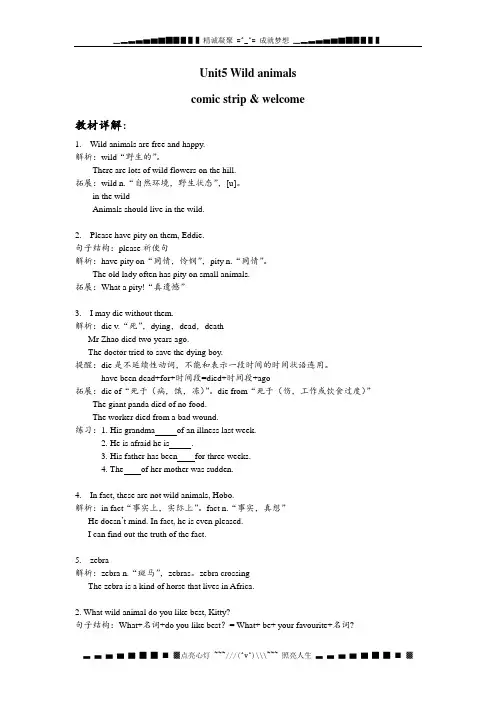
Unit5 Wild animalscomic strip & welcome教材详解:1.Wild animals are free and happy.解析:wild“野生的”。
There are lots of wild flowers on the hill.拓展:wild n.“自然环境,野生状态”,[u]。
in the wildAnimals should live in the wild.2.Please have pity on them, Eddie.句子结构:please祈使句解析:have pity on“同情,怜悯”,pity n.“同情”。
The old lady often has pity on small animals.拓展:What a pity!“真遗憾”3.I may die without them.解析:die v.“死”,dying,dead,deathMr Zhao died two years ago.The doctor tried to save the dying boy.提醒:die是不延续性动词,不能和表示一段时间的时间状语连用。
have been dead+for+时间段=died+时间段+ago拓展:die of“死于(病,饿,冻)”。
die from“死于(伤,工作或饮食过度)”The giant panda died of no food.The worker died from a bad wound.练习:1. His grandma of an illness last week.2. He is afraid he is .3. His father has been for three weeks.4. The of her mother was sudden.4.In fact, these are not wild animals, Hobo.解析:in fact“事实上,实际上”。
牛津译林版英语八年级上册Unit5Wildanimals(reviewlessons)说课稿
3.通过阅读文章,教授阅读技巧,帮助学生理解文章主旨,提高阅读理解能力;
4.设计口语表达环节,让学生运用所学词汇和时态,进行角色扮演和小组讨论,提升口语表达能力。
(三)巩固练习
为了帮助学生巩固所学知识并提升应用能力,我计划设计以下巩固练习或实践活动:
1.词汇填空:设计一份与野生动物相关的词汇填空练习,让学生在语境中运用词汇;
(2)熟练运用一般现在时态描述动物特征和行为;
(3)提高阅读理解能力,了解野生动物的生存现状;
(4)提高口语表达能力,学会用英语描述动物。
2.教学难点:
(1)词汇的掌握和运用;
(2)一般现在时态的运用;
(3)阅读理解的提高;
(4)口语表达能力的培养。
二、学情分析导
(一)学生特点
本节课面向的是八年级学生,这一年龄段的学生具有以下特点:好奇心强,对新鲜事物充满兴趣;认知水平逐渐提高,具有一定的抽象思维能力;学习兴趣方面,喜欢通过互动、游戏等活泼的形式学习;学习习惯上,已具备一定的自主学习能力和合作学习能力,但还需教师引导和督促。
2.句型转换:给出一些一般现在时的句子,让学生进行句型转换,巩固时态运用;
3.阅读理解:提供一篇关于野生动物保护的文章,让学生运用所学阅读技巧进行阅读,并回答问题;
4.口语表达:组织小组讨论,让学生就野生动物保护问题发表自己的看法,提升口语表达能力。
(四)总结反馈
在总结反馈阶段,我将采取以下措施:
1.引导学生自我评价:让学生回顾本节课所学内容,评估自己在词汇、语法、阅读和口语表达方面的掌握情况;
2.学生在口语表达时,可能存在语法错误和表达不清晰的问题;
3.部分学生可能对一般现在时态的运用不够熟练。
牛津译林版八年级上册Unit5《Wildanimals》(Reading1)说课稿
牛津译林版八年级上册Unit 5《Wild animals》(Reading 1)说课稿一. 教材分析《牛津译林版八年级上册Unit 5 Wild animals(Reading 1)》主要讲述了关于野生动物的保护问题。
通过一篇关于非洲象的阅读材料,引导学生了解非洲象的生活习性以及目前面临的生存困境。
文章语言真实自然,富有感染力,能够激发学生的学习兴趣,同时培养学生的环保意识。
本节课的内容与学生的生活实际密切相关,易于引起学生的共鸣。
二. 学情分析八年级的学生已经具备了一定的英语基础,能够运用英语进行简单的交流。
但他们在阅读理解、词汇积累以及写作方面还存在一定的困难。
因此,在教学过程中,教师需要关注学生的个体差异,善于激发学生的学习兴趣,引导他们主动探究,提高他们的阅读理解能力和环保意识。
三. 说教学目标1.知识目标:学生能够掌握文章中的重点词汇和短语,理解文章的主要内容,了解非洲象的生活习性和目前面临的生存困境。
2.能力目标:学生能够运用所学知识进行阅读理解,提高自己的阅读能力;通过讨论和写作,提高自己的表达和交流能力。
3.情感目标:学生能够树立环保意识,关注野生动物的保护问题,养成关爱自然、保护动物的良好习惯。
四. 说教学重难点1.教学重点:学生能够掌握文章中的重点词汇和短语,理解文章的主要内容,了解非洲象的生活习性和目前面临的生存困境。
2.教学难点:学生能够运用所学知识进行阅读理解,提高自己的阅读能力;通过讨论和写作,提高自己的表达和交流能力。
五. 说教学方法与手段1.教学方法:采用任务型教学法,让学生在完成任务的过程中,提高自己的阅读理解能力和表达能力。
2.教学手段:利用多媒体课件、图片等辅助教学,激发学生的学习兴趣,提高课堂效果。
六. 说教学过程1.Pre-reading:教师通过展示一些关于野生动物的图片,引导学生谈论自己喜欢的动物,激发学生的学习兴趣。
2.While-reading:教师引导学生快速阅读文章,回答一些简单的问题,帮助学生理解文章大意。
最新【牛津译林版】八年级英语上册:Unit 5 Wild animals Reading II课件
S1
S2
1. What does Xi Wang mean? It means “hope”.
2. What did she look like when she
was born?
She looked like a white mouse.
3. What could she do when she was
bear bore born
What could she do when she was 4 months old?
She started to go outside for the first time.
verbs + to-infinitives
More such words:
agree begin decide fail forget hope prepare learn remember try want plan
in the protected areas.
Challenge yourselves
Translate the following sentences into English
1.现在大多数野生动物都面临严重的问题。 Most wild animals are facing serious problems now.
Unit 5 Wild animals Reading (II)
How much do you know about Xi Wang?
What did she look like when she was born?
When she was born / At birth, it looks like a white mouse. bear vi [beə(r)] 生(小孩)
牛津译林版英语八上Unit5《Wildanimals》(integratedskills)说课稿

牛津译林版英语八上Unit 5《Wild animals》(integrated skills)说课稿一. 教材分析《牛津译林版英语八上Unit 5 Wild animals》主要介绍了一些野生动物,包括老虎、狮子、熊、猴子等。
本单元以动物为主题,通过学习动物的特点、生活习性以及保护动物的重要性,提高学生对野生动物的认识和关注。
本节课为单元的Integrated Skills部分,主要通过听力、口语、阅读和写作等多种形式,让学生综合运用本单元所学知识。
二. 学情分析八年级的学生已经具备了一定的英语基础,对于一些基本的词汇和句型能够熟练掌握。
但是,对于一些较为复杂的动物特点和保护动物的观点表达,还需要进一步引导和培养。
因此,在教学过程中,需要关注学生的个体差异,针对不同水平的学生给予适当的辅导和激励。
三. 说教学目标1.知识目标:学生能够掌握本节课所学的词汇和句型,了解各种野生动物的特点和生活习性。
2.能力目标:学生能够听懂、会说、会读、会写关于野生动物的短文,提高学生的综合语言运用能力。
3.情感目标:学生能够认识到保护动物的重要性,培养关爱动物的情感。
四. 说教学重难点1.重点:学生能够掌握本节课所学的词汇和句型,运用所学知识进行口语交流和写作表达。
2.难点:学生能够正确使用一般现在时描述动物的特点和生活习性,以及表达保护动物的观点。
五. 说教学方法与手段1.任务型教学法:通过设置各种任务,激发学生的学习兴趣,提高学生的参与度和积极性。
2.情境教学法:创设生动、真实的情境,帮助学生理解动物的特点和生活习性。
3.合作学习法:鼓励学生分组讨论、合作完成任务,培养学生的团队协作能力。
4.多媒体教学手段:利用多媒体课件和视频,丰富教学内容,提高学生的学习兴趣。
六. 说教学过程1.导入:通过展示一些野生动物的图片,引导学生谈论自己喜欢的动物,从而引入本节课的主题。
2.展示:教师通过多媒体课件,展示本节课所学的词汇和句型,让学生初步感知和理解。
Unit5+Wild+animals+Task+-2025学年牛津译林版英语八年级上册
Giant panda
Be a careful viewer
Looks
not very big, thick fur
Food Abilities
animals, sometimes fruit
can see, hear and smell things far away can run for hours without stopping
Is it a perfect report?
Be a careful viewer
black and white stripes live in Africa live mainly on grass
Zebra
How many wild animals do you know?
Be a careful viewer
Language Points
1. They are good at climbing and swimming. be good at doing sth. = do well in doing sth. 擅长做某事 e.g. He is good at drawing. =He does well in drawing. 他擅长画画。
Self-assessment
重点单词和短语: report, tail, insect, move, slowly, daytime, otherwise, be good at, in the daytime
Unit 5 Period 6
书写呼吁保护野生动物的报告: 1.介绍濒危动物的looks、food、 abilities、qualities; 2.介绍濒危动物现在的危险处境 和呼吁大家采取行动保护动物。
牛津译林版英语八上Unit 5《Wild animals》(integrated skills)教学
牛津译林版英语八上Unit 5《Wild animals》(integrated skills)教学设计一. 教材分析牛津译林版英语八上Unit 5《Wild animals》(integrated skills)以野生动物为主题,通过介绍非洲、亚洲和北极地区的动物,让学生了解不同动物的生活习性和保护状况。
本单元包括阅读、听力、口语、写作和语法等多个方面的内容,旨在提高学生综合运用英语的能力。
二. 学情分析八年级的学生已经具备一定的英语基础,能够运用英语进行简单的交流。
但他们在口语表达、听力理解、阅读分析和写作技巧方面仍有待提高。
此外,学生对野生动物保护的认识有待加强。
三. 教学目标1.知识目标:学生能够掌握有关野生动物的词汇和表达方式,了解不同动物的生活习性和保护状况。
2.能力目标:学生能够运用英语进行听力、口语、阅读和写作练习,提高综合运用英语的能力。
3.情感目标:学生能够认识到保护野生动物的重要性,增强环保意识。
四. 教学重难点1.重点:野生动物相关词汇和表达方式的掌握,阅读和听力理解的提高。
2.难点:口语表达和写作技巧的运用,对野生动物保护意义的深入理解。
五. 教学方法1.任务型教学法:通过完成各种任务,激发学生的学习兴趣,提高学生的参与度。
2.情境教学法:创设真实的语境,让学生在实践中学习和运用英语。
3.合作学习法:鼓励学生分组讨论,培养学生的团队精神和沟通能力。
六. 教学准备1.教师准备:教材、教学课件、野生动物图片和视频、相关阅读材料。
2.学生准备:完成预习任务,了解野生动物的基本知识。
七. 教学过程1.导入(5分钟)利用图片和视频展示不同野生动物,引导学生谈论自己喜欢的动物,激发学生的学习兴趣。
2.呈现(10分钟)教师展示课文标题《Wild animals》,引导学生预测文章内容。
然后逐段呈现课文,让学生注意生词和短语。
3.操练(15分钟)学生分组进行角色扮演,模拟课文中的对话,巩固所学词汇和表达方式。
最新牛津译林版八年级英语上册 Unit 5 Wild animals精品课件
Eddie and Hobo
Would Eddie like to live in the wild?
最新初中英语精品课件设计
PRraecatdistehweitdhiayloougur ep.artner
Act the dialogue out in the front.
Kitty
favourite animals monkeys
Reason clever , funny
Simon lions
strong, run fast
Peter pandas
cute
最新初中英语精品课件设计
Work in Groups
Talk about the animals you like best .
最新初中英语精品课件设计
最新初中英语精品课件设计
最新初中英语精品课件设计
最新初中英语精品课件设计
Where do bears live?
n.自然环境、野外[waild]
They live in the wild. They are wild animals.
adj. 野生的
最新初中英语精品课件设计
Unit5 Wild animals
Comic strip & welcome to the unit
and stronger.
Hi, guys. Come on. We’ll be late.
【'zebrə】
最新初中英语精品课件设计
Can we join you?
【'dɒlfɪn】
s
最新初中英语精品课件设计
Finish Part A on Page57
牛津译林版8上Unit 5 Wild animals 单元知识默写(Comic strip-Rea
牛津译林版8上Unit 5 Wild animals 单元知识默写(Comic strip-Reading)Comic Strip & Welcome to the unit一、默写课文中的单词。
1.野生的adj.自然环境,野生状态,n.2.自由的,不受束缚的adj.3.一道菜;盘,碟,n.4.同情"n.5.死讥. 6.海豚n.7.大熊猫n.8.松鼠,n.9.斑马n.二、默写课文中的短语。
1.野生动物2,居住在野外’3由又快乐4.同情它们5,<口)不可能6.实际上,事实上7.最喜欢猴子8.如此聪明又滑稽9.动物世界之王10.看上去如此可爱11.我最喜欢的动物12.随时成为餐桌上的莱三、根据汉语提示完成下列句子。
1.野生动物喜欢居住在野外。
Wild animals____________________________________________.2.它们是强壮的而且它们能跑得很快。
They're____________ and they__________________________________________. 3.它们随时可能成为餐桌上的莱肴。
They may on the table_______________________________. 4.--因此请你不要吃它们好吗?——没门!--So eat them?--______________________________________________!5.我最喜欢熊猫。
它们看起来如此可爱。
I like . They__________________________________________. 6.--你最喜欢什么野生动物?--我最喜欢狮子。
-- wild animal__________________________________________?--I like___________________________________.7.没有它们我可能会死。
最新初中八年级上册牛津译林版8A Unit5 Wild animals Grammar课件(14页)精品PPT课件
1.Why should we protect wild animals?
Because they are our friends.
While-tBiblioteka sk:1.Learn Part B and finish the exercises by yourself.
I wanted to see wild animals there. wild animals are our friends. the dolphin show was long.
Because ————————————————————————— 4.Why must we protect wild animals? Because —————————————————————————
Task2:Read the passage and answer some questions. because of
用法相似:if,until ,as soon as ,when, after,before. arrive 1.Please let me know as soon as you ______(arrive) here tomorrow. won’t go (not go) to bed until his father comes 2.He _________ back. finishes 3.He will go back home when he _______ (finish) the work. arrived 4.He came to see me as soon as he _______ (arrive) here yesterday. go 5.He didn’t _______(not go) to bed until his father came back. grew (grow) into 6.When the duck grew up, it _______ a beatiful swan.