
外研版七年级英语下册 Module 4 Life in the future 课后练习
外研版英语七年级下册Mudule4 Life in the future 课后练习Name:__________________ 翻译:明天将会下大雨。
将来每个人都会在家学习。
人们将通过互联网获取信息。
将来会有更多的树吗?题二:翻译:他们将会通过电子邮件把作业发送给老师。
村庄里将会有许多小汽车。
将来人们用机器人做家务。
你家将会有机器人吗?题三:翻译:我们希望将来污染会更少。
今后不许迟到。
十年后Sandy将成为一名记者。
题四:将来我们的生活将会不同。
今后注意你的身体。
我们十分钟后回来。
题五:There ____ an English speaking contest for middle school students in our city.A. isB. areC. willD. will beThere _____ an NBA basketball game in ten days.A. is going to haveB. are going to haveC. is going to beD. are going to beThere _____ strong winds in spring.A. isB. areC. will beD. willThere _____ a football match and a concert this weekend.A. is going to haveB. are going to haveC. are going to beD. is going to be题七:翻译:我们将能和机器人交谈。
21世纪末世界将会是什么样子?你的老师是个什么样子的人?他很严厉。
题八:翻译:我们将能去太空旅行。
明天天气什么样?你的妈妈是个什么样子的人?她很温柔。
题九:翻译:我们再也不犯这种错误了。
我们不再信任他了。
他再也不能保持沉默了。
He can _____ keep silent ____ ______.题十:翻译:我不会再忍受下去了。
他承诺不再玩电脑游戏了。
你不再是个孩子了。
You are_____ a child ____ ______.题十一:他不仅演奏得很好,而且会作曲。
他不仅平时工作,星期日也工作。
Not only you but also he _____tired of having one examination after another.A. beB. amC. isD. are题十二:翻译:他不但在学英语,而且还在学法语。
她在课堂上和家里都说俄语。
Not only Zhou Xia but also her parents _____ fond of watching football ma tches.A. beB. amC. isD. are题十三:翻译:为什么你不也一起来呢?我不讲法语,她也不讲法语。
题十四:翻译:我要到伦敦去, 我妹妹也要去。
要是她不去,我也不去。
题十五:翻译:她周末将会带我去电影院。
金钱不会给你带来幸福。
她主动提出要帮她妈妈搬箱子。
请给我取来一双手套。
题十六:翻译:你可以把这些书带到教室去吗?社会主义给我们带来了自由和幸福。
他经常为老年人搬水。
我让她去给我拿一张晚报来。
题十七:Lucy watches TV every night.(用tomorrow改写句子)Lucy___ _____ ______ tomorrow.I will do some reading tomorrow.(对划线部分提问)电影院今晚将上映一场电影。
句型转换He will come back in three days.(对划线部分提问)_____ _____ _____he come back?The snow will stop later in the day.(变为否定句)I’m going to buy some new clothes on Sunday.(改为一般疑问句)题十八:I go to the cinema every week.(用tomorrow改写句子)I ___ _____ ______ the cinema tomorrow.Mary will do some washing tomorrow.(对划线部分提问)下周有运动会。
句型转换Lily will leave for London in three hours.(对划线部分提问)_____ _____ _____ Lily _____ _____ London?They will go hiking this Sunday.(变为否定句)Daming is going to go over his lessons for his English test.(改为一般疑问句)Mudule4 Life in the future答案课后练习参考答案题一:There will be heavy rain tomorrow.Everyone will study at home in the future.People will get information on the Internet.Will there be more trees in the future?解析:1. 根据时间状语“明天”,可判定为将来时。
故用There be句型的一般将来时形式。
2. 根据时间状语“将来”,可判定为将来时。
3. 此句用一般将来时,will后接动词原形。
4. 根据时间状语“将来”,可判定为将来时。
一般疑问句把will 提到句首。
题二:They will send their homewo rk to their teacher by email.There will be a lot of cars in the village.People will use robots to do the housework.Will there be robots in your home?解析:1. 此句用一般将来时,will后接动词原形。
2. 此句用一般将来时。
强调某地有某物时用there be 句型,故此题用There be句型的一般将来时形式。
3. 根据时间状语“将来”,可判定为将来时。
4. 此题用将来时。
一般疑问句把will 提到句首。
题三:We hope that there will be less pollution in the future.Don’t be late in future.Sandy will be a reporter in ten years.解析:1. in the future表示“将来”。
故此句用一般将来时。
2. in future表示“从今以后”。
3.“in加一段时间”与将来时连用,表示“多久以后”。
题四:Our life will be different in the future.Pay attention to your health in furue.We will come back in ten minutes.解析:1. in the future表示“将来”。
故此句用一般将来时。
2. in future表示“从今以后”。
3.“in加一段时间”与将来时连用,表示“多久以后”。
题五:D C解析:1. 句意为“我们市将有一个中学生口语演讲比赛”。
There be句型的一般将来时为There will be…或There is going to be…。
2. 句意为“十天后将有NBA篮球赛”。
There be句型的一般将来时为There will be…或There is going to be…。
题六:C D解析:1. 句意为“春天将会有大风”。
There be句型的一般将来时为There will be…或There is going to be…。
2. 句意为“这周将会有一场足球赛和一场音乐会”。
There be句型的一般将来时为There will be…或There is going to be…。
题七:We will be able to talk with robots.What will the world be like by the end of 21st century?What’s your teacher like? He is strict.解析:1.表示“将来能够做某事”,用will be able to do sth.。
2. What will …be like?句型可以表示“……将会是什么样子?”。
3. What’s sb. like?可以用来询问人的性格特点,表示“是什么样子的人”。
题八:We will be able to travel in the space.What will the weather be like tomorrow?What’s your mother like? She is tender.解析:1.表示“将来能够做某事”,用will be able to do sth.。
2. What will …be like?句型可以表示“……将会是什么样子?”。
3. What’s sb. like?可以用来询问人的性格特点,表示“是什么样子的人”。
题九:We won’t make such mistakes any more.; We won’t believe in him any more.; not…any longer. 解析:1. 用作副词,表示时间上“不再”,可以使用no longer/not…any longer/not…any more.2. 用作副词,表示时间上“不再”,可以使用no longer/not…any longer/not…any more.3. 用作副词,表示时间上“不再”,可以使用no longer/not…any longer/not…any more.题十:I won’t put up with it any more.; He promised not to play computer games any more.; not…any longer解析:1. 用作副词,表示时间上“不再”,可以使用no longer/not…any longer/not…any more.2. 用作副词,表示时间上“不再”,可以使用no longer/not…any longer/not…any more.3. 用作副词,表示时间上“不再”,可以使用no longer/not…any longer/not…any more.题十一:He not only plays well, but also writes music.He works not only on weekdays but on Sundays as well. C解析:1. 用于连接两个表示并列关系的成分,着重强调后者,其意为“不仅……而且……”;其中的also 有时可以省略。
初中英语《Module4Lifeinthefuture》单元教学设计以及思维导图
主题单元学习目标(说明:依据新课程标准要求描述学生在本主题单元 学习中所要达到的主要目标)
知识与技能:1.语法:一般将来时:will + 原形动词。 2.词汇:cable TV, calculator, cell phone, computer, education,
comfortable 等。 3.功能:预测与想象的表达。
Step 1. 创设情境导入 看图片,在小组内描述图片。
Step 2. 展示学习目标 Step 3. 出示提纲学生自学(讲评课出示学案、训练课出示练习题)
自主完成教材上的习题,巩固所学的知识。 Step 4. 师生互动合作探究(讲评课、训练课:自我纠错、合作合作探究)
1.We won’t travel by bus or bike any more.我们将不再乘公交车或自 行车旅行。
专题划分
(说明:除了说明主题单元将划分成几个专题以及每个专
题所用的课时外,还应说明哪一个专题或专题中的哪一个
活动将以研究性学习活动的形式来开展学习活动。)
专题一:Everyone will study at home. ( 一 课时)
专题二:Everyone will have a small car. ( 一 课时)
专题二
Everyone will have a small car.
所需课时 课内共用一课时,每周五课时;课外共用二课时
专题学习目标 (说明:描述学生在本专题学习中所要达到的学习目标, 注意与主题单元的学习目标呼应)
பைடு நூலகம்
To get necessary information from the reading material.
初一七年级英语下册外研版Module 4 Life in the future 教案
Module 4 Life in the futureUnit 1 Everyone will study at home.一、教学目标:1. 语言知识目标:1) 掌握本单元所学单词和短语:chalk, ruler, carry, change, everything, in thefuture, life, will, maybe, ask, by, be able to, not...any more...2)能听懂谈论未来的简单对话,能判断未来事实。
2. 情感态度价值观目标:通过对未来美好的憧憬,培养学生积极乐观的精神。
二、教学重难点1. 教学重点:以谈论将来生活为中心,介绍并询问有关将来生活的信息。
2. 教学难点:一般将来时will 的陈述句,否定句,一般疑问句及回答。
三、教学过程Step 1 Warming upGive some pictures and videos about the schools in the future to students. Let them watch it.Step 2 Work in pairs. Look at the picture of Activity 1 and use the words in the box to help you describe it.1. Will our life be different in the future? Yes, it will. / No, it won’t.2. Will our school change? Yes, they will. / No, they won’t.3. Will everything be different? Yes, it will. / No, it won’t.4. Will students need computers at school? Yes, they will. / No, they won’t.5. Will they carry lots of books to school? Yes, they will. / No, they won’t.Step 4 Listen and read. Then let the students do Activity 3.Step5 Complete the passage of the Activity 4Betty: We’ll always (1) _____ teachers because computers will never be (2) _____ to check the students’ (3) ______ and answer their (4) _____ by (5) _____orInternet. Will students need to go to school (6) _____? Yes, (7) _____they will, because school is good fun, but everyone will have lots of(8) ______ time.Step6 Work in pairs. Ask and answer the questions.1. Will schools be different in the future?2. Will students use books in the future?Step7 Work in pairs. Talk about what your school will be like in ten years.— We will study at home and only go to school for sports and games.— Well, this is good, but I’ll miss my teachers and friends.Step8 Language Points1. In 20 year’s time, maybe there won’t be any schools.句中的“in +一段时间” 表示“一段时间之后”,常用于将来时。
外研版初中英语七年级下册教案:Module4 Life in the future
Module4 Life in the futureUnit 1 Everyone will study at home.本单元以学校为题材,通过对未来的描述,掌握一般将来时的表达方式,同时表达自己对未来的设想,充分发挥想象力,通过对美好未来的憧憬,培养乐观向上的精神。
一.教材分析1.通过对第四模块的学习,学生已经学会使用be going to do 表示计划,安排作某事。
对一般将来时态有了一定的了解。
2.本模块以讲诉学校生活入手,对未来生活展开丰富的想象。
贴近学生生活,大部分学生会对本课产生浓厚的兴趣。
二.教学目标1.知识技能目标(1)词汇能够准确读出并写出cable TV, calculator, cell phone, computer, email, Internet, satellite, climate, education, technology, transport, machine,comfortable, rough, strong, expensive, smooth, dull 等单词;能准确读出technology 等词语。
(2)语法学习一般将来时will do的用法,(3) 技能能通过对本课对话的学习,使学生学会用将来时态表达对未来的设想。
2.情感目标用丰富的想象力预测未来的学校生活,培养乐观向上的精神。
3. 教学重点和难点一般将来时的用法和用一般将来时表达对未来的设想。
三.教学过程Step 1. lead-in:活动1:Ask and answer“What can you see in our classroom?” Ask the students to use the words to d escribe the classroom.[设计意图]:本活动为的是解决对话中出现的词汇障碍,为听对话作好准备,同时,通过对话题的讨论激活学生的背景知识,为听力理解做知识方面的铺垫。
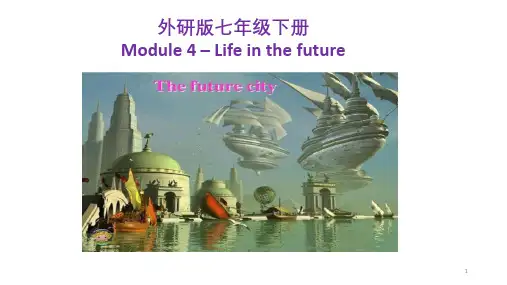
外研版七年级下册 Unit 4 Life in the future PPT课件
语法讲解: 一般将来时 will+动词原形
思考如何翻译?
将来每个桌子上都会有一台电脑。
There will be a computer on every desk in the future.
将来每个桌子上不会有一台电脑。
There will not be a computer on every desk in the future.
A. is
B. is going to have
C. will have D. is going to be
5. ---Mom, when can I go out to play football?
---Finish your homework first, or I ___C_____let you go out.
D. is going to be
(2). Look at the dark clouds. It _________D_______ rain.
A. will
B. is going to be C. will be D. is going to
14
语法讲解: 一般将来时 will +动词原形
4. be going to+动词原形和 will+动词原形的辨析: (1). 纯粹的将来的客观事实,不表明计划打算,用will+动词原形。 (2). 有迹象表明将会发生某事,用be going to+动词原形。
20
词汇讲解 need: v. 需要 need sth: 需要某物 e.g. I need some money to buy snacks. need to do sth: 需要做某事 e.g. I need do my homework right now.
外研版英语七年级(下) Module 4 .Life in the future
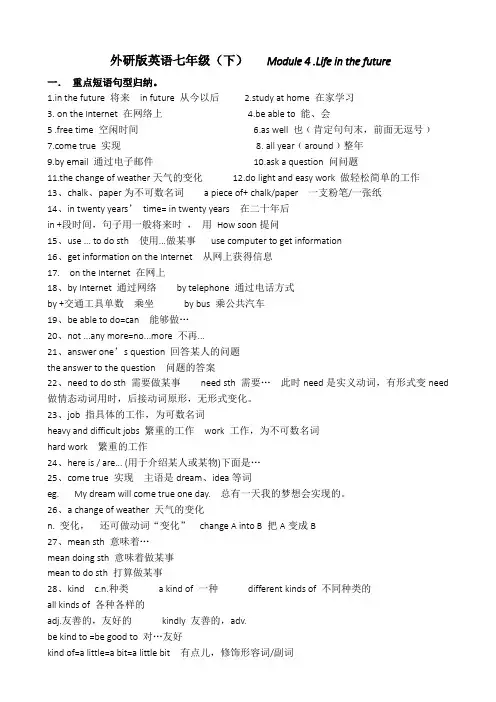
外研版英语七年级(下)Module 4 .Life in the future一.重点短语句型归纳。
1.in the future 将来in future 从今以后2.study at home 在家学习3. on the Internet 在网络上4.be able to 能、会5 .free time 空闲时间 6.as well 也﹙肯定句句末,前面无逗号﹚e true 实现8. all year﹙around﹚整年9.by email 通过电子邮件10.ask a question 问问题11.the change of weather天气的变化12.do light and easy work 做轻松简单的工作13、chalk、paper为不可数名词 a piece of+ chalk/paper 一支粉笔/一张纸14、in twenty years’time= in twenty years 在二十年后in +段时间,句子用一般将来时,用How soon提问15、use ... to do sth 使用...做某事use computer to get information16、get information on the Internet 从网上获得信息17. on the Internet 在网上18、by Internet 通过网络by telephone 通过电话方式by +交通工具单数乘坐by bus 乘公共汽车19、be able to do=can 能够做…20、not ...any more=no...more 不再...21、answer one’s question 回答某人的问题the answer to the question 问题的答案22、need to do sth 需要做某事need sth 需要…此时need是实义动词,有形式变need 做情态动词用时,后接动词原形,无形式变化。
Module 4《Life in the future》课件3(24页)(外研版七

1.Planes will be very large so flying will be very cheap.
2. It will be hot all year so the winter will be very short.
3. Coputers will be very small so they’ll be very light.
P23. 6
1.Planes will take a lot of people. 2.Summer will be short and cool. 3.It will be cheap to heat our homes. 4.Machines will do interesting jobs.
In the future, large machines will do all the difficult jobs.
Planes will be very large so flying will be very cheap.
Fuel will be expensive.
Everyone will have a small car.
The North Pole
bad weather
heavy rain
strong wind
use the sun t be very small, so they’ll be very light.
Machines will do the dull jobs No one will do heavy work.
Unit 2
comfortable uncomfortable
dull
interesting
cheap
外研版英语七年级第二学期Module 4 Life in the future 单元练习(含3个单元+答案)
外研版英语七年级下册Module 4 Life in the future 单元练习Unit1 Everyone will study at home一. 根据句意和首字母提示补全单词1. How is her l______ in England now?2. What are you going to be in the f _________?3. Danny has nothing to do now. He is f_____.4. Look! My English teacher is writing on the blackboard with c________.5. I have some q________ to ask you, Miss Black.二. 用所给词的适当形式填空.1. Here _____ (be) two nice photos of my family.2. Robots are able to (do) lots of things for us.3. Chinese students have a lot of homework_______(do)every day.4. Our teachers are all very __________(friend) to us students.5. . In my dream school there won’t be_____ (some) dirty classrooms.三. 单项选择( )1. There will _____ lots of rain in the next year.A. haveB. beC. hasD. is( )2. My grandparents go to the supermarket ______ bus every week.A. onB. inC. withD. by( )3. You need _______early tomorrow.A. comesB. comeC. comingD. came( )4. —What are you doing, Lily? —I’m sending a letter to my sister ____ email.A. withB. byC. useD. of( )5. Can you give me ________? We have none in our classroom.A. chalkB. a chalkC. some chalksD. a piece of chalk( )6.—Why are you in such a hurry, Mike?—There ______ an NBA basketball game in ten minutes.A. will beB. will haveC. is going to haveD. are going to be( )7. — Will ________ any schools in fifty years?— It's hard to say. Maybe students will study at home.A. there areB. there beC. these areD. they are( )8. Jim and Jack _______ to Los Angeles in two days.A. will goB. goesC. goD. is going( )9. —______you study at home in 100 years? —Yes, I______.A. Are; amB. Will; willC. Will; doD. Are; do( )10. —Will students have lots of homework to do this weekend?—________. Teachers won’t give them much homework any more.A. Yes, they willB. Yes, they doC. No, they won’tD. No, they don’四.句型转换.1. Tom and Jim will go swimming tomorrow. (改为否定句)___________________________________2. Will the weather get warm in the future? (作否定回答)___________________________________3. We’ll go to London on Saturday afternoon. (对划线部分提问)___________________________________4. My father will go to England by plane. (对画线部分提问)___________________________________5. China is a modern and strong country.(用in twenty years改写句子)____________________________________________________五. 根据汉语提示完成句子.1. Excuse me. Can you help me_________ (拿) this box?2. I am busy this week, but I will be ________(空闲的) next week.3. ___________(也许) I will be a manager in the future.4. How many ___________(直尺) have you got, Lisa?5. Wang Na __________(需要) a bottle of cola.六.补全对话A: What do you think your life will be like in ten years?B: 1______________A: Where will you live?B: 2______________A: How will you get there?B: 3_____________A: Will life be interesting there?B: Yes. I think it will be very interesting.A: 4_____________B: Of course there will be. I think the department stores(百货商店) will have all kinds of things and we can take anything for free.A: 5_____________B: I agree (同意). People will have a happy life there.1. ______2. ______3. ______4. ______5. ______七. 任务阅读①. Life in the future will be different from life today. But what will life be likein the future? The population(人口) is growing A . There will be many people in the world and most of them will live to over 100 years old. Computers will be very B and useful, and there will be computers in every home. Travelling will be very cheap and C .And many people will go to other countries for holidays. There will be changes in our food, too. There will not be________(many) room for cows and sheep, so meat will be very expensive. ②也许没有人会每天都吃它。
外研版七年级英语下册Module 4 Life in the future精品课件
2. –________ you ____D____ free tomorrow?
– No. I ________ free the day after tomorrow.
A. Are; going to; will B. Are; going to be; will
C. Are; going to; will be D. Are; going to be; will be
一般将来时的构成
一般将来时表示将来发生的动作或存在的状态 助动 词will + 动词原形
肯定式: 主语+will+动词原形+其他组卷网
否定式: 主语+will+not+动词原形+其他. 疑问式: Will+主语+动词原形+其他 简略回答: (肯) Yes,主语+will .
(否) No,主语+will+not .
▪ 11、一个好的教师,是一个懂得心理学和教育学的人。2021/7/292021/7/292021/7/29Jul-2129-Jul-21
▪ 12、要记住,你不仅是教课的教师,也是学生的教育者,生活的导师和道德的引路人。2021/7/292021/7/292021/7/29Thursday, July 29, 2021
Module 4 Life in the future
Unit 1 Everyone will study at home.
一般将来时 will
详见课本P94----95学组卷网
科网
(Simple Future Tense )
一般将来时表示将来某一时刻的动作或状态, 或将来某一段时间内经常的动作或状态。
外研版七年级英语下册 精品课件 Module 4 Life in the future(共110张PPT)
Tony writes a passage about the life in the future. Listen and answer these two questions. 1.What will the clothes be like in the future? 2.Who will do all the heavy and difficult jobs in the future?
句中的 “in + 一段时间”表示“一段时间 之后”,常用于将来时。可以用 how soon 来提问。例如: — How soon will you be back? 你多久回来? — In a week. 一个月之后。
They can ask their teachers questions by Internet, telephone or email. 他们可以通过互联网、电话或电子邮件 向老师提问。 句中的 “by”表示方式,意 思是“用……,靠……,通 过……”。 例如: Send it by air mail. 用航空邮件寄吧。 They want to travel by train. 他们想坐火车旅行。
重难点讲解
¤ Well, I’m not sure. 喔,我不确定。 ¤ That’ll be great! 那太棒了!
more 是形容词 many 和 much “多的” 的比较级。意为“更多的”,即: many — more 多的 更多的
much — more 多的 更多的
如: many books — more books much milk — more milk
Now Tony and his kids are talking about the future in class too. Listen and answer these two questions. 1.Where will students study in the future? 2.Will students have a lot of homework to do in the future?
外研版七年级英语下册 Module 4 Life in the+future专题讲解(有答案)
外研版英语七年级下册Module4 Life in the future专题讲解Name:__________________本单元提纲1. 主题功能:能够谈论未来的生活2. 重点单词:change, ask, traffic, cheap, heavy, hour 等。
3. 重点短语:in the future, not...any more, on the internet, come true, heavy rain 等。
4. 核心句型:Will school be different in the future?Everyone will study at home.等。
语法结构:will结构的一般将来时重难点精讲Will school be different in the future?将来学校会不一样吗?本句是一般将来时的一般疑问句,结构为“will+主语+动词原形+其它?”。
该句式的答语有两种形式:肯定回答Yes,主语+will否定回答No,主语+won’t一般将来时表示的是未来的事情或者是对将来的预测,will没有人称和数的变化。
如果表示将来不会,就要用will not或者缩写成won’t。
题一:翻译:那边将会有一个大型的公园。
将来每张桌子上都会有一台电脑。
我想人人都将用电脑学习。
他们将不用课本。
学校里会有电脑吗?In the future意为“将来,未来”。
in the future 意为“将来”in future 意为“今后,以后”,相当于from now onIn twenty years’ time, maybe there won’t be any schools.在20年后,也许将不会有任何学校。
in twenty years’ time意为“在20年后”,其中years’是名词所有格结构。
在一般将来时中,“in+时间段”表示“在一段时间之后”。
题二:翻译:谁知道将来会发生什么事情?今后多注意你的拼写。