
新课标新教材人教必修第三册高中英语Unit5SectionⅢGrammar--情态动词和过去将来时课件69
(1)①can 表示可能性时,指的是理论上的可能,它通常不用来表 示某事实际发生的可能性或真实性。如:
Accidents can happen.Anybody can make mistakes. 如果我们要表达某事发生的实际可能性,要用 may,could 或 might 等。
We may spend our summer holidays in Hangzhou this year. Will you answer the telephone ? It could/may/might be your mother. ②could 用来征求意见时,语气要比 can 委婉,但在回答问题时 我们不能用 could,因为语气委婉,可能性就变小了。如: —Could I use your telephone? —Yes,please go ahead.
Unit 5 THE VALUE OF MONEY
Section Ⅲ Grammar——情态动词和过去 将来时
突破 语法大冲关
一、复习情态动词 情态动词表示说话人对某一动作或状态的态度。初中阶段大家已 经学习了一些情态动词,这里将对情态动词的特征、功能和用法进行 总结。
[观察例句] 1.Oliver believes that with a million-pound bank note a man could live a month in London. 2.Young man,would you step inside a moment,please? 3.May we ask what you're doing in this country and what your plans are?
③在过去时态的肯定句中需要某种条件或努力做成某事,我们要 用 was/were able to 而不能用 could。如:
It was a holiday and the children were able to go to the seaside. The girl worked hard so she was able to pass the final test.
(7)ought to 与 should 意思接近,大多数情况下二者可以互换,但 是 should 谈的是自己的主观看法,ought to 则更多反映客观情况,在 谈到法律、义务和规定时使用。如:
We should/ought to help each other and learn from each other in our work.
She is your mother,so you ought to support her. We ought to go and see Mary tomorrow,but I don't think we will.
(8)need 用作情态动词,仅用于否定句和疑问句,而不用于肯定 句。在肯定句中要用 must,have to,should,ought to 或将 need 当作 行为动词使用。如:
议
The cookies Susan made are delicious,you ought to try
some.
Would you recommend the play to other people?
表示愿望 I would like to know the date. I'd love to go to your birthday party.
表示发出指 Will you please take her to the library?
Could you offer me work here? 示或提出请
Can I ask a question?
求
May we ask what you're doing in this country?
表示提出帮 Will you stay for lunch?
(3)must 表示推测时,其反意疑问句有好几种形式。①“must+ 动词原形”对目前的情况进行推测时以及用 must+be+v.ing 形式 对目前正在发生的情况进行推测时,疑问短语部分要与 must 之后的 动词相一致。如:
The mathematics teacher must be in the office now,isn't he?
may might must dare
may not might
not must not
dare not
/ห้องสมุดไป่ตู้
will will not
won't
mightn't would would not wouldn't
mustn't need daren't ought to
need not ought not to
[归纳用法] 1.情态动词的基本特征 (1)在形式上,情态动词没有实义动词的各种变化,只有 could, would,had to,might 等几个过去式,其他情态动词如 must、ought to 等的过去式皆与现在式同形。
(2)在意义上,大多数情态动词有多个意义,如 can 可以表达“能 力;可能;许可”等。
needn't oughtn't to
3.情态动词的主要表意功能
用法
例句
表示能力 The little boy can read and write. I could feel the ground shaking.
Those of you who are familiar with the game will know this. 表示可能和 They made a bet which would settle their argument. Oh,you must be Sylvia's husband. 推测 It may seem lucky to you but not to me. That might not be true. There ought to be enough space for all of us.
The minister must have arrived in Shanghai,hasn't he?
(4)shall 可以用来征求对方意见,用于第一、三人称。此外它也 可以用来表示说话人的命令、警告、允诺、威胁或决心等,这时它用 于第二、三人称。如:
Shall she go to the concert with us this evening?(征求意见) You shall go to the front at once.(命令) Don't worry.You shall get the answer this very afternoon.(允诺) He shall be sorry one day.I tell you.(警告) Nothing shall stop us from fighting against pollution.(决心)
(5)在表示将来的时间、条件状语从句中,不能用 will(这时的 will 不是情态动词,而是助动词,帮助构成将来时)。如:
If it will rain tomorrow,we shall not go to the mountain village.(误) If it rains tomorrow,we shall not go to the mountain village.(正) 当情态动词 will 表示意愿或决心时,是可以用于条件状语从句 的。如: If you will listen to me,I'll give you some advice on how to learn English. If you will come this way,the manager will meet you.
(3)在用法上,情态动词与助动词一样,需后接动词原形,构成 谓语动词。
2.情态动词的否定式及缩略形式
情态动 词
否定式
缩略形 情态动
式
词
否定式
缩略形式
can could
cannot/ can not could not
can't couldn't
shall sould
shall not shan't should not shouldn't
4.I can't say that I have any plans. 5.Anyway,I didn't dare to try again. 6.You mustn't worry about that. 7.If you'll excuse me,I ought to be on my way.
(2)must 与 have to 都可以表示“必须”的意思,但要注意以下两 点区别。
①must 只有现在时,而 have to 有现在时、过去时和将来时。如: We must work hard,or we'll fail in the examination.Years ago,the poor girl had to leave school for lack of money. ②must 表示主观看法,have to 则侧重于客观需要。如: We must be strict with ourselves in everything.In cities with many cars,some people have to wear masks.
(6)should 除表示必要或义务外,还可表示推测或可能。如: The American friends should be here now. “should/ought to+have+过去分词”既可表示本该做而事实上 没有做的事,也可以表示惊讶、责备、赞叹等情绪。如:
2021-2022学年人教版高中英语必修三教学案:Unit 5 Section 3 Word版含答案
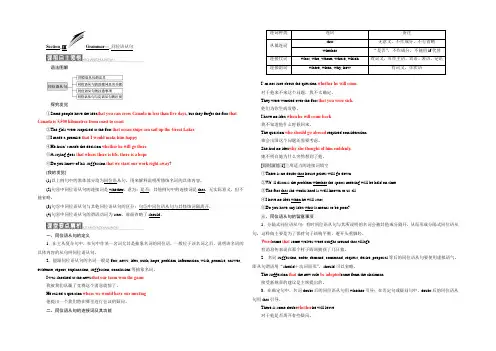
Section_ⅢGrammar—_同位语从句语法图解探究发觉①Some people have the idea that you can cross Canada in less than five days, but they forget the fact that Canada is 5,500 kilometres from coast to coast.②The girls were surprised at the fact that ocean ships can sail up the Great Lakes.③I made a promise that I would make him happy.④He hasn't made the decision whether he will go there.⑤A saying goes that where there is life, there is a hope.⑥Do you know of his suggestion that we start our work right away?[我的发觉](1)以上例句中的黑体部分均为同位语从句,用来解释说明所修饰名词的具体内容。
(2)句④中同位语从句的连接词是whether,意为:是否;其他例句中的连接词是that,无实际意义,但不能省略。
(3)句⑤中同位语从句与其他同位语从句的区分:句⑤中同位语从句与其修饰词隔离开。
(4)句⑥中同位语从句的谓语动词为start,前面省略了should。
一、同位语从句的定义1.在主从复合句中,在句中作某一名词尤其是抽象名词的同位语,一般位于该名词之后,说明该名词的具体内容的从句叫同位语从句。
2.能跟同位语从句的名词一般是fact, news, idea, truth, hope, problem, information, wish, promise, answer, evidence, report, explanation, suggestion, conclusion等抽象名词。
人教高中英语必修3Unit5Grammar (共28张PPT)
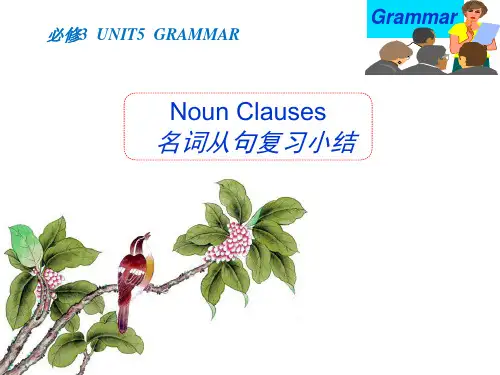
9.At last they arrived at _w_h__a_t__ was called the Death Valley by the locals.
对比:
At last they arrived at the place _w__h_ic__h_ was called the Death Valley by the locals.
A.how B.what C.when D.which
4.It is obvious to the students ___D__ they should get well prepared for their future.
A. as B. which C. whether D. that
5.__C__wants to stay in a hotel has to pay their own way.
4.To my surprise, the town is far different from w__h_a_t_ it used to be.
5._W_h_e_t_h_e_r the new treatment疗法 will
be effective remains to be seen.
6.Perseverance毅力 is w__h_a_t it takes to do anything well.
表语从句
从句的判断:谓语个数-中心谓语-从句位置.
Have a try!
从句的判断:主句意义联系.
(1)_____ makes the shop different is _____ it offers more personal services.
(2) The reason ____ he gave for coming late was ____ his mother didn’t allow him to.
人教版高中英语必修5 Unit3 Grammar名师教学设计
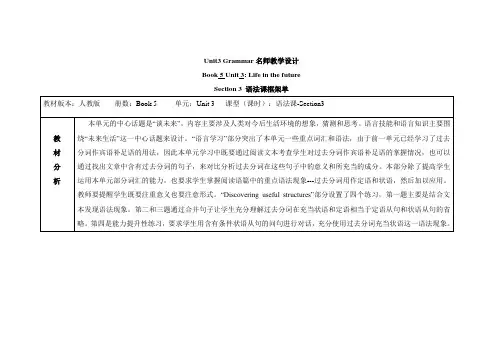
(详见附后的教学设计)
教
学
评
价
1.本课时的目标设计清晰可操作,活动的设计紧扣目标要求并与目标达成一致;
2.语法课的活动环节设计遵循语法学习规律,自上而下逐层递进,注重培养学生归纳总结的能力;
3.语法课后的活动设计体现对情景中再现语法的教学策略,注重了对学生运用语法知识能力的培养。
Section 3语法课教学设计
教
学
目
标
语言目标:
1.学生能掌握过分词作定语和状语这一语法现象。
2.学生能准确找到过去分词的逻辑主语,并明确他们之间的被动关系。
语义目标:
1.学生能准确分析过去分词在句中充当的成分(作状语和定语)。
2.学生能熟记,过去分词的巧学口诀。
语用目标:
1.学生能正确理解过去分词作状语和定语的句子。
2.学生能在语境中正确地使用过去分词
步骤
过程
措施(教师活动与学生活动)
目的
持续性评价
DELC1
预备与激活先期知识
Step 1
Leading in(导入…
T: Today we will learn something about how to use the past participle as the adverbial and attribute. Let’s read the passage and underline the sentences which contains past participles.
情感目标:
1.学生能对语法学习变得更感兴趣;
2.学生能逐渐形成通过文本学习主动归纳语法现象的意识。
学习策略:
1.通过分析对比,发现语法现象;
2019-2020学年英语人教版必修3课后习题:Unit 5 Section Ⅲ— Grammar Word版含解析

SectionⅢ—Grammar课后篇巩固提升一、用适当的连词、连接代词或连接副词填空1.The fact he works hard is well known to us all.答案that2.There is a common belief among them rubbish can and should be put to good use.答案that3.He’s come from the government with a message the meeting won’t be held tomorrow.答案that4.I made a promise if anyone set me free I would make him king of the world.答案that5.The nurses are trying their best to reduce the patient’s fear he would die of the disease.答案that6.Modern science has given clear evidence smoking can lead to many diseases.答案that7.The report makes people worried some teenage girls smoke like boys in some middle schools.答案that8.They expressed the wish she would accept the award.答案that9.Do you have any idea is actually going on in the classroom?答案what10.A number of questions will be discussed by the students beginners of English fail to use the language properly.答案why二、合并句子1.She expressed the hope.The hope was that she would go on a tour of Guangzhou again.She expressed thehope.答案that she would go on a tour of Guangzhou again2.The question is who caught sight of the accident then.We want to know the answer to the question. We want to know the answer to thequestion.答案who caught sight of the accident then3.The news was not true.The news was that he managed a company.The news was not true.答案that he managed a company三、借助同位语从句把下列句子译成英语1.但是我看不到通过升学考试的可能性。
2020_2021学年高中英语Unit5FirstaidSectionⅢGrammar教师用书教案新人教版必修5

Unit 5 First aid省略语境自主领悟先观察原句后自主感悟1.These burns are not serious and (they) should feel better within a day or two (days).2.If burns are on arms or legs,keep them higher than the heart,if (it is) possible.3.It shows that a knowledge of first aid can make a real difference.4.First degree burns turn white when (they are) pressed. 1.例句1为并列句,因为两个分句的主语都是These burns,故第二个分句的主语省略;介词within后的宾语中因前面有名词day,故or后的同一名词days省略。
2.例句2中的条件状语从句中含有it is,可以省略。
3.例句3中的及物动词show后接宾语从句,连接词that一般可以省略。
4.例句4中的时间状语从句的主语和主句的主语First degree burns一致,且状语从句中含有be动词时,省略状语从句中的主语和be动词。
为了避免重复,将句子中的一个或几个成分省去,这种语法现象叫省略。
省略是避免重复、突出新信息并使上下文紧密连接的一种语法手段。
英语中的省略有下列几种情况。
一、简单句的省略1.祈使句的省略。
在祈使句中,通常省略主语you。
(You) Go down this street and turn right at the second crossing.请(你)沿着这条街走,然后在第二个十字路口向右拐。
2.There be 句型的省略。
(Is there)Anything else?(还有)其他东西吗?3.疑问句的答语省略。
—Are you from America?—Yes,I am (from America).——你来自美国吗?——是的,我是(来自美国)。
人教版高中英语选择性必修第三册精品课件 Unit 5 Poems Section Ⅲ

好。
★look forward to (to为介词)期望;盼望;期待
I’m looking forward to receiving your early reply.
我盼望早日收到你的答复。
【合作探究】
读一读·细观察
阅读下列句子,写出句中黑体词组的含义
/weər̍evə(r)/ conj. 在任何地方;在所有……的情况下
(用于问句)究竟在(到)哪里
6. grief
7. complicated
/riːf/ n. 悲伤;悲痛;伤心事
/̍kɒmplIkeItId/ adj. 复杂的;难懂的
8. variation
/̩veəri̍eIʃn/ n. 变化;变体;变奏曲
含义 扑灭
说一说·勤归纳
【即学即用】
写出下列句中黑体词组的含义
①We put up our flag on Monday morning.
举起
②They have put up a fence to keep the dog and chicken.
③You must put on your special clothes to protect yourself.
home.
答案:make a list of
4.My room is comfortable and I can
Jim
for the
night.
答案:put;up
5.
答案:In addition to
Tom,another five students attended the meeting.
9. racial
高中英语 Unit 5 The power of nature Section Ⅲ— Grammar
Unit 5The power of nature主题语境:人与自然——灾害防范SectionⅢ—Grammar课后篇巩固提升一、变式训练1.Because I was tired,I stopped to have a rest.=,I stopped to have a rest.2.Because I had experienced a few earthquakes before,I wasn’t frightened.= a few earthquakes before,I wasn’t frightened.3.If you turn to the right,you will find a path leading to his cottage.=,you will find a path leading to his cottage.4.Because I had spent all night watching the game,I was very tired the next day. =all night watching the game,I was very tired the next day.5.As I came out of my house,I saw my father planting trees in the garden.= my house,I saw my father planting trees in the garden.二、根据汉语意思,用动词-ing形式(短语)完成如下句子1.由于生病,我不得不待在家里。
,I had to stay at home.2.他把咖啡杯掉在了地上,摔得粉碎。
He dropped the coffee cup to the ground, .3.过马路的时候要小心些。
When ,please be careful.4.听到这个消息我们都高兴地跳了起来。
高中英语Unit5TravellingabroadSectionⅢGrammar——非限制性定语从句教案(含解析)新人教版选修7
Section ⅢGrammar——非限制性定语从句语境自主领悟先观察原句1.Xie Lei,who is 21 years old,has come to our university to study for a business qualification.2.Living with host families,in which there may be other college students,gives her the chance to learn more about the new culture.3.She is halfway through the preparation year,which most foreign students complete before applying for a degree course.4.“You have to get used to a whole new way of life,which can take up all your concentration in the beginning,” expla ined Xie Lei,who had lived all her life in the same city in China.后自主感悟1.所有例句中的黑体部分都是非限制性定语从句,其标志为从句与主句之间用逗号隔开。
位置可以置于主句之中(如例句1、2),也可以置于主句之后(如例句3、4)。
2.例句1中先行词为Xie Lei,指人,在从句中作主语,故用who引导。
3.例句2中先行词为host families,指物,在从句中作介词in 的宾语,故用in which 引导。
4.例句3中先行词为the preparation year,指物,在从句中作动词complete的宾语,故用which引导。
5.例句4中which指代整个主句的内容;who指代先行词Xie Lei。
高中英语Unit5FirstaidSectionⅢGrammar_省略教案含解析新人教版必修
Section Ⅲ Grammar—省略语法图解探究发现1.(You) Come in, please!2.John is a lawyer, and his wife (is) a cleaner.3. a.First degree burns turn white when (they are)pressed.b.If burns are on arms or legs, keep them higher than the heart, if (it is) possible.4. a.He is the man(who/whom/that) you can depend on.b.There is no doubt that John’s quick thinking and the first aid skills (that/which) he learned at school saved Ms Slade’s life.5.The boy wanted to play football in the street, but his mother did not allow him to (play football in the street).6. It shows (that) a knowledge of first aid can make a real difference.[我的发现](1)例句1为简单句中的省略。
(2)例句2为并列句中的省略。
(3)第1组例句为状语从句的省略。
当状语从句的主语和主句的主语指的是同一人或物,且由人称代词的主格担当,或当状语从句的主语为it,而且从句谓语中含有be动词时,可以把从句的主语和be动词一起省略。
(4)第2组例句为关系代词的省略。
当关系代词在限制性定语从句中作宾语时可以省略。
(5)例句5为不定式的省略。
有时可用不定式符号“to”来替代上文中出现的不定式。
新教材高中英语Unit5LanguagesaroundtheworldSectionⅢGrammar__定语从句(Ⅱ)教案含解析新人教版必修1
Section ⅢGrammar——定语从句(Ⅱ)语境自主领悟先观察原句后自主感悟1.There are many reasons why this has been possible,but one of the main factors has been the Chinese writingsystem.2.Emperor Qinshihuang united the seven major statesinto one unified country where the Chinese writingsystem began to develop in one direction.3.I told my mum that I wanted to give up,and that Iwould never live in a country where German was spoken.4.I finally understood the reason why my mum hadencouraged me not to give up.5.Then I saw an advertisement that offered a wonderfulsummer course,and that was the day when I decided totake on a new language.6.That was a time when the Chinese people were dividedgeographically.1.关系副词when在定语从句中作时间状语(第5、6句)2.关系副词where在定语从句中作地点状语(第2、3句)。
3.关系副词why在定语从句中作原因状语(第1、4句)。
一、关系副词的用法关系副词在引导定语从句时,其功能相当于介词短语,在句中作状语。
when,where,why 在定语从句中分别作时间状语、地点状语和原因状语。