
牛津沪教中考英语第一轮复习八年级上册unit3-4词汇释义完形语法填空阅读理解综合练习(含答案)
牛津沪教深圳版八年级上册Unit 3-4综合练习一.从下面每小题的A、B、C、D四个选项中选出可以替换划线部分的最佳选项【】1.Why not buy a cheaper monitor?A、Why do youB、Why don't youC、Why you notD、Why you don't 【】2. My dream is to work as an English teacher.A、beB、doingC、beingD、do【】3. He was unaware of his mistake.A、knewB、realizedC、didn't realizeD、not know【】4. Young Chinese usually depend on their parents before 22.A、are dependent onB、are independent onC、is dependent onD、is independent on 【】5.What about playing chess with me now?A、Let'sB、WhyC、Let usD、How about【】6. I do not know how to operate this machine.A、controlB、liftC、matchD、open【】7. The teacher said every one should raise at least one question in class.A、answerB、bring upC、talk overD、put on【】8. The girl helped take care of her aged grandmother very well.A、look upB、take outC、look afterD、look at【】9.He didn’t realize his mistakes until his friend reminded him of that.A、knowB、noticeC、makeD、run【】10. They hardly ever go to bed before midnight.A、sometimesB、alwaysC、oftenD、almost never 【】11. I will go to the meeting in place of him tomorrow.A、as forB、according toC、instead ofD、because of【】12. It's wrong to make fun of the old people.A、laugh atB、make friends withC、smile atD、shout to【】13.Without water, people can't live.A、If there is waterB、If there is no waterC、With waterD、With any water 【】14.At the beginning of the meeting, we watched a short film.A、At the end ofB、In the endC、At the start ofD、In the start【】15. We usually do our homework in the evening.A、in the daytimeB、at nightC、before 6D、by 7【】16.I am sorry that I am unaware of the mistake.A、don’t knowB、don’t care aboutC、knows a little aboutD、knows a lot about 【】17.Could you tell me the grand total?A、little timeB、large numberC、whole workD、full amount【】18.When I was young,I always depended on others.A、made friends withB、laughed atC、lived withD、relied on【】19.Finally,Jack operated the machine successfully.A、made…changeB、made…workC、made…restD、made…stop【】21.Look! The tiny baby over there is so cute!A、very lovelyB、very smallC、very bigD、very old【】22.My mother used to work as a teacher in the village.A、likeB、beC、be likeD、have【】23.This machine is very expensiv e.A、costs a little moneyB、looks beautifulC、costs a lot of moneyD、doesn’t cost muc h 【】24.Jack works hard.In addition,he is kind to his friends.A、For exampleB、BesidesC、In addition to his friendsD、Howeve【】25.Uncle Zhang often tells us some funny stories.A、interestingB、boringC、strangeD、sad【】26.Would you like to try this dish created by my mother?A、boughtB、likedC、madeD、remember【】27.We cant see this kind of animal often during the daytime.A、summerB、dayC、performanceD、nighttime【】28.I’m glad that I have a comfortable bed at last.A、nice and softB、big and beautifulC、large and softD、small and hard 【】29.What’s the main topic of conversation?A、purposeB、subjectC、interestD、place【】30.The postman may arrive anytime during the day.A、sometimesB、oftenC、from time to timeD、at any time【】31.The material of the coat is special,so it’s a little expensive.A、not commonB、not cheapC、not popularD、not comfortable 【】32.Xiaomi company produced a new mobile phone last month.A、grewB、developedC、soldD、gave【】33.Do you remember any funny stories about work?A、interestingB、difficultC、terribleD、great【】34.The building was built a century ago.A、a hundred yearsB、ten yearsC、a thousand yearsD、a million years 【】35.It’s very practical to slove the problem in this way.A、cleverB、goodC、usefulD、different【】36.No passengers got hurt in the traffic accidentA、students in the schoolB、workers in the factoryC、doctors in the hospitalD、people on the bus二.根据句子意思,用所给单词的适当形式填空1.My father _______________ (work) as a scientist.2.Sorry. I was ______________(aware) of my mistake.3.Look! Two _______________(mouse).are biting two _______________(mouse).4.Don't _______________ (dependent) on your parents too much. You're 14 years old this year.5.I'm looking forward to _______________(visit) the Moon in the future.6.The speaker is broken. What _______________ (happen)?7. My elder sister usually buys _______________ (I) a skirt on my birthday.8. Why not _______________(use) the new monitor?9._______________ (be) the main unit made in China?10.Who will be _______________ (good) at controlling the machine, Tim or Tom?11.Jack is now_________________(type) a report in the office.12.This monitor is_________________(expensive) than that one13.I know he is_________________(aware) of his mistake because he still acts in the same old way.14.They_________________(sell) all the books an hour ago.15.Mr. Brown controls two_________________(company)16.Two_________________(railway) will be built next year17.Mary is thirteen_________________(inch) tall.18.Of all the songs, this song is the_________________(popular) with young people.19.The_________________(speak) standing by the shop's door is making much noise20.The two mice look the same. But I think that one is_________________(tiny).21.How many________________(passenger) are there in the waiting room?22.She went shopping instead of________________(watch) TV.23 Jack keeps in touch with________________(I).24.He was born in the early________________(19) century.25.A few________________(million) years ago, our Earth was quite different.26.Will your mother allow you________________(buy) an iPhone5?27.This invention can make our city________________(beautiful) than before.28.He is a________________(create) boy.29.Many ________________(invent) were full of strange ideas.30.Zhou Xingchi is a________________(fun) actor.31.I think my car is as________________(nice) as yours.32.Your MP5 is not so________________(expensive) as his.三.语法填空Summer is coming. The weather becomes hotter and hotter. A lot of people like swimming in the swimming pools or in the sea. They think water makes them 1. _________________ (feel) cool. But some people 2. _________________ (is) not careful enough. They often think they can swim 3. _________________ (well) than others and they don't have to4._________________ (worried) about anything. So these years, many accidents happened and some people5._________________ (lose) their lives. Most of them were students. As we all know,6. _________________ (safe) is the most important. Do you know how to protect yourself? To protect yourself, you must be careful. Remember not to swim in a7. __________________(danger) place. Don't swim alone, and when you see a “No Swimming” sign, don't swim,8. _________________. Of course, you can swim9. _________________ someone who can keep you safe.10. _________________you remember these, swimming will be safer.四. 完形填空Since last year, Where Are We Going, Dad has become the most popular show. On the show, the five fathers and their____1_____ traveled around China and even went abroad to New Zealand. They rode camels through the western deserts . They fished on the east coast and sold vegetables for their bus fare home in southwestern Yunnan province.. One dad doesn’t know ____2____ to do his daughter’s hair, so some people try to help him. _____3____ one must survive(生存) with his son for three days in the desert because the father can’t cook, they only eat instant noodles(方便面). Why is Where Are We Going ,Dad so popular? ______4______ it is about how Chinese parents look ____5_____ their kids. The show makes modern parents think ______6_____ what they should do with their kids. In addition, Chinese culture, the father is strict and the mother is kind. _____7_____ , on the show, we see fathers who are much gentle on their kids and more involved(参与) in their growth. In the ____8___ children w ere taught their parents’ wishes and look after them in their old age. But today Chinese parents increasingly realize that respecting their children’s choices may be a better____9____ to prepare them for modern society. As they raise their children, parents are growing up ___10____ the same time.【】1、A、children B、sons C、kid【】2、A、what B、how C、when【】3、A、the other B、another C、other【】4、A、So B、Because C、when【】5、A、on B、for C、after【】6、A、of B、about C、for【】7、A、But B、However C、Therefore【】8、A.past B、pass C、history【】9、A、road B、ideas C、way【】10、A、at B、in C、for五. 阅读理解APeter Brown sat quietly when Dr. Johnson examined him. The doctor looked at the boy’s throat, took his temperature and listened to his heart. Finally, he asked Peter’s mother a few questions.“When did Peter begin to feel ill?” “This morning when he got up. He said he felt too sick to go to school today.” “What did he eat for breakfast?” “Orange juice, two pieces of bread, an egg and a glass of milk.” I see,” the doctor asked Peter, “How do you feel now,my boy?” Peter answered “Terrible, I think I’m going to die(死).”The doctor said, “You won’t die. In fact, you’ll be fine by dinner time.” “Oh, doctor! Do you really think so?” Peter’s mother looked very glad, Dr. Johnson answered, “Mrs. Brown, your son has a sickness tha t is common(普通的)to boys at a time like this. It comes and goes quickly.Mrs. Brown said, “But I don’t understand.” “Today,” the doctor told her, “the most exciting football final of the World Cup is on TV. If Peter feel well enough to watch TV this afternoon, and I think he does. He will be fine when the final is over. It’s the only cure(疗法) I know of this sickness. Now, if you’ll excuse me, I must go across the street to see the Ford’s boy, Steve. He seems to have the same thing as Peter has today.”【】1.Peter said that he didn’t feel well when he_____________.A、had breakfastB、went to schoolC、got up【】2.Peter ate_____________for breakfastA、very littleB、a lotC、nothingC、He wanted to watch the football final on TV【】4The doctor did the following(以下的) things except_________A、looked at the boy’s throat B. listened to his heart C、gave Peter some medicine【】5.According to the passage, which of the following is TRUE?A、Steve was terribly ill.B、Peter’s mother called the doctor and asked many questions.C、Peter and Steve both wanted to watch the football games.BI was in a strange city, besides I could not speak a word of the language. After having spent my first day in the town center, I decided to lose my way on my second day, since I believed that this was the surest way of getting to know the strange city.I rode on a bus for several stops, then got off it and walked on. The first two hours passed pleasantly enough. Then I decided to turn back to my hotel for lunch. I wanted to ask the way. But the trouble was that the only word I knew of the language was the name of the street my hotel was in.I stopped to ask a newspaper-seller. He smiled and handed me a paper. I shook my head and repeated the name of the street and he put the paper into my hands. I had to give him some money and went on my way. The next person I asked was a policeman. The policeman listened to me carefully. There was a strange look in his eyes as he pointed left and right and left again. I nodded politely and began walking in the direction he pointed. About an hour passed and I noticed that the houses were getting fewer and fewer and green fields were seen on either side of me. I knew the only thing left for me to do was to find the nearest railway station.【】1.The writer believed that if you wanted to get to know a strange city, _____________.A、You should go everywhere on foot.B、You should have a mapC、You should ask people the wayD、You should get lost【】2.The newspaper-seller ____________.A、could understand what he saidB、didn’t know what he saidC、laughed at himD、didn’t want to take the money【】3.The writer’s real trouble was that __________A、he couldn’t speak the languageB、he followed the policeman’ directionC、he took the wrong busD、he left the town-centre【】4.The policeman ___________.A、didn’t help himB、pointed at himC、didn’t understand what he really meantD、didn’t know the way【】5.Towards the end of the story, the writer _____________.A、got closer to his hotelB、found that he was much farther away from the hotelC、got to the hotel with the help of the policemanD、found the hotel in the direction the policeman pointed参考答案一.1-5 BACAD 6-10 AACAD10-11 CABCD 16-20ADDBD21-25 ABCBA 26-30CBAAD31-36 ABAACD二.1.works 2.unaware 3.mice mouses 4.depend 5.visiting6.happened7.mee9.Is 10.better11.typing 12.more expensive 13.unaware 14.sold panies16.railways 17.inches 18.most popular 19.speaker 20.tinier21.passengers 22.watching 23.me 24.19th lions26.to buy 27. More beautiful 28.creative 29.inventions 30.funny31.nice 32.expensive三.1.feel 2.are 3.better 4.worry 5.lost6. Safety7.dangerous8.either9.with 10.If四.1-5 ABBBC 6-10 BAACA五.CBCCC CBACB。
2022年牛津译林版中考复习之八年级英语上册Units3-4

中考复习之8AU3-4 一、重要词汇1.president总统,国家主席2.top顶部,上面3.take care保重4.wide宽的;宽广的5.shine 照耀,发光shone/shone6.clear晴朗的;清晰的7.sky天,天空8.journey旅行,旅程9.boring乏味的10.finally最后adj. final11.arrive到达n. arrival12.arrive in/at到达13.can’t wait to do迫不及待14.get on上车15.get off下车16.interest令人感兴趣的事(或人);兴趣17.place of interest景点18.not believe one’s eyes不相信自己的眼睛,非常惊讶19.culture文化20.Internet网络21.luckily幸好,幸运的是22.take place进行,发生23.cheer欢呼,喝彩24.exactly 确切地,精确地25.stand for 代表,象征26.crazy、crazier比较级be crazy about 对…着迷27.mistake 错误,失误28.correct 正确的incorrect29.certain确定的uncertain30.active积极的,活跃的,主动的inactive31.possible 可能的impossible32.go wrong弄错;犯错;(机器)出故障33.stick粘住,钉住stuck/stuckplete 完成35.spell拼写spelt/spelt二、重要词组1.climb a hill 爬山2.as high as a real one 与真的一样高3.take a boat trip 乘船旅行4. 90 feet wide 90英尺宽5.be made of 由……制成6. join their school trip to the World Park参加世界公园之旅7.keep the secret to oneself 不把烦恼说出去8.pay someone to do sth.花钱请人做某事9.look terribly bad 看上去坏极了10.advise sb. to take a course 建议某人参加一个课程11.attend lessons 上课12.on the other side of the card在卡片的另一边13.so many books 如此多的书14.clear instructions 清楚的说明15.have fun doing sth 做某事很开心16.stop cleaning the house 停止打扫房子17. put up a picture 张贴一副画三、重要句型1. You need to exercise and keep fit. 你需要运动来保持健康。
牛津上海版 八上Unit3 知识点和练习题
主题:第五讲:8AM1U3 知识点复习+阅读首字母(句子间的逻辑关系)难点:1. U3重点单词、词组和句型;2. 基础题型练习1.内容Ⅰ. 本单元重点单词梳理1. trouble n.(l) 麻烦e.g. Tom never makes any trouble at school. 汤姆在学校从不惹麻烦。
(2)困难;困境e.g. We got in trouble when the car broke down in a storm.车子在暴风雨中坏了,我们陷入了困境。
【例题】Don't bring Mr Wang__________. He is too tired.A. too much troubleB. so many troublesC. much too troubleD. so more troubles2. happen v.出现,发生e.g.What happened next, Jim? 后来怎么啦,吉姆?【常用搭配】(1) happen to sb./sth.成为某人(事)的体验或命运;降临到某人(事)的头上e.g. What's happened to my feet? They hurt badly!我的脚怎么了?很疼呀!(2) happen to be/do恰巧,碰巧e.g. Mary happened to be there when I went into the kitchen.=It happened that Mary was there when l went into the kitchen.当我进厨房的时候,恰巧玛莉在那。
【指点迷津:happen,take place】happen和take place都表示“发生”,二者都不能用于被动语态,happen强调偶然性,而take place则强调必然性或计划性。
e.g. The traffic accident happened on a foggy afternoon,这起交通事故发生在一个多雾的下午。
(牛津版)中考英语一轮复习【第6课时】八上 Units 3-4复习ppt课件

第6课时 Units 3-4 [八年级上册]
自 学 反 馈
类别 课标考点要求
1. shine v. → ________ shiny (adj.) 有光泽的;反光的
2.helpful adj. → ________ helpless (反义词) useful (adj.) 词汇 3. use v. → ________ 拓展 4.lucky adj. → ________ luckily (adv.) 5. mean v. → ________ meaning (n.) 意义 → __________ meaningful (adj.) 有意义的
11.possible adj. → ____________ impossible (反义词)
自学反馈
重点突破
第6课时 Units 3-4 [八年级上册]
1. 需要做某事 ________________ need to do sth 2.不如 ________________ not as/so…as… 3. 坐船旅行 ________________ take a boat trip take place 4.进行,发生 ________________ a little boring 短语 5. 有点儿乏味 ________________ can't wait to do sth 归纳 6.迫不及待地做某事 ________________ in some ways 7. 在某种程度上 ________________ cheer for 8.为……欢呼 ________________ 9. 在某人的支持下 ________________ with one's support 10.当心 ________________ take care
牛津深圳2020中考复习八年级上册3-4单元(26张)

since distance
n. n. v. adj. prep. n.
中文
拓展
/ people on the bus or car / =useful=helpful / distant adj.
Key words
英文
anytime develop introduction instead of daytime
HOMEWORK
中文
拓展 =be =realize=come to know =with one’s help=rely on =besides /
Unit 4 Inventions
Key words
英文
中文
advertisement n.
funny adj.
create v.
telephone n.
wheel n.
Inventions
Targets
1. 作业讲解; 2. 上节课内容回顾; 3. 听说训练; 4. 3-4单元复习; 5. 综合题型训练。
Revision
【典例分析】
( ) 1. Some people like to rest in their free time. __________ like to travel.
number instructions
check include
牛津沪教版英语八年级上八年级英语Unit3复习练习含答案

八年级上Unit 3 Trouble复习练习一. 课前回顾( ) 1. A. to struggle physically with sb.( ) 2. B. good show( ) 3. C. problem, worry, difficulty( ) 4. D. a large number of people( ) 5. E. at any time( ) 6. F. kind( ) 7. G. say you are willing to do sth. for sb.( ) 8. H. to take sth. from a person without permission二、本节内容【语言点讲解】1. ever [adv.] 在任何时候,从来►注意ever一般出现在疑问句中,肯定回答不用ever;否定回答用never Do you ever see Peter?--- Have you ever been to Africa?--- Yes, I have. 或No, never.2. argue [v.] 争吵,争论► argue with sb. about sth. 和某人争论某事他和玛丽就度假的最佳去处发生了争执。
He _______________________________________ the best place for their holiday.► [n.] 争吵,争论,辩论:_______________ = (近义词)_______________他们经常为钱的事发生争执。
They often _______________________________________.3. deal [v.] 过去式_______________,过去分词_______________► deal with sth. / sb. 处理你怎么处理麻烦? _______________________________________How do you _______________ the old books? = What do you _______________ the old books?4. trouble [n.] 问题,困难► have trouble (in) doing sth.= have difficulty (in) doing sth. 做某事有困难► [adj.] 讨厌的,麻烦的,困难的:_______________我们在找你所要的那本书时遇到了很多困难。
专题03 Unit 1-Unit 4语法复习(知识梳理+专题过关)(解析版)-八年级上册(牛津上海版
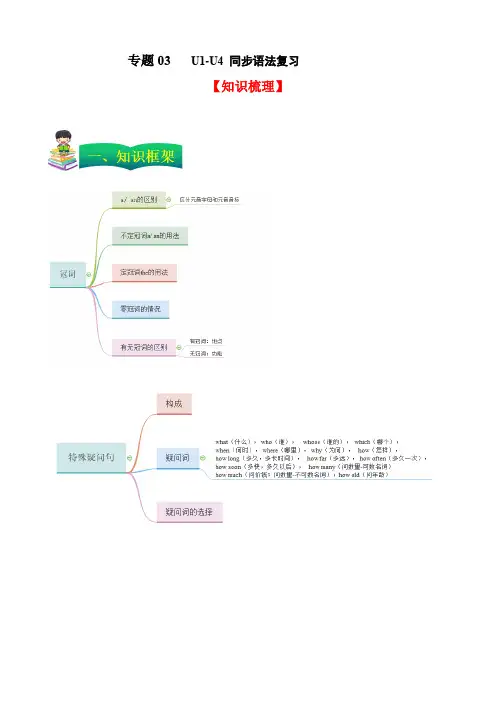
专题03 U1-U4 同步语法复习【知识梳理】Ⅰ.冠词一、冠词概述1.冠词是虚词,本身不能单独使用,也没有词义,它用在名词的前面,帮助指明名词的含义。
2.冠词分为不定冠词和定冠词两种:不定冠词用于单数可数名词之前,通常带有“一”、“某一”、“一种”的含义;定冠词则表示名词为特定者,表示“这”、“那”、“这些”、“那些”的意思,在可数的单复数名词或不可数名词前面都可以用。
二、 a 和an 的区别1.不定冠词有a 和an 两种形式,a 用于辅音音素(不是辅音字母)开头的词前,an 用于元音音素(不是元音字母)开头的词前。
例如:a boy, a university, a European (欧洲的)country;an hour, an island, an elephant, an umbrella三、不定冠词的用法1. 不定冠词用来表示“一”这个数量,意思和one差不多:例如:a. Rome was not built in a day.罗马不是一天建成的。
b. He will be back in a day or two.他将在一至两天内返回。
说明:这种用法在表示重量、长度、时间等的词组中特别普遍。
例如:a pair of socks, a hundred, two yuan, a meter, eight hours a day, twice a week, a cup of tea.2.泛指某一类人、事或物,这是不定冠词的基本用法。
例如:A grammar book is necessary to a language learner. 对语言学习者来说,语法书是很必要的。
A house is a useful animal.3.泛指某人或某物,但不具体说明何人或何物。
例如,A man is looking for you.4.表示“每一”,相当于every 例如,I go to school five days a week.我一周上五天课。
中考英语一轮复习八年级上册第四单元
我们今天吃鱼不吃肉,好吗?
Shall we have fish instead of meat today?
为了减肥,他每天步行上班而不是开车上班。
In order to lose weight, he walks instead of driving to work every day.
Simon 从不学习。相反,他整天打游戏。
Learning aims
1. 识别常用的DIY工具
2.掌握部分形容词前缀un-, in-, im,完成反义词 的转换
3.能运用祈使句发出指令,提出请求或建议等 4.能运用情态动词should和had better提出建议
或劝告
tools 工具
scissors a pair of scissors paper
2. Computer is one of the most important ___t_o_o_ls_____(工具)in daily life now.
3. Pass me a pair ofs_c_is_s_o_r_s(剪刀) .I want to make a card.
4. I want to put up the picture on the wall. Would you please lend me some __g_lu_e__(胶水) 5. The garden is full of __ro_s_e_s__(玫瑰).
牛津上海8年级上册Unit3-Unit4重要知识点及语法点复习练习
I. Read and choose the best answer.(选择最恰当的答案)( ) 1. Sandy’s ambition is ______ an astronaut.A. /B. beC. to beD. tobeing( ) 2. There is ______ “s” in the word “smile”, _____“s” is the first letter.A. an, theB. a, theC. an, anD.a, an( ) 3. My uncle was born _____ October 1975.A. inB. onC. atD. from( ) 4. My brother is keen on _____ model planes.A. makeB. makingC. to makeD.makes( ) 5. A film star _____ King Kelly died in a small village two days ago.A. calledB. is calledC. is callingD.calls( ) 6. I know his father is a famous _____ in Hong Kong.A. engineersB. architectC. designersD.doctors( ) 7. Alice used to go there with her mother,_______?A. doesn’t sheB. didn’t sheC. did heD.didn’t he( ) 8. Tim Green enjoys ______ rugby and tennis at weekends.A. to playB. playedC. playingD.to playing( ) 9. Paul’s _______ is to work as a dentist in the future.A. ambitionB. magazineC. hobbyD.address( ) 10.We are so glad to see that Shanghai ________ these years than ever before.A. is developingB. has developingC. developD.developed( ) 11. Joe had spent nearly a month preparing his graduation speech, the effect wasn’t as good as he had expected.A. andB. butC. orD.so( ) 12. We should turn off the lights when we leave the room so that we can save .A. electricityB. electronicC. electricD.electrical( ) 13. --- The machine can translate simple messages into 24 different languages.--- How !A. amazingB. interestingC. surprisedD.surprising( ) 14. Nowadays, PM 2.5 pollution is becoming ________ in China. Everyone must help to fight against it.A) seriouser and seriouser B) more and more seriousC) more serious and more serious D) more serious and serious( ) 15. It’s possible for ordinary people ________ on the moon in the near future.A. walkB. to walkC. walkingD.will walk( ) 16. The traffic police warned the driver ________ drive over 60 miles in town.A. notB. don’tC. not toD.to not( ) 17. A: ________ will the first mail arrive?B: In about 20 minutes’ time.A. How longB. How oftenC. How farD.How soon( ) 18. Lei Feng ________ for his warm heart and kind deeds. We should learn from him.A. knowsB. is knownC. was knownD.has known( ) 19. A: What a heavy rain! Will it last long, Susan?B: ________ We're getting into the rainy season now.A. I'm afraid so.B. I'm afraid not.C. That's impossible.D.Of course not.( ) 20. -Would you please help me with my singing skills?-________. You can come to my home on weekends.A. I hope so.B. Good idea.C. I’m afraid I can’t.D.No problem.V. Fill in the blanks with the words in their proper forms.(用括号中所给的单词的适当形式填空)1. Are there any _______ things on the moon?(live)2. At _______, I tried my best to help the lady.(little)3. It is an old _______ machine that is still used today.(calculate)4. Qian Xuesen is a Chinese scientist and he has an __________ brain.(amaze)5. The sports car has a very________ engine.(power)6. China is still a _________(develop) country. We Chinese people must work harder to make our motherland richer and stronger.7. It’s popular to send and receiver an __________ (electric) mail.8. The motorbike began to speed at an________ speed.(amaze)9. Do you know the _______ to the problem?(solve)10. With the __________ of our country , our life is getting better and better.(develop)VI. Rewrite the sentences as required. (按要求改写句子)1. We had to go to school last Saturday.(改为否定句)We __________ __________ to go to school last Saturday2. We will have a meeting at 10:00 a.m. .(对划线部分提问)________ will you have a meeting?3. The old man was so weak that he couldn’t walk by himself.(保持句意不变)The old man was _______ weak________ walk by himself.4. Abacuses are so fast and accurate that people still use them today.(保持句意不变)Abacuses are fast and accurate ________ __________ people to still use today.5. Can you solve the problem above?(保持句意不变)Can you _______ an _______ to the problem above?Reading comprehensionⅠ.Choose the best answer(根据短文内容,选择最恰当的答案)The flamingo(火烈鸟) is a beautiful water bird with bright pink or red feathers. Over many thousands of years, the flamingo has adapted to the place where it lives. Its legs changed. Its neck and bill changed, too.The flamingo gets all its food from the water. Its neck is long and thin, which helps the bird reach the water more easily. Its bill is long and bent. Around the edge of the bill is a small fringe. This fringe lets in all the small plants and animals that the flamingo eats. But it keeps mud and water out of the bird's mouth.Many water birds are fine swimmers. But the legs of the flamingo are not made for swimming. They are long and thin and look like stilts(高跷). The flamingo does not swim into deep water. It wades close to the shore. Flamingo legs are fine for wading!The flamingo may seem strange to us. But if it had not adapted to the place where it would have died out.()1. The main idea of the whole story is that .A. the flamingo has adapted to where it livesB. birds with long legs live longer than othersC. all wading birds have long, thin billsD. the flamingo is a kind of beautiful bird()2. The word in the story that means a bird's mouth is________.A. mudB. fringeC. billD. edge( )3. The fringe around the edge of the bill is used .A. to let the plant and animals inB. to keep mud and water outC. to protect the billD. both A and B( )4. The story does not say this, but you can tell that________.A. the flamingo can fly better than most birdsB. the flamingo could not live away from waterC. all the birds like to wade in the waterD. all birds have small fringes( )5. Which of the following does this story lead you to believe?A. Most birds have long legs.B. Birds adapt very quickly.C. Not all water birds swim well.D. Water birds like flamingo are getting fewer.Ⅱ. Read and choose the best words or expressions to complete the passage (选择最恰当的单词或词组完成短文)“Will you lend me fifty dollars? I’ll pay it right back.” The saying goes: Lend money to a friend and you 1 the money and the friend. It may be a simple matter of a friend asking you to pay for a sandwich because he or she forgot to bring money. Or it could be you pay for your friend’s bus fare because all your friend has is a large 2 . Or you may lend larger amounts of money. Here is what some people have to say about this sensitive issue.I never lend money to friends. I prefer to give money when someone needs it. Maybe I’ll get it back, or maybe I won’t. I just sent a guy some money. I didn’t tell him. It’s a 6 . He’s out of work, and this is where the rent for next month is coming from. When he gets a job, he’ll probably pay me back. Don’t you think I’m right? Herbert( )1. A. keep B. make C. pay D. lose( )2. A. size B. car C. bill D. house( )3. A. disappeared B. agreed C. returned D. came( )4. A. happy B. mad C. tired D. healthy( )5. A. difficult B. best C. foolish D. wrong( )6. A. joke B. chance C. surprise D. storyⅢ. Read the passage and fill in the blanks with proper words. The first letters.are given(在短文空格内填人适当的词,使其内容通顺,每空限填一词,首字母已给)When people think of food in the United States, they think mostly of f 1 food like hamburgers, hot dogs, and fried chicken..But in f 2 , in American cities like New York, Chicago, and Los Angeles, there are thousands of different kinds of restaurants with foods from all over the world. So if you like trying d 3 foods, the United States is the place for you.You can eat tempura in Japanese r 4 , tacos in Mexican restaurants, paella in Spanish restaurants, pasta in Italian restaurants, and you can also eat America's most p____5____ food, pizza. When you travel in the USA, the food is sure to satisfy you.Ⅳ. Read the passage and fill in the blanks with proper words. The first letters.are given(在短文空格内填人适当的词,使其内容通顺,每空限填一词,首字母已给)t was 15 years ago when I first came to Maine. Every March I was worried that spring might not come this year. The hills, sky and forest were gray, like an old painting. “Just wait,” a neighbor said. “You’ll w 1 up one morning and spring will just be there.”Then there was an old apple tree. It sat on an undeveloped field in my neighborhood. It belonged to no one and therefore to e 2 . The tree’s dark branches sprawled (伸展)in the sky freely. No one ever pruned (修剪)it, but each spring it blossomed and the air became nice with the good s 3 of apples.Until last year, I thought I was the only one aware of this tree. And then one day, I thought it should be pruned. I set out with a tool to remove a few branches. My neighbors heard me and they opened their doors to watch me. These were people Ih 4 knew and spoke to, but it was as if I had come into their personal gardens.My mobile-home neighbor was the first to speak. “You’re not cutting it down, are you?” Another neighbor warned me, “Don’t kill it, now!” Soon half the neighborhood had j 5 me under the apple tree. It struck me that I had lived there for five years and only now was learning these people’s names, what they did for a living and how they passed the winter. It was as if the old apple tree was gathering us under its branches --- for knowing each other and sharing wonder.One thaw(融化n.)l 6 to another. Just the other day I saw one of my neighbors at the local store. We had a chat. He said this recent winter had been especially long and he felt s 7 not having seen or spoken to anyone in our neighborhood. And then, he looked at me and said, “We need to prune that apple tree again.”Ⅰ:1-5 BBBDB 6-10 CBAAC 11-15 DCBBC 16-20 ACDBDⅠ:1. living 2. least 3.calculating 4.amazing5.powerful6. developing7. electronic8.amazing9.solution10.developmentⅠ:1. didn’t have 2.when 3.too to 4.enough for 5.find solution1. A2. C3. D4. B5. BB:1. D 2. C 3. A 4. B 5. B 6. CC:1. Fast 2. fact 3. Different 4. Restaurants 5. popular D: 1. wake 2. everyone/everybody 3. smell 4. hardly 5. joined 6. led 7. sorry。
D_牛津上海8年级上册Unit3-Unit4重要知识点及语法点精讲及练习(有答案)
U3-U4重要短语及句型Unit 31. deal(dealt-dealt ) with trouble 处理麻烦how to deal with/what to do with...如何处理...(两种)be in trouble处于困难中have trouble in doing sth. 在...方面有困难have trouble with sth. 某事有困难get sb. into trouble使某人陷入困境;2. hear a big argument 听见一阵争吵声3.say quietly= say in a low voice轻声说4.What’s going on/happening/up?发生什么事?sth. happen to sb. 某事发生在某人身上happen to do sth. 碰巧做某事5.steal (stole, stolen) sb sth = steal sth from sb 偷了某人某物6.notice sb doing/ do sth.注意到某人做某事7.hurry to sp = go/get to sp. in a hurry 匆忙赶往某地hurry up/hurry off 匆忙离开/赶快8. go after him= follow him跟着他9. be afraid of the man 害怕那个人be afraid of sth/doing sth 害怕/(做)某事be afraid to do 害怕/(做)某事be afraid + that 从句害怕/(做)某事10. in detail 详细地11. remember arresting a thief in a clothes shop 记得在一家服装店逮捕过一名小偷12. release him 把他释放13. smuggle some rare birds 走私一些珍稀动物14. fight for freedom 为自由而战15. would rather(not) do sth. 宁愿(不)做某事Unit 41.odd numbers奇数2.even numbers 偶数3.calculate percentages and square roots 计算百分比和平方根4.call the brain a living computer 把人脑称为一台活电脑5.add A to B 把A加到B6.at least 最起码,最少at most 最多7.in many different ways 用很多不同的方式in the same way 用相同的方式8.count in tens 以十进制的方法数数9.developing country 发展中国家developed country 发达国家with the development of … 随着……的发展10.make it easier to write 使书写更简单11.the following story 下列的故事12. in a flash 一瞬间13.be like lightning 闪电般地,飞快地14.programme the computer with instructions用指令给电脑编程15.a modern electronic calculator 一只现代的电子计算器16.add… and… 把……和……加起来subtract …from … 把……减去……multiply … by … 把……乘以……divide … by 把……除以……词性转换:Unit 3-4原词可能的变形argue v. 争吵argument n. 争吵crowd n. 人群crowded adj. 拥挤的quietly adv. 安静地quiet adj. 安静的go v. 去gone adj. 不复存在的strange adj. 奇怪的stranger n. 陌生人theft n.偷窃罪,偷窃案thief n. 小偷worry n./v. 担心worried adj. 担心的worriedly adv.担忧地sudden adj. 突然的suddenly adv. 突然地rare adj. 稀罕的,很少的rarely adv. 很少地rob v. 抢劫robber n. 强盗robbery n.抢劫案tour v. 参观tourist n. 参观者usual adj. 通常的usually adv. 通常地unusual adj. 不寻常的danger n. 危险dangerous adj. 危险的true adj. 真的truly adv. 真地truth n. 事实hurry v. 匆忙hurried adj. 匆忙的hurriedly adv. 匆忙地follow v. 跟随following adj. 下列的原词可能的变形invent (v.) 发明invention (n.) 发明物inventor (n.) 发明家amaze (v.) 使惊奇amazed(adj.) 感到惊奇的amazing (adj.) 令人惊奇的calculate (v.) 计算calculation (n.) 计算calculating (adj.) 计算的calculator (n.) 计算器electron (n.) 电子electronic (adj.)电子的electric (adj.)带电有关的electrical (adj.)与电有关的electricity (n.) 电live (v.) 生活living (adj.) 活的alive (adj.) 活着的lively (adj.) 活泼的instruct (v.) 指示instruction (n.) 指示develop (v.) 发展developing (adj.)发展中的developed(adj.)发达的development (n.) 发展near (adv.) 接近nearly (adv.) 差不多power (n.) 力powerful (adj.) 强大的Greece (n.) 希腊Greek (n./adj.) 希腊人,希腊语/ 希腊的nation (n.) 国家national (adj.) 国内的international (adj.) 国际的nationality (n.) 国籍especial (adj.) 特别的especially (adv.) 特别,尤其light (n.) 光lightning (n.) 闪电life (n.) 生命lifetime (n.) 一生program (v.) 编程programme (n.) 节目solve (v.) 解决solution (n.) 解答同义句转换:【U3同义句转换】1. go on = happenWhat’s going on? = What’s happening? = What’s up?例题:What was going on? =What _____________ ____________? = What _____________ ____________?2. take a /an bus/ferry/taxi/underground to sp. = go to sp. by bus/ferry/taxi /underground例题:We went to the Museum by bus last week.= We ____________ a ____________ to the Museum last week.They often take a ferry to go to school. = They often go to school ____________ ____________.3. sb. spend (spent) time (in) doing sth./on sth. = It takes (took) sb. time to do sth.例题:Tina spent two hours cooking the meal last Saturday.= It ____________Tina two hours ________________________ the meal last Saturday.4. go to sp. in a hurry/hurriedly = hurry to sp. do sth. in a hurry = hurry to do sth.例题:She went to the bus stop in a hurry.= She ________________________the bus stop. = She went to the bus stop ____________.I caught the bus in a hurry this morning. = I ______________________ catch the bus this morning.5. There’s nobody in sp. = sp. is empty.例题:There is nobody in the classroom. = The classroom is ____________.6. follow = go after例题:We followed the men here. = We ________________________ the men here.7. a(数字)-year-old man = a man of(数字)例题:The taller man was aged about 25. = The taller man was a man _____________ _____________ 25.8. too + adj. (for sb.) to do sth. = so + adj. that +句子(否定)= not + adj.(反义)enough (for sb.) to do sth.例题:The classroom is too small for us to sit in.= The classroom is ____________________________________ for us to sit in.= The classroom is ____________ small ____________ we ____________ sit in.Wendy was not old enough to drive a car.= Wendy was ________________________ to drive a car.= Wendy was ____________ ____________ ____________ she can’t drive a car.9. left +过去时间点ago = has/have been away + for 时间段例题:Alice left Shanghai three weeks ago.= Alice ____________________________________ from Shanghai for three weeks.10….,doing…(两个动作同时发生)例题:They sat in the garden. They talked about the day they spent together.= They sat in the garden, ____________ about the day they spent together.11. neither of…+v.(单数形式)例题:Sammy didn’t finish her homework. Her sister didn’t, either.= ____________ of the two sisters ____________ their homework.12….so…(表示结果)例题:Dad was keen on the football match. He went to HongKou Football Stadium to watch it.= Dad was keen on the football match _________ he went to HongKou Football Stadium to watch it.13. tell sb. that + 宾语从句例题:The man stole his friend’s purse. One of the women told my father about that.= One of the women ____________ my father ____________the man stole his friend’s purse.14. get out of bed = get up例题:I get out of bed at six every morning. = I ________________________ at six every morning.【U4同义句转换】1. in the past = in ancient timesIn the past, many people wear silk clothes.= In ________________________, many people wear silk clothes.2. nobody = no oneNobody has been to the West Lake. = ________________________ has been to the West Lake.3. so + adj. + that + 句子(肯定)= adj. + enough to do sth.Her brain is so powerful that she can work it out in such a short time.= Her brain is ________________________ to work it out in such a short time.Abacuses are so accurate that the people still use them today.= Abacuses are ________________________for people to use them today.4. add…and… divided by…is / equals…Divide 36 by 4, the answer is 9. = 36 ____________ by 4 ____________ 9.Four and three is seven. = If you ____________ four and three, you get ____________.5. sb. spend (spent) time (in) doing sth./on sth. = It takes (took) sb. time to do sth.Jim took three seconds to find the answer.= ________________________Jim three seconds to find the answer.I spent 3 hours making a birthday cake for my dad.= It ____________ me 3 hours ____________ make a birthday cake for my dad..6. too adj. for sb. to do sth. = so adj that + 句子(否定)= not adj.(反义)enough for sb.to doThe problem is so difficult that all the students can’t work it out.= The problem is ____________ difficult ____________ all the students work out.The old man is so weak that he couldn’t walk by himself.= The old man is ____________ weak ____________walk by himself.= The old man is ________________________ enough to walk by himself.7….or you will do …=If you don’t do…, you will…Hurry up, or you’ll miss the train.= If you ____________ hurry up, you ____________ miss the train.8. solve= work outI will help you solve the problem. = I will help you ________________________ the problem.9. almost = nearlyThe job is almost finished. = The job is ______________ finished.10. in a short time = in a flashMum will be back in a short time. = Mum will be back ________________________ ____________.11. correct = accurateHe gave correct answers to the questions. = He gave ____________ answers to the questions.12. not forget = remember turn off = not turn on (反义转换)Don’t forget to turn off the lights before you leave.= ____________ to turn off the lights before ____________.Please turn off the radio. =Please ____________ turn ____________ the radio.13. not anything=nothingHe didn’t say anything at the meeting. = He ________________________ at the meeting.14. no one else = nobody elsePaul sings the best in our class. = ________________________ in our class sings as well as Paul does.= ____________________________________ in our class sings as well as Paul does.15. represent = stand forThe heart represents love. = The heart ________________________ love.16. joined + 过去时间点ago = has / have been in …+for 时间段He joined the army five years ago.= He ____________________________________ the army for five years.17….not… …not…,either = neither…nor…+ v.(单数形式)Li Hua doesn’t like swimming. Wang Hai doesn’t like swimming, either.= ____________ Li Hua ____________ Wang Hai ____________ swimming.。
D_牛津上海版八年级上册Unit3-4语法复习及阅读D篇专项讲解
U3-U4语法+阅读DUnit 3单词——过去式——过去分词see-saw-seen give-gave-given make-made-made build-built-built take-took-taken put-put-putleave-left-left come-came-come catch-caught-caught find-found-found eat-ate-eaten stop-stopped-stopped keep-kept-kept write-wrote-written drive-drove-driven break-broke-broken say-said-said teach-taught-taught know-knew-known go-went-gone hear-heard-heard get-got-got has/have-had-had buy-bought-bought rob-robbed-robbed admit-admitted-admitted dial-dialled-dialled hold-held-held know-knew-known plan-planned-planned cut-cut-cut cost-cost-cost read-read-readfall-fell-fallen run-ran-run fight-fought-fought steal-stole-stolen buy-bought-bought sell-sold-soldUnit 41.基数词变序数词基变序,很容易,1,2,3,特殊记,结尾字母t,d,d,8少t,9去e, ve要用f替。
几十几只变个位就可以,整十变序也容易,y变ie就可以。
末尾th别忘记。
注意:four—fourteen—forty—forty-two nine—nineteen—ninety—ninety-ninefourth—fourteenth—fortieth—forty-second ninth—nineteenth—ninetieth—ninety-ninth2.几种特殊数词表达法:(一)普通分数:子基母序,分子>1,分母+S1/3: one third 2/3: two thirds1/2:读作a half或one half1/4读作a quarter 或one fourth(二)百分比:基数词+ percent (per cent)2%读作two percent 27%读作twenty-seven percent(三)习惯表达:one and a half apples= one apple and a half 一个半苹果half an apple半个苹果one or two apples= one apple or two 一两个苹果10:30 half past ten10:25 twenty–five past ten9:45 fifteen to ten 或a quarter to ten3.加减乘除---数字的运算(一)基础知识:=: is/ equals +: plus -:minus *: multiplied by /: divided by 都是介词。