
英语人教版八年级下册教学设计Unit2 SectionB 2a-2d
Unit 2 I’ll help to clean up the city parks Section B 2a-2d
教学设计
第一环节:
教师提问:Who keeps a dog as a pet? What do you think of your dog?
观看一分钟视频。
引出:The dog is a clever dog. It helps care for the little boy. It is a dog helper. A dog helper is a special trained dog. Usually a dog helper can understand orders.
此时,教师出示a dog helper的多媒体课件
第二环节:
教师提问:A dog helper can help a little boy. What other people do you think a dog helper can help?
在教师引导下, 学生说出:blind people (people who can’t see); deaf people (people who can’t hear); can’t use his arms; people can’t use his legs
教师一边引导;一边出示多媒体课件。
最后引出:
A dog helper can help disabled people.
第三环节:
教师指出本课所要阅读的内容:a thank letter
This class, we’ll read a letter about a disabled person and a dog helper.
教师出示多媒体课件,课件内容为Ben Smith写给Miss Li的信件。
根据信件格局提问:Who wrote the letter? (Ben Smith)
Who did Ben write the letter to? (Miss Li)
第四环节:
预测文本内容。
教师出示课本插图,对学生发问,让学生对文本内容进行预测。
Who do you think the man is? (Ben Smith)
What can we know about the man? (He can’t use his legs or arms)
What do you think of the dog? (It is a dog helper. Maybe it can help Ben)
In what ways can the dog help Ben? (Answer the phone, open and close doors, carry things) Who do you think the woman is (Miss Li or Ben’s friend)?
第五环节:
略读课文。
学生快速阅读课文,判断下列句子正误:
1. Ben can’t use h er arms or legs well. (T)
2. Miss Li gave money to Animal Helpers. (T)
3. Miss Li talked to Animal Helpers one day last year. (F)
4. Ben was excited about the idea of having a dog. (T)
5. Lucky helps Ben a lot and he loves him. (T)
第六环节:
寻读课文。
第一段:Read paragraph 1 and answer questions. (运用多媒体课件)
What is Animal Helpers?
It is a group. The group helps disabled people.
Who gave money to Animal Helpers?
Miss Li
之后:出示包含group, disabled, difference的两个句子,让学生猜测词性和词意。
第二段:Read paragraph 2 and fill in the blanks.
1. Ben is a disabled person. He can’t ____________ or ________ well.
2. Normal things are difficult for Ben ________, ________, ________
3. A friend helped Ben out. He talked to ________. Ben was excited about the idea of_____.
回答预测时大家很可能会出错的第三题,Ben的一个朋友给动物助手组织打电话,而不是Miss Li.
之后:出示包含imagine, difficulties, normal的三个句子,让学生猜测词性和词意。
第三段:Read paragraph 3 and fill in the blanks.
1.After ______ months of training with a dog, he brought him home.
2.The dog’s name is _____. He can understand ______, understand Ben when he ______.
之后:出示包含training, kindness的两个句子,让学生猜测词性和词意。
然后:Why does Ben say “I’m only able to have a dog helper because of your kindness?
(Miss Li gave money to Animal helpers for the dog.)
第四段:Read paragraph 4 and answer questions. (运用多媒体课件)
Why did Ben thank Miss Li again? (She bought Lucky for him. &.She gave money to Animal Helpers)
We should learn from Miss Li and helps others who are in need.
第七环节:
读后输出,评价。
1. Challenge yourself 学生填空。
(使用多媒体课件)
Ben Smith is a __________ man who can’t use his arms or legs well. One day, a friend of his talked to Animal Helpers about getting him a special _______ dog. After six months of _______ with the dog, Ben brought him home. He named the dog Lucky. Lucky can ________ him when he gave him orders. He makes a big ________ to Ben’s life. So Ben wants to say ________ to Miss Li, because she ________ to Animal Helpers and made it possible for him to have Lucky.
第八环节:
读后输出
四人为一小组,讨论In what other ways do you think dogs are able to help people?其中一人为reporter。
第九环节:
作业:根据Lucky 档案,写一篇短文介绍Lucky,要求包含Lucky档案全部内容,字数60词左右。
狗狗档案(使用多媒体课件)
Name:_____________________________
From:_____________________________
Owner:____________________________
Who bought him:____________________
What he can do: He can ________ me when I give him _______.
His influence(影响):
He ___________________ to my life.。
人教版英语八年级下册Unit2SectionB(2a2e)教学设计

2.阅读理解:选取一篇与冒险相关的文章,设计5-10道阅读理解题,要求学生完成。问题类型包括细节理解、推理判断和主旨大意等,以检验学生对阅读策略的掌握。
-对于基础较好的学生,可以设置更具挑战性的任务,如撰写小短文或进行深入讨论。
4.阅读策略训练:通过指导学生预习、课堂讨论和课后复习,培养学生的阅读策略。
-在预习阶段,学生通过完成预测任务来激活背景知识。
-在课堂讨论中,引导学生通过问题解答和总结来加深对文本的理解。
-课后复习时,鼓励学生运用所学策略进行自我检测和提升。
人教版英语八年级下册Unit2SectionB(2a2e)教学设计
一、教学目标
(一)知识与技能
本章节主要是人教版英语八年级下册Unit 2 Section B(2a-2e)的内容,旨在帮助学生掌握以下知识与技能:
1.能够理解和运用与本单元主题相关的词汇和短语,如"adventure", "safety", "explore", "in case", "as well as"等。
5.听力技能培养:通过多样化的听力练习,如听对话、短文并完成相关任务,提高学生的听力技巧。
-设计梯度性的听力任务,从简单的信息捕捉到复杂的推理判断,逐步提升学生的听力能力。
6.情感态度培养:在教学过程中,注重学生情感态度的引导,鼓励他们勇敢面对挑战,培养团队合作精神。
人教版英语八年级下册Unit2_Section B (2a~2e)教案与反思
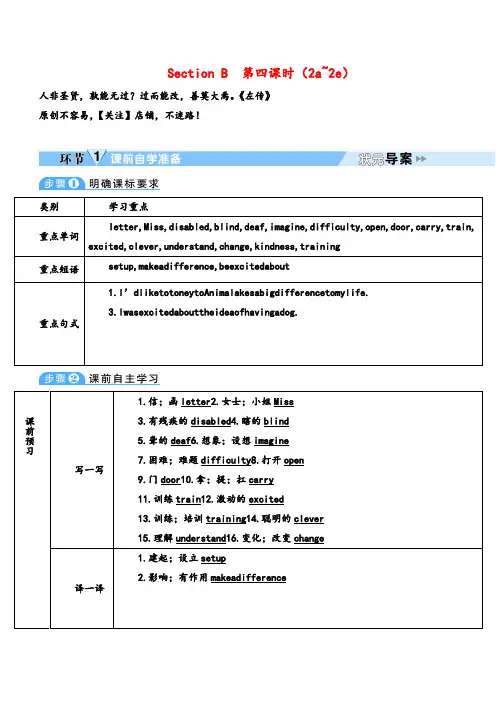
Section B 第四课时(2a~2e)人非圣贤,孰能无过?过而能改,善莫大焉。
《左传》原创不容易,【关注】店铺,不迷路!类别学习重点重点单词letter,Miss,disabled,blind,deaf,imagine,difficulty,open,door,carry,train, excited,clever,understand,change,kindness,training重点短语setup,makeadifference,beexcitedabout重点句式1.I’dliketotoneytoAnimalakesabigdifferencetomylife.3.Iwasexcitedabouttheideaofhavingadog.课前预习写一写1.信;函letter2.女士;小姐Miss3.有残疾的disabled4.瞎的blind5.聋的deaf6.想象;设想imagine7.困难;难题difficulty8.打开open9.门door10.拿;提;扛carry11.训练train12.激动的excited13.训练;培训training14.聪明的clever 15.理解understand16.变化;改变change译一译1.建起;设立setup2.影响;有作用makeadifference背一背1.我想要谢谢你寄钱给“动物帮手”。
I’dliketotoneytoAnimalHelpers.2.对于拥有一只狗的想法,我感到很兴奋。
Iwasexcitedabouttheideaofhavingadog.3.你认为狗还在其他什么方面能帮助人? Inwhatotherwaysdoyouthinkdogsareabletohelppeople?新课导入Teaceothersinourdailylife.Howdoyouusuallythankthepeoplewhohelpyou?Nowpleas ediscussthiswithyourpartnersinagroup.新课展示【完成教材2a~2b的任务】1.快速阅读信件回答2b的两个问题,完成后请学生说出答案。
人教版英语八年级下册 Unit2_SectionB(2a-2e)教案
Unit2 SectionB(2a-2e)名师教案课型4 Reading and Learning (Section B 2a-2e )1.0Teaching Analysis教情分析1.1Teaching objectives 教学目标1.1.1Language targets 语言目标1.1.1.1Key Words and Chunks1.1.1.1.1For applying: letter, Miss, set up, disabled, make a difference to,blind, deaf, imagine, difficulty, open, door, carry, train, excited,training, kindness, clever, understand, change1.1.1.1.2For comprehending:1.1.1.2Sentence Structures1) I’d like to thank you for giving money to Animal Helpers.2) You helped to make it possible for me to have Lucky.3) What would it be like to be blind or deaf?4) Or imagine you can’t walk or use your hands easily.5) She talked to Animal Helpers about getting me a special trained dog.6) She also thought a dog might cheer me up.7) I love animals and I was excited about the idea of having a dog.8) In what other ways do you think dogs are able to help people?1.1.1.3Grammar Focus1) I’ll send you a photo of him if you like, and I could show you how hehelps me. (if you like是条件状语从句,意为“如果你喜欢”;how he helpsme是宾语从句,意为“他如何帮助我”)2) I’m su re you know that this group was set up to help disabled people likeme. (was set up是一般过去式的被动语态,一般过去时的被动语态的结构为“was/were+动词过去分词”)1.1.2Ability goals 能力目标1.1.2.1帮助学生通过单词的词性来帮助理解单词在句中的含义。
英语人教版八年级下册unit2 SecB2a_2b

Section B 第4课时(2a〜2b)1.1Teaching objectives 教学目标1Language targets 语言目标Key Words and ChunksFor applying: letter, Miss, set up, disabled, make a difference to, blind, deaf, imagine, difficulty, open, door, carry, train, excited, training, kindness, clever, understand, changeSentence Structures1) I’d like to thank you for giving money to Animal Helpers.2) You helped to make it possible for me to have Lucky.3) What would it be like to be blind or deaf?2.Ability goals 能力目标帮助学生通过单词的词性来帮助理解单词在句中的含义。
教会学生感谢信的写作并在信件中清晰地描述自己的经历。
Emotional goals 情感目标引导学生对别人的帮助表达真挚的感谢。
启发学生和他们分享自己的快乐自主学习方案1.自学生词,并记住拼读及拼写。
2.预习课本,找出重点短语及句子。
3.读记后完成自学导练作业。
课堂导学方案Step 1情景导入T:We live in the world. We should help each other. We often get some help from others in our daily life. How do you usually thank the people who help you? Now please discuss this with your partners in agroup.环节说明:由得到别人的帮助我们该如何做为话题引出本节课的学习内容,过渡自然,同时也完成了2a的教学内容。
人教版八年级英语下册Unit2SectionB(第二课时)教学设计
(此作业旨在提高学生的口语表达能力,同时增进亲子或朋友间的互动交流。)
3.词汇作业:请学生用本节课学习的运动比赛类词汇和短语,编写5个句子,要求句子通顺、意义明确,体现一般过去时态的用法。
3.教师讲解一般过去时态的结构和特点,并让学生进行模仿和练习,巩固所学知识。
4.教师设计一些与运动比赛相关的句子,让学生用一般过去时态进行改写,如:They are playing basketball. → They played basketball yesterday.
(三)学生小组讨论
1.教师将学生分成小组,每组选择一个运动项目,用一般过去时态讨论以下问题:
1.教师呈现本节课的重点词汇和短语,如:baseball, tournament, team, victory, lose, score, encourage等,引导学生学习并理解这些词汇的含义。
2.教师通过示例句子和语境,引导学生学习一般过去时态的用法,如:We played baseball last week. Our team won the game.
2.教学难点突破设想:
(1)通过生动的语境和图片,引导学生感知和运用一般过去时态,降低学习难度。
(2)设计不同难度的听说读写活动,使学生在实践中逐步掌握一般过去时态的用法。
(3)针对学生的个体差异,提供个性化的辅导和反馈,帮助学生克服难点。
(二)教学设想
1.导入:以学生感兴趣的体育比赛为话题,通过图片和视频引入新课,激发学生的学习兴趣。
6.评价反馈:
人教版八年级下册英语Unit2SectionB(2a2e)教学设计
-针对学生的个体差异,给予个性化的指导,提高他们的自信心。
-对学习困难的学生,给予关注和鼓励,帮助他们克服困难,提高学习效果。
5.课后巩固,拓展提高:
-设计富有挑战性的课后作业,让学生在课后巩固所学知识。
-鼓励学生进行拓展阅读,了解更多优秀人物的品质,提高自身素养。
6.情感教育,培养价值观:
2.要求每组选择一个人物,用一般现在时态进行描述,并在组内分享。
3.鼓励学生互相提问、讨论,以提高口语表达能力和思维品质。
4.教师巡回指导,给予个性化的建议和指导,帮助学生提高讨论效果。
(四)课堂练习
课堂练习环节,教师将:
1.设计各种练习题,包括词汇填空、句型转换、阅读理解等,让学生巩固所学知识。
2.要求学生根据课文内容,用一般现在时态描述人物品质,提高写作能力。
2.学会使用一般现在时态描述人物的性格特点,如"He is always polite to others."。
3.能够理解并运用本节课所学的阅读策略,如预测、扫读、精读等,提高阅读理解能力。
4.能够通过小组合作,运用所学知识进行角色扮演,提高口语表达能力。
5.掌握如何用英语撰写人物描述,提高写作能力。
-在教学中融入情感教育,引导学生关注优秀人物品质,培养良好的道德观念。
-通过讨论、反思,帮助学生树立正确的人生观和价值观。
四、教学内容与过程
(一)导入新课
为了激发学生的学习兴趣,本节课将从以下方面导入新课:
1.利用多媒体展示不同国家和地区的人物图片,引导学生观察并讨论他们的性格特点。
2.邀请学生分享他们所了解的优秀人物及其品质,为新课的学习奠定基础。
二、学情分析
英语人教版八年级下册unit2 sectionb (2a-2d)
Unit2 I’ll help clean up the city parkSection B(2a—2e)课程设计一、教学目标1、了解英语单词的词性,提高学生的阅读能力,培养学生的语感。
2、教育学生学会感恩。
二、教学内容:1、New words and expressions : letter, miss, set up , make a difference, disabled, blind, deaf, imagine, difficulty, open, door, carry, train, excited training, kindness, clever, understand, change三、教学用品:多媒体,白板Step 1 GreetingStep 2 Lead-inT: Have you ever helped others? Have you ever gotten help from others? What should we do who someone helps us? Of course, we should thank them. How do you usually thank them? Say thanks to them face to face, by calling up them or writing to them? Discuss it with your partner.设计意图:让学生学会对别人的帮助表示感谢,学会感恩,通过讨论的方式激发学生的思维,调动他们的积极性。
Step 3 Reading1.Present new words and expressions1) Let the students read the words and phrases according the phonetic symbols on Page 117.2) Write out the Chinese meanings of the words and phrases.Letter--- miss---, set up--- , make a difference---, disabled--, blind--, deaf--, imagine---, difficulty----, open---, door----, carry----, train---, excited---- training-----, kindness------, clever----, understand----, change------2.PredictGet the students to predict ”what is the passage about?”3. Fast readingRead the passage as quickly as you can, and answer the following questions.1)Who wrote the letter to Miss Li? Why?2)What did Miss Li do?4. Detail readingRead the passage carefully and answer the following questions1)What is Animal Helpers?2)What kind of person is the writer?3)What is Lucky?4)What can Lucky help the writer do?5)Would you like to help the persons like the writer?Step 4 After-readingDiscuss the questions with a partner in groups1)In what other ways do you think dogs are bale to help people?2)What other animals can we train t help people?Then every group give s a report of the answers to the class. Let’s see which group does best.Step 5 Parts of speechKnowing what part of speech a word is can help you understand the word’s meaning. What do you know about parts of speech? Then introduce something about parts of speech.Look at the list of words in 2c, Circle the part of speech of each word and make your own sentences with these words.Step 6 Basic Types of Sentence StructureLet the students know something about the five basic types of sentence structure基本句型一;S+V(主+谓)基本句型二:S+V+P(主+谓+表)基本句型三:S+V+O(主+ 谓+宾)基本句型四:S+V+o+O(主+谓+间宾+直宾)基本句型五:S+V+O+C(主+谓+宾+宾补)Then match the different parts in 2d to make true sentence设计意图:这两部分主要是让学生对英语的词性和基本句子结构有个初步了解,这样不但有利于提高学生的阅读能力,还能为以后的学习打下坚实的基础。
人教版英语八年级下册Unit2SectionB2a2e教学设计
四、教学内容与过程
(一)导图片,包括游乐园、电影院、博物馆等,引导学生用英语描述这些场景,激发学生对本节课话题的兴趣。
2.邀请学生分享他们在周末或假期中的有趣经历,其他同学猜测他们可能去过哪些地方,做了哪些事情,为新课的学习营造轻松愉快的氛围。
-词汇和短语的掌握,如:amusement park, exciting, frightening, disappointing, boring, be worth doing等。
-阅读策略的培养,包括获取主旨大意和细节信息的能力。
2.难点:
-学生在实际语境中正确使用现在完成时态,避免常见错误。
-学生在阅读过程中,能够准确把握文章结构,理解并分析作者的观点和态度。
人教版英语八年级下册Unit2SectionB2a2e教学设计
一、教学目标
(一)知识与技能
本章节的学习目标是让学生掌握并运用人教版英语八年级下册Unit 2 Section B 2a-2e部分的核心词汇和语法结构,提高学生的英语听、说、读、写四项基本技能。具体包括:
1.掌握本章节的生词和短语,如:amusement park, exciting, frightening, disappointing, boring, be worth doing等。
5.情感态度方面,八年级学生正处于青春期,对新鲜事物充满好奇,愿意分享自己的经历。本章节的主题贴近学生生活,有助于激发他们的学习兴趣和参与意识。
三、教学重难点和教学设想
(一)教学重难点
1.重点:本章节的重点在于学生对现在完成时态的掌握和运用,以及核心词汇和短语的识记与运用。
八下人教版英语第二单元2b教案设计
八下人教版英语第二单元2b教案设计教案设计:八下人教版英语第二单元2b教学目标:1. 学习并掌握本单元的重点词汇和短语。
2. 能够运用所学的词汇和短语描述人物的外貌特征和个性特点。
3. 能够运用所学的句型表达自己对人物的喜好和不喜好。
教学重点:1. 掌握本单元的重点词汇和短语。
2. 运用所学的词汇和短语描述人物的外貌特征和个性特点。
3. 运用所学的句型表达自己对人物的喜好和不喜好。
教学准备:教材、录音机、图片或卡片、多媒体设备教学过程:Step 1: Warm-up1. Greet the students and review the previous lesson briefly.2. Show some pictures of different people and ask the students to describe their appearances and personalities.Step 2: Presentation1. Introduce the new vocabulary and phrases by showing pictures or using flashcards.2. Present the new sentence patterns: "What does he/she look like?" and "What is he/she like?" Explain the differences between the two questions.3. Play the recording for the students to listen and repeat the new words, phrases, and sentence patterns.Step 3: Practice1. Divide the class into pairs or small groups.2. Give each group a set of picture cards with different people on them.3. Ask the students to take turns asking and answering questions about the people on the cards using the sentence patterns they have learned. For example: - A: What does he/she look like?- B: He/She has short hair and wears glasses.- A: What is he/she like?- B: He/She is friendly and outgoing.4. Monitor the students' conversations and provide assistance when needed. Step 4: Production1. Ask the students to think about their favorite celebrities or fictional characters.2. In pairs or small groups, have the students describe the appearances and personalities of their chosen characters using the sentence patterns they have learned.3. Encourage the students to use more adjectives and provide reasons for their descriptions.4. Select a few pairs or groups to share their descriptions with the whole class. Step 5: Consolidation1. Review the new vocabulary, phrases, and sentence patterns with the wholeclass.2. Play a game of "Guess Who" where students take turns describing a person and their partner has to guess who they are describing.3. Provide feedback and praise the students' efforts.Step 6: HomeworkAssign homework that reinforces the vocabulary, phrases, and sentence patterns learned in class. For example, students can write a short paragraph describing their favorite celebrity or fictional character.教学延伸:1. 鼓励学生使用更多的形容词和副词来描述人物。
英语人教版八年级下册Unit 2 Section B2教学设计
Unit 2 I’ll help to clean up the city park.Time: March 2ndPlace: Class3,Grade8Instructor: Bian WenyongSection B (2a-2e)Teaching Aims:1. Knowledge Objects:(1) Key vocabulary: letter, miss, set up, make a difference, blind, deaf…(2) Target language:①I’d like to thank you for giving money to Animal Helpers.②I’m sure you know that this group was set up to help disabled people like me. …2. Ability Object:To train students’ listening, speaking reading abilities and skills..3. Moral Objects:(1) To raise students’ interest of learning English.(2) To make students protect animals.Teaching Key Points:1. Key vocabulary in this period.2. Target language in this period.Teaching Difficulties:1. Improve students’ listening.2. Improve students’ reading skills.Teaching Aids:A computer for multimedia use.Teaching Procedures:Step 1 Warming up and revision1. Daily greeting.2. Check the homework.Step 2 Presentation1. T: Show some pictures of disabled people and their lives, for example, a blind man, some deaf girls. Tell Ss their lives may be very difficult. They sometimes need our help.2. Talk about the dog-helper. What can it do?e.g. A dog-helper can lead a blind man to many places. It can get the things a man wanted.3. Present the new words and learn the new words together.4. Let Ss discuss the questions in 2a, then check the answers.Step 3 ReadingPre-reading1. T: Now let’s work on 2b. First, let’s read the questions and make sure we know the meanings of the questions. Then scan the passage and find the answers to the questions.1) What kind of letter is it? 2) Who wrote the letter to Miss Li? Why?2. Ss read the letter quickly and try to find the answers.3. Check the answers with the class.While-reading1. T: N ow let’s read these sentences about the letter. Read the passage again. Judge if the sentences are True or False. Please underline under the main sentences.1) The writer can’t use her arms or legs well.2) Lucky was brought to the writer by her friend.3) They have been trained at “Animal helpers” for seven months.4) A dog-helper is for those who are disabled.5) Lucky can understand different orders.2. Ss read the letter again and judge the sentences.3. Check the answers with the class.Post-readingWork on 2c1. Now look at the list of words below. Circl e the part of the speech of each word and make your own sentences with these words.2. Let some Ss circle the part of speech and try to make sentences with the words. Let some Ss read their sentences and correct their mistakes.3. Ss check the sentences with their partners.Work on 2d1. Tell Ss that they will use information in the letter to make true sentences by matching the different parts. Ss work by themselves.2. Check the answers together.Step 4 Discussing1. Let Ss discuss the two questions in 2d.2. Ask some Ss to say out the answers.Step 4 SummarySummarize what we have learned in this period.Step 5 Homework1. Try to retell the story.2. Preview the next period.Blackboard DesignUnit 2 I’ll help to clean up the city park.letter miss disabled blind set updeaf imangine difficult make a differenceexcited kindness understand cheer upchange interest。