
人教版九年级英语第八单元 Unit 8 Section B 知识点精讲
人教版九年级英语第八单元Unit 8 Section B 知识点精讲Section B单词
1. land /lænd/ v.着陆;降落
典例The plane will land in five minutes.
飞机将在五分钟后着陆。
反义take off(飞机)起飞
拓展land n.陆地
They can' t live on land.它们不能在陆地上生活。
2. suit /sju:t/ n.西服;套装v.适合
典例a business suit职业装
Do you think the color of this suit(n.) suits(v.)me?你认为这套西服的颜色适合我吗?
谚语A guest should suit the convenience of the host.客随主便。
3. express /ɪk'spres/ v.表示;表达
助记*容易(e)错误(x)地按键(press)来表达自己。
典例to express doubts表示怀疑
express accurately准确地表达
短语express onese表达某人自己(的思想)
联想expression n.表达
4. circle /'sɜː (r)kl/ n.圆圈v.圈出
典draw a circle(名词)画一个圆圈
stand in a circle(名词)站成一圈
circle the important words(动词)圈出重要的单词
拓展circle v.盘旋
5. Britain /'brɪtn/(= Great Britain)大不列颠
典例Mark teaches Chinese in Britain.马克在大不列颠教汉语。
联想British n.英国人adj.英国的;英国人的
6. receive /rɪ'siv/ v.接待;接受;收到
助记re/r/+cei/si/+ve/w/= receive
典例receive a letter/present收到一封信/一个礼物
receive a phone call接到一个电话
辨析receive与accept
receive指“收到”,着重指行为本身,不管是否接受
accept指“接受”,着重指经过考虑以后愿意接受
一句辨义The boy has received his present, but he will not accept it. 这个男孩已收到了他的礼物,但他不会接受它的。
7. leader /'li:də(r)/ n.领导;领袖
助记lead(n.领导)+-er(名词后缀)= leader
典例team leader组长;小组领导
political leader政治领袖
8. medical /'medɪkl/ adj.医疗的;医学的
助记我(me)给弟弟(d)打电话(call去掉1)让他去做医学检查
典例medical treatment医学治疗
medical equipment医疗设备;医疗器材
medical school医学院
联想medicine n.药
9.purpose /pɜ:(r)pəs/ n.目的;目标
助记葡(pu)萄树(r)摆个姿势(pose),目的是拍照。
人教版九年级英语《Unit8ItmustbelongtoCarla.》SectionB_说课稿1

人教版九年级英语《Unit 8 It must belong to Carla.》Section B_说课稿1一. 教材分析人教版九年级英语《Unit 8 It must belong to Carla.》Section B,本节课的主要内容是学习关于推测句型的用法。
通过本节课的学习,学生能够掌握must/can’t 用来推测事物的归属,同时能够学会如何用 yes/no 来回答must/can’t 引导的疑问句。
此外,本节课还要求学生能够熟练运用所学生词和句型进行交流。
二. 学情分析九年级的学生已经具备了一定的英语基础,对于基本的语法知识和日常交流已经有了一定的掌握。
但是,学生在口语表达和听力理解方面还存在一定的困难,因此,在教学过程中,需要注重学生的口语训练和听力练习。
同时,学生对于推测句型的理解和运用还不够熟练,需要通过大量的练习来提高。
三. 说教学目标1.知识目标:学生能够掌握must/can’t 用来推测事物的归属,能够用所学生词和句型进行交流。
2.能力目标:学生能够熟练运用所学生词和句型进行口语表达,提高听力理解能力。
3.情感目标:通过本节课的学习,学生能够提高对英语学习的兴趣,增强自信心。
四. 说教学重难点1.教学重点:学生能够掌握must/can’t 用来推测事物的归属,能够用所学生词和句型进行交流。
2.教学难点:学生能够熟练运用所学生词和句型进行口语表达,提高听力理解能力。
五. 说教学方法与手段1.教学方法:采用任务型教学法,通过设定各种情境,让学生在实际操作中学习和运用所学生词和句型。
2.教学手段:利用多媒体课件,为学生提供丰富的视觉和听觉材料,帮助学生更好地理解和掌握所学内容。
六. 说教学过程1.导入:通过展示一张照片,引导学生猜测照片中的人是谁,激发学生的学习兴趣。
2.新课呈现:通过多媒体课件,展示本节课的主要内容,引导学生学习must/can’t 用来推测事物的归属。
3.课堂练习:设置各种情境,让学生运用所学生词和句型进行口语表达,提高听力理解能力。
人教版英语9年级上册第8单元sectionB知识点总结
move up 上升,提升 catch a bus赶公共汽车
a long period but also keep them healthy. p63
一些人认为岩石不仅可以阻止人们生病,还可以保持他们的健康。
stop ...from doing... 阻止...做某事
not only...but also... 不但,而且
10. I'm still waiting for the bus,so I might be a bit late for the party.
at work 在工作 call the police 报警
run after 追赶 an ocean of许许多多、无穷无尽的
get on
上车 run for exercise跑步锻炼
get off
下车 the rest of其余的人或物
make noise (可数)吵闹 at the same time 同时
I had to move because of my job.
因为工作的原因我得搬家。
hear 听 指听的结果 listen 听 指听的过程 Did you hear ? 你听到了吗?(指听的结果,听或没听到) I often listen to the music. 我经常听音乐。(指听的过程)
p64 我还在等公共汽车,所以参加聚会我可能会晚一点。
wait for be late for
等待; 等候 因……而迟到
because of , because because of +名词/代词/名词性短语 because +从句 eg:I do it because I like it.
人教版新目标九年级英语全册Unit 8 Section B 2a-2e 课件
not only … but also…
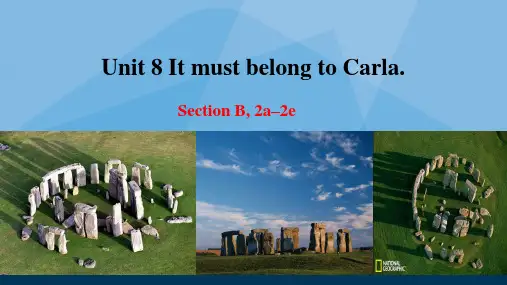
Para 2-3What was Stonehenge used for?
giving_r_ea_s_o_n_s__
ethxipnrgiedsseshiaanspgptewnoing supporting ideas
_a_t_e_tmh_ep__lsea_m__e__ti_m_e_ cgoivmimngunai_cc_aht_oe_iwc_ei_t_h the gods
Para.1givGinegneral introduction of Stonehenge
reasons
receive_m__or_e_th_a_n_7_50_,_00_0___ visitors
as ?
Visitor?
People like to go in _J_u_n_e___ see the sun __r_is_in__g_____
calendar
because it directly related to the sun
a medical purpose
prevent illness and keep people healthy
a burial place or a place to honor ancestors
was built to celebrate a victory over an enemy
1. What is Stonehenge? 2. When was it built? 3. Who built it ?
history n. 历史 historic adj. 具有历史意义的 historical adj. 有关历史的
historian n. ? 历史学家
最新人教版九年级英语第八单元Unit8(知识点+习题)
最新人教版九年级英语第八单元Unit8(知识点+习题)最新人教版九年级英语第八单元Unit8(知识点+习题)一、短语归纳最新人教版九年级英语第八单元Unit8(知识点+习题)2. go to/attend a concert3. something valuable/unusual/strange4. the rest of....5. pick it up6. each other=one another7. go to a picnic=go for a picnic8. be interviewed by...9. strange noises10. at first11. run away12. feel uneasy13. have no idea=don't know14. have fun doing sth.15. There must be …doing sth.16. run after17. wear a suit18. express a difference / result19. add information20. at the same time21. most famous historical places22. a group of…2324. so many centuries ago25. point out26. on midsummer's morning27. the center of ... ……28. move up最新人教版九年级英语第八单元Unit8(知识点+习题)1. belong to 属于(=be)It must belong to Carla. = It must be Carla's.※练一练① The notebook must be my friend's.(同义句)The notebook must __________ _______ my friend.② The book must be Jim's.(否定句)The book _________ ________ Jim's.③ The book on the ch air must belong to ________. Her name is on the cover.A. herB. hersC. sheD. him2. attend a concert参加音乐会(go to concert 去听音乐会)【比较应用】attend主要指以观众或听众的身份参加婚礼,丧礼,会议或讲座或上课. join in参加某项活动,尤指参加正在进行的活动.join 参加某个组织、党团、俱乐部等机构,成为其中一员.take part in参加某些活动或工作,在其中起了作用.(可和join in 互换)※练一练Mr. John invited many friends to _______ his wedding.A. take part inB. joinC. join in D attend3. anything valuable贵重的东西当形容词修饰something,anything,nothing,everything等复合不定代词时,后置.something unusual anything strange nothing important※练一练In this book,you can learn________.A. something educationalB. educational somethingC. anything educationalD. educational anything4. the rest of my friends 我剩下的朋友the rest of... (剩余的……)作主语,谓语动词的单复数由of 后边的名词决定.※练一练①The rest of the books_____dull.②The rest of oil _____not enough.5. ...must have picked it up. ……一定是捡起它了.⑴must have done sth(过去一定做某事了)表示对过去的事情的推测⑵pick up捡起(代词放中间)※练一练When he saw a wallet on the ground,he _______ at once.A. picked it upB. gave it upC. picked up itD. worked it out6. happen与take place 发生(无被动式)⑴ happen 特别指那些偶然或未能预见的事件发生.Sth. happened to sb.某人发生了某事Sb. happened to do sth.某人碰巧做某事⑵ take place 指某事按计划进行或按计划发生.★take place有“举行”之意,而happen有“碰巧”的意思.※练一练①A strange thing happened _____ her last night,so she is afraid to stay at home alone tonight.A. atB. forC. withD. to②Great changes _________________(发生)in China since the last thirty years.③The meeting _________________(举行)next Friday.④ _________________(碰巧)that I had no money on me.7. There must be something visiting the homes. 一定有什么东西光顾这些住户.⑴There be+主语+doing sth.有某人(物)正在做某事(表存在)There are some people surfing on the sea,aren't there?There is a cat eating fish in the corner.⑵There must be +主语+doing 一定有某人(物)正在做……(对某种存在的推测)There must be someone playing the violin there. 准有人在那里拉小提琴.※练一练①There _____________________________________________ in the forest.一定有人在森林里砍树.②There _______________________________ in the tree.树上有只鸟儿在唱着歌.8. feel sleepy 感动困乏sleepy adj. 困乏的,昏昏欲睡的sleepy expression(懒洋洋的表情)asleep adj. 睡着的(表语形容词)fall/be asleep①In spring,people often feel_________(sleep)②I didn't have a good_____ last night,so I was ______ and I fell _____ in class.A. sleep; asleep; sleepB. asleep; sleep; sleepyC. sleep; sleepy; asleepD. sleepy; sleep; asleep9. ...not only one of Britain's most famous historical places but also one of its greatest mysteries.⑴not only... but also...不但……而且……⑵either... or... 要么……要么……;不是……就是……(两者选择其一)⑶neither... nor...既不……也不……(两者都不)⑷both... and... ……和……(两者)都这四组连词都可以用来连接两个性质相同的并列成分,作主语、谓语、宾语或表语等,但⑴⑵⑶在连接句子主语时,谓语动词采取“就近原则”.both... and... 连接两个主语时,谓语动词通常用使用复数形式.Neither he or she works here. 他和她都不在这里工作.(主语)你要么跟我一块去,要么走回家去.(谓语)I have neither time nor money. 我既没时间也没钱.(宾语)He is not only a teacher,but also an actor. 他不仅是一名教师,也是一位演员.(表语)Either you or I am wrong. 不是你错就是我错.(表语)You may stay either in a hotel or in a private house. 你可以住在饭店或私人的家里.(地点状语)g back either today or tomorrow. 她不是今天来就是明天来.(时间状语)※练一练①Both my father and my mother _____(be )teachers hard.②-I hear _____ your father _____ your mother likes watchingBeijing Opera.-Yes,they both love it very much.A. both; andB. either; orC. Neither; norD. not only; but also③Not only my friends but also I _____ interested in football and Messi is our favorite star.A. beB. amC. isD. are④ Would you like some juice or coffee?-_____ is OK. I really don't care.A. BothB. EitherC. NeitherD. All⑤ Both Tom and Lucy like music that is relaxing. (改为否定句)______ T om______ Lucy ______ music that is relaxing.⑥ Would you like s ome juice or coffee?-______. I really don't mind.A. EitherB. NeitherC. Both D All★not only … but also连接两个分句时,not only可用于句首,第一个从句主谓要倒装.Not only is he clever,but also he is hard working.10. ... another popular idea. 另一个受欢迎的主意.【迷津点拨】other,the other,others,the others,another⑴ other adj.别的,其他的pron. 其余的(人或事物)Do you have any other question(s)?We need to help each other.⑵ the other特指两者中的另一个.经常构成:one... the other...(the other = the other +单数名词)He has two daughters. One is a nurse,the other is a worker.⑶others 特指某一范围内的人或物除去一些外,剩下部分中的另一些(不是全部).经常构成:some... others... ,others...Some of us like singing and dancing,others like sports,others like....有时也泛指其他的人或物:We must help others.(我们必须帮助别人.)⑷ the others 特指某集体中除了一个(些)后,剩下的部分(全部).the others = the other +复数名词Two boys will go to the zoo,and the others will stay at home.⑸ another 泛指同类事物中(三者或三者以上或数量不明)另一个.经常构成: one... another... ,another...(another = another +单数名词)I don't like this one. Please show me another.★表示“再、又,还”时:another +基数词+名词复数=基数词+ more +名词复数I'll be here for another two weeks/two more weeks.※练一练① These cakes are very delicious,I want to have_____ one.A. otherB. the otherC. othersD. another②Many people are in the zoo. Some are watching animals,and ______ are taking photos.A. the otherB. the othersC. othersD. another.③New Zealand has two islands. One is North Island and ______ is South Island.A. anotherB. the other C other D. the others11. 含有way的短语in the way 妨碍;挡道in the way of 防碍……in a certain way 按一定的方法in a/some way(s) 在某方面,在某种程度(意义)上,以某种方式by the way 顺便说一下on the way(to.. )在(去……)的路上go out of one's way 格外努力※练一练The car is _____,can you park it to another place?A. in the wayB. by the wayC. in the endD. in style12. ...prevent illness and keep people healthy. 预防疾病和保持人们健康.prevent sb. (from) doing sth. =stop sb. (from) doing sth.★keep sb. doing让某人一直做某事※练一练①Plants prevent the sun from ____________(make)the earth drier.②The heavy rainstorm stopped him from returning. (同义句)The heavy rainstorm ___________ him _______ ______________.③She closed the gate to prevent the dog ____ going out of the garden.A. atB. onC. ofD. from13. ...it receives more than 750,000 visitors.receive 收到;接到(被动)accept 接受;接纳(主动)He received the present,but he didn't accept it. 他收到了礼物,但没有接受. ※练一练①On her birthday ,she ____ a gift from a boy,but she didn't _____ it.A. received ,receiveB. accepted ; acceptC. received ; acceptD. accepted ; receive②His family are worried about him because they haven't _______ letters from him for a long time.A. acceptedB. receivedC. writtenD. collected三、语法回顾(肯定猜测和否定猜测)⑴must一定,肯定(可能性100%,疑问、否定用can,can't)⑵may/could可能,也许(可能性50%,疑问否定用could,couldn't)⑶ might有可能,差不多(可能性30%)※练一练① Whose T-shirt is this?-It_______ be John's. It's ________small for himA. can't ; much tooB. can't; too muchC. mustn't ; too muchD. mustn't ; much too② I hear that Bob is in hospital. He ______be ill.A. mustB. shouldC. wouldD. can't③ This could be Robert's basketball.(提问)_________ basketball _________ this _______?四、课后作业作业①:习题单项选择.一、( )31. — Tony is ________ man.— Yes. He is the tallest in his class.A. quite a tallB. a quite tallC. quite tall aD. tall a quite( )32. — ________ books are these?— I am not sure. They may belong to Peter.A. WhichB. WhoC. WhoseD. Whom( )33. —The famous star was interviewed ______ the local newspaper.— Yes,I also heard the news.A. ofB. byC. asD. with( )34. —What’s Lily’s favorite color?— _____.A. PianoB. PandaC. PieD. Pink( )35. —Don’t throw these books. They may be ________ to you.—OK. I won’t.A. convenientB. awfulC. valuableD. useless( )36. — Carl,________ are you late for school?— Because my bike is broken.A. whyB. whenC. howD. where( )37. There are ________ stars in the sky.A. millionsB. millions ofC. million( )38. — Did you _________ the letter from your pen pal?— No,I didn’t.A. avoidB. reportC. writeD. receive( )39. — Edison was one of _______ inventors in the world.—Yes,I agree.A. the greaterB. greaterC. the greatestD. greatest( )40. — Can he help us?—I’m not sure. He ________ help us solve this mystery.A. mightB. mustC. shouldn’tD. mustn’t( )41. — The visitors knew little about the island when they ________ there.— Really? What did they do first?A. arriveB. have arrivedC. would arrive( )42. — He has never seen the movie,________?— No,he hasn’t.A. is heB. has heC. isn’t heD. hasn’t he( )43. Not only you but also he _______ on well with the new students.A. getB. gettingC. getsD. to get( )44. I hear ________ he will be back in two days.A. thatB. whereC. ifD. when( )45. — Whose baseball is this?— ________ He loves baseball.A. So do I.B. I enjoy playing baseball.C. I don’t know.D. It must be Nick’s.二、完形填空.Justin and Mary woke up early. 46 told them about a monster that haunted (怪兽出没) the lake D. tall a quite D. million of D. arrived yesterday. It was only 5:00 AM,so 47 else in the house was still asleep. Mary and Justin went to the boat dock (码头). It was too foggy (有雾的) to 48 anything. Do you think Uncle Thomas was just trying to scare (惊吓) us?” Justin said. Mary said,“ 49 what he said? The monster haunts the lake. The people in the story were in 50 .” “You want to go out on the water? Mom will be angry,” Justin said. “Maybe we don’ t have togo anywhere. We 51 sit in the boat while it’ s docked (停靠码头). That would be safe,” Mary said. Justin carefully climbed into the boat first. Then Mary climbed into the boat and sat 52 him. They looked around,and gradually,the sun began to rise. Mary suddenly shouted,“The monster!” They hugged each other in fear,but then they heard a laugh. Justin realized something and said,“Uncle Thomas?” “I knew that you would get up 53 because of my story,” Uncle Thomas said. Mary and Justin were 54 that there was no monster after all. Uncle Thomas laughed,“I brought 55 for us. Are you hungry?” “Yes,we are. Let’s have breakfast,” Mary and Justin said.( )46. A. Uncle Thomas B. Their mother C. Their father D.Their teacher ( )47. A. everything B. anything C. everyone D. nothing ( )48. A. feel B. catch C. hear D. see( )49. A. Remember B. Imagine C. Attend D. Receive( )50. A. buses B. trains C. boats D. planes( )51. A. must B. mustn’t C. couldn’t D. can( )52. A. beside B. outside C. of D. for D. for( )53. A. slowly B. suddenly C. early D. late( )54. A. happy B. sad C. nervous D. afraid( )55. A. lunch B. breakfast C. supper D. pocket三、阅读理解.I was woken up by a strange sound. I was terrified and ran downstairs. I found my mom in the kitchen,getting my brother ready for school. “Mom,did you hear anything? I,uh,I thought I saw an alien.” D. In 1898. Just a dream!” Mom answered. As I walked to the window,I cried. I saw a little alien with big and black eyes. It tried to run between my legs. Although I was scared,for some reason,I squeezed (挤) my legs together in time to catch it. It took out something and hurt me.I felt a terrible sense of nothingness and fainted (晕倒). Then I woke up. At first,I could hardly move. I wasn’t sure whether I had had a dream or not. I stood up and walked downstairs. I saw my mom in the kitchen. She was really getting my brother ready for school,wearing her pink clothes. Then I realized it was just a dream because in my dream she was wearing her work clothes. From then on,I always dreamt about aliens. At that time,I really thought maybe I had some kind of relationship (关系) with aliens. Later I realized that I used to have those dreams because I always read books or watched TV programs about aliens!( )61. What did the writer do when he saw the alien?A.He was too scared to move.B.He knew it was a dream and w asn’t afraid.C. He was so scared that he fainted.D. He wanted to catch the alien. ( )62. The underlined word “nothingness” in the passage means “________” in Chinese.A. 虚无B. 无奈C. 兴奋D. 开心( )63. The writer found that it was just a dream ______.A. as soon as he woke upB. before he went downstairsC. when he saw his motherD. when he was hurt by the alien( )64. Which of the following is TRUE according to the passage?A.The writer had the dream at noon.B. The writer’s mother’s work clothes might not be pink.C. The writer’s mother was worried about his dream.D. When the writer had the dream,his family were out.( )65. Why did the writer use to have dreams about aliens?A. He had some kind of relationship with aliens.B. He was terribly ill.C. He maybe did something about aliens before going to bed .D. The dreams were all about the writer’s real experiences.。
九年级英语八单元b部分知识点
九年级英语八单元b部分知识点在九年级英语课程中,八单元B部分是一个相对较为重要的部分,涉及到了一些核心的语法知识和词汇。
本文将就部分重要知识点展开讨论,并给出一些例子和解释,以便同学们更好地理解和运用这些知识。
首先我们来讨论一下被动语态的构成和用法。
被动语态是英语语法中的一个重要部分,它与主动语态形成鲜明的对比。
在被动语态中,动作的承受者成为句子的主语,而动作的执行者则变成句子的宾语。
被动语态的构成通常是“be + 过去分词”,其中“be”根据句子的时态和人称的不同而变化。
比如在一般现在时态中,我们常常用“am/is/are + 过去分词”来构成被动语态。
例如:“The letter is written by Tom.”(这封信是汤姆写的)。
除了被动语态,我们还需要学习一些常用的词汇和短语。
这些词汇和短语在日常生活和学习中都是非常常见的,掌握它们可以帮助我们更好地理解和表达英语。
比如,“disappointed”(失望的),“enthusiastic”(热情的),以及“exciting”(令人兴奋的)等等。
此外,还有一些短语需要我们特别注意,比如“look forward to”(期待),“give up”(放弃),以及“take part in”(参加)等等。
这些短语的用法可能与汉语中的表达方式不同,所以我们需要多加练习和运用,以便熟练掌握。
除了词汇和短语,我们还需要学会如何使用一些重要的语法结构。
比如,直接引语和间接引语的转换是英语中常见的语法现象。
当我们将直接引语转换为间接引语时,往往需要对动词的时态和人称进行相应的调整。
例如,“He said, 'I am happy.'”(他说:“我很开心”)可以转换为“He said that he was happy.”(他说他很开心)。
通过这个例子,我们可以看到当直接引语的时态是一般现在时态时,间接引语中的时态要向过去倾斜。
最后,我们还需要学习一些表示目的和原因的连词和副词。
新人教九年级英语unit8知识点

新人教九年级英语unit8知识点新人教九年级英语Unit 8知识点Unit 8的主题是"Adventures and Travel",通过学习这一单元,我们将了解到关于冒险和旅行的词汇、语法和交际用语。
本文将结合具体的例子和练习,帮助大家掌握这些知识点。
一、词汇在这个单元中,我们将学习一些与冒险和旅行相关的词汇。
比如,我们会学习到一些描述旅行的词汇,如"journey"(旅行)、"destination"(目的地)和"itinerary"(行程)。
同时,我们还会涉及到一些动词,如"go sightseeing"(观光)、"explore"(探索)和"hike"(徒步旅行)。
为了更好地掌握这些词汇,我们可以通过一些练习来记忆。
比如,我们可以利用词汇卡片来熟悉这些词汇的写法和发音。
我们也可以通过模拟真实场景,进行对话练习,提高词汇的运用能力。
二、语法在这个单元中,我们将学习到一些与动词的语态相关的语法知识。
比如,我们会学习到被动语态的用法和构成。
被动语态的构成通常是由"be"动词加上动词的过去分词。
例如,"The book isread by him."(这本书被他阅读)。
为了更好地理解被动语态的用法,我们可以通过练习来加强对其的掌握。
例如,我们可以进行填空练习,选择正确的动词形式来构成正确的句子。
我们还可以进行改错练习,找出句子中的错误,并进行修改。
这样可以帮助我们更好地理解和运用被动语态。
三、交际用语在这个单元中,我们还将学习一些与旅行和冒险相关的实际交际用语。
例如,我们将学习如何向他人询问旅行的经历,如"What did you do on your trip?"(你旅行时做了什么?)或者"What wasthe most memorable part of your adventure?"(你冒险中最难忘的部分是什么?)。
人教版九年级英语Unit 8 Section B(2b~3b)课件
You made my day!
我们,还在路上……
the answer.
不习惯读书进修的人,常会自满于现状,觉得再没有什么事情需要学习,于是他们不进则退。经验丰富的人读书用两只眼睛,一只眼睛看到纸面上的话,另 一眼睛看到纸的背面。20Байду номын сангаас2年4月3日星期日2022/4/32022/4/32022/4/3 书籍是屹立在时间的汪洋大海中的灯塔。2022年4月2022/4/32022/4/32022/4/34/3/2022 正确的略读可使人用很少的时间接触大量的文献,并挑选出有意义的部分。2022/4/32022/4/3April 3, 2022 书籍是屹立在时间的汪洋大海中的灯塔。
二、根据句意用所给词的适当形式填空。 6.He went home __d_ir_e_c_tl_y_(direct)after school. 7.He didn't go to school because of __il_ln_e_s_s__(ill). 8.As teachers,they must be _p_l_a_n_n_e_rs__(plan)first. 9.People should eat more _h_e_a_l_th_y__(health) food. 10.In 2001,a group of English volunteers tried
一、根据句意及汉语提示写单词。 1.—Do you know green life? —Yes.Save __e_n_e_rg_y__(能源)and reduce pollution. 2.GPS is used for finding out one's __p_o_s_it_io_n__(位置). 3.They killed a lot of __e_n_e_m__ie_s__ in the past.We are proud of them. 4.Everywhere we saw people celebrating the __v_i_ct_o_r_y__( 胜利). 5.—What were you doing at that ___p_e_ri_o_d__(一段时间)? —I was practicing the violin.
人教版九年级上册英语Unit 8 Section B 完整课件(80页)
Review What does she do? She could/might be a/an_n_u__rs_e_.
What does he do?
He could/might be a/an _d_o_c_t_o_r.
What is the panda doing?
2. something in the sky
it must be __a_U__F_O___
3. something strange
I must be _d_r_e_a_m_i_n_g__
4. a woman with a they must be
camera
_m_a_k_i_n_g__a_m__o_v_ie__
A UFO is landing.
An alien is running after a man.
The man is running.
What does the man look like? How does he feel? Why? Describe the pictures.
1b Listen and number the pictures [1-3] in 1a. Then write two or three sentences to finish the story.
2
3
1Leabharlann __A_w__o_m_a_n__i_s_f_il_m_i_n_g__w_i_th__a_c_a_m__e_r_a_. _T_h_e_y____
__a_re__m_a_k__in_g__a_m__o_v_ie_._____________________
人教版九年级英语第八单元b部分知识点
人教版九年级英语第八单元b部分知识点在人教版九年级英语教材的第八单元B部分,我们将学习一些重要的知识点,包括词汇、语法以及阅读理解等。
现在,让我们一起来深入了解这些知识点。
首先,让我们来学习一些重要的词汇。
在这个单元,我们将学习关于“旅行”的词汇,比如“passport”(护照)、“visa”(签证)、“departure”(出发)、“arrival”(到达)等等。
这些词汇在我们日常生活中用到的频率很高,掌握它们有助于我们更好地理解和应用这些词汇。
接下来,我们将学习一些重要的语法。
这个单元中,我们将学习比较级和最高级的用法。
比较级用于比较两个事物的差异,而最高级则用于三个或三个以上事物之间的比较。
在使用比较级和最高级时,我们需要注意形容词和副词的变化规则,例如在单音节形容词中,比较级用“-er”或“more”,最高级用“-est”或“most”。
掌握这些变化规则非常重要,可以帮助我们正确表达自己的意思,并且加深对语法的理解。
除了词汇和语法,阅读理解也是本单元的重要内容之一。
通过阅读一些关于旅行的文章,我们可以加深对旅行活动的理解,并且提高自己的阅读理解能力。
在阅读理解的过程中,我们需要注意文中的关键信息,可以通过划线、圈出重要词汇等方式帮助我们更好地理解文章。
另外,我们还应该锻炼自己的推理能力,根据文中的信息进行逻辑推理,找出正确答案。
在学习这个单元的过程中,我们不仅仅是为了应付考试或者达到课程要求,更重要的是培养自己的英语思维和语言运用能力。
因此,我们在学习的过程中,应该注重理解和应用知识,而不是死记硬背。
通过实践和练习,我们可以逐渐提高自己的英语水平。
除了课本上的内容,我们还可以通过其他途径来提高自己的英语能力。
可以多听英语歌曲、观看英语电影或者进行英语口语交流等等。
这些都是很好的提高自己英语水平的方式,可以帮助我们更好地融入英语的环境中,从而提高自己的听说读写能力。
总之,在人教版九年级英语第八单元B部分的学习中,我们将学到很多关于旅行的知识,并且不仅仅是课本上的内容,我们还可以通过其他途径提高自己的英语能力。
新人教版九年级英语unit8知识点归纳
新人教版九年级英语unit8知识点归纳新人教版九年级英语Unit 8知识点归纳在新人教版九年级英语教材的Unit 8中,我们学习了许多有关网络与社交媒体的知识,这些知识对于我们现代社会的学习、工作与交流起着重要的作用。
在本篇文章中,我们将对Unit 8中的一些重要知识点进行归纳总结,为大家巩固学习提供帮助。
第一部分:网络和社交媒体的介绍在Unit 8的第一部分,我们了解到了网络和社交媒体对我们的生活产生了巨大的影响。
我们可以通过互联网搜索信息,使用社交媒体平台与朋友分享生活、交流想法。
社交媒体的开展为我们提供了许多便利,但同时也需要我们提高信息的安全意识,避免上当受骗。
第二部分:信息的价值和安全性在这一部分,我们学习了信息的价值以及如何保证信息的安全性。
我们应该正确评估信息的真实性和可靠性,避免被虚假信息所误导。
同时,我们还学习了一些保护个人信息的方法,如设置复杂的密码、不随意分享个人信息等。
第三部分:网络对人际关系的影响网络的兴起对人际关系产生了深远的影响。
我们可以通过社交媒体与朋友、家人保持联系,拓展社交圈子。
然而,过度沉迷网络也会使我们与现实世界的人际交往减少。
因此,我们要学会合理利用网络,保持平衡的生活方式。
第四部分:网络安全问题及解决方法在网络上,我们也会面临一些安全问题,如网络欺诈、网络侵犯等。
我们应该学会辨别垃圾信息,不随意下载和点击可疑链接。
同时,我们还需要保护好自己的个人信息,避免泄露给不明身份的人。
第五部分:虚拟社交和现实社交的比较在这一部分中,我们探讨了虚拟社交和现实社交两种不同形式的人际交往。
虚拟社交使我们能够与更多人联系,但同时也带来了面对面交流的减少。
我们应该在虚拟社交和现实社交之间寻找平衡,发展健康的人际关系。
第六部分:如何利用社交媒体提升自己在这一部分中,我们学习了如何利用社交媒体平台提升自己。
我们可以通过发布优秀的作品、分享知识与经验来展示自己的才艺与能力。
同时,我们还要注意自我管理,避免沉迷于社交媒体而忽视其他重要的事务。