
初中英语 牛津译林版八年级下册 Unit3 Online tours 知识点
牛津译林版八年级下册Unit3 Online tours
1.Have you noticed the “Tour” icon at the top of the page?
你有注意到在页面上方的“旅游”图标吗?
the top of 在......的顶部;在......的巅峰
He steadied a coin on the top of the basketball bank.
他把一枚硬币稳稳地放在篮板的顶上面。
2.Every year, thousands of people gather here on New Year’s Eve.
每一年除夕的时候,数以千计的人们聚集在这里。
thousand 千
前面用具体数字时,用法结构:数字+ thousand + 名词复数
thousands of “数千...,成千上万的....”表示笼统数字,前面不可加具体数字There are two thousand students in their school.
他们学校有两千学生。
There are thousands of students in their school.
他们学校有数千学生。
类似用法还有:hundred(百),million(百万),billion(十亿)
用法:具体数字+ hundred/million/billion + 名词复数
Hundreds/millions/billions of + 名词复数
3.It’s exciting to see the huge glass ball falling through the darkness!
令人兴奋的是看到一个巨大的玻璃球在黑暗中落下。
It’s + adj + to do sth. 做某事是怎样的
句中的it为形式主语,不是真正的主语,而真正的主语是后面的不定式“to see......”
It’s difficult to learn math well.
学好数学是困难的。
fall through 落空,失败
What do you think are the chances this project will fall through?
你认为这个项目失败的可能性有多大?
4.In the centre of the island is Central Park.
在岛的中心是中央公园。
the centre of ......的中心
The old people saw cattle as the centre of their culture.
旧时的人们把牛看成是他们文化的中心。
5.With several lakes, hills and a large green lawn, it’s a good place to relax after a hard day’s work.
公园内有几片湖水,几座小山以及一大片绿草坪,是人们辛苦工作一天后放松的好去处。
with several lakes, hills and a large green lawn 为介词短语,起副词作用。
with “带有,伴随”
With a smile on his face, he came into the classroom.
他面带微笑走进了教室。
6.It has been famous for its theaters since the early twentieth century.
自20世纪早期以来,它便以剧院闻名。
the early twentieth century 20世纪早期
the late twentieth century 20世纪晚期
be famous for 因......而著名
Some athletes sometimes will be famous for a short time.
有些运动员有时只出名一阵子。
7.So much for New York.
关于纽约就讲这么多。
so much for sth. (表示就某事讲完了)关于......就讲这么多,......到此为止Thank you both so much for joining us and for telling these stories.
非常感谢你们来参加我们的节目并且讲述了这些故事。
8.There’s a “back” icon at the bottom of the page.
在页面的底部有一个“返回”图标。
the bottom of ......的底部
The bottom of the candle is fused with its holder.
蜡烛的底部与烛台熔在一起。
9.Have you ever dreamt of travelling around the world without a passport?你有没有梦想过不用护照去环游世界。
dream of doing sth. 奢望做某事,梦想做某事
I shouldn’t dream of doing such a thing.
我不该梦想着做这样的事。
10.Yesterday Daniel showed me an online tour of the USA.
昨天丹尼尔带我在线旅游美国。
show sb sth. 给某人展示某物。
I want to show you my home.
我想向你们展示我的家。
11.The website takes you to different places around the world.
网络可以带你去世界各地。
take sb to sp. 带某人去某地。
I’ll take you to my hometown.
我打算带你去我的家乡。
12.Would you mind showing me how to start this online tour?
请你演示一下如何开始这个在线旅游好吗?
Would you mind doing......?可用于客气地请某人做某事。
mind doing sth. 介意做某事。
Would you mind explaining the sentence again?
你再解释一下这句话行吗?
13.My pleasure.
不客气。
日常用语,通常用作对别人道谢的回答,相当于“You’re welcome”。
14.It is made up of England, Scotland, Wales and Northern Ireland.
它(英国)由英格兰,苏格兰,威尔士和北爱尔兰组成。
be made up of 由......组成
Our class is made up of 32 boys and 23 girls.
我们班级有32个男生和23个女生。
一般过去时和现在完成时区别
一般过去时和现在完成时都可以表示过去发生的动作,但是在具体的语境中,这两种时态有明显的区别。
一般过去时表示过去某个时间发生的事情或存在的状态,说话的侧重点在陈述过去发生的事情或状态。
I want to Beijing last month.
我上个月去过北京。
Tom was in China in 2008.
2008年汤姆在中国。
现在完成时表示到说话时为止已经发生或完成(不一定结束)的动作或状态,强调造成的结果或对现在产生的影响。
I have bought a new mobile phone.
我买了一部新手机。
I have been to Landon many times.
我去过伦敦很多次了。
一般过去时通常与表示过去的时间状语连用:yesterday, last week, two years ago, just now, in 2008等。
现在完成时则通常和频度副词或表示一段时间的状语连用:many times, never, these days, this week, since..., for...等。
Unit3Onlinetours知识讲义牛津译林版八年级英语下册

牛津版译林英语8B知识点总结Unit3 Online tours【Wele to the unit】1. I agree.【知识点一】:agree v.同意①同意某人的意见agree with + 人②就某事达成一致意见agree on + 事情③同意做某事agree to do sth.④同意… agree + 宾语从句(1) 反义词disagree(2) 名词agreement2. send and receive emails【知识点一】:send v. 发送;寄出(sent/sent)寄给某人某物send sb sth = send sth to sb【知识点二】:receive v.收到,接到从某人哪里收到某物receive sth. from sb.区分:receive 客观收到accept主观接受Eg. The man received a letter just now.My aunt gave me a book and I accepted it happily.(1) I __________ a new bike on my birthday, but I didn't ___________ it.A. received; receiveB. accepted; receiveC. received; acceptD. accepted; accept(2) I haven't __________ my penfriend's letter for two weeks.Maybe he is too busy recently.A. acceptedB. receivedC. writtenD. collected(3) Nowadays _____________(接收) emails is faster and _____________(简单) than before.3. —What do you usually use your puter for?—I usually use it to search for information.【知识点一】: use sth. to do sth. 使用某物做某事= use sth. for doing sth.【知识点二】: search /sɜːtʃ/(1)v. 搜寻,搜索①search sp. 搜寻某地搜寻房间search the room②search sp. for... 在某地搜寻某物Eg. They are searching the forest for the missing boy.③search sb. for sth. 搜查;搜身Eg. The police searched the thief for the lost money.④search for sth. / sb. 寻找某物/ 某人=look / hunt / seek for(2) n.搜寻,搜索in search of... 为了寻找...Eg. She went into the kitchen in search of something to drink.(1) — Why did Mike _____ the room?— I’m not sure. Maybe he wanted to ____ his watchA. search; findB. search for; findC. search; lookD. search for; look for(2) It took the parents the whole day ___________ the town ___________ the lost baby.A. searching; forB. to look; forC. to search; forD. finding; out(3) — Would you please show me your new puter?— Sorry, my brother __________ (search) for something on it.【知识点三】: information /ˌɪnfəˈmeɪʃn/ un. 信息①一条信息a piece of information②信息时代information age(1) v. inform 通知①inform sb. of sth. 通知某人某事Eg. The boss informed us of his arrival.4. —How often do you use your puter for this? —Almost every day.【知识点一】:how often(1) how often 表多久一次,问频率Eg. How often does your brother exercise? Twice a week.(2) how long 表示多长时间,对一段时间进行提问Eg. How long did you stay there? A bout three weeks.(3) how soon 表示多久,对将来的时间进行提问Eg. How soon will he be back?In a week.(1)_____________ do you write to your pen friend?Twice a month.A. How oftenB. How soonC. How longD. How many times(2)___________ do you water the plants? Twice a day.A. How longB. How soonC. How oftenD. How much【知识点二】:almost adv. 几乎,差不多辨析almost 和nearly(1) almost:在程度上比nearly更强可与any、nobody、never、nothing、none等否定词连用(2) nearly:常用在具体数字前面不可与any、nobody、never、nothing、none等否定词连用可与not构成短语not nearly—远远不如:Nearly everyone knows him.=Almost everyone knows him.【Reading】1 I’m your tour guide.【知识点一】:guide /ɡaɪd/(1) cn. 导游,向导①一位导游a tour guide②导盲犬guide dog(2) n. 指南,手册a Guide to Family Health(3) v. 领路;指引带领某人到/穿过guide sb. to/ throughEg. She guided us through the busy streets to the park.2. Have you noticed the “Tour” icon at the top of the page? Just click on it, and you can visit Asia, Africa, Europe, America and more in only eight hours!【知识点一】:notice(1) v. 注意;注意到①注意到某人/某事notice sb/sth②注意到某人做某事notice sb do (强调动作发生的全过程或经常发生)notice sb doing sth. (强调动作正在发生)③notice + 从句(2) un. 注意注意到… take notice ofEg. Don't take any notice of what you read in the papers.(3) cn. 通知,布告,公告牌Eg. There is a notice on the office door saying “No Smoking”.(1) Have you noticed a tall boy __________ a basketball ____________ into the building?A. has; runB. have; runningC. with; runD. with; running(2) When I passed the river, I saw some children ________________ (play) on the sand.【知识点二】:at the top of 在……顶端反义短语:at the bottom of 在……底部Eg. There stands a tall tree at the top of the mountain.【知识点三】:click vi. 点击单击某物click on sth.double left click on左键双击left click on左键单击3. Wall Street, the worldfamous trade center, is here at the southern end of Manhattan Island. There are many big panies and international banks here.【知识点一】:worldfamous /wɜ:ld ˈfeɪməs/(adj.) 世界著名的,举世闻名的①因为...而举世闻名be worldfamous for...This player was worldfamous for scoring the first goal of the 2010 World Cup.这位球员因打进了2010世界杯第一个球而举世成名。
牛津译林版八年级英语下册Unit3Onlinetours知识点总结
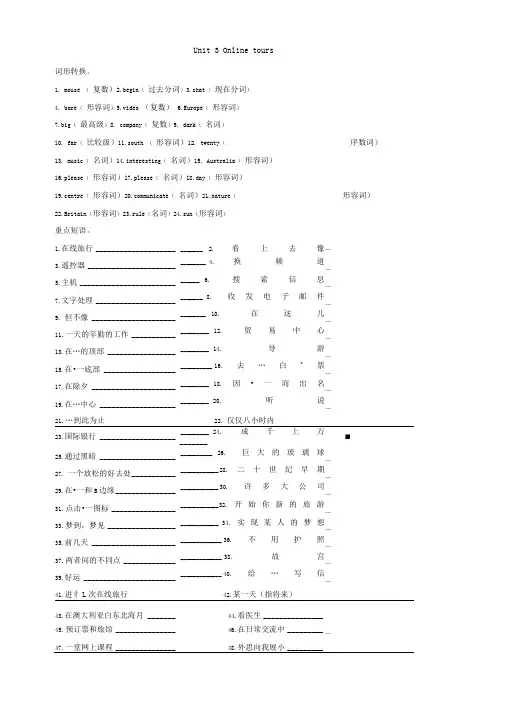
Unit 3 Online tours词形转换。
1. mouse ( 复数)2.begin ( 过去分词)3.chat ( 现在分词)4. bore ( 形容词)5.video (复数)6.Europe ( 形容词)7.big ( 最高级)8. company ( 复数)9. dark ( 名词) 10. far ( 比较级)11.south ( 形容词)12. twenty (序数词)13. music ( 名词)14.interesting ( 名词)15. Australia ( 形容词) 16.please ( 形容词)17.please ( 名词)18.day ( 形容词) 19.centre ( 形容词)municate ( 名词)21.nature ( 形容词)22.Britain (形容词)23.rule (名词)24.sun (形容词)重点短语。
1.在线旅行 ____________________ _______2.看上去像 ______ — 3.遥控器 ______________________________ 4. 换频道______ —5.主机 ________________________ ______6. 搜索信息_____ —7.文字处理 ____________________ _______ 8. 收发电子邮件_____—9. 但不像 _____________________ ________ 10. 在这儿_______ —11.一天的辛勤的工作 ___________ _________ 12. 贸易中心_______ —13.在…的顶部 _________________ _________ 14. 导游_______ —15.在•一底部 __________________ __________ 16.去…白^票________ —17.在除夕 _____________________ _________ 18.因•一而出名_______ —19.在…中心 ___________________ _________ 20.听说_______—21.…到此为止 22. 仅仅八小时内23.国际银行 ____________________________ 24. 成千上万 _______■25.通过黑暗 ___________________ __________ 26. 巨大的玻璃球________ —27. 一个放松的好去处 ___________ ____________ 28.二十世纪早期__________ —29.在•一和B 边缘 _______________ ____________ 30. 许多大公司__________ —31.点击•一图标 ________________ ____________ 32.开始你新的旅游_________ —33.梦到,梦见 _________________ ____________ 34.实现某人的梦想_________ —35.前几天 _____________________ _____________ 36.不用护照___________ —37.两者间的不同点 _____________ _____________ 38.故宫___________ —39.好运 _______________________ _____________ 40.给…写信__________—41.进彳L 次在线旅行 42.某一天(指将来)43.在澳大利亚白东北海月 _______ 44.看医生 _______________45.预订票和旅馆 _______________ 46.在日常交流中 _________ —47.一堂网上课程 _______________48.外思向我展小 _________49.…..的对立50.问路51.怎样启动这台电脑52.乐意效劳53.感谢你的帮助54.澳大利亚的季节55.看起来像一艘有许多帆的轮船________________________________________________________56.由…组成57. 为…作准备58.有着悠久的历史60.一个岛国61.用英镑62. 国王和王后的家63.做某事的最佳时间64 自然美景65.经常改变66.介绍一个国家67.例如68. 世界文化69.因•一而出名70.其他野生鸟词汇。
牛津译林八年级下册Unit3知识点总结
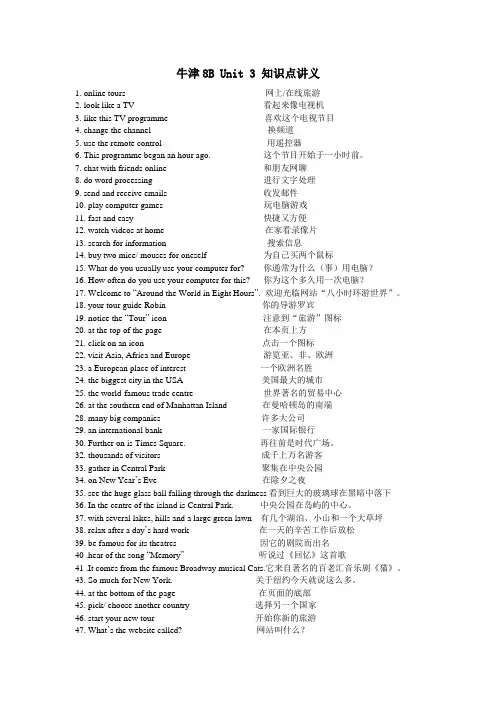
牛津8B Unit 3 知识点讲义1. online tours 网上/在线旅游2. look like a TV 看起来像电视机3. like this TV programme 喜欢这个电视节目4. change the channel 换频道5. use the remote control 用遥控器6. This programme began an hour ago. 这个节目开始于一小时前。
7. chat with friends online 和朋友网聊8. do word processing 进行文字处理9. send and receive emails 收发邮件10. play computer games 玩电脑游戏11. fast and easy 快捷又方便12. watch videos at home 在家看录像片13. search for information 搜索信息14. buy two mice/ mouses for oneself 为自己买两个鼠标15. What do you usually use your computer for? 你通常为什么(事)用电脑?16. How often do you use your computer for this? 你为这个多久用一次电脑?17. Welcome to “Around the World in Eight Hours”. 欢迎光临网站“八小时环游世界”。
18. your tour guide Robin 你的导游罗宾19. notice the “Tour” icon 注意到“旅游”图标20. at the top of the page 在本页上方21. click on an icon 点击一个图标22. visit Asia, Africa and Europe 游览亚、非、欧洲23. a European place of interest 一个欧洲名胜24. the biggest city in the USA 美国最大的城市25. the world-famous trade centre 世界著名的贸易中心26. at the southern end of Manhattan Island 在曼哈顿岛的南端28. many big companies 许多大公司29. an international bank 一家国际银行30. Further on is Times Square. 再往前是时代广场。
8B Unit3 Online tours知识点汇总

8B Unit3 Online tours单元知识点汇总Comic strip&Welcome to the unit1.It looks like a TV.它看起来像台电视机。
look like意为“看起来像”,like此处用作介词,意为“像,如……一样”,后接名词或代词作宾语。
look forward to期待,盼望look after照料,照顾look out当心,小心look over检查look at看look up查阅(词典)look for寻找look down on/upon轻视,瞧不起2.I agree.我同意。
agree此处用作不及物动词,意为“同意”。
I don't agree.我不同意。
①agree on意为“在……方面取得一致意见”,主语必须指协调的双方或多方。
①agree to+表示“提议、办法、计划”等的名词,意为“同意某事”。
①agree with sb.意为“同意/赞成某人的意见”。
①agree to do sth.意为“同意做某事”。
①agree +宾语从句,意为“同意……”。
3.Look,this programme began an hour ago.看,这个节目一小时前开始的。
begin(began,begun)此处用作不及物动词,意为“开始”。
School begins in September.学校9月份开学。
begin也可用作及物动词,begin doing sth.和begin to do sth.都表示“开始做某事”。
4.It's boring.它很枯燥。
boring形容词,意为“没趣的;令人厌烦的”,常用来说明事物具有的特征,故常修饰物;bored也是形容词,意为“感到无聊的”,常用来说明人的感受,故常修饰人。
用法类似的词还有excited,exciting;surprised,surprising;interested,interesting等。
牛津译林八年级下册Unit 3 Online tours Reading II知识点课件(共35张PPT)

一大块绿色的草坪 a large green lawn lawn n. (可数)
relax v. 放松 relaxes relax oneself 你经常怎样放松自己? How do you often relax yourself?
relaxing adj. 使人放松的 relaxed adj. 感到放松的 Listening to light music makes me feel _r_e_l_a_x_e_d__.
•
adj. 欧洲(人)的
• a European country
• You have chosen: NEW WORK • choose – chose – chosen • choose sth • choose to do sth • choose sb to do sth • choose sb as/to be • choose sth to do • eg. • choose subjects to study • choose music to listen to
• an African country
• an Asian country
• America n. 美洲;美国
• American n. 美洲人;美国人
•
adj. 美洲(人)的;美国(人)的
• an American country
•
• Europe n. 欧洲
• European n. 欧洲人
2) 在20世纪早期/晚期
in the (early/late) twentieth century
century n. 世纪(前面通常为序数词) centuries
牛津译林版八年级下册 第三单元知识点总结汇总
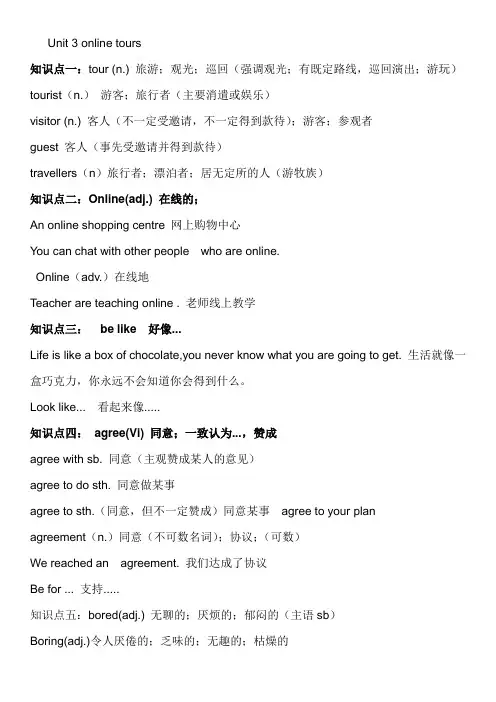
Unit 3 online tours知识点一:tour (n.) 旅游;观光;巡回(强调观光;有既定路线,巡回演出;游玩)tourist(n.)游客;旅行者(主要消遣或娱乐)visitor (n.) 客人(不一定受邀请,不一定得到款待);游客;参观者guest 客人(事先受邀请并得到款待)travellers(n)旅行者;漂泊者;居无定所的人(游牧族)知识点二:Online(adj.) 在线的;An online shopping centre 网上购物中心You can chat with other people who are online.Online(adv.)在线地Teacher are teaching online . 老师线上教学知识点三:be like 好像...Life is like a box of chocolate,you never know what you are going to get. 生活就像一盒巧克力,你永远不会知道你会得到什么。
Look like... 看起来像.....知识点四:agree(Vi) 同意;一致认为...,赞成agree with sb. 同意(主观赞成某人的意见)agree to do sth. 同意做某事agree to sth.(同意,但不一定赞成)同意某事agree to your planagreement(n.)同意(不可数名词);协议;(可数)We reached an agreement. 我们达成了协议Be for ... 支持.....知识点五:bored(adj.) 无聊的;厌烦的;郁闷的(主语sb)Boring(adj.)令人厌倦的;乏味的;无趣的;枯燥的I felt bored with the boring film.知识点六:倒装句:英语正常语序:主语+谓语+....完全倒装:谓语(实义动词)+主语(用于一般现在时和过去时)Here comes the bus.注意:主语是代词,不用倒装Here you are.副词标志词要位于句首。
江苏专版牛津译林八年级下册Unit 3 知识点复习总结
江苏专版译林八下U3知识点总结1.Online tours 在线旅游解析:online,形容词,意为“联网的,在线的”,在句中常作前置定语。
常用短语: online shopping网购; online publishing网络出版; online games网络游戏。
如:----You can go online by mobile phone.你可以通过手机上网。
----- Look up a Chinese word in an online dictionary.用在线词典查一个汉字。
拓展:online,副词,意为“在线地”。
如:------You can find much information about the football match online.你可以在网上找到很多关于足球比赛的信息。
2.It looks like a TV.它看起来像台电视机。
解析: look like意为“看起来像”,后接名词或代词作宾语。
look 为系动词,意为“看起来,看上去”; like 为介词,意为“像”。
如: ➢The sun looked like an orange globe.太阳看上去像个橘黄色的球体。
➢Mrs Fang is over sixty, but she still looks young.方太太60多岁了,但她看起来仍然年轻。
3.Look, this programme began an hour ago.看,这个节目一小时前开始的。
解析:programme,名词,意为“节目”,是可数名词,美式英语中常用program。
如:-----We listened to some interesting programmes last night.昨晚我们收听了一些有趣的节目。
拓展:programme作名词,还可表示“计划,方案”。
如:------The programme will continue in the coming school year.该方案会在新学年继续下去。
Unit3Onlinetours知识点归纳牛津译林版英语八年级下册
Unit 3 Online tours 在线旅行【重点词汇】1.agree[v.]同意(1)(2)agree + 宾语从句同意...(3)agree with,agree to,agree on①agree with后面跟sb.表示同意某人的意见、看法1)She agrees with him about this matter.②agree to后面跟表示计划、办法的一些名词1)She doesn’t agree to the suggestion.③agree on表示双方通过协商在某方面达成一致或达成协议1)They agree on leaving next week.2.programme<英>节目;计划,方案=<美>program(1)后面接on或about说明节目的内容①Did you see that programme on/about BeiJing last night?3.boring[adj.]无聊的,令人厌烦的(1)boring无聊的,常用来修饰物,指事物本身无趣(2)bored感到厌烦的,常用来形容人,指人的感受4.channel[n.]频道(1)[n.]水渠;海峡5.mouse(pl.mice或mouses)鼠标(1)鼠标垫mouse pad6.receive[v.]收到,接到(1)(2)(3)receive和accept区别①receive收到,接到;表示客观上收到,并不意味着同意或愿意接受。
②accept接受;主观上乐意接受。
(4)[v.]接待,招待receive guests会客7.almost[adv.]几乎,差不多(1)almost和nearly区别都可以修饰不定代词、形容词、副词、动词、介词等,两者可以互换①almost在接近程度上比nearly更强。
②nearly通常用在具体的数字之前。
例句:几乎每个人都认识他。
Almost everyone knows him.=Nearly everyone knows him.例句:马上就到十点半了。
牛津译林版2018-2019学年八年级英语下册Unit3Onlinetours知识点总结
8B Unit 3 Online Tour单元重点知识点总览1. look like 看起来像…2.agree的用法agree to do sth. 同意做谋事agree with sb. 同意某人的意见或看法agree on/about sth. 在.....上达成一致意见3.send sth. to sb. = send sb. sth.e sth. to do sth.= use sth. for doing sth. 使用某物做某事5.almost和nearly的区别almost可以同no one, nothing, no, none,nobody,never搭配,而nearly则不可;但可以说not nearly,不可说农田almost.6.Welcome 和Welcome to的区别Welcome home!欢迎回家。
Welcome to my home!欢迎来我家做客。
7.further和farther的区别在做副词时两者都表示距离方面的“更远,较远”;在做形容词时:further 表示抽象意义,指程度上“更多,更进一步,更深一层”farther 只表示距离上“更远,较远”8.数字+hundred/thousand/millionhundreds of:成百上千/ thousands of:成千上万9.be famous for: 因…而著名be famous as:作为…而闻名,后接表示身份,职业等名词10. be filled with= be full of11. dream of: ①做梦,梦见,梦到②向往,渴望,想象12. opposite:.介词:“在…对面”,相当于across from, 常与名词一起构成介词短语,表方位相容词:另一边的,对面的,相反的副词:在对面名词:“相反的人或物,对立面”,常与介词of 一起使用13. mind doing sth.14. be made up of: 由…组成be made in: 在…制造be made of: 由…制成的(能看出原材料)be made from: 由…制成(看不出原材料).15.between:指两者之间among:用于三个或三个以上的人或物之中16. prepare:prepare for = get ready for: 为…做准备prepare…for…:“为…准备…”17. remember:remember to do sth.: 记得去做某事(此事还未做)remember doing sth.: 记得已做过某事(此事已完成)18.(It’s)my pleasure: 用于已经帮助别人,别人感谢你时,回答“不客气,没关系”With pleasure:用于别人请求你帮忙而你还未做,表示答应别人的请求,很荣幸能帮你这个忙。
牛津译林英语8B Unit3 Online tours 知识点
牛津译林英语8B Unit 3知识点一、重要词汇和短语1. use的用法use for 用作eg. We used the seal's fur for coats. 我们用海豹皮做大衣。
used to do 过去经常eg. We used to grow vegetables. 我们过去是种蔬菜的。
use up 用光eg. By this time he had used up all his savings.be used to doing sth. 习惯做某事eg. I'm used to taking a walk after supper. 我习惯餐后散步。
be used to do 被用来做...use out 耗尽= out of useeg. These words have already passed out of current use. 这些词现在己不通用。
2、look like指外表“看起来像”,既可指人也可指物。
Eg.That man looks like our English teacher. 那个人像我们的英语老师。
The strange thing looks like a plate. 那个奇怪的东西看起来像一个碟子。
3、chat with sb和某人聊天/ have a chat with sbEg. He likes chatting with an outgoing person.他喜欢与性格外向的人聊天。
4、speak / say / talk / tell的用法对比speak表示说话的方式,后面一般接语言:She speaks English. 她说英语。
say主要指说话的内容:I am a teacher."he says. 他说我是一名老师。
talk主要指与什么人说话和谈论什么事情,一般和 to,with,about连用比如:He likes talking to/with me. 他喜欢和我交谈。