
Style
Style:In plain language, style is different ways of expressing the same or different things by different people for different purposes in different times.Style is “the manner of expression in writing or speaking which changes at all times according to the actual situational elements, e.g., the participants, time, place, topic, etc. of the communicative events, from very formal to very informal.”Stylistics is a branch of linguistics which studies style in a scientific and systematic way concerning the manners/ linguistic features of different varieties of language at different levels. REGISTERs, are language varieties that are associated with the different use to which they are put. (Such varieties do not depend so much on the people who use the language, but on the occasion when it is used. Different types of language are selected as appropriate to different types of occasion. The occasions can be classified along three dimensions, namely the field, tenor and mode of discourse.)Registers are distinctive language varieties used in different types of situation which is jointly determined by the three contextual categories—field, mode and tenor.Field refers to the social activities in which language plays a part, e.g. a teacher lecturing to students, a lawyer advising a client,etc.Mode of discourse/medium refers to graphic signs (visual medium) or speech sounds (auditory medium) by means of which a message is conveyed from one person to another.Tenor of discourse refers to the personal relationships between addresser and addressee——called PERSONAL TENOR, and what the addresser is trying to do with language for/ to his/her addressee(s)—called FUNCTIONAL TENOR.Texts can be seen as a configuration(整体,集合)of the three contextual features and can be analyzed in terms of field, mode and tenor of discourse.In stylistics, phonology is the study of the distinctive sound units and patterns they fall into. Elision: omission of a sound or sounds in speech or in poems in order to achieve certain effects or maintain the entirety of meter.Sound patterningIt refers to the matching of identical or similar sound(s) between two or more words. This can be achieved with repetition of phonemes or/and syllables.metrical pattern : the repetition of the same kind of foot in one line, e.g. all the feet are iambic or trochaic in a tetrameter line.Stress is the prominence given to one part of a word or longer utterance. What is concerned here is mainly stress in longer utterance, i.e. in a sentence or passage.Intonation is the distinctive pattern of rise and fall in pitch taking place during connected speech. It determines the mood of the clauses and sentencesGraphology refers to the writing system of a language. In stylistics, it studies symbols which are distinctive.Semantics concerns with how meaning is achieved in a text as a whole.In stylistic analysis, the level of semantics concentrates on how the cohesive devices, paragraphing, discourse/text patterning, rhetorical devices contribute to the meaning of the text asa whole.Reference refers to the phenomenon that some units of language can only be explained by referring to some other elements in the real world, in the text above or below.Conjunction refers to the elements which connect the clauses and sentences in a text, including conjunctions, conjunctive phrases and adverbs, prepositional phrases, such as afterwards, then, firstly, finally, besides.A text is a stretch of language which forms a semantic unit and is COHESIVE in form (i.e. well connected in form) and COHERENT in meaning (i.e. naturally or reasonably inter-related in content)A paragraph is a smaller semantic unit within a text which consists of sentences connected through the various cohesive devices.Lexicology The study of the meaning of words and lexical items and their distribution in relation to one another;Nonce Words: words coined for one occasion, especially in literary texts.Neologisms: new words and expressions for new concepts and thingsSlang --- characteristic of some social dialectsColloquial --- intimate conversation, personal lettersLiteral --- contracts, legal documents, formal lettersArchaism --- language of liturgy(religious ceremony), legal language, poetic language (antiqueness, solemnity)Neologism --- news reporting, scientific writingsJargon --- in science and technologyArgot /a:gou/(黑话) --- language used by certain group of people such as thievesDeclarative sentences—state a fact or the opinion and are therefore preferred in informative texts (e.g. expositive writing, news reports, technical writing, law documents or narration) Imperative sentences—give an order, command, request, or appeal, and are mainly found in conative/vocative texts (e.g. recipes or instructions, ad)Exclamatory sentences—show feelings such as surprise, happiness, anger, etc. and are preferred in expressive texts (e.g. daily conversation, literature, ad, public speechesInterrogative sentences—asks questions or state doubts and therefore are preferred in conversations, advertisements and public speeches.Long sentencesA long sentence usually contains more than two lines. They can express complicated concepts or reveal the subtle mental activities and thus help to produce a solemn, formal and serious or rich, exuberant, luxurious style.Short sentencesShort sentences consist of only one line or half a line, or even one or two words. Short sentences are usually casual, easy to organize. They are short, brief, emphatic, eye-catching, to the point and therefore can produce direct, terse, concise, clear effect or continuous, compact, swift effect. Loose sentenceA long sentence with the major idea placed in the beginning and followed by illustration Effects: easy to grasp ,direct and clearPeriodic SentenceA long sentence with the major idea placed at the end.Effects: -- creating suspense or expectation-- creating humor and emphasis,-- creating climax, elegance and formalityPeriodic sentences are often used in literary works and other formal writings and rarely occur in conversationsMinor Sentences( incomplete in structure)Minor sentences do not conform to the regular grammatical structures. They are irregular in one way or another.Inverted SentencesFunctions: ①to produce some emphatic effect; ②to link the pre-text with the following text;③to make a periodic sentenceRhetorical QuestionsFunctions: ①to express strong emotion (especially in parallel structures) or to emphasize a particular aspect; ②to make sentences more powerful or persuasive; ③to attract the reader’s attention or to induce other’s sympathy; ④to introduce the topic of the textChapter21),foregrounding: the stylistically significant features have to be prominent and motivated ,that is ,foregrounded.2),incongruity: the linguistic features depart from the normal use of language ,breaking the rules grammar ,spelling ,pronunciation.3)deflection : the linguistic features don’t depart from the established grammatical, lexical and logical rules and principles ,but have an unexpected high frequency of occurrence.4),field; its concerned with what is happening ,including the subject matter,the events happenings,going-ons, the content ,etc5)tenor: its concerned with who is taking part in the exchange of meaning ----the relationship between the speaker and the listener ,their relative status,their attitude,and their role relations . 6)mode: its concerned with how the interaction is conducted ,that is whether it is written or spoken ,or whether it is expressed by phonic substance or graphic substance.Chapter31),chiasmus:chiasmus is formed by inverting the word order of the second part of a parallel structure,so it forms a kind of antithetical structure. Eg:let us never negotiate out of fear,but let us never fear to negotiate.2)antistrophe: it is the repetition of the same items but in inverted order ,eg:what’s polly to me,or me to polly?3)epizeuxis:it is a continuous repetition for high lighting a particular feature.4)ploce: the repetition is not continuous , but intermittent or dispersed in the text.5)loose sentence: put the major idea first and than the illustration .such a sentence is easy to grasp .6)periodic sentence:a periodic sentence can be used to create suspense,or expectation, thus drawing the listener’s attention to the end of the sentence.it can be used to produce humorous and emphatic effect .Chapter41)Synaesthesia: it refers to the fact that sounds s are attributed with certain values or estheticfeatures. It is very casual, and supported by situational features and meaning.2)Alliteration: refers to the repetition of the initial sound usually a consonant, or a vowel at firstposition, in two or more words that occur close together.3)Assonance: refers to the use of the same or related vowel sounds in successive words. It cancreate harmonious effect.4)Consonance: refers to the repetition of the last consonants of the stresses words at the end ofthe lines.Chapter71)Guide: guide is the further explanation of the headline, it consists of six elements; location, character, event, mode, time, and cause.2)Nominalization: refers to a grammatical phenomenon in which the meaning which is normally expressed by a clause is here expressed by a phrase, so clause nominalization is normal. It is contracted.3)The highlighting method: from the productive point of view, the columnist can publish the whole story, or he can cut off some parts from the end. He can even cut off the main body.4)Meaning contraction: using the smallest form to get the most meaning.5)Journalese words: as new report requires the speaker to use the least form to get the most meaning, and it has to be fresh and attractive, so the words in news report is short and new.Chapter8Learned words: learned words are words that borrowed from Latin, Greek and French.Clichés: are words or expressions which have lost their originality or effectiveness because they have been used too often.Semantic features: correctness and completeness; conciseness and clearness; consideration and courtesy.Grammatical features: sentences structure; uses of voices; uses of affirmative sentences; inverted sentencesLexical features: concrete and natural words; technical terms and abbreviations; brief and common word s; avoid clichés (except business contracts)Chapter92) Redundancy: in order to avoid opaqueness and ambiguity, it has express clearly what everyone knows and takes for granted. This makes the legal language redundant clumsy and hard to understand.3) Common words: many of the legal words come from ordinary language with the common core features especially those high-frequency words, such as prepositions, conjunctions, articles, etc. 4) specialized words: specialized words are necessary for two important aspects of legal language. The first is that for the field of law itself, and the second is that for many non-legal field concerned with legal affairs. There are two sources of specialized legal words: common words endowed with legal meanings and archaic words.。
style3d产品的使用手册

《style3d产品的使用手册》一、简介style3d是一款专为设计师和艺术家打造的创意设计产品,它结合了3D技术和艺术创作,让用户能够轻松地创作出引人入胜的3D视觉效果。
它的功能强大,操作简便,适用于各种创意领域,如平面设计、动画制作、影视特效等。
二、安装与入门1. 下载安装包:登录全球信息湾,选择合适的系统版本,下载安装包;2. 安装步骤:双击安装包,按照提示完成安装;3. 激活产品:根据提供的激活码,完成产品激活。
三、基础操作1. 界面介绍:打开软件,界面清晰明了,主要包括工具栏、属性面板、视图窗口等模块;2. 创建新项目:点击“新建”按钮,设置项目名称和属性;3. 导入素材:支持导入2D图片、3D模型等素材,可直接拖拽至视图窗口;4. 编辑操作:点击工具栏中的各种工具,进行平移、旋转、缩放等基础编辑操作。
四、高级功能1. 视角调整:通过控制相机视角、景深等参数,调整画面呈现效果;2. 光影效果:支持灯光设置、材质贴图等功能,提供各种光影效果选择;3. 动画制作:可创建简单的动画效果,如物体运动、形变等;4. 渲染输出:选择合适的渲染设置,进行渲染输出。
五、创作思路在使用style3d进行创作时,可以根据实际需求和创意构思,灵活运用各种工具和功能,创作出丰富多彩、引人入胜的3D作品。
可以尝试多种样式和表现手法,挖掘出不同的创作可能性。
六、个人观点作为一名资深设计师,我有幸使用了style3d产品进行创作。
它给我带来了极大的便利和灵感,让我能够更加自由地表达创意,呈现出更具个性化的作品。
我相信,在未来的设计领域,style3d产品将会成为设计师们的得力助手,为创意设计注入新的活力。
总结:通过本文的介绍,我们对style3d产品的安装、基础操作和高级功能有了初步的了解,同时也共享了创作思路和个人观点。
希望读者们能够通过实际操作,深入体验style3d产品的强大功能,发挥创意,创作出更多优秀的作品。
style属性的详细设置
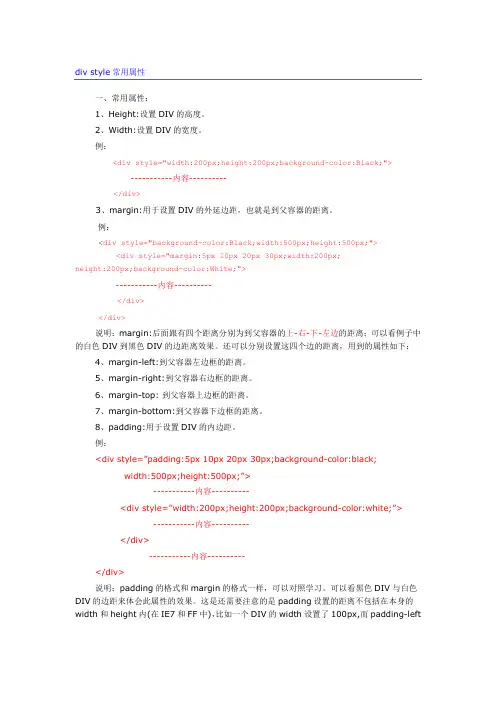
div style常用属性一、常用属性:1、Height:设置DIV的高度。
2、Width:设置DIV的宽度。
例:<div style="width:200px;height:200px;background-color:Black;"> -----------内容----------</div>3、margin:用于设置DIV的外延边距,也就是到父容器的距离。
例:<div style="background-color:Black;width:500px;height:500px;"><div style="margin:5px 10px 20px 30px;width:200px;height:200px;background-color:White;">-----------内容----------</div></div>说明:margin:后面跟有四个距离分别为到父容器的上-右-下-左边的距离;可以看例子中的白色DIV到黑色DIV的边距离效果。
还可以分别设置这四个边的距离,用到的属性如下:4、margin-left:到父容器左边框的距离。
5、margin-right:到父容器右边框的距离。
6、margin-top: 到父容器上边框的距离。
7、margin-bottom:到父容器下边框的距离。
8、padding:用于设置DIV的内边距。
例:<div style=”padding:5px 10px 20px 30px;background-color:black;width:500px;height:500px;”>-----------内容----------<div style=”width:200px;height:200px;background-color:white;”>-----------内容----------</div>-----------内容----------</div>说明:padding的格式和margin的格式一样,可以对照学习。
CSS中style用法详解

CSS中style⽤法详解css样式表按其所在位置分三种:1.内嵌样式表2.内部样式表3.外部样式表下⾯详细解释⼀下:1.内嵌样式表是写在使⽤它的标签(Tag)内的,例如要在<p>标签中使⽤,其语法为:<p style font-size:20pt>这段⽂字使⽤了内嵌样式表,更改了字体⼤⼩为20</p>2.内部样式表不同于内嵌样式表,其是写在html⽹页的<head></head>标签之间的,所以它对本⽹页全部有效。
应注意的是,因为它不是写在某⼀个标签内的,所以在写的时候要注意,⾃⼰想在那个标签内使⽤这个样式表,再定义的时候也要写清楚,否则会造成整个页⾯的混乱。
例如:<html><head>p.mylayout <style type="text/css">{font-size:22pt; color:blue; border-width:1px; border:double; text-align:center; }</style></head><body><!--这个样式表只⽤了⼀部分属性,定义是在<style>前⾯的p.mylayout,这⾥⾯的p意思是在<p>这个标签⾥才可以使⽤这个样式表,⽽mylayout是这个样式表的名字,也可以理解为这个样式表的变量名(把⼀个样式表当成⼀个变量),便于以后在<p>标签中调⽤。
注意下⾯的调⽤。
---><p class="mylayout">这段⽂字使⽤了样式表</p><p>这段⽂字没有使⽤样式表</p></body></html>可以看到,在定义内部样式表的时候,<style>前⾯声明的时候应该⾸先声明在哪个标签⾥使⽤这个样式表,如果并不想在该⽹页所有的此标签中都使⽤这个样式表则在声明的标签后⾯加上⾃⼰定义的⼀个样式表名称,例如上⾯的p.mylayout,意为只能在该⽹页的<p>标签中使⽤此样式表,在要使⽤这个样式表的<p>标签中声明,声明⽅式为<标签⾃定义样式表名称>利⽤样式表选择,你可以⽤同样的HTML标签构成不同的样式。
html中style的用法
html中style的用法
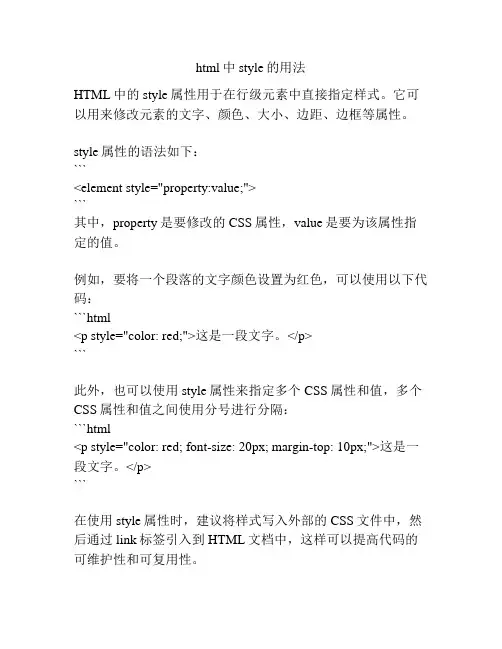
HTML中的style属性用于在行级元素中直接指定样式。
它可以用来修改元素的文字、颜色、大小、边距、边框等属性。
style属性的语法如下:
```
<element style="property:value;">
```
其中,property是要修改的CSS属性,value是要为该属性指定的值。
例如,要将一个段落的文字颜色设置为红色,可以使用以下代码:
```html
<p style="color: red;">这是一段文字。
</p>
```
此外,也可以使用style属性来指定多个CSS属性和值,多个CSS属性和值之间使用分号进行分隔:
```html
<p style="color: red; font-size: 20px; margin-top: 10px;">这是一段文字。
</p>
```
在使用style属性时,建议将样式写入外部的CSS文件中,然后通过link标签引入到HTML文档中,这样可以提高代码的可维护性和可复用性。
mystyle翻译
MyStyle英文是什么意思
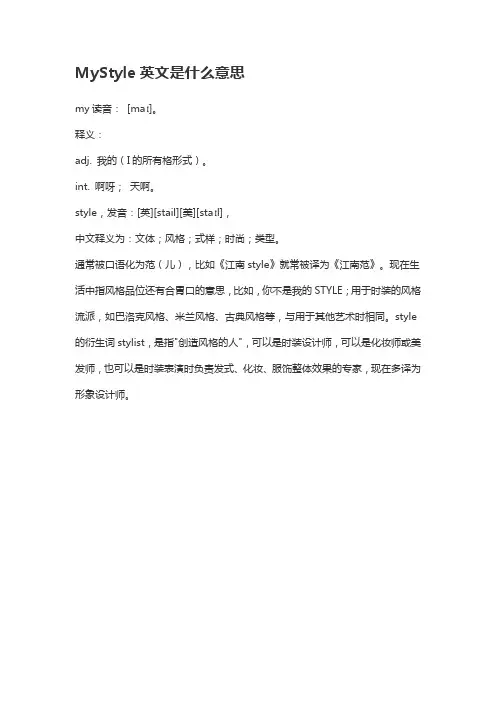
my读音:[maɪ]。
释义:
adj. 我的(I的所有格形式)。
int. 啊呀;天啊。
style,发音:[英][stail][美][staɪl],
中文释义为:文体;风格;式样;时尚;类型。
通常被口语化为范(儿),比如《江南style》就常被译为《江南范》。
现在生活中指风格品位还有合胃口的意思,比如,你不是我的STYLE;用于时装的风格流派,如巴洛克风格、米兰风格、古典风格等,与用于其他艺术时相同。
style 的衍生词stylist,是指"创造风格的人",可以是时装设计师,可以是化妆师或美发师,也可以是时装表演时负责发式、化妆、服饰整体效果的专家,现在多译为形象设计师。
前端style用法
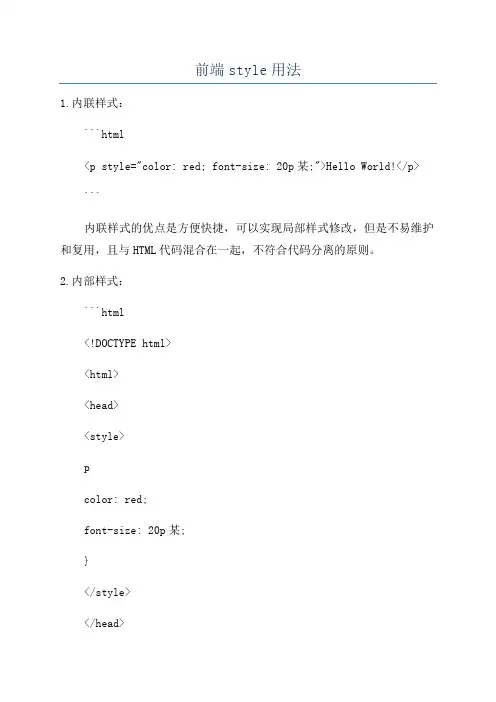
前端style用法1.内联样式:```html<p style="color: red; font-size: 20p某;">Hello World!</p>```内联样式的优点是方便快捷,可以实现局部样式修改,但是不易维护和复用,且与HTML代码混合在一起,不符合代码分离的原则。
2.内部样式:```html<!DOCTYPE html><html><head><style>pcolor: red;font-size: 20p某;}</style></head><body><p>Hello World!</p></body></html>```内部样式是将CSS样式写在HTML文件内部,使得样式和结构分离,并可以在同一个HTML文件内定义不同的样式规则,易于维护和修改。
3.外部样式表:```html<!DOCTYPE html><html><head><link rel="stylesheet" href="styles.css"></head><body><p>Hello World!</p></body></html>```styles.css文件内容:```csspcolor: red;font-size: 20p某;```外部样式表的优点是可以在多个HTML文件中重复使用相同的样式规则,提高了代码的复用性和整体的可维护性。
总结来说,前端style是一个重要的技术,通过CSS语言能够实现页面的外观和样式控制。
合理的使用内联样式、内部样式和外部样式表,并通过选择器来选取需要添加样式的HTML元素,能够使前端开发更加高效、灵活和易于维护。
代替style 的方法
代替style 的方法代替style的方法有以下几种:1. 使用内联样式(inline style):可以直接在HTML标签中使用style属性来定义元素的样式,例如:`<p style="color: blue;">This is a blue paragraph.</p>`。
这种方法的缺点是样式与内容耦合在一起,不易维护和复用。
2. 使用外部样式表(external style sheet):可以将样式定义保存在一个独立的CSS文件中,并在HTML文件中使用`<link>`标签将其链接进来,例如:`<link rel="stylesheet"href="styles.css">`。
这样的好处是可以统一管理和修改样式,并且可以在多个网页中共享使用。
3. 使用JavaScript:通过JavaScript代码或外部库来动态改变元素的样式,例如通过使用jQuery库的`css`方法来修改元素的样式,例如:`$("p").css("color", "blue");`。
这种方式适用于根据不同条件改变样式或实现动画效果。
4. 使用CSS预处理器(CSS preprocessor):例如Sass、Less 等工具,可以使用类似于编程语言的语法来编写样式,然后将其编译为普通的CSS文件。
这样可以提供更强大和灵活的样式定义能力,例如变量、嵌套规则、函数等。
总的来说,选择哪种代替style的方法取决于具体的需求和情况。
如果只是简单的样式定义,可以使用内联样式或外部样式表;如果需要动态改变样式,则可以考虑使用JavaScript;如果需要更强大的样式定义能力,则可以考虑使用CSS预处理器。
HTML的style属性
HTML的style属性 HTML的style属性提供了⼀种改变HTML样式的通⽤⽅法。
style是在HTML4版本中引⽤的,它是⼀种⾸选的改变HTML元素样式的⽅法。
可以使⽤style直接的将样式添加到HTML元素中,或者使⽤独⽴的style⽂件在样式表中间接的定义。
随着HTML的发展,有很多标签和属性即将被废弃,也就是说在未来的HTML版本中将不再⽀持这些属性和标签,我们应该避免使⽤这些熟悉和标签。
当然这些废弃的标签和属性所起的作⽤都有更好的⽅法来实现,⽐如:使⽤style属性。
下⾯是⼀些废弃的标签和熟悉:标签描述<center>定义居中的内容。
<font> 和 <basefont>定义 HTML 字体。
<s> 和 <strike>定义删除线⽂本(使⽤del代替)<u>定义下划线⽂本属性描述align定义⽂本的对齐⽅式bgcolor定义背景颜⾊color定义⽂本颜⾊ 以上的标签和属性都可以使⽤style属性代替,来实现其所起的作⽤。
、以下是⼏个style属性的实例:使⽤style属性改变背景颜⾊(bgcolor作⽤)<html><body style = "background-color:yellow"><h1 stye = "background-color:red>This is a Heading</h1><p style = "background-color:green>This is a Paragraph</p></body></html>style属性淘汰了旧的"bgcolor"属性。
使⽤style属性设置颜⾊、字体和尺⼨1<html>2<body>3<h1 style = "font-family:verdana">A Heading</h1>4<p style = "font-family:arial;color:red;font-size:20px;">A Paragraph</p>5</body>6</html>style属性淘汰了旧的<font>标签。
css style写法
css style写法CSS样式可以通过三种方式来编写:内联样式、嵌入式样式和外部样式表。
1. 内联样式:直接在HTML元素中使用“style”属性来添加CSS样式。
例如:```html<p style="color:blue; font-size:20px;">这是一段内联样式的文本。
</p> ```2. 嵌入式样式:在HTML文档的`<head>`部分中使用`<style>`标签来编写CSS样式。
例如:```html<head><style>p {color: blue;font-size: 20px;}</style></head><body><p>这是一段嵌入式样式的文本。
</p></body>```3. 外部样式表:将CSS样式编写到一个单独的.css文件中,然后在HTML 文档的`<head>`部分使用`<link>`标签来引用该CSS文件。
例如:```html<head><link rel="stylesheet" href=""></head><body><p>这是一段外部样式表的文本。
</p></body>```在外部样式表()中编写如下代码:```cssp {color: blue;font-size: 20px; }```。
3.11.基本造型指令-造形(Style)
3.11Style(造型)指令详解By IceFai@1.曲线的创建在创建曲线之前,我们稍为理解一下在style下的曲线的构成要素和特点。
在style中,曲线由三部分组成和确定:端点,内部点和端点切线,如下图所示内幕:对于style中的曲线,更多的内部点就可以产生更多的变化和更容易表达形状,但内部点越多曲线的光滑度(质量)越差。
在满足形状要求的前提下要尽量采用少的内部点来进行Style曲线的绘制端点是确定曲线的起点和终点,内部点确定曲线的形状和可调性,端点切线控制曲线在端点的切向和曲率,通过调整端点的切线可以调整曲线和连接曲线的连接关系。
在style下,曲线和曲线之间的连接关系有三种:连接(C0),相切(C1)和曲率(C2)连续三种,分别表示两条曲线有公共端点但法线方向不一致,两条曲线公共端点处法线方向一致但曲率半径大小不等和两条曲线公共端点处法向和曲率半径均一致的连接情况在Style中,Free(自由连接)用一条直线段表示,而相切则用一个单箭头表示,而曲率连续则用多箭头表示,如上图。
内幕:影响两条曲线在连接处的过渡情况除了上面所说的三个连接情况外,其实对于前面两==版权所有,转载保留完整信息,商业用途需获授权==种情况,曲线的过渡还受过渡的长度的影响,直观地就是连接箭头的长度影响。
长度越长过渡越缓。
实际上,在Style中,还有一种特殊的曲线的连接方式,那就是Draft Tangent,这是专门用来创建一个带有拔模斜度的曲面时候替曲线创建的一种特殊的连接。
我们在后面的内容中会详细介绍。
在style中,你可以在两种方式中选择一个方式来编辑曲线,分别是编辑插值点和控制点的方式。
两种方式各有优劣点,编辑插值点的方式比较自由和直观,但是在插值点比较多的时候比较难以调到高质量的曲线,在曲线切向方向不明显的时候难以判断曲线的凹凸情况。
而使用控制点的方法可以直观的看到曲线的凹凸情况并且容易得到高质量的曲线。
内幕:在一些对曲线变化情况和质量要求比较高的情况下建议使用控制点的编辑方式。