
牛津英语二年级上册2A全册教案上海版
牛津英语二年级上册2A全册教案(上海
版)
xford English 2AU1(1)
AimsTo leallowing words, e.g, avening, nigg.
Teaching focusTo gg., Good ….
Teaching Aidsmedia, mask, cardProceduTeacher's activitiesStudents' activitiesPuPre-taarag a song.
2. Say ag a song.
2. Say a利用歌曲,让学生进入学习状态。
While-tadure
1. To teach :a(1) To elicit:
T: Good aboys and girls.
(Show the word and picture.)
(2) Read the word.
(3) T: Say “good a” to your classmaa(4) Showu(Kitty, Alice, Danny, EddFang.)
2. To teach: evening
(1) Show a picture and ask: Look at the sun. Is it a?
(2) Read the word.
(3) Fillblanks: _vening
(4) Guess: Morning or Evening?
(5) Say “Good evening”ger, Mr dog, …
(6)Let student do pair-wTo teach: night
(1) T: Lug. What do you see?
(2) Read
(3) Show a picture (a girl says “Good night”um and dad.)
Rhyme:
Night, night, good night, Mum.
Night, night, good night, Dad.
Good night, good nigHu----hu---
(4) Make a new(5) Show a pictugT: It’s night. Good night, childTo teach: morning
(1) La cock (sound)
(2) Read
(3) Enjoy a song.1. Ss: Good a2. Boys readGirls readay “Good a”ay tog(Good a…): No.
2answPlay a guessing game.
4. Role-plavening show (animals’ masks)Wa: I see…
2. Readay aake a: Good nig(Enjoy a song: Good night.)
2. Follow the teagg根据上课的实际时间,先教授
a一词.
从情景过度到实际生活,学生从学到用。
通过这一练习,使学生初步感知单词evening的词形。
创设情景,给学生特定的语境,回归生活实际。
通过歌曲,活跃课堂气氛的同时巩固单词。
Post-task activity1.Follow the teaad
2.Whag?laaLook and saLook andg. Good ____. (picture)a2g1. Say aacher
2. DxHomework1. Lape and read the new words.
2. Try to greet your parents. 养成课后复习、坚持听录音的学习英语的好习惯。
板书设计
教学反思
Oxford English 2AU1 (2)2AM1U1 Greetings Look and say
AimsTo lea: How are you, …?
I’Thank you. / And you?
I’Language focusTo gluently.
Teaching aidsmedia, mask,
cardP roceduTeacher’s activitiesStudents’ activitiesPuPre-task preparagGood morning to you
2. Look and say.
3. Qugg.
2. Look and say.
3. Qu歌曲,互相招呼中让学生对前一课时的内容进行适当的复习和回顾。
While-tadure1. Teach: How are you, ...?
I’Thank you.
① Show a picture ab out Miss Fang and Eddie. T-P
② Pladia and Teach “ I’Thank you.
P-P
③ Puask of Eddad and gudTeach: I’Thank you. And you? / I’① PuaFangad and greet wudT-P
② Teach: I’Thank you. And you?
③ Teach: I’T-P
④ WaT-S S1-S2
G1-G2 B-GLearn: How are you, ...?
I’Thank you.
① Follow the teacher and say.
T-P
② Learn “I’Thank you.
P-P
③ Greet EddLearn: I’Thank you. And you? / I’① GFang.
T-P
② Learn: I’Thank you. And you?
③ Learn: I’T-P
④Wairs.
开门见山,突破难点和重点。
联系实际生活,对学生的语言量进行适当的扩充以达到
在生活中的运用。
联系生活,让学生正确使用所学知识在生活加以实践。
Post-task activity1. Look and2. Look and say.
3. Act out the dialogue.1. Look and2. Look and say.
3. Act out the dialogue.让小朋友在看一看、选一选、读一读、演一演中加强对本课的巩固。
AssigRead the text and2. Greet your pads.
板
书
设
计
1A M1U1 Greetings
How are you, ...?
I’Thank you. I’Thank you. And you? I’。
上海版牛津英语二年级上册2AUnit7Weather4课时英文教案.docx
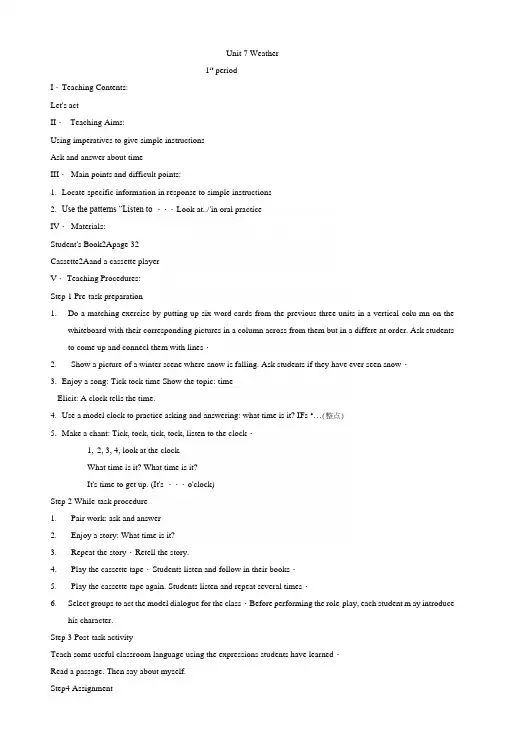
Unit 7 Weather1st periodI、Teaching Contents:Let's actII、Teaching Aims:Using imperatives to give simple instructionsAsk and answer about timeIII、Main points and difficult points:1.Locate specific information in response to simple instructionse the patterns “Listen to ・・・ Look at../'in oral practiceIV、Materials:Student's Book2Apage 32Cassette2Aand a cassette playerV、Teaching Procedures:Step 1 Pre-task preparation1.Do a matching exercise by putting up six word cards from the previous three units in a vertical colu mn on thewhiteboard with their corresponding pictures in a column across from them but in a differe nt order. Ask students to come up and connecl them with lines・2.Show a picture of a winter scene where snow is falling. Ask students if they have ever seen snow・3.Enjoy a song: Tick tock time Show the topic: timeElicit: A clock tells the time.e a model clock to practice asking and answering: what time is it? IFs •…(整点)5.Make a chant: Tick, tock, tick, tock, listen to the clock・1,2, 3, 4, look at the clock.What time is it? What time is it?It's time to get up. (It's ・・・ o'clock)Step 2 While-task procedure1.Pair work: ask and answer2.Enjoy a story: What time is it?3.Repeat the story・ Retell the story.4.Play the cassette tape・ Students listen and follow in their books・5.Play the cassette tape again. Students listen and repeat several times・6.Select groups to act the model dialogue for the class・ Before performing the role-play, each student m ay introducehis character.Step 3 Post-task activityTeach some useful classroom language using the expressions students have learned・Read a passage. Then say about myself.Step4 Assignment1.Follow the flash story and retell to your parents.2.Talk about My day2nd periodI、Teaching Contents:Let's talkII、Teaching Aims:1.Asking yes/no questions to obtain simple responses・ing imperatives to give simple instructionsIII、Main points and difficult points:Use modelled phrases to communicate with other learnersIV、Materials: PPT, etcV、Teaching Procedures:Step 1 Pre-task preparation1.Show students some snowflake patterns・ Have one cut out before class・ Put it in front of your mouth andblow, saying Look at the snow. Listen to the wind. Have studen(s copy you.2.Daily report: day, weather, ect3.Elicit: Winter is coming ・ Raise questions about win ter: What do you see? What do you like to do?4.Elicit: snow, snowman, snowball, ice, window flower5.Make a snowman by gluing three white cotton balls in a column on a sheet of blue constructions pa per. Glue ona cut-out of a black hat and a red scarf. Add dots on with white chalk to represent sno w. Point to the snowmanand say This is a snowman. Repeat snowman for students to follow.6.Elicit: Do you like winter? Answer: Yes, I do. No, I don't.Step 2 While-task procedure1.Put up the wallchart for page 33 and ask students to look at it for a short time. Take down the wall cha4rt and askstudents to name some of the things they saw.2.Put-up the wallchart again. Point at the scene and say It is winter. Repeat winter. Shiver and say Fm cold.Repeat cold several times・ Students repeat after you.3.Hold up a puppet and say Are you cold? The puppet shivers and says Yes, Fm cold・ Then ask the p uppet Doyou like winter? The puppet replies No, I don^t・4.Play the cassette tape for students to listen to the correct pronunciation. Student follow in their books.5.Divide the class into pairs・ Students practice acting the dialogue・ Select pairs to act the model dialog ue inclass・6.Relaxing time: Sing a song: Little Snowman7・Show other seasons and talk about like or dislike: Do a survey in pairs・8. Make a chaWinter, winter, do you like winter? Yes, yes, yes, I do.Summer, summer, do you like summer? No, no, no, I don't.1.Put up picture cards of some food items on the board・ Have the same pairs practice making new dial ogues bysubstituting snow and snowman with different food items・ Tell the reasons if they can.2.Invite a number of groups to act their dialogues to the class・Step 4 Assignment: Learn a flash story…Snowman3nl periodI、Teaching Contents:Let's learnII、Teaching Aims:ing nouns to identify clothinging adjectives to express how you feeling nouns to identify season and weatherIII、Main points and difficult points:ing nouns to identify clothing2.Pronounce words properlyIV、Materials: PPT, a puppetV、Teaching Procedures:Step 1 Pre-task preparation1.Sing a song: Little Snowman2.Daily report: Talk about winter3.Check the homework: retell the flash story…Winter4.Hold up a puppet and say You are cold. You must wear a ha(・ Put a hat on the puppet. It says Tha nk you.Continue putting toy clothing on the puppet until it has a hat, a pair of gloves and a scarf o n.5.Point to the hat, the gloves and the scarf on the puppet and say the words・ Repeat for students to fo How.Step 2 While-task procedure1.Put the vocabulary picture cards on your desk・ Say the words and invite individual students to come up and pickout the right card.2.Put up the picture card for hats on the board, and put the word card next to it. Read the word sever al times andask the students to repeat. Do the same with the other 6 new words.3.Open the Student's Book to page 34. Play the cassette tape・ Ask the students to point to the relevant picturesand repeat the words・4.Put up the picture and word cards on the board in a random order. Ask individual students to come up andrearrange them by putting the word card below their corresponding picture cards, as shown in t heir Student's Books・5.CAI: show many clothes and ask Ss to talk about like or dislike and tell the reason.1.Draw the outline of Sam on the board・ Put the picture cards for the clothing vocabulary items on the table.Have individual students come up and put the clothing items on Sam with magnets・ Then stick thecorresponding words next to the picture cards.2.Play a game: Clothes game and learn more clothing words.Step 4 Assignment:Learn a flash story■一Winter4th periodI、Teaching Contents:Let's play & Let's enjoyII、Teaching Aims:ing adjectives to express how people feeling nouns to refer to facial featuresIII、Main points and difficult points:1. Maintain an interaction by providing informationIV > Materials: PPTV、Teaching Procedures:Step 1 Pre-task preparation1.Draw a snowman with a big hat on the board・ Write several lists of six words each・ Tell students th at ifanyone can read any of the lists, you will write his name on the hat!2.Revise the words face and nose by showing students the word cards and asking them to read the wor ds.Step 2 While-task procedure1.Hole up a puppet and the puppet begins to say the rhyme slowly.2.Say Lei's listen to the rhyme again・ We will make the sounds and do the actions, too.3.Play the cassette tape for the class to listen to and encourage them to make the sounds and d o the actions.4.Play the cassette tape again, pausing at each line until students are familiar with the rhyme.e the cassette tape again, this time letting students read and follow the rhyme on Students B ook page 35, miming the actions at the some time・6.For the better Ss: Make a long rhymeThe wind blows on my face. My face is cold.The wind blows on my nose・ My nose is cold.(My ears / feet/ toes are ...)Step 3 Post-task activities1.Ask individuals or groups of students to perform the rhyme in front of the class・2.Play a guessing game・ Say 1 will do an action and you must try to guess the word it refers to. Mim e actionssuch as wind blowing, snowing, or shivering・3.Continue the guessing game but ask individual students to do the actions for the class to guess・Step4 AssignmentRead a passage: Winter。
二年级英语教案-上海版牛津英语2A教案

I’m fine, too.
Language focus
To greet others fluently.
Teaching aids
media, mask, cards, etc.
Procedures
Step
Teacher’s activities
Students’ activities
Purpose
Students’ activities
Purpose
Pre-task
1. Song<Hello! How are you> 1. Sing the song.
歌曲,进入英语
preparation 2. Look and say. 3. Quick response. Good morning. Good afternoon. Good night. Good evening. Goodbye. How are you
your classmates or teachers.
(4) Show some pictures
(Kitty, Alice, Danny, Eddie, Miss Fang.)
2. To teach: evening (1) Show a picture and ask:
Look at the sun. Is it
Aims
Oxford English 2A M1 U1(1)
To learn the following words, , afternoon, evening, night, morning.
Teaching focus To greet the others, ., Good ….
Teaching Aids media, mask, cards, etc.
二年级英语教案设计上海版牛津英语2A教案设计

(2) Read
1. Ss: Good night.
(3) Show a picture (a girl (Enjoy a song: Good night.)
says “Good night” to 2. Follow the teacher
her mum and dad.)
3. Sing or enjoy the song
Aims Teaching focus Teaching Aids
Step Pre-task preparation
实用标准文档
Oxford English 2A M1 U1(1)
To learn the following words, e.g, afternoon, evening, night, morning. To greet the others, e.g., Good ….
板 1A M1U1 Greetings 书 How are you, ...? 设 I’m fine. Thank you. I’m fine. Thank you. And you? 计 I’m fine, too.
教学 反思
文案大全
实用标准文档
Oxford English 2A M1 U1 (3)
Content Aims
2AM1U1 Greetings Say and act Learn the letters 1.To learn the letters: A , a, B, b 2. To use the daily expressions in the different situations. 3. Try to say the tongue twister: An apple and a bag.
沪教版牛津英语二年级上册2A全册教案

沪教版牛津英语二年级上册2A全册教案Unit 1 Where I Live Teaching aids:A. Words : letters Aa --Bb , bin , park , road , building , ShanghaiB. Structures : I live in …. I love …. I see …. That’s …C. Functions : Give simple instructions; Refer to specific classroom objects.Material:1. Student's Book 2A page 2--62. Cassette 1A and a cassette player3. Wallcharts4. Photograph page 15. Alphabet CardsTeaching times:5 timesLearning targets:A. Basic aims:1. Be able to identify the letters Aa -- Bb2. Be able to give simple instructions3. Be able to use the simple present tense to indicate facts4. Be able to "point to your home"5. Read the rhymeB. Further aims:1.2.Practise saying a new rhyme substituting 'Shanghai' with another places Language focus:1. Using the definite article to refer to specific classroom objects2. Using the simple present tense to express interests and preferences3. Learning the words: bin , park , road , building , ShanghaiPeriod 1Teaching focus:Using imperatives to give simple instructionsUsing the definite article to refer to specific classroom objectsTeaching steps:Period 2Teaching focus:Using the simple present tense to indicate factsUsing the simple present tense to express interests and preferences Teaching steps:Period 3Teaching focus:Using nouns to identify objectUsing proper nouns to refer to places Teaching steps:Period 4Teaching focus:Asking ' Wh-' questions to find out various kinds of specific information about a person Using the simple persent tense to express truthUsing the simple persent tense to express interests and preferencesTeaching steps:Period 5Teaching focus:Using the simple persent tense to express interests and preferences Teaching steps:Unit 4 Going about Teaching designing:Teaching aids:A.Words: letters Gg—Hh, plane, ferry, train, taxi, car, bus, van.B.Structures: Get ……How do you go to……C.Functions: Give simple instructions; Using connectives to add information Material:1.Student’s Book 2A page 17-212.Cassette 1A and a cassette player3.Wall charts4.Photograph page 145.Alphabet CardsTeaching times:5 timesLearning targets:A.Basic aims:1.Be able to identify the letters Gg--Hh2.Be able to give simple instructions3.Be able to introduce oneself using I’m.4.Be able to write the sentence Hello, I’m <name>.5.Sing a song.B.F urther aims:ing more information to introduce oneself2.The sorts of the alphabetLanguage focus:ing imperatives to give simple instructions2.Asking How questions to find out means and Using prepositions to indicatemeas3.Learning the words: plane……Period 1Teaching focus:Using imperative to give simple instructions Teaching steps:Period 2Teaching focus:Asking How questions to find out mean Using prepositions to indicate means Using formulaic expressions to take leave Teaching steps:Period 3Teaching focus:Using nouns to identify forms of transport. Teaching steps:Period 4Teaching focus:Using formulaic expressions to indicate how people travel Teaching steps:。
上海版牛津英语二年级上册2AUnit2Asnackbar4课时英文教案.docx

Unit2 Asnack bar1st periodI、Teaching Contents:Let's learn; Let's talk— May I have a hot dog?II、Teaching Aims:1、Using nouns to identify food and drinks: pizza, biscuit, hot dog, juice, water2、Using the structure to conimunicate with others: May I have a hot dog? Yes, here you are.3、Extend some expressions to describe food and drinks: yummy, delicious, nice, tasty, yukkyIII、Main points and difficult points:Using nouns to identify food and drinksIV、Materials: Picture cards, word cards, CAIV、Teaching proceduresStep 1 Pre-task preparations1.T and Ss greet each other then Ss do daily English report・2.Enjoy some part of cartoon film Disney Magic English: Delicious food3.T questions: What food do you see in the movie? What food do you like to eat? Show some food on t he screen・ Ss answer and discuss in groups・4.T encourages Ss to find out her likes on food・ Then lead out the new word■— pizza・5.T draws circles, triangles, olives and changes into food to elicit: biscuit, sandwich, hamburger, hotdog・Ss watch and guess what can it be using shapes・ Then practice the new words.Step 2 While-task procedures1.T gives instruction to Ss to eat different food in different manners. Ss pretend toeat food and read the words・ Make rhymes like:Pizza, pizza, big and round・ Pizza, pizza, I like pizzas・ Yummy, yummy, yummy!2.T puts some food or food pictures on the desk and changes it a snack bar. T and Ss make a dialogue・ Encouraged by T, Ss make a dialogue with T. Then T and Ss exchange their roles and make a dialogue・ E licit the new sentence structure:S: Hello! What do you like/ want?T: May I have a hot dog?S: Yes, here you are.3.Ss in pairs practice the new structure to make dialogues・Step 3 Post-task activities1.T is a shop assistant. T gives Ss commands to arrange the shelf. Ss help T to put correct food on the s helfaccording to Ts order・2.T and Ss make a dialogue as a seller and a buyer. Listen to a dialogue and make a new dialogue in gr oups・ Act out the dialogueStep 4 AssignmentRead the words aloud and make rhymes.VI、Blackboard designA snack barpizzabiscuitMay I have a(some) hot dogsandwichhamburgerjuice/ water/ Coke/ tea/ milkYes, here you are.2nd periodI、Teaching Contents:Let's play9 let's enjoyII、Teaching Aims:1、Using the sentence pattern May / have ・..? to get goods・2、Extended words: hot, tired, How much?III、Education Aims: Improve their abilities of cooperation with others.IV、M ain points and difficult points:Using formulaic expressions to buy somethingUsing nouns to identify food and drinksV、Materials: Picture cards, word cards, CAIVI、T eaching procedureStep 1 Pre-task preparations1.Daily greeting2.T shows the pictures and review.What do you see?What do you like to eat/ drink?Ss respond・(pair work, group work, train work)3.T divides Ss into groups・ Ss in groups do a survey: what do you want? Then report the shopping list toT.4.T puts the list on the Bb and asks Ss to count. Ss guess and count the number of the food. one biscuit,two biscuits, three biscuits four sweets, Elicit: some biscuits, some juiceStep 2 While-task procedures1.On the screen T shows some food or some real food in the snack bar. Ask Ss to count. Ss answer: How many pizzas/cakes…?2.Read their own shopping lists together・3.T is a buyer. S is a seller. Make a dialogue: May I have…?4.Ss in groups to buy the same things to see which group is the best seller and buyer.5.Ss in pairs practice buying and selling according to the shopping list on P 10Step 3 Post-task activities1.T plays the flash story on Pll. Ss repeat.2.Ss in pairs/ groups act this story・3.Group work: Make a new story・4.Order the meal in groups・ See whose orders the most nutritious meal.Let's chant: Can I have some more?Step 4 AssignmentMake a shopping dialogue with your partner・3rd periodI、Teaching Contents:Let's act, lettersII、Teaching Aims:1、Using imperatives to give demands2> Learn the letter C DIII、Main points and difficult points:Using imperatives to give simple instructionsUsing indefinite determiner "some” to show quantitiesIV、T eaching aids: picture cards, word cards, CAIV、Teaching proceduresStep 1 Pre-task preparations1.T shows a box to Ss. T gives them some information:It is small. It has two short ears and a long tail. It can catch mice. It likes fish. It goesu Miao-miao v. Ss guess what's in it?2.New letter: Cc Read: Cc /k/ cat, learn to write3.The same input of Dd Read: Dd /d/ dog, learn to write4.Group work: Try to say more・Step 2 While-task procedures1.T lists out those food words that have Cc /k/, Dd /d/・ Read these words.2.T questions: what do you like to eat? Ss answer: I like to eat....3.They exchange・ Elicit: cake, noodles Ss practice the words・4.Find out what kind of noodles Ss like to eat. Answer: I like chicken noodles, fish noodles, meat noodle5.T pretends to invite them to eat and elicit: Have some・・・Ss accept and pretend to eat and drink: Thank you.Yummy, delicious, nice・Practice the new item.6.Enjoy a rhyme・ Ss can make a new rhyme・Step 3 Post-task activities1.Show kinds of food on the screen: (to eat and drink) questions: what can you eat for breakfast/ lunch/ d inner? Ssprovide suitable food to T using: Have some ・・・ for... T appreciates their offers・2.T and a good S make a model dialogue. Mum, Fm home・Are you thirsty? Have some juice.Thank you. Mum. I'm hungry, too.All right. Have some biscuits・Oh, how nice!3.Pair work: Make a new one・ Then act it out.4.Role play: T gives the different scenes: At a snack bar/ in the restaurant/ At home Group work to mak e a shortplay.Step 4 AssignmentsPrepare a dialogue with partners like the one in class・4th periodI、Teaching Contents:RevisionII、Teaching aids: radio, word cardsIII、Teaching proceduresStep 1 Pre-task preparationsI、Review words: WhaCs missing? BingoGuess and match list and count2^ Ask and answer: What do you like to eat/ drink? Do a survey.Step 2 While-task procedures1、Enjoy a short movie: listen, watch and find what they like・ Then answer・2、According to the movie in groups make a shopping list.3、Shopping: In groups act the dialogue・4、After shopping comes a party. Do group work to serve the food: Have some・・・ Thank you. Step 3 Post- task activities1、Finish the exercises on <Workbook>2、Unit quiz: <Work book>。
上海版牛津英语二年级上册2AUnit2Asnackbar4课时英文教案

Unit2 Asnack bar1st periodI、Teaching Contents:Let ' searn; Let ' Salk-- May I have a hot dog?II、Teaching Aims:1、Using nouns to identify food and drinks: pizza, biscuit, hot dog, juice, water2、Using the structure to communicate with others: May I have a hot dog? Yes, here you are.3、Extend some expressions to describe food and drinks: yummy, delicious, nice, tasty, yukky111、Main points and difficult points:Using nouns to identify food and drinksIV、Materials: Picture cards, word cards, CAIV、Teaching proceduresStep 1 Pre-task preparations1.T and Ss greet each other then Ss do daily English report.2.Enjoy some part of cartoon film Disney Magic English: Delicious food3.T questions: What food do you see in the movie? What food do you like to eat? Show some food on t he screen. Ss answer and discuss in groups.4.T encourages Ss to find out her likes on food. Then lead out the new word--- pizza.5.T draws circles, triangles, olives and changes into food to elicit: biscuit, sandwich, hamburger, hot dog. Ss watch and guess whatcan it be using shapes. Then practice the new words.Step 2 While-task procedures1.T gives instruction to Ss to eat different food in different manners. Ss pretend toeat food and read the words. Make rhymes like:Pizza, pizza, big and round. Pizza, pizza, I like pizzas. Yummy, yummy, yummy!2.T puts some food or food pictures on the desk and changes it a snack bar. T and Ss make a dialogue. Encouraged by T, Ss make a dialogue with T. Then T and Ss exchange their roles and make a dialogue. E licit the new sentence structure:S:Hello! What do you like/ want?T:May I have a hot dog?S: Yes, here you are.3.Ss in pairs practice the new structure to make dialogues.Step 3 Post-task activities1.T is a shop assistant. T gives Ss commands to arrange the shelf. Ss help T to put correct food on the s helf according to T' sorder.2.T and Ss make a dialogue as a seller and a buyer. Listen to a dialogue and make a new dialogue in gr oups. Act out the dialogueRead the words aloud and make rhymes.VI、Blackboard designA snack barStep 4 AssignmentpizzabiscuitMay I have a(some) hot dogsandwichhamburgerjuice/ water/ Coke/ tea/ milkYes, here you are.2nd periodI、Teaching Contents:Let ' play, let ' enjoy11、Teaching Aims :1、Using the sentence pattern May I have •••? to get goods.2、Extended words: hot, tired, How much?III、Education Aims: Improve their abilities of cooperation with others.IV、Main points and difficult points:Using formulaic expressions to buy somethingUsing nouns to identify food and drinksV、Materials : Picture cards, word cards, CAIVI、Teaching procedureStep 1 Pre-task preparations1.Daily greeting2.T shows the pictures and review.What do you see?What do you like to eat/ drink?Ss respond.(pair work, group work, train work)3.T divides Ss into groups. Ss in groups do a survey: what do you want? Then report the shopping list to T.4.T puts the list on the Bb and asks Ss to count. Ss guess and count the number of the food. one biscuit, two biscuits, three biscuitsfour sweets, Elicit: some biscuits, some juiceStep 2 While-task procedures1.On the screen T shows some food or some real food in the snack bar. Ask Ss to count. Ss answer: Ho w many pizzas/cakes •••?2.Read their own shopping lists together.3.T is a buyer. S is a seller. Make a dialogue: May I have •••?4.Ss in groups to buy the same things to see which group is the best seller and buyer.5.Ss in pairs practice buying and selling according to the shopping list on P 10Step 3 Post-task activities1.T plays the flash story on P11. Ss repeat.2.Ss in pairs/ groups act this story.3.Group work: Make a new story.4.Order the meal in groups. See whose orders the most nutritious meal.Let ' chant: Can I have some more?Step 4 AssignmentMake a shopping dialogue with your partner.3rd periodI、Teaching Contents:Let ' act, lettersII、Teaching Aims :1、Using imperatives to give demands2、Learn the letter C DIII、Main points and difficult points:Using imperatives to give simple instructionsUsing indefinite determiner "some"to show quantitiesIV、Teaching aids: picture cards, word cards, CAIV、Teaching proceduresStep 1 Pre-task preparations1.T shows a box to Ss. T gives them some information:It is small. It has two short ears and a long tail. It can catch mice. It likes fish. It goes “Miaomiao” .Ss guess what'所it?2.New letter: Cc Read: Cc /k/ cat, learn to write3.The same input of Dd Read: Dd /d/ dog, learn to write4.Group work: Try to say more.Step 2 While-task procedures1.T lists out those food words that have Cc /k/, Dd /d/. Read these words.2.T questions: what do you like to eat? Ss answer: I like to eat ….3.They exchange. Elicit: cake, noodles Ss practice the words.4.Find out what kind of noodles Ss like to eat. Answer: I like chicken noodles, fish noodles, meat noodle s--5.T pretends to invite them to eat and elicit: Have some…Ss accept and pretend to eat and drink: Thank you. Yummy, delicious, nice.Practice the new item.6.Enjoy a rhyme. Ss can make a new rhyme.Step 3 Post-task activities1.Show kinds of food on the screen: (to eat and drink) questions: what can you eat for breakfast/ lunch/ d inner? Ss provide suitablefood to T using: Have some …for …T appreciates their offers.2.T and a good S make a model dialogue. Mum, I ' ntnome.Are you thirsty? Have some juice.Thank you, Mum. I ' ntnungry, too.All right. Have some biscuits.Oh, how nice!3.Pair work: Make a new one. Then act it out.4.Role play: T gives the different scenes: At a snack bar/ in the restaurant/ At home Group work to mak e a short play.Step 4 AssignmentsPrepare a dialogue with partners like the one in class.4th periodI、Teaching Contents:RevisionII、Teaching aids: radio, word cardsIII、Teaching proceduresStep 1 Pre-task preparations1、Review words: What' smissing? BingoGuess and match list and count2、Ask and answer: What do you like to eat/ drink? Do a survey.Step 2 While-task procedures1、Enjoy a short movie: listen, watch and find what they like. Then answer.2、According to the movie in groups make a shopping list.3、Shopping: In groups act the dialogue.4、After shopping comes a party. Do group work to serve the food: Have some•- Thank you.Step 3 Post- task activities1、Finish the exercises on <Workbook>2、Unit quiz: <Work book>。
牛津上海版小学二年级上2A教案设计
学年度第一学期二年级英语教学工作计划教学的知识目标:1、本学期要求41个单词的词汇量,其中包括表示时间、器官,玩具、学习用品、星体、植物和食物的名次学习;表示动作的动词学习;还有表示数量的量词学习;描述体形、年龄的形容词。
要求能音、形、义的辨别,部分简单单词要求拼写。
还有26个基本英文字母的学习。
2、学习表示问候的句型:Good evening \ Good night ,复习Good morning \Good afternoon \ Goodbye \Hello\Hi !等问候词。
3、定惯词a 、an 的学习及了解其区别。
4、学会用I’m …. 介绍自己。
5、学会用who am I ? 问,用you’re ….. 来回答及询问别人用Are you …? 用Yes/No, I’m…. 来回答。
6、学会用Can you ….? 及用Yes , I can .. . No, I can’t …7、学会第三人称的描述:She / He is …. 询问:Is she/ he …? Yes, she /he is ….No, she/he isn’t ….8、学会用My 和Your 描述自己或别人的东西。
9、学会What can you see ? I can see …. 及学问方式Can you see ….? 回答:Yes, I can . No, I can .10、认识介词:in ,on ,at ,under11、学会祈使句:put …. In/on …,复习Give me …., please .及回答Here you are . Thank you .12 、继续学习数词six 、seven 、eight、nine、ten . 并学会用How many 提问及回答There is/ are …..13、了解否定祈使Don’t ….. 及回答:I’m sorry .14、初步掌握I like …It likes ….教学的目标任务:本学期总共有四个模块十二个单元的学习任务,本书的设计都是以一个具体主题为背景来分单元学习的,而每个单元又是一个具体的主题,所以每个单元都有一个最终的学习任务要完成。
上海版牛津小学二年级英语教案2a 2b
上海版牛津小学二年级英语教案(2a+2b)Unit 1 Where I LiveTeaching aids:A. Words : letters Aa --Bb , bin , park , road , building , ShanghaiB. Structures : I live in …. I love …. I see …. That’s …C. Functions : Give simple instructions; Refer to specific classroom objects.Material:1. Student's Book 2A page 2--62. Cassette 1A and a cassette player3. Wallcharts4. Photograph page 15. Alphabet CardsTeaching times:5 timesLearning targets:A. Basic aims:1. Be able to identify the letters Aa -- Bb2. Be able to give simple instructions3. Be able to use the simple present tense to indicate facts4. Be able to "point to your home"5. Read the rhymeB. Further aims:1.2.Practise saying a new rhyme substituting 'Shanghai' with another places Language focus:1. Using the definite article to refer to specific classroom objects2. Using the simple present tense to express interests and preferences3. Learning the words: bin , park , road , building , ShanghaiPeriod 1Teaching focus:Using imperatives to give simple instructionsUsing the definite article to refer to specific classroom objectsPeriod 2Teaching focus:Using the simple present tense to indicate factsUsing the simple present tense to express interests and preferencesPeriod 3Teaching focus:Using nouns to identify objectUsing proper nouns to refer to placesPeriod 4Teaching focus:Asking ' Wh-' questions to find out various kinds of specific information about a person Using the simple persent tense to express truthUsing the simple persent tense to express interests and preferencesPeriod 5Teaching focus:Using the simple persent tense to express interests and preferencesUnit 4 Going aboutTeaching designing:Teaching aids:A.Words: letters Gg—Hh, plane, ferry, train, taxi, car, bus, van.B.Structures: Get ……How do you go to……C.Functions: Give simple instructions; Using connectives to add information Material:1.Student’s Book 2A page 17-212.Cassette 1A and a cassette player3.Wall charts4.Photograph page 145.Alphabet CardsTeaching times:5 timesLearning targets:A.B asic aims:1.Be able to identify the letters Gg--Hh2.Be able to give simple instructions3.Be able to introduce oneself using I’m.4.Be able to write the sentence Hello, I’m <name>.5.Sing a song.B.Further aims:ing more information to introduce oneself2.The sorts of the alphabetLanguage focus:ing imperatives to give simple instructions2.Asking How questions to find out means and Using prepositions to indicate meas3.Learning the words: plane……Period 1Teaching focus:Using imperative to give simple instructionsTeaching steps:Period 2Teaching focus:Asking How questions to find out mean Using prepositions to indicate means Using formulaic expressions to take leave Teaching steps:Period 3Teaching focus:Using nouns to identify forms of transport. Teaching steps:Period 4Teaching focus:Using formulaic expressions to indicate how people travel Teaching steps:Period 5Teaching focus:Using nouns to identify different forms of transport Teaching steps:Unit 5 Crossing the roadTeaching designing:Teaching aids:D.Words: letters—Ii Jj, stop, light, go, fast, slow.E.Structures: Look at the light. It’s…, Go! / Stop! / Wait! /F.Functions: Using imperatives to give simple instructions; To give simpleinstructions.Material:6.Student’s Book 2A page 22-267.Cassette 1A and a cassette player8.Wall charts9.Photograph page 1410.Alphabet CardsTeaching times:5 timesLearning targets:C.Basic aims:6.Be able to identify the letters Ii--Jj7.Be able to give simple instructions8.Be able to introduce oneself using I’m.9.Be able to writ e the sentence Hello, I’m <name>.10.Sing a song.D.F urther aims:ing more information to introduce oneself4.The sorts of the alphabetLanguage focus:ing imperatives to give simple instructionsing adjectives to describe objects6.Learning the words: stop……Period 1Teaching focus:Using imperative to give simple instructions Teaching steps:Period 2Teaching focus:Using imperative to give simple instructions Using adjectives to describe objectsTeaching steps:Period 3Teaching focus:Using imperatives to give simple instructions Using nouns to identify thingsUsing adjectives to describe objects Teaching steps:Period 4Teaching focus:Using imperative to give instructions Using adjectives to describe coloursTeaching steps:Period 5Teaching focus:Using imperatives to give simple instructions Using adjectives to describe objectsTeaching steps:The Allocation for Grade 2B2B Unit 1 Farm animals【单元分析(UNIT ANALYSIS)】一.教材地位(UNIT POSITION)1.从第一、二单元“动物”的主题来看,本单元教材内容是着重围绕“农场上的动物”这个课题展开。
牛津英语上海版二年级第一学期M2U2教案
2A Module 2 Me, my family and friendsUnit 2 That’s my friendThe first periodI. Teaching aims:1. Learning the opposite meaning word: young and old.2. Describing someone with the sentences: He/She is ….3. Getting to know who he/she is with asking with: Who is he/she?4. Describing one family member with more sentences.II. Key points:1. Learning the opposite meaning word: young and old.2. Describing someone with the sentences: He/She is ….3. Describing one family member with more sentences.III. Difficult points:Describing one family member with more sentences. IV. Teaching aids:Computers, word cards, picture, photos of family members.Board writing:This is my mother. Who’s he?Kind and dear. He’s my ….This is my father. He is … and ….Big and tall. He can … and ….This is my sister. I like my ….The second periodI. Teaching aims:1. Learning the word: friend.2. Using senteces to get more information of others: Is he/she your…? Is he/she …? Yes, he/she is. No, he/she isn’t..3. Getting to know more about others with asking.4. Showing love of person your like.II. Key points:1. Learning the word: friend.2. Using senteces to get more information of others: Is he/she your…? Is he/she …? Yes, he/she is. No, he/she isn’t..III. Difficult points:Identify ‘Is he/she your …? Is he/she …?’.IV. Teaching aids:Computers, word cards, picture, photos of family members.Board writing:P1: This is Sally.P2: Is she your friend? P1: Yes, she is. She is kind and dear. P2: Is she tall? P1: Yes, she is. P2: Is she fat? P1: No, she isn’t . she ’s thin. I like my friend.The third periodI. Teaching aims:1. Learning the word: insect, jar.2. Learning the pronuncitation of letters: Ii and Jj.3. According to the information and get to know who he/she is.4. Getting to know more about other with playing games.II. Key points:1. Learning the word: insect, jar.2. Learning the pronuncitation of letters: Ii and Jj.3. According to the information and get to know who he/she is.III. Difficult points: Leanring the pronuncition of Jj and word of insect. IV . Teaching aids: Computers, word cards, picture, photos of family members.P1: Is that a boy/girl? P2: Yes./No.P1: Is he/she …? P2: Yes./No.P1: Who’s he/she? P2: He/She’s ….。
上海版牛津英语2a教案全册教案
Unit 1 Where I LiveTeaching aids:A. Words : letters Aa --Bb , bin , park , road , building , ShanghaiB. Structures : I live in …. I love …. I see …. That’s …C. Functions : Give simple instructions; Refer to specific classroom objects.Material:1.Student's Book 2A page 2--62.Cassette 1A and a cassette player3.Wallcharts4.Photograph page 15.Alphabet CardsTeaching times:5 timesLearning targets:A.Basic aims:1.Be able to identify the letters Aa -- Bb2.Be able to give simple instructions3.Be able to use the simple present tense to indicate facts4.Be able to "point to your home"5.Read the rhymeB.Further aims:1.saying a new rhyme substituting 'Shanghai' with another placesLanguage focus:ing the definite article to refer to specific classroomobjectsing the simple present tense to express interests andpreferences3.Learning the words: bin , park , road , building , Shanghai Period 1Teaching focus:Using imperatives to give simple instructionsUsing the definite article to refer to specific classroom objectsTeaching steps:Period 2Teaching focus:Using the simple present tense to indicate factsUsing the simple present tense to express interests and preferencesTeaching steps:studentsIinstudentsItostudentstheand listen to the woman and her son). The boy asked Sam where he lived and Sam replied ' I live in Shanghai.' The boy said ' I love Shanghai.' Sam was pleased. Children, do you love Shanghai If you do, you must help to keep it clean. Do not litter. Throw all rubbish into the bin. Can you find a bin in this picture(Point to it)B: Ask questions such as the following:Where doesSam liveWhere doyou liveDose SamlovePost-task activitiesDraw a picture of the place they live in.say something aboutpictures by using the sentences ' I live in …,I love … ' Talk aboutConsolidationLook,listen andtick thecorrectsentence.Listen anddraw.HomeworkRead the 'Let 's talk ' after theShanghaiDo you loveShanghaiWhat isthis(pointto a bin anda buildingrespectively)C: Hold up a stamped envelope and say ' My friend in Canada sent this to me. She had to write ' Shanghai ' on it because Ilive in Shanghai.Say ' I live in Shanghai. ' and ask students to copy you.D: Hug a toy bear and say ' This is my bear. Her name is Sally. I love Sally. 'Show the picture ofPeriod 3Teaching focus:Using nouns to identify objectUsing proper nouns to refer to places Teaching steps:look at the letters and listen to the tapePost-task activitiesstudents have just learneds1: I see a bin.S2: That' s a building.Homework Workbook page 3:Colour theword in thepuzzle.Trace theletters.Read the ' let' s learn ' after the cassettePeriod 4Teaching focus:Asking ' Wh-' questions to find out various kinds of specific information about a personUsing the simple persent tense to express truthUsing the simple persent tense to express interests and preferencesTeaching steps:The students into groups of four,one student ask the question ' Where do you live'the other three answer it.(change roles.)The students to come to the front and actThe students to repeat.HomeworkWorkbookpage 4: Listen and draw the lines to find where they live.Read the 'let' s play' after thePeriod 5Teaching focus:Using the simple persent tense to express interests and preferencesTeaching steps:activityThe students practise saying a new rhymePractise in pairThe students read the new rhymeHomeworkRead the 'let' senjoy‘ afterthecassette.Make a newrhymeUnit 4 Going aboutTeaching designing:Teaching aids:A.Words: letters Gg—Hh, plane, ferry, train, taxi, car, bus,van.B.Structures: Get ……How do you go to……C.Functions: Give simple instructions; Using connectives toadd informationMaterial:1.S tudent’s Book 2A page 17-212.C assette 1A and a cassette player3.W all charts4.P hotograph page 145.A lphabet CardsTeaching times:5 timesLearning targets:A.Basic aims:1.B e able to identify the letters Gg--Hh2.B e able to give simple instructions3.B e able to introduce oneself using I’m.4.B e able to write the sentence Hello, I’m <name>.5.S ing a song.B.Further aims:1.U sing more information to introduce oneself2.T he sorts of the alphabetLanguage focus:1.U sing imperatives to give simple instructions2.A sking How questions to find out means and Using prepositionsto indicate meas3.L earning the words: plane……Period 1Teaching focus:Using imperative to give simple instructionsTeaching steps:Period 2Teaching focus:Asking How questions to find out mean Using prepositions to indicate means Using formulaic expressions to take leave Teaching steps:Period 3Teaching focus:Using nouns to identify forms of transport. Teaching steps:Period 4Teaching focus:Using formulaic expressions to indicate how people travel Teaching steps:Period 5Teaching focus:Using nouns to identify different forms of transport Teaching steps:Unit 5 Crossing the roadTeaching designing:Teaching aids:D.Words: letters—Ii Jj, stop, light, go, fast, slow.E.Structures: Look at the light. It’s…, Go! / Stop! / Wait!/F.Functions: Using imperatives to give simple instructions;To give simple instructions.Material:6.S tudent’s Book 2A page 22-267.C assette 1A and a cassette player8.W all charts9.P hotograph page 1410.A lphabet CardsTeaching times:5 timesLearning targets:C.Basic aims:6.B e able to identify the letters Ii--Jj7.B e able to give simple instructions8.B e able to introduce oneself using I’m.9.B e able to write the sentence Hello, I’m <name>.10.Sing a song.D.Further aims:3.U sing more information to introduce oneself4.T he sorts of the alphabetLanguage focus:4.U sing imperatives to give simple instructions5.U sing adjectives to describe objects6.L earning the words: stop……Period 1Teaching focus:Using imperative to give simple instructions Teaching steps:Period 2Teaching focus:Using imperative to give simple instructions Using adjectives to describe objects Teaching steps:studentsthestudentstheandand follow in the page 23. Tell a story something like this,,,B Ask questions such as the following:What didSam and hisfather dobeforecrossingthe roadWhat didSam’sfather sayWhat colourwas thelight Whatdid Sam sayWhat didthey dowhen theysaw thislightThen whatdid theysee on theroad Whatdid Sam’sfather say C Point to the bus on the wallchart and say ‘The bus is slow.’Point to thePeriod 3Teaching focus:Using imperatives to give simple instructions Using nouns to identify thingsUsing adjectives to describe objects Teaching steps:。