
虚拟语气 时态退步表格 经典例题
完整虚拟语气用法表格归纳图
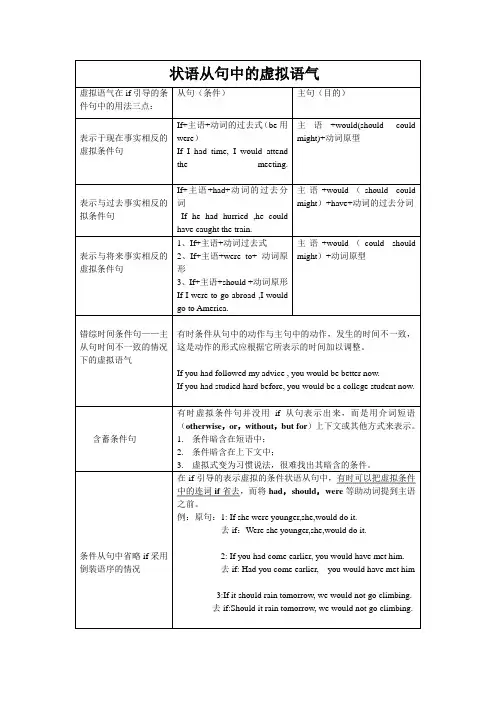
状语从句中的虚拟语气虚拟语气在if引导的条件句中的用法三点:从句(条件)主句(目的)表示于现在事实相反的虚拟条件句If+主语+动词的过去式(be用were)If I had time, I would attendthe meeting.主语+would(should couldmight)+动词原型表示与过去事实相反的拟条件句If+主语+had+动词的过去分词If he had hurried ,he couldhave caught the train.主语+would(should couldmight)+have+动词的过去分词表示与将来事实相反的虚拟条件句1、If+主语+动词过去式2、If+主语+were to+ 动词原形3、If+主语+should +动词原形If I were to go abroad ,I wouldgo to America.主语+would(could shouldmight)+动词原型错综时间条件句——主从句时间不一致的情况下的虚拟语气有时条件从句中的动作与主句中的动作,发生的时间不一致,这是动作的形式应根据它所表示的时间加以调整。
If you had followed my advice , you would be better now.If you had studied hard before, you would be a college student now.含蓄条件句有时虚拟条件句并没用if从句表示出来,而是用介词短语(otherwise,or,without,but for)上下文或其他方式来表示。
1.条件暗含在短语中;2.条件暗含在上下文中;3.虚拟式变为习惯说法,很难找出其暗含的条件。
条件从句中省略if采用倒装语序的情况在if引导的表示虚拟的条件状语从句中,有时可以把虚拟条件中的连词if省去,而将had,should,were等助动词提到主语之前。
高中英语虚拟语气常见考点归纳总结(表格)

解题思路:先依据上下文 确定本句发生的时间,然后 按基本形式中从句变化办法 进行即可。
1
高中虚
名称
类型
主句
wish后接 宾语从句
I wish I wish I wish
表示“命令、 建议、要求” 的词相关的名 名词 词性从句 性 从句
Our teacher suggested It is suggested by the doctor My suggestion is He gave the suggestion
从) that the
sports
meeting
(should)
be
put
off
(同
从)
that you should attend the meeting
that you fail the exam
that he be late for class
考点说明或解题思路
从句谓语动词遵循“时态前 推”的基本原则,考察时注 意上下文时间或时间状语。
1、主从句谓语动词的形式同 上。 2、if 去掉是前提,从句主谓 倒装,主句主谓语正常顺序 。
解题思路:从句和主句各看 各的时间状语,再套用基本 变化形式即可。
what would you do we couldn’t have finished the work ahead of time I would have taken part in the sports meeting I would have known nothing about it we would have put his name on the list yesterday
If he should not come tomorrow
虚拟语气(表格)刘婕

It is
that+主语+(should)do…
主语从句 虚拟宾语从句可以和相应的 表语从句 同位语从句转换
My suggestion was that he (should) go there at once. (表语从句) It is suggested that he (should) go there at once. (主语从句) This is the suggestion that/which he made at the meeting. (定语从句)
1. speak clearly so that they may understand you. 2. I hired a boat so that I could to fishing. 3. He looked down so that she should not see his eyes. 4. He wore a mask so that no one should recognize him. 1. Long live the People’s Republic of China! 2. May you be happy! 3. May you have a long and happy life!
He would rather visit us(than stay at home). he visited us today. I would rather he visited us tomorrow. He had visited us yesterday. 1. He demanded that Jerry (should) go there at once. 2. She advised that he (should) give up smoking. 3. He suggested that we (should) make better use of the school library. 4. He ordered that the murderer (should) be sentenced to death. 5. He requested that Alice should attend the medical conference. Tom insisted(建议说)Mike (should) apologize to his teacher, but Mike insisted (坚持说)that he was not wrong at all. 1. It is necessary that we (should) keep the balance of nature. 2. It is important that he (should) be sent there at once. 3. It is requested that Miss Cai (should) give a permmance at the party. 4. It was arranged that they should leave the following week. 5. It is strange that he (should) say so. 6. It is a pity that he (should) miss such a golden chance. 1. I suggested that he (should) go there at once. (宾语从句) I made a suggestion that he (should) go there at once. (同位语从句)
虚拟语气的三种时态表格例句
《虚拟语气的三种时态表格例句》嘿,咱今天来唠唠虚拟语气的三种时态。
这玩意儿听着挺复杂,其实也不难啦。
咱先看看都有哪三种时态哈。
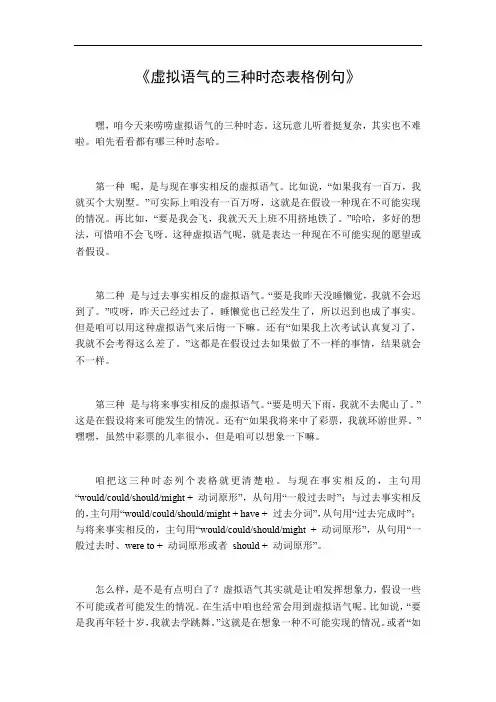
第一种呢,是与现在事实相反的虚拟语气。
比如说,“如果我有一百万,我就买个大别墅。
”可实际上咱没有一百万呀,这就是在假设一种现在不可能实现的情况。
再比如,“要是我会飞,我就天天上班不用挤地铁了。
”哈哈,多好的想法,可惜咱不会飞呀。
这种虚拟语气呢,就是表达一种现在不可能实现的愿望或者假设。
第二种是与过去事实相反的虚拟语气。
“要是我昨天没睡懒觉,我就不会迟到了。
”哎呀,昨天已经过去了,睡懒觉也已经发生了,所以迟到也成了事实。
但是咱可以用这种虚拟语气来后悔一下嘛。
还有“如果我上次考试认真复习了,我就不会考得这么差了。
”这都是在假设过去如果做了不一样的事情,结果就会不一样。
第三种是与将来事实相反的虚拟语气。
“要是明天下雨,我就不去爬山了。
”这是在假设将来可能发生的情况。
还有“如果我将来中了彩票,我就环游世界。
”嘿嘿,虽然中彩票的几率很小,但是咱可以想象一下嘛。
咱把这三种时态列个表格就更清楚啦。
与现在事实相反的,主句用“would/could/should/might + 动词原形”,从句用“一般过去时”;与过去事实相反的,主句用“would/could/should/might + have + 过去分词”,从句用“过去完成时”;与将来事实相反的,主句用“would/could/should/might + 动词原形”,从句用“一般过去时、were to + 动词原形或者should + 动词原形”。
怎么样,是不是有点明白了?虚拟语气其实就是让咱发挥想象力,假设一些不可能或者可能发生的情况。
在生活中咱也经常会用到虚拟语气呢。
比如说,“要是我再年轻十岁,我就去学跳舞。
”这就是在想象一种不可能实现的情况。
或者“如果明天天气好,我们就去野餐。
”这是在假设一种将来可能发生的情况。
所以呀,虚拟语气并不难,只要咱多练练,就能掌握得很好啦。
虚拟语气三种基本结构表格

虚拟语气三种基本结构表格虚拟语气是一种表示假设、愿望、建议、命令等非事实状态的语法现象。
根据虚拟语气的用法,可以将它分为三种基本结构:虚拟条件句、虚拟假设句和虚拟祈使句。
一、虚拟条件句虚拟条件句用于表示与事实相反或不可能实现的条件。
虚拟条件句一般由“if”引导,主句可以用"would/could/should/might + 动词"的形式来表示结果。
1.虚拟条件句基本结构:-如果主句的谓语动词是一般过去时,从句的谓语动词使用过去完成时。
例如:If I had studied harder, I would have passed the exam.(如果我学习更努力一些,我就能通过考试了。
)-如果主句的谓语动词是现在时,从句的谓语动词使用过去完成时。
例如:If it hadn't rained, we would have gone to the park.(如果没有下雨,我们就去公园了。
)2.虚拟条件句的用法:-表示与现在事实相反的假设;例如:If I were you, I would quit that job.(如果我是你,我就辞职。
)-表示与过去事实相反的假设;例如:If I had known it, I would have told you.(如果我当时知道,我就告诉你了。
)-表示对未来的猜测、设想或假设;例如:If he arrives late, we will start without him.(如果他迟到了,我们将开始而不等他。
)二、虚拟假设句虚拟假设句用于表示与现在或将来事实相反的假设。
虚拟假设句的谓语动词一般使用"should/were"的形式。
1.虚拟假设句基本结构:-表示与现在事实相反的假设:例如:I wish I were taller.(但事实上我并不高。
)-表示与将来事实相反的假设:例如:If I should see him, I will tell him.(但我并不打算去找他。
完整虚拟语气用法表格归纳图
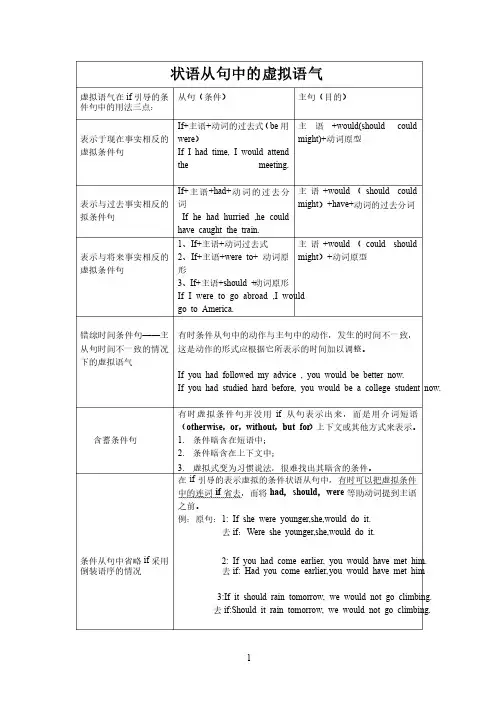
状语从句中的虚拟语气虚拟语气在if 引导的条件句中的用法三点:件句中的用法三点:从句(条件)从句(条件) 主句(目的)主句(目的)表示于现在事实相反的虚拟条件句虚拟条件句 If+主语+动词的过去式(be 用were ) If If I I I had had had time, time, time, I I I would would would attend attend the meeting. 主语+would(should could might)+动词原型动词原型表示与过去事实相反的拟条件句拟条件句If+主语+had+动词的过去分词 If If he he he had had had hurried hurried hurried ,he ,he ,he could could have caught the train. 主语+would (should could might )+have+动词的过去分词动词的过去分词表示与将来事实相反的虚拟条件句虚拟条件句 1、If+主语+动词过去式动词过去式 2、If+主语+were +were to+ to+ 动词原形3、If+主语+should +动词原形动词原形If I were to go abroad ,I would go to America. 主语+would (could should might )+动词原型动词原型 错综时间条件句——主从句时间不一致的情况下的虚拟语气下的虚拟语气有时条件从句中的动作与主句中的动作,发生的时间不一致,这是动作的形式应根据它所表示的时间加以调整。
这是动作的形式应根据它所表示的时间加以调整。
If you had followed my advice , you would be better now. If you had studied hard before, you would be a college student now. 含蓄条件句含蓄条件句 有时虚拟条件句并没用if 从句表示出来,而是用介词短语(otherwise ,or ,without ,but for )上下文或其他方式来表示。
(完整版)完整虚拟语气用法表格归纳图
在expect,believe,think,suspect等动词的否定或疑问形式后的宾语从句中的虚拟语气
经常用“should+动词原型(或完成形式),表示惊奇,怀疑,不满等情绪。
I cannot believe that you should think so.
在“It is (was)+名词+that…..”结构句中的虚拟语气
表示建议,命令,请求,道歉,怀疑,惊奇等。
It’s a pity that you (should) miss a good chance.
这类名词有:advice,decision,desire,demand,idea,order,pity,proposal,recommendation,suggestion,surprise,wish,wonder等。
“In case”引导的从句中即可用陈述句,也可以用虚拟语气
(should)+动词原型
例:1.The game will be put off in case it (should) snow.
2.The game will be put off in case it snows.
名词性从句中的虚拟语气
表示“要求”的:ask,desire, request,demand,require,beg
表示“同意,坚持”的:insist
表示“决定,命令”的:decide,order
注意:suggest,insist不表示建议或坚持要某人做某事时,即它们用于其本意暗示,表明,坚持认为时,宾语从句用陈述语气。
完整虚拟语气用法表格归纳图
状语从句中的虚拟语气虚拟语气在if引导的条件句中的用法三点:从句(条件)主句(目的)表示于现在事实相反的虚拟条件句If+主语+动词的过去式(be用were)If I had time, I would attendthe meeting.主语+would(should couldmight)+动词原型表示与过去事实相反的拟条件句If+主语+had+动词的过去分词If he had hurried ,he couldhave caught the train.主语+would(should couldmight)+have+动词的过去分词表示与将来事实相反的虚拟条件句1、If+主语+动词过去式2、If+主语+were to+ 动词原形3、If+主语+should +动词原形If I were to go abroad ,I wouldgo to America.主语+would(could shouldmight)+动词原型错综时间条件句——主从句时间不一致的情况下的虚拟语气有时条件从句中的动作与主句中的动作,发生的时间不一致,这是动作的形式应根据它所表示的时间加以调整。
If you had followed my advice , you would be better now.If you had studied hard before, you would be a college student now.含蓄条件句有时虚拟条件句并没用if从句表示出来,而是用介词短语(otherwise,or,without,but for)上下文或其他方式来表示。
1.条件暗含在短语中;2.条件暗含在上下文中;3.虚拟式变为习惯说法,很难找出其暗含的条件。
条件从句中省略if采用倒装语序的情况在if引导的表示虚拟的条件状语从句中,有时可以把虚拟条件中的连词if省去,而将had,should,were等助动词提到主语之前。
虚拟语气的用法归纳表格
虚拟语气的用法归纳表格虚拟语气是一种表达虚拟、假设、愿望、建议等情态的语气形式,在英文中被广泛使用。
本文通过归纳整理虚拟语气的用法,帮助读者更好地掌握和运用这一语法知识。
虚拟语气的用法归纳用法示例表达假设If I were a bird, I would fly in the sky.表达与事实相反的愿望I wish I were a millionaire.表达建议I suggest that she take a break.表达过去某种可能性If I had studied harder, I might have passed theexam.表达对他人的要求、命令或建议The teacher insisted that the students be quiet inclass.I wish I hadn’t said that.表达对过去某一事件感到后悔或惋惜表达对过去某一事件的推测She looks sad. She might have failed the exam.表达对未来事件的推测If it doe sn’t rain, we will have a picnic tomorrow.用法解析与示例1. 表达假设虚拟语气常用于表达与事实相反的假设情况。
例如:“If I were a bird, I would fly in the sky.”(如果我是一只鸟,我会在天空中飞翔。
)这里的“were”是对现实情况的假设。
2. 表达与事实相反的愿望虚拟语气还可以用于表达与事实相反的愿望。
例如:“I wish I were a millionaire.”(我希望我是个百万富翁。
)这里的“were”表示对现实情况的愿望,暗示对现状的不满或渴望改变。
3. 表达建议虚拟语气在表达建议时也经常使用。
例如:“I suggest that she take a break.”(我建议她休息一下。
完整虚拟语气用法表格归纳图
完整虚拟语⽓⽤法表格归纳图虚拟语⽓在as if/as though引导的⽅式状语从句中1.表⽰与现在事实相反或对现在情况有怀疑,谓语动词⽤过去式。
He treats the boy as if he were his own son.2.表⽰与过去事实相反,谓语动词⽤过去完成时。
He spoke as if he had known about it.3.表⽰与将来事实相反,(表⽰将来的可能性不⼤),⽤would (might, could)+动词原形He acts as if he could win in the game .注意:1.在as if/as though 句中,如果有可能成为事实,⽤陈述语⽓。
例:He looks as if he going to be ill.2.as though或as if引导的状语从句,从句主语和主句主语相同时,从句中可省略主语和部分谓语。
虚拟语⽓⽤在lest,for fear that,so that及inorder that引导的⽬的状语从句中表⽰“以防,以免”等意思谓语动词多⽤should/could/might+动词原型构成For fear that it may rain tomorrow, we should bring an umbrella.由“providing(that)/provided(that)/on condition that/suppose (that)/supposing (that)”引导的条件从句根据情况,1.可以⽤虚拟语⽓。
例:suppose/supposing that it rained,we shouldn’t goout.2.也可以⽤陈述语⽓。
例:They are willing to surrender provided they aregiven free pardon..“In case”引导的从句中即可⽤陈述句,也可以⽤虚拟语⽓(should)+动词原型例:1.The game will be put off in case it (should) snow.2.The game will be put off in case it snows.名词性从句中的虚拟语⽓⼀:宾语从句中的虚拟语⽓1.在动词wish/hope 后的宾语从句中的虚拟语⽓,表⽰⼀种不可能实现的愿望。