
冀教版七年级英语下全册教案
Lesson 1 May I Go to Beijing?1.导入新课:教师出示一副天安门广场的图片。
Ask: Do you know what its name is?Help them to answer: It’s Tian’anmen Square.Teach: squareSs repeat: square.Ask: Do you know where it is?Ss: It’s in Beijing.T: Beijing is the capital city of our country. Have you been to Beijing? (教师提示学生汉语)S1: I have been to Beijing.S2: I have never been to Beijing.T: Li Ming is a student. He has never been to Beijing. He wants to go to Beijing very much. Now he is talking with his mother.2.介绍本课内容。
1) 教师讲解情态动词may的用法:May I go to Beijing?肯定回答:Yes, you may.否定回答:No, you may not.2) too…to句型:ZhaoYang is too young to go to school.3) go+ ving go shopping,go boating,go skating3.表演学生听两遍录音,模仿录音,朗读对话。
首先教师扮演妈妈,找一学生扮演李明,进行表演。
然后找三组学生到前面进行表演,评出最佳表演小组。
4.展示能力教师提供词组:The Water Park, go boating, eat an ice-cream, go swimming. 学生两人一组编对话,要求学生运用句型:May I …? Yes, you may. No, you may not.5.总结拓展总结本课重点短语和句型,要求学生记住谚语,“One is never too old to learn.” 告诫学生“学无止境,积极进取”。
6.随堂测试测试本课内容,结束本课。
Lesson 2 May I Invite Danny and Jenny?1.复习1). 采用小组表演形式复习Lesson 12)复习打电话的日常用语。
A: Hello! 喂!B: Hello!This is Ann speaking. Who’s that?喂!我是安,你是谁?2.导入新课请一名学生来当记者,采访李明:Journalist: I know you want to go on a trip to Beijing. Who are you going with?Li Ming : I want Danny and Jenny to come on our trip to BeijingJournalist: Does your mother agree with you?Li Ming: I’m not sure. / I don’t know.3.听、读、操练学生听一遍录音,回答教师的问题。
“Does Li Ming’s mother want to talk to Mrs. Smith?再放两遍录音,学生跟读。
两人一组进行练习。
4.讲解本课内容1) 教师讲解情态动词can的用法: can + 动词原型Jenny can come.She can sing English songs.2) leave 与leave for 辨析We will leave Shanghai at 9:00.我们将在9点离开上海。
They leave for Shanghai at 9:00.他们在9点向上海出发。
3)arriveWhen do you arrive in Beijing? 你们什么时候到达北京?They will arrive at the hospital before six o’clock.他们将在6点前到达医院。
5.打电话表演四人小组表演对话。
要求动作表情到位 ( 李明和詹尼的动作必须符合情节,并且要表现出迫不及待的心情 )。
评出最佳表演小组。
6.总结拓展总结本课重点短语和句型。
7.随堂测试请试着翻译下列词组,看谁写得又快又准。
1. 我们的旅行2. 与格林夫人交谈3. 去旅行4. 在加拿大居住5. 到达上海6. 向天津出发Lesson 3 How Far Is Beijing?1. 复习--导入新课教师出示一小男孩数数字的图片。
教师:Look at the picture. What’s the boy doing?帮助学生回答:He is counting.Ss repeat: count教师:Can you count from one to one hundred?抽取几个学生进行速诵数字的比赛。
one, two, three, four…教师:Can you count from one hundred to one thousand?Can you count from one thousand to ten thousand?2.听,读数词。
放第一部分的录音,学生跟读三遍,教师纠正不正确的发音。
如: thousand。
让学生反复练习。
3. 数词读写比赛。
4. 四人小组用阿拉伯数字写出20个数词,请一位同学做评委,掌握好其他三人读完数字所需的时间, 评出获胜者。
教师在幻灯片上出示一系列数词, 各小组评出的获胜者在班级进行决赛,评出速读冠军。
5. 教师在幻灯片上出示一系列数词, 全体学生用英语写出数词, 看谁写得又快有准确。
6.听录音,找数词教师放第二部分的录音,学生找出对话中出现的数词。
找三位同学回答所听到的数词。
其他学生齐读数词,然后随录音模仿。
教师讲解距离的表达方法:How far is it from your home to school?It’s two kilometres.How far is it from China to Canada?About eight thousand five hundred kilometres.7.小组操练句型教师给出关键词,学生两人一组进行练习。
1) Shijiazhuang Qinghuangdao 600 kilometres2) home factory 5 kilometres8.总结拓展总结本课重点短语和句型。
Lesson 4 How Can We Go to Beijing?1.导入新课教师播放一段飞机、公共汽车、火车的视频片断,播放同时教师介绍:An airplane is fast.A bus is slow.A train is faster than a bus but slower than an airplane.2.听录音,学新词教师出示飞机、公共汽车、火车的图片,学生边看图片,边听课本录音第一部分,掌握新词 airplane, fast. slow的读音。
3.讲解形容词的比较级1) 教师出示自行车和公共汽车的图片,说:A bike is slower thana bus. A bus is faster than a bike.2) 出示公共汽车和火车的图片,说:A bus is slower than a train.A train is faster than a bus.教师讲解比较级的构成形式:A +is +形容词的比较级+than+ B.3) 学生运用教师出示的交通工具图片进行模仿操练。
4.听,读,说教师提问:How can Li Ming go to Beijing?学生听一遍录音后,找到问题的答案。
学生跟读录音两遍,两人小组进行练习。
5. let sb do sth 句型操练L et’s go to Beijing by plane.Let’s sing a song.Let’s take a train.6.唱歌。
教师讲解歌词,学生唱歌,巩固复习本课的重点句型。
7.总结拓展总结本课重点短语和句型。
8.随堂测试Lesson 5 Leaving and arriving1.复习请两组同学表演 Lesson 4 , Part2。
2.导入新课教师:We have known Jenny and Danny will come to China. They will go on a trip to Beijing. Now I have some questions to ask you.Show flash cards, ask the students to answer the questions.1) When do they leave Canada?2 ) When do they arrive in China?3)When do they leave for Beijing?4)When do they arrive in Beijing?3.听,读,说教师放两遍第一部分的录音,学生找到问题的答案。
学生以两人为小组,问答幻灯片上的问题。
教师要求学生正确运用介词in, on ,at。
4.介绍本课新内容1)教师出示写信、购物、天安门广场、故宫的图片,教学词组:write home, go shopping, go to Tan’anmen Square, go to the Palace Museum.2) 生以四人小组为单位,拿出课前准备好的台历,听录音,读单词,掌握星期名称Sunday, Monday, Tuesday, Wednesday, Thursday, Friday, Saturday.5.根据表格内容,谈论旅行计划。
教师:Suppose we will have a three-day holiday. Here’s what we want to do! Look at the plan of our trip.总结本课重点短语和句型。
7.随堂测试Lesson 6 Li Ming Packs His Suitcase1. 查作业,导入新课教师预先向学生布置作业,让学生从家中带来一些水果。
Ask some students:1) How many apples do you have?2) How many pears do you have?3) How many oranges do you have?2.教师讲解How many + 可数名词复数+do you have?教师出示服装类图片,利用图片上的服装,如:hat, sweater, gloves, coat, socks, trousers 进行操练. 教学新单词clothes, jacket.How many hats do you have? Two.How many coats do you have? One.How many jackets do you have? Three.学生需注意:socks, trousersHow many pairs of socks do you have? I have one pair of socks.3.操练句型A: How many apples do you have?B: I have three.A: How many pens do you have?B: One.A: You need more pens, too!4.听,读,表演教师放第一部分录音三遍,学生跟读录音,两人一组自由练习对话。
七年级英语冀教版下册全册教案
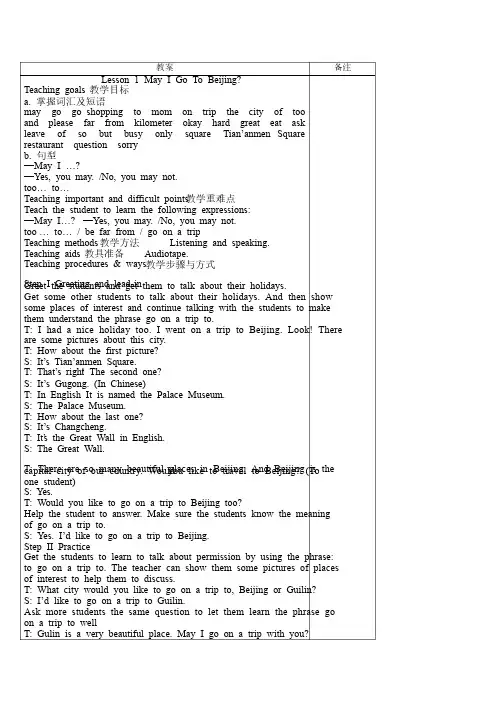
教案教案 备注备注Lesson 1 May I Go To Beijing? Teaching goals 教学目标教学目标a. 掌握词汇及短语掌握词汇及短语 may go go go shopping shopping to mom on trip the city of too and please far from kilometer okay hard great eat ask leave of so but busy only square Tian’anmen Square restaurant question sorry b. 句型句型 —May I …? —Yes, you may. /No, you may not. t oo… to… Teaching important and difficult points 教学重难点教学重难点 Teach the student to learn the following expressions: —May I…? —Yes, you may. /No, you may not. too … to … / be far from / go on a trip Teaching methods 教学方法教学方法 Listening and speaking. Teaching aids 教具准备教具准备 Audiotape. Teaching procedures & ways 教学步骤与方式教学步骤与方式教学步骤与方式 Step I Greeting and lead-in Greet the students and get them to talk about their holidays. Get some other students to talk about their holidays. And then show some places of interest and continue talking with the students to make them understand the phrase go on a trip to. T: I had a nice holiday too. I went on a trip to Beijing. Look! There are some pictures about this city. T: How about the first picture? S: It’s Tian’anmen Square. T: That’s right ! The second one? ! The second one? S: It’s Gugong. (In Chinese) T: In English It is named the Palace Museum. S: The Palace Museum. T: How about the last one? S: It’s Changcheng. T: It’s the Great Wall in English. S: The Great Wall. T: There are so many beautiful places in Beijing. And Beijing is the capital city of our country. Would you like to travel to Beijing? (To one student) S: Y es. T: Would you like to go on a trip to Beijing too? Help the student to answer. Make sure the students know the meaning of go on a trip to. S: Yes. I’d like to go on a trip to Beijing. Step II Practice Get the students to learn to talk about permission by using the phrase: to go on a trip to. The teacher can show them some pictures of places of interest to help them to discuss. T: What city would you like to go on a trip to, Beijing or Guilin? S: I’d like to go on a trip to Guilin. Ask more students the same question to let them learn the phrase go on a trip to well T: Gulin is a very beautiful place. May I go on a trip with you? Help the student to answer: Yes, you may. Or No, you may not. Explain the meaning in Chinese if necessary. S: Yes, you may. T: T: (To (To (To another another another student) student) student) I I I have have have no no no money money money to to to go go go on on on a a a trip trip trip to to to Guilin. Guilin. May I borrow some money? S: No, you may not. Step III Text learning Get the students to learn the text. Listening Get the students to listen to the tape and answer a question. And then get them to repeat after the tape. T: T: Li Li Li Ming Ming Ming wants wants wants to to to go go go on on on a a a trip trip trip to to to Beijing. Beijing. Beijing. Listen Listen Listen to to to the the the tape tape carefully. Does Li Ming’s mother go on a trip to Beijing too? S: (After listening) Yes. Paraphrasing Explain the following sentences. Notes: 1. You are too young to go, Ling Ming. It means Li Ming is too young. If he goes to Beijing, he cannot take care of himself. 2. Beijing is far from our city. It means Beijing is not near Shijiazhuang. 3. You work hard in school. It means Li Ming studies hard. Practice Get the students to read and act out the dialogue in pairs. And then ask them to work in pairs and make up their own dialogues using go on a trip to, too… to…, be far from and May I…? They can talk from the following aspects: 1.Where you want to go for a trip; 2. Why you cannot / can go there; 3.Who will go with you. Walk around to give them a hand if necessary. Sample dialogue: S1: May I go on a trip to New York, mom? S2: No, you may not. Now York is too far to go. S1: Dad? S3: No, you are too young to go. You can go to a city near our home. S1: May I go on a trip to Lasa? S3: No, you may not. It’s far from our city.S1: May I go on a trip to Beijing? S2 and S3: Yes, you may. We will go to Beijing too. Step IV Homework Finish the exercises in Activity book. Practice the dialogue in pairs. Preview Lesson 2 Lesson 2 May I Invite Danny and Jenny? Teaching goals 教学目标教学目标 a. 掌握词汇掌握词汇want come hello with who when do leave for arrive. b. 认知词汇认知词汇 invite them Mrs. call oh wonderful invitation bye hooray c. 句型句型 When do you leave for …? / When do you arrive in / at …? —May I speak with / to …? —This is … (speaking). Who’s that?Teaching important and difficult points 教学重难点教学重难点Grasp the expressions of making phone calls. Teaching methods 教学方法教学方法 Listening and speaking. Teaching aids 教具准备教具准备 Audiotape and pictures. Teaching procedures & ways 教学过程与方法教学过程与方法教学过程与方法 Step I Lead-in and speaking T: Good morning, class. S: Good morning, Miss /Mr. /Ms. … T: We know that Li Ming will go on a trip to… S: Beijing! T: Do you want to go to Beijing? Why or why not? Help Help the the the students students students to to to answer answer answer these these these questions questions questions from from from the the the following following aspects: Affirmative: 1. have fun; 2. learn a lot that can not be found in the text book; 3. make other friends … Negative: 1. Beijing is too far away; 2. too young to go; 3. … T: If you can go to Beijing, who do you want to take with you? Why? S: I may go with my parents. They can take care of me, and share the happiness together. S: I may go with my friends. We have the same interest and can have a lot of fun. S: I may go with my little brother. I can learn to take care of him and learn a lot. T: Good! Wish you a good trip to Beijing. Step II Reading Fast reading Get the students to scan the dialogue to look for the expressions about making phone calls in English. T: Li Ming wants to go to Beijng, do you know who does he want to take to Beijng? Now, look through the text and show me the answer. S: Jenny and Danny. T: That ’s it! But where are Jenny and Danny? S: They live in Canada. T: So how can Li Ming invite them? S: Make a phone call. T: Good! Please read the dialogue in Lesson 2 silently and try to find out ways to make a phone call. After the students finish reading, summarize the following patterns. —Hello. May I speak with / to …?—Yes, this is…. Who’s that?—This is …T: Great! Careful reading Get the students to learn about how to invite somebody on the phone. 1. Paraphrasing Make a dialogue to help the students understand the phrases leave for and arrive at / in. T: Hello. May I speak to Mary? S: Hello. This is Mary. Who is that? T: This is … I’m going on a trip to Beijing. Would you like to go with me? S: Y es. T: Let’s meet at the school gate at 9:00 on Friday. OK? S: OK. Draw Draw the the the school school school gate gate gate and and and Beijing Beijing Beijing West West Railway Railway Station Station Station on on on the the blackboard and let the student come to the front of the classroom to act act with with with you. you. you. The The The two two two walk walk walk from from from the the the school school school gate gate gate in in in the the the picture picture picture to to Beijing Railway Station in the picture. T: We are leaving our school. We are leaving for Beijing. Now we are arriving arriving in in in Beijing, Beijing, Beijing, arriving arriving arriving at at at Beijing Beijing Beijing West West West Railway Railway Railway Station. Station. Station. W W e usually arrive at a small place; and arrive in a big place. Got it? Write Write the the the phrases phrases phrases on on on the the the blackboard, blackboard, blackboard, explain explain explain them them them and and and lead lead lead the the students to read them. 2. Reading Get the students to read the dialogue and answer the questions given. After that ask them to listen and repeat, and then act out the dialogue. Who does Li Ming want to take to Beijing? (He wants to take Danny and Jenny to Beijing.) Can Jenny come? (Yes, she can.) When do Li Ming and his mother leave for Beijing? (They leave on February 1 in the morning.) When When do do do they they they arrive arrive arrive in in in Beijing? Beijing? Beijing? (They (They (They arrive arrive arrive in in in Beijing Beijing Beijing in in in the the afternoon on February 1.) Step III Presentation Let Let the the the students students students work work work in in in pairs pairs pairs to to to make make make up up up similar similar similar dialogues dialogues dialogues to to practice the expressions of making a phone call. They can talk from the following aspects: 1. Where you want to go for a trip; 2. Who you want to invite to have a trip; 3. When you leave. Ask some pairs to act out their dialogues. Step IV Homework Finish off the exercise in Activity book. Preview Lesson 3. Lesson 3 How Far Is Beijing? Teaching goals 教学目标教学目标 a. 掌握词汇掌握词汇 me about here him there say thousand b. 认知词汇认知词汇 dinosaur think visit Edmonton laugh worry be partner practice c. 句型句型 How far is it from … to …? It It’’s about … kilometers. Teaching important and difficult points 教学重难点教学重难点 Grasp the expressions of talking about distance. How to express numbers from one hundred to ten thousand. Teaching methods 教学方法教学方法 Listening, and speaking. Teaching aids 教具准备教具准备 Audiotape and maps. Teaching procedures & ways 教学过程与方式教学过程与方式教学过程与方式 Step I Revision Greeting T: How are you doing? S: We are fine. Revision Help the students review Lessons 1 & 2 by asking questions. Why does Li Ming want to go on a trip to Beijing? Because Beijing is the capital city of our country and it’s not far from his city, Shijiazhuang. Why does Li Ming’s mother let Li Ming go on a trip to Beijing? Because Because Li Li Li Ming Ming Ming is is is not not not too too too busy, busy, Beijing Beijing is is is not not not very very very far far far from from Shijiazhuang, Li Ming is a good student and works hard in school. What can Li Ming do in Beijing? He can go shopping, eat in restaurants and go to a hotel. Step II Lead-in Show the students the map of China and the world map to help them to talk about distance. Lead the students to read the numbers in this lesson. Step III Text learning Reading Get Get the the the students students students to to to read read read the the the text text text again again again and and and answer answer answer the the the following following questions. T: Now please read the dialogue and find out the answer to the two questions: Why is Mrs. Dinosaur worried? And can Danny go? S: Because Canada is too far from China. S: Yes, he can. T: That’s right. Listening Then get the students to listen to and repeat after the tape. Later, ask them to act out the dialogue. Step IV Get the students to talk about distance. Speaking Write How far is it from … to …? / It’s about… kilometers and some numbers on the Bb to let the students practice talking about distance. Explain the usage of hundred and thousand. Notes: Notes: hundred, hundred, hundred, thousand thousand 前面有具体数字时,不要加s; 一般情况下,百位与个位之间用and (也可以不用and )十位和个位之间可以用连字符,也可以不用。
冀教七年级下册英语全册教案
Unit 1 A Trip to the Silk Road 单元目标第一课时Lesson 1 A Trip to China 课时目标自主学习一、根据句意及汉语提示写出单词。
1.She led(带路)me into the drawing-room.2.Jenny's father and mother read the note(便笺).3.I had to give him a chance(机会).4.He sent (寄)me a note to thank me for the dinner.5.We won the game.What good news(消息)!二、写出下列画线短语的汉语意思。
1.Guess what!We're learning about the Silk Road this month in school.猜怎么着;了解2.Read the note from Jenny's school and take turns asking for permission to go on the trip.轮流;请求允许;去旅行自主学习环节1新课导入T:Hello, boys and girls.Do you like to travel?Ss:Yes.T:So, tell me something about your travel experiences.S1:I went on a trip to Beijing last summer with my parents.We visited many places of interest...S2...设计意图:师生之间的问答谈及旅行,这就自然而然地引出本课时的话题,为接下来的课文学习作铺垫。
环节2新课学习1.教师邀请3名学生分角色朗读教材第2页的对话内容,教师注意纠正学生的发音问题。
2.教师让学生快速阅读对话,阅读后邀请一名学生说出该对话谈论的主题。
【完整升级版】冀教版七年级英语下全册教案1

【完整升级版】冀教版七年级英语下全册教案1【完整升级版】冀教版七年级英语下全册教案1(本⽂档为word格式。
下载后您可以进⾏编辑和修改!我可以去北京吗?1。
新课介绍:教师展⽰天安门⼴场图⽚问:你知道它的名字吗?帮助他们回答:这是天安门⼴场。
教学:正⽅形Ss重复:正⽅形。
问:你知道它在哪吗?学⽣:在北京。
T:北京是我国的⾸都。
你去过北京吗?(⽼师提⽰学⽣说中⽂)S1:我去北京了。
S2:我去北京。
李明是⼀名学⽣。
他去了北京。
他⾮常想去北京。
冰淇淋,去荡秋千。
学⽣两⼈⼀组进⾏对话,要求学⽣使⽤句型:我可以吗??是的,你可以。
不,你不能。
5。
总结并扩展总结这节课的关键短语和句型,要求学⽣记住谚语,“活到⽼学到⽼。
”告诫学⽣“⽆休⽌地积极学习”6。
课堂测试测试本课的内容以结束本课我可以邀请丹尼和珍妮吗?1。
回顾1)。
分组复习第1 2课。
复习电话的⽇常⽤语。
你好!你好。
你好!我是安。
那是谁?您好!这是安。
你是谁?⼀名学⽣被邀请做记者采访李明。
李明:我想让丹尼和珍妮参加我们的北京之旅。
记者:你妈妈同意吗?李明:我不确定。
听录⾳,阅读并练习学⽣再听⼀遍录⾳,回答⽼师的问题。
“李明的妈妈想和史密斯太太说话吗?播放两次录⾳,学⽣们跟着播放。
两⼈⼀组。
4.解释这⼀课的内容⽼师解释了情态动词can的⽤法:can+原形动词Jenny可以来了。
她会唱英⽂歌。
2)离开并离开去分析我们将在9: 00离开上海。
我们将在九点钟离开上海他们九点钟出发去上海。
3)到达你什么时候到达北京?你什么时候到达北京?他们将到达3北京有多远?1。
复习-新课介绍教师展⽰⼩男孩数量图⽚⽼师:看这幅画。
帮助学⽣回答:他在数。
2。
听并读单词播放第⼀部分的录⾳。
学⽣们读了三遍。
⽼师纠正了不正确的发⾳。
例如:千让学⽣反复练习3。
数字读写竞赛4。
这个四⼈⼩组⽤阿拉伯数字写了20个数字。
请让其中⼀名学⽣担任评委,掌握其他三名学⽣完成阅读数字所需的时间,并选出获胜者。
初中英语冀教版七年级下册教案
初中英语冀教版七年级下册教案一份优秀的英语教案是老师上好一堂课的保障。
下面给大家分享一些初中英语冀教版七班级下册教案,大家快来跟一起欣赏吧。
初中英语冀教版七班级下册教案(范文)Lesson 4 How Can We Go to Beijing?1.导入新课老师播放一段飞机、公共汽车、火车的视频片断,播放同时老师介绍:An airplane is fast. A bus is slow.A train is faster than a bus but slower than an airplane. 2.听录音,学新词老师出示飞机、公共汽车、火车的图片,学生边看图片,边听课本录音第一部分,掌握新词airplane, fast. slow的读音。
3.讲解形容词的比较级1) 老师出示自行车和公共汽车的图片,说:A bike is slower than a bus. A bus is faster than a bike.2) 出示公共汽车和火车的图片,说:A bus is slower than a train. A train is faster than a bus.老师讲解比较级的构成形式:A +is +形容词的比较级+than+ B.3) 学生运用老师出示的交通工具图片进行仿照操练。
4.听,读,说老师提问:How can Li Ming go to Beijing? 学生听一遍录音后,找到问题的答案。
学生跟读录音两遍,两人小组进行练习。
5. let sb do sth 句型操练Lets go to Beijing by plane. Lets sing a song. Lets take a train.6.(唱歌)。
老师讲解歌词,学生唱歌,巩固复习本课的重点句型。
7.(总结)拓展总结本课重点(短语)和句型。
8.随堂测试Lesson 5 Leaving and arriving1.复习请两组同学表演Lesson 4 , Part2。
冀教版英语七年级下册教案
冀教版英语七年级下册教案$$Lesson Plan for Grade 7 English (Second Semester) - Hebei Education Edition$$**Topic:** Exploring the World of Nature**Objectives:**1. To enhance students' ability to understand and speak about the natural world in English.2. To develop students' reading comprehension skills through reading texts about nature.3. To improve students' writing skills by writing descriptive paragraphs about natural landscapes.4. Tofoster students' appreciation for the beauty and importance of nature.**Materials:**1. Textbooks2. Multimedia resources (videos, images)3. Worksheets with reading comprehension questions and writing prompts4. Vocabulary flashcards**Procedure:****Step 1: Introduction (5 minutes)**1. Begin the lesson by greeting the students and asking them about their favorite places in nature.2. Share a few pictures of beautiful natural landscapes to spark students' interest and engage them in a discussion about nature.**Step 2: Vocabulary Building (10 minutes)**1. Introduce new vocabulary related to nature (e.g., mountain, river, forest, wildlife, scenery) using flashcards.2. Have students repeat the words after you and then ask them to use the new vocabulary in sentences.**Step 3: Reading Comprehension (15 minutes)**1. Divide students into small groups and distribute the worksheets with reading comprehension questions.2. Ask students to read a text about a specific natural landscape (e.g., the Great Barrier Reef) and answer the questions in their groups.3. Encourage students to discuss the answers with their peers and clarify any misunderstandings.**Step 4: Discussion and Sharing (10 minutes)**1. Gather the students back together and ask each group to share their answers to the reading comprehension questions.2. Facilitate a discussion about the naturallandscape described in the text, focusing on its features, beauty, and importance. 3. Encourage students to express their opinions and ask questions.**Step 5: Writing Activity (15 minutes)**1. Provide students with a writing prompt asking them to describe a natural landscape of their choice.2. Guide students through the writing process, emphasizing descriptive language, details, and organization.3. Encourage students to use the new vocabulary learned in Step 2 and incorporate their own observations and imagination.**Step 6: Presentation and Feedback (10 minutes)**1. Invite several students to read their written descriptions to the class.2. Provide constructive feedback on the use of language, creativity, and descriptive skills.3. Encourage peer-to-peer feedback by asking students to give suggestions to their classmates.**Step 7: Summary and Homework (5 minutes)**1. Summarize the key points learned during the lesson, emphasizing the importance of protecting and respectingnature. 2. Assign homework: Ask students to create a poster or collage that visually represents the natural landscape they described in their writing.**Assessment:**1. Evaluate students' participation in discussions and their ability to use new vocabulary correctly.2. Grade students' written descriptions based on creativity, use of descriptive language, and organization.3. Provide feedback on the homework assignment, focusing on creativity and visual representation skills.**Reflection:**After the lesson, reflect on the students' engagement, comprehension, and participation. Identify areas where further clarification or reinforcement may be needed and make adjustments to the lesson plan accordingly. Consider incorporating more multimedia resources or hands-on activities to enhance students' learning experience in future lessons.。
最新冀教版七年级下册英语教案(全册)
冀教版七年级英语下册教学计划一、学情分析:经过一学期的学习,七年级大部分学生对英语仍然保持着浓厚的兴趣,但有少数学生由于遇到困难,教学兴趣可能会开始减退。
因此,这个学期在教学中,教师应该以学生的发展为宗旨,以培养学生的创新精神和实践能力为重点,面向全体学生,在激发学生兴趣的同时,扎扎实实地从每个学生抓起。
教师在以活动为课堂教学的主要形式的同时,要充分发挥任务性教学的优化使用,设计丰富多彩的教学活动,有效的教学任务。
同时注意到学生中存在的两极分化,教学内容注意由简到难,循序渐进,在知识的复现中做好及时补差工作。
充分培养学生的听说读写能力,尤其要加强识读,拼写的能力,重视阅读能力和写作能力的同步培养,重视英语作为语言的交际功能。
结合“双减”政策的进一步落实,减少作业量,杜绝低效作业,实行分层次作业布置。
二、教材分析:本册教材分为8个单元,每单元6课,共48课。
冀教版初中英语是根据“新课程标准”中一级要求进行编写,以“话题---功能---结构---任务”相结合的原则,力求使话题、功能、结构和任务四个方面在比较真实的情景中紧密联系,融为一体;本教材提倡“任务型”的教学模式,让学生在教师的指导下,通过感知、体验、实践、参与和合作等方式,实现任务的目标,感受成功。
在教学过程中进行情感和策略调整,以形成积极的教学态度,促进语言实际运用能力的提高。
在设计教案时,不但要对培养学生的综合素质发挥积极作用,同时也要满足立德树人的要求。
三、教学目标:1.能按要求掌握所学的单词和句型。
2.能运用日常交际用语,活用句型,进行简单的交流,并做到大胆开口,发音正确,所用话语与场合符合。
3.能在图片、手势,情景等非语言提示的帮助下,听懂清晰的话语与录音。
4.培养良好的书写习惯,能做到书写规范整洁。
5.培养良好的听英语、读英语、说英语、用英语的习惯,能自觉的模仿语音、语调,逐步培养语感。
6.能在任务型教学的过程中运用相关的语言知识,完成某项任务,并促使语言能力的提高。
冀教版英语七年级下册教案(全册)
Lesson 1 A Trip to China【教学目标】掌握单词、短语及重要句型。
【教学重点】掌握并运用一般将来时【教学难点】同上【教学过程】一、词汇学习1. Here is a good ________________(机会) for you.2. ________________________(丝绸之路) has a long history.3. Here is the ________________(短信) from school.4. How much ______________(消息) did you get from him?5. Who_______________(带领) the trip? – Mr. Martin will.二、听力训练课本P3 Let’s Do It. Part 1.三、任务阅读课本P3 Let’s Do It. Part 2.四、课文讲解1.语法讲解——一般将来时(表示将来某个时间发生的动作或存在的状态)①构成will + do(动词原形)②常见的时间状语:a. tomorrow明天; b. next… 下….-如:next week下周;next year明年; c. soon 尽快; d. tonight=this evening 今晚;e. someday 有朝一日;f. in the future 在未来③含有will的句子变一般疑问句,把will提前。
回答时用Yes, sb. will. 或No, sb. won’t.Eg. The girl will watch TV.–Will the girl watch TV? Yes, she will. No, she won’t.④含有will的句子变否定句,在will 后加not,即will not = won’t.Eg. The girl will play. –The girl won’t play.跟踪练习①My brother _________________(fly) to Beijing tomorrow.②______the boy_____________(watch) the film tonight?③They______________(not play)basketball with us next week.④Her father will help me.(变一般疑问句,作肯定和否定回答)________________________________________________________________⑤Mom will buy some apples. (变否定句)⑥He will draw. (划线提问)____________________________________________2. May I ask you a question?May I….? 表达有礼貌的请求。
冀教版初中英语七年级下册全册教案(复习)
Task 4: Draw a map of your city. Ask and answer the distance between two places using: Where is …? / How far is it from … to…? / It’s about...
Task 5: Have a competition in your group. One student writes numbers. The other students try to say them in English quickly. Please see who can say them most quickly.
Functions, grammar, and structures in this unit.
Teaching methods教学方法Task-based speaking.
Teaching aid教具准备Cards.
Teaching procedures & ways教学过程与方式
Step homework checking
S: Tina likes to go on a trip toEdmontonbecause there are many delicious donuts. It is about 9600 kilometers fromShijiazhuangtoEdmonton. She wants to take a plane. It is fast and fun.
S3: I’m in Seat 6.
S1: That’s wonderful.
Task 2:You are on a plane. The plane is taking off. You look out of the window and talk about what you can see with your friends.
冀教版英语七年级下册教案全册
教学内容
Lesson 1 : A trip to China
第几课时
1
共几
课时
1
知
识
目
标
1. New words and phrases
2. understand the meaning of text
3. Structures:May I ask.....? May I go with you ......?
思
课时教案
教学内容
Lesson 2:Meet you in Beijing
第几课时
2
共几
课时
1
知
识
目
标
1. Words and phrases:exciting,along,kilometer,special,culture,arrive,leave,How far is it from.....to.....?
This term ,what we will learn?
In unit one,we will learn the history of China and culture of China-the Silk Road.
Step 2. Lead in.
Explain the Silk Road in Chinese first,what about the Silk Road,talking about the history of China and culture of China.then we learn the new words.
教学
重点
Asking for permission:May I ask.....? May I go with you ......?
冀教版七年级英语下册教案
冀教版七年级英语下册教案第一单元:教师自我介绍教学目标•了解教师的职业特点和工作经历;•能够用简单的英文自我介绍。
教学过程Step 1:自我介绍教师向学生介绍自己的姓名、职业、工作经历和兴趣爱好,并邀请学生也介绍一下自己。
Step 2:观看视频播放一段英文自我介绍的视频,让学生了解英语自我介绍的常用表达方式。
Step 3:共同探讨老师与学生共同讨论英语自我介绍的常用表达方式和常见错误,加深学生对自我介绍的认识。
Step 4:合作练习让学生两两合作,根据老师提供的模板,用英语互相进行自我介绍,并刻意避免句子结构简单重复和语法错误。
Step 5:展示演讲邀请几位学生上台展示自己的英语自我介绍,老师需要进行语音语调分析和修正。
相关扩展•学生可在家完成英文自我介绍的作业,与全班分享;•学生可以与老师或同学进行多次合作练习,并不断优化自己的表达能力。
第二单元:身体健康教学目标•掌握身体部位的名称,如头、腿等;•学会用简单的句子描述身体部位的疼痛情况。
教学过程Step 1:图片展示展示人体各个部位的图片,引导学生认识身体的各个部位,并了解其名称。
Step 2:身体部位练习让学生模仿老师口头描述身体部位名称,并进行口头练习。
Step 3:疼痛描述让学生用英语简单描述身体部位的疼痛情况,并教授有关疼痛描述的常用表达方式。
Step 4:角色扮演让学生两两合作,进行角色扮演,模拟身体部位疼痛的情况。
其中一名学生扮演患者,另一名学生扮演医生,进行简单的交流和诊断。
相关扩展•学生可以通过查阅相关资料,了解有关身体健康和急救知识;•可以邀请医生和护士进行讲课,增强学生对身体健康的认识。
第三单元:家庭和职业教学目标•了解家庭成员和职业的名称;•能够用英语简单描述某个家庭成员或职业的特征。
教学过程Step 1:图片展示展示家庭成员和职业的图片,让学生了解家庭成员和职业的名称,简单了解其特征。
Step 2:分类练习让学生将家庭成员和职业分类,并进行口头训练。