
人教版英语七年级下册 Unit 11 how was your school trip 语法解析
Today I went on a school trip. We visited the science museum and it was really interesting. We got there so fast by train. We saw farms and villages along the way. At the museum, I learned a lot about robots. I didn’t know they could play chess with us. 注意语序 go on a trip = take a trip 外出旅游 Do you want to go on a trip? go on a trip to sw. 去某地旅游 I went on a trip to Beijing last week. 宾语从句的时态 一、如果主句的谓语动词是一般现在时或一般将来时,宾 语从句中的谓语动词可根据意义的需要,使用任何一种时 态。如: 1) Can you tell me when you will come again? 2) I don’t know if he arrived yesterday. 3) Could you tell me what you were doing at eight last night?
Summary( The rules of the past form)
1.规则动词的过去式变化如下
watch - watched cook - cooked
listen- listened dance - danced clean-cleaned milk - milked talk— talked play - played
•Peter: Hi, Eric. How was your trip last week? •Eric : It was excellent. I visited my grandparents in the countryside. 1. How was…? 询问某事情况句型 答语: It was great. It was OK. It wasn’t good. All right. (很好) It was not bad. 等 How +be+…? what +be +…+like? How ___her was holiday? 她的假期过得怎么样? Eg: _____ It ___ was ___ not ____. bad 还不错。 __ 2. excellent adj.极好的,优秀的 very good excellent here.这里 的食物很好。 Eg: The food is__________ excellent doctor.她是位优秀的医生。 She is an __________ 3. in the countryside 在乡下 countryside n. 农村;乡村 She is from countryside. country n.国家 adj. 乡下的
2. Did Carol take any photos? 卡罗尔拍照片了吗? take与photo, picture等词搭配时,表示
“拍摄,摄影”。表示“拍摄某物或人”,
就要在短语后面接介词“of”引入所拍摄的
对象。
e.g. The girl likes to take photos of herself
陈述句:主语+动词过去式+其它 I go to the movie. →I went to the movie. 否定句:主语+助动词didn’t+动词原形+其它 I don’t go to school today. →I didn’t go to school. 一般疑问句:Did +主语+动词原形+其它? Do you have breakfast? Yes, I do./No, I don’t. →Did you have breakfast? Yes, I did./No, I didn’t.
exercise- exercised show - showed
do - did
2.不规则动词的过去式变化
go - went
are - were
am, is- was
isn’t -wasn’t don’t- didn’t take - took have/ has -had
ride -rode
feed - fed
二. 如果主句的谓语动词为一般过去时,从句应用相应 的过去时态。 She said that she was working on the Internet.
使用宾语从句的时态还应注意下列特殊情况: 一. 如果宾语从句中有明确表示过去的时间状语,不论 主句用什么时态,从句一律用过去时。如: She says she came to work here in 1998. 她说她是1998年来这里工作的。 二. 如果宾语从句表示客观真理、科学原理、自然现象、 现阶段存在的客观事实、现在经常性或习惯性的动作、 谚语、格言等,不论主句用何种时态,从句一律用一般 现在时。如: Our teacher told us that light travels much faster than sound. 我们老师对我们说光比声音传播要快得多。
3. 情态动词的一般过去时态 肯定句式:主语 + 情态动词的过去式 +v原型+ 其它. 否定句式:主语 + 情态动词的过去式 + not +v原型 + 其它. 一般疑问句:情态动词的过去式 + 主语 + v原型+ 其它? could , may→______, might 注:情态动词的过去式:can→_____ would ,shall-______ must ,will-______ should must→_____ 。 4.特殊疑问句式:特殊疑问词+ 一般疑问句? 1)特殊疑问词+was/were+主语+其他? 2)特殊疑问词+情态助动词过去式+主语+v.原形+其他? 3)特殊疑问词+did+主语+v.原形+其他? 1)Why ____ was ____he late for school last Monday? 他上周一为什么上学迟到了? do 2)What _____ could ______she ____twenty years ago? 20年前她能做什么? Where did go yesterday?昨天你去哪了? 3) _____ _____you_____
grow - grew read - read
规则动词过去式的构成
构成规则 一般在动词原形末尾加-ed 结尾是e的动词加-d 原形 work play hope live 过去式 worked played hoped lived stopped tripped studied worried
末尾只有一个辅音字母的 stop 重读闭音节词,先双写这 trip 个辅音字母,再加-ed 结尾是“辅音字母+y”的动 study 词,先变“y”为“ i”再加worry
It was so cool! Then the guide taught us how to make a model robot. I took a lot of great photos, too. After that, I went to the gift shop and bought some lovely gifts for my parents. They weren’t expensive. All in all, it was an exciting day. teach sb. to do sth. 教某人做某事 My mother teaches me to make soup. teach sb. sth. 教某人某事 She teaches me English. teach oneself 自学 How can you speak English? I teach myself. = I learn it by myself.
show sb. around+某地 带领某人参观…… Let me show you around the city. show up 露面 show off 炫耀 on show 展出 learn about+n/代词/v-ing =know about… pick…采摘,挑选 Don’t pick flowers in the garden. 挑选 Pick a number from one to ten. pick up 捡起,拾起 I picked up some money just now. 搭载,接某人 Pick me up at the hotel. 了解/知道有关…
with her cell phone.
一般过去时
构成
知识结构
动词的过去式
1. 表示过去某个时间发 生的动作或存在的状态。 2. 表示过去经常或 反复发生的动作。 yesterday the day before yesterday last night/week … days ago just now a moment ago 具体时间
一般过去时
用法
常用时间
1.表示过去某个时间发生的动作或存在的状态。 如:Lily was 16 years old last year. 2.表示过去经常或反复发生的动作。 如:Tom got up at 6:00 last week.
am(is) →was are →were 陈述句:He was at home yesterday. 否定句:He wasn’t at home yesterday. 疑问句:Was he at home yesterday? Yes, he was./No, he wasn’t.
人教版七年级英语下册《Unit 11 How was your school trip》公开课课件
2) 副词 adv. yesterday, luckily 3)动词 v. worry 2. 句型:How was your school trip?
It was great.
Talk about the picture.
人教版七年级英语下册《Unit 11 How was your school trip》优质课课件
1. How was your day? 2. How was the weather that day? 3. What did you do? 4. Did you like doing that? Why? 5. What else did you do?
1. Did Helen and Jim go on the same trip? Yes, they did.
2. How do they feel about the trip?
Helen felt it was exciting. Jim felt it was terrible.
2c Complete the chart. How do Helen and Jim describe these things?
Section B(2a–Self Check)
Aims and language points:
Teaching aims (教学目标) 1. 复习并学习形容词,能区分褒义词和贬义词。 2. 能够理解阅读文章。 3. 能够通过阅读短文使学生学会如何使用形容词进行评论, 怎样发表自己感想。 4. 学会使用一般过去时态写日记。
Self Check Complete the conversations with the correct forms of the verbs in the box.
2.
have do swim go be see feed
1. A: I went to the countryside this summer. B: Really? How ___w_a_s_____ the trip? A: It ___w_a_s_____ great! B: What __d_id____ you __d_o_____ there?
2013人教版英语七年级下UNIT11语法精讲

2.实义动词的一般过去时态:没有人称和数的变化 肯定句:主语+动词过去式+… I went home at eight yesterday.
三、规则动词过去式的构成
大多数动词的过去式是在动词原形后加 ed 构成。 1)一般情况下在词尾直接加 ed.如: play ― played work― worked
2)以e结尾的动词只加d. 如: like — liked love ― loved
3) 以辅音字母+y结尾的动词,变y 为i,再加ed. 如: study ― studied worry ― worried 4) 以重读闭音节结尾的动词,如果末尾只有一 个辅音字母,要双写最后这个辅音字母,再加ed. 如: stop — stopped
go for a walk
milk a cow
ride a horse
feed chickens talk with a farmer
take some photos
June
Sun Mon Tues Wedn Thurs Fri Satur 26 2 27 3 28 4 29 5 30 6 31 7 1 8
What did you ___ last weekend? do We ____________________ visited the fire station.
How was your trip last weekend? ___ It was boring.
Unit11单元知识点归纳总结及配套练习-人教版英语七年级下册
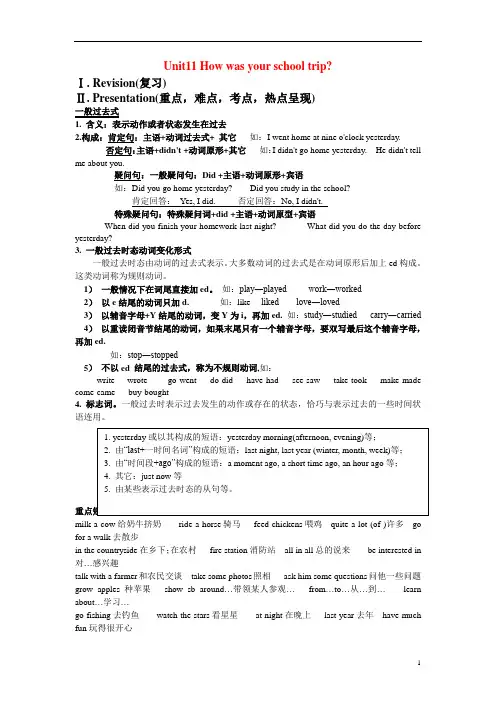
Unit11 How was your school trip?Ⅰ. Revision(复习)Ⅱ. Presentation(重点,难点,考点,热点呈现)一般过去式1. 含义:表示动作或者状态发生在过去2.构成:肯定句:主语+动词过去式+ 其它如:I went home at nine o'clock yesterday.否定句:主语+didn't +动词原形+其它如:I didn't go home yesterday. He didn't tell me about you.疑问句:一般疑问句:Did +主语+动词原形+宾语如:Did you go home yesterday?Did you study in the school?肯定回答:Yes, I did. 否定回答:No, I didn't.特殊疑问句:特殊疑问词+did +主语+动词原型+宾语When did you finish your homework last night? What did you do the day before yesterday?3. 一般过去时态动词变化形式一般过去时态由动词的过去式表示。
大多数动词的过去式是在动词原形后加上ed构成。
这类动词称为规则动词。
1)一般情况下在词尾直接加ed。
如:play―played work―worked2)以e结尾的动词只加d. 如:like--- liked love―loved3)以辅音字母+Y结尾的动词,变Y为i,再加ed. 如:study―studied carry―carried 4)以重读闭音节结尾的动词,如果末尾只有一个辅音字母,要双写最后这个辅音字母,再加ed.如:stop―stopped5)不以ed 结尾的过去式,称为不规则动词,如:write --wrote go-went do-did have-had see-saw take-took make-made come-came buy-bought4. 标志词。
(精品)七年级英语下册 Unit 11 How was your school trip讲义 (新版)人教新目标版
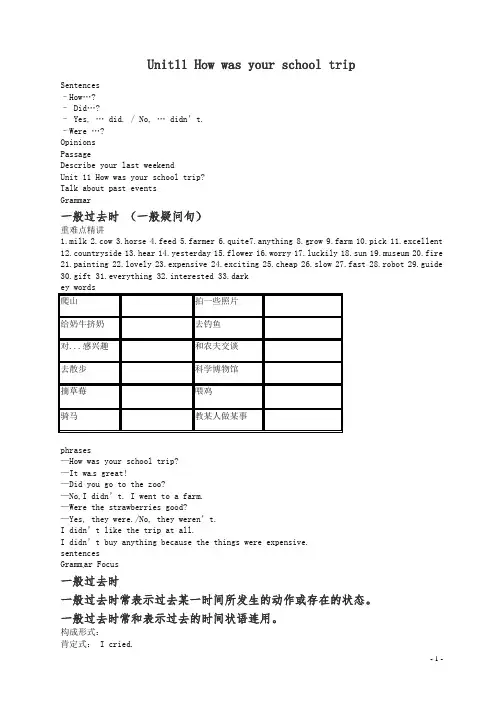
Unit11 How was your school tripSentences–How…?–Did…?–Yes, … did. / No, … didn’t.–Were …?OpinionsPassageDescribe your last weekendUnit 11 How was your school trip?Talk about past eventsGrammar一般过去时(一般疑问句)重难点精讲k2.cow3.horse4.feed5.farmer6.quite7.anything8.grow9.farm 10.pick 11.excellent 12.countryside 13.hear 14.yesterday 15.flower 16.worry 17.luckily 18.sun 19.museum 20.fire 21.painting 22.lovely 23.expensive 24.exciting 25.cheap 26.slow 27.fast 28.robot 29.guide 30.gift 31.everything 32.interested 33.darkphrases—How was your school trip?—It wa s great!—Did you go to the zoo?—No,I didn’t. I went to a farm.—Were the strawberries good?—Yes, they were./No, they wer en’t.I didn’t like the trip at all.I didn’t buy anything because the things were expensive.sentencesGramm ar Focus一般过去时一般过去时常表示过去某一时间所发生的动作或存在的状态。
2020年人教版七年级英语下册Unit11 How was your school trip 要点详解
Unit11 How was your school trip 要点详解How was your school trip? 重点词汇1. beat, win(1)beat指在比赛或战斗中打败某人。
意为“蠃”,此时,其宾语只能是表示人或团队的词语,不能用表示比赛、奖品等内容的词语作其宾语。
beat的反义词为lose. lose to sb. 输给某人。
(2)win表示“赢”,其宾语是表示比赛、奖品等内容的词语,不能用表示人的词语作其宾语。
win还可以作不及物动词用,后面不接宾语,表示“获胜”。
其反义词也为lose. lose sth.. 输了某事(物)。
如:He won the tennis match. 他赢得了那场网球比赛。
We are sure that we can beat them. 我们相信能战胜他们。
2. gift 礼物(1) gift用作名词,表示“礼品,礼物”时,与present同义。
Thank you for your beautiful gift. 谢谢你送给我的漂亮礼物。
(2) gift用作名词,表示“天赋,天资,才能”时,常构成短语have a gift for意为“有某方面的天赋。
如:She has a gift for music. 她有音乐天赋。
(3) gifted用作形容词,意为“有天才的,有才华的”。
如:He is a very gift person. 他是一个很有才华的人。
3. visitor 访问者,参观者,游客Millions of visitors visit the Great Wall every year.每年有数百万游客游览长城。
visitor是由“动词visit+or”构成的名词,类似的词还有actor, inventor, translator等。
思维拓展:“动词+er”构成名词,如:worker, teacher, singer等。
The teacher teaches us very well. 这位老师教我们教得非常好。
2020年人教版新目标七下Unit 11 How was your school trip 单词和课
2020年人教版新目标七下Unit 11 How was your school trip ?单词与课本要点解释Section Ak v. 挤奶 cow n. 奶牛milk 此处作及物动词,意为“给……挤奶”;还可作不及物动词,意为“挤奶,出奶”。
cow可数名词,意为“母牛,(尤指)奶牛”。
milk a cow 给奶牛挤奶I helped my father to milk the cow. 我帮助我父亲给奶牛挤奶。
This cow milks very well.这头奶牛出奶很好。
His aunt has two cows on the farm. 他姑姑在农场有两头奶牛。
【拓展】milk还可用作不可数名词,意为“牛奶”。
Would you like some milk? 你想喝些牛奶吗?2.horse n. 马 ride a horse 骑马3.feed (fed) v. 喂养;饲养feed chickens 喂鸡fed 为 feed 的过去式。
feed 此处作及物动词,意为“喂养;饲养”,其后常接表示动物名称的词作宾语。
I feed my dog every day. 我每天都喂我的狗。
My father's job is to feed animals. 我父亲的工作是喂养动物。
【拓展】feed的常见用法有:①feed sth.to sb. /sth. 把某物喂给某人/某物Please feed some grass to the cow. 请给这头奶牛喂些草。
She fed milk to the baby. 她给婴儿喂了牛奶。
②feed on 以……为生,以……为食Sheep feed on grass. 绵羊以草为食。
③feed…on/with…用……喂……He feeds the dog on meat. 他用肉喂狗。
4.farmer n. 农民;农场主farm名词,意为“农场”;动词意为“耕种;干农活”。
(精品)七年级英语下册 Unit 11 How was your school trip讲义 (新版)人教新目标版
Unit11 How was your school tripSentences–How…?–Did…?–Yes, … did. / No, … didn’t.–Were …?OpinionsPassageDescribe your last weekendUnit 11 How was your school trip?Talk about past eventsGrammar一般过去时(一般疑问句)重难点精讲k2.cow3.horse4.feed5.farmer6.quite7.anything8.grow9.farm 10.pick 11.excellent 12.countryside 13.hear 14.yesterday 15.flower 16.worry 17.luckily 18.sun 19.museum 20.fire 21.painting 22.lovely 23.expensive 24.exciting 25.cheap 26.slow 27.fast 28.robot 29.guide 30.gift 31.everything 32.interested 33.darkphrases—How was your school trip?—It wa s great!—Did you go to the zoo?—No,I didn’t. I went to a farm.—Were the strawberries good?—Yes, they were./No, they wer en’t.I didn’t like the trip at all.I didn’t buy anything because the things were expensive.sentencesGramm ar Focus一般过去时一般过去时常表示过去某一时间所发生的动作或存在的状态。
七年级英语下册Unit 11 How was your school trip知识点
七年级英语下册Unit 11 H as ur shltrip知识点七年级英语下册Unit11Hasurshltrip知识点一.短语归纳gfraal去散步2ila挤牛奶3rideahrse骑马4feedhiens喂小鸡talith与……谈话6taephts拍照7quitealt相当多8sh…arund带领……参观9learnabut了解10fr…t…从……到……1grstraberries种植草莓12pistraberries采草莓3intheuntrside在乡下14gfishing去钓鱼1atnight在夜晚16altf许多;大量7eut出来9alngthea沿线21busthfrsb为某人买某物23taea/thetrain乘火车2nt…atall根本不……18gnashltrip去学校郊游20afterthat之后22allinall总的来说24beinterestedin 对……感兴趣二.用法集萃H+be…?+lie?……怎么样?2tan+可数名词复数太多的……3tuh+不可数名词太多的……4teahsbhtdsth教某人怎样做某事quite+a/an+形容词+可数名词单数=a+ver+形容词+可数名词单数一个相当/很……三.重点句型—Diduseeans?—es,IdidIsaquitealt你看到奶牛了么?是的,我看到很多。
2—Didurideahrse?—N,Ididn’tButIileda你骑马了吗?没有,但是我喂了奶牛。
3Thefarershedarlarundthefar农民带着卡诺参观了农场。
4arlpiedsestraberriesandtthehe卡诺采了一些草莓并带回了家。
Hasurshltriplastee?上周你的郊游怎么样?6Ivisitedgrandparentsintheuntrside我看望了我在农村的祖父母。
7Hastheeatherthere?那的天气怎么样?8Itsagreat,andtheairasslean天气好极了,并且空去是那么干净。
(精品)七年级英语下册 Unit 11 How was your school trip讲义 (新版)人教新目标版
Unit11 How was your school tripSentences–How…?–Did…?–Yes, … did. / No, … didn’t.–Were …?OpinionsPassageDescribe your last weekendUnit 11 How was your school trip?Talk about past eventsGrammar一般过去时(一般疑问句)重难点精讲k2.cow3.horse4.feed5.farmer6.quite7.anything8.grow9.farm 10.pick 11.excellent 12.countryside 13.hear 14.yesterday 15.flower 16.worry 17.luckily 18.sun 19.museum 20.fire 21.painting 22.lovely 23.expensive 24.exciting 25.cheap 26.slow 27.fast 28.robot 29.guide 30.gift 31.everything 32.interested 33.darkphrases—How was your school trip?—It wa s great!—Did you go to the zoo?—No,I didn’t. I went to a farm.—Were the strawberries good?—Yes, they were./No, they wer en’t.I didn’t like the trip at all.I didn’t buy anything because the things were expensive.sentencesGramm ar Focus一般过去时一般过去时常表示过去某一时间所发生的动作或存在的状态。