
2018年高考英语二轮复习第一部分 阅读理解篇 专题1 阅读理解第2讲 推理判断类 课件
阅读理解篇
专题一 阅读理解
第二讲 推理判断类
• 推理判断题属于高层次阅读理解题。要求 考生在理解表面文字信息的基础上,尽量 考虑文中全部信息或事实,在通篇理解文 章的基础上领会作者的言外之意,做出正 确的推理和判断,从而理解文章的隐含意 义和深层意义。推理的原则是据文推理, 合情推理,不可妄加推理,过度推理。
• 推理须知 • 1.直接陈述文章内容的选项不能选,要选 择根据文章推理出来的选项。 • 2.推理不是凭空猜测,而是立足已知推断 未知,因此正确选项一定能在文中找到依 据或理由。 • 3.不能以自己的观点代替作者的想法,因 此脱离原文的主观臆断都是错误的。
分 类 例 析
• 1.隐含推断题——“逻辑关联”得结论
• (2016·全国Ⅲ,D片段) • Bad news sells.If it bleeds, it leads.No news is good news, and good news is no news.Those are the classic rules for the evening broadcasts and the morning papers.But now that information is being spread and monitored(监控) in different ways, researchers are discovering new rules.By tracking people's e-mails and online posts, scientists have found that good news can spread faster and farther than disasters and sob stories. • “The ‘if it bleeds’ rule works for mass media,” says Jonah Berger, a scholar at the University of Pennsylvania.“They want your eyeballs and don't care how you're feeling.But when you share a story with your friends, you care a lot more how they react.You don't want them to think of you as a Debbie Downer.”
• 第二步 比对原文和选项进行推理甄选 • 要注意推理的基础是原文内容,而不是自 己的经验和主观判断,不可凭借自己的主 观意愿臆断。有的题目的推理即为原文具 体层面的“同义归纳”。所涉及的逻辑关 系都是最简单的逻辑判断,一步即可推得, [解题思路] • 第一步 速读文章,找出相关信息句,并标出进行推理 判断的关键词 • ① They want your eyeballs and don't care how you're feeling. _________________________________________________ _ • ② But when you share a story with your friends, you care a lot more how _________________________________________________ they react. ______________ ______ • ③ You don't want them to think of you as a Debbie Downer. _________________________________________________ • 第二步 根据该题选项的特点将找到的信息改编成选项C inconsiderate of others/thoughtless of others • 尝试解答: _______________________________________
• Q:What can we infer about people like Debbie Downer? • A.They're socially inactive. • B.They're good at telling stories. • C.They're inconsiderate of others. • D.They're careful with their words.
1 2 3 4
题型特点 解题流程 分类例析 复习练案
题 型 特 点
• 一、推理判断题题干常用词 • 一般来说,推理判断题题干中主要包括下面的词语: know about, learn from, infer, imply, suggest, conclude, purpose, attitude, probably, most likely等。 • 二、推理判断题正确选项的特征 • 1.“立足原文,只推一步”,即根据原文内容,一步即 可推得。 • 2.选项中一般不可以出现绝对概念,如only, never, all, absolutely等,正确答案的表述一般有一点模糊,会用一 些相对能够留有一些余地的词汇,如often, usually, sometimes, some, may, might, can, could, possibly, probably 等。
解 题 流 程
• 要做好推理判断题,需要充分阅读理解文章、分析语篇 特征、寻找解题依据。考生应该在领会全文的基础上做 出正确的推理和判断。 • 第一步 依据题干和选项及“顺序原则”确定信息源 • 推理判断题应该首先按照题干要求的范围进行解题,如 果题目中没有提到具体的段落,那么通过“顺序原则” 找到区域范围。如果这种情况下还是不能找到信息源, 就必须考虑按照题干和四个选项的信息词从全文各个角 落寻找答案。
2019年高考英语二轮复习第一板块阅读理解之题型篇一第1讲【细节理解题】
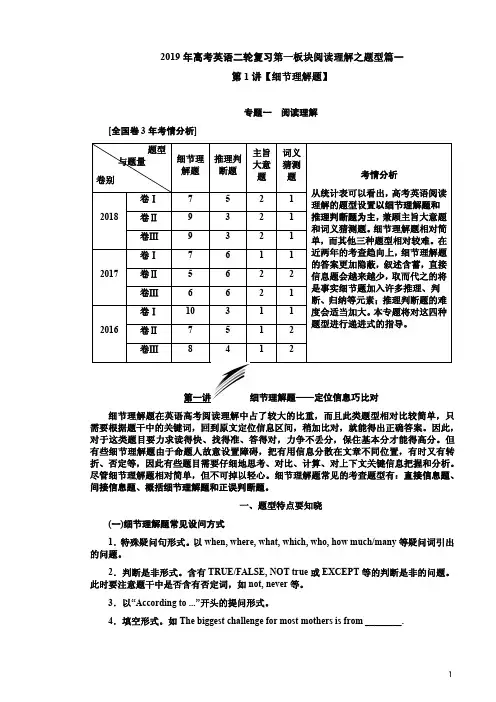
2019年高考英语二轮复习第一板块阅读理解之题型篇一第1讲【细节理解题】专题一阅读理解[全国卷3年考情分析]题型与题量卷别细节理解题推理判断题主旨大意题词义猜测题考情分析从统计表可以看出,高考英语阅读理解的题型设置以细节理解题和推理判断题为主,兼顾主旨大意题和词义猜测题。
细节理解题相对简单,而其他三种题型相对较难。
在近两年的考查趋向上,细节理解题的答案更加隐蔽,叙述含蓄,直接信息题会越来越少,取而代之的将是事实细节题加入许多推理、判断、归纳等元素;推理判断题的难度会适当加大。
本专题将对这四种题型进行递进式的指导。
2018卷Ⅰ7521卷Ⅱ9321卷Ⅲ93212017卷Ⅰ7611卷Ⅱ5622卷Ⅲ66212016卷Ⅰ10311卷Ⅱ7512卷Ⅲ8412第一讲细节理解题——定位信息巧比对细节理解题在英语高考阅读理解中占了较大的比重,而且此类题型相对比较简单,只需要根据题干中的关键词,回到原文定位信息区间,稍加比对,就能得出正确答案。
因此,对于这类题目要力求读得快、找得准、答得对,力争不丢分,保住基本分才能得高分。
但有些细节理解题由于命题人故意设置障碍,把有用信息分散在文章不同位置,有时又有转折、否定等,因此有些题目需要仔细地思考、对比、计算、对上下文关键信息把握和分析。
尽管细节理解题相对简单,但不可掉以轻心。
细节理解题常见的考查题型有:直接信息题、间接信息题、概括细节理解题和正误判断题。
一、题型特点要知晓(一)细节理解题常见设问方式1.特殊疑问句形式。
以when,where,what,which,who,how much/many等疑问词引出的问题。
2.判断是非形式。
含有TRUE/FALSE,NOT true或EXCEPT等的判断是非的问题。
此时要注意题干中是否含有否定词,如not,never等。
3.以“According to...”开头的提问形式。
4.填空形式。
如The biggest challenge for most mothers is from________.(二)细节理解题正确选项特征同义替换指对原文句子中的关键词进行同义替换。
新教材2024高考英语二轮专题复习专题一阅读理解第二部分怎样准解题第二讲推理判断题__于文有据不枉断

技法4 文章出处类——根据文章体裁和内容推出处
arguments and reasoning resulted in a global reduction in error.
Although the studies led by Navajas have limitations and many questions remain,the potential implications for group discussion and decision-
【近3年全国卷考情分析】
清迷点·扫盲点
练重点·练难点
清迷点·扫盲点
一、推理判断题解题技巧要掌握
技法1 推断隐含意义类——逻辑分析得结论 知答题方略 一“抓”一“整”找“依据”,巧做推断隐含题 1.抓住特定信息进行逆向或正向推理:要善于抓住某一段话中的关键 信息,即用某些关键词或短语去分析、推理、判断,利用逆向思维或 正面推理。 2.整合全文(段)信息进行推断:有时需要在弄懂全文(段)意思的基础上, 整合与题目相关的有用信息,综合起来去推理判断,确定最佳结论。 3.以事实为依据:推断一定要以文章所提供的事实为依据,不能凭空 想象,这样才能做出合理的推断。
group members actually did in their discussion. Did they tend to go with
those most confident about their estimates? Did they follow those least willing to change their minds? This happened somet the dominant response. Most frequently,the groups reported that they “shared arguments and reasoned together.” Somehow , these
第1部分 专题1 第2讲 第3节 考点3 词义猜测题-2023年新高考英语二轮专题复习冲刺
句意理解题——“意义吻合”法
典例片段 (2022·山西省高考一模) (第四段)By 1982, he had owned six chemist's shops, when Bhikhu, a then financial analyst, joined him, adding some “financial discipline” to his company. Vijay says: “I simply couldn't have done it without him.” As he puts it, “Brought up under one roof, we understand one another from A to Z.”
Since the restoration process began, at least 15 wells have been restored in the city of Delhi. The cost will be around $60,000, but by doing so, the water supply for the city could reach an additional 33,000 gallons. Rajkumar Sharma, a local citizen, said, “I was elated at the reuse of the stepwells. The stepwell in our village was the only source of water. With time, it had dried up and changed into a place for rubbish. We now have access to clean water for drinking and other purposes.”
高考英语大二轮复习专题一阅读理解2推理判断题课件
√A.The people.
B.The plays.
C.The characters.
D.The costumes.
解析 细节理解题。根据文章第五段内容可知,作者最喜欢戏剧项目中的人。 故选A。
12/13/2021
1234
4.What can be a suitable title for the text? A.The Senior Play Project
√B.Acting for the First Time
C.What Makes a Good Actor D.A Lesson Learnt Through Acting
解析 标题归纳题。根据文章第一段“On Wednesday,January 13th,I performed on stage for the first time.”及全文内容可知,文章主要叙述了作者 第一次登台表演的经历。故选B。
My first character is a man named Roger who is a senior advisor to a presidential candidate in a play called“The Spot”.He’s a short-tempered guy who says what he wants and takes what he wants to assist his candidate in today’’s on the set of The Spot,an advertisement for the candidate,to make sure everything runs smoothly and that any problems are dealt with quickly and efficiently.
2018届高三英语二轮复习河南:阅读理解课件 (共15张PPT)

方法二: 忠于原文,各个排除
易错点三:பைடு நூலகம்观臆断, 天马行空
• A. B. C. D. 例3 Why did the father keep the empty box for many years? He missed his dead daughter much. He represents his daughter’s love and encouraged him to overcome difficulty. He really likes the golden box his daughter gave him. He is poor.
方法四: 辨别词义, 还原文意
实战演练--自我总结
Check the answer
49-52 BDAC
小结:
• 误 由于选项不是对原文内容的简单重复, 而 是用其同义句进行表达, 因此要仔细对照选 项和原文, 看是否有词语, 概念, 时态错误. • 偏 这种选项的干扰特点是信息在原文中出 现过, 但是范畴发生了变化, 或是用文章中 提到的片面内容概括文章主题. • 虚 选项本身没有错误, 可是文章中没有涉及, 或是与题干无关, 此类型错误迷惑性很强
易错点一:粗心大意, 忽视题干
方法一:读准题意, 正确判断
易错点二: 偏离原文,断章取意
例2. What can we learn from the story? A. The unconditional love from others is most valuable. B. parents shouldn’t always be angry with children when they are wrong. C. We should value the golden box that others gave us. D. As children, don’t forget to give parents a box full of kisses on Christmas. ①Which one can be inferred from the passage? ②Which of the following statements is TRUE according to the passage?
(完整)2018高考英语全国卷II(精校版)含答案,推荐文档

2018 高考英语全国卷II第一部分听力(共两节,满分30 分)第一节(功5 小题,每小题1.5 分,满分7.5 分)听下面5 短对话,每段对话后有一个小题,从题中给的A、B、C 三个选项中选出最佳选项。
听完每段对话后,你都有10 秒钟的时间来回答有关小题和阅读下一小题。
每段对话仅读一遍。
1.what does john find difficult in learning German?A.PronunciationB.VocabularyC.Grammar2.What is the probable relationship between the speakers?A.ColleaguesB.Brother and sisterC.Teacher and student3.Where does the conversation probably take place?A. In a bankB. At a ticket coffeeC. On the train4.What are the speakers talking about?A.A restaurantB.A streetC.A dish5.How does this woman think of her interview?A.It was toughB. It was interestingC. It was Successful第二节(功15 小题,每小题 1.5 分,满分22.5 分)听下面5 短对话或独白,每段对话或独白后有几个小题,从题中给的A、B、C 三个选项中选出最佳选项。
听完每段对话或独白后,你将有时间阅读各个小题,每小题5 秒钟;听完后,各小题有5 秒钟的作答时间。
每段对话或独白读两遍。
听第6 段材料,回答第6、7 题。
6.When will Judy go to the party?A.On MondayB.On TuesdayC.On Wednesday7.What will Max do next?A. Fly a kiteB. Read a magazineC. Do his homework听第7 段材料,回答第8、9 题。
2018高考英语(通用)二轮训练:阅读理解(推理判断)含答案
2018高考英语(通用)二轮训练:阅读理解(推理判断)含答案阅读理解----推理判断题推理判断题常见的命题形式:1.细节推断题(1)It can be inferred/concluded from the passage that .(2)The author strongly suggests that .(3)The writer implies but not directly states that .(4)The writer/author indicates/suggests/implies that .2.文章来源或读者对象类推断题(1)The passage would most likely be found in .(2)In which of the following publications would this passage most likely come from?(3)Where is the passage most likely to have been taken from?3.写作意图类推断题(1)What is the main purpose of the author in writing this passage?(2)The purpose of the passage is to get people to .(3)The writer writes the last paragraph in order to .4.态度倾向类推断题(1)The attitude of the author towards...is .(2)What’s the writer’s attitude towards...?(3)What does the author think about...?1.细节推断题要求考生根据语篇关系,推断具体细节,如时间、地点、人物关系、人物身份、事件等。
2018年高考英语全国2卷真题及答案(word版) 含写作和详细解析
2018年普通高等学校招生全国统一考试(卷2)英语(考试时间:120分钟试卷满分:150分)注意事项:1. 答卷前,考生务必将自己的姓名、准考证号填写在答题卡上。
2. 作答时,务必将答案写在答题卡上,写在本试卷及草稿纸上无效。
3. 考试结束后,将本试卷和答题卡一并交回。
第一部分听力(共两节,满分30分)做题时,先将答案标在试卷上。
录音内容结束后,你将有两分钟的时间将试卷上的答案转涂到答题卡上。
第一节(共5小题;每小题1.5分,满分7.5分)听下面5短对话,每段对话后有一个小题,从题中给的A、B、C三个选项中选出最佳选项。
听完每段对话后,你都有10秒钟的时间来回答有关小题和阅读下一小题。
每段对话仅读一遍。
例:How much is the shirt?A.£19.15.B.£9.18.C.£9.15.1.What does John find difficult in learning German?A.Pronunciation.B.Vocabulary.C.Grammar.2.What is the probable relationship between the speakers?A.Colleagues.B.Brother and sister.C.Teacher and student.3.Where does the conversation probably take place?A. In a bank.B. At a ticket office.C. On a train.4. What are the speakers talking about?A.A restaurant.B.A street.C.A dish.5.What does the woman think of her interview?A.It was tough.B.It was interesting.C.It was successful.第二节(共15小题;每小题1.5分,满分22.5分)听下面5段对话或独白,每段对话或独白后有几个小题,从题中所给的A、B、C三个选项中选出最佳选项。
2023年高考英语二轮复习第一部分阅读能力突破篇专题一阅读理解第2讲推理判断题
第一部分 专题一 阅读理解
高考二轮总复习 • 英语 新教材
返回导航
该类型的命题方式常常以下列形式呈现: 1.It can be inferred/concluded from the text that ________. 2.What can we infer/learn from...? 3.We can learn from the passage that ________. 4.The passage/story...indicates/suggests/implies that ________.
them, had little privacy, rare baths, and a blanket of snow on their quilt when they woke up in the morning.(她们和一个当地家庭,哈里森一家一 起搬进去,并且和他们一样,几乎没有隐私,很少洗澡,早上醒来时被 子上覆盖着一层雪。)”以及“In spring, the snow was replaced by mud over ice.(在春天,覆盖在冰上的雪被泥替代。)”可知,女孩们的生活条 件非常艰苦,她们饱受磨难。故选D。
第一部分 专题一 阅读理解
高考二轮总复习 • 英语 新教材
返回导航
Wickenden is a very good storyteller.The sweep of the land and the stoicism (坚忍) of the people move her to some beautiful writing.Here is a picture of Dorothy Woodruff, on her horse, looking down from a hill top: “When the sun slipped behind the mountains, it shed a rosy glow all around them.Then a full moon rose.The snow was marked only by small animals: foxes, coyotes, mice, and varying hares, which turned white in the winter.”
2018届高三英语第二轮复习资料-----阅读理解
阅读理解第一节(共15小題;每小題2分,满分30分)阅读下列短文,从毎题所给的四个选项(A,B,C和D)中,选出最佳选项,并在答题卡上将该项涂黑。
一“Wash your hands!” How many times have you heard that from your parents? You might think they’re just complaining you, but actually the most important thing you can do to keep from getting sick is to wash your hands.According to the Centers for Disease Control and Prevention, if you don’t wash your hands often, you can pick up germs from other sources and then make yourself sick. You’re at risk ever y time you touch your eyes, nose, or mouth. In fact, one of the most common ways people catch colds is by rubbing their noses or their eyes after the cold virus has gotten on their hands.If people don’t wash their hands frequently (especially when the y’re sick), they can spread germs directly to other people or onto surfaces that others touch. And before they know it, everyone around them is coming down with something!Think about all of the things that you touched today —from the telephone to the toilet. Maybe you blew your nose and played with your dog. Whatever you did, you came into contact with germs. So it’s easy for germs on your hand to end up in your mouth.By washing your hands often in the right way, you’ll wash away germs — such as bacteria and viruses that you have picked up from other people, through polluted water and food, or from animals and animal wastes.Do you know that 1 out of 5 people don’t wash their hands after using the restroom? Students don’t wash their hands ofte n or well. In one study, only 58% of female and 48% of male middle-school and high-school students washed their hands after using the bathroom.Remember, washing your hands often is the key to preventing the spread of many common illnesses.1. What can we learn from the text?A. Some parents are always annoying children.B. We will catch colds if we rub our noses often.C. If we can wash our hands often, we will never get sick.D. It is easy for us to catch colds if we get the cold virus on our hands.2. The underlined part in Paragraph 3 probably means “ _________ “ .A. falling to the groundB. seeing you with giftsC. getting an illnessD. leaving you alone3. We can learn from Paragraph 4 that _________ .A. no one can free from germsB. telephones are as dirty as toiletsC. blowing our nose is harmful to usD. we are living in danger due to germs4. According to the text, what should we do to prevent the spread of the virus?A. Keep away from germs.B. Wash hands oftenC. Don’t touch dirty things.D. Don’t keep dogs.二We try to be our best at work. We offer more hours than we are expected but this damages our family life. We spend time with people who we have nothing in common with, and attend social events we have no interest in, even though very often end up unhappy.In fact, most people think about themselves and their own problems 99% of the time, and scarcely give others a second thought. Even so, we live our lives to impress them instead of being ourselves. We spend money that we can’t afford, purchasing the latest fashions, the best car, or even a house which is not a home but a show-house, to impress our friends and neighbors.When what others think about us starts to control our life, it is time to change. There are times, of course, when it is wiser to consider our effect on other people, such as going for a job interview. It’s time to wake up and think about ourselves, and start creating a sustainable future based on our own likes and dislikes. We should find out other ways to get our self-worth by being a loving parent, a good friend or helping others when we can. This will give us far more happiness.Think about your own life now and see if you need to make any changes. Look at your family and your true friends, the way you use your time, and focus on your motivating force. Make more rational (理智的) life choices that will give you a better future for yourself and your family.1. According to the text, people work over time because ____________ .A. they want to gain more payment.B. they tried to make others satisfied.C. they have nothing else to do but work.D. their family expect them to do so.2. It is better to think specially in others’ shoes when you _______.A. go for a holidayB. hunt for a jobC. visit your friendD. attend a lecture3. We’re advised to change when we are __________ .A. trying to avoid being controlled by others in lifeB. preparing better for a job interviewC. reducing our effect on othersD. making ourselves understood4. The next is arranged in a form of __________ .A. problem --–analysis --- solutionB. general view--- secondary viewsC. result---reasonD. point---evidence三My 18-year-old son passed his driving test last year. But my responsibilities linked to this event for a year were not my favorite. As the mother and sole parent, I’m up for the challenges. However, I don’t care for the challenge of being a Driving Instructor. I feel I did a good job. I was fairly patient, not too nervous. I didn’t want to make my son nervous because I was!Many hours were spent with him in the driver’s seat. I couldn’t take my eye off the road around us, always assuming idiot drivers will make mistakes. Mostly he was good. Several times he expertly avoided near collisions, which were the fault of the other drivers. One day though, while driving through Tim Hortons, he drove up to the window but couldn’t reach it to collect his order. So he undid his seat belt and reached over, and I heard the car engine roar. As he reached over, his foot depressed the gas pedal to the floor. Thank goodness he had placed the gear in park. Thank goodness I had taught him to do this.Two weeks ago he drove on the highway to Oakville. I was nervous. It was Thanksgiving weekend with everyone on the highway. I told him to slow down or stop a thousand times. “Mum, relax, you such a back seat driver.” he said. We made it there but he hasn’t driven much with me since. He told me he was n’t going to as I criticized him too much when he’s driving. This reminded me of the days when his dad was my passenger in the car. He would stretch his feet out to the imaginary pedals and grab the dash board like I was flying an airplane. How did that help me? It didn’t. It made me nervous and I stopped driving if he was in the car.I wonder how you stop being the driving instructor after being it for a year, especially now my 16-year-old daughter is starting to learn with me in the passenger seat. Lord help me please!1 . Which words can be used to describe the author?A. Kind and creative.B. Brave and caring.C. Stubborn but careful.D. Clever and hardworking.2. How did the author like her work as a driving instructor for a year?A. Worthy.B. BoringC. Interesting.D. Unsatisfactory.3. Paragraph 2 is mainly about _________.A. the author’s skilled drivingB. the author’s worry about her sonC. the author’s feeling about her son’s drivingD. the author’s success as a back seat passenger4. Why did the author mention her husband in Paragraph 3?A. To show she is a good driver.B. To show she is disappointed with her son.C. To show her husband is different from her son.D. To show the passenger’s reaction doesn’t help in the driver’s driving.四To control the nation’s growing problem with food wastage, the South Korean government has started a unique initiative (倡议) ----“Pay as You Trash”. According to the initiative, the South Korean government has three methods in place to charge citizens for the food thrown away. One is through an RFID (Radio Frequency Identification) card –when users tap this card over a specially designed food waste bin, the lid will open. This waste is automatically weighed and recorded in the user's account. The user needs to settle this bill every month.The second billing method is through pre-paid garbage bags. These specially designed bags are priced based on volume. For instance, in Seoul, a 10-liter garbage bag costs around 190 won (less than $1). There's also a bar code management system in place, in which residents throw food waste directly into dustbins and pay for it by purchasing bar code stickers attached to the bin.Even before the pay-by-weight system was introduced, South Koreans were still being charged for food waste---the cost was simply divided equally among the residents of each apartment block. The new system is not only fair, but is also designed to make consumers really feel the pinch of excessive waste. The more food they toss out, the more they end up paying.Thanks to the initiative, residents like Seoul housewife Ms. Kwan are now adopting creative methods to avoid food waste. She makes sure to strain all the liquid out of leftover food before throwing it away. While preparing vegetables, she tries to use as much as the edible parts aspossible,1. Why does the South Korean government decide to launch the initiative?A. People are complaining about food waste.B. More and more food wastes are produced.C. Food waste is worsening the government.D. People have little knowledge of saving food.2. The underlined word “pinch” in Paragraph3 means “______________” .A. joyB. amountC. painD. cause3. Before the initiative was launched, the residents ___________ .A. didn’t pay for their food wasteB. paid for their food waste by weightC. had to pay for their food garbage bagsD. paid for food waste equally in their blocks4. According to the text, the initiative “Pay as You Trash” _________ .A. is working effectivelyB. was thought to be unfair at firstC. is quite expensive to carry outD. is being attempted in some areas五When a storm is coming, most people leave the area as quickly as possible and head for safety. But there are a few people who will get into their cars and go straight for the center of the storm.These people are willing to risk being killed by floods or 100-kilometer- an-hour winds for the excitement of watching the storm close up."Storm chasing (追逐)"is becoming an increasingly popular hobby,especially in the Midwest of the United States, where there are frequent storms between March and July.A storm chaser begins the dayby checking the Internet for the latest weather reports, and then drives up to l,000 kilometers to where the storm will be and waits for it to develop.Although anyone can do it,storm chasing is extremely dangerous.The power of a big storm can throw a cow into the air or destroy a whole house in seconds.Storm chasers are also often hurt in accidents caused by driving in a heavy rain. If you are a beginner, it is much safer to join a group for storm– chasing vacations during the storm season.Even then, storm chasing is not all adventure and excitement."Storm chasing is 95%driving,"says Daniel Lynch,who spends most of his summer storm-chasing."Sometimes you can sit around for hours waiting for something to happen, and all you get is blue sky and a few light showers."However, for storm chasers, it is all worth it. "When you get close to a storm,it is the most exciting sight you will ever see in your life," says Jasper Morley."Every storm is an example of the power of nature.It is the greatest show on Earth."1. For storm chasing, the first thing storm chasers do is to _____.A. head straight for the center of the stormB. get into the car for safetyC. wait patiently for the storm to developD. collect information about a coming storm2. Beginners of storm chasing are advised _____.A. not to drive in a heavy rainB. to do it in an organized wayC. not to get too close to a stormD. to spend more time on it in summer3. By saying " it is all worth it " in the last paragraph,the author means that _____.A. storm chasing costs a lot of moneyB. storm chasing is worth hours of waitingC. efforts in storm chasing are well paidD. a storm presents the greatest show on Earth4. What can we learn from the text?A. Sometimes storm chasers get nothing but disappointment.B. Many storm chasers get killed in the storms.C. Storm chasing is becoming popular around the world.D. Storm chasing is only fit for young people六Take a trip to one of London’s theme parks for an exciting day out. From thrilling rides through history to wild animals--- both mythical and real---- London’s theme parks offer great entertainment for families and groups.Unlike most London attractions, some amusement parks aren’t in Central London, but are easily reached by train, coach or car.Chessing World of AdventureWhether it’s exciting rides, wild animals or underwater adventures you love, Chessing is worth visiting. The Theme Park has 10 themed lands with more than 40 rides and attractions including roller coasters and rides suitable for young children. Chessington Zoo houses 1,000 animals including tigers, lions and giraffes.Shrek’s AdventureTake a bus driven by Donkey to the magical Far Far Away. Meet Princess Fiona, Puss in Boots, Sleeping Beauty and many more. Explore a maze (迷宫) of paths and rooms to find Shrek and live actors and special effects help tell the tale. A dream-come-true for kids and Shrek lovers alikes. Suitable for all ages, but particularly those aged six to twelve years old.London DungeonTake a scary but humorous 90-minute journey through 1,000 years of London’s history at the ever-popular London Dungeon. There are 18 interactive shows with 20 live theater actors and two rides to guide you through the city’s secret past. Walk the Whitechapel Maze with Jack the Ripper, visit a torture chamber (酷刑室), and be careful not to lose your head on The Tyrant boat ride with King Henry VIII!KidZaniaSet your imagination free at KitZania at Westfield London—the new role playing park for children. KidZania is the place where children can role-play around 60 different jobs and professions aims to teach life skills such as financial literacy, teamwork and independence.1. If visitors want to enjoy the excitement of roller coasters,they can go to ________ .A. KidZaniaB. Shrek’s AdventureC. London DungeonD. Chessing World of Adventures2. Who might be most likely interested in London Dungeon?A. Students studying history.B. Underwater adventures.C. Police officers.D. Animal lovers3. What can children do in KidZania?A. Communicate with theater actors.B. Experience a big storm.C. Improve their learning skills.D. Learn more about some jobs.4. Where does this text probably come from?A. A science textbook.B. A news report.C. A travel guidebook.D. A geography magazine.七When a leafy plant is under attack,it doesn’t sit quietly. Back in 1983, two scientists, Jack Schultz and Ian Baldwin, reported that young maple trees getting bitten by insects send out a particular smell that neighboring plants can get. These chemicals come from the injured parts of the plant and seem to be an alarm.What the plants pump through the air is a mixture of chemicals known as volatile organic compounds,VOCs for short.Scientists have found that all kinds of plants give out VOCs when being attacked. It’s a plant’s way of crying out.But is anyone listening? Apparently. Because we can watch the neighbors react.Some plants pump out smelly chemicals to keep insects away. But others do double duty.They pump out perfumes designed to attract different insects who are natural enemies to the attackers. Once they arrive, the tables are turned. The attacker who was lunching now becomes lunch.In study after study, it appears that these chemical conversations help the neighbors. The damage is usually more serious on the first plant, but the neighbors, relatively speaking, stay safer because they heard the alarm and knew what to do.Does this mean that plants talk to each other? Scientists don’t know. Maybe the first plant just made a cry of pain or was sending a message to its own branches, and so, in effect, was talking to itself. Perhaps the neighbors just happened to “overhear” the cry. So information was exchanged, but it wasn’t a true, intentional back and forth.Charles Darwin, over 150 years ago, imagined a world far busier, noisier and more intimate (亲密的) than the world we can see and hear. Our senses are weak. There’s a whole lot going on.1. What does a plant do when it is under attack?A. It makes noises.B. It gets help from other plants.C. It stands quietlyD. It sends out certain chemicals.2. What does the author mean by “the tables are turned” in paragraph 3?A. The attackers get attacked.B. The insects gather under the table.C. The plants get ready to fight back.D. The perfumes attract natural enemies.3. Scientists find from their studies that plants can ________ .A. predict natural disastersB. protect themselves against insectsC. talk to one another intentionallyD. help their neighbors when necessary4. what can we infer from the last paragraph?A.The word is changing faster than ever.B. People have stronger senses than beforeC.The world is more complex than it seemsD. People in Darwin’s time were imaginative.八Known as “The Man with the Golden Arm,” nearly every week for the past 60 years, James Harrison has donated blood plasma(血浆) from his right arm. The reasons can date back to a serious medical procedure.“When I was 14, I had a chest operation,” recalls Harrison, who is now aged 78. “My father said I had received 13 units of blood and my life had been saved by unknown people. So I said when I’m old enough, I’ll become a blood donor.”Soon after Harrison became a donor, doctors called him in. His blood, they said, could be the answer to a deadly problem.“In Australia, up until about 1967, there were about thousands of babies dying each year because of the rhesus disease (恒河猴症).” explains Jemma Falkenmire, of the Australian Red Cross Blood Service.Harrison was discovered to have an unusual antibody (抗体) in his blood and in the 1960s he worked with doctors to use the antibodies to develop an injection (注射剂) called Anti-D which can prevent this disease.Harrison’s blood is precious. Every batch of Anti-D that has ever been made in Australia has come from Harrison’s blood. He and Anti-D are credited with saving the lives of more than 2 million babies, according to the Austral ian Red Cross blood service: That’s 2 million lives saved by one man’s blood.Harrison is considered a national hero, and has won numerous awards. He has now donated his plasma more than 1,000 times, but no matter how many times he’s given blood there’s on e thing that will never change: “I look at the ceiling or the nurses, maybe talk to them a bit, but never once have I watched the needle go in my arm. I can’t stand the sight of blood, and I can’t stand pain.” he says.1. What was the main reason for Harri son’s becoming a blood donor?A. He has a golden arm.B. He has precious blood plasma.C. His father encouraged him to help others.D. Donated blood once made him survive.2. Why is James’ blood more precious?A. James has the Anti-D in his blood.B. His blood is more useful in treating the rhesus disease.C. James’ blood is the main source of Anti-D in Australia.D. James has donated more plasma than other donators.3. How does Harrison feel when donating his plasma?A. Nervous.B. Relaxed.C. AnxiousD. Excited.九In this day and age, it may seem like getting two people with different views together to discuss them is a recipe for disaster. Just think about what would happen if you sat down and had an open and honest conversation with someone with completely opposing views. Could it bringyou closer together?However, the Human Library Organization is counting on it.At a Human Library, people volunteer to become “books” and make their experiences open and available. “Readers” are encouraged to ask them questions freely, and they’ll get honest answers in return. There’s no judgment, and no questions are off-limits.You won’t find unpleasant comments, and you won’t lose faith in humanity. At the Human Library, you actually feel better about the world you live in. You might even make a new friend!“The human “books” consist of people who have been discriminated by society.” said Ronni Abergel, the Human Library Organization’s founder, who has set out to build a space for conversati ons that can challenge prejudices through dialogue. “The most pleasantly surprising thing about it is how close all the human books become to one another,” she said.Human Libraries help to remind us there really is more that unites us than divides us. And as events now spread throughout 82 countries, with Human Libraries even set to launch soon in Pakistan and Jordan, you can tell that is a shared feeling.“We can spend billions and billions on trying to build up homeland security and our safety, but real safety comes from having positive relations to other groups in your community,” said Abergel. “Real safety is not going to come from building walls. It’s going to come from reaching out and getting to know each other.”1. What does the first paragraph imply?A. Heated discussions are often carried out among people.B. Open dialogue can’t always lead to close relation.C. People with opposing views are not honest enough.D. We tend to have open dialogues with people around us.2. What will readers get at a Human Library?A. A fair judgment.B. Unpleasant comments.C. An available experience.D. Regaining confidence.3.Which of the following can replace the underlined “launch” in Para. 6 in meaning?A. Accelerate.B. Substitute.C. Succeed.D. Start.4. What did Abergel advise people to do to get real safety?A. Strengthen bonds between people.B. Join other groups in the community.C. Pull down walls between communities.D. Spend less money on homeland security.十A guiding principle for master cellist Yo-Yo Ma is that “the intersection (交汇) of cultures is where new things appear.” Certainly his biography is an intersection of cultures. He was born to Chinese parents in Paris, France; both his parents were musicians. When he was seven, his family moved to the United States. Gifted for his age, Ma attended Juilliard, the world famous music institute. He then chose to earn a liberal arts degree at Harvard rather than focusing only on music.Even in his earliest performing years, Yo-Yo Ma had a strong belief that it was important to share music with all kinds of people. Stories are told about how he once performed in the hallway of a large building for people who were unable to get tickets to his concert. He remained interested in making music accessible to diverse audiences and furthered his interest in different cultures when he visited the Bushmen of the Kalahari. He developed a vehicle to further these ideals when he founded the Silk Road Project.As he has said, the Silk Road is a metaphor(隐喻) for a number of things: as the Internet of ancient times, the routes were used for trade, by religious people, adventurers, scientists, storytellers. Everything from algebra to Islam moved along the Silk Road. It’s the local-global thing. In the cultural world, you want to make sure that voices don’t get lost, that rich traditions continue to live, without becoming common.This lesson explores the philosophy behind Yo-Yo Ma’s founding of the Silk Road Ensemble (乐团), his belief that the arts, and particularly music, can make the world better, and that through cooperation, one can both preserve tradition and shape cultural evolution. Students also explore their own attitudes toward the arts, writing reflective essays on how the arts have played a role in their own lives.1.What do we learn about Yo-Yo Ma according to Paragraph 1?A. He studied music in FranceB. He started his career in HarvardC. He showed great musical talentD. He earned a liberal arts degree in Julliard2.Which of the following can best replace the underlined word “vehicle” in Paragraph 2?A. CarB. MediumC. SkillD. Project3. What does Yo-Yo Ma think of the Silk Road?A. The route is key to musical developmentB. It has significant influence on the worldC. It simply helps with the spread of religionsD. Traditions are passed on through the route4.Why did Yo-Yo Ma found the Silk Road Ensemble?A. To foster cooperation in businessB. To record the voices along the routeC. To explore people’s attitude toward the artsD. To share music and promote cultural development十一If you need to spend time on the road, it's important to find ways to keep safe on your feet.Don’t suppose it’s your right of way. Yes, you might be crossing at the right place, at the right time, within the crosswalk area, but you are still exposed to danger. It could be a distracted driver, or a cyclist with a loose sense of traffic rules, so you could still get hurt. You can be in the right legally, but that won't be much help when you're in the hospital.Follow pedestrian signals. Just as drivers aren't supposed to speed up to beat a light when crossing through an intersection, pedestrians need to take the same care when obeying their own signals. If the hand is flashing and the countdown is into single digits(数字), stay where you are. Trying to outrun the flashing hand is unsafe, especially as cars try to clear the intersection before the light turns red.Give drivers enough time to stop when crossing. Don't suppose that drivers will jam on their brakes when you hit the crosswalk signals. Some provinces, such as Alberta, issue a ticket if you don't give drivers enough time to brake.Cross quickly. Once you've followed all of the other rules, and it is safe to cross the street, don't then just wander along in front of six lanes(车道)of traffic. There's no need to run or jog, but respect the drivers who respected you enough to stop for you.21. Who is the text intended for?A. Drivers.B. Cyclists.C. Police.D. Pedestrians.22. Which of the following can best replace the word “distracted” in Paragraph 2?A. Considerate.B. Strange.C. Kind-hearted.D. Absent-minded.23. In what case would pedestrians in Alberta be fined?A. Racing against time with drivers.B. Following crosswalk signals.C. Crossing the crosswalk area.D. Walking outside six lanes.24. What can be a suitable title for the text?A. Rules for Traffic PoliceB. Tips to Keep Safe on Your FeetC. Things Every Driver Should KnowD. Signals for Both Pedestrians and Drivers十二At primary school in New Zealand, I was introduced to a school savings account run by one of the local banks. When our money box was full, we took it to the bank and watched with pride as our coins flowed across the counter. As a reward, we could choose our next money box from a small variety, and start the whole savings routine again. Every week I watched my parents sort out the housekeeping and "make ends meet". Sometimes it was annoying to wait for things we really felt we needed.Later, as a university student, I managed on an extremely small student allowance. Students were ignored by banks then, because we were so poor, and there was no way I could have gotten credit, even if I had tried. We collected our allowance three times each year, deposited it to the best advantage and withdrew it little by little to last until the next payout of student allowance.When our daughter, Sophie, began to walk, we made a purposeful choice to encourage her to use money wisely. We often comment when the TV tells us "You owe it to yourself to borrow our money"—to whom do we really owe it? And what would happen if our income were reduced or dried up? Now, as a 12-year-old child, it's almost embarrassing to see her tight "financial policy", and wait for the unavoidable holiday sales to buy what she wants.I agree that financial education in schools is very important. But the root of the problem lies with us and the way we behave as role models to those who follow.1. What did the author learn from her parents?A. How to become a banker.B. Where to open a savings account.C. Where to choose a money box.D. How to make ends meet.2. How did the author manage the student allowance?A. He applied for a credit card.B. He spent it three times a year.C. He put it in the bank.D. He seldom withdrew it.3. What reflects Sophie’s tight “financial policy”?A. Reducing her savings.B. Buying things on sales.C. Canceling holiday plans.D. Borrowing money from banks.4. What’s the text mainly about?A. Parents’ money problems.B. Students’ school education.。