
[推荐]冀教版八年级英语下册(全册)精品教案汇总(125页)
[推荐]冀教版八年级英语下册(全册)精品教案汇总Unit 1 Spring is coming!Lesson 1 How’s the weather?本节课是冀教版初中英语八年级下册第一单元lesson1, 功能话题是谈论天气;文本结构是对话;语法重点是初步认识合成词, 并能够运用将来时态预测天气, 以及正确使用will写简短的天气预报。
因此, 在新课标理念、教材内容以及任务型教学法理论的指导下, 本节课教学设计如下【知识与能力目标】The words and phrases: shower; thunderstorm; thunder; sunrise; sunset; rise; set; exact.【过程与方法目标】①What’s the weather like today?②What’s the temperature?【情感态度价值观目标】Listen, say, read and write.【教学重点】1. What’s the weather like today? It’s cold, cool, warm.2. What’s the temperature? It’s ten degrees.3. be scared of sb./sth.4. There will be…=There is/are going to be…【教学难点】1. What’s the weather like today? It’s cold, cool, warm.2. What’s the temperature? It’s ten degrees.3. be scared of sb./sth.4. There will be…=There is/are going to be…图片, PPT1.课堂导入:通过小小预报员引出“天气”话题“Do you want to be a reporter? Can you talk about the weather in English? ”给学生设置任务“用英语谈论天气”, 进而引出本课的语言主题“天气”。
2.学习新知(1)复习snow,wind,rain,cloud,sun首先利用网站中“单词袋袋裤”中的“温故”栏目出示天气图片, 学生看图片猜单词, 从而复习snow, wind ,sun ,cloud ,rain这几个单词, 同时板书单词。
【设计意图:学生复习snow,wind,rain,cloud,sun几个名词, 引出cloudy,rainy,snowy,sunny, windy的学习, 并为对比名词和形容词做准备。
】整合点:运用网站展示图片使教学内容更直观、更形象, 从而帮助学生更好的掌握有关天气的单词。
(2)学习新知snowy,windy,rainy,cloudy,sunnyT: Please look out of the window. The sun comes out. The weather i s sunny. It’s warm.板书sunny,和sun对比。
学生小组讨论在snow, wind, rain, cloud的后面做怎样的变化形成本课所要学习的形容词。
此时充分调动学生的学习主动性, 小组派代表汇报结果, 同时板书单词, 之后通过网站中“单词袋袋裤”的“知新”栏目查找这些单词的汉意, 教师指导学生进行单词的朗读。
【设计意图:学生通过比较, 初步了解本课中的天气词汇与上一课学习的名词的联系。
】(3)通过网站自学第一部分点击网站的“看图识天气”栏目播放课文第一部分的flash课件, 学生结合具体情境进行一对一的跟读模仿。
【设计意图:通过一对一的跟读模仿, 培养学生自主学习的能力。
】整合点:通过网站播放学习内容, 将静态的文字转化成动态的情境, 刺激学生的多种感官, 有利于学生更好的模仿和实践。
(4)填一填通过“填一填”栏目, 复习本课形容天气的词汇, 学生输入答案, 回答正确与否会有相应的提示音。
【设计意图:通过操练, 培养学生正确运用天气词汇。
】(5)学习句型How’s the weather today? It’s_______.学生先整体感知, 自主学习网站上的视频对话, 进行一点一说的学习, 跟读对话。
然后结合实际情况教师提问:“How’s the weather today?”“How’s the weather in (月份)?”师生对话、生生对话, 充分练习此句型。
【设计意图:学生学会使用How’s the weather today? It’s______.句式问答天气。
】整合点:学生通过网站的视频资源自主学习, 充分发挥了学生的自主能动性。
3.巩固操练(1)点击“智力大冲浪”栏目, 出现相应的日期和天气情况, 生生操练句型“What day is it?”“How’s the weather today?”(2)然后点击网站中的“天气转转转”栏目, 转出相应的城市天气, 师生对话、生生对话, 讨论此城市的天气状况。
【设计意图:在轻松愉快的气氛中, 学生巩固运用本课描述天气的词汇和句型, 做到学以致用, 语言输出。
】整合点:利用网站, 学生自己亲自操作电脑, 师生对话和生生对话, 使英语课堂变得丰富多彩, 增加趣味性。
(3)找规律, 学习字母组合ir, ur, er, or在单词中的发音将这些不同字母组合的单词打乱顺序, 学生将这些单词分类, 然后指导学生读一读, 找到规律后, 尝试读新的单词。
【设计意图:通过找规律、总结, 学生掌握字母组合在单词中的发音。
】整合点:学生在电脑上通过拖动完成单词分类, 实现了人机互动, 激发了学生的学习兴趣和参与热情。
4.自我展示这节课我们学习了五个描述天气的形容词, 但是在实际的生活中, 天气情况远不止这些, 学生通过网站拓展栏目查找foggy 等更多描述天气的词汇, 然后通过中国天气网, 观察图片, 选择某一城市结合之前学过的句型What day is it? What do you wear? 及本课新句型创编对话。
5.结束课堂Homework:选一个季节, 和同学或父母谈论这个季节的天气情况。
略。
Unit 1 Spring is coming!Lesson 2 It’s getting warmer!Talking about outdoor activities.【知识与能力目标】Thenew words and language points: neither; nor; boot; jasmine; blossom; sunshine; swing【过程与方法目标】Spring has arrived in Shijiazhuang. I see many people in the park exercising.【情感态度价值观目标】 Listen, say, read and write.1) 区分 arrive 与 reach2) neither… nor…e.g. I need neither my heavy winter coat nor my boots now!Ask and describe the weather of spring.1. What is spring weather like?2. It becomes warmer. The temperature goes up!【教学难点】1) 区分 arrive 与 reach2) neither… nor…e.g. I need neither my heavy winter coat nor my boots now!Ask and describe the weather of spring.1. What is spring weather like?2. It becomes warmer. The temperature goes up!图片, PPT【预习案】(10分钟)1、大声朗读课文, 理解课文大意, 在文中划出生词和下列句子并背诵。
⑴.It was quite warm an d the air was fresh.⑵.I need neither my heavy winter coat nor my boots now!⑶.The days are getting longer and the sun rises earlier in the morning.⑷. We will have a basketball game next week.2、独立完成自测题。
A.课本Lesson2 Let’s Do It! ①B. 选词填空并翻译。
boot swing blossom sunshine jasmine neither⑴The flowers .⑵Shall we play on the ?⑶ Bill nor his parents are at home.⑷The are too big for me.⑸Why do plants need ?⑹On my way to school, I saw some winter blossoming.【探究案】(20分钟)【知识点探究】1.I need neither my heavy winter coat nor my boots now!我既不需要厚重的冬天外套也不需要穿靴子了!Neither …nor… 意为“既不……也不……”其含义是否定的, 可连接任意两个并列的成分。
但当连接两个并列主语时, 谓语动词应遵循“就近原则”。
例如:Neither my parents nor I am at home today.其反义词组为:both…and…2.The days are getting longer and the sun rises earlier in the morning.句中get 作系动词, 后跟形容词, 意为“变得……”。
例如:Our country is getting richer and stronger. 我们的国家变得越来越富强。
3.Every morning, I see lots of people exercising in the park.每天早上, 我看见好多人在公园里锻炼。
see sb. doing sth. 表示“看见某人在做某事”。
例如:I see him going out of the classroom. 我看见他正从教室出来。
同样, hear sb. doing sth. 表示“听见某人在做某事”。
【初中英语】八年级下全册教案 冀教版
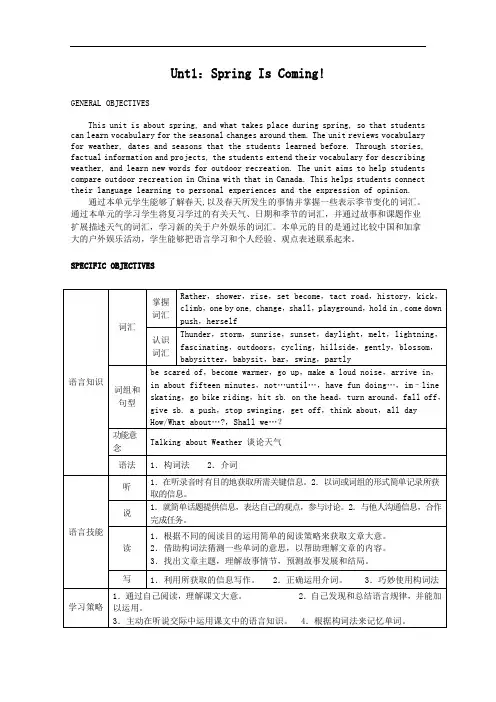
Unt1:Spring Is Coming!GENERAL OBJECTIVESThis unit is about spring, and what takes place during spring, so that students can learn vocabulary for the seasonal changes around them. The unit reviews vocabulary for weather, dates and seasons that the students learned before. Through stories, factual information and projects, the students extend their vocabulary for describing weather, and learn new words for outdoor recreation. The unit aims to help students compare outdoor recreation in China with that in Canada. This helps students connect their language learning to personal experiences and the expression of opinion.通过本单元学生能够了解春天,以及春天所发生的事情并掌握一些表示季节变化的词汇。
通过本单元的学习学生将复习学过的有关天气、日期和季节的词汇,并通过故事和课题作业扩展描述天气的词汇,学习新的关于户外娱乐的词汇。
本单元的目的是通过比较中国和加拿大的户外娱乐活动,学生能够把语言学习和个人经验、观点表述联系起来。
SPECIFIC OBJECTIVESLanguage knowledge﹡Master these words and phrases : rather, shower, rise, set﹡know these words and phrases: thunder, storm, sunrise, sunset.Class OpeningWelcome the students to come back to school. Introduce the new lesson and new students, Ask the students these questions : How is their winter holidays? Have they been anywhere? How did they spend the spring festival? what is the date today?What day is it today? What season is it? What is the weather like today? What is the temperature? Who is on duty today?Key Steps :Step 1 Ask the students to discuss the questions in “ Think About” If it is possible to show some pictures about different seasons.Step 2 . Let the students listen to the tape of the dialogue carefully with the following questions:What’s the weather like today? What’s the degree?Did Danny tell us what time the sun would rise and set?Step 3. Ask the students to read the dialogue several times in groups of three.Then ask them to act out the dialogue in groups,Step 4. Class Activity – Weather Map In this activity, Students will listen to the tape and make a weather map. Before this draw a simple map includes a city,a lake, the edge of the ocean, some mountains on the blackboard. Listen and draw.Class Closing :1) Ask the student to listen to the radio or watch TV for the next twenty-fourhours and write a weather report in English for at least eight cities.2) The next readingLesson 2 It’s Getting warmer.Language knowledge﹡Master these words and phrases : become ,fact﹡know these words and phrases: daylight , melt lightning, fascinating, go up, make a loud noiseClass OpeningAsk the student to read their weather report that they wrote according to the CCTV weather report. Then ask the same questions like yesterday.Key steps:Step1 Lead in such way : Ask How did they spend the spring festival? Was it cold during the Spring festival? Then say , “In today’s lesson, we will go on talking about the weather in spring. Can you name the four seasons in English? Ask the students to discuss and talk about the “Think About It” .Step2 Ask the students to read the text silently with the questions of exercises1 on activity books .Step3 Play the tape and ask the students to listen and read after the audiotape twice .Answer the questions to see if they can understand the text .Read the text one sentence by one sentence single. Then explain the problem they have. Pay attention to the phrases become warm , make a loud noise and so on.Step 4 Divide the students into two groups to do “ let’s do it “Step 5 Do some exercises on the activity books .Class closingread the text.The next readingLesson 3 Postcards!Language knowledge﹡Master these words and phrases : road, history, kick﹡know these words and phrases: outdoors, cycling, not…until…, have fun doing , in –line skatingClass OpeningAsk the students these questions : How is their winter holidays? Have they been anywhere? How did they spend the spring festival? what is the date today? What day is it today? What season is it? What is the weather like today? What is the temperature? Who is on duty today?Then read the text of lesson two and check the words and phrases they learned before two days.Lesson 4. Sun is rising.LESSON PREPARATl0NLANGUAGE KNOWLEDGE⊙掌握词汇及短语:climb,change,one by one⊙识别词汇及短语:hillside,gently,blossomLANGUAGE NOTES1.Weather is warming,…天气变暖和了,warm在这里是动词“变暖”的意思。
冀教版英语八年级下册教案(全册)
Unit 1Spring is Coming!Lesson 1: How’s the Weather ?(two periods)教案Teaching Content:Mastery words and expressions: rather, shower, rise, rose, risen, setOral words and expressions: thunder, storm, sunrise, sunsetTeaching Aims: Talking about the weatherTeaching Important Points:1.Describe the weather in spring;2.Talk about the temperature.Teaching Difficult Points:Describe the nature phenomenon.Teaching preparation: the pictures of springTeaching Aids: audiotape; flashcards; picturesType of lesson: new lessonTeaching Procedure:一、温故知新。
Check some words and phrases .二、激情导入。
Lead inFree talk:1.What weather do you like? Why or why not?2.What sports can you do in this season?三、新课学习。
Step 1: Showing the teaching aims on the blackboard and asking students to read them together.1.Remembering some new words and phrases of lesson 1 work in group.2.Talking about seasons.3.Understanding the dialogue meaning.Step2. Come to “THINK ABOUT IT”Let the students work in groups and answer the following questions:1.Look outside. Wh at’s the weather like today?2.How does this weather make you feel?Step3. Listen to the tape and answer the following questions:1.What’s the weather like today?2.It is snowing, isn’t it?3.what’s the temperature?4.Is it going to rain today, isn’t it?Step4. Read the text and check the answers. Read the text in roles.Step5. PracticeWork in three students. Suppose you are a weather reporter. Now report today’s weather to the others in your group. Then report it to the class. Step6. PracticeMake up a dialogue between two or three students in class. It is about the weather in spring. Let some students act it out before the class.四、达标训练,作业布置。
初中英语冀教版八年级下册教案
初中英语冀教版八年级下册教案推荐文章八年级上册英语重要常考知识点热度:仁爱英语八年级下册期末试卷热度:仁爱英语八年级下册课文翻译2017 热度:外研版八年级上册英语教案热度:初中生八年级上册英语教学计划热度:英语教案本身所包括了教学组成部分、教师教学安排、教学手段与方法和教学时间等。
下面是小编为大家精心整理的初中英语冀教版八年级下册教案,仅供参考。
初中英语冀教版八年级下册教案范文Lesson 57: Let’s Clean Up!Teaching Content:Mastery words and expressions: yard, rubbish, pick up, bit, a bit of, bigOral words and expressions: garbage, pollution, finish doing, get to workTeaching Aims:1. Let the students understand to protect our environment is our duty.2. We should keep our school yard clean.Teaching Important Points:1. Know how many ways we can say “garbage”.2. Talk about the destroy of the rubbish.Teaching Difficult Points:Some words and expressions, such as: pick up, clean up Teaching Preparation: picturesTeaching Aids: audiotape, flashcards, picturesType of lesson: new lessonTeaching Procedure:Step1. Come to “TALK ABOUT IT.”Step2. Show the new words to the students. Let the students read the words first. Then let them read after the tape.Step3. Listen to the tape and do Exercise 3 in activity book. Step4. Read the text and check the answers silently. At the same time, answer the following questions:1. Where are Jenny, Brian and Danny?2. How’s the weather?3. What do English people call “rubbish”?4. What is Jenny studying in class this week?5. What does the teacher think of Jenny’s idea?Step5. Read the text in roles loudly. Then let some students act it out in front of the class.Step6. PracticeExplain some language points to the class. Then ask the students to make up sentences with them.1. But look at all of the rubbish!2. Somebody should pick up that garbage!3. It would take too long.4. Each student could clean up a bit of the school yard.5. We would finish cleaning in an hour.Step7. Come to “LET’S DO IT.”Work in teams with three or four people. Let some students act their dialogue out in front of the class.Step 8. Homework1. Finish off the exercises in activity book.2. Go on the next reading in the student book.Summary:This lesson is close to our life. Try to take the students out of the classroom and show the garbage to them. Then let them saywhat they feel about the garbage. Ask them to act the dialogue out in the school yard. 冀教版英语八年级下册第八单元教案Lesson 57: Let’s Clean Up!Teaching Content:Mastery words and expressions: yard, rubbish, pick up, bit, a bit of, bigOral words and expressions: garbage, pollution, finish doing, get to workTeaching Aims:1. Let the students understand to protect our environment is our duty.2. We should keep our school yard clean.Teaching Important Points:1. Know how many ways we can say “garbage”.2. Talk about the destroy of the rubbish.Teaching Difficult Points:Some words and expressions, such as: pick up, clean up Teaching Preparation: picturesTeaching Aids: audiotape, flashcards, picturesType of lesson: new lessonTeaching Procedure:Step1. Come to “TALK ABOUT IT.”Step2. Show the new words to the students. Let the students read the words first. Then let them read after the tape.Step3. Listen to the tape and do Exercise 3 in activity book. Step4. Read the text and check the answers silently. At the same time, answer the following questions:1. Where are Jenny, Brian and Danny?2. How’s the weather?3. What do English people call “rubbish”?4. What is Jenny studying in class this week?5. What does the teacher think of Jenny’s idea?Step5. Read the text in roles loudly. Then let some students act it out in front of the class.Step6. PracticeExplain some language points to the class. Then ask the students to make up sentences with them.1. But look at all of the rubbish!2. Somebody should pick up that garbage!3. It would take too long.4. Each student could clean up a bit of the school yard.5. We would finish cleaning in an hour.Step7. Come to “LET’S DO IT.”Work in teams with three or four people. Let some students act their dialogue out in front of the class.Step 8. Homework1. Finish off the exercises in activity book.2. Go on the next reading in the student book.Summary:This lesson is close to our life. Try to take the students out of the classroom and show the garbage to them. Then let them say what they feel about the garbage. Ask them to act the dialogue out in the school yard.八年级英语复习题完型填空(10分)阅读下面短文,根据短文内容从每小题A、B、C、D中选出能填入空白处的最佳答案。
冀教版八年级下英语教案设计(新)

冀教版八年级下英语教案设计(新)冀教版八年级下英语教案设计会宁甘沟中学:王岚Unit 2 Lesson 13 why are plants important?【课题】: why are plants important?【教材与学生分析】本教材充分吸收了国际上新的外语教学理念和实践经验,以人物的活动为主线,围绕最基本最常用的词汇、句型逐步展开教学,有丰富多彩的练习形式和文化背景,把探究学习引入教学中使学生能主动的融入创造性有意义的整体性学习中.现在初二的学生对于英语学习应该具有一定的基础和方法,但我们所处在山区农村中学,从初一才开始接触英语,所以对于英语的学习还没有掌握好的方法,学生在学习中还存在许多问题。
就这一班学生来说已有一定的英语的基础,但还不能在英语学习中运用灵活运用,所以课堂中老师应尽可能多的运用多种教学方法来引导学生学习。
【教学目标】:语言知识:掌握本课的单词及植物植物在我们生活中的重要作用。
语言技能:在听录音时有目的的获取所需关键信息。
语言运用:能通过学习本课的对话简单的复述课文,加强对本课的阅读、理解。
情感态度:能通过谈论植物的重要性,让学生掌握植物在生活中的重要作用,并且让学生树立爱护植物的思想。
Teaching Aims:A: Learn the importance of the trees.B: Learn to how to express the usage of the trees. Learning aims:1. Remember the new words: air, energy, die, heat, nothing, bamboo, kilogram, shade, carry away, make…into.2. The important sentences:①Trees help clean the air.②Donuts don’t grow on the trees!③All plants take energy from the sun and make it into food.④Without food, they would have nothing to eat and they would die.Language Focus:1. Trees can help clean the air.help…(to) do sth. / help …with sth. 帮助…做…2. Donuts don’t grow on trees!on the tree (on trees) 与in the tree (in trees):on the tree (on trees): “在树上”,指树本身所长的东西,如树叶,花等。
超级资源(共48套125页)冀教版八年级英语下册(全册)精品教案(word版,已编辑好)
超级资源(共48套125页)冀教版八年级英语下册(全册)精品教案(word版,已编辑好)Unit 1 Spring is coming!Lesson 1 How’s the weather?本节课是冀教版初中英语八年级下册第一单元lesson1,功能话题是谈论天气;文本结构是对话;语法重点是初步认识合成词,并能够运用将来时态预测天气,以及正确使用will写简短的天气预报。
因此,在新课标理念、教材内容以及任务型教学法理论的指导下,本节课教学设计如下【知识与能力目标】The words and phrases: shower; thunderstorm; thunder; sunrise; sunset; rise; set; exact.【过程与方法目标】①What’s the weather like today?②What’s the temperature?【情感态度价值观目标】Listen, say, read and write.【教学重点】1. What’s the weather like today? It’s cold, cool, warm.2. What’s the temperature? It’s ten degrees.3. be scared of sb./sth.4. There will be…=There is/are going to be…【教学难点】1. What’s the weather like today? It’s cold, cool, warm.2. What’s the temperature? It’s ten degrees.3. be scared of sb./sth.4. There will be…=There is/are going to be…图片,PPT1.课堂导入:通过小小预报员引出“天气”话题“Do you want to be a reporter? Can you talk about the weather in English? ”给学生设置任务“用英语谈论天气”,进而引出本课的语言主题“天气”。
最新最全冀教版英语八年级下册全册教学课件

have a look
1. Good morning, everyone. 2. It will be snowy and hot. 3. It’s not snowing, but it is cloudy. 4. There will be a shower this afternoon.
Maybe there will be a thunderstorm. 5. Now talk about the sunrise and the sunset.
2021/4/12
1. Good morning, everyone. every+one=everyone 2. It will be snowy and hot. snow+y=snowy 3. It’s not snowing, buhunder n.雷(声) sunrise n.日出 sunset n.日落
rise v.&n.升起,上升,增加 set v.落沉,放置,制定 exact adj.精确的,准确的
2021/4/12
Now let’s listen to a dialogue, and tell me what’s the weather like on the radio.
2021/4/12
Presentation Learn some new words.
What’s the weather like in spring? It’s warm. It’s sunny. sun +ny sunny
2021/4/12
It’s hot. Sometimes it’s rainy.
2021/4/12
Fill in the blanks.
全新冀教版八年级英语下册教案(全册 共114页)
全新冀教版八年级英语下册教案(全册共114页)目录Unit 1 Spring is coming! Array Lesson 1 How’s t he weather?Lesson 2 It’s getting warmer!Lesson 3 The sun is rising!Lesson 4 The Spring CityLesson 5 Babysitting on a Spring DayLesson 6 Stories about springUnit 2 Plant a PlantLesson 7 Planting treesLesson 8 Why are plants important?Lesson 9 Gardening with MaryLesson 10 Make your garden grow!Lesson 11 Amazing plantsLesson 12 Danny’s plantUnit 3 Animals are our friendsLesson 13 Danny’s big scareLesson 14 Amazing animalsLesson 15 The zoo is openLesson 16 The Bear EscapedLesson 17 Save the tigersLesson 18 Friendship between animalsUnit 4 The Internet Connects UsLesson 19 How Do You Use the Internet?Lesson 20 A computer helpsLesson 21 Books or computers?Lesson 22 Travel on the InternetLesson 23 The Internet-Good or Bad?Lesson 24 An Email to GrandpaUnit 5 Buying and SellingLesson 25: Raising MoneyLesson 26 Cookies, Please!Lesson 27 Business EnglishLesson 28 Ms. Liu’s Great IdeaUnit 1 Spring is coming!Lesson 1 How’s the weather?◆教材分析本节课是冀教版初中英语八年级下册第一单元lesson1,功能话题是谈论天气;文本结构是对话;语法重点是初步认识合成词,并能够运用将来时态预测天气,以及正确使用will写简短的天气预报。
冀教版新课标八年级英语下册教案
冀教版新课标八年级英语下册教案英语教案的教学设计直接决定了是否能够上好一节英语课,下面是小编为大家精心整理的冀教版新课标八年级英语下册教案,仅供参考。
冀教版新课标八年级英语下册教案范文一、教材依据: Unit1: Spring is coming!Lesson 4: The Spring City二、教材分析:本单元围绕春天展开中心话题,描述了春天的天气和户外活动,加强了同学们对异国文化的了解和对祖国文化的热爱提高了学生学习英语的兴趣。
三、学情分析:现在初二的学生对于英语学习应该具有一定的基础和方法,但我们所处在山区农村中学,从初一才开始接触英语,所以对于英语的学习还没有掌握好的方法,学生在学习中还存在许多问题。
对于所学句子还不能在平时灵活运用,所以课堂中老师应尽可能多的运用多种教学方法来引导学生学习。
四、教学目标:1、知识与技能目标掌握本课的单词,了解春城——昆明的美景,并能在听听录音时,有目的的获取所需关键信息。
2、过程与方法目标通过听录音,自读及小组合作的方法学习课文,让学生热爱春天,热爱大自然!3、情感态度与价值观能通过谈论春天的天气,温度,空气和植物,让学生了解春天,热爱春天,了解异国文化和祖国文化的差异,拥抱大自然!五、教学重难点1、单词2、短语及语法六、教法与学法小组讨论、合作探究、教师指导七、课型新授八、教学过程Step 1.Lead-inA warming-upA sayingStep 2.pictures show and new words, then, listeningShow some pictures about spring and learn the new words by playing a game, the do the listening about the text and answer one simple question.What is the spring city?It’s Kunming.Step 3.ReadingAsk several students to read the text and pay attention to the new words, the students read it again, and discuss together about the four questions in “Let’s Do It.part1”Step 4. ListeningDo the listening in “Let’s Do It!”part2, listen to it twice, and then invite some students to answer them.Step 5.DiscussingDivide the class into small groups; write the following words on the blackboard:Air /weather/ plants/ and outdoor activities.Step nguage points1. feel like /sound like / smell like / taste likefeel like doing sth.2. because and because ofBecause +句子Because of + n./pron./doing3. hundreds of /基数词+单位名词(hundred /thousand/million/billion)4. think of =consider5. all over the world =around the world6. all year round7. plenty of=a lot of =lots of8. long for= look forward toStep 6.Homework1、Write a short passage about spring in your hometown2、Preview Lesson 5Step 7.Summary:Review the text is very important. The students know what they will take to the class, what is useful to the study. Let them to talk about The Spring City. --- Its air, weather, plants and the outdoor activities in spring.九、板书设计:Lesson 4: The Spring CityAir weather plants and the outdoor activities十、教学反思:本节课在前几节课学习的基础上进一步来学习春天,通过运用多媒体向学生展示了春天的景色。
八年级英语下册 Unit1--Unit4单元教案 冀教版
Unit 1 Me and My ClassLesson 1 Li Ming Is Back to SchoolⅠ.Teaching content:1. New words and phrases: grade, student, class, pupil, cousin; be back, have lessons/classes2. Introduce yourself and your schoolⅡ.Teaching goals1. Learn new words: back grade, student, class, pupil & cousin2. Make sure the Ss can introduce themselves and their school3. Talk about the differences between schools in China and other countries. Ⅲ.Key points:1) Some new words and phrases2) Introduce a school by mailⅣ.Difficult points: Compare schools in China and CanadaⅤ.Preparation: some word cards, picturesⅥ.Teaching resources: recorder, pictures or cardsⅦ.Type of the lesson: listening and speakingⅧ.Teaching procedure1: Class opening1)Teacher’s and Ss’ self-introductions.T: I’m your (new) English teacher from today. My name is …. You can call me Mr./Ms.x. I’m glad to learn English with you. I hope to be your friend, so I want to know you now. Please introduce yourself to me. Who wants to be my first friend?S1: My name is Wang Wei.T: Good, thank you Wang Wei. You are a handsome boy. .S2: My name is Li Xiaohua.T: Very good. Glad to get my second friend. Thanks, Xiaohua. Your red skirt is so beautiful. I like red very much. Where are you from?…(The teacher can ask Ss some other questions, such as: How old are you? Do you like Englis h? What’s your favorite color? etc. but do remember to praise each student for whatever he/she says in English.)2)Lead in today’s new lessonT: After you introduced yourselves, I have known some of you. Now I want to know something about our school. Who can tell me? Is it big?S3: Yes, It’s very big.T: oh? How big is it?S4: Every grade has 8 classes.T: Wow, yeah. It’s quite big. Then we have 24 classes (the teacher can pause a little here , waiting for the Ss speak together) altogether. Very good, Who can tell me how many students in our class?S5: Forty-eight.T: Thank you, S5. You know our class well. How many girls in our class?S6: twenty-five.…T: Thank you all for telling me about our school. Who knows schools in some other countries? For example, in Canada, their schools are bigger or smaller? You can guess the answer. Who wants to have a try?S7: bigger?T: Good! A nice try. Thanks.S8: I think, smaller.T: Good, it’s a different answer. Thank you. We’ll get the answer after we learn this lesson. Please turn to Page 2 of your textbook. We have more questions to discuss.2. New lessonStep 1: Ask the Ss to discuss the questions in “Think About It.”Take the first question as an example:T: Have you changed over the summer holiday? S9, what about you?S9: Yes, Mr/Ms.x. I’m taller. I often went swimming with my brother.T: Swimming is good exercise in summer. What about others?S10: I’m thinner but taller. I played football everyday with my friends.S11: I’m sorry to say I’m fatter now. I like watching TV at home in the summer holiday.…Step 2: Listening and answering:A) Listen to the tape (of the first e-mail) with some questionsT: We’ve talked about our school and class. Next, let’s listen to Li Ming’s e-mail then you can know schools in Canada are bigger and smaller. Please listen carefully and answer the following three questions:1) Where did Li Ming write the letter/mail?2) How many pupils are there in Li Ming’s class?(Play the tape )T: Jenny is in Canada. Do you think schools in Canada is bigger or smaller? Ss: (together) smaller.T: Very good. S12, answer question 1, please.S12: (Li Ming wrote the letter) In China.T: Good, S13, How many pupils are there in Li Ming’s class? Do you know “pupils”? Yes, “pupil” means stud ent.S14: There are fifty pupils in his class.T: Right, very good.B) Listen to the tape (of the second e-mail) and answer the following question. (Do the same as in section A)Who will come from the U.K.?Step 3: Reading and discussingA) Fast readingT: Read the two e-mails fast and silently. Then let’s discuss more about them. Here are some more questions:1) Who is the e-mail from and to?2) What can you learn from the two e-mails?3) Do you like schools in Canada?4) Do you going from room to room for your class? Is it good exercise?5) Who is Brian in the second mail? How old is he?…B) Second reading and further discussingT: Read the text a second time. Then we’ll have a further discussion in groups of 4 students. The question for you is: What are the same or different things between the schools in China and Canada. I’ll give you 5 minutes to discuss. Then you should report your discuss to our class.(Five minutes later, collect the result of their discussion.)T: group 1, what are the same things between the schools in China and Canada?S15(from group 1): There are classrooms in all the schools.T: Good! Anything else? Group 2?S16 (from group 2): There are many teachers.T: Very good! What’s the different things then?S17(from group 3): Schools in China are bigger.S18(from group 4): Every teacher has a different classroom in Canada.S19(from group 5): Students in Canada go from room to room for their lessons. Students in China have class in one room.S20(from group 6): In Canada, there are more teachers in their schools.School begins at 8:30 in Canada, later than in China.…Step 4: Answering questionsEncourage the Ss to ask questions about the text, including the meaning or usage of the new words and phrases in this lesson. Explain to the students and make notes on the blackboard. (see the explanations in the attached reference materials) Step 5: “Let’s Do It” sectionT: It’s our new school term. It’s our first lesson today. Then let’s talk about the new term. Look at the qu estions in “Let’s Do It!” and talk more.3 question you’ll get: What is the same in the new term? What will be different? What will you do differently?Step 6: Homework1) Write an e-mail to your friend2) Finish off the exercises in the activity book3. Class closingSum up this lesson and end it.T: Today we learned two e-mails. There are some new words and phrases we should remember: grade, student, class, pupil, cousin; be back, have lessons/classes. We also know about the differences between schools in China and Canada. Please practise writing an e-mail to your friends after class and finish your homework. That’s all for today.lesson 2 Many Faces, One PictureⅠ.Teaching content:1. New words and phrases: photo, look like (four skills) ; photograph, wish2. Likes and dislikes3. The Simple Present Tense (positive and negative forms)Structures: I like…/ I don’t like…Ⅱ.Teaching goals1.Master some new words and phrases: photo, look like, take pictures/photos2.Get to know some other words: wish, photograph3.Learn to express likes and dislikes1. Master the negative form of the Simple Present TenseⅢ.Key points:1) look like2) likes and dislikesⅣ.Difficult points: Express one’s dislikes: I don’t like…Ⅴ.Preparation:1) One photo of you2) Some real things such as a banana, a book and some clothes3) Some cards with words of describing yourself4) A big piece of paper and glueⅥ.Teaching resources: recorder, tape , some cards, a big piece of paperⅦ.Type of the lesson: listening and speakingⅧ.Teaching procedure1: Class opening1) Greet the students and check the homeworkT: Hi/Hello/Good morning, everyone/class! How are you today? It’s a beautiful day, isn’t it?Ss: Yes, it’s sunny.T: Ok, Let me check your homework first.(a few minutes later)2) Prepare for the new lessonT: let’s try to remember what we learned yesterday. We talked about Li Ming’s school. In this lesson, we will talk about something new.(Take out the banana, book and a piece of clothes of the bag)T: Can anyone guess why I have brought these things? What is the connection between these things? Please guess. Look, this is my red blouse, I’ve to ld you I like red very much. And the book, it’s my birthday present last year. Yes, this is a banana.I often buy bananas because I like eating bananas.Ss: You like all of them!T: Very good, you got it!2. New lessonStep 1: lead in(Show the three things )T: These are the things I like best. Next I want to know more about you.Step 2: Discussion before the new lessonT: Look at the questions in “Think About It!” and discuss about them. (introduce the questions to the Ss and give them five minutes to discuss)T: All right! Time for me to know how well you know about your friends. S1, who is your best friend?S1: Wang Gang.T: What do you know about him?S1: He likes basketball very much.T: What about you, S2?S2: My best friend is my cousin, she likes school.T: Good! S3, talk about the favourite photo of yourself, please. When was it taken? S3: Just in the summer holiday.T: Good! What about you, S4? When was your favourite photo taken? And where?S4: It was taken in Beijing last year. My father took the photo for me.Step 3: Discussion about the picture in the textbookT: Look at the picture in your books and let’s talk about it: what is in the girl’s hands? What is she doing?(introduce the word “wish” to the students and make sure they know the me aning of “photo”)Step 4: Further discussionAsk about the title of this lesson: Why is the lesson called “Many faces, One picture?”Step 5: listen and find the answerAsk the Ss to listen to the tape and find the right answer; the answer is in the text. Check the answer with the Ss:Answer: Everyone brings a photo of him or her. We put them together and make a big picture of our class. There are many faces of the students in the big picture. Step 6: Project 1: Make a class pictureMake sure the Ss understand what they must do in the project. Explain what a collage is. (in Chinese if necessary) A collage is a picture made of many little pictures. T: Draw a picture of yourself if you don’t have a photo. Write down at least three sentences about yourself on a small piece of paper. That’s your name card. Of course, our cards are better.(After a few minutes, Ask several Ss a few questions to help them describe themselves.) The questions can go like this:1. What is your name?2. How old are you?3. How tall are you?4. What are you wearing in your picture or photograph?5. What do you like to do?6. Where do you live?(The class will make a collage.T: First, work in pairs please! Ask your deskmate questions about themselves. Then ask other members in your group similar questions.(Let the Ss find their own partner to practise. Using the sentences in their cards. Encourage the Ss to read what they have written down. Then use their own words.)T: Now, it’s the time for us to introduce you r partners to out class now. S5, introduce your classmates, please.(After the Ss’ introductions, ask them to glue the pictures to a big sheet of paper for the whole class. Several Ss can glue at the same time.)At the end, the class has a collage! Post the collage in the classroom or the halfway for everyone to see.Step 7: Homework1) Read the text in Lesson 2Do the remaining exercises in the activity bookLesson 3 Getting to Know You!Ⅰ.Teaching content:1.New words and phrases: Miss, married/be married, either, glad, really, also, dislike, hate, interest, violin, music, comb2.Likes and dislikes2. I don’t know her.She doesn’t like purple.What does she hate to do?What foods do you love?Ⅱ.Teaching goals1.Learn the usage of the following new words: Miss, married/be married, either, glad, really, also, dislike, hate, interest, violin, music, comb2. Learn how to express likes and dislikes (oneself and others)3. Consolidate the usage of the negative question form of the Simple Present Tense Ⅲ.Key points:I want to talk to SandraI don’t know her, either.I like donuts bestⅣ.Difficult points: Express one’s dislikes: I don’t like…,either.What do you hate?Ⅴ.Preparation:1) Draw some pictures or find some pictures for the characters in this lesson: Danny, Jenny, Miss Cox and Brain.2) Write down the key new words on cards.1) A rubber toy of dinosaurⅥ.Teaching resources: recorder, tape , word cards, some picturesⅦ.Type of the lesson: listening, speaking and readingⅧ.Teaching procedure1. Class opening1) Greet the Ss in everyday English. Help them respond in correct way.2) Correct the exercises of activity books3) Ask “Who’s on duty?” Listen to the students’ report. They may talk about the date, the weather, their favourite colour, book , sports or film. Give them words and expressions when necessary to help them.4) Draw a picture “an unhappy artist” on the blackboard.T: Look at the “long” face of the artist. He is unhappy, yes? When is he unhappy? Guess the reason, pleaseGive the Ss a few minutes to talk about the reason in order to start the new lesson.2. New lessonStep 1: lead inT: Do you like watching TV? I like some programs very much. For examples, “Talking Straight” (shihua shishuo ) and “Sons and Daughters of the East” (dongfang zhi zi). Do you like them? The project you are going to do is to interview each other. You can ask your classmates many questions just like the hosts or hostess do in the TV programs, such as Wang Xiaoya, Li yong and so on. Of course, you have to use English! But it’s fun! I’m sure you will like it.Step 2: Listen and find use informationT: Listen to the tape please and find the answer of this question: Who does Danny want to interview?(show the rubber dinosaur and draw so me “tears” on its face)T: These are Danny’s tears. Do you like dinosaurs? (Yes!) but Danny is unhappy now. Do you want to know the reason? Read the text on Page 4 with the title of “She’s so Beautiful!”Step 3: Read and discussAfter the Ss read the text fast and silently, let the Ss discuss the following question:Why is Danny scared? ( Because he wants to talk to Sandra)Do you think Danny and Sandra will become good friends? Why? (Yes, they will become good friends. Because girls like dinosaurs and they have a nice talk to each other) What is Sandra like? (She’s beautiful.)Check the answers with the whole class.Step 4: Further reading and further discussionT: Read the text a second time and have a further discussion about it. Answer more questions about it.1) Do they like Miss Cox’s surprise in their English lesson?2) Why can the students call their English teacher “Miss” Cox?3) What colour does Sandra love?4) What does Sandra dislike?5) What are Sandra’s interests?Step 5: Explain some new words and phrases (see Text Explanation of Lesson 3) Step 6: Project 21) T: It’s a interview project. So you can be the host or hostess now. You can ask any question that you are interested in. Let’s prepare some small cards for the interview first.2) Guide the Ss to make interview cards like this:Interview Chart 1Help the Ss remember some useful words for the charts. such as “food” , “clothes”, “animals” and “colours”. List the verbs that students know to fill in the charts. Examples of possible questions and answers:Q: What is your favourite ?A: My favourite is .Q: What do you love/hate to do?A: I love /hate to .Q: Do you like to ?A: Yes, I like to / No, I don’t like to . Q: What do you like best about your school?A: I like best.Q: Who is your best friend?A: is my best friend.(Have Ss find a partner and take turns interviewing each other.)T: Ask your partner those questions and write down their answers. Then fill in your charts.(If time permits, collect the Ss answers and talk about the results of their interviews.)3. Class ClosingT: Practise your likes and dislikes after class, It’s your oral homework and don’t forget the written homework in your activity books. Let’s call it a day. Bye, boys and girls!Lesson 4 On a School DayⅠ.Teaching content:1. New words in this lesson:A:jeans,weekend, wool, cotton, blouse,be made of (four skills) B:round/all year around,iron,tidy (get familiar with them)2. weather and clothesⅡ.Teaching goals1. Master the news in this lesson: jeans,weekend, wool, cotton, blouse,be made of2. Talk about weather and clothes3. Learn the English songⅢ.Key points:He wears pants on a school day/ blue jeans on the weekendSomething different all year aroundⅣ.Difficult points: Wear diffe rent clothes in different weathersⅤ.Preparation:1) Prepare some clothes in different seasons: some in winner against cold,some in summer for keeping cool;2) Some color chalks; Some pictures with different clothes3) Draw some sketches of typical clothes in 4 seasons of a yearⅥ.Teaching resources: word cards, some pictures,some clothes,slide projector Ⅶ.Type of the lesson: listening, and singingⅧ.Teaching procedure1. Warming up(Singing “Good morning ”song, whose tune is from “Happy birthday ”song. Teacher entered the classroom. )T: Do you like singing? Who can sing a song for us? What about English songs? Introduce some famous but simple songs to the Ss such as “Twinkle stars”, “Jingle bell”, “Mary has a little lamb”, etc. Who ca n sing a song for us?(Maybe most of the Ss can only sing some Chinese songs. It doesn’t matter, praise the Ss who have sung to get them excited. It’s good for today’s lesson)T: Yeah, you can sing Chinese songs very well. Today let’s learn an English song, then you can sing to your parents in future. But what kind of songs do you like?2. New lessonStep 1: lead inT: What’s the weather like today? What clothes are you wearing on school days or on the weekend? There’s a song about it. Would you like to learn the song? (show the Ss the clothes and the word cards to prepare for learning the new words about clothes. Make sure they know the meaning of the song)Step 2: A quick review about clothes wordsReview some old words for clothing, then learn the new words in this lesson: blouse, jeans, be made of, cotton, woolStep 3: Read and understandT: Let’s read the lyrics of the song. Pay attention to the new words we learned just now. Notice the rhyme, rhythm and repetition in the song. (It’s a good preparation for learning the song fast)Step 4: Explanation1) Explain the meaning of the lyrics, especially some sentence structures. Also help Ss to group words in the song. For instance: He wears pants / on a school day, Bluejeans / on the weekend, something different / all year around.1) Ask some questions about the song to make the Ss under it wellWhat does he wear on a school day? (Pants)Does he wear pants every day? (No, he wears blue jeans on the weekend)What is his clothing made in winter? (wool)Does he always wear the same clothes all year around? (No, he wears different ) Step 5: listen and learnT: Now let’s listen to tape. You can just listen for the first time to get the tune. Then sing in a low voice with the tape.Step 6: Practise singingAsk the Ss themselves after having listened to the songs for several times. Then listen to the tape once again. Select one particular student who sings well to be an example or lead to sing for the other students.Step 7: DiscussionDon’t miss the “speech bubbles”! Talk about them with the students. Ask questions like these:Do boys wear dresses? (No, girls wear dresses.)What’s in the girls hands? ( A sweater.)Do you love sweaters?Do you like its colour? What’s your favourite colour?3. Ending class1) Homework: finish the remaining exercises in activity book2) Learn the song after classPrepare another song to share with class next lesson for singing.Lesson 5 The Best ClothesⅠ.Teaching content:1. New words and expressions:A:anymore/not…any more, gray=grey, paint , very much, voice, silly, classmates(four skills) B:backpack(get familiar with them)C: names of persons: Peter, Gina(read)2. Likes and dislikes about clothesⅡ.Teaching goals1. Learn to use the new words and phrases: anymore/not…any more, gray=grey, paint , very much, voice, silly, classmates2. Learn to make comments on clothes3. Sentences structures about comments on clothesⅢ.Key points:I don’t like this pair.What did you do to your runners?They look silly.Krista could not think of an answer.Ⅳ.Difficult points:1) The right attitude towards new clothes2) be friendly to classmatesⅤ.Preparation:Prepare a new pair of shoes and old ones and a big paper for a sketch of a dress Ⅵ.Teaching resources: a big piece of pa per, some marks and paints, a pair of old shoes.Ⅶ.Type of the lesson: reading and comprehendingⅧ.Teaching procedure1. Class opening1) Make the class warm by singing the song “On a school Day” together with the students.2) Check up their homework in the activity book. Give them some explanation when necessary2. New lessonsStep 1: Lead inT: Today let’s continue to talk about clothes. Look at my old shoes. Oh! They are gray, really too old. I like new clothes and shoes. What about you? I also have some nice pictures here for fashionable clothing. (show the pictures to the students.) Step 2: Discussion in “Think About It!”T: We’ve got some questions to discuss in “Think About IT!” Read though all the questions and discuss with your par tners. I’ll give you 5 minutes in this section. (Five minutes later, check out Ss’ results of discussion)Step 3: Listen and get key pointsT: Listen to the recorder, please. And answer two questions after that.Q1: Who told Krista to paint her shoes? (Peter)Q2: Who said Krista’s shoes were silly? (Gina)Step 4: Read and understandT: Read the text fast and silently by yourselves then have a discussion about the story. There are more questions for you:1) What do Krista’s runners look like? (They are o ld and gray.)2) What does Krista do to her runners? (She paints her runners with marks and paints.)3) Is Gina Krista’s good friend? (No, Krista doesn’t like Gina.)4) Why does Gina laugh at Krista? Is it right? (Because Krista paints her shoe s and they look silly. No, it’s wrong to laugh at others.)Step 5: Further discussionT: Discuss the story more deeply. Think about the two questions:1) If you were Krista what would you do? (suggested answer1: If I were KristaI wouldn’t paint my sh oes. I will just keep them clean and take good care of them. We feel very comfortable when wearing old shoes. Suggested answer 2: I would also paint my shoes. Because I think it’s funny to make old shoes have a different color.)2) If you were Gina wha t would you say when you see Krista’s painted shoes? (suggested answer 1: If I were Gina I would say :”Hi, Gina, you did a good job. Your runners look so nice now.” suggested answer 2: If I were Gina I wouldsay :”Please buy a pair of new shoes. Old one are still old after painted ”) Step 6: Meaning of the storyT: Read the text once again, please. Try to get the meaning of the story. Then discuss what’s the right attitude towards appearance and classmates.Step 7: “Let’s Do It!” sectionT: Let’s see what we should do in this part.11) Find the reason why Krista wants to cry. Does it recall the similar feeling when you feel embarrassed? Did the feeling last a long time?2) Guess how the story will go without reading the second part in the Reader. Read it for your partner and check whether your guess is right or wrong.3. Class closingT: let’s see our homework for today.1) The third reading in the reader2) Other exercises in the activity book3) The next reading in the students bookSometimes we not only get fun from some stories but also significant experience. “Reading makes a wise person.” So let’s enjoy reading and leaning. Have a nice day. Bye for now.Lesson 6 Meet Ms. LiuⅠ.Teaching content:1.New words and phrases: A: Mr./ Mrs./ Ms. , special, husband, piano, singer, nervous. ( used freely) B: finish, introduce, English (for oral English)1. Introduction of a teacherⅡ.Teaching goals1. Master the new words: Mr./ Mrs./ Ms. , special, husband, piano, singer, nervous.2. Learn how to introduce a teacher.3. Some useful expressions: using Mr./Mrs./Ms. in the correct wayⅢ.Key points:Now he is ready to introduce someone to the classI talked to someone very special.Walking to school in January.Don’t be nervous.Ⅳ.Difficult points: How to present a good introduction of a teacherⅤ.Preparation:1. Write down the key new words on cards.2. Prepare something in our daily life or draw some pictures3. Find some photos of famous hosts or hostesses in magazines, like Wang Xiaoya, Li Yong and so onⅥ.Teaching resources: photo, word cards, some pictures, recorder and slide projectorⅦ.Type of the lesson: speaking and practisingⅧ.Teaching procedure1. Warming up1) GreetingsT: Hi, class! Good morning. How are you doing today? It’s September now, not hot and cold. I like autumn in the four seasons of year. And remember we need to wear different clothes in different seasons.2) A brief review of yesterd ay’s lesson3) Duty reportT: Who’s on duty today? Introduce the weather to us today. And describe what clothes your classmates are wearing.2. New lessonStep 1: Lead in(Show the photo of Wang Xiaoya)T: You like her very much, yes? Me, too! Woul d you like to talk to her? We’ve learned how to interview someone. Imagine you’ve interviewed Wang Xiaoya. And then you are asked to introduce her to your class. Do you know what we want to know about her? Guide the Ss to know the way of introducing someone with some questions:1) Where does she live? (She works in CCTV, so she lives in Beijing.)2) What does she do? (She a good hostess of “Quiz Show” on TV.)3) What is she good at? (She is good at hosting.)4) How is she doing her work? (She works very well. Others even learn from her and her program)5) How do you like her? (She always smiles and I like her very much.) Step 2: key point: introduce how to use Mr./Mrs./Ms correctly(Show a photo of a family)T: Look at this photo, please. It’s a photo of the famous host of Li Yong. Who is the lady besides him? Yes, his wife. And this little girl is their daughter. I can call Li Yong “Mr. Li”. Do you know what we can call his wife? Right! “Mrs. Li”. So what about his daughter?(Let the Ss try to guess. Maybe some of them know the answer. Then guide them to be aware of the differences of the three words.)T: Good, so let’s summarize the usage of the three words: We use “Mr.” before his family name. No matter he is married or not. But we only call a married woman “Mrs.” Right? Then what about a girl, an unmarried one? Yes. Very good. We call a girl “Miss”. We can call a lady “Ms.x” if we don’t know whether she is married or not.Step 3: Discussion of questions in “Think About It!”T: There are some questions for us to discuss on top of Page 8. Read them and think about it. You can discuss with you partners. Then take turns to speak for a introduction.Step 4: Listen and useful informationT: Li Ming will talk on the tape. He also introduced a teacher, Ms. Liu. Listen for the first time and get the answer to this question: How long has Ms. Liu lived inShijiazhuang? (For two years)Step 5: Further study of the textT: Read the text by yourselves, please, and try to get the information about Ms. Li u as much as possible. Ask me what you can’t understand.Step 6: Discussion and understandingGuide the Ss to discuss the text about Ms. Liu. Check them whether they can understand the text well. The following detailed questions are available:1) How d oes Ms Liu’s students like her? ( Her students like her very much.)2) How long has she been an English teacher? ( For seven years.)3) Does she always live in China? (No. She once went to school in London to learn English.)4) What food does Ms. Liu like? (Dumplings)5) What’s her favourite animal? (Monkeys)6) Does she have many interests? Give us some examples. (Yes. Ms. Liu has many interests. She likes swim , the piano and she sings well.)7) What does Ms. Liu hate to do? (She hates walking to school in January, because it’s cold.)Step 7: card-makingT: After the discussion, we have know Ms. Liu very well. Now take out a piece of paper. Let’s make a personal card for Ms. Liu.(Present the card by using the slide projector)Step 8: “Let’s Do It!” sectionGive the Ss these expressions for introducing their teacher: My favourite teacher is . He/She likes and hates . His/Her favourite is .3.Homework1) Read the text2) Make a card like the one of Ms. Liu after classFinish off the exercises in activity book.Lesson 7 Jenny’s WeekⅠ.Teaching content:1. Vocabulary:A:diary, name, later, parent, invite(four skills)B: one…the other… , go to the movies C: Name: Mary (girl)2. A diaryⅡ.Teaching goals。
Unit1Lesson1How'stheWeather教案冀教版英语八年级下册
回答同样用Today is+周几或It's+周几
e.g. –What's the date today?
–Today is March 16. / It's March 16.
–What day is it today?
–Today is Fridayer
Temperature
Time
Day time
Sunrise
Night
Sunset
Step7: Writing
Work in pairs. Talk about the weather in your hometown. The write a short weather report andshare it with the class.
Key points
1.Master the new words and phrases
2.Master the following sentences:(1)What's the weather like today? (2)There will be a shower this afternoon (3)I'm scared of thunder (4)What strange weather!
Step3: Listening
Have ss listen to the audio and fill in the blanks.
Hello, everyone. Here is my weather report. Today is Friday, 28. It is. Thewill reach 10℃during the day. It's quite warm today. There will be athis afternoon. Maybe there will be a. Today, the sun rose at 7:25 a.m., and it will set at 6:09 p.m.