
英语高等考试的实词与虚词
英语的虚词与实词虚词<介词、代词、连词、冠词、数词>虚词没有实在意义,不能独立承担句子成分,包括冠词、介词、连词和感叹词:而且还有一个重要的特点,那就是,虚词没有词形的变化:一、冠词(art..):用在名词前,帮助说明名词。
如:a,an,the.1.不定冠词:a,an2.定冠词:the二、介词(prep.):表示它后面的名词或代词与其他句子成分的关系。
如in,on,from,above,behind, across, against, along, around, among, before, below, beneath, besides, beyond, despite, during, except, front, including, inside, like, into, next, near, of, onto, out, out of, outside, over, owning to, per, regarding, since, through, till, towards, under, unlike, until, up, upon, via, while, with, within, without…1.简单介词:是由一个单词构成的介词。
可分为三类:①普通介词:如at,by,for,from,in,of,on,to,with等②合成介词:如onto,into,within等③分词介词:如including等2.二重介词:是由两个简单介词连用而构成的介词。
如:from behind,since before,until after等3.短语介词:是由两个或两个以上的词所组成的短语构成的介词。
如:in front of,because of,instead of 等三、连词(conj.):用来连接词、短语或句子。
按在句子中的作用可分为并列连词和从属连词:After, although, also, and, anywhere, as, as long as, as soon as, because, before, both…and…but,considering, either…or…even if, even so, even though,, everywhere, for, hence, however, if, in case, in order that, instead of, likewise, never, nevertheless, not only…but also, now that, once, or, otherwise, regardless, since, so, so that, such that, thus, till, until, unless, when, whenever, wherever, whether, where, while…1.并列连词①表示平行或对等关系的并列连词:and,both…and,as well as,not only…but also,neither…nor等②表示转折关系的并列连词:but,yet,while等③表示选择关系的并列连词:or,either…or等④表示因果关系的并列连词:for,so等2.从属连词:是引导从句的连词①引导名词性从句的连词:that,whether,if②引导副词性从句的连词:when,while,as,since,before,after,once,as soon as,until,till,because,now that,although,though,even if,even though,no matter how,no matter what,whatever,however,whether…or,if,unless,so long as,as long as,in order that,so that,so…that,as if,as though,than,where,wherever等四、代词(pron.):主要用来代替名词。
如:all, another, any, anybody, anyone, anything, each, either, every, everybody, everything, he, her, himself, themselves, itself, I, it, me, mine, yours, neither, nobody, none, nothing, other, others, so, some, something, someone, that, these, they, this, those, us, what, whatever, when, whenever, who, whoever, whose, …五、感叹词(interj..)表示喜、怒、哀、乐等感情。
如:oh,well,hi,hello1). 名词前面一般用冠词,代词或介词等。
①. A young man, while traveling through a desert, came across a spring of clear water. ________ water was sweet.②. Besides, shopping at this time of the year was not ________ pleasant experience.③. The young man went home ________ a happy heart.④. Mo Yan won the Nobel Prize for ________ great works.⑤._______ time going by, the boy has grown into a strong man.⑥.The girl danced ______ the music of Paul Mallrat’s band.(2). 缺主语或宾语,一般填代词。
①. Here are two bags. The blue ________ is mine.②. Suddenly the wall moved——________ was made of trees.③. New technologies have made _________ possible to turn out new products faster.④._________ is important for our students to exercise one hour every day.(3). 并列的两个或多个单词,短语,或句子之间设空,一般填入并列连词and, but, or等。
①. Each winner receives a gold medal, a diploma ________ a sum of money.②. He was very tired from doing this for a whole day, ________ he felt very happy.③. Which do you prefer, folk music ________ pop music?(4). 两句之间,如果不是并列句,则很可能是主从句,因此需要填入从属连词(what,which,who, how, when等)。
比如宾语从句,定语从句或者是状语从句的连接词。
这种空格需要同学们根据句子结构,分析到底是什么从句,从而选择合适的从属连词。
①. Finally he reached a lonely island ________ was completely cut off from the outside world.②. ________hard your try, it is difficult to lose weight.③. If you happen to get lost in the wild, you’d better stay ________ you are.④. ________we have enough evidence, we cannot win the case.⑤. Some children want to challenge themselves by learning a language different from______ their parents speak at home.⑥.At the same time, there had been a growing number of overseas students ________came back to China after study.⑦.My face turned red on hearing ________ my mother said.⑧._______ she couldn’t understand was _______ fewer and fewer students showed interest in her lessons.⑨.It was the ability to do the job ____ matters not where you come from or what you are.⑩.No sooner had she gone out___________ a student came to visit her.实词是指有实在意义,能独立承担句子成分的词,包括名词、代词、形容词、副词、动词和数词。
而且还有一个重要的特点,那就是,实词有词形的变化,尤其是动词,可谓变化多端:1、名词(n.):表示人、事物、地点或抽象概念的名称。
如:boy,morning,bag,ball,class,orange.2、形容词(adj..):表示人或事物的性质或特征。
如:good,right,white,orange .3、数词(num.):表示数目或事物的顺序。
如:one,two,three,first,second,third,fourth.4、动词(v.):表示动作或状态。
如:am,is,are,have,see .5、副词(adv.):修饰动词、形容词或其他副词,说明时间、地点、程度等。
如:well,very,here,often,quietly,slowly.构词法Word Formation在英语中词的构成方式主要有三种:合成、转化和派生。
英语高等考试的实词与虚词

.英语的虚词与实词虚词<介词、代词、连词、冠词、数词>虚词没有实在意义,不能独立承担句子成分,包括冠词、介词、连词和感叹词:而且还有一个重要的特点,那就是,虚词没有词形的变化:一、冠词(art..):用在名词前,帮助说明名词。
如: a ,an ,the.1.不定冠词:a ,an2.定冠词:the二、介词(prep.):表示它后面的名词或代词与其他句子成分的关系。
如in,on,from,above,behind,across, against, along, around, among, before, below, beneath, besides, beyond, despite, during, except, front, including, inside, like, into, next, near, of, onto, out, out of, outside, over, owning to, per, regarding, since, through, till, towards, under, unlike, until, up, upon, via, while, with, within, without …1.简单介词:是由一个单词构成的介词。
可分为三类:①普通介词:如at,by,for,from,in,of,on,to,with等②合成介词:如onto,into,within等③分词介词:如including 等2.二重介词:是由两个简单介词连用而构成的介词。
如:from behind ,since before ,until after 等3.短语介词:是由两个或两个以上的词所组成的短语构成的介词。
如: in front of ,because of ,instead of 等三、连词(conj.):用来连接词、短语或句子。
按在句子中的作用可分为并列连词和从属连词:After, although, also, and, anywhere, as, as long as, as soon as, because, before, both …and … but,. considering,either…or…even if,evenso,even though,,everywhere,for,hence,however,if,incase,in order that, instead of, likewise, never, nevertheless, not only …but also, now that, once, or, otherwise, regardless, since, so, so that, such that, thus, till, until, unless, when, whenever, wherever, whether,where,while…1.并列连词①表示平行或对等关系的并列连词: and ,both …and,as well as ,not only …but also ,neither …nor 等②表示转折关系的并列连词 :but ,yet ,while 等③表示选择关系的并列连词: or ,either …or等④表示因果关系的并列连词: for ,so 等2.从属连词:是引导从句的连词①引导名词性从句的连词: that ,whether ,if②引导副词性从句的连词:when ,while ,as ,since ,before , after ,once ,as soon as ,until ,till ,because ,now that ,although ,though ,even if ,even though ,no matter how ,no matter what ,whatever ,however ,whether …or,if ,unless ,so long as ,as longas ,in order that ,sothat ,so …that,as if,as though,than,where,wherever等四、代词(pron.):主要用来代替名词。
高中英语语法填空 实词虚词总结
高中英语语法填空实词虚词总结The study of English grammar is a fundamental aspect of language learning, as it provides the foundation for effective communication and understanding. One of the key components of English grammar is the distinction between content words and function words. Content words, also known as lexical words, are those that carry meaning and convey the main ideas in a sentence, while function words, also known as grammatical words, serve to connect and organize the content words. In the context of high school English grammar exercises, the understanding and mastery of these two categories of words is crucial for successful language acquisition.Content words in English can be further divided into several subcategories, including nouns, verbs, adjectives, and adverbs. Nouns are words that name people, places, things, or ideas, and they form the core of a sentence's subject. Verbs, on the other hand, express actions, states of being, or occurrences, and they form the core of the sentence's predicate. Adjectives are words that describe or modify nouns, while adverbs modify verbs, adjectives, or other adverbs, providing additional information about the action or state.In high school English grammar exercises, students are often required to identify and correctly use content words in various contexts. This may involve filling in blanks with the appropriate noun, verb, adjective, or adverb, or constructing sentences that demonstrate the proper usage of these word types. Mastering the identification and application of content words is essential for developing strong language skills, as it allows students to convey their ideas clearly and effectively.Function words, on the other hand, serve to connect and organize the content words in a sentence. These include articles (a, an, the), prepositions (in, on, at), conjunctions (and, but, or), pronouns (he, she, it), and auxiliary verbs (is, are, will). While these words may not carry the same semantic weight as content words, they play a crucial role in creating coherent and grammatically correct sentences.In high school English grammar exercises, students are often required to demonstrate their understanding of function words by correctly using them in various contexts. This may involve filling in blanks with the appropriate article, preposition, or conjunction, or identifying the correct pronoun or auxiliary verb to complete a sentence. Mastering the usage of function words is essential for developing fluency and accuracy in written and spoken English.One of the key challenges in high school English grammar exercises is the ability to distinguish between content words and function words, and to use them appropriately in sentence construction. Students may struggle with identifying the correct part of speech for a given word, or with understanding the subtle nuances in the usage of function words. To overcome these challenges, it is important for students to engage in regular practice, to seek feedback and guidance from their teachers, and to develop a strong understanding of the underlying principles of English grammar.In addition to the mastery of content words and function words, high school English grammar exercises may also focus on other aspects of language, such as sentence structure, verb tenses, subject-verb agreement, and the use of modifiers. These elements work in conjunction with the understanding of word types to create cohesive and grammatically correct sentences.Overall, the study of content words and function words in high school English grammar exercises is a crucial component of language learning. By developing a solid understanding of these word types and their respective roles in sentence construction, students can enhance their communication skills, improve their academic performance, and prepare themselves for the challenges of higher education and the professional world.。
高中英语 实词和虚词
❖ 虚词
虚词是没有实在意义的词,一般不能单 独充当句子成分(副词例外),不能单独回 答问题(少数副词除外)。其存在的价值在 于帮助构成句子的语法结构,表示某种语法 关系。
❖ 汉语的虚词主要有六种:副词、助词、连词、 介词、叹词、拟声词。无论在现代汉语中, 还是在文言文中,虚词的数量都相对较少, 但作用却很大。
单用
配对 使用
只要、只有、除非、一旦;
1.只要是为人民的利益,
粉身碎骨,赴汤蹈火,也
只要(一旦)……就(便)……;只有……,才……; 在所不惜。
除非……才……;除非……不……;除非……否则 2.游览者无论站在哪个点
……;不……不……;没有……就没有……;无论( 上,眼前总是一幅完美的
不管、不论)……都……
量短语);可重叠表“每”的意思;有的可以单独作 主语、定语
小练习:用横线标出下列语段中的数量词。 这以后的28年间,邓稼先始终站在中国原子武器 设计制造和研究的第一线,领导许多学者和技术人员, 成功地设计了中国的原子弹和氢弹,把中华民族国防 自卫武器引导到了世界先进水平。 1964年10月16日中国爆炸了第一颗原子弹。 1967年6月17日中国爆炸了第一颗氢弹。
的闰土了。
虽然(尽管、虽说是、虽说、固然)……,但是(可是 2.当时我很想把这种感觉
、但、却)……
写下来,但又不能写成。
单用
配对 使用
由于、因为、因此、所以、因而、从而、以致、致
使、可见、既然
1.因为他没有任何私心,
所以他无所畏惧。
因为……所以……;由于……因此(因而、所以
2.既然普洛柯尔说这是野
)……;既然……就(那么、那就)……;之所以…… 狗,那它就是野狗。
英语中-什么是实词?什么是虚词?
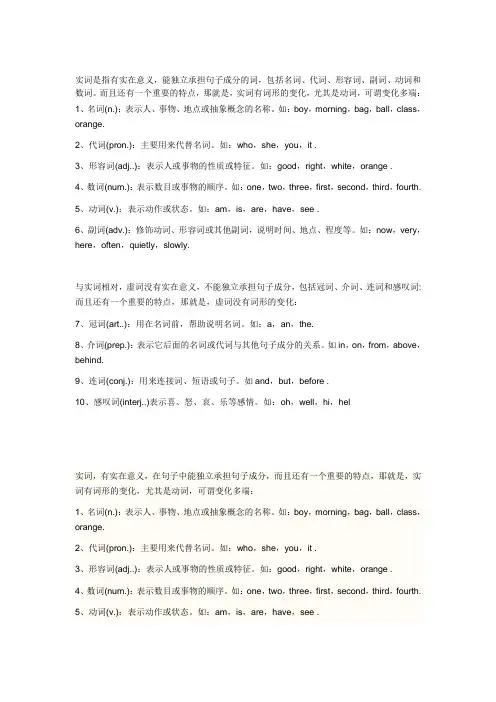
实词是指有实在意义,能独立承担句子成分的词,包括名词、代词、形容词、副词、动词和数词。
而且还有一个重要的特点,那就是,实词有词形的变化,尤其是动词,可谓变化多端:1、名词(n.):表示人、事物、地点或抽象概念的名称。
如:boy,morning,bag,ball,class,orange.2、代词(pron.):主要用来代替名词。
如:who,she,you,it .3、形容词(adj..):表示人或事物的性质或特征。
如:good,right,white,orange .4、数词(num.):表示数目或事物的顺序。
如:one,two,three,first,second,third,fourth.5、动词(v.):表示动作或状态。
如:am,is,are,have,see .6、副词(adv.):修饰动词、形容词或其他副词,说明时间、地点、程度等。
如:now,very,here,often,quietly,slowly.与实词相对,虚词没有实在意义,不能独立承担句子成分,包括冠词、介词、连词和感叹词:而且还有一个重要的特点,那就是,虚词没有词形的变化:7、冠词(art..):用在名词前,帮助说明名词。
如:a,an,the.8、介词(prep.):表示它后面的名词或代词与其他句子成分的关系。
如in,on,from,above,behind.9、连词(conj.):用来连接词、短语或句子。
如and,but,before .10、感叹词(interj..)表示喜、怒、哀、乐等感情。
如:oh,well,hi,hel实词,有实在意义,在句子中能独立承担句子成分,而且还有一个重要的特点,那就是,实词有词形的变化,尤其是动词,可谓变化多端:1、名词(n.):表示人、事物、地点或抽象概念的名称。
如:boy,morning,bag,ball,class,orange.2、代词(pron.):主要用来代替名词。
如:who,she,you,it .3、形容词(adj..):表示人或事物的性质或特征。
英语实词和虚词的分类

英语实词和虚词的分类1 实词与虚词定义实词(Substantive)通常是指某种实体,它们可以在句子中充当名词或代词,提供具体描述,是表达主体。
因此,实词主要包括名词、代词、数词、形容词和动词。
虚词(Functional Word )是调整或维持句子结构和语序的“单词”,如连词、介词、助词和叹词等,它们的作用更多的是对句子的功能和结构起着一定程度的调节和控制作用,并不构成句子的主体性内容。
2 实词分类(1)名词(Nouns)名词是可以用来指代一个人或事物的词语。
一般名词,又称常用名词,是指专有名词和普通名词。
其中,普通名词又包括固有名词和抽象名词两类。
(2)代词(Pronouns)代词是指可以替代名词使用的词汇,通常可以代表人或物,在句子中可以承担名词的功能。
代词分为人称代词、物主代词、指示代词、相互代词、疑问代词等类型。
(3)数词(Numeral)数词是表示数量的词,指序数词和基数词,以及分数、时间等概念。
(4)形容词(Adjective)形容词是指用以提供句子中名词的额外信息,给予名词更多描述性特征的词,通常和名词紧密结合起来,作定语的角色。
(5)动词(Verb)动词是表示动作或行为的一种词语,也可表示名词所处的状态,是句子的核心结构,起着总体动作描述作用。
3 虚词分类(1)连词(Conjunction)连词是指表示逻辑关系的语汇,可以将句子中的内容逻辑上连接起来,从而调整句子结构或扩展句子含义。
(2)介词(Preposition)介词是指介于名词和其他成分之间,表达某种位置、方向、表达时间、表示属性、表示类型等相关的词,构成的复合结构称为介词短语,可以充当句子中其他成分的表语、定语或状语。
(3)助词(Auxiliary verb)助词是指句子中的一些虚词,可以帮助动词等自身不能形成谓语的功能,起到调整语序及语态的功能,常见的包括:be动词,助动词及情态动词等。
(4)叹词(Interjection)叹词是一种表达感情或加以强调、唤醒注意的虚词,可以某种程度上加强句子的色彩性和感情表达,常见的叹词有:啊、呦、嗨等。
英语实词与虚词
Thank you for watching!
Good-bye!
形容词(adjective)adj.是很多 语言中均有的主要词类中的 一种。主要用来修饰名词的 词,表示事物的特征。形容 词用来修饰名词或代词,表 示人或事物的性质、状态, 和特征的程度好坏,与否。
5.副词(adverb)adv.: 是一种用来修饰动词、形容词、全句的词, 说明时间、地点、程度、方式等概念的词。 副词是一种半虚半实的词。副词可分为:时 间副词、地点副词、方式副词、程度副词、 疑问副词、连接副词、关系副词、频率副词 和说明性副词等。
代词(pronoun)pron.是代替名词 的一种词类。大多数代词具有 名词和形容词的功能。英语中 的代词,按其意义、特征及在 句中的作用分为:人称代词、 物主代词、指示代词、反身代 词、相互代词、疑问代词、关 系代词、连接代词和不定代词 九种。
数词(numeral)Num.表示“多少” 和“第几”的词,叫数词。其用法 相当于名词或者形容词。数词分为 基数词和序数词两种。
6.动词(Verb)v.: 动词,就是用来形容或表示各类动作的词汇。 基本上每个完整的句子都有一个动词,要表 示第二个动作时可使用不定词、动名词、对 等连接词、从属连接词或增加子句等方承担句子成分,包括冠词、 介词、连词和感叹词:而且还有一个重要的特点,那就是, 虚词没有词形的变化。
冠词(article)是虚词,本身不能单独使用, 也没有词义,它用在名词的前面,帮助指 明名词的含义。 冠词可以说是名词的一种标志,它不能 离开名词而独立存在。表示的主语数量 或者特征。
介词(preposition)是一种用来表示词与词、 词与句之间的关系的虚词,在句中不能单 独作句子成分。介词后面一般有名词代词 或相当于名词的其他词类,短语或从句作 它的宾语。介词和它的宾语构成介词词组, 在句中作状语,表语,补语或介词宾语。 介词可以分为时间介词、地点介词、方式 介词、原因介词和其他介词。
高三虚词知识点大全
高三虚词知识点大全虚词在语法中起着非常重要的作用,它们具有一定的语法功能,但没有具体的词义。
在高三英语学习中,熟悉和掌握虚词的用法是非常关键的。
本文将为大家总结高三英语中常见的虚词知识点,帮助大家在学习和应用中更加准确和流利地运用这些虚词。
1. 介词介词是一种虚词,它在句中常用来表示关系、时间、地点、目的等。
以下是一些常见的介词及其用法:1.1 表示关系:of, to, for, with, on, at, in等。
例如:- The book on the table is mine.(桌子上的书是我的。
)- I am responsible for this project.(我负责这个项目。
)1.2 表示时间:on, at, in, before, after, during等。
例如:- I'll see you at 9 o'clock.(我会在9点见你。
)- They went to the park in the morning.(他们上午去了公园。
)1.3 表示地点:in, on, at, to, from等。
例如:- She is in the classroom.(她在教室里。
)- I'm going to the supermarket.(我要去超市。
)1.4 表示目的:for, to, with等。
例如:- I bought some flowers for my mom.(我给我妈妈买了些花。
)- He went to the library with his classmates.(他和同学一起去了图书馆。
)2. 连词连词是一种虚词,它用来连接词、短语、从句等,并起到衔接句子和段落的作用。
以下是一些常见的连词及其用法:2.1 并列连词:and, or, but, so, for等。
例如:- He likes to play basketball and soccer.(他喜欢打篮球和足球。
英语实词和虚词的分类
英语实词和虚词的分类随着世界的全球化,英语已经成为全球统一的语言,广泛应用于国际间的交流活动。
因此,要深入了解英语,就必须研究它的词汇,掌握它的词类和词汇的具体用法。
英语单词有实词和虚词两大类。
实词(Substantive)是指可以独立使用,表示人或物,及其属性、状态、行为等的词,如man,house,brave,good,run等,它们可以在句子中单独使用,充当主语、宾语或表语等。
实词又可分为名词、形容词、代词、动词等,如table(名词) wonderful(形容词) we(代词) write(动词)等。
虚词(Function Word or Non-Substantive)是指不能独立使用,不能表示任何抽象概念或实体的词,如指示代词,冠词,连接词,介词,副词,感叹词等。
这些词没有具体的实词形式,而是以句子为单位,结合实词,来指示句子的意思,表达语气或调整语句结构,比如the(冠词)and(连词)in(介词)very(副词)oh(感叹词)等。
由于实词和虚词的特殊性,在学习英语的过程中,我们应认真掌握这两大类词汇。
首先,要努力记住实词,因为它们是用来表达一定含义的基本建筑材料,如果记不住这些词,就无法进行有效的交流活动;其次,也要注意学习虚词,因为它们是用来填补语句空白,牵引句子结构,调整语气等等,不能忽视。
除此之外,在学习过程中,需要注意实词和虚词的用法,而不仅仅是简单的记忆。
实词的用法较为简单,一般来说,只要熟悉每个词的词形上的变化,以及人称、数和格的变化,就可以掌握它们的用法;而虚词的用法则相对复杂一些,需要考虑句子结构、语法规则、语义和语境等因素,以便正确使用。
要掌握英语的语法,实词和虚词都必不可少,它们两者之间相互联系、相互作用,共同组成一个完整的语言体系。
因此,学习英语时,要认真研究它们的分类,并熟练掌握实词和虚词的用法,以便更好地掌握英语语法,提高交流能力。
英语词法知识实词虚词课件-高三英语一轮复习
用于判断名词的词性
测试
④One reason for the persistence of this pyramid of production is that for the past half-century, much of the world's media culture has been defined by television and television is defined by downloading
虚词
虚词类别 介词
Men in Black
I live in China.
关键知识点 介词+n.构成介词短语
做定语或状语
常见介词
虚词类别 连词 介词 冠词
关键知识点
并列连词:连接单词、短语、句 子
构成并列结构或并列句 从属连词: 主要连接句子
介词+构n成.构复成合介句词短语 做定语或状语 冠词+n.
实词一共有四种 :
名词(代词、数词)noun 动词 verb 形容词 adjective 副词 adverb
实词
实词类别 名词 动词
关键知识
和谓语动词构成主谓关系 做主语、宾语、表语
和主语名词构成主谓关系 做谓语
①Students are hardworking.
英语实词与虚词【可编辑范本】
实词与虚词的区别和分析实词是指有实在意义,能独立承担句子成分的词,包括名词、代词、形容词、副词、动词和数词。
而且还有一个重要的特点,那就是,实词有词形的变化,尤其是动词,可谓变化多端:1、名词(n.):表示人、事物、地点或抽象概念的名称。
如:boy,morning,bag,ball,class,orange.2、代词(pron.):主要用来代替名词.如:who,she,you,it 。
3、形容词(adj。
.):表示人或事物的性质或特征。
如:good,right,white,orange .4、数词(num。
):表示数目或事物的顺序。
如:one,two,three,first,sec ond,third,fourth。
5、动词(v。
):表示动作或状态。
如:am,is,are,have,see。
6、副词(adv。
):修饰动词、形容词或其他副词,说明时间、地点、程度等。
如:now,very,here,often,quietly,slowly。
与实词相对,虚词没有实在意义,不能独立承担句子成分,包括冠词、介词、连词和感叹词:而且还有一个重要的特点,那就是,虚词没有词形的变化:7、冠词(art..):用在名词前,帮助说明名词。
如:a,an,the.8、介词(prep.):表示它后面的名词或代词与其他句子成分的关系。
如in,on,from,above,behind.9、连词(conj.):用来连接词、短语或句子.如and,but,before .10、感叹词(interj.。
)表示喜、怒、哀、乐等感情。
如:oh,well,hi,hel宾语补足语宾语补足语就是用来对宾语加以补充说明的文字,和宾语一起构成复合宾语.可做宾语补足语的通常有名词,形容词、副词、不定式,分词等。
宾语和宾语补足语之间在逻辑上往往有主表、或者主谓的关系。
Ifound him clever。
clever就是宾补,和him有主表的关系,即我们可以说:He is clever。