
人教版英语八年级下册 Unit 1 what's the matter
and needed to go to the hospital
right away.
3b Read the passage again and check
the things that happened in the story.
students' problems?Make conversations.
What's the matter with Judy?
She talked too much yesterday and didn't drink enough water. She has a very sore throat now.
Language points
1. What’s the matter? 这是人们特别是医生和护士询问病人 病情时常用问句, 意思是“怎么了?” 其后常与with连用。类似的有: What’s wrong? 怎么啦? What’s wrong with you? 你怎么了? What’s your trouble? 你怎么了? What’s the trouble with you? 你怎么了? What’s up? 你怎么了?
[1-5] in the order you hear them.
2
4
3
1
5
2b Listen again. Match the problems
with the advice.
1 fever 2 stomachache
3 cough and sore throat
4 toothache 5 myself
如:I have some trouble (in) reading the letter. 当trouble意为“麻烦事;烦心事”时, 是可数名词。
如:She was on the phone for an hour telling me her troubles.
3b Read the passage again and check
letter [a-m ] for each part of the body.
_h_ arm __e_ back _g__ ear
__i _ eye _b__ foot
_a_ hand __j_ head __l_ leg
__c_ mouth
_d__ neck __m_nose __k_ stomach __f_ tooth
fever. What _d_id_ you do on the
weekend?
Lisa: I played computer _g_a_m__esall weekend.
Mandy: That’s probably why. You need to take breaks _a_w_a_y from the computer. Lisa: Yeah, I think I sat in the _s_am__e way for too long without moving. Mandy: I think you should _l_ie_ down and rest. If your head and neck still hurt tomorrow, then go to a _d_o_c_t_or_.
Grammar Focus
2. have a cold “伤风, 感冒”, 是固定
词组,表示身体不适的常用词组还有: have a bad cold 重感冒 have a fever 发烧 have a headache 头痛 have a stomachache 肚子痛, 胃痛 have a toothache 牙痛
拓展: 1. 牙疼 have a toothache 2. 胃疼 have a stomachache 3. 背疼 have a backache 4. 头疼 have a headache 5. 喉咙疼 have a sore throat 6. 发烧 have a fever 7. 感冒 have a cold
√man onto the bus.
6 ____ The old man got to the hospital in time.
3c Discuss the questions with a partner.
1. Why was Wang Ping surprised that the
passengers agreed to go to the hospital
What’s the matter with him/her?
He /she __h_a_s__a_c_o_l.d
have a cold
have a fever have a toothache
have a sore throat have a stomachache
2a Listen and number the pictures
1b Listen and look at the picture.
Then number the names 【1-5】.
Nancy ___4_ Sarah ___1_ David ___2_ Ben ___3_ Judy ___5_
1C Look at the picture. What are the
Unit 1
R 八年级下册
SectionA 1a-2d
Can you name the parts of the body?
Language Goals: Talk about health problems and accidents; Give advice
1a Look at the picture. Write the correct
a lie down and rest b drink some hot
tea with honey c see a dentist and
get an X-ray d take your temperature e put some medicine
on it
2c Make conversations using
4 ____ The passengers on the bus did not want to go to the hospital, so only Wang Ping
√went with the woman and old man.
5 ____ Some passengers helped to get the old
with
him?
2. Did the passengers think Wang Ping did the
right thing? How do you know?
3. Do you agree that people often do not help
others because they do not want to get into
Language points
3. ... because they don’t want any trouble, ... 当trouble意为“困难;麻烦”时,是不可数名词。
如: I’m sorry to give you so much trouble. (1) be in trouble意为“有困难;陷入困境”。
Imagine you are the school doctor. A few students have health problems. Role-play a conversation between the doctor and the students.
2d Role-play the conversation.
Lisa: OK. Thanks, Mandy.
Unit 1
R 八年级下册
SectionA 3a-3c Grammar Focus-4c
Presentation
He has a stomachache. He was lying on the side of the road.
What’s the matter the man?
the things that happened in the story.
√ 1 ____ Wang Ping was the driver of bus No.26 at 9:00 a.m. yesterday.
2 ____ Bus No. 26 hit an old man on
√Zhonghua Road.
see sb. do sth. 看见某人做过某事 如: I often see him draw a picture.
Language points
2. But to his surprise, they all agreed to go with him. to one’s surprise 使......惊讶的是,出乎......意料 如: To their surprise, all the students pass the exam. Much to everyone’s surprise, the plan succeeded.
如: He always asks me for help when he is in trouble.
(2) get sb. into trouble 意为“使某人陷入困境”。 如: If you come, you may get me into trouble.
(3) 主语 + have / has trouble (in) doing sth. 意为“某人在做某事方面有困难”。
Language points
人教版初二(下)英语unit1 what's the matter知识点讲解与练习
八年级下册英语Unit 1 what’s the matter?词汇篇学生通过本讲学习,能够掌握本单元的重点词汇句型,并在综合能力上有一定的拓展。
1.matter的用法(1)名词:事情,问题What’s the matter? =what’s wrong (with you)? =what’s the trouble怎么啦?出什么事啦?(2)动词:有重大影响,有重要性如:What does it matter?2.疾病的表达法have a cold/a fever/ a toothache/ a stomachache3.take 的固定搭配take one’s temperature/ take breaks/ take risks/take some medicine/take off/ take care of/take away 4.surprise的用法1.做名词:to one’s surprise 使。
惊讶的,出乎。
意料2.做动词:surprise sb使某人吃惊3.做形容词:surprising, surprised的用法5.get的用法get off下车/get on上车/get into陷入,参与6.be used to sth/doing sth 习惯于做某事be used to do sth 被用作去做某事used to do sth 习惯于做某事7.out of的固定搭配look out of 向。
外看/ get out of从。
出来/ run out of用光基础演练1.---What’s wrong ______you?---I fell off the bike and hurt my leg.A. ofB. withC. forD. by2.Tom and Jenny enjoyed _________playing computer games.A. himselfB. herselfC. ourselvesD. themselves3. Sally became interested ___________science and wanted to be a scientist.A. forB. inC. throughD. at4. ---I had a __________.---You’d better go to see a dentist.A. headacheB. feverC. coldD. toothache5. I didn’t _________my temperature, but I knew I had a fever.A. giveB. setC. takeD. show二、根据汉语意思翻译句子。
Unit1What’sthematter整单元课件人教版英语八年级下册

A: What’s the matter? B: I have a headache.
A: What’s the matter? B: I have a sore back
A: What’s the matter? B: I have a sore throat.
What’s the matter with you? I h_a_v_e__ __a__ _c_o_l_d_.
A: What’s the matter? B : I have a cold.
A: What’s the matter? B: I have a fever.
A: What’s the matter? B: I have a stomachache.
A: What’s the matter? B: I have a toothache.
You shouldn’t eat anything.
对
stomachache
症
下
药 toothache
fever sore throat
What’s the matter?
I have a _f_e_v_e_r____.
You should__d_r_in_k__l_o_ts_o_f__w_a_te_r_a_n_d__g_o_t_o_b_e_d__.
X-ray X射线;X光 toothache 牙痛 headache 头痛
break 休息;间歇 hurt 疼痛;受伤
passenger 乘客;旅客 off 离开(某处)
onto 向;朝 trouble 问题;苦恼
hit 击;打
预习单词(英译中)
herself 她自己 sick 生病的;有病的 knee 膝盖
人教版八年级英语下册Unit1What’sthematter(16课时)教学设计

2.增强学生的健康意识,使其认识到健康的重要性,养成良好的生活习惯。
3.培养学生积极向上的心态,面对困难和挫折时,能够保持乐观,寻求帮助。
4.通过学习英语,拓宽学生的国际视野,使其了解并尊重不同文化背景下的健康观念。
5.鼓励学生参与课堂活动,增强自信心,培养合作精神。
3.加强词汇教学,通过游戏、竞赛等形式,帮助学生记忆和巩固词汇。
4.设计多样化的听力练习,提高学生的听力水平,培养其英语语感。
5.关注学生的情感态度,引导他们正确面对健康问题,培养积极的心态。
三、教学重难点和教学设想
(一)教学重难点
1.词汇和短语:本章节的重点词汇和短语涉及描述健康问题的各个方面,如身体部位、症状等。这些词汇和短语的掌握对于学生能够流畅地表达和交流至关重要。
3.听力训练:利用课外时间,观看英语原声视频,如健康主题的TED演讲或医生与患者的对话,提高听力水平,并记录下新学到的表达方式。
4.口语作业:与同学组成小组,进行角色扮演,录制一段关于健康问题的对话视频,要求每个成员都有发言机会,并在视频中加入适当的身体语言。
5.写作练习:写一篇关于“如何保持健康生活方式”的短文,至少80词,使用本节课学习的词汇和句型,表达个人观点。
3.学生分享:鼓励学生分享自己在生活中遇到的健康问题及解决方法,激发学生兴趣,为新课学习做好铺垫。
(二)讲授新知
1.教学内容:教师针对本节课的重点词汇、短语和句型进行讲解,如:“What’s the matter?” “I have a toothache/too much homework.” “You should/need to…”等。
八年级英语下册Unit1What’sthematter短语语法知识点汇总(新版)人教新目标版

Unit 1 What’s the matter一、必背短语Section A 部分have a cold have a stomachachehave a sore throat have a sore backlie down and rest take one’s temperaturetalk too much take breaks/a breakget off get an X-ray11.看见某人正在做.. see sb. doing think twiceexpect sb. to do 14.使…惊讶的to one’s surpriseagree to do sth. in time17.多亏,由于thanks to 18.陷入困境;惹麻烦get into troubleSection B 部分rest for a few days …放下;低下p ut…downtell sb. to do tell sb. not to dohave problems/trouble/difficulty (in) doing sth…感兴趣be interested in be used to doing sthused to do sth take risks/a risk10.由于/因为+n./pron. because of in a dangerous situationin a difficult13.用尽,耗光run out (of)situationbe ready to do cut off…以至于…s o…that…17.以便于;为了so that/in order that【教材内容解析】Section A1.What’s the matter? (P. 1)What’s the matter意为“怎么了?出什么事了?”,常用来询问对方遇到什么麻烦或者有什么不顺心的事,后接with sb./sth.表示“某人/某物怎么了”。
Unit1what’sthematter_SectionA知识点梳理人教版八年级英语下册
人教版八年级下册英语课本知识点梳理Unit 1 wh at’s the matter? sectionA课文内容:What's the matter? 怎么了? (教材第1页)【用法详解】What's the matter? 怎么了?/出什么事了?常用于询问某人患了何种疾病,遇到了什么困难等,也可用于询问某物出了什么故障,其后可接with sb./sth.,表示“某人/某物怎么了?”。
其中matter 用作名词,意为“问题;事情”matter前须加定冠词the。
【例句】What's the matter? 怎么了?Bad luck.I lost my pen. 真倒霉,我弄丢了钢笔.What's the matter with him? 他怎么了?He has a sore back.他背痛【拓展】matter[动词] 要紧;有关系多用在否定句、疑问句或条件句中It doesn't matter.没关系。
(通常用来回答对方的道歉)I have a cold. 我感冒了。
(教材第1页)【用法详解】have a cold (患)感冒。
其中have 用作及物动词,意为“患(病);遭受(病痛)”,常用于结构“have a/an +疾病名称”表示患病或身体某部位不舒服。
此时它不能用于进行时态,其第三人称单数形式为has,过去式为had。
常见的表示病痛的短语还有:have a fever 发烧have a toothache 牙疼have a headache头痛have a cough 咳嗽have a stomachache胃痛Do you often have a cold? 你经常感冒吗?Jim had a stomachache after supper yesterday.吉姆昨天晚饭后胃痛。
l have a stomachache.我胃痛。
( 教材第1 页)【用法详解】stomachache [名词]胃痛;腹痛是由“名词stomach(;腹部)+ache(疼痛)”构成的复合名词。
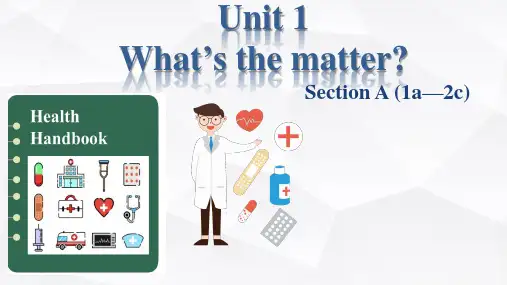
Unit+1+What’s+the+matter课件-2024-2025学年人教版八年级英语下册
Homework
If you can: Be a health helper.Care about
students who have health problems
and give them some proper advice in
You must:
English.
1.Read the tape- scripts
Listen and number the pictures(1-5) in the order you hear them.
2 3
4
1
5
Listen and match the problems with the advice.
Problems
1.fever
Advice
a. lie down and rest
Watch a video.
Game time: Act and guess
have a headache /ˈhedeɪk/
have a toothache /ˈtuːθeɪk/
have a stomachache /'stʌməkeɪk/
have a cough /kɒf/
have a fever
Chapter III
Dangerous situation Self-protection Spirit
Chapter IV
Practical Activities
Name Problem
Listen and write down their problems.
Sarah has a _c_o_l_d______
A:What’s the matter with...?
人教版英语八年级下册Unit1What'sthematterSectionB2a—2e说课稿
1.在课前精心准备,确保板书内容精炼、有条理。
2.在课堂上适时更新板书,避免一次性呈现过多信息。
3.用不同颜色的粉笔强调重点,提高视觉效果。
4.在适当的时候引导学生共同参与板书,增强互动性。
(三)学习动机
为了激发学生的学习兴趣和动机,我将采取以下策略或活动:
1.利用生活情境导入新课,让学生感受到学习英语的实用性。
2.设计丰富多样的互动活动,如角色扮演、小组讨论等,提高学生的参与度和积极性。
3.创设竞争氛围,通过小组竞赛、个人展示等形式,激发学生的学习兴趣和进取心。
4.肯定和鼓励学生的进步,关注个体差异,使每个学生都能在课堂上获得成就感。
3.听力练习:播放一段关于身体不适的对话,让学生回答相关问题,提高听力理解能力。
4.课堂游戏:设计“症状猜猜看”游戏,让学生通过描述症状,猜测疾病名称,增加课堂趣味性。
(四)总结反馈
在总结反馈阶段,我将采取以下措施:
1.让学生自我评价:让学生回顾本节课所学内容,分享自己的收获和不足。
2.同伴评价:组织学生相互评价,鼓励他们提出建议和改进措施。
(三)教学重难点
根据对学生的了解和教学内容的分析,本节课的教学重点和难点如下:
重点:
1.新词汇和重点句型的掌握。
2.情态动词should的用法。
难点:
1.对身体不适症状的描述,尤其是不同症状的词汇记忆和运用。
2.情态动词should在交际中的灵活运用。
二、学情分析导
(一)学生特点
本节课面向的是八年级学生,他们的年龄大约在14-15岁之间。这一年龄段的学生正处于青春期,思维活跃,好奇心强,善于模仿,对新事物充满兴趣。在认知水平上,他们已经具备了一定的英语基础,能够进行简单的日常交流,但语言表达能力有待提高。在学习兴趣方面,学生对与生活实际紧密相关的主题更加感兴趣,喜欢通过互动和游戏的方式进行学习。然而,学生的学习习惯参差不齐,部分学生缺乏自主学习能力和良好的学习计划。
人教版八年级英语下册Unit1 What's the matter全单元课件
3. Do you think it comes from a newspaper or a book?
你认为它是来自报纸还是书呢?
4. I think I sat in the same way for too long without
moving. 我想我以同样的姿势一动不动地坐得太久了。
44. be used to doing sth. 习惯做某事 45. run out (of) 用完;用尽 46. so that 以便 47. so. . . that 如此… …以至于… 48. be in control of 掌管;管理 49. in a d iffic u lt situation 在闲境屮 50. keep on doing sth. 继续或坚持做某事 51. make a decision 做出决定 52. take risks 冒险 53. give up 放弃
2.能运用情态动词should句型给出建议。 3. 正确使用反身代词。
Section A 1a-2d
body
tooth
feet
teeth
nose faceear
toe
neck
face
lห้องสมุดไป่ตู้g
heel
elbow
sing a song
1a Look at the picture. Write the correct letter[a—m] for each part of the body.
__k__arm __c__back _g___ear _i___eye _m___foot __a__hand_l___head b____leg _f___mouth ___d_neck _j___nose __h__stomach _e___tooth
Unit1What'sthematter人教版英语八年级下册教案
(3)时态运用:一般现在时和现在进行时在本章节的对话和描述中占有重要地位,教师需重点讲解并指导学生如何在询问和描述身体状况时正确运用这两种时态。
二、核心素养目标
《Unit 1 What's the matter》的教学旨在培养学生的英语学科核心素养,具体目标如下:
1.提升学生的语言能力,通过学习本章内容,使学生能够熟练运用英语询问和描述身体状况,表达关心与建议,提高实际生活中的交际能力;
2.增强学生的文化意识,了解和尊重不同文化背景下对待疾病和身体状况的态度及表达方式;
举例:
-当学生询问他人身体状况时,能使用"What's the matter?"这一核心句型;
-当描述自己或他人身体不适时,能运用"I have a stomachache."、"You have a fever."等句型;
-在给出建议时,可以使用"You should take some medicine."等短语。
四、教学流程
(一)导入新课(用时5分钟)
同学们,今天我们将要学习的是《Unit 1 What's the matter》这一章节。在开始之前,我想先问大家一个问题:“你们在日常生活中是否遇到过朋友或家人身体不适的情况?”比如,朋友突然说肚子疼,你会怎么关心和帮助他们呢?这个问题与我们将要学习的内容密切相关。通过这个问题,我希望能够引起大家的兴趣和好奇心,让我们一同探索如何用英语询问和描述身体状况。
人教版八年级英语下册Unit1What’sthematter单元全部优秀教学案例
一、案例背景
人教版八年级英语下册Unit1 "What's the matter"主要围绕询问病痛和提供帮助展开,通过学习本单元,学生能够掌握基本的交际用语,询问他人的不适并给出适当的建议。此外,本单元还涉及到日常生活中的礼貌用语和表达关心他人的方式。
3.鼓励学生运用本节课所学句型和词汇进行交流,关注语言的准确性和流畅性。
4.各小组派代表进行表演,其他小组成员观摩并给予评价。
(四)总结归纳
1.教师引导学生回顾本节课所学内容,总结询问病痛和提供帮助的常用句型和词汇。
2.强调在日常交际中,如何用英语表达关心他人和礼貌用语。
3.提醒学生注意身体保健,养成良好的生活习惯,预防疾病。
五、案例亮点
1.情境教学法的运用:通过展示漫画、播放视频等情境,让学生在真实的语境中感知、理解和运用本单元所学内容。这种教学方法有助于提高学生的学习兴趣,增强他们的实际交际能力。
2.任务型教学法的运用:通过设计各种任务,如编写对话、角色扮演等,让学生在实际操作中运用所学知识,提高团队合作和沟通能力。这种教学方法有助于培养学生的实践能力和综合素质。
(二)问题导向
1.设计有针对性的问题,引导学生思考和探讨,如:“当你生病时,你会怎么做?”“你认为如何关心他人的健康?”等。
2.通过问题驱动,激发学生的好奇心,培养学生独立思考和解决问题的能力。
3.引导学生运用所学知识解决实际问题,如:“如果你的朋友生病了,你应该如何安慰他?”
4.鼓励学生提问,培养他们主动参与课堂、积极表达自己的观点的习惯。
3.教授日常英语交际中常用的表达关心和礼貌用语,如:“How are you?”、“Are you all right?”等。