
高中英语必修三:unit3 Grammar and usage 教案
Unit 3 Back to the past
Grammar and usage
Object complement & Either …or… and neither … nor… & Subject-verb agreement Teaching Ai ms: L earn the grammar:
◆Object complement
◆Either… or and neither… nor
◆Subject-verb ag reement
Teaching Poi nts:
How to use th e object complement / either… or / neither… nor / subject-verb agreement in different situations. The key point is to help students guess the exact usage from the context.
Teaching Methods:
1. Inductive method
2. Comparative method
3. Communicati ve approach
Teaching Aids:
1. A multimedia
2. A blackboard
Teaching Procedures:
Step 1 Object c omplement
(1)Situation one
— Did you find anything special when you went to the classroom?
—No, I didn’t.
—You found the door open, didn’t you?
—Oh, yes. But I found nobody in the classroom.
(2) Position
V. + Object + object complement
e.g. The inspector shot the drug-dealer dead.
(= The drug-dealer was shot dead by the inspector.)
(3)Situation two
—What do you think about her performance?
— We consider that her performance is a big success.
( We consider her performance a big success. )
—What do people think about dogs?
—People believe that dogs are honest.
( People believe dogs to be honest. )
(4)Usage
An object complement , which gives information about the object, can be a noun, a noun phrase, an adjective, a to-infinitive, a bare infinitive, or a prepositional phrase.
Step 2 E ither… or / neither… nor
(1) Situation one
—I have got one ticket for Liu Xiang’s 110m hurdle race to be held in Nanjing.
Either you or your desk-mate can have it.
—Is it on Saturday or on Sunday?
—It is on next Monday.
—Oh, what a pity. I am afraid neither I nor my desk-mate can enjoy it.
(2)Situation two
—Which language can I use to write the speech? ( English / Chinese )
—------ You can write the speech either in English or in Chinese.
(3) Situation three
—It is neither your fault nor mine. It’s your friend Jack’s fault.
—Whose fault is it? ( yours / mine )
(4)Situation four
—Which one can I take, Sir?
—I am afraid, you can take _______________. (neither the gun nor the cigar)
(5)Situation five
—Where can I stay on Saturday afternoon, Sir?
—You can stay ______ in the classroom _____ in the dormitory. ( either … or) Step 3 Subject-verb agreement
Grammar rules
Read the 6 points on Page 10, find out the usages of subject-verb agreement. Step 4 Practice
When the subject is a group noun like: class/ family/ government/ team… , we use a singular verb if the noun identifies a singular or unit, or a plural verb if it identifies a number of individuals.
Step 5 Homework
Do the exercises in Workbook.。
译林英语必修3Unit3Grammar and usage 教学ppt课件(25张)
Practice
Pair work
They saw the Emperor
(走 )in the street.
We do not hope it to be the second Loulan.
He had his cTupwboaordsm(柜子in) utes to translate the followings into English, using
The two thieves had/made the lights b_u_r_n_ing (burn)all night long.(ving)
have+o+oc(v/ving/ved)
“让/使...做/一直做/被做”
make sb. adj./ do sth
毕业照使我们记住美好的 校园生活。
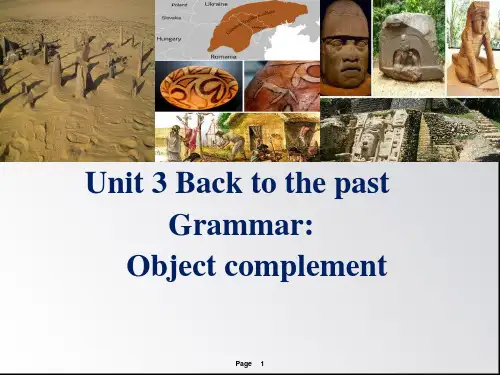
Unit 3 Back to the past Grammar:
Object complement
Page 1
Teaching aims: By the end of this class, you will:
1. learn how to use different kinds of object complement. 2. use object complement in set situations. 3. discuss and write an article with object complement. 4. learn what to do to protect our environment.
By the end of this class, you will:
object complement. a wise choice
高一英语《Unit3 Grammar and usage》教学设计
《Unit 3 Grammar and usage》教学设计(2)Ⅰ. Teaching aims:Enable the Ss to grasp the non-restrictive attributive clauses and question tags.Ⅱ. Teaching important points:How to use correctly non-restrictive attributive clauses and question tags.Ⅲ. Teaching difficult points:The function and formation of the non-restrictive attributive clauses and question tags.Ⅳ. Teaching methods:Inductive and deductive methods, task-based learning and cooperative learning Ⅴ. Teaching aids:A computer, a blackboardⅥ. Teaching procedures:Step I Revision and lead in1.Ask the students to recall what they’ve learned about the attributive clauses2.Ask them practice finishing some sentences using attributive clauses3.Conclusion of what has been learnt about the attributive clauses4.make a comparison to introduce the non- restrictive attributive clausesStep II work on the non- restrictive attributive clauses1. Ask the Ss to find out the restrictive and non- restrictive attributive clauses in the text.2. tell the differences between the two kinds of attributive clauses by giving examples and making conclusions3. Ask them to summarize what has been learnt and practice using the non- restrictive attributive clauses4. The important points of attributive clauses1) non- restrict ive attributive clauses led by “as” and “which”高一英语教学设计2) non- restrictive attributive clauses led by “some/ any of which/ whom…”5.practice (correction, multiple choices, comparison)Step III Homework1.Go over the restrictive and non-restrictive attributive clauses.2. Finish the exercises of Part A and B on p48-49 in your textbook3. Finish Part C1 on P96 in your workbook.Step IV work on question tags1.ask questions and lead in2.discuss what question tags are3.discuss the situations in which question tags are used according to examples4.practice finding out the question tags in the text and explain them5.ask questions about the types and formations of question tags6.give examples and conclude the formation of question tags7.tips on how to use the question tags8.practice timeStep V Language pointsExplanation and practice1)consider2)affect/ effect/ effort/ offer3)recognize/ realizeStep Ⅵpractice and consolidation of the grammar pointsStep VII Homework1.Go over the question tags.2. Finish Part A and B on P51 in your textbook as well as Part C2 on P96 in your workbook.3. Preview Task.2。
2021-2022年高中英语 测试报 Unit3第二部分 Grammar and usage1教案

2021年高中英语测试报 Unit3第二部分 Grammar and usage1教案牛津译林版必修3单元:Unit 3 Back to the past板块:Grammar and usage课堂设计指导思想:通过设计的活动和练习,学习三个语法项目:宾语补足语,either … or and neither … nor和主谓一致。
Teaching aims:具体陈述本课时要做的事及其目的,要从学生学习的角度陈述,如:1.Help students to grasp the rules of subject-verb agreement and the objectplement... ;e the pound sentences introduced by neither … nor …, either… or …, notonly … but also … ;3.D evelop the students’ ability of using the grammar rules to make correctsentences.Teaching procedures:Step 1 Lead inAsk questions and introduce the topic.【设计说明】通过问答引入主题。
Step 2 Learn and understandMake sure students know the definition and basic grammatical rules of object plement.【设计说明】明确宾语补足语的规则,为下面的操练做准备。
Step 3 PracticeGive more examples and follow the steps on page 48.Step 4 Learn more about either … or and neither … nor1. Fill in the blanks with the missing words and introduce the topic of either …or and neither … nor2. Make sure students know the definition and basic grammatical rules of either …or and neither nor.【设计说明】简单的语境设置,检测学生对所学内容的掌握。
高中英语 Unit3 Grammar and usageTask教案 牛津译林版必修3
Unit 3 Back to the past TaskGiving a talk about a historical eventTeaching Objectives:1 to teach and instruct students some specific procedures when trying to achieve a goal2 to make students be aware of the appropriate ways of performing each individual procedure and master the skills3 to make sure students have opportunities to combine the skills they have learned with reality4 to aid stu dents to choose and organize the information they have got and help them complete their products5 to enhanc e students’ overall abilities and improve their integrated skills Important and difficult points:Make students learn how to write an outline of a speech and how to host a talk about a historical event.Teaching procedures:Step 1 Lead-inGet the students to know s omething about how to give a talk about a historical event. Discuss the following questions in groups:1. When you have conversations with your friends, what decides the topic you are talking about?2. Will the topic be different if someone else joins your co nversation?3. Wi ll the topic be different if you move to another place to talk?4. Will it be different if you are doing something else while you are talking?Step 2 Skills building 1Make students know how to listen to get the main ideas, and do the listening on P52. In step1, students use the skill to listen to a conversation and find the useful expressions. When we are listening to get the main ideas of something, we should tr y to find out:1.how many people are talking2. where they are3. what they are doing4. what they are talking aboutFinish the listening.Step 3 Skills building 2Make the students how to describe pictures and try to write a description of a historical place. In step 2, write a description about the Attack on Pearl Harbor according to the information found on a website.1. How would you describe a picture?2. From an audience’s point of view, what do you want to know most when seeing a picture?3. How do you decide whether a description is good or not?When we are describi ng a picture, we should pay attention to:• Do no t point out every detail.•Briefly mention the picture’s subject.• Focus on the related background information about it.Step 4 Skills building 3Make st udents know what a simple outline of a speech often includes and organize some notes into an outline for a speech. In step 3, plan an outline to introduce their illustration and give their talks.Homework1.Write a passage about the Grand canal in about 150 words according to the informationgiven on P1132.Preview Project.。
【高中英语】2018最新人教新课标高中英语必修三:unit3 Grammar and usage 教案

— Did you find anything special when you went to the classroom?
—No, I didn’t.
—Youfound the door open, didn’t you?
—Oh, yes. But Ifound nobody in the classroom.
Step 4 Practice
When the subject is a group noun like: class/ family/ government/ team…, we use a singular verb if the noun identifies a singular or unit, or a plural verb if it identifies a number of individuals.
—People believe that dogs are honest.
( Peoplebelieve dogs to be honest. )
(4)Usage
An object complement , which gives ion about the object, can be a noun, a noun phrase, an adjective,a to-infinitive, a bare infinitive, or a prepositional phrase.
(2) Position
V. + Object + object complement
e.g. The inspector shot the drug-dealer dead.
(= The drug-dealer was shot dead by the inspector.)
译林版高中英语选必三Unit3 Grammar and usage 教案

《英语》(选择性必修·第三册)Unit 3 Back to the pastGrammar and usageI. Learning objectivesBy the end of the lesson, students will be able to:1. identify the use of predictive clauses;2. complete sentences with proper linking words to form predictive clauses;3. write a short paragraph based on given situations, using predictive clauses.II. Key competence focus1. Choose proper linking words to form predictive clauses.2. Make sentences with predictive clauses.III. Predicted area of difficulty1. Compare some linking words such as that and what, why and because, etc.2. Apply predictive clauses in different situations.IV. Teaching proceduresStep 1 Lead-in1. T asks Ss to define history by using the sentence pattern “History is…”, leading to the topic—predictive clauses.T: Boys and girls, what is history? Can you give a definition to history? You may say “History is …”.2. T shows two sentences on the screen after Ss give their answers.(1) History is a dialogue between the present and the past.(2) History is not what you thought. It is what you remember.3. T asks Ss to observe the two sentences and analyse their elements and structures.T: Please mark the sentence elements and structures. As we can see, both of them use SVP. A noun is used as the predictive in the first sentence, while a noun clause is used as the predictive in the second one. We call it a predictive clause.【设计意图:用一个开放式的问题(历史是什么?)激发学生的兴趣,学生可以给出任何不同的定义,然后引导学生观察教师给出的两个句子,引出表语从句的概念。
高中英语 Unit3 Grammar and usageReading教案
Unit 3 Back to the past ReadingLost civilizationsTeaching aims:1)To talk about lost civilizations2)To help the students develop the ability of reading diary entries.Important and difficult points:The way of reading diary entries.Teaching procedures:Step1Lead-in1.Show students a video about ancient Pompeii.2.Answer questions1) Where are Pompeii and Loulan?2)What happened to them?3)What is it like now?4)What else do you want to know about them?Step2 Reading comprehension.1.Ask students to read the passage quickly and try to find answers to the questions in Part A.2.Ask students to read again and complete Part C1.3.Let students complete Part C2.Step 3 Reading strategy1.Discuss in pairs about what features are usually included in diary entries.2.Let students read the Reading strategy.3.When you are reading diary entries recording someone’s travels, you should look for:⑴ Dates and place names⑵Facts and historical information⑶Personal feelings and opinions4.Find out the facts and historical information about the two cities.Step 4 Discussion1.Is it useful for people to study things from the past? Why or why not?2.Since as long ago as 1553 people have said, ‘History repeats itself.’What do you think this saying means? Do you agree with it? Why or why not?Step 5Homework.1. Read the passage carefully and preview the new words and phrases.2. Make a summary of the text.。
2019新版人教新课标高中英语必修三:unit3Grammarandusage教案
Teaching Points:
How to use the object complement / either…or / neither…nor / subject-verb agreement in different situations. The key point is to help students guess the exact usage from the context.
—Whose fault is it? ( yours / mine )
(4)Situation four
—Which one can I take, Sir?
—I am afraid, you can take _______________. (neither the gun nor the cigar)
—------ You can write the speech either in English or in Chinese.
(3) Situation three
—It is neither your fault nor mine. It’s your friend Jack’s fault.
Grammar rules
Read the 6 points on Page 10, find out the usages of subject-verb agreement.
Step 4 Practice
When the subject is a group noun like: class/ family/ government/ team…, we use a singular verb if the noun identifies a singular or unit, or a plural verb if it identifies a number of individuals.
高中英语 Unit3 Grammar and usageWord power教案 牛津译林版必修3
Unit 3 Back to the Past Word PowerUNESCO World Heritage & Words related to archaeology●Teaching objectives:1.Can develop the students’ ability of using the target language in real situation.2.Can enlarge the students’ vocabulary by learning some words abou t archaeology.3.Can expand the students’ knowledge archaeology.4.Can help the students grasp the use of some commonly used pair nouns and group nouns.●Teaching methods:1.Students-centered.2.Teacher and students’ interaction3.Multimedia way.Leading in1. Do you want to know more about the ancient civilizations in the world?2. How can we get information about the ancient civilizations?3. Do you know anything about UNESCO?Part A . UNESCO World HeritageStep 1. Ask the students what do they know about UNESCO.What does UNESCO stand for?United Nations Educational, Scientific and Cultural Organization.How many World Heritage sites are there on the World Heritage List put out byUNESCO?Altogether there are about 900 World Heritage sites.What are the three types of World Heritage sites?Sites are divided into three types:1)cultural heritage sites2) natural heritage sites3) mixed cultural and natural heritage sitesStep 2. Let the students read the article on page 46 and know more about the three types of World Heritage sites.Step 3. Show them some pictures and ask them to tell others which type of World Heritagesites they are.DiscussionSuppose you are an archaeologist and you have just got news that an ancient tomb is discovered. What would you take with you? And what are the items used for?Part B. Learn some words and information about archaeology.Step 1.Show a picture of a archaeologist and ask questions.What is he? What is he doing?Step 2. Label each picture, using an expression and words and information about archaeologyStep 3 Students read Part A carefully, paying attention to the word in blue.Step 4 Students read and fill in the blanks of Part B.Step 5. Students have a group discussion•Which subject are you interested in?•What are you going to be when you grow upStep 6. Ask the students to write out as many words as possible.Homework1.Remember the pair nouns and group nouns.2.Preview the Grammar.。
译林版高中英语选必三Unit3 Grammar and usage 教案(雅礼版)
Unit 3 Back to the pastGrammar and usage: Predicative clauses◆内容分析:本板块围绕单元话题,引导学生在有关“史学家司马迁”的语篇这个观察、探究表语从句的使用情况,自主归纳其核心规则。
再通过单句、语篇两个层面的巩固练习让学生内化新知;最后让学生运用所学,准确、恰当、得体地使用目标语法,完成具体情境中的写作任务,实现“形式——意义——使用”的统一。
◆教学目标:By the end of this section, students will be able to:1.identify the use of predicative clauses;2.work out the rules of predicative clauses;e predicative clauses to finish related tasks;4.write a short paragraph based on each of the situation using predictive clauses.◆教学重难点:1.To summarize the general rules.2.To apply the rules correctly and properly.◆教学过程:Step 1 Lead-inShow a picture to the student and ask a question: What do you know about the great historian Sima Qian?Born in either 145 or 135 BCE, during China’s Han dynasty, Sima Qian is “the father of Chinese history”. Sima Qian wrote Shi Ji, or Records of the Historian.A Exploring the rulesStep 2 Have students read the essay on page 34 and answer the following questions.1. What is the essay about?2. What greatest achievement did Sima Qian make?3. What contributed to Sima Qian’s success?Possible Answer:1. The essay is about the great historian Sima Qian.2. He wrote the Shiji (Records of the Grand Historian).3. His father’s influence, his learning and travelling and his perseverance.Step 3 Useful expression对......感兴趣take an interest in周游全国travel extensively across the country获取广泛的信息get a wide range of information继他父亲之后成为太史令succeed his father as Grand Historian方便他接触...... facilitate his access to ...整理可用的资源sort out the available resources需要艰苦的努力require painstaking efforts有效且高效地effectively and efficiently继续某事carry on with sth.被关进监狱be put in prison身体上和精神上physically and mentally无论顺境还是逆境in good times or bad timesStep 4 Have students find the sentences with predicative clauses in the essay and fill in the box of Part A on page 34Learning and travelling were exactly what helped him in his later career as a historian.AnswerHis father’s dream was that one day he could write a great masterpiece recording what had happened in history.His chief concern was whether he could do his job more effectively and efficiently. 【设计意图:通过填空,让学生熟悉文本内容。