
人教版八年级上册英语全册教案
Unit1 Wheredidyougoonvacation 教学课题 第一课时 SectionA(1a-2d)
教学目标 【知识目标】 Importantwords:anyone,anywhere,wonderful,few,most Importantphrases:quiteafew,onvacation,anythinginteresting Importantsentences: 1.Wheredidyou/he/she/theygoonvacation 2.Didyou/he/she/theygotoCentral Park 【能力目标】 能用目标语言谈论过去发生的事件。 【情感目标】 通过听力训练、角色扮演等方式,学会与他人分享经历,并提高学生的英语听说能力。 教学重难点 重点:动词一般过去时态的应用。 难点:动词过去式的变化规则。 教学过程 ◆Step1 Leadingin 1.Guess:GetSstoguesswhattheteacherdidonvacation: ①WheredidIgoonvacation ②WhatdidIdoonvacation 2.Freetalk:GuideSstotalkabouttheirownvacation. ①Howwasyoursummervacation ②Wheredidyougoonvacation ③Didyoudoanythingspecial/great ④Didyougoanywhereinteresting/beautiful... ⑤Didyoumeetanyoneinteresting 设计意图 通过情境设计,从学生身边的问题导入新课,减少难度,从而调动了学生参与课堂教学活动的热情,提高学生的学习积极性。 ◆Step2 合作探究 出示一些假期活动的图片(见课件),根据问题进行互动交流学习。 ◆Step3 1a Matchtheactivitieswiththepictures.(见课件) ◆Step4 Pairwork Makeconversationsaboutthepeopleinthepicture.(1c) ◆Step5 Listening1b 1.Studentsreadthenamesandguesstheiractivities.(结合1a中的短语) 2.Listentothetapeandnumberthepeopleinthepicture[1-5]. 3.Checktheanswers.(见课件) 教学过程 ◆Step6 Listening 2a&2b 2a.Listen.WheredidthepeoplegoonvacationCompletethechart.(见课件) 2b.Listenagain.Check(√)Yes,IdidorNo,Ididn’tforeachquestion.(见课件) ◆Step7 Pairwork 2c 以小组为单位分角色表演,完成2c。(见课件) 设计意图 加强情景交际,进一步巩固一般过去时的特殊疑问句和一般疑问句。 ◆Step8 Role-playtheconversation 2d 1.Fastreading: Read2dandanswerthequestions.(见课件) (1)DidHelengoanywhereinteresting (2)Didsheseeanythingwonderful (3)DidRickdoanythingspecial 2.Readcarefullyandtrytograspthemainidea. 设计意图 通过速读和精读,让学生限时掌握对话内容。 ◆Step9 Challenge挑战自我 补全对话(见课件) 设计意图 通过此环节,使学生完成2d中的语言目标。 ◆Step10 Summary 总结本节课语言知识点(见课件)。 设计意图 梳理本课的知识要点。 ◆Step11 Homework Makeaconversationaboutwhatyoudidlastweek. Rememberthewordsandphrasesinthisclass. 板书设计 SectionA(1a-2d) 重点句型: 1.DidyougotoCentralPark 2.Didyoudoanythingspecial 3.IwenttoNew York City. 4.Didyougoanywhereinteresting 课堂练习 Ⅰ.根据句意及首字母补全单词 1.WheredidJimgoonv 2.—Wheredidyougo,Gina —Iv themuseum. 教学过程 3.Theboywenttothesummerc andhehadgreatfun. 4.—DidyougotoNewYorkCity —No,Id . 5.Myfathers athomeandw TVyesterday. Keys:1.vacation 2.visited 3.camp 4.didn’t 5.stayed;watched Ⅱ.句型转换 1.Iwasatschoolyesterday.(A:改为一般疑问句,并做肯定或否定回答 B:改为否定句) A: atschoolyesterday Yes,I ./No,I . B:I atschoolyesterday. 2.LinTaovisitedtheGreatWallwithhisparentslastyear.(A:改为否定句 B:改为一般疑问句) A:LinTao theGreatWallwithhisparentslastyear. B: LinTao theGreatWallwithhisparentslastyear 3.Bobwentsomewhereinterestingonvacation.(改为否定句) Bob interestingonvacation. 4.Tarawenttothemountainsonvacation.(对画线部分提问) Tara onvacation Keys:1.Wereyou;was;wasn’t;wasn’t 2.didn’tvisit;Did;visit 3.didn’tgoanywhere 4.Whatdid;do 教学反思 教学课题 第二课时 SectionA(GrammarFocus-3c)
教学目标 【知识目标】 Importantwords:something,nothing,everyone,myself,yourself,hen,pig,seem,bored,someone,diary Importantphrases:haveagoodtime,buysth.forsb.,goshopping,ofcourse,inthecountryside,keepadiary 【能力目标】 熟练使用一般过去时和不定代词等知识叙述自己的一次经历和感受。 【情感目标】 通过小组学习的形式,使学生乐于运用简单的英语知识与他人进行交流,乐于描述过去发生的事情。
教学重难点 重点: 1.一般过去时的一般疑问句和特殊疑问句。 2.复合不定代词。 难点:正确运用一般过去时谈论过去的事件。 教学过程 ◆Step1 Leadingin T:Wheredidyougoonvacation S:Iwenttosummercamp. T:Didyoudoanythingspecialthere S:Yes,I... T:Didyoubuyanythingforyourparentsorfriends S:Yes,Ibought...for.../No,Iboughtnothing. T:Howwas/were... S:Itwas/Theywere.. T:Nowclass,whenwedescribesomeeventswedidinourvacation,weusesimplepasttense. Nowwritethepasttenseoftheverbs.(见课件) 设计意图 通过复习动词的过去式,进一步加深学生对这一时态的记忆与掌握。同时,为下面的grammar学习做好铺垫。 ◆Step2 GrammarFocus 1.AskthestudentstoreadthesentencesandtrytotranslatethemintoChinese. 2.Workingroups. 找出GrammarFocus表格中所列一般过去时疑问句的共同特征。(见课件) 一般过去时疑问句在主语前用助动词did提问,谓语动词用原形 3.自主探究 找出GrammarFocus表格中所有的不定代词,并按照指代“人”和指代“事物”进行罗列。(见课件) 设计意图 通过学生的合作探究,进一步总结和巩固一般过去时的疑问句的共同特征。通过自主探究,总结本单元的另一学习重点——不定代词。 ◆Step3 3a 1.Studentsreadthewordsinthebox,andknowtheirmeanings. 2.Studentsreadtheconversationandfinishthetask. 3.Checktheanswers.(见课件) 4.Readtheconversationaloudbythestudents. 5.Underlinesomephrasesandsentencepatterns. anythingfun ofcourse buysth.forsb. anythingIliked ◆Step4 3b 1.Readthepassageandfinishthetask. 2.Checktheanswers.(见课件) 3.Readthepassagealoudbythestudents. 4.Underlinesomephrasesandsentencepatterns. inthecountryside feed(fed)somehens babypigs seem+表语 seemtobe+表语 seemtodo Studentsread3bagainandtrytoanswerthefollowingquestions.(见课件) 教学过程 1.WheredidMarkgoonhisvacation 2.Howwashisvacation 3.Whatwastheproblem 4.Didanyoneseembored 设计意图 通过学生的速读和精读,加深对文本的理解,进一步理解不定代词的意义和用法。 ◆Step5 Groupwork 3c Askyourgroupquestionsabouttheirlastvacation.Thentelltheclassyourresults.(见课件) 拓展创新 小组合作:讨论3c表格中的问题,然后以组为单位展示自己的学习成果。 Example: Inourgroup,everyoneatesomethinginarestaurant.xxxandxxxreadsomethinginteresting... ◆Step6 Homework
人教版英语八年级上册 Unit 1 全单元教案
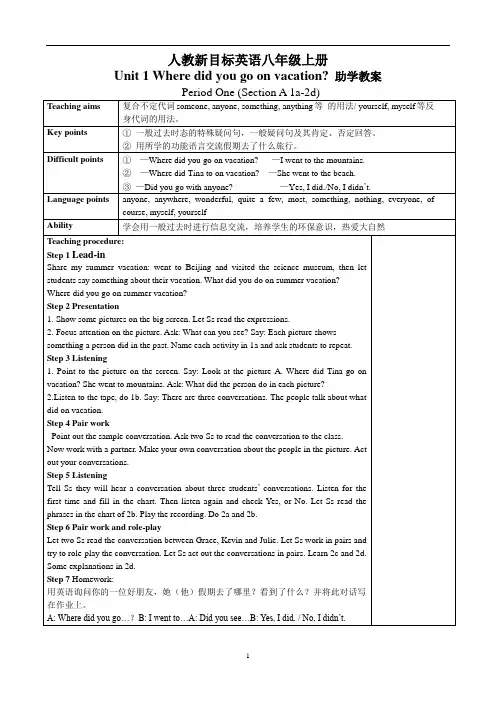
Step5Listening
Tell Ss they will hear a conversation about three students’conversations. Listen for the first time and fill in the chart. Then listenagainandcheck Yes, or No.Let Ss readthe phrases in the chart of 2b.Play the recording. Do2aand 2b.
③—Did you go with anyone?—Yes, I did./No, I didn’t.
Language points
anyone, anywhere, wonderful, quite a few, most,something, nothing, everyone, of course, myself, yourself
Key points
①一般过去时态的特殊疑问句,一般疑问句及其肯定、否定回答。
②用所学的功能语言交流假期去了什么旅行。
Difficult points
①—Where did you go on vacation?—I went to the mountains.
②—Where did Tina to on vacation?—She went to the beach.
2)阅读填空能力的提高。
Language points
人教版新目标八年级上册英语优质课教案全册教案教学设计

人教版新目标八年级上册英语优质课教案全册教案教学设计U n i t1-10(总57页)--本页仅作为文档封面,使用时请直接删除即可----内页可以根据需求调整合适字体及大小--Unit 1 Where did you go on vacation?New York City; Central Park,exam,were,rainy, delicious,expensive,inexpensive.crowded.flew,kite,later,felt,little, corner, discuss,etc Where did you go on vacation? I went to the mountains.Did she go to Central Park?Yes,she did.No, she didn’t语法:一般过去时特殊疑问句、一般疑问句及肯、否定回答。
根据初中英语新课程标准和本科教材内容,我确定了以下目标:1. Master the vocabulary2. Master the key patterns:Where did you go on vacation? I went to the mountains •Did she go to Central Park?Yes,she did.No, she didn’t单元教学重难点1.Vocabulary and Expressions2. Grammar Focus:Where did you go onvacation?I went to the mountains. Did she go on Central Park?Yes, she did.No, she didn’t Use the past tense to talk about activities that happened in the past in English with the following s entences:Where did you go on vacation?Did you go to…Yes. … /No,…Such as; go abroad, go hiking, go climbing, summer camps, and so on接近学生的生活,They are all interested in talking about it.Section A中1a. 1b. 1c. 2a. 2b. 2c. Grammar focus教学目标知识与能力1. Match the vocabulary:New York City,Central Park,exam.2. Master and use:Where did you/ they /he / she go,vacation? I / They /He /She went to the mountains\New York City\beach\summer camp.Did you go to the beach? Yes,I did.No, I didn’t.过程与方法通过例子Who went to the movies last Saturday?引出动词go的过去式went,从而引出一般过去时态。
新人教版八年级英语上册Unit3 教案

新人教版八年级英语上册Unit3 教案本教案针对新人教版八年级英语上册Unit3的教学内容。
该单元主要包含以下两大话题:1)时间和频率表达方式;2)日常活动及其规划。
通过教学,学生将能够熟练运用常用的时间和频率表达方式,并能够描述日常活动并做出相应的规划安排。
1.能够运用常见的时间和频率表达方式,如days of the week。
months of the year。
at。
on。
in。
every等;2.能够描述日常活动,并能够就日常活动做出规划安排;3.能够流利地使用所学词汇和句型进行交流。
1.时间和频率表达方式的准确运用;2.描述日常活动的基本句型的运用。
第一课时1.教授并练days of the week;2.学生进行日常活动的描述和规划。
1.复并巩固days of the week;2.教授并练months of the year;3.学生进行月份与日常活动的搭配练。
1.复并巩固days of the week和months of the year;2.教授并练at。
on。
in等时间表达方式;3.学生进行日常活动时间的描述练。
1.复并巩固时间表达方式;2.教授并练every的用法;3.学生进行日常活动规划的练。
1.情境教学法:通过创设真实的情境,让学生在实际生活中应用所学知识;2.合作研究法:通过小组合作研究,鼓励学生相互交流和合作,提高研究效果;3.游戏教学法:通过游戏形式激发学生的兴趣,提高研究积极性。
1.针对每一课时的研究内容,设计相应的练题进行评估;2.利用小组活动和教师提问的方式进行课堂实时评估;3.通过学生的作业和考试成绩,对研究效果进行总体评估。
1.教材:新人教版八年级英语上册Unit3;2.多媒体设备:投影仪、音响等;3.黑板和白板笔。
通过教材分析,我将采用情境教学法、合作研究法和游戏教学法等多种教学方法,来激发学生研究的兴趣,提高研究效果。
同时,将充分利用教学资源,使课堂内容更加生动有趣。
人教版八年级上册英语全册教案设计(2022年10月修订)
人教版八年级上册英语全册教案设计(2022年10月修订)新目标英语八年级第一学期教材分析一、解读课标要求基础教育阶段英语课程目标的各个级别均以学生语言技能、语言知识、情感态度、学习策略和文化意识五个方面的综合行为表现为基础进行总体描述。
本册教学内容属于英语课程标准中的四级目标部分,以培养学生的综合语言运用能力为总体目标;以培养学生语言技能、语言知识、情感态度、学习策略和文化意识等素质为具体目标;以促进学生个性发展为根本目标。
在教学中的主要任务是培养学生的学习兴趣、培养语言综合运用能力、培养创新能力和培养跨文化意识。
针对本册重难点内容,将课程标准要求解读为:听力技能:听懂正常语速、熟悉话题的语段,识别主题,获取主要信息;能根据连续的指令完成任务;能听懂广播、电视中初级英语教学节目。
口语技能:能根据提示给出连贯的简单指令;能引出话题并进行几个回合的交谈;能在教师的帮助下或根据图片用简单的语言描述自己或他人的经历;能在教师的指导下参与角色扮演等活动;能在上述口语活动中使用正确的语音、语调。
阅读技能:能连贯、流畅地朗读课文;能读懂说明文等应用文体的材料;能从简单的文章中找出有关信息,理解大意;能根据上下文猜测生词的意思;能理解并解释图表提供的信息;能理解简易读物中的事件的发生顺序和人物行为;能读懂简单的个人信件;能使用英汉词典等工具书帮助阅读理解;除教材外,课外阅读量应累计达到10万词以上。
技能:能正确使用标点符号;能用词组或简单句为自己创作的图片写出说明;能写出简短的文段,如简单的指令、规则;能在教师的帮助下或以小组讨论的方式起草和修改作文。
编写者根据教学内容有机地渗透了学习策略、情感态度以及文化意识的培养。
学习策略主要包括:认知策略、调控策略、交际策略、资源策略。
情感态度主要体现在培养学生的学习兴趣;学习动机与目的;学习自信心;克服学习上的困难;在英语交际中理解并尊重他人情感;合作精神。
文化意识包括文化知识、文化理解和跨文化交际能力。
人教版新目标八年级上册英语全册教案集
人教版新目标八年级上册英语全册教案集Unit 1How often do you execisePage 1. Section A 1a~1cI. Teaching Aims and Demands1.Knowledge Objects:Names of activities; Adverbs of frequency.What do you usually do on weekends I often go to the movies. 2.Ability Objects:Writing and listening skills; Communicative competence.3.Moral Object:Keep a diary every day in English.II.Teaching Key Pointswatching TV , reading , shopping , skateboarding , exercising. III.Teaching Difficulties1.always , usually , often , sometimes , hardly ever , never ;2.What does she do on weekendsShe often goes to the movies. IV.Teaching MethodsDiscovering, listening and writing methods; Pairwork.V.Teaching AidsA tape recorder; Large monthly calendar showing the days of the week;A projector.VI.Teaching ProceduresStep IGreet the classT : Good morning, boys and girls.(S : Good morning.)I’ll introduce myself first. My name’s …,I’ll be your English teacher this term. Do you like English(S: Yeah.)Now let’s begin. This class we’ll learn Unit 1.How often do you exercisePlease open your books at page 1 .Step II 1aFirst look at the picture . Ask a few students to say what they see in the thought bubbles. Each thought bubble shows something a person does on weekends.Then name each activity. Ask students to repeat each one.One girl is shopping . Another girl is reading. This boy is exercising. Another girl is watching TV. These girls are skateboarding.Point out the sample answer. Then ask students to list all the activities in the thought bubbles. If they don’t know how to write the activities, use bilingual dictionaries.Then ask the student who finishes first to write the answers on theboard.Check the answers and ask students to correct their own activities.Step III1bShow six new words on the screenalwaysusuallyoften sometimeshardly ever never总是通常经常有时难得从不Teach new words. Read the new words to students. Ask them to repeat. Tell students these words are adverbs of frequency. Point to each scene in Activity 1a . Ask students to look at each picture and tell what the person does on weekends.Listen to the recording and write the letter of one activity (a through e ) after the word in the list.Then check the answers with the whole class.Step IV 1c PairworkDisplay a large calendar that shows the days of the week. Tell students Saturday and Sunday are the weekend. Ask students to repeat Weekend.Ask two students to read the example dialogue in speech bubbles.What do you usually do on weekends I often go to the movies.Now work with a partner. Make your own conversations about the people in the picture. For example,Picture a : What does she do on weekendsShe often goes shopping.Then have students work in pairs. Make their own converwations about the people in the picture. Then ask some pairs to present their conversations to the class.Picture b :What does she do on weekendsShe often does reading.Picture c :What does he usually do on weekends He often doesexercise.Picture d : What does he usually do on weekends He often watches TV.Picture e : What do they usually do on weekendsThey often skateboard.Step VSummary and HomeworkThis class we’ve learnt some names of activities.And we also learnt someadverbs of frequency.Now homework: write a weekend diary what you do on weekend. If necessary. I’ll ask you to read your diaries to the class.StepVIBlackboard DesignUnit 1.How often do you execisewatching TV readingskateboardingexercisingshoppingWhat does she do on weekendsShe often goes shopping.Step VII Teaching reflection:Unit 2 What’s the matterPage 8Section A2a~2cGrammar FocusI . Teaching Aims and Demands1.Knowledge Objects:New words; Some advice; Grammar Focus.2.Avility ObjectsListening, reading and writing skills. Communicative competence.3.Moral Object :II. Teaching Key Pointstoothachefevershouldn’tlie down and resthot tea with honey see a dentist drink lots of waterIII.Teaching DifficultiesWhat’s the matterI have a toothache.Maybe you should see a dentist.That’s a good idea.He has a stomachache.He shouldn’t eat anything.IV.Teaching Methods:Listening,reading and writing methods. Pairwork.V.Teaching Aids :A tape recorder;A projector.VI.Teaching ProceduresStep IGreet the class .Show the new words on the screen.Read the new words to students and ask them to repeat.Talk about the Chinese meanings.feverlieresthoneydentistwater shouldn’tStep II 2aNow open your books at Page 8. First read the eight items to students and ask them to repeat.toothache sore throatstomachachefeverlie down and resthot tea with honey see a dentist drink lots of waterListen to the recording . Please pay attention to the first one has been done for you . The boy has a toothache and the advice is to see dentist.Then check the answers on the blackboard.Step III2bFirst look at the four pictures. Each picture illustrates one of the conversation.Now we’ll listen to the conversations again. This time listen for the missing words. Write the missing words on the blank lines.(Play the recording one time only)Then check the answers.Step IV 2c PairworkFirst I’ll have two students read the dialogue in the box .A: What’s the matterB: I have a toothache.A: Maybe you should see a dentist.B: That’s good idea.Now practice the conversation in Activity 2b. Take turns having the problems and giving advice.Ask students to work in pairs. After they practice a while, haveseveral pairs of student present their conversations to the class.Step V Grammar Focus(Show on the screen)I have a headache.He has a toothache.You should go to bed.He shouldn’t eat anything.She should see a dentist.shouldn’t = should notStep VI SummaryThis class we’Step VII Homework:Practice the conversations and review the Grammar Focus.Step XBlackboard DesignUnit 2 What’s the mattertoothache lie down and restsore throathot tea with honeystomachachesee a dentistfeverdrink lots of waterStep XITeaching reflection:Unit 3 What are you doing for vacationPage 16 Section B 1a~2cI.Teaching Aims and Demands1.Knowledge Objects:Key vocabulary; Target language; Oral practice.2.Ability Objects:Listening, speaking, reading and writing skills;Communicative competence.3.Moral Object :Take walks and keep healthy.II.Teaching Key Points1.Key vocabulaygo bike riding , go sightseeing , take walks , go fishing , rent videos.2.Target languageWhere are you going for vacationWhat’s it like thereWhat are you doing thereWho are you going withHow long are you stayingIII.Teaching Difficulty :Oral practice.IV. Teaching MethodsListening, speaking, reading and writing methods;Pairwork.V.Teaching Aids:A tape recorder;A projector.VI.Teaching ProceduresStep I Greet the class .Step IISection B1aShow five pictures on the screen, ask students to read the five phrases.go bike riding , go sightseeing , take walks , go fishing , rentvideos.Call attention to the first picture. For example, Look at this girl. She ’s happy . She ’s fishing. Repeat. She ’s fishing . Students repeat. Do this for all the five pictures.Then ask students match the words and check the answers.Step III 1bNow work with a partner. Talk about what you would like to do on vacation.Talk about the activities in 1a and other activities you know.Help students to find partners.Then havethe class listen to one student ask another about each activity.Step IV 2a and 2bLook at the picture, please. Listen to the conversation carefully. Put a checkmark next to the questions you hear the reporter asks. Then listen again. This time write He Yu answers to the questions.Then check the answers.Step V 2c PairworkFirst ask two students to read the conversation in the box.A: Hello, He Yu . Can I ask you some questions about your vacation plansB: Yes .A: What are you doing…Now work in pairs.Student A you are the reporter. Student B you are He Yu .Ask and answer questions about He Yu’s vacation. Then change roles.As students work, move around the classroom, offering language support if needed.Then ask pairs of students to present their conversations to the class.Step VIISummaryThis class we’ve learnt key vocabulary and target language. And also we’ve done an oral practice.Step VIIHomeworkAfter class, ask classmates about the vacation plan and fill in a chart.(Show the chart on the screen.)Step VIII Blackboard DesignUnit 3 What are you doing for vacationgo bike riding ,go fishing ,go sightseeing ,rent videos, take walks .Step X Teaching reflection :Unit 4How do you get to schoolPage 19 Section A 1a ~1cI. Teachig Aims and Demands1.Knowledge Objects:Key vocabulary; Target language; Oral practice.2.Ability Objects:Listening and writing skills; Communicative competence.II. Teaching Key PointsKey vocabulary: walk, subway, take the subway, train, take the train, ride a bike, take the bus, take a taxi, go in a parent’s car.III.Teaching DifficultiesTarget language :Hey, Dave. How do you get to schoolI walk. How about you , SallyI ride my bike.How does Bob get to schoolHe takes the train.IV. Teaching Methodsistening and writing methods; Pairwork.V . Teaching Aid : A tape recorder;A projector.VI. Teaching ProceduresStep IGreet the class and show the screen:(This is a picture. A house on one side of the board and a school on the other side. Some streets with left and right turns leading from the house to the school.) Teach the two buildings home and school.Use finger to trace a path from the house to the school.Ask students, How do you get to school Do you walk Do you ride a bicycle (For example, if you ask , How do you get to school and a student replies, Bike, say , Oh , you ride your bike. Class, repeat. I ride my bike. The class repeats.)Say, Today we’re talking abot how you go from one place to another.Step IISection A 1aFirst ask students to look at the picture. And read the sample sentences to them. Ask them to repeat.Hey, Dave. How do you get to schoolI walk. How about you, SallyI ride my bike.Then let students say how other students in the picture get ot school. Give them some help if necessary. For example, take the bus ; take the train; take the subway.Read the phrases to them and ask them to repeat. Then ask them towrite them in the box and add other ways to get to school.Then check the answers.Step IV 1bFirst point out the names of the students in the box. Ask one student to read the names. Now listen to the conversation. Please write the number of the name in the white box next to the student. One of them has already been done.Then ask students to say what each person is doing.Write the phrases on the board: walking, taking the train, taking the subway, taking the bus.Check the answers on the screen. Then ask the students how Bob /Mary /Paul /Yang Lan /John gets to schoolThen, use these persons to make a dialogue like this:A: Hey, Bob. How do you get to schoolB: I take the train. How about you, MaryA: I take the subway.Ask students to complete the activity individually.Then check the answersStep V 1c PairworkAsk two students to read the dialogue in the box to the class.A: How does Bob get to schoolB: He takes the train.Now work with a partner. Make your own conversations about how the people in the picture get to school.Then ask students to work in pairs. Ask and answer how students get to school in the picture..(Present their conversations to the class.) As they talk , move around the room, offering language or pronunciation support as needed.Step VISummary and HomeworkThis class we’ve learnt some key vocabulary and the target language . How do you (does he )get to school Next class I’ll ask some students to tell me the answers.Step VII Blackboard DesignUnit 4 How do you get to schoolwalksubwaytraintake the subway/train go in a parent’s carHow do you get to school I walk.How does he get to schllo He walks.Step VIIITeaching reflection:Uint 5 Can you come to my partyPage 26 Section2a~2cI.Teachig Aims and Demands1.Knowledge ObjectsKey vocabulary; Target language; Grammar focus.2.Ability ObjectsListening skill and communicative competence.3.Moral ObjectIt’s polite to refuse one’s invitation if you can’t go.II.Teaching Key Points1.Key vocabulary:hey, baseball game , too much homework2.Target languageHey, Dave,can you go to the movies on SaturdayI’m sorry, I can’t . I have too much homework this weekend.I have to help my mom.I’m playing soccer.I have to go to my guitar lesson.I’m going to the movies.I have to visit my aunt.III.Teaching Difficulties:Grammar focus;Pairwork.IV.Teachig MethodsListening and speaking methods;Communicative approach; Pairwork.V.Teaching Aids:A tape recorderVI.Teaching ProceduresStep IGreet the class.Step II 2aFirst ask students to look at the sentences to the class twice. The first time say can and the second time say can’t .Listen to the conversations carefully and then circle the word “can〞or “can’t 〞.Check the answers with the whole class.Step III 2bAsk a student to read the five sentences in Activity 2b.Listen to the recording again and fill in the three numbers as they listen.Step IV 2c PairworkAsk students if they can give other reasons besides the lists in Activity 2b.(Possible answers : not feeling well, have to babysit, going on a trip.)Look at the sample conversation in the book. Ask a pair of students to read it to the class.A : Hey, Dave,can you go to the movies on SaturdayB : I’m sorry, I can’t . I have too much homework this weekend.A : That’s too bad. Maybe another time.B : Sure, Joe. Thanks for asking.Now work with a partner. One of you is student A and one of you is student B. Student A, invites your partner to do something with you. Student B, say you can’t do it and give a reason.Then change roles.Then ask some pairs of students to present their dialogues to theclass.If some pairs do well, give them little presents to praise them.Step VSummary and HomeworkToday we’ve learnt how to say “no〞to someone’s invitation and give a reason. After class practice the concersations with you partner.Step VIBlackboard DesignUnit 5 Can you come to my partyhas tohave toShe ____play basketball. He_____study.They _____go to party. I_____study for a test.Step VIITeaching reflcetion:Unit 6I’m more outgoing than my sister.Page 31Section A1a~1cI.Teaching Aims and Demands1.Knowledge Objects:Key vocabulary; Targe language; Oral practice.2.Ability Objects:Listening and speaking skills; Communicative competence.3.Moral Object:Learn to play a musical instrument.II. Teaching Key Points1.Key vocabularyTall, short, thin, heavy, long hair, short hair, calm, wild, more than.2.Target LanguageIs that SamNo, that’s Tom. He has shorter hair than Sam.Is that TaraNo, it isn’t. It’s Tina .Tara’s shorter than Tina.III.Teaching Difficulty:Oral practice using the target language.IV.Teaching MethodListening and speaking methods; Communicative approach.V. Teaching AidsA tape recorder; A projector; Some objects.VI.Teaching ProceduresStep IGreet the class.Step IIMake a simple drawing of a boy and a girl on the board. Make the boy tall and make the girl a little taller than the boy. Write the name Lucyunder the girl and the name Bob under the boy. Then compare Lucy and Bob and ask studets to repeat the sentences.Bob is tall. Lucy is tall. Lucy is taller than Bob.Then bring out two rulers of different length. Say ,This is a ruler. It’s Bob’s ruler.(longer) This is Lucy’s ruler.(long)Bob’s ruler is longer than Lucy’s.Step III Show some new words on the screen.more than calm wildRead the new words to students and ask them to repeat.Step IV 1aT : Now please open your books at page 31. First, look at the picture. How many people are there in the pictureS: Nine .T: Good, please tell me their names.S: Pedro and Paul. Ton and Sam. Tara and Tina.T: Great! Who is taller, Pedrl or PaulS: Pedro.T: That’s right. Pedro is taller .Ss: Pedro is taller.Then ask students to repeat the following sentences:Tina is wilder than Tara. Tara is calmer than Tina.Sam is wilder than Tom. Sam has longer hair than Tom.Tom is calmer than Sam. Tom has shorter hair than Sam.Pedro is heavier than Paul. Paul is thinner than Pedro.Tell students to draw lines between the words of the opposite meanings . For example, tall and short.Step V 1bFirst tell students what the twins are. Twins are children born at the same time to the same parents. Sometimes they look exactly alike, but not always. The twins in this picture do not look exactly alike.Listen to the conversation carefully and number the pairs of twins (1~3)in the picture. Then check the answers.Step VI 1cPairworkFirst ask two students to read the sample conversation to the class.A: Is that TaraB: No, it isn’t .It’s Tina.Tara’s shorter than Tina.Then have students work with a partner. Make converwations aboutthe other twins.Ask some pairs of students to say one or more of their conversations to the class.Step VIISummary and HomeworkToday we’ve learnt the twins are having a concert. We’ve learnt how to compare people. After class, give more practice, compring your school things. Next class I’ll ask some of you to say your conversations.Step VIII Blackboard DesignUnit 6I’m more outgoing than my sister.BobLucyLucy is taller than Bob.Bob is shorter than Lucy.Step XTeaching reflection:Unit 7How do you make a banana milk shakePage 41Section A1a~1cI.Teaching Aims and Demands1.Knowledge Objects:Key vocabulary; Target language; Writing practice.2.Ability Objects:Listening, sequencing, writing and cooperating skills.1.Moral Objects:Knowing that it is not easy to be a chef.There is a lot of fun in cooking.II. Teaching Key Points1.Key vocabulary:Turn on , cut up, peel, pour, put, drink, blender2.Target languageHow do you make a banana milk shakeFirst, peel the bananas and cut it up.Then put the milk into the blender…III. Teaching MethodsWatching, listening and writing methods; Pairwork.IV. Teaching Aids:A tape recorder ; A projector.V. Teaching ProceduresStep IGreet the class.Step IILearn the following new words with the help if the pictureswhile showing them on the screen.blender milk bananaPoint to the pictures and the names of all items and ask students to repeat.Step IIISection A 1aShow the pictures with the blanks on the screen as shown on students’book.Ask students to tell what they see in the picture.Point out the blank lines in the picture.Ask students to write the names of the actions on the blank lines.Give one sample answer. Then ask students to fill in the blanks on their own.Ask a student who finishes first to write the answers on the blackboard.Check the answers on the blackboard and ask students to correct their own answers.Step IV 1bListen and put the instructions in the correct order.Point out the actions in the picture and the list if actions in Activity 1b.Ask different students to look at the picture and tell what is happening .Ask others to read the list of actions in Activity 1b.Listen to the conversation and ask the students to complete the activity on their own. Then check the answers.Step V 1cPairworkPoint out the instructions in Activity 1b.Ask a student to read the instructions in the correct order.Now work with your partner.Cover the instructions in 1b and tell your partner how to make a banana milk shake.Point out the example in the speech bubble and say, You can start like this, if you want to .Ask one or two students to say the list of instructions to the class without looking at the book.Step VISummaryToday we have learned some names of food. And we also learned how to make a banana milk shake.After class if you want to drink something you could make a special one. Not by your mother or father, but by you.You could make it anytime. And we know it is not easy to be a chef. But still there is a lot of fun in cooking.Step VII HomeworkWrite a sequence of making an apple milk shake.Step IX Blackboard DesignUnit 7 How do you make a banana milk shaketurn on cut uppeel pour put drinkblenderSequence of making milk shake:peel …cut up ………Step XTeaching reflection:Unit 8 How was your school tripPage 47Section A1a~1cI.Teaching Aims and Demands1.Knowledge ObjectsKey vocabulary; Target language.2.Abiklity ObjectsListening, speaking, writing and cooperating skills.1.Moral ObjectWhat you do today is what you do tomorrow.II.Teaching Key Points1.Key vocabularyaquarium, zoo, seals, sharks, photos, souvenir, ate, took, hung out.2.Target languageDid you go to the zooNo, I didn’t. I went to the aquarium.Were there any aharksNo, there weren’t any sharks, but there were some really smart seals.III. Teaching Difficulty:Spoken practice.IV. Teaching MethodsOral practising, listening, writing, asking and answering methods; Pairwork.V. Teaching ProceduresStep I Greet the class.Step IIToday we are going to learn Uint 8 How was your school tripDuring this unit we will learn more ways to talk about things that happened yesterday, last week or last year. Now I’d like to ask some questions about things you did yesterday or last week.Warming – up:Ask different students questions about things they did yesterday or last week using verbs they have already studied.Ask the students to give the short answers, Yes, I did . No, I didn’t .Yes, I was. No, I wasn’t. Use these verbs: do/did, is/was, are/were, buy/bought, go/went, and see/saw.Review the present and past of some verbs students have already studied. Remember to use only these verbs: do/did, is/was, are/were, buy/bought, go/went, and see/saw.Step IIIShow new words on the screenaquarium shark seal souvenirLead the students read the words above and add some more words needed to teach.Step IV Section A 1aAak students to make separate lists.Ask students to read their lists to the class. On the board, make a list of all the activities students talk about using a past verb and the activity. Point to the items and ask different students to read theitems to the class.Step V 1bPoint out the picture and the list of activities. Read the instructions.Listening carefully and circle only the things you hear on the recording .Check the answers.Step VI 1c PairworkAsk students to look at the picture in Activity 1a. Then point out the sample comversation in Activity 1c. Ask two students to read it to the class.Say, Now work with a partner. Make your own conversations about the people in the picture.Ask several pairs to present one or more of their converwations to the class.Step VII GameDivide the class into two teams. Name one team “past〞and the other “present〞. The “past 〞team will talk about things that happened last week or last year. The “present〞team will talk about things that happen every day. The “past 〞team starts by saying a sentence. The “present〞team has to change the sentence into a “present〞sentence. For example,I went swimming yesterday becomes I go swimming every day. The “present〞team to change. Each team gets one point for changing a sentence correctly.Step VIII SummaryToday we have learned how to talk about what you didon your last school trip. This is about something happened in the past. And now we know how to say it in English. We have to work hard every day then we could make progress every day.Step IX HomeworkReview the Activity 1a. Practice the Activity 1b with yout partner.Step X Blackboard DesignUnit 8 How was your school tripDid you go to the zooNo, I didn’t. I went to the aquarium.Were there any aharksNo, there weren’t any sharks,but there were some really smart seals.Step XITeaching reflection:Unit 9 When was he bornPage 56Section B1a~2cI.Teaching Aims and Demands1.Knowledge Objects: Key vocabulary; Target language; Writing practice.2.Ability Objects : Listening, writing and speaking skills.1.Moral Object: Working hard makes a man.II.Teaching Key Points1.Key vocabularytalented, loving, outstanding, unusual, beautiful, creative, kind, famous.2.Target languageA: Who’s MidoriB: She’s a famous violinist.A: When was she bornB: She was born in 1971.A: When did she tour the U.S.III.Teaching Difficulty: Target language.IV. Teaching MethodsListening, writing and speaking methods; Pairwork; Groupwork.V. Teaching Aids: A tape recorder; A projector.VI.Teaching ProceduresStep I Greet the class .Step II Lead- in and IntroductionToday we start to learn to talk more about people.They are different but just common like us.Show the new words on the screen.talented loving outstanding unusual creative grandchildviolinist skating skater becomePoint to them and lead the students to learn them.Step III Section B 1aFirst learn the words in the yellow bar at the top of the page. Write them on the board. Then point to the words one by one and ask students to say what they mean. Have students explain the words, or use the words in several sentences to show what they mean. For example , T: Talented. A talented person can do something very well. Deng Yaping is a talented table tennis player, Sun Yanzi is a talented singer. Who else is talentedS: Carlos is a talented soccer player.Read the instructions and point out the pictures. Ask a student to read the names of the people in the pictures. Help him if he has some difficulties in pronunciation of the names.Ask students to write one or orwo words from the list under each person’s picture. Give students an example to help them understand how a possible answer is.Step IV 1b GroupworkPoint to the different people in the pictures in Activity 1a.Ask several students to read to the class the words they wrote under each picture.Read the sample sentences: A: Arthur is a loving frandfather.He spends all his free time with his grandson.Say, Now work with a group. Make your own statements about the people in the pictures using the words you wrote in your book.Ask students to tell the class what they said about some of the people.Step V 2aRead the instructions and point out the words in the list in Activity 1a. Say, Listen to the boy and girl talking about people the admire. Circle the words you hear.Check the answers.Step VI 2bShow the eight sentences on the book’box. Stuents read.Check the answers.Step VII 2c PairworkPoint out the sample conversation. Ask two studnts to read it to the class.Then lead the class to read the sample conversation toghther.Have students work in pairs. Ask some pairs of students to say a conversation to the class.Step VIII SummaryToday we have learned to talk about people with words talented, loving, outstanding, unusual, beautiful, creative, kind, famous.And we listened to a story about Midori and Laura. Both of them became very famous when they were very young. Working hard makes a man. You are young, you have chances to prepare and go.Step X Blackboard DesignUnit 9When was he borntalentedlovingoutstandingunusualbeautiful creativekind famousA: Who’s MidoriB: She’s a famous violinist.A: When was she born B: She was born in 1971.。
八年级上册英语教案人教版全册
八年级上册英语教案人教版全册1. 背景八年级上册英语教案人教版全册是针对八年级学生的英语教学大纲,旨在提供全面而系统的英语教学内容。
本教案覆盖了上册所有单元,帮助学生提高听、说、读、写等英语技能。
2. 教学目标- 提高学生的英语听力和口语表达能力- 培养学生的阅读理解能力- 帮助学生掌握英语语法知识- 引导学生运用所学知识进行写作3. 教学内容本教案包含上册所有单元的教学内容,每个单元的教学内容都经过精心设计,结合了各种教学资源和活动,以便提高学生的研究兴趣和参与度。
4. 教学方法- 听力训练:通过听录音和跟读练,提高学生的听力理解能力。
- 口语练:通过小组讨论、角色扮演等活动,培养学生的口语表达能力。
- 阅读理解:通过阅读文章和回答问题,培养学生的阅读理解能力。
- 语法研究:通过解析语法规则和练题,帮助学生掌握英语语法知识。
- 写作训练:通过写作练和作文,引导学生用所学知识进行写作。
5. 教学评估教学过程中,可以通过听力测试、口语表达、阅读理解、语法练和写作评价等方式对学生的研究情况进行评估。
根据评估结果,及时调整教学方法和内容,以提高教学效果。
6. 教学资源为了支持教学活动,需要准备以下教学资源:- 教科书和课本:提供教学材料和练题- 录音机或电脑:播放课文录音和听力材料- 板书和投影仪:展示教学内容和示范演示- 练册和作业纸:进行口语和写作练- 多媒体资料:如图片、视频等,用于辅助教学效果7. 教学计划具体的教学计划可以按照每个单元进行安排,包括课前准备、教学活动和作业布置等内容。
可以根据实际教学情况进行调整,确保教学进度和效果。
8. 总结八年级上册英语教案人教版全册是一份全面而系统的教学指南,旨在提高学生的英语能力和综合素养。
通过精心设计的教学内容和活动,帮助学生掌握听、说、读、写的英语技能,并培养其全面发展。
以上是八年级上册英语教案人教版全册的简要概述,希望对您的教学工作有所帮助。
【精品】人教版初中英语八年级上册全册教案教学设计
【精品】人教版初中英语八年级上册全册教案教学设计一、教学目标本教案旨在通过设计有趣和灵活的教学活动,帮助八年级学生掌握人教版初中英语八年级上册全册的相关内容。
二、教学内容本教案涵盖了八年级上册全册的所有教学内容,包括单元主题、课文、语法、听说读写等各个方面。
通过细分教学内容,为每个单元和课时设计相关教学活动。
三、教学方法为了激发学生的研究兴趣和提高教学效果,本教案采用多种教学方法,如听力训练、口语练、阅读理解、写作练等。
通过多种形式的活动,提供多样化的研究体验。
四、教学活动每个单元和课时都有相应的教学活动安排,包括引入新知识、课文讲解、练和巩固等。
教师可以根据具体情况适当调整教学活动的顺序和内容。
五、评估与反馈为了评估学生的研究情况和提供及时的反馈,本教案设计了各种评估方式,如课堂作业、测试、口头回答问题等。
教师可以根据学生表现和需要进行评估,并根据评估结果进行调整和改进教学。
六、教学资源本教案列出了所需的教学资源,包括教材、课件、多媒体设备等。
教师可以提前准备好相关资源,以便顺利开展教学活动。
七、教学进度安排根据教学内容和学校的具体情况,本教案给出了教学进度的安排。
教师可以参考该进度安排,合理安排教学活动和时间,确保教学进度的顺利进行。
八、教学反思与改进本教案鼓励教师进行教学反思和改进,通过总结教学经验和反馈意见,及时调整和改进教学方法和教学内容,提高教学效果和教学质量。
以上是对人教版初中英语八年级上册全册教案教学设计的简要介绍,详情请参考教案的具体内容。
如有疑问或需要进一步帮助,请随时与我联系。
人教版八年级上册英语全册教案版
Unit 1 Where did you go on vacation?New York City; Central Park,exam,were,rainy,delicious,expensive,inexpensive.crowded.flew,kite,later,felt,little, corner, discuss,etc Where did you go on vacation? I went to the mountains.Did she go to Central Park?Yes,she did.No, she didn’t语法:一般过去时特殊疑问句、一般疑问句及肯、否定回答。
根据初中英语新课程标准和本科教材内容,我确定了以下目标:1.Master the vocabulary2.Master the key patterns:Where did you go on vacation? I went to the mountains •Did she go to Central Park?Yes,she did.No, she didn’t单元教学重难点1.Vocabulary and Expressions2. Grammar Focus:Where did you go onvacation?I went to the mountains. Did she go on Central Park?Yes, she did.No, she didn’t Use the past tense to talk about activities that happened in the past in English with the following sentences:Where did you go on vacation?Did you go to…?Yes. …/No,…Such as; go abroad, go hiking, go climbing, summer camps, and so on接近学生的生活,They are all interested in talking about it.Section A中1a. 1b. 1c. 2a. 2b. 2c. Grammar focus教学目标知识与能力1. Match the vocabulary:New York City,Central Park,exam.2. Master and use:Where did you/ they /he / she go,vacation? I / They /He /She went to the mountains\New York City\beach\summer camp.Did you go to the beach?Yes,I did.No, I didn’t.过程与方法通过例子Who went to the movies last Saturday?引出动词go的过去式went,从而引出一般过去时态。
八年级上册英语全册教案
八年级上册英语全册教案第一章:Unit 1 How often do you exercise?教学目标:1. 能够听、说、读、写表示频率的词汇,如often, sometimes, rarely等。
2. 能够用一般现在时询问和回答关于某人做某事的频率。
3. 能够正确使用频度副词和实义动词构成一般现在时句子。
教学内容:1. 词汇教学:often, sometimes, rarely, every day, twice a week等。
2. 语法教学:一般现在时态的构成和用法。
3. 听力训练:听懂对话并回答问题。
教学活动:1. 导入:通过谈论日常锻炼来引入主题。
2. 新课内容:讲解频度副词和一般现在时态的用法。
3. 听力练习:播放对话,让学生回答问题。
4. 口语练习:学生分组讨论,询问并回答关于做某事的频率。
5. 写作练习:让学生写一段话,描述自己每周做某事的频率。
第二章:Unit 2 Do you like pop music?教学目标:1. 能够听、说、读、写表示音乐的词汇,如pop music, rock music, jazz等。
2. 能够用一般现在时询问和回答关于某人的喜好。
3. 能够正确使用实义动词和频度副词构成一般现在时句子。
教学内容:1. 词汇教学:pop music, rock music, jazz, classical music等。
2. 语法教学:一般现在时态的构成和用法。
3. 听力训练:听懂对话并回答问题。
教学活动:1. 导入:通过谈论不同类型的音乐来引入主题。
2. 新课内容:讲解音乐词汇和一般现在时态的用法。
3. 听力练习:播放对话,让学生回答问题。
4. 口语练习:学生分组讨论,询问并回答关于音乐的喜好。
5. 写作练习:让学生写一段话,描述自己喜欢的音乐类型。
第三章:Unit 3 Could you please clean your room?教学目标:1. 能够听、说、读、写表示请求的词汇,如could you please, will you等。
八年级上册英语教案人教版5篇
八年级上册英语教案人教版5篇八年级上册英语教案人教版篇1一、教材内容分析本课是人教版八年级上册英语第一单元第三个话题的第一课时,主要谈话讨论如何给别人提出建议,并给予适当的评论。
二、教学目标(知识,技能,过程与方法情感态度、价值观)1、知识与技能(1)掌握Why don’t you get her a scarf ? That’s too boring .这种句型,并认识新单词。
(2)运用新句型熟练的进行小组对话。
(3)进行听力练习。
2、过程与方法(1)能够通过师生说、两两说和自主听读体验交际式英语教学的一般过程,掌握英语说听的基本方法;(2)能够通过两两说和综合说体验合作学习的过程和方法;(3)能够仔细倾听老师和同学的发言,有语言表达和与同学交流的愿望。
(4)能够通过观看图片激发说话的欲望。
3、情感态度与价值观(1)培养学习英语的兴趣;(2)在学生两两交流和小组合作交流中,培养孩子合作意识和合作精神,能够相互配合完成一段通顺流畅的说话训练;(3)使学生学会礼貌待人。
三、学习者特征分析1、学生是八年级的学生。
2、学生已经学习了camera、hat,flowers 等物品的词。
3、学生对 great,interesting,boring 这些评论性的词非常熟悉。
4、学生好奇心强,对送什么礼物很感兴趣。
5、学生善于表现自己,乐于交际。
6、学生的听力能力不够强。
四、教学策略选择与设计1、谈话策略:运用谈话法引入新课。
2、自主听读策略:学生通过自主听读拓展材料,在完成课标要求的基础上训练听说能力,积累和丰富英语词汇和句式。
3、角色扮演法:让学生通过扮演不同角色,小组对话练习熟练地掌握重点句型。
五、教学环境及资源准备1多媒体教室。
2 本课教材,课件。
六、教学过程教学过程教师活动学生活动设计意图及资源准备Step1: Greeting Hello , cliass! How are you! Are you happy ... Greeting. 拉近教师和学生的距离。