
冀教版八年级英语下册Unit 3 Animals Are Our Friends(Review)单元复习课件
Putting It All Together Ⅰ. Read this introduction about pandas. Then fill out the table.
Pandas are mammals. They are black and white. They can grow to be between 1.2 to 1.9 metres tall. Bamboo is their main source of food. Wild pandas live in China. Their average life span is about 20 years. The average weight of a panda is about 80 to 130 kilograms. They are so cute that people all over the world love them.
In cold places, bears sleep all winter. They go to sleep from October to April. Before they go to sleep, they eat quite a lot.
They have a good sense of smell but poor eyesight. They also have poor hearing. But they are very clever. We can see in the zoo how clever they are when they beg for food. They sit up and hold their paws. A dog can do this after we teach it, but bears learn to do this by themselves.
□Only in Asia.
□√In Asia, Africa and America.
3. When are bears dangerous? □√When they feel scared. □Any time.
4. In cold places, how long do bears sleep? □Nearly four months. □√Almost seven months.
Bears are very strong animals. They have short tails and thick legs. They eat almost everything.
They feed mainly on roots, frogs and fish. They seem to like meat, fruit, vegetables, milk and rice better than other things. They also eat small insects.
a_n_im__a_ls___. They are big and s_tr_o_n_g____. They live in groups. They have a l_o_n_g_____life, just like human beings. They are usually friendly to people. They eat grass, and people can ride on their backs. But when they feel scared or they get angry, they become d_an__g_er_o_u_s_. They can knock down trees and carry them out of the f_o_re_s_t____.
Ⅲ. Complete the dialogue with the sentences in the
box. Then work in pairs and talk about other
animals. Tera:____C_____ Bob:Yes. I know some interesting facts about monkeys. Tera:____B_____ Bob:Some monkeys have long noses. Their noses can be
Tera:Cool!_____D______
A. What else do you know? B. What do you know about them? C. Have you heard of any amazing animals? D. Monkeys really are amazing animals.
have __a_n_y____? B:Yes, I do. A:May I borrow __s_o_m__e__? B:Sure. Here you are. A:Thank you.
Listening and Speaking Ⅰ. Listen and repeat. 1.But there are only a few thousand tigers in the wild today. 2.Kiwis can be as big as chickens. 3.They ate, slept and swam together. 4.That's a true story of friendship!
Ⅱ. Indefinite Pronouns:some,any I have some donuts for you. I don’t have any donuts today. S_o_m__e_p_e_o_p_l_e_h_u_n_t_a_n_d__k_il_l_t_ig_e_r_s_f_o_r_m_o_n_e_y_.__________ W__e_d_o_n_'_t_h_a_v_e_a_n_y__p_a_n_d_a_s_a_t_t_h_e_E_d_m__o_n_t_o_n_Z_o_o_,__D__a_n_ny. I can use indefinite pronouns properly. ☆☆ ☆ ☆ ☆
Ⅱ. Listen to the passage and tick the correct
answers.
1. What do bears mainly feed on?
□Milk and insects.
□√Roots, frogs and fish.
2. Where do bears live?
Unit 3 Animals Are Our Friends
Unit Review
Building Your Vocabulary Read the passage and fill in the blanks. The first letter
is given. You probably know that elephants are the largest land
Stand So Still I'm at the zoo watching all the animals, I want to make friends with one today. Throw some food to the ducks by the water, Stand so still while they waddle my way.
We can see bears in Asia, Africa and America. We usually think they are very dangerous. But in fact, they try hard not to meet with people. It isn’t because they are shy. They can be dangerous when they are in danger.
__W__h_e_n_t_h_e_m__o_n_k_e_y_s_a_r_e_h_a_p_p_y__or__e_x_ci_t_ed__, _th_e_y____ __sh__ak__e_t_h_ei_r_n_o_s_e_s_. __________________________
__T_i_ge_r_s_a_r_e__sy_m__b_o_ls__o_f _st_r_e_n_g_th__a_n_d_c_o_u_r_a_g_e_._____ I can talk about animals in English. ☆☆ ☆ ☆ ☆
as big as eggplants. Tera: Ha! That's really big!_____A______ Bob: Some monkeys are clever. They are able to do simple
maths. Tera: Wow! Is that true?
Bob:Yeah! Some monkeys even have a better memory than humans. They can remember colours and shapes.
Typas
mammal Food bamboo Home China
about 20 years
between
about
Size 1.2 to 1.9 Weight 80 to 130
metres
kilograms
tall
Ⅱ. Writing Share an interesting story about animals with your
classmates. Then write it down.
Self-Evaluation Find more examples from this unit. Then mark your stars. Ⅰ. Talking about Animals
2024八年级英语下册Unit3AnimalsAreOurFriends写作能力提升练课件新版冀教版

总结 In a word, it’s fun to have a pet.
种树 的重 要性
Trees are important to people. Trees can give food to people and animals. They can make the air cleaner. They can make the earth more beautiful. Trees can protect the soil.
members can talk about their pets together. Keeping pets will improve the relationship between the family members.
In a word, it’s fun to have a pet. Do you want one?
句 型: 1. Animals are important in the food chain. 2. We should think of animals as friends. 3. We should do our best to protect animals.
环顾四周,你会发现许多人拥有自己的宠物,请 根据下面的提示,写一篇英语短文来谈一谈养宠物的好 处。可适当发挥。80 词左右。 提示 : 1.To improve yourself. (look after; make friends) 2. Develop a good relationship with family members. (talk
_fl_o_w_e_r_. _B_e_n__b_a_r_k_e_d_a_n_d__j_u_m_p_e_d__i_n_to__th__e_w_a_t_e_r_a_t_o_n__ce_.______ _W__h_e_n_m__y_p_a_r_e_n_t_s_h_e_a_r_d__B_e_n__b_a_r_k_in_g_,_t_h_e_y_r_a_n__t_o_t_h_e_r_i_v_e_r__ _q_u_ic_k_l_y_a_n_d__t_h_e_y_s_a_w__B_e_n__w_a_s__p_u_s_h_in_g__m_e__t_o_t_h_e_b_a_n_k__w_i_t_h__ _it_s_m__o_u_th__. ___________________________________________ _____N_o_w__w_e__lo_v_e__B_e_n__m_o_r_e__th_a_n__b_e_f_o_re_,_a_n_d__w_e__c_o_n_s_id_e_r__it__ _a_s _a_m__e_m__b_e_r_o_f_o_u_r_f_a_m__il_y_._____________________________ ____________________________________________________ ____________________________________________________
冀教版初中英语八年级下册Unit3 Animals Are Our FriendsPPT课件

翻译下列的短语。
Today was April Fools’ Day. Jenny and Brian wanted to _p_la_y__a_t_r_ic_k__o_n_ Danny. Danny was
sleeping. Jenny and Brian _w_o__k_e_ him up. They told Danny a bear _e_s_c_a_p_e_d_ from the zoo.
Task 2 Listen and correct the following passage.
fierce
Hale Waihona Puke shortbamboo
plants can’t as fast as
eight
smaller and smaller
Task 3
Read the lesson and fill in the blanks to complete the story.
4. Wait a minute. 等一会儿。
此句为祈使句,还可以说成wait a moment.
5. You are joking, aren’t you?
反义疑问句:陈述句+逗号+省略问句+ 问号
You are from America, aren’t you?
There stands a house and lots of trees, doesn’t there?
冀教版初中英语八年级下册Unit 3 Animals Are Our Friendsword教案 (2)
Unit 3 Animals Are Our FriendsLesson 13 Danny’s Big ScareTeaching content:Mastery words and expressions: scare, doorbell, scream, tiny, sofa, vacation, gentle, loyal Oral words and expressions: amazing, imaginationLearning important and difficult points:1) yet的用法2) ask sb. to do sth. 的用法Teaching difficult points:The imaginary pets.Teaching preparation: picturesTeaching aids:audiotape, flashcards, picturesTeaching type: new lessonTeaching procedures:Step 1. Come to “THINK ABOUT IT”◆ What’s your favorite animal? Why?◆ Do you have a pet?What is its name?◆ What kind of pets would you like to have?Step 2. Listen to the tape and answer the following questions:Step 3. Read the text and check the answers. Then read the text again. Play the tape again and let the students read after it. Play the tape for several times until they can read it correctly and fluently.Step 4. Let some students lead the class to read the text sentence by sentence.Step 5. PracticeWork in pairs. Practice the similar dialogue according to the text.Step 6. Come to “PROJECT”Do you have a pet? Do many animals live with your family? Some people have dogs. Some people have cats. Some people have fish. Some people even have snakes! Do you have a pet?Step 7. Homework1. Finish off the activity book.2. Go on the next reading in the next lesson.Lesson 14 Amazing AnimalsTeaching content:Oral words and expressions:long-eared, jerboa, mouse, kiwi, lay, eggplant, shake, flap, avoid Learning important and difficult points1) remind的用法2) lay的用法Teaching preparation: picturesTeaching aids:audiotape, flashcards, picturesType of lesson: new lessonTeaching procedures:Step 1. ReviewStep 2. Come to “THINK ABOUT IT.”◆ Can you name some animals you have never seen before?◆ What animals do you think are amazing? Why?Step 3. Read the text silently and ask the students to answer the following questions:Step 4. Play the tape and let the students read after it. Pause after every line, and ask the students to repeat.Step 5. Let some students read the text in class and the others listen to see if they have any mistakes. Can they find and correct the mistakes?Step 6. Let the students rewrite the story and read it to the class.Step 7. Discuss the reading with the students. Use as much English as possible. Ask questions to make it easier for students to participate.Step 8. HomeworkWould you like to have a pet?Why or why not?Write a paragraph.Lesson 15 The Zoo Is OpenTeaching content:Mastery words and expressions: danger, dangerous, mainly, bamboo, giraffeLearning important and difficult points:1.take photos2.nearly的用法Teaching preparation: picturesType of lesson: new lessonTeaching procedures:Step 1. Show some pictures of animals to the class. Ask the students:What animals do you like best?What animals can you see in the zoo?Step 2. Come to “THINK ABOUT IT.”▲ Have you ever been to the zoo?▲ What animals do you think are dangerous? Why?▲ What rules should we obey at the zoo?Step 3. Read the text.Step 4. PracticeStep 5. Read the text in roles. The teacher walks in the classroom while they are reading. Help them if necessary.Step 6. Let some students come to the front and act the dialogue out.Step 7. HomeworkPrepare the dialogue in group of three in “Let’s Do It”, and act it the next class.Lesson 16 The Bear Escaped!Teaching content:Mastery words and expressions: escape, fierce, protect, foolLearning important and difficult points:1.escape的用法2.if的用法3.wake upTeaching preparation: picturesTeaching aids:audiotape, flashcards, picturesType of lesson: new lessonTeaching procedures:Step 1. Free talkStep 2. Come to “THINK ABOUT IT.”★ When is April Fools’ Day?★ What do people do on that day?★ Have you ever played a trick on a friend? What did you do?Step 3. Listen to the tape and answer the questionsStep 4. Read the text and check the answers. Then let the students read it loudly in class. Aftera while, ask the students to act it out in front of the class.Step 5. Come to “LET’S DO IT”◆What do you thin k of the idea of April Fools’ Day?◆ Have you ever played a trick on someone? Share a trick with you partner.◆What do you think “ white lie” means?Step 7. HomeworkDo you know any other interesting foreign festivals?Write them down, and share with your partner next class.Lesson 17 Save the TigersTeaching content:Mastery words and expressions: century, fur, symbol, courage, brave, chain, balance, reason, disappear, kill, cut, decreaseLearning important and difficult points:1) the number of2) balance的用法3) danger的用法Teaching preparations: picturesTeaching aids:audiotape, flashcards, picturesTeaching procedures:Step 1. ReviewStep 2. Come to “THINK ABOUT IT.”Where can you usually see a tiger?Do you think tigers need our help? Why or why not?Step 3. Listen to the tape and repeat after it. Play the tape for several until they can read it correctly and fluently.Step 4. Let some students act the dialogue out in front of the class.Step 8. HomeworkWork in groups and discuss some ways we can protect animals. Write down your ideas.Lesson 18 Friendship Between AnimalsTeaching content:Mastery words and expressions: friendship, rhino, skin, warn, insect, relationship, survive, mzee, hippo, tortoise, truly, boundaryLearning important and difficult points:1) use的用法2) warn的用法Teaching preparation: picturesTeaching aids:audiotape, flashcards, picturesType of lesson: new lessonTeaching procedures:Step 1. Come to “THINK ABOUT IT”◆Do you think there is friendship between animals?◆ What different animals have you seen living well together?Step 2. Listen to the tape and let some students retell the main idea about the text. If they can’t do well, don’t publish them. Encourage them and say: “I know it is very difficult for you. It’s also difficult for me. Let’s face the problem together.”Step 3. Read the text silently and answer the questionsStep 4. ExerciseStep 5. HomeworkWhat will you do if you go to the zoo?Do you know anything that we cannot do in the zoo? Why?Think about it, and write a short paragraph.。
八级英语下册 Unit 3 Animals Are Our Friends教案 (新版)冀教版
Unit 3 Animals Are Our FriendsLesson 13 Danny’s Big ScareTeaching content:Mastery words and expressions: scare, doorbell, scream, tiny, sofa, vacation, gentle, loyal Oral words and expressions: amazing, imaginationLearning important and difficult points:1) yet的用法2) ask sb. to do sth. 的用法Teaching difficult points:The imaginary pets.Teaching preparation: picturesTeaching aids:audiotape, flashcards, picturesTeaching type: new lessonTeaching procedures:Step 1. Come to “THINK ABOUT IT”◆ What’s your favorite animal? Why?◆ Do you have a pet?What is its name?◆ What kind of pets would you like to have?Step 2. Listen to the tape and answer the following questions:Step 3. Read the text and check the answers. Then read the text again. Play the tape again and let the students read after it. Play the tape for several times until they can read it correctly and fluently.Step 4. Let some students lead the class to read the text sentence by sentence.Step 5. PracticeWork in pairs. Practice the similar dialogue according to the text.Step 6. Come to “PROJECT”Do you have a pet? Do many animals live with your family? Some people have dogs. Some people have cats. Some people have fish. Some people even have snakes! Do you have a pet?Step 7. Homework1. Finish off the activity book.2. Go on the next reading in the next lesson.Lesson 14 Amazing AnimalsTeaching content:Oral words and expressions:long-eared, jerboa, mouse, kiwi, lay, eggplant, shake, flap, avoid Learning important and difficult points1) remind的用法2) lay的用法Teaching preparation: picturesTeaching aids:audiotape, flashcards, picturesType of lesson: new lessonTeaching procedures:Step 1. ReviewStep 2. Come to “THINK ABOUT IT.”◆ Can you name some animals you have never seen before?◆ What animals do you think are amazing? Why?Step 3. Read the text silently and ask the students to answer the following questions:Step 4. Play the tape and let the students read after it. Pause after every line, and ask the students to repeat.Step 5. Let some students read the text in class and the others listen to see if they have any mistakes. Can they find and correct the mistakes?Step 6. Let the students rewrite the story and read it to the class.Step 7. Discuss the reading with the students. Use as much English as possible. Ask questions to make it easier for students to participate.Step 8. HomeworkWould you like to have a pet?Why or why not?Write a paragraph.Lesson 15 The Zoo Is OpenTeaching content:Mastery words and expressions: danger, dangerous, mainly, bamboo, giraffeLearning important and difficult points:1.take photos2.nearly的用法Teaching preparation: picturesType of lesson: new lessonTeaching procedures:Step 1. Show some pictures of animals to the class. Ask the students:What animals do you like best?What animals can you see in the zoo?Step 2. Come to “THINK ABOUT IT.”▲ Have you ever been to the zoo?▲ What animals do you think are dangerous? Why?▲ What rules should we obey at the zoo?Step 3. Read the text.Step 4. PracticeStep 5. Read the text in roles. The teacher walks in the classroom while they are reading. Help them if necessary.Step 6. Let some students come to the front and act the dialogue out.Step 7. HomeworkPrepare the dialogue in group of three in “Let’s Do It”, and act it the next class.Lesson 16 The Bear Escaped!Teaching content:Mastery words and expressions: escape, fierce, protect, foolLearning important and difficult points:1.escape的用法2.if的用法3.wake upTeaching preparation: picturesTeaching aids:audiotape, flashcards, picturesType of lesson: new lessonTeaching procedures:Step 1. Free talkStep 2. Come to “THINK ABOUT IT.”★ When is April Fools’ Day?★ What do people do on that day?★ Have you ever played a trick on a friend? What did you do?Step 3. Listen to the tape and answer the questionsStep 4. Read the text and check the answers. Then let the students read it loudly in class. Aftera while, ask the students to act it out in front of the class.Step 5. Come to “LET’S DO IT”◆What do you think of the idea of April Fools’ Day?◆ Have you ever played a trick on someone? Share a trick with you partner.◆What do you think “ white lie” means?Step 7. HomeworkDo you know any other interesting foreign festivals?Write them down, and share with your partner next class.Lesson 17 Save the TigersTeaching content:Mastery words and expressions: century, fur, symbol, courage, brave, chain, balance, reason, disappear, kill, cut, decreaseLearning important and difficult points:1) the number of2) balance的用法3) danger的用法Teaching preparations: picturesTeaching aids:audiotape, flashcards, picturesTeaching procedures:Step 1. ReviewStep 2. Come to “THINK ABOUT IT.”Where can you usually see a tiger?Do you think tigers need our help? Why or why not?Step 3. Listen to the tape and repeat after it. Play the tape for several until they can read it correctly and fluently.Step 4. Let some students act the dialogue out in front of the class.Step 8. HomeworkWork in groups and discuss some ways we can protect animals. Write down your ideas.Lesson 18 Friendship Between AnimalsTeaching content:Mastery words and expressions: friendship, rhino, skin, warn, insect, relationship, survive, mzee, hippo, tortoise, truly, boundaryLearning important and difficult points:1) use的用法2) warn的用法Teaching preparation: picturesTeaching aids:audiotape, flashcards, picturesType of lesson: new lessonTeaching procedures:Step 1. Come to “THINK ABOUT IT”◆Do you think there is friendship between animals?◆ What different animals have you seen living well together?Step 2. Listen to the tape and let some students retell the main idea about the text. If they can’t do well, don’t publish them. Encourage them and say: “I know it is very difficult for you. It’s also difficult for me. Let’s face the problem together.”Step 3. Read the text silently and answer the questionsStep 4. ExerciseStep 5. HomeworkWhat will you do if you go to the zoo?Do you know anything that we cannot do in the zoo? Why?Think about it, and write a short paragraph.。
冀教版英语八下Unit 3《Aimals Are Our Friends》单元说课稿

冀教版英语八下Unit 3《mals Are Our Friends》单元说课稿一. 教材分析冀教版英语八下Unit 3《Animals Are Our Friends》是一篇关于动物与人类关系的文章。
本单元的主题是动物是我们朋友,通过学习本单元,学生能够了解不同动物的特点和生活习性,以及如何与动物和谐相处。
教材内容包含了动物的种类、特征、生活习性等方面的知识,旨在培养学生对动物的关爱和保护意识。
二. 学情分析八年级的学生已经具备了一定的英语基础,对于动物的知识也有一定的了解。
然而,学生在英语表达方面还存在一定的困难,尤其是对于一些动物的特点和生活习性的表达。
因此,在教学过程中,需要注重学生的语言表达能力的培养,引导学生运用英语进行思考和表达。
三. 说教学目标1.知识目标:学生能够掌握本单元的重点单词和句型,了解不同动物的特点和生活习性。
2.能力目标:学生能够用英语描述动物的特点和生活习性,提高学生的英语表达能力。
3.情感目标:培养学生对动物的关爱和保护意识,引导学生与动物和谐相处。
四. 说教学重难点1.教学重点:学生能够掌握本单元的重点单词和句型,用英语描述动物的特点和生活习性。
2.教学难点:学生能够正确运用英语表达动物的特点和生活习性,尤其是对于一些特殊动物的特点的描述。
五. 说教学方法与手段1.教学方法:采用任务型教学法,通过学生参与各种活动,提高学生的英语表达能力。
2.教学手段:利用多媒体教学,展示各种动物的图片和视频,帮助学生更好地理解和表达。
六. 说教学过程1.导入:通过展示一些动物的图片,引导学生谈论自己喜欢的动物,激发学生的学习兴趣。
2.新课呈现:教师引导学生通过观察图片和阅读文章,了解不同动物的特点和生活习性。
3.课堂活动:学生分组讨论,用英语描述所学的动物的特点和生活习性。
4.语言练习:学生进行角色扮演,模拟与动物的对话,提高学生的英语表达能力。
5.巩固活动:学生完成相关的练习题,巩固所学知识。
冀教版八年级下册Unit 3 Animals Are Our Friends Lesson 14 A
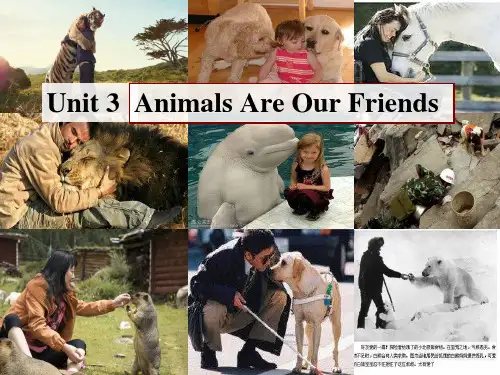
5. It can jump out of the water and flap its wings up to 70 times a second.它可以 跳出水面,以每秒钟多达七十次的频率 挥动翅膀。 up to表示程度或数量,意思是“多达, 达到……程度或数量”。例如:
Their noses are as big as eggplants.
9. What do these monkeys do when they are happy or excited?
They shake their noses.
4. They are famous for their large noses. 它们以大鼻子而闻名。
Name: Long-nosed monkeys Where do they live? _T_h_e_y_l_iv_e__in__S_o_u_th__ea_s_t_A__si_a_. What makes them amazing? _T_h_e_y__a_r_e_f_a_m_o_u_s__fo_r__th_e_i_r__ _la_r_g_e__n_o_s_es_._T__h_e_ir_n__o_se_s____ _a_r_e_a_s_b__ig__a_s _e_g_g_p_la_n__ts_.____ _W__h_e_n_t_h_e__m_o_n_k__ey_s__a_r_e____ _h_a_p_p_y__o_r_e_x_c_it_e_d_,_t_h_e_y_____ _s_h_a_k_e_t_h_e_ir__n_o_s_e_s._________
冀教版八年级英语下册Unit3AnimalsAreOurFriends优质教案(2)
Unit 3 Animals Are Our FriendsLesson 13 Danny’s Big ScareTeaching content:Mastery words and expressions: scare, doorbell, scream, tiny, sofa, vacation, gentle, loyal Oral words and expressions: amazing, imaginationLearning important and difficult points:1) yet的用法2) ask sb. to do sth. 的用法Teaching difficult points:The imaginary pets.Teaching preparation: picturesTeaching aids:audiotape, flashcards, picturesTeaching type: new lessonTeaching procedures:Step 1. Come to “THINK ABOUT IT”◆ What’s your favorite animal? Why?◆ Do you have a pet?What is its name?◆ What kind of pets would you like to have?Step 2. Listen to the tape and answer the following questions:Step 3. Read the text and check the answers. Then read the text again. Play the tape again and let the students read after it. Play the tape for several times until they can read it correctly and fluently.Step 4. Let some students lead the class to read the text sentence by sentence.Step 5. PracticeWork in pairs. Practice the similar dialogue according to the text.Step 6. Come to “PROJECT”Do you have a pet? Do many animals live with your family? Some people have dogs. Some people have cats. Some people have fish. Some people even have snakes! Do you have a pet? Step 7. Homework1. Finish off the activity book.2. Go on the next reading in the next lesson.Lesson 14 Amazing AnimalsTeaching content:Oral words and expressions:long-eared, jerboa, mouse, kiwi, lay, eggplant, shake, flap, avoidLearning important and difficult points1) remind的用法2) lay的用法Teaching preparation: picturesTeaching aids:audiotape, flashcards, picturesType of lesson: new lessonTeaching procedures:Step 1. ReviewStep 2. Come to “THINK ABOUT IT.”◆ Can you name some animals you have never seen before?◆ What animals do you think are amazing? Why?Step 3. Read the text silently and ask the students to answer the following questions: Step 4. Play the tape and let the students read after it. Pause after every line, and ask the students to repeat.Step 5. Let some students read the text in class and the others listen to see if they have any mistakes. Can they find and correct the mistakes?Step 6. Let the students rewrite the story and read it to the class.Step 7.Discuss the reading with the students. Use as much English as possible. Ask questions to make it easier for students to participate.Step 8. HomeworkWould you like to have a pet?Why or why not?Write a paragraph.Lesson 15 The Zoo Is OpenTeaching content:Mastery words and expressions: danger, dangerous, mainly, bamboo, giraffeLearning important and difficult points:1.take photos2.nearly的用法Teaching preparation: picturesType of lesson: new lessonTeaching procedures:Step 1. Show some pictures of animals to the class. Ask the students:What animals do you like best?What animals can you see in the zoo?Step 2. Come to “THINK ABOUT IT.”▲ Have you ever been to the zoo?▲ What animals do you think are dangerous? Why?▲ What rules should we obey at the zoo?Step 3. Read the text.Step 4. PracticeStep 5. Read the text in roles. The teacher walks in the classroom while they are reading.Help them if necessary.Step 6. Let some students come to the front and act the dialogue out.Step 7. HomeworkPrepare the dialogue in group of three in “Let’s Do It”, and act it the next class.Lesson 16 The Bear Escaped!Teaching content:Mastery words and expressions: escape, fierce, protect, foolLearning important and difficult points:1.escape的用法2.if的用法3.wake upTeaching preparation: picturesTeaching aids:audiotape, flashcards, picturesType of lesson: new lessonTeaching procedures:Step 1. Free talkStep 2. Come to “THINK ABOUT IT.”★ When is April Fools’ Day?★ What do people do on that day?★ Have you ever played a trick on a friend? What did you do?Step 3. Listen to the tape and answer the questionsStep 4. Read the text and check the answers. Then let the students read it loudly in class.After a while, ask the students to act it out in front of the class.Step 5. Come to “LET’S DO IT”◆What do you think of the idea of April Fools’ Day?◆ Have you ever played a trick on someone? Share a trick with you partner.◆What do you think “ white lie” means?Step 7. HomeworkDo you know any other interesting foreign festivals?Write them down, and share with your partner next class.Lesson 17 Save the TigersTeaching content:Mastery words and expressions: century, fur, symbol, courage, brave, chain, balance, reason, disappear, kill, cut, decreaseLearning important and difficult points:1) the number of2) balance的用法3) danger的用法Teaching preparations: picturesTeaching aids:audiotape, flashcards, picturesTeaching procedures:Step 1. ReviewStep 2. Come to “THINK ABOUT IT.”Where can you usually see a tiger?Do you think tigers need our help? Why or why not?Step 3. Listen to the tape and repeat after it. Play the tape for several until they can read it correctly and fluently.Step 4. Let some students act the dialogue out in front of the class.Step 8. HomeworkWork in groups and discuss some ways we can protect animals. Write down your ideas.Lesson 18 Friendship Between AnimalsTeaching content:Mastery words and expressions: friendship, rhino, skin, warn, insect, relationship, survive, mzee, hippo, tortoise, truly, boundaryLearning important and difficult points:1) use的用法2) warn的用法Teaching preparation: picturesTeaching aids:audiotape, flashcards, picturesType of lesson: new lessonTeaching procedures:Step 1. Come to “THINK ABOUT IT”◆Do you think there is friendship between animals?◆ What different animals have you seen living well together?Step 2. Listen to the tape and let some students retell the main idea about the text. If they can’t do well, don’t publish them. Encourage them and say: “I know it is very difficult for you. It’s also difficult for me. Let’s face the problem together.”Step 3. Read the text silently and answer the questionsStep 4. ExerciseStep 5. HomeworkWhat will you do if you go to the zoo?Do you know anything that we cannot do in the zoo? Why?Think about it, and write a short paragraph.。
冀教版八年级英语下册 (Amazing Animals)Animals Are Our Friend
D. the cleaner
【解析】动词avoid后面接名词、代词或动名词作宾语, 故选D。
Lesson 14 Amazing Animals
句型透视 ●1 With their long ears,they also remind people of rabbits. 它们的长耳朵也使人们想起兔子。 He reminded me of visiting the zoo. 他提醒我参观这个动物园。
It opens up the world to us.
If a friend lives far away, the Internet makes it easy to stay in touch.
Bad things about the Internet
一.
Spending too much time online is harmful to people's health.
Unit 3 Animals Are Our Friends
Amazing Animals
Lesson 14 Amazing Animals
课前自主预习
单 1. long-eared长__耳__的____
词 2.老鼠;鼠标___m_o_u_s_e _→___m_i_ce___(复数)
lay
laid
Lesson 14 Amazing Animals
活学活用
2.2017·益阳改编 If more people give up driving cars, the air
will get much __D______ in a few days.
A. clean
B. cleaner
C. the cleanest
冀教版八年级下册英语《Save the Tigers》Animals Are Our Friend
2. Tigers are symbols of
ห้องสมุดไป่ตู้
.
A.friendship and peace B. strength and courage
C. danger and balance
3. The number of tigers in the wild is
.
A. not changing B. increasing C. decreasing
5.翻译:People have cut down a lot of trees as well ___人__们_也__已_经__砍_掉__大_量__树_木__. _5_._砍_掉________________6_._也___________
Practice
at the beginning of, in balance, cut down, in danger, as well
wild w1.a在s…ar开o端und 100000. But today, that number has _dr_o_p_p_ed__t_o_
a few thousand.
2.下降
2.What is the reason tigers are important to the environment?
2023-12-07
A letter ofmitment 承诺书
I promise I will never buy any products
我承诺:绝不购买任何野生动物制品
from the wild animals. I will try my
我会尽我所能保护动物和环境
best to protect the wild animals and the environment.
冀教版英语八年级下册Unit3 Animals Are Our Friends课件
【辨析】happen和take place
happen
take place
常指预想不到的事件 的发生, 具有偶然性
常指事先计划好或预 想到的事情的发生, 具 有必然性
A car accident happened in that street. 那条街上发生了一起交通事故。
The sports meeting will take place tomorrow. 运动会明天举行。
It can flap its wings up to 70 times a second.
要点1 mouse n. 老鼠 Step 1难点·探 mouse的复数是什么?
Step 2语境·悟
*Long-eared jerboas look like mice. 长耳朵的跳鼠看起来像老鼠。(P36) *How many mouses do you have? 你有几个鼠标?
名词、代词或v. -ing形式作宾语, 但不能接动词不定式 作宾语。从意思上看, 可表示避开或躲避某人或某物, 也可表示防止某事的发生。
Step 4考点·练
(
)①(2019·安顺中考)—What time do you get up in
theCmorning on school days?
—I get up at 7: 00 every morning to avoid _____the
Unit 3 Animals Are Our Friends
Unit 3 Animals Are Our Friends Lesson 13
Ⅰ. 根据汉语提示写出下列单词或短语
1. 惊吓; 受惊
v. &n. _____
2. 尖声喊叫