
沪教版英语课本八年级上册U1语法点Language points of unit1
初中英语外研版八年级上册《Language points》课件PPTPPT
Try to __D_____. Do not depend on your dictionary all the time.
A. know C. help
B. achieve D. guess
02
新课导入
guess n. 猜测;猜想 Do you really want to know? Make a guess!
3. suggest + (that) + 主语 + (should) do + sth.,其中的 should可以省略
ask sb. to do sth. 要求某人做某事 The teacher asks Tom to come earlier. 老师让汤姆早点来。
how to improve their English
固定搭配:疑问词+不定式(to do)
how to learn / speak / ... what to say / ask / ... when to leave / start / ... where to go / stop / ...
If a short man enters your shop, you can __B____ him or her ______ short coat and tight trousers.
A. advice; to wear B. advise; to wear C. advise; wearing
你真的想知道吗?猜猜看!
I’ll give you three guesses. 我让你猜三次。
常见搭配: make / have a guess (at sth.) (对某事)作猜测
3. I also advise you to talk about the films...
八年级上册Unit1Reading沪教版

III. Complete the sentences below. About dinosaurs • Dinosaurs lived (1) _____________ on Earth over (2) ___________ years before human beings . • Some were (3) _____ and others were (4) ____. • Some could (5) _____. • Some ate (6)______ and others ate (7) _____. • Dinosaurs lived on Earth for more than (8) _________________ years.
Look it up!
Here are two articles from an encyclopaedia. Da Vinci, Leonardo Leonardo da Vinci (1452—1519) was an Italian painter, inventor, musician, engineer and scientist. Da Vinci was born in the countryside. From an early age, he showed great intelligence and artistic ability. As he grew older, he learnt to do many different things. His paintings are very famous, and one, the Mona Lisa, is perhaps the most famous painting in the world. He also had many inventions. For example, his notebooks include some interesting drawings of flying machines. (See Art)
八年级英语上册Unit1EncyclopaediasMorepractice课件pptx沪教版

Encyclopaedias
More Practice
Background knowledge
interesting places or things
Read the following encyclopaedia article about big attractions in Australia.
1. Besides the subjects and picture, we can also find
______ on page 358.
A. volumes B. a guide word C. similar subjects
2. The guide word on this page is ______.
Complete the table.
When was the Big Banana made?
Where is it? Who made it? Why was it made?
The Big Banana
The Big Merino The Big Merino is in the city of Goulburn. Merinos are a type of sheep. They can live in dry weather. Some places in Australia are very dry, so these sheep are very important to the farmers there. Inside the Big Merino, there is a small museum about the history of wool in Australia. Visitors can also climb up to the Big Merino’s head and look at the view through its eyes.
八年级英语Unit 1 教案

Unit 1Where did you go on vacation?本单元教材以Where did you go on vacation?为中心话题, 围绕着描述“过去发生的事情”展开, 学习和运用一般过去时态的一般疑问句Did you go/see/buy. . . ?和特殊疑问句Where/What/How. . . ?询问过去的事件, 让学生学会谈论和分享过去发生的事件。
本课教学内容与学生的实际生活密切相关, 易于引发学生运用简单的英语进行交流。
在学习活动中, 学生通过交换对过去发生的事情的描述及看法, 促进学生之间和师生之间的情感交流, 增进情谊。
Section A的主要学习内容是: 复习一般过去时态和动词的规则与不规则变化, 学习一般过去时态的一般疑问句: Did you. . . ?及不定代词的用法。
Section B安排了许多听、说、读、写的任务活动, 教师在教学中可以灵活运用这些活动, 将其中的一些活动进行变化或整合, 充分调动学生参与的积极性, 提高学生的听说读写功底。
第一课时Section A(1a-2d)Teaching Goals【教学目标】Key words & phrases:anyone, anywhere, wonderful, few, most, quite a few, go on vacationKey sentences:1. Where did you go on vacation?I went to the mountains/New York City/summer camp/the beach.2. Did you. . . ?Yes, I did. /No, I didn't.Teaching Key Points【教学重点】The vocabulary:New York City, Central Park, few, most, quite a few, on vacationTarget language:Where did you/they/he/she go on vacation?I/They/He/She went to the mountains/New York City/summer camp/the beach. Did you. . . ?Yes, I did. /No, I didn't.Teaching Difficult Points【教学难点】Use the target language above to talk about past events.Teaching Aids【教学工具】An English textbook, a tape recorder, CAI or courseware.Teaching Steps【教学过程】★Step 1Leading inGreet the class and introduce what to learn in this period.Teacher: Welcome back to school!Did everyone have a good time during the summer vacation?Today we'll begin to learn the topic where you went on vacation.Teacher: Where did you go on vacation?Students: ______.①I went to the mountains.②I visited museums.…★Step 2Pre-taskPage 1, 1a & 1b.1.Look at the picture.2.Match each activity.3.Check the answers in 1b.4.Practice reading.Page 1, 1c.1.Focus on the conversation in the box.2.Practice reading.3.Pairwork: Where did you go on vacation?I. . .4.Groupwork: Divide the class into groups of four or five. Make conversations.First S1 to S2:S1: Where did you go on vacation?S2: I. . .S1: Where did she/he go on vacation?S2: She/He. . .★Step 3While-taskPage 2, 2a & 2b.1.Play the recording for the first time. Students complete the chart in 2a.2.Check the answers. (Point to one student who raises his or her hand. )3.Play the recording a second time and say: There are three conversations. The people talk about where they went on vacation. Listen to the recording and check(√) Yes, I did or No, I didn't for each question.4.Correct the answers.★Step 4Post-taskPage 2, 2c & 2d.1.Focus on the conversation in 2c & 2d.2.Practice reading. Make students scan the conversations first.3.Teach and then make students role-play the conversation in pairs.4.Have a group of students present their conversation to the class.★Step 5Homework1.Practice the conversation on Page 2, 2d.2.Do the exercises on Page 1 in students' book.Board Design板书设计Unit 1Where did you go on vacation?The first period Section A(1a-2d)1.Key vocabulary: anyone, anywhere, wonderful, quite a few, go on vacation2.Target language:A: Where did Tina go on vacation?B: She went to the mountains.第二课时Section A(GF-3c)Teaching Goals【教学目标】Key words:something, nothing, everyone, myself, yourself, someone, seem, bored, diaryKey phrases:go out, have a good time, of course, keep a diaryKey sentences:1. Where did you go on vacation?I went to New York City.2. Did you go out with anyone?Did you buy anything special?3. How was the food?How was your vacation?Teaching Key Points【教学重点】The vocabulary:something, nothing, everyone, myself, yourself, someone, seem, bored, diary, go out, have a good time, of course, keep a diary, on vacation Target language:How was the food?Everything tasted really good!Did you go shopping?Of course!Did everyone have a good time?Oh, yes. Everything was excellent.Teaching Difficult Points【教学难点】1. Use the target language above to talk about past events.2.The usage of someone, anyone, everyone, no one, something, anything, everything, nothing.Teaching Aids【教学工具】An English textbook, CAI or courseware.Teaching Steps【教学过程】★Step 1Leading in(T—teacher S—student)T: Where did you go last weekend?S: I went to the beach.T: Did you go there with anyone?S: Yes. I went to the beach with my brother.T: Did you have a good time there?S: . . .★Step 2Pre-taskPage 3, Grammar Focus.1.Review the grammar box. Work in pairs. One asks and the other answers.2.Practice reading the sentences in the chart.★Step 3While-taskPage 3, 3a & 3b.1.Teach these new words: anyone, something, anything, everything, nothing, everyone, no one.2.Call students' attention to the conversation in 3a. Make students complete it individually.3.Choose a student to give his or her answers. Write the answers on the board.4.Correct the answers.5.Lead students to read this conversation.6.Have students work in pairs and role-play the conversation. As they talk, move around the classroom monitoring their work. Offer language or pronunciation support as needed.7.Make students complete the blanks in the e-mail message in 3b with the words in the box.8.Check the answers and then make students practice reading it.★Step 4Post-taskPage 3, 3c.Complete the task in 3c. Ask your group questions about their last vacation. Then tell the class your results.★Step 5Homework1.Review the indefinite pronouns learned in this period.2.Do the exercises on Page 2 in students' book.Board Design板书设计Unit 1Where did you go on vacation?The second period Section A(GF-3c)1.The vocabulary: something, nothing, everyone, someone, myself, yourself, go out, of course2.Target language:①A: Where did you go on vacation?B: I went to New York City.②A: Did you buy anything special?B: Yes, I bought something for my father.3.Structure: something special4.Answers to 3a and 3b.第三课时Section B(1a-1e)Teaching Goals【教学目标】Key words:delicious, exciting, terrible, expensive, cheap, boringKey sentences:1. Where did Lisa go on vacation?2. Did she do anything special there?Did she buy anything for her best friend?Did Lisa like her vacation?3. How was/were. . . ?Teaching Key Points【教学重点】The vocabulary:delicious, exciting, terrible, expensive, cheap, boringTarget language:Where did Lisa go on vacation?Did she do anything special there?Did she buy anything for her best friend?How was/were. . . ?Teaching Difficult Points【教学难点】1. 询问去过何地以及感受(评价) Where did you go?I went to the beaches. How was it?It was exciting.2.Use the target language to talk about your past events.Teaching Aids【教学工具】An English textbook, a tape recorder, CAI or courseware.Teaching Steps【教学过程】★Step 1Leading in1.Greetings.2.T: Where did you go on vacation?S: I went to summer camp.T: Did you do anything special there?S: Yes, I. . .T: Did you buy anything for your parents or friends?S: Yes, I bought. . . for. . . /No, I bought nothing.T: How was/were. . . ?S: It was/They were. . .★Step 2Pre-taskPage 4, 1a & 1b.1.Look at the six pictures.2.Match the words with the pictures.3.Students complete the task in 1b individually.4.Check the answers.★Step 3While-taskPage 4, 1c & 1d.1.Make students scan the questions in 1c.2.Play the recording for the first time. And say: Listen to the tape. Lisa is talking about her vacation. Complete the four questions.3.Play the recording a second time. Students complete the task in 1d.4.Correct the answers.★Step 4Post-taskPage 4, 1e.Ask 3 or 4 students to answer questions about Lisa's vacation. You can begin your questions with: Where did. . . ?What did. . . ?Did she. . . ?How was. . . ?How were. . . ?★Step 5Homework1.Review these sentences: Where did. . . ?Did. . . ?How was/were. . . ?2.Do the exercises on Page 3 in students' book.Board Design板书设计Unit 1Where did you go on vacation?The third period Section B(1a-1e)1.Words: delicious, exciting, terrible, expensive, cheap, boring2.Sentences:①Where did Lisa go on vacation?②Did she buy anything special?③Did she buy anything for her best friend?④Did Lisa like her vacation?3.Answers to Activity 1a:1—5f a c e b d Answers to Activity 1b: wordsdeliciousexcitingcheapwordsterribleexpensiveboring第四课时Section B(2a-2e)Teaching Goals【教学目标】Key words:activity, decide, try, bird, bicycle, building, trader, wonder, difference, top, wait, umbrella, wet, below, enough, hungry, as Key phrases:feel like, because of, go to the beach, a lot of, a little, take the train, too many, what aboutKey sentences:1. I wonder what life was like here in the past.2. What a difference a day makes!3. We waited over an hour for the train because there were too many people.Teaching Key Points【教学重点】Learn Jane's diary entries about her vacation.1. The vocabulary: activity, decide, try, wonder, difference, wait, below, enough, hungry, as, feel like, because of2. Target language: I wonder what life was like here in the past. We waited over an hour for the train because there were too many people.Teaching Difficult Points【教学难点】1. because and because of2. What a difference a day makes!3. Learn to write a diary.Teaching Aids【教学工具】An English textbook, CAI or courseware.Teaching Steps【教学过程】★Step 1Leading in1.Greetings.2.Introduce what to learn in this period, especially the articles in 2b, Jane's diary entries. Teacher begins like this: Today we'll focus on two diary entries about Jane's vacation. Through the learning you'll know how to write a diary. Let's begin now.★Step 2Pre-taskPage 5, 2a & 2b.1.Review and discuss the questions in 2a box with your partner.2.Project these new words on the screen or write them on the board and teach the new words. Ask students to repeat them. And make sure everyone knows the meanings.activity n.活动;decide v.决定;try v. & n.尝试, 设法;wonder v.想知道;difference n.差异;top n.顶部;wait v. & n.等待;umbrella n.伞;below prep. & adv. 在……下面;enough adj. 充足的;hungry adj. 饥饿的3.Make students scan the articles first. Ask students to put a mark in contents that are unfamiliar to them. Then the teacher lead students to learn these two articlessentence by sentence. Pay attention to these points: (1) decide v.决定;decide to do sth. 决定做某事;(2) try v.尝试;try doing sth. 尝试做某事;try to do sth. 尽力做某事;(3) below prep. & adv. 在……下面;(4) feel like 给……的感觉;(5) because and because of;(6) wonder v.想知道4.Practice reading.★Step 3While-taskPage 6, 2c & 2d.1.Make students read Jane's diary entries again. Fill in the chart in 2c.2.Students complete the conversation in 2d using the information in Jane's dairy entries.3.Choose 3 or 4 students to give their answers.4.Correct the answers.5.Have students work in pairs. Student A will be Anna and student B will be Jane. Act the conversation out.★Step 4Post-taskPage 6, 2e.1.Make students complete the blanks in 2e.2.Ask one student to write his or her answers on the board.3.Check the answers together with the class.4.Practice reading.★Step 5Homework1.Write a diary.2.Do the exercises on Page 4 in students' book.Board Design板书设计Unit 1Where did you go on vacation?The fourth period Section B(2a—2e)1.Key vocabulary: decide, try, wonder, difference, top, wait, below, enough, hungry, as, feel like, because of, too many2.Sentences:①I wonder what life was like here in the past.②And because of the bad weather, we couldn't see anything below.第五课时Section B(3a-Self Check)Teaching Goals【教学目标】Key words & phrases:duck, dislike, take photos, Tian'anmen Square, the Palace Museum, bring back, shopping center, have a fun time, school trip, come up Key sentences:1. How did you feel about the trip?2. It was so beautiful that we forgot about the last five hours!Teaching Key Points【教学重点】The vocabulary:dislike, take photos, Tian'anmen Square, the Palace MuseumTarget language:What did you like best?Did you dislike anything?How did you feel about the trip?Teaching Difficult Points【教学难点】Write a travel diary.Teaching Aids【教学工具】An English textbook, CAI or courseware.Teaching Steps【教学过程】★Step 1Leading in1.Greetings.2.T: Beijing is the capital of our country. It's famous for its long history and places of interest, such as Tian'anmen Square, the Palace Museum, the SummerPalace and so on. And Beijing duck is very delicious. Have you ever been to Beijing?Tell your travel to us.★Step 2Pre-taskPage 7, 3a.1.Look at the three pictures.2.Use the words and phrases in the box to complete the blanks in the article.3.Check the answers.★Step 3While-taskPage 8, Self Check.Complete the tasks in Self Check.1.Have students complete the task of Part 1. Then Choose 2 or 3 students to give their answers. Check the answers.2.Induct students to complete the passage of Part 2. Check the answers.3.Practice reading.★Step 4Post-taskPage 7, 3b & 3c.1.Make students answer the questions in 3b and take notes.2.Teach students how to write a travel diary.3.Students write a travel diary like Jane's on Page 5 using the notes in 3b.4.Choose 2 or 3 students' diaries. Make students read them out. Point out the weakness and induct the students to correct their diaries.★Step 5Homework1.Write a travel diary.2.Do the exercises on Page 5 in students' book.Board Design板书设计Unit 1Where did you go on vacation?The fifth period Section B(3a-Self Check)1.Key vocabulary: dislike, Tian'anmen Square, the Palace Museum, have a fun time, come up2.Sentences:①Did you dislike anything?②How did you feel about the trip?③My legs were so tired that I wanted to stop.。
八年级上册Unit1Writing沪教版

A week later, Sammy (15) __g_o_t__t_h_e_m_o_n_e_y___ (get, money).
Write an ending
•What did Sammy do with the money? •What happened to Dudley later?
Unit 1 Encyclopaedias
Grammar
Let’s talk about something about dinosaurs
live on Earth, before human beings
live everywhere
be, small
be, big
can fly eat meat
eat plants learn about, from
Describe what happened in each picture.
take, home Sammy took the stone home.
put, by, window He put it by the window.
hear noise He heard some noise.
climb out, look at A baby dinosaur climbed out and looked at Sammy.
call, “Dudley” Sammy called it “Dudley”.
A baby dinosaur
A Look at the pictures below and on page 12. Then complete the story. Picture 1: One day, Sammy (1) _w_e_n_t_f_o_r_a__w_a_l_k_____ (go, walk) in the mountains.
英语八年级上册《Unit 1 Encyclopaedias More practice Study skills Culture corner》_0
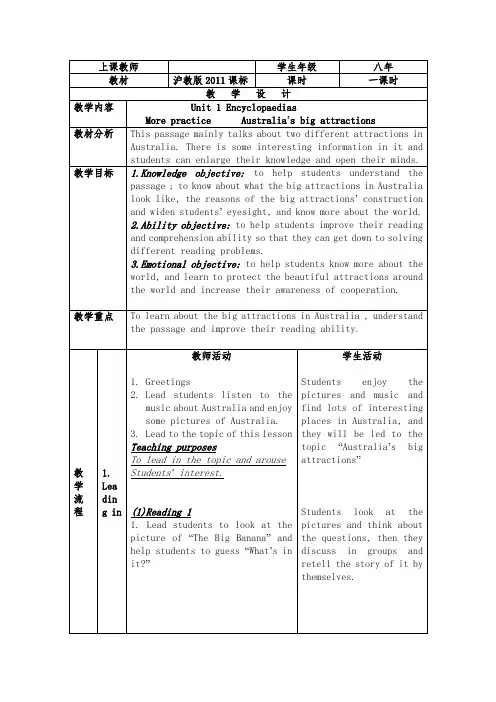
上课教师学生年级八年教材沪教版2011课标课时一课时教学设计教学内容Unit 1 EncyclopaediasMore practice Australia’s big attractions教材分析This passage mainly talks about two different attractions in Australia. There is some interesting information in it andstudents can enlarge their knowledge and open their minds. 教学目标 1.Knowledge objective:to help students understand the passage ; to know about what the big attractions in Australialook like, the reasons of the big attractions’ constructionand widen students’ eyesight, and know more about the world.2.Ability objective: to help students improve their readingand comprehension ability so that they can get down to solvingdifferent reading problems.3.Emotional objective: to help students know more about theworld, and learn to protect the beautiful attractions aroundthe world and increase their awareness of cooperation.教学重点To learn about the big attractions in Australia , understand the passage and improve their reading ability.教学流程1.Leading in教师活动1.Greetings2.Lead students listen to themusic about Australia and enjoysome pictures of Australia.3.Lead to the topic of this lessonTeaching purposesTo lead in the topic and arouseStudents’ interest.(1)Reading 11. Lead students to look at thepicture of “The Big Banana”andhelp students to guess “What’s init?”学生活动Students enjoy thepictures and music andfind lots of interestingplaces in Australia, andthey will be led to thetopic “Australia’s bigattractions”Students look at thepictures and think aboutthe questions, then theydiscuss in groups andretell the story of it bythemselves.教学流程教学流程2.The teacher designs a series ofpictures and ask students to talkabout what happened in thepictures to know the generalstory of the Big Banana.Teaching purposesTo help students learn the articlein a new way and get a general ideaof the passage.3.Lead students to open the book toread the article with twoquestions.When was it the Big Banana build?Why was it build?4.Lead students to read thepassageTeaching purposesTo help students get more detailedinformation of the article andhave a comprehensive learning ofthe passage.(2)Reading 21.Lead to the topic。
沪教版英语八年级上册精品教案Unit 1 period 3
1.阅读教材6页写出下列词语的汉语意思:win _____________ find out _____________so much ______________ hard work _______________2.阅读教材14至15页内容,初步了解如何使用百科全书,并猜测下列词语的词义。
consist of _________________ a number of __________________volum饿________________ in alphabetical order ___________________look for ______________ guide word ____________________1、预习反馈:2、出示学习目标:3、探究点一:Study skills(1)了解百科全书的使用及相关词语Volum饿________________ in alphabetical order ___________________consist of _________________ a number of __________________(2)完成教材15页A,B,C中的练习题。
探究点二:Listening(1)阅读Listening板块中的要求,观察第一幅图,然后回答问题。
•In the picture, which one is Jane Dickinson?•Did she win the quiz? How do you know that?(2)听录音,在每个空格中填入一个单词或数字。
探究点三:Talk time(1) 听录音,注意划线部分的朗读。
(2) 归纳:________ , ___________, ________, _______等实词在句子中需要重读。
_________, _________, _________, __________, _________, _________,__________等虚词在句子中不重读。
八年级上册Unit1Morepractice沪教版
A. Violin
B. Violinist
C. Violist
3. We can look for more information on Violoncello from the subject
“________”.
A. Violist
B. Violin
C. Cello
4. If we want to find information on the different sizes of violins, the key word
for us to look for is _______.
A. violin
B. sizes
C. music
This is the guide word at the top of each page.
Sometimes an encyclopaedia tells us where to look for more information on a similar subject.
1, We have read another encyclopaedia article about big attractions in Australia. 2.We have learned how to use encyclopaedias.
一、根据句意和所给首字母写出所缺单词。 1. The light comes in t_h_r_o_u_g_h___ the window. 2. The watermelon is a t_y_p_e__ of fruit. 3. I think David’s suggestion will w_o_rk___ .Let’s do as he suggested. 4. There are many big a_tt_r_ac_t_io_n_s__ in Guangzhou, such as the Canton Tower. 5. I enjoy the beautiful v_i_e_w__ of the beach in the starlight.
初中英语外研版八年级上册《Module 2 Unit 1language points》课件PPT
Module 2
外研版初中英语八年级上册课件
目录
CONTENTS
01 复习巩固
03 教学重点
02 新课导入 04 拓展练习
01
复习巩固
1. Pretty good! pretty 在这里是作副词,意思是“相当地;非常;很”, 修饰形容词或副词
I’m pretty sure that he’ll say yes. 我非常确定他会说是。
Shanghai has a population of 13 million. 上海有一千三百万人。
[Practice] 请根据上句改写下句,使上下两句意思相 同或相近。 1. What’s the population of Japan? __H_o_w__m__a_n_y_ people _a_r_e__th_e_r_e__ in Japan? What’s the __n_u_m_b__er__o_f_ the people in Japan?
03
教学重点
[拓展] 表达“某地有多少人口”通常有两种方法:
1)“The population of + 某地+ be + 数词”。 如:
The population of Shanghai is 13 million. 上海的人口有一千三百万。
2)“某地+ has a population of +数词”。如:
( C ) The experts think that India’s population may be ______ than China’s ______ 2020. A. many, by B. more, in C. larger, by
沪教牛津版英语八年级上册全套教学案含答案
2015-2016沪教牛津版初中英语八年级上册全套教学案Content第一讲 (2)Unit1 Language points (2)第二讲 (9)Grammar-不定代词 (9)第三讲 (13)Unit2 Language points (13)第四讲 (27)Grammar-数词 (27)第五讲 (35)Unit3 Language points (35)第六讲 (46)Grammar-形容词和副词 (46)第七讲 (56)Unit4 Language points (56)第八讲 (70)Grammar-形容词副词同级比较 (70)第九讲 (76)Unit5 Language points (76)第十讲 (89)Grammar-现在完成时 (89)第十一讲 (97)Unit6 Language points (97)第十二讲 (108)Grammar-现在完成时补充 (108)第十三讲 (116)Unit7 Language points (116)第十四讲 (128)Grammar-if条件状语从句 (128)第十五讲 (133)Unit8 Language points (133)第十六讲 (138)Grammar-情态动词 (138)优乐单元测 (144)V ocabulary (230)八年级上册英语教案资料第一讲Unit1◆知识探究1.Is my encyclopaedia useful, Lo?1)useful: 有用,有益,有帮助 a useful book2)use +ful= useful 名词+ful= 形容词3)以-ful结尾形容词反义词多是相应以-less结尾形容词。
eg: useful--useless careful--careless helpful--helpless2.Leonardo da Vinci was an Italian painter, inventor, musician,engineer and scientist. 动词后加后缀-er/ -or构成一种职业。