
湖南省长沙市长郡中学2020-2021学年高一上学期适应性调查考试 英语试题附答案
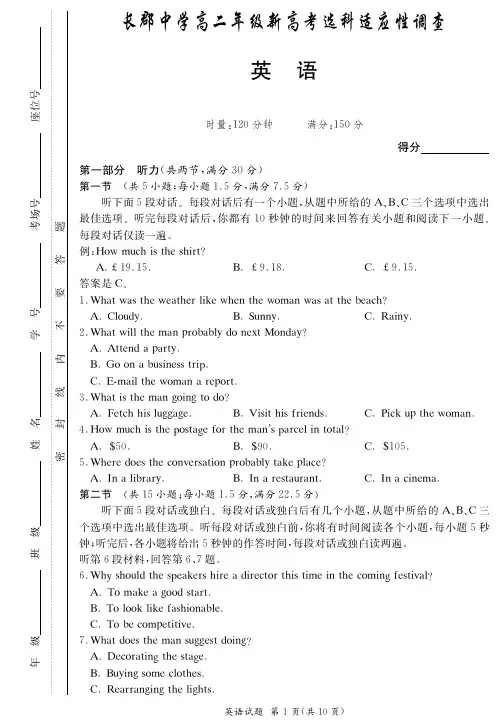
湖南省长沙市长郡中学2020-2021学年高二上学期新高考选科适应性调查考试英语试题
!&!2+/6,-.+/<0&B03(+/48
"!J6.+/-)((/0!
#!J6.+/3).)(6!
$!J6.+/',6./0!
!(!%&'4&6B8&/-.+/<0&B03(43-.
"!"7&).&6/(&6.+! #!"7&)..'&(&6.+-! $!"7&)..+0//(&6.+-!
!'!2+98&.+/38)4.-368.//63B/0-'&05-/I/034+&)0-/3*+839
"[\ $
!!2+3.'3-.+/'/3.+/04,5/'+/6.+/'&(36'3-3..+/7/3*+
"!$4&)89!
#!:)669!
#!2+3.',44.+/(36<0&737498&6/=.>&6839
$!;3,69!
"!"../683<30.9!
#!?&&637)-,6/--.0,<!
$!M&68&6!
!)!2+/6',44.+/'&(367/B,6+/0.&)0
2020-2021学年长沙市长郡中学高三英语上学期期中考试试题及参考答案
2020-2021学年长沙市长郡中学高三英语上学期期中考试试题及参考答案第一部分阅读(共两节,满分40分)第一节(共15小题;每小题2分,满分30分)阅读下列短文,从每题所给的A、B、C、D四个选项中选出最佳选项AThe Costa Book Awards consistently pick winners that are both of the moment and subsequently endure. It's our pleasure to confirm this year’s Category Winners.First Novel Award WinnerBook: Eleanor Oliphant is Completely FineAuthor: Gail HoneymanEleanor is 31 years old; work finishes on a Friday and begins again on a Monday. Between, her only company will be two bottles of vodka and her own solitary, unique wit (机智). It is contentment, of a kind, but an unexpected shared experience suddenly opens the door to possibility. Challenging reader expectations with a living, breathing character, Gail Honeyman’s debut (初次登台、开张)is a funny and moving diamond.Biography Award WinnerBook: In the Days of RainAuthor: Rebecca StottThe Exclusive Brethren were aclosed community who believed the world is ruled by Satan. Into this is born Rebecca. Her father had been an influential Brethren Minister. As her father lay dying, he begged her to help him write the memoir. He wanted to tell the story of their family who for generations had all been members of a fundamentalist Christian sect.Poetry Award WinnerBook: Inside the WaveAuthor: Helen DunmoreTo be alive is to be inside the wave, always travelling until it breaks and is gone. These poems are concerned with the borderline between the living and the dead — the underworld and the human living world – and the acutely intense being of both.Children's Award WinnerBook:The ExplorerAuthor: Katherine Rundell, Hannah HornFour children survive their aircraft plunging into the Amazon jungle, but for Fred and his friends it’s only the beginning of a cruel battle for survival. Brimming with adventure and a real command of character and incident, Rundell has few peers in superb children's fiction.1.What kind of life does Eleanor lead?A.boring and lonely.B.funny and touching.C.exciting and complex.D.ordinary and happy.2.Why did Rebecca Stott writeIn the Days of Rain?A.To introduce beliefs of the Exclusive Brethren.B.To help her father fulfill his last wish.CTo share the life of fundamentalist Christians.D.To pass on her family traditions.3.For a young adventurous soul, which book seems more appealing?A.Eleanor Oliphant is Completely FineB.In the Days of RainC.Inside the WaveD.The ExplorerBOnce a rich and clever boy had practically everything a boy could want, so he was not interested in most toys. But he couldn't get a very old mirror, and heconvinced his parents to buy it from mysterious(神秘的)old man. When the mirror arrived home, the boy went to see his reflection in it. His face looked very sad indeed. He tried smiling and making funny faces, but his reflection continued with its sad expression. "What a terrible mirror! It's the first time I've seen a mirror that didn't work properly!" the boy jumped violently.That same afternoon he went into the street to play and bought a few toys, but on his way to the park he saw a little girl who was crying her heart out. The girl was crying so much and looked so lonely that the rich boy went over to help her and to see what had happened. The little girl told him that she had lost her parents.Together the two set off in search of the parents. As the little girl wouldn't stop crying, the boy spent his money buying her sweets to cheer her up. Finally, after much walking, they found her parents who were much worried and were looking for her everywhere.The rich boy said goodbye to them. As it was getting late, he decided to head for home, without being able to play. At home, he went to his room, and noticed a shining light in the corner, the same corner he had left the mirror in. Seeing this, he went over to the mirror, and realised that the light was coming from his own body, soradiant(闪亮的)with happiness he had become.And so he understood the mystery of that mirror, the only mirror which could faithfully reflect the true joy of its owner. He realised it was true. He felt very happy at having helped that little girl. And since then, each morning when he looked in that mirror and failed to see a special shine, he knew what he had to do to bring it back.4. How did the boy feel when he first looked into the mirror?A. Embarrassed.B. Angry.C. Worried.D. Delighted.5. Why was the little girl crying so hard?A. She couldn't find her parents.B. She couldn't get the mysterious mirror.C. Her parents couldn't buy toys for her.D. The boy refused to give his toys to her.6. What could the boy see in the mirror after he went back from the park?A. A shining toy.B. A broken mirror.C. His happy face.D. The lovely girl.7. What is the purpose of this text?A. To tell us a horrible story.B. To introduce to us a strange mirror.C. To warn us not to be selfish.D. To encourage us to help others.CMany Americans experience surprise (or disappointment) when they wake up on Christmas Day. They might be surprised or disappointed by a family member’s actions. They might be happy or unhappy about a Christmas gift. Imagine a child expects to get an Xbox or PlayStation for Christmas. On Christmas morning, they quickly open their gift. Inside is an English grammar book. They might feel disappointed. The Everyday Grammar team would prefer the new English grammar book. But if you are like most young people, you would probably rather have a new video game.Today, we are going to explore those feelings-feelings of surprise and disappointment. In other words, we are going to explore how speakers show that reality was better or worse than their expectations.Many languages use words to express expectation. Speakers also use words to express how events are not happening as expected. This idea is known as “counter expectation”.Do not worry about the term. Just remember that it means that speakers use words to show that reality is countering their expectations.English has many words that serve this purpose. Three of the most common are the words “even”, “still” and “actually”. You will often hear them in informal, everyday speech. Speakers use these words to showdisappointment. The pitch of their voice tells you what they mean. Let’s study examples of each word.Speakers often use the word "even” to show disappointment or surprise. Imagine a young child that expects a phone call from a family member-perhaps an uncle or grandparent. The phone call never comes. The child might say the following: “What’s wrong with him? He didn’t even call me on Christmas day.” Americans sometimes use “still” for showing how reality does not quite meet their expectations: “You’re still here? It’s over! Go home. Go!” Another common word that shows surprise or disappointment is “actually”: “I can’t believe it! Uncle Bob actually stole her Christmas gift.”8. What might most young Americans prefer as a Christmas gift according to paragraph 1?A. A newly made video game.B. An English grammar book.C. A new designed school bag.D. A unique jacket from their parents.9. What does the underlined phrase “counter expectation” in paragraph 3 mean?A. Expression of disappointment.B. Something expected to happen.C. The same with one’s expectation.D. A result against what is expected.10. What do the three words “even”, “still” and “actually” have in common?A. They are easy to understand.B. They express disappointment.C. They show delighted feelings.D. They are used most at Christmas.11. What’s the last paragraph mainly about?A. Expectations from loved ones.B. Different uses of the three words.C. Examples of the use of the three words.D. Emotions of disappointment and surprise.DWhere doyou usually put your toothbrush?Do you keep it in the bathroom? How’s your toothbrush looking these days? Even if you can’t see it with a naked eye, experts say it may be saturated(使饱和)with millions of toilet germs!Dr. Charles Oerba, a germ expert, is amicrobiology professor at the University of Arizona. He says there are approximately 3 million bacteria per square inch in most toilet bowls, and every time you flush it without closing the lid, those millions of bacteria droplets spray into the air as far as twenty feet away and dirty everything in their path. And a common victim is your poor toothbrush, usually, left out on the bathroom sink, right?So, what do we do? Dr. Gerba says it’s easy. Close the toilet lid before you flush—that’ll greatly cut downthe germs, which will otherwise float in the air. And wash your toothbrush every few days in mouthwash or peroxide to get rid of any germs hiding in it. You can even put it through the dishwasher to sanitize(消毒)it. And alwaysstore your toothbrush in a closed cabinet.Here’s one more tip from Dr. Gerba, who says our kitchen sink is probably dirtier than our toilet. “If an alien came from space and studied the bacterial counts, he probably would conclude he should wash his hands in your toilet and go to the bathroom in your sink.” He says that’s because the kitchen sink is a great place where E. coli(大肠杆菌)to live and grow since it’s wet and damp. Bacteria feed on the food that people put down the drain or—that’s left on dishes in the sink. To reset your sink’s bacteria count back to zero, you’d better regularly wash it with hot water and sanitize yoursink with special chemicals. In fact, you may want to do it every day or before preparing dinner.12. What is the purpose of the text?A. To show how to brush your teeth.B. To tell people the importance of health.C. To warn people of the invisible germs.D. To introduce a microbiology professor.13. What can we learn from Paragraph 2?A. Bathroom sinks are the dirtiest places.B. Bacteria are bad for people’s health.C. Why bacteria spread through the air.D. How bacteria spread in the bathroom.14. What does the underlined word“that”in Paragraph 4 refer to?A. The food.B. The toothbrush.C. The sink.D. The chemical.15. Why does Dr. Gerba mention the example of an alien?A. To tell us a fiction story of an alien studying bacteria.B. To show our kitchen sink may be dirtier than our toilet.C. To teach us how to reset sink’s bacteria count back to zero.D. To prove coli prefers to live in the kitchen and the drain.第二节(共5小题;每小题2分,满分10分)阅读下面短文,从短文后的选项中选出可以填入空白处的最佳选项。
湖南省长郡中学2021届高三上学期高考适应性月考卷(二)英语试题
绝密★启用前湖南省长沙市长郡中学2021届高三毕业班上学期高考适应性月考卷(二)英语试题本试题卷共10页。
时量120分钟。
满分150分。
注意事项:1.答卷前,考生务必将自己的姓名、准考证号填写在答题卡上。
2.回答选择题时,选出每小题答案后,用铅笔把答题卡上对应题目的答案标号涂黑。
如需改动,用橡皮擦干净后,再选涂其他答案标号。
回答非选择题时,将答案写在答题卡上,写在本试卷上无效。
第一部分听力(共两节,满分30分)做题时,先将答案标在试卷上。
录音内容结束后,你将有两分钟的时间将试卷上的答案转涂到答题卡上。
第一节(共5小题;每小题1.5分,满分7.5分)听下面5段对话。
每段对话后有一个小题,从题中所给的A、B、C三个选项中选出最佳选项。
听完每段对话后,你都有10秒钟的时间来回答有关小题和阅读下一小题。
每段对话仅读一遍。
例: How much is the shirt?A. £ 19.15.B. £ 9.18.C. £ 9.15.答案是C.1. What does the man want the woman to do with the clothes?A. Dry them.B. Fold them.C. Wash them.2. How was the weather recently?A. Rainy.B. Snowy.C. Sunny.3. What does the man write about first?A. An earthquake.B. A fire.C. His boss.4. Who thought Sara should go overseas to study?A. Her friends.B. Her parents.C. Her teacher.5. What is the probable relationship between the speakers?A. Neighbors.B. Roommates.C. Husband and wife.第二节(共15小题;每小题1.5分,满分22.5分)听下面5段对话或独白。
湖南省长沙市长郡中学2021届高三上学期月考(一) 英语试题(word版含答案解析)

听下面 5 段对话或独白。每段对话或独白后有几个小题,从题中所给的 A、B、C 三个选项中 选出最佳选项,并标在试卷的相应位置。听每段对话或独白前,你将有时间阅读各个小题,每 小题 5 秒钟;听完后,各小题将给出 5 秒钟的作答时间。每段对话或独白读两遍。
听第 6 段材料,回答第 6、7 题。
6.What day is it today probably?
A. In two days.
B.In four days.
C.In five days.
听第 9 段材料,回答第 13 至 16 题。
13.What does the man suggest seeing at first?
A. A circus.
B. A musical.
C.A comedy.
14.Which of the following is launched last week?
8.What does the man say about the house in Eccles?
A.It was the cheapest. B.It was the bigest.
9.What was the disadvantage of the house in Monton?
A. Law.
B.Management.
2.What do we know about the little girl?
A. She was dancing.
B.She was in high spirits.
C.She was buying a skirt.
3.What did the woman do last night?
A. She had weight-loss pills. B.She ordered a takeout.
湖南省长沙市长郡中学2024-2025学年高三上学期月考试卷(一)英语试卷
湖南省长沙市长郡中学2024-2025学年高三上学期月考试卷(一)英语试卷一、阅读理解As Pakistan and China are marking 2023 as a Year of Tourism, Pakistan’s breathtaking natural beauty, diverse cultural heritage and historical landmarks are all set to catch the attentionof tourists.Balochistan: Nature’s Bounty UnveiledStretching across vast expanses, Balochistan is Pakistan’s largest province, boasting not only abundant mineral resources but unique natural beauty. Its mountain ranges, mines and extensive coastal belt, which is home to the prosperous Gwadar Port, attract adventurers.Punjab: A Tapestry of History and HeritageIn the heart of Pakistan lies Punjab province, a land of green agricultural fields, intricate (交错的) river networks, ancient forts and charming Mughal-era gardens. Over two millennia (千年) ago, the Gandhara Buddhist civilization thrived in northern Pakistan, with Taxil a serving as its primary center of learning.Sindh: A Tapestry of History and CultureSindh, in Pakistan’s southern region, weaves together a tale of history and natural beauty. Itis home to the ancient city of Mohenjo-Daro, a relic of the Indus Valley Civilization, along with the modern city of Karachi and its picturesque coastline.Northern Pakistan: Nature’s MasterpieceSpread over 72,496 square kilometers, Pakistan’s northern regions are a masterpiece of nature. Among towering peaks, including numerous summits over 8,000 meters, peaceful valleys like Gilgit, Hunza and Skardu offer a brief escape.As Pakistan invites the world to explore its diverse and fascinating landscapes, it also extends a warm invitation to discovery the history, spirituality and natural wonders that define this remarkable nation.1.As a Buddhist, your favorite destination in Pakistan might be __________.A.Balochistan B.Punjab C.Sindh D.Gilgit2.What do the four parts have in common?A.Natural beauty.B.Historical origin.C.Cultural relics.D.Diverse resources.3.The passage serves as a(n) __________.A.guidance B.introduction C.commercial D.noticeThere comes a time when the old must give way to the new, and it is not possible to preserve everything from our past as we move towards the future. Finding and keeping the right balance between progress and the protection of cultural sites can be a big challenge.Big challenges, however, can sometimes lead to great solutions. In the 1950s, the Egyptian government wanted to build a new dam across the Nile in order to control floods, produce electricity, and supply water to more farmers in the area. But the proposal led to protests. Water from the dam would likely damage a number of temples and destroy cultural relics that were an important part of Egypt’s cultural heritage. After listening to different voices, the government turned to the United Nations for help in 1959.A committee was established to limit damage to the Egyptian buildings and prevent the loss of cultural relics. The group asked for contributions from different departments and raised funds within the international community. Experts investigated the issue, conducted several tests, and then made a proposal for how the buildings could be saved. Finally, a document was signed, and the work began in 1960.The project brought together governments and environmentalists from around the world. Temples and other cultural sites were taken down piece by piece, and then moved and put back together again in a place where they were safe from the water. In 1961, German engineers moved the first temple. Over the next 20 years, thousands of engineers and workers rescue d 22 temples and countless cultural relics. Fifty countries donated nearly $80 million to the project. When the project ended in 1980, it was considered a great success. Not only had the countries found a path to the future that did not run over the relics of the past, but they had also learnt that it was possible for countries to work together to build a better tomorrow.The spirit of the Aswan Dam project is still alive today. If a problem seems too difficult for a single nation, the global community can sometimes provide a solution.4.What was the major concern regarding the construction of the new dam?A.The damage to local farms.B.The high cost of the construction.C.The disapproval of local communities.D.The potential harm to cultural remains.5.How were the cultural sites rescued?A.By rebuilding similar cultural sites.B.By building fences around them.C.By taking them down into pieces.D.By removing and piecing them together again.6.Which of the following best describes the Aswan Dam project?A.International cooperation is not necessary for large-scale projects.B.It is possible to achieve progress without sacrificing cultural heritage.C.The opinions of experts should be ignored in favor of popular opinion.D.Countries should always prioritize their own interests over global concerns.7.What is the key to the success of the Aswan Dam project?A.Trial and error.B.Adequate investment.C.Global cooperation.D.Careful investigation.Since the last ice age, humans have cleared nearly half of the earth’s forests and grasslands for agriculture. With the world population expanding, there’s ever-increasing pressure on farmland to produce not only more food but also clean energy. In places such as Yakima County, Washington, it’s created competition for space as land-hungry solar panels (板) consume available fields. Last month, the state approved plans to cover 1,700 acres of agricultural land with solar panels, fueling concerns over the long-term impacts of losing cropland.A recent study from the University of California, however, shows how farmers may soon harvest crops and energy together. One researcher, Majdi Abou Najm, explains that visible light spectrum (光谱) can be separated into blue and red light waves, and their photons (光子) have different properties. Blue ones have higher energy than red ones. While that gives blue light what is needed to generate power, it also results in higher temperatures. “From a plant angle, redphotons are the efficient ones,” says Abou Najm. “They don’t make the plant feel hot.”A goal of the study is to create a new generation of solar panels. He sees potential in the organic solar cells, which come from carbon-based materials. Thin and transparent, the cells are applied like a film onto various surfaces. This new technology could be used to develop special solar panels that block blue light to generate power, while passing the red light on to crops planted directly below. These panels could also provide shade for heat-sensitive fruits during the hottest part of the day.By 2050, we’ll have two billion more people, and we’ll need more food and more energy. By maximizing the solar spectrum, “we’re making full use of an endlessly sustainable resource,” says Abou Najm. “If a technology kicks in that can develop these panels, then the sky is the limit on how efficient we can be.”8.What problem does the first paragraph focus on?A.Losing cropland to solar panels.B.Distribution of the world population.C.Reduction in forests and grasslands.D.Competing for land between farmers.9.What does the underlined word “that” in paragraph 2 refer to?A.Generation of solar power.B.Hot weather increasing efficiency.C.Blue photons having higher energy.D.Separation of visible light spectrum.10.What do we know about the organic solar cells?A.They make fruits heat-sensitive.B.They can cool down in hot days,C.They allow red light to pass through.D.They can store carbon-based materials.11.What does Abou Najm think of the future of the new solar panels?A.Limited.B.Promising.C.Uncertain.D.Challenging.While Industry 5.0 is believed to have started in 2020, the rise of AI in recent years has led experts to say it is now coming. Imagine AI-powered robots that see, hear, touch and more, pooling fresh data from across those groups of sensors to create that data with the vast ranges of digital data stored elsewhere online. The age is a major leap from the First Industrial Revolution, when steam engine started to achieve widespread commercial use.Professor John Nosta says, “The integration of sensory capabilities into AI models is not merely a technological leap. It represents a shift in our philosophical understanding of artificial and human intelligence.”He has also referred to the new era as “the Cognitive (认知) Age,” which will completely change how humans live, work, and think about themselves. According to Nosta, humans don’t typically think of computers as “experiencing” the world themselves. But that assumption will be challenged as more advanced AI systems are hooked up to ever more and ever greater sensors. The machines won’t just be logic boxes that humans input data and commands for processing. The AI will collect that data more and more on its own, experiencing the world for itself.“This is not just about understanding words, but also about grasping the tone, pitch (音高), and emphasis, which add layers of meaning often absent in written text. Image recognition adds another layer of complexity,” he added. “For example, it can analyze photographs, identify objects, and even understand the emotional content of facial expressions.”The Johannesburg-based business school is just one of many college-level programs attempting to investigate and teach its students about the still-emerging IR 5.0. Seton Hall in New Jersey offers a three-credit course on this latest age in human technology and trade; MIT has brought in guest speakers to lecture on the concept, and many other research institutions are following suit.12.Where does IR 5.0 differ from previous industrial revolution?A.It processes data and commands.B.It interacts with humans through texts.C.It enhances human sensory capabilities.D.It employs more senses in its application. 13.Why is IR 5. 0 called the Cognitive age?A.AI collects and interprets data itself.B.AI turns written texts into voice.C.AI understands written language well.D.AI has an ability of expressing emotions 14.How do some colleges address IR 5.0?A.By offering related courses.B.By expecting more industrial revolution.C.By applying AI to the technological trade.D.By preparing for the rapid economic changes.15.What is the best title for the text?A.Al Is Approaching Us Gradually B.A New IR Is About Machine LearningC.AI Has Developed Its Own Senses D.We Are Entering IR 5.0 NowPursue Y our Dreams Today, Not TomorrowHave you caught yourself daydreaming about your dreams? We often postpone our dreams, trapped in a cycle of delay. But why wait? 16 You don’t have to take a huge, life-changing step. You can take minute steps toward a brighter future. And start right now.17 If you never try, you’re going to be weighed down by your regrets. You’re always going to wonder how your life would’ve turned out if you actually took a chance on yourself. Don’t let your future self be disappointed by your present self.It doesn’t matter how old you are or how many people have warned you that you’re never going to succeed. Even the most successful people have had their hesitations about whether they had what it took to make it in their field. 18 Embrace a mindset of determination, knowing that success is within your reach.At the end of the day, you need to carve out a path for yourself that will lead to the most satisfaction. If you allow your fear to get the best of you, you’re never going to forgive yourself.19 . It’s what you would encourage your friends to do, so why aren’t you giving yourself that same push?Sometimes, following your passion means spending a lot of your time each day. It may require making slight adjustments to your schedule, but you don’t have to sacrifice everything to follow your hearts. Try to strike a balance between your current life and your dreams. 20 Pursue your dreams now, even though that means you might need to break out of your comfort zone, and even though it means entering the unknown.A.Ask yourself what would be worse.B.Starting small is completely acceptable.C.You owe it to yourself to go after your dreams.D.New opportunities may lead to personal growth.E.If things go well, you can gradually make further shifts.F.You need to move past your insecurities and explore your full potential.G.Hard as it is, it’s crucial to wave off the doubts in the back of your mind.二、完形填空As a first-generation Asian immigrant(移民)who had grown up in poverty, I knew I was beyond 21 to be admitted into Harvard. I loved books, but it never crossed my mind to become a(n) 22 of any sort. I didn’t 23 to have unrealistic dreams.Still, something 24 me. My deskmate had 25 our friendship recently. There wasn’t a dramatic fight or disagreement. He had 26 moved on to new friends. I felt an ache in my chest that 27 night. I started doodling(涂鸦)on my notepad and then, suddenly, my hand started writing words. I’d written a poem about him. There and the page was the truth about how much it hurt to 28 him.That tiny poem was a 29 that rooted in my heart. I realized I could possibly become a writer and from that moment on. It was all I 30 to do. So I changed my field of study to English. I 31 my first short story while I was still a student. I went on to write my first novel, Girl in Translation, which became an international 32 and is taught in schools around the world.That night, I learned that art isn’t a 33 . It’s at the core of what makes us human. Although I’d believed that immigrants couldn’t 34 to be creative. I understood then that we had always been the ultimate artists. 35 ourselves again and again as we try to adapt to a new landscape.21.A.innocent B.fortunate C.dependent D.voluntary 22.A.surgeon B.lawyer C.artist D.engineer 23.A.regret B.expect C.agree D.refuse 24.A.bothered B.inspired C.interested D.satisfied 25.A.adapted to B.shown off C.broken off D.referred to 26.A.unwillingly B.cautiously C.helplessly D.simply27.A.lonely B.peaceful C.happy D.fancy 28.A.marry B.lose C.upset D.desert 29.A.romance B.seed C.secret D.shadow 30.A.hesitated B.resolved C.declined D.denied 31.A.bought B.borrowed C.priced D.published 32.A.bestseller B.effort C.challenge D.gap 33.A.necessity B.reality C.game D.luxury 34.A.pretend B.offer C.fail D.afford 35.A.rescuing B.recovering C.recreating D.relaxing三、语法填空阅读下面短文, 在空白处填入1个适当的单词或括号内单词的正确形式。
长沙市长郡中学2023-2024学年高一上学期期末考试英语试卷(不含音频,含解析)
英语时量:120分钟满分:150分得分________ 第一部分听力(共两节,满分30分)做题时,先将答案标在试卷上。
录音内容结束后,你将有两分钟的时间将试卷上的答案转涂到答题卡上。
第一节(共5小题;每小题1.5分,满分7.5分)听下面5段对话。
每段对话后有一个小题,从题中所给的A、B、C三个选项中选出最佳选项。
听完每段对话后,你都有10秒钟的时间来回答有关小题和阅读下一小题。
每段对话仅读一遍。
例:How much is the shirt?A. £19.15.B. £9.18.C. £9.15.答案是C。
1. What is Alex going to do right after the final exam?A. Travel to Italy.B. Take a part-time job.C. Look after his brother.2. Why does the man make the phone call?A. To change his booking.B. To cancel a reservation.C. To book a table.3. What did the man plan to do this evening?A. Go on a business trip.B. Attend a concert.C. Talk with his boss.4. How does the woman feel now?A. Proud.B. Puzzled.C. Worried.5. Who is probably the woman?A. A cook.B. A customer.C. A cleaner.第二节(共15小题;每小题1.5分,满分22.5分)听下面5段对话或独白。
每段对话或独白后有几个小题,从题中所给的A、B、C三个选项中选出最佳选项。